(DEPARTMENT OF PHARMACOLOGY)
PHARMACOLOGICALAND TOXICOLOGICAL
SCREENING METHODS
• PRESENTATION TOPIC :
• Oral toxicity
• SUBMITTED TO : Dr NAGARATHNA P.K.M
• PRESENTED BY: DIANA MORIA
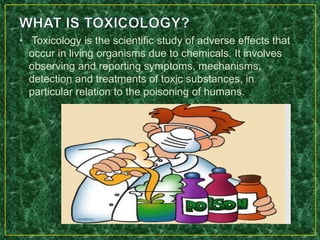
• Toxicology is the scientific study of adverse effects that
occur in living organisms due to chemicals. It involves
observing and reporting symptoms, mechanisms,
detection and treatments of toxic substances, in
particular relation to the poisoning of humans.
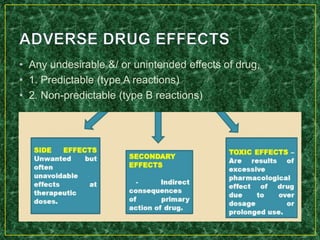
• Any undesirable &/ or unintended effects of drug,
• 1. Predictable (type A reactions)
• 2. Non-predictable (type B reactions)
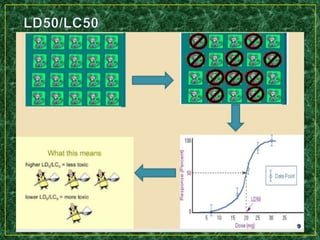
• LD50 represents the individual dose
required to kill 50% of a population of test
animals. It is an index determination of
medicine and poison’s virulence. lower the
LD50 dose, the more toxic the pesticide.
• The concentrations of the chemical in air
that kills 50% of the test animals during the
observation period is the LC50 value.
Other durations of exposure (versus the
traditional 4 hours) may apply depending
on specific laws
• Karber’s method
• Miller and Tainter method
• Lorke’s method
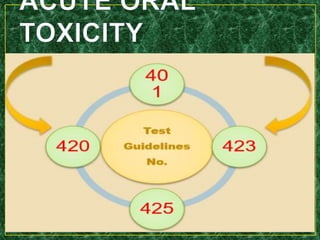
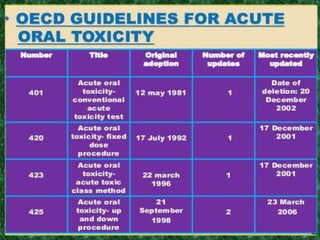
• Fixed dose method
• UP and down method
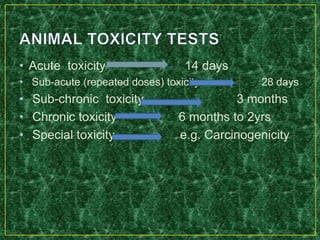
• Acute toxicity 14 days
• Sub-acute (repeated doses) toxicity 28 days
• Sub-chronic toxicity 3 months
• Chronic toxicity 6 months to 2yrs
• Special toxicity e.g. Carcinogenicity
• Test substances :- at doses that are
known to cause marked pain and
distress due to corrosive or severely
irritant actions, need not be
administered.
• Moribund animals shall be humanely
killed.
• It is the principle of the test that, based on
a stepwise procedure with the use of a
minimum number of animals per step(3)
• sufficient information is obtained on the
acute toxicity of the test substance .
• .
• Selection of animal species:-
• The preferred rodent species is the rat,
although other rodent species may be
used. Normally females are used .
• should be nulliparous (8-12weeks)
wt_/+20
• Male can also be use if they shows better
sensitivity to the TS.
• The animals are randomly selected, marked to permit
individual identification, and kept in their cages for at
least 5 days prior to dosing to allow for acclimatisation to
the LC.
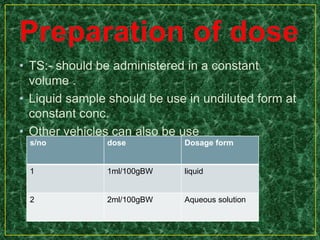
• TS:- should be administered in a constant
volume .
• Liquid sample should be use in undiluted form at
constant conc.
• Other vehicles can also be use
s/no dose Dosage form
1 1ml/100gBW liquid
2 2ml/100gBW Aqueous solution
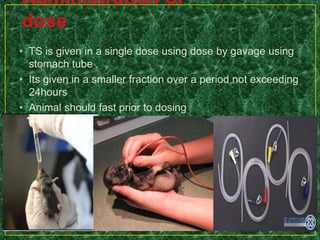
• TS is given in a single dose using dose by gavage using
stomach tube .
• Its given in a smaller fraction over a period not exceeding
24hours
• Animal should fast prior to dosing
• 3 animals are use for each step
• Dose level to be used as the starting dose
is selected from one of the above 4 fixed
levels 5,50.300,2000mg/kg
• If there is no information about the
compound it is recommended to start using
300mg/kg
The limit test is primarily used in situations
where the experimenter has information
indicating that the test material is likely to be
nontoxic.
 Information about the toxicity of the test material
can be gained from knowledge about similar
tested compounds, taking into consideration the
identity and % of components known to be of
toxicological significance
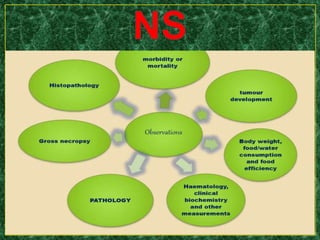
• Observe the animal individually at for
30mins for period of 24hrs
• Special attention at the 1st 4hrs daily for
14days
• Time in which toxicity appears or
disappears is important and recovery
period.
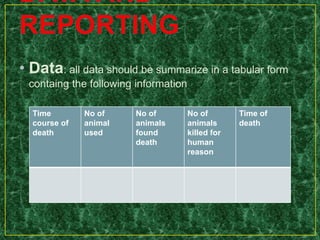
• Data: all data should be summarize in a tabular form
containg the following information
Time
course of
death
No of
animal
used
No of
animals
found
death
No of
animals
killed for
human
reason
Time of
death
• Should contain the follow
• Test substance
• Vehicle
• Test animal
• Test condition
• Tabulation of response data and dose level
for each animal are noted .
• BW , time of sacrifice and time and date of
death.
• Histopathology and necropsy finding .
• In a study of toxic characteristics of
substance, acute oral toxicity testing is
initial step.
• Gives information on health hazards.
• Test substance administered orally, in
graduated doses to several groups of
experimental animals.
• One dose used per group.
• At least 5 rodents at each dose level of same
sex are used.
• Observations for effects & death are made.
• After completion of study in one sex, study in
another sex is carried out.
• Studies suggested in rodents but can be
adopted for studies in non-rodents.
• As 1st alternative to conventional
acute toxicity test. Testing in 1 sex
usually females is considered
sufficient.
• Uses fewer animals. Causes less
suffering to the animals.
• Uses only moderately toxic doses,
doses expected to be lethal should be
avoided
Principle of test substance
Description of method
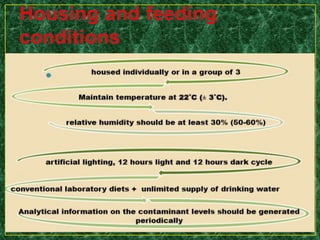
Housing and feeding
Preparation of animal
Preparation of dose
Dose administration
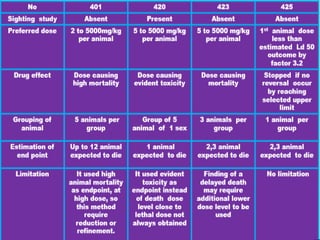
• Procedure involves 2 step study
• 1- sighting study
• 2-main study
• Purpose : to allow selection of appropriate
starting dose
• For the main study.
• Single dose is administered in a sequential
manner.
• Sighting study is completed when decision on
starting dose is done
• No of animal and dose level
• Usually 5 animals are use
• Limit test
• Observation same
• report
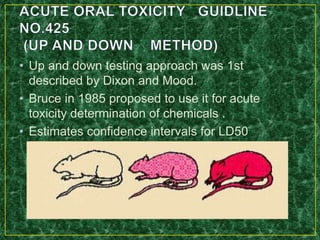
• Up and down testing approach was 1st
described by Dixon and Mood.
• Bruce in 1985 proposed to use it for acute
toxicity determination of chemicals .
• Estimates confidence intervals for LD50
 In procedure (main test ) 1-animal dosed at a
time, at minimum of 48hrs interval.
Suggested starting dose is 175 mg/kg or can be
selected from 1.75, 5.5, 17.5,
55,175,550,2000mg/kg .
 Animal receives 1st dose a step below the level
of the best estimate of LD50 .
• consist of a single ordered dose
progression in which animal are dose
and kept for minimum of 48hrs
• First animals receive dose step below
level of best estimate of LD50 if
animal survives next dose is increase
by factor of 3.2times original dose
• And decreases if animal dies.
• Limit test for 2000
• Limit test for 4000
• Limit test for main test
• Its calculate using likelihood method ,
following dixion .assume 𝜕 as death or
delay death
• L=L1L2………Ln
• Li=1-f(Zi) if animal survives
• Li =f(zi) if animal dies
• Where Zi=⟮log (di)- µ ] ̸ 𝜕 di]
• After main test and estimation of
LD50 its possible to compute the
interval estimates for LD50.
• The wide confidences interval should
be narrow
• If main test is repeated should be
close to the original value
• Test report
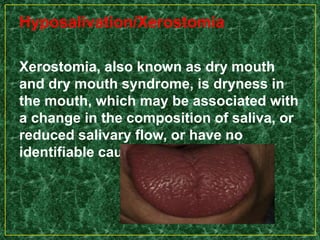
Hyposalivation/Xerostomia
Xerostomia, also known as dry mouth
and dry mouth syndrome, is dryness in
the mouth, which may be associated with
a change in the composition of saliva, or
reduced salivary flow, or have no
identifiable cause
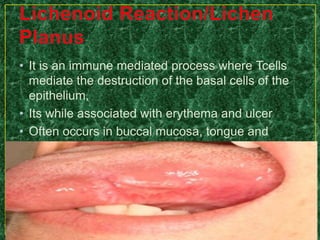
• It is an immune mediated process where Tcells
mediate the destruction of the basal cells of the
epithelium,
• Its while associated with erythema and ulcer
• Often occurs in buccal mucosa, tongue and
gingiva.
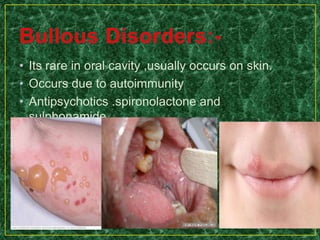
• Its rare in oral cavity ,usually occurs on skin.
• Occurs due to autoimmunity
• Antipsychotics .spironolactone and
sulphonamide
•others
•Thank You

Oral toxicity

  • 1.
    (DEPARTMENT OF PHARMACOLOGY) PHARMACOLOGICALANDTOXICOLOGICAL SCREENING METHODS • PRESENTATION TOPIC : • Oral toxicity • SUBMITTED TO : Dr NAGARATHNA P.K.M • PRESENTED BY: DIANA MORIA
  • 2.
    • Toxicology isthe scientific study of adverse effects that occur in living organisms due to chemicals. It involves observing and reporting symptoms, mechanisms, detection and treatments of toxic substances, in particular relation to the poisoning of humans.
  • 3.
    • Any undesirable&/ or unintended effects of drug, • 1. Predictable (type A reactions) • 2. Non-predictable (type B reactions)
  • 4.
    • LD50 representsthe individual dose required to kill 50% of a population of test animals. It is an index determination of medicine and poison’s virulence. lower the LD50 dose, the more toxic the pesticide.
  • 5.
    • The concentrationsof the chemical in air that kills 50% of the test animals during the observation period is the LC50 value. Other durations of exposure (versus the traditional 4 hours) may apply depending on specific laws
  • 7.
    • Karber’s method •Miller and Tainter method • Lorke’s method • Fixed dose method • UP and down method
  • 8.
    • Acute toxicity14 days • Sub-acute (repeated doses) toxicity 28 days • Sub-chronic toxicity 3 months • Chronic toxicity 6 months to 2yrs • Special toxicity e.g. Carcinogenicity
  • 11.
    • Test substances:- at doses that are known to cause marked pain and distress due to corrosive or severely irritant actions, need not be administered. • Moribund animals shall be humanely killed.
  • 12.
    • It isthe principle of the test that, based on a stepwise procedure with the use of a minimum number of animals per step(3) • sufficient information is obtained on the acute toxicity of the test substance . • .
  • 13.
    • Selection ofanimal species:- • The preferred rodent species is the rat, although other rodent species may be used. Normally females are used . • should be nulliparous (8-12weeks) wt_/+20 • Male can also be use if they shows better sensitivity to the TS.
  • 15.
    • The animalsare randomly selected, marked to permit individual identification, and kept in their cages for at least 5 days prior to dosing to allow for acclimatisation to the LC.
  • 16.
    • TS:- shouldbe administered in a constant volume . • Liquid sample should be use in undiluted form at constant conc. • Other vehicles can also be use s/no dose Dosage form 1 1ml/100gBW liquid 2 2ml/100gBW Aqueous solution
  • 17.
    • TS isgiven in a single dose using dose by gavage using stomach tube . • Its given in a smaller fraction over a period not exceeding 24hours • Animal should fast prior to dosing
  • 18.
    • 3 animalsare use for each step • Dose level to be used as the starting dose is selected from one of the above 4 fixed levels 5,50.300,2000mg/kg • If there is no information about the compound it is recommended to start using 300mg/kg
  • 19.
    The limit testis primarily used in situations where the experimenter has information indicating that the test material is likely to be nontoxic.  Information about the toxicity of the test material can be gained from knowledge about similar tested compounds, taking into consideration the identity and % of components known to be of toxicological significance
  • 20.
    • Observe theanimal individually at for 30mins for period of 24hrs • Special attention at the 1st 4hrs daily for 14days • Time in which toxicity appears or disappears is important and recovery period.
  • 22.
    • Data: alldata should be summarize in a tabular form containg the following information Time course of death No of animal used No of animals found death No of animals killed for human reason Time of death
  • 23.
    • Should containthe follow • Test substance • Vehicle • Test animal • Test condition
  • 24.
    • Tabulation ofresponse data and dose level for each animal are noted . • BW , time of sacrifice and time and date of death. • Histopathology and necropsy finding .
  • 25.
    • In astudy of toxic characteristics of substance, acute oral toxicity testing is initial step. • Gives information on health hazards. • Test substance administered orally, in graduated doses to several groups of experimental animals. • One dose used per group.
  • 26.
    • At least5 rodents at each dose level of same sex are used. • Observations for effects & death are made. • After completion of study in one sex, study in another sex is carried out. • Studies suggested in rodents but can be adopted for studies in non-rodents.
  • 27.
    • As 1stalternative to conventional acute toxicity test. Testing in 1 sex usually females is considered sufficient. • Uses fewer animals. Causes less suffering to the animals. • Uses only moderately toxic doses, doses expected to be lethal should be avoided
  • 28.
    Principle of testsubstance Description of method Housing and feeding Preparation of animal Preparation of dose Dose administration
  • 29.
    • Procedure involves2 step study • 1- sighting study • 2-main study
  • 30.
    • Purpose :to allow selection of appropriate starting dose • For the main study. • Single dose is administered in a sequential manner. • Sighting study is completed when decision on starting dose is done
  • 31.
    • No ofanimal and dose level • Usually 5 animals are use • Limit test • Observation same • report
  • 32.
    • Up anddown testing approach was 1st described by Dixon and Mood. • Bruce in 1985 proposed to use it for acute toxicity determination of chemicals . • Estimates confidence intervals for LD50
  • 33.
     In procedure(main test ) 1-animal dosed at a time, at minimum of 48hrs interval. Suggested starting dose is 175 mg/kg or can be selected from 1.75, 5.5, 17.5, 55,175,550,2000mg/kg .  Animal receives 1st dose a step below the level of the best estimate of LD50 .
  • 34.
    • consist ofa single ordered dose progression in which animal are dose and kept for minimum of 48hrs • First animals receive dose step below level of best estimate of LD50 if animal survives next dose is increase by factor of 3.2times original dose • And decreases if animal dies.
  • 35.
    • Limit testfor 2000 • Limit test for 4000 • Limit test for main test
  • 36.
    • Its calculateusing likelihood method , following dixion .assume 𝜕 as death or delay death • L=L1L2………Ln • Li=1-f(Zi) if animal survives • Li =f(zi) if animal dies • Where Zi=⟮log (di)- µ ] ̸ 𝜕 di]
  • 37.
    • After maintest and estimation of LD50 its possible to compute the interval estimates for LD50. • The wide confidences interval should be narrow • If main test is repeated should be close to the original value • Test report
  • 39.
    Hyposalivation/Xerostomia Xerostomia, also knownas dry mouth and dry mouth syndrome, is dryness in the mouth, which may be associated with a change in the composition of saliva, or reduced salivary flow, or have no identifiable cause
  • 40.
    • It isan immune mediated process where Tcells mediate the destruction of the basal cells of the epithelium, • Its while associated with erythema and ulcer • Often occurs in buccal mucosa, tongue and gingiva.
  • 42.
    • Its rarein oral cavity ,usually occurs on skin. • Occurs due to autoimmunity • Antipsychotics .spironolactone and sulphonamide •others
  • 43.