Copyright © 2019 by ScottMadden, Inc. All rights reserved.
HR Shared Services Benchmarking
Study Highlights
ScottMadden and APQC HR Shared Services Benchmarking Study
October 2019
Copyright © 2019 by ScottMadden, Inc. All rights reserved.
About the Study
Introduction
History and Timeline
n First cycle – Fall 2011
n Second cycle – Fall 2012
n Third cycle – Fall 2013 to Winter 2014
n Fourth cycle – Fall 2015 to Winter 2016
n Fifth cycle – Spring 2017 to Summer 2017
n Sixth cycle – Spring 2019 to Summer 2019
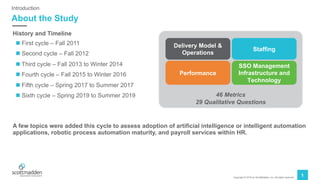
A few topics were added this cycle to assess adoption of artificial intelligence or intelligent automation
applications, robotic process automation maturity, and payroll services within HR.
46 Metrics
29 Qualitative Questions
Staffing
SSO Management
Infrastructure and
Technology
Delivery Model &
Operations
Performance
1
Copyright © 2019 by ScottMadden, Inc. All rights reserved.
2
Metric List
Introduction
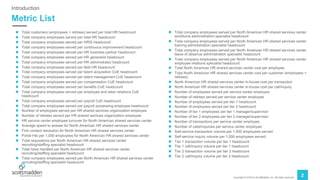
n Total customers (employees + retirees) served per total HR headcount
n Total company employees served per total HR headcount
n Total company employees served per HRIS headcount
n Total company employees served per continuous improvement headcount
n Total company employees served per HR business partner headcount
n Total company employees served per HR generalist headcount
n Total company employees served per HR administrator headcount
n Total company employees served per field HR headcount
n Total company employees served per talent acquisition CoE headcount
n Total company employees served per talent management CoE headcount
n Total company employees served per compensation CoE headcount
n Total company employees served per benefits CoE headcount
n Total company employees served per employee and labor relations CoE
headcount
n Total company employees served per payroll CoE headcount
n Total company employees served per payroll processing employee headcount
n Number of employees served per HR shared services organization employee
n Number of retirees served per HR shared services organization employee
n HR service center employee turnover for North American shared services center
n Average speed to answer for North American HR shared services center
n First contact resolution for North American HR shared services center
n Portal hits per 1,000 employees for North American HR shared services center
n Total requisitions per North American HR shared services center
recruiting/staffing specialist headcount
n Total hires handled per North American HR shared services center
recruiting/staffing specialist headcount
n Total company employees served per North American HR shared services center
recruiting/staffing specialist headcount
n Total company employees served per North American HR shared services center
workforce administration specialist headcount
n Total company employees served per North American HR shared services center
training administration specialist headcount
n Total company employees served per North American HR shared services center
leave of absence administration specialist headcount
n Total company employees served per North American HR shared services center
employee relations specialist headcount
n Total North American HR shared services center cost per employee
n Total North American HR shared services center cost per customer (employees +
retirees)
n North American HR shared services center in-house cost per transaction
n North American HR shared services center in-house cost per call/inquiry
n Number of employees served per service center employee
n Number of retirees served per service center employee
n Number of employees served per tier 1 headcount
n Number of employees served per tier 2 headcount
n Number of tier 1 employees per tier 1 manager/supervisor
n Number of tier 2 employees per tier 2 manager/supervisor
n Number of transactions per service center employee
n Number of calls/inquiries per service center employee
n Self-service transaction volume per 1,000 employees served
n Self-service inquiry volume per 1,000 employees served
n Tier 1 transaction volume per tier 1 headcount
n Tier 1 call/inquiry volume per tier 1 headcount
n Tier 2 transaction volume per tier 2 headcount
n Tier 2 call/inquiry volume per tier 2 headcount
Copyright © 2019 by ScottMadden, Inc. All rights reserved.
3
Participant Demographics
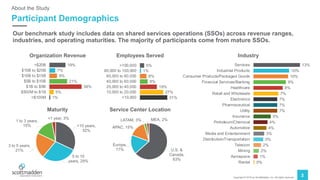
Our benchmark study includes data on shared services operations (SSOs) across revenue ranges,
industries, and operating maturities. The majority of participants come from mature SSOs.
Industry
Maturity
Organization Revenue Employees Served
Service Center Location
19%
7%
9%
21%
38%
5%
1%
>$20B
$15B to $20B
$10B to $15B
$5B to $10B
$1B to $5B
$500M to $1B
<$100M
5%
1%
8%
9%
19%
27%
31%
>100,000
80,000 to 100,000
60,000 to 80,000
40,000 to 60,000
20,000 to 40,000
10,000 to 20,000
<10,000
13%
10%
10%
9%
8%
7%
7%
7%
7%
5%
4%
4%
3%
3%
2%
2%
1%
0%
Services
Industrial Products
Consumer Products/Packaged Goods
Financial Services/Banking
Healthcare
Retail and Wholesale
Electronics
Pharmaceutical
Utility
Insurance
Petroleum/Chemical
Automotive
Media and Entertainment
Distribution/Transportation
Telecom
Mining
Aerospace
Rental
U.S. &
Canada,
63%
Europe,
17%
APAC, 15%
LATAM, 3% MEA, 2%
>10 years,
32%
5 to 10
years, 29%
3 to 5 years,
21%
1 to 3 years,
15%
<1 year, 3%
About the Study
Copyright © 2019 by ScottMadden, Inc. All rights reserved.
4
Service Delivery Model and Governance
Highlights from Latest HR Benchmarks
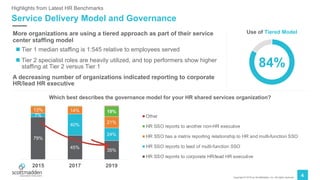
More organizations are using a tiered approach as part of their service
center staffing model
n Tier 1 median staffing is 1:545 relative to employees served
n Tier 2 specialist roles are heavily utilized, and top performers show higher
staffing at Tier 2 versus Tier 1
A decreasing number of organizations indicated reporting to corporate
HR/lead HR executive
79%
45%
35%
7%
40%
24%
13% 14%
21%
19%
2015 2017 2019
Other
HR SSO reports to another non-HR executive
HR SSO has a matrix reporting relationship to HR and multi-function SSO
HR SSO reports to lead of multi-function SSO
HR SSO reports to corporate HR/lead HR executive
Which best describes the governance model for your HR shared services organization?
Use of Tiered Model
84%
Copyright © 2019 by ScottMadden, Inc. All rights reserved.
5
Staffing – Tier 2 Specialists
Highlights from Latest HR Benchmarks
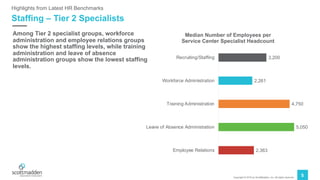
Among Tier 2 specialist groups, workforce
administration and employee relations groups
show the highest staffing levels, while training
administration and leave of absence
administration groups show the lowest staffing
levels.
3,200
2,261
4,750
5,050
2,363
Recruiting/Staffing
Workforce Administration
Training Administration
Leave of Absence Administration
Employee Relations
Median Number of Employees per
Service Center Specialist Headcount
Copyright © 2019 by ScottMadden, Inc. All rights reserved.
6
Staffing – CoEs
Highlights from Latest HR Benchmarks
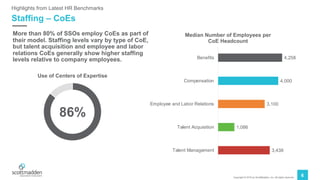
More than 80% of SSOs employ CoEs as part of
their model. Staffing levels vary by type of CoE,
but talent acquisition and employee and labor
relations CoEs generally show higher staffing
levels relative to company employees.
Use of Centers of Expertise
86%
4,258
4,000
3,100
1,086
3,438
Benefits
Compensation
Employee and Labor Relations
Talent Acquisition
Talent Management
Median Number of Employees per
CoE Headcount
Copyright © 2019 by ScottMadden, Inc. All rights reserved.
7
Staffing – Field HR
Highlights from Latest HR Benchmarks
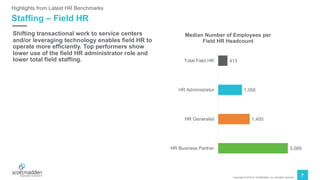
Shifting transactional work to service centers
and/or leveraging technology enables field HR to
operate more efficiently. Top performers show
lower use of the field HR administrator role and
lower total field staffing. 413
1,056
1,400
3,089
Total Field HR
HR Administrator
HR Generalist
HR Business Partner
Median Number of Employees per
Field HR Headcount
Copyright © 2019 by ScottMadden, Inc. All rights reserved.
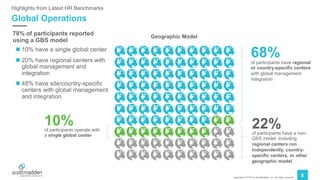
10%of participants operate with
a single global center
68%of participants have regional
or country-specific centers
with global management
integration
22%of participants have a non-
GBS model, including
regional centers run
independently, country-
specific centers, or other
geographic model
Geographic Model
8
Global Operations
Highlights from Latest HR Benchmarks
78% of participants reported
using a GBS model
n 10% have a single global center
n 20% have regional centers with
global management and
integration
n 48% have site/country-specific
centers with global management
and integration
Copyright © 2019 by ScottMadden, Inc. All rights reserved.
9
Global Operations (Cont’d)
Highlights from Latest HR Benchmarks
Top U.S. Locations Top Global Locations
n Chicago, IL
n New York, NY
n Charlotte, NC
n Atlanta, GA
n San Francisco, CA
n Philadelphia, PA
n Houston, TX
n Seattle, WA
n Denver, CO
n Los Angeles, CA
n Dallas, TX
n Milwaukee, WI
n London, United Kingdom
n Hong Kong, Hong Kong
n Dubai, United Arab Emirate
n Shanghai, China
n Melbourne, Australia
n Mumbai, India
n Hyderabad, India
n Gurgaon, India
n Prague, Czech Republic
n Bangalore, India
n Dublin, Ireland
n São Paulo, Brazil
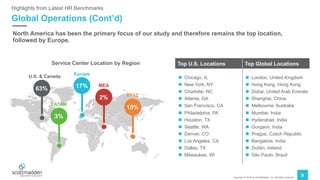
North America has been the primary focus of our study and therefore remains the top location,
followed by Europe.
Service Center Location by Region
63%
U.S. & Canada
17%
Europe
2%
MEA
15%
APAC
3%
LATAM
Copyright © 2019 by ScottMadden, Inc. All rights reserved.
10
Staffing – Service Center
Highlights from Latest HR Benchmarks
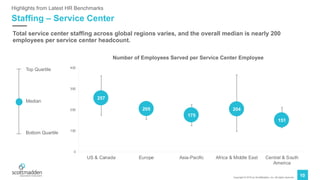
Total service center staffing across global regions varies, and the overall median is nearly 200
employees per service center headcount.
Number of Employees Served per Service Center Employee
257
205
175
204
151
0
100
200
300
400
US & Canada Europe Asia-Pacific Africa & Middle East Central & South
America
Top Quartile
Median
Bottom Quartile
Copyright © 2019 by ScottMadden, Inc. All rights reserved.
11
Technology Standardization
Highlights from Latest HR Benchmarks
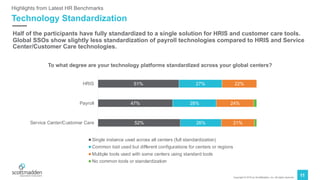
Half of the participants have fully standardized to a single solution for HRIS and customer care tools.
Global SSOs show slightly less standardization of payroll technologies compared to HRIS and Service
Center/Customer Care technologies.
51%
47%
52%
27%
28%
26%
22%
24%
21%
HRIS
Payroll
Service Center/Customer Care
Single instance used across all centers (full standardization)
Common tool used but different configurations for centers or regions
Multiple tools used with some centers using standard tools
No common tools or standardization
To what degree are your technology platforms standardized across your global centers?
Copyright © 2019 by ScottMadden, Inc. All rights reserved.
12
Intelligent Automation
Highlights from Latest HR Benchmarks
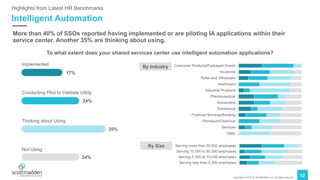
More than 40% of SSOs reported having implemented or are piloting IA applications within their
service center. Another 35% are thinking about using.
To what extent does your shared services center use intelligent automation applications?
Implemented
17%
Conducting Pilot to Validate Utility
24%
Thinking about Using
35%
Not Using
24%
Consumer Products/Packaged Goods
Insurance
Retail and Wholesale
Healthcare
Industrial Products
Pharmaceutical
Automotive
Electronics
Financial Services/Banking
Petroleum/Chemical
Services
Utility
By Industry
Serving more than 50,000 employees
Serving 10,000 to 50,000 employees
Serving 5,000 to 10,000 employees
Serving less than 5,000 employees
By Size
Copyright © 2019 by ScottMadden, Inc. All rights reserved.
13
Intelligent Automation (Cont’d)
Highlights from Latest HR Benchmarks
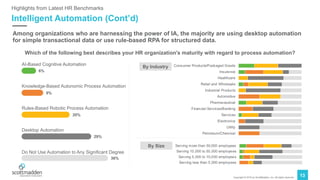
AI-Based Cognitive Automation
6%
Knowledge-Based Autonomic Process Automation
9%
Rules-Based Robotic Process Automation
20%
Desktop Automation
29%
Do Not Use Automation to Any Significant Degree
36%
Serving more than 50,000 employees
Serving 10,000 to 50,000 employees
Serving 5,000 to 10,000 employees
Serving less than 5,000 employees
By Size
Consumer Products/Packaged Goods
Insurance
Healthcare
Retail and Wholesale
Industrial Products
Automotive
Pharmaceutical
Financial Services/Banking
Services
Electronics
Utility
Petroleum/Chemical
By Industry
Which of the following best describes your HR organization's maturity with regard to process automation?
Among organizations who are harnessing the power of IA, the majority are using desktop automation
for simple transactional data or use rule-based RPA for structured data.
Copyright © 2019 by ScottMadden, Inc. All rights reserved.
14
Intelligent Automation (Cont’d)
Highlights from Latest HR Benchmarks
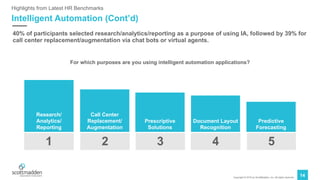
40% of participants selected research/analytics/reporting as a purpose of using IA, followed by 39% for
call center replacement/augmentation via chat bots or virtual agents.
Document Layout
Recognition
4
Prescriptive
Solutions
3
Predictive
Forecasting
5
Research/
Analytics/
Reporting
1
Call Center
Replacement/
Augmentation
2
For which purposes are you using intelligent automation applications?
Copyright © 2019 by ScottMadden, Inc. All rights reserved.
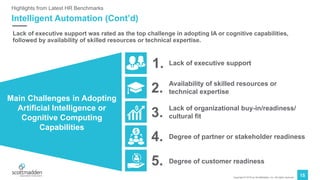
Lack of executive support was rated as the top challenge in adopting IA or cognitive capabilities,
followed by availability of skilled resources or technical expertise.
15
Intelligent Automation (Cont’d)
Highlights from Latest HR Benchmarks
Main Challenges in Adopting
Artificial Intelligence or
Cognitive Computing
Capabilities
Lack of executive support
Availability of skilled resources or
technical expertise
Degree of partner or stakeholder readiness
Lack of organizational buy-in/readiness/
cultural fit
Degree of customer readiness
1.
2.
4.
5.
3.
Copyright © 2019 by ScottMadden, Inc. All rights reserved.
16
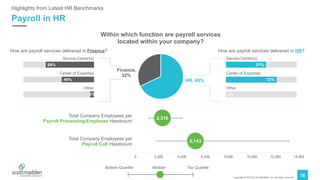
Highlights from Latest HR Benchmarks
HR, 68%
Finance,
32%
57%
72%
0%
Service Center(s)
Center of Expertise
Other
How are payroll services delivered in HR?
69%
46%
6%
Service Center(s)
Center of Expertise
Other
How are payroll services delivered in Finance?
Within which function are payroll services
located within your company?
Payroll in HR
2,310
5,143
0 2,000 4,000 6,000 8,000 10,000 12,000 14,000
Total Company Employees per
Payroll Processing Employee Headcount
Total Company Employees per
Payroll CoE Headcount
Top QuartileMedianBottom Quartile
Copyright © 2019 by ScottMadden, Inc. All rights reserved.
17
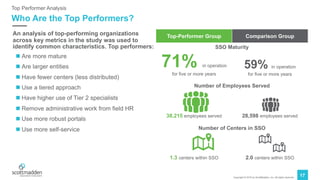
Who Are the Top Performers?
Top Performer Analysis
An analysis of top-performing organizations
across key metrics in the study was used to
identify common characteristics. Top performers:
n Are more mature
n Are larger entities
n Have fewer centers (less distributed)
n Use a tiered approach
n Have higher use of Tier 2 specialists
n Remove administrative work from field HR
n Use more robust portals
n Use more self-service
Top-Performer Group Comparison Group
71% in operation
for five or more years
59% in operation
for five or more years
38,215 employees served 28,598 employees served
1.3 centers within SSO 2.0 centers within SSO
SSO Maturity
Number of Employees Served
Number of Centers in SSO
Copyright © 2019 by ScottMadden, Inc. All rights reserved.
18
Want to Find Out How You Compare?
n Contact us at info@scottmadden.com
n Sign up to be notified of our next cycle
n Unique benchmarking study
n No cost to participate
n Receive detailed report of all metrics and qualitative
results
n Peer group comparisons are provided where relevant

ScottMadden HR Shared Services Benchmarking Study Highlights 2019

  • 1.
    Copyright © 2019by ScottMadden, Inc. All rights reserved. HR Shared Services Benchmarking Study Highlights ScottMadden and APQC HR Shared Services Benchmarking Study October 2019
  • 2.
    Copyright © 2019by ScottMadden, Inc. All rights reserved. About the Study Introduction History and Timeline n First cycle – Fall 2011 n Second cycle – Fall 2012 n Third cycle – Fall 2013 to Winter 2014 n Fourth cycle – Fall 2015 to Winter 2016 n Fifth cycle – Spring 2017 to Summer 2017 n Sixth cycle – Spring 2019 to Summer 2019 A few topics were added this cycle to assess adoption of artificial intelligence or intelligent automation applications, robotic process automation maturity, and payroll services within HR. 46 Metrics 29 Qualitative Questions Staffing SSO Management Infrastructure and Technology Delivery Model & Operations Performance 1
  • 3.
    Copyright © 2019by ScottMadden, Inc. All rights reserved. 2 Metric List Introduction n Total customers (employees + retirees) served per total HR headcount n Total company employees served per total HR headcount n Total company employees served per HRIS headcount n Total company employees served per continuous improvement headcount n Total company employees served per HR business partner headcount n Total company employees served per HR generalist headcount n Total company employees served per HR administrator headcount n Total company employees served per field HR headcount n Total company employees served per talent acquisition CoE headcount n Total company employees served per talent management CoE headcount n Total company employees served per compensation CoE headcount n Total company employees served per benefits CoE headcount n Total company employees served per employee and labor relations CoE headcount n Total company employees served per payroll CoE headcount n Total company employees served per payroll processing employee headcount n Number of employees served per HR shared services organization employee n Number of retirees served per HR shared services organization employee n HR service center employee turnover for North American shared services center n Average speed to answer for North American HR shared services center n First contact resolution for North American HR shared services center n Portal hits per 1,000 employees for North American HR shared services center n Total requisitions per North American HR shared services center recruiting/staffing specialist headcount n Total hires handled per North American HR shared services center recruiting/staffing specialist headcount n Total company employees served per North American HR shared services center recruiting/staffing specialist headcount n Total company employees served per North American HR shared services center workforce administration specialist headcount n Total company employees served per North American HR shared services center training administration specialist headcount n Total company employees served per North American HR shared services center leave of absence administration specialist headcount n Total company employees served per North American HR shared services center employee relations specialist headcount n Total North American HR shared services center cost per employee n Total North American HR shared services center cost per customer (employees + retirees) n North American HR shared services center in-house cost per transaction n North American HR shared services center in-house cost per call/inquiry n Number of employees served per service center employee n Number of retirees served per service center employee n Number of employees served per tier 1 headcount n Number of employees served per tier 2 headcount n Number of tier 1 employees per tier 1 manager/supervisor n Number of tier 2 employees per tier 2 manager/supervisor n Number of transactions per service center employee n Number of calls/inquiries per service center employee n Self-service transaction volume per 1,000 employees served n Self-service inquiry volume per 1,000 employees served n Tier 1 transaction volume per tier 1 headcount n Tier 1 call/inquiry volume per tier 1 headcount n Tier 2 transaction volume per tier 2 headcount n Tier 2 call/inquiry volume per tier 2 headcount
  • 4.
    Copyright © 2019by ScottMadden, Inc. All rights reserved. 3 Participant Demographics Our benchmark study includes data on shared services operations (SSOs) across revenue ranges, industries, and operating maturities. The majority of participants come from mature SSOs. Industry Maturity Organization Revenue Employees Served Service Center Location 19% 7% 9% 21% 38% 5% 1% >$20B $15B to $20B $10B to $15B $5B to $10B $1B to $5B $500M to $1B <$100M 5% 1% 8% 9% 19% 27% 31% >100,000 80,000 to 100,000 60,000 to 80,000 40,000 to 60,000 20,000 to 40,000 10,000 to 20,000 <10,000 13% 10% 10% 9% 8% 7% 7% 7% 7% 5% 4% 4% 3% 3% 2% 2% 1% 0% Services Industrial Products Consumer Products/Packaged Goods Financial Services/Banking Healthcare Retail and Wholesale Electronics Pharmaceutical Utility Insurance Petroleum/Chemical Automotive Media and Entertainment Distribution/Transportation Telecom Mining Aerospace Rental U.S. & Canada, 63% Europe, 17% APAC, 15% LATAM, 3% MEA, 2% >10 years, 32% 5 to 10 years, 29% 3 to 5 years, 21% 1 to 3 years, 15% <1 year, 3% About the Study
  • 5.
    Copyright © 2019by ScottMadden, Inc. All rights reserved. 4 Service Delivery Model and Governance Highlights from Latest HR Benchmarks More organizations are using a tiered approach as part of their service center staffing model n Tier 1 median staffing is 1:545 relative to employees served n Tier 2 specialist roles are heavily utilized, and top performers show higher staffing at Tier 2 versus Tier 1 A decreasing number of organizations indicated reporting to corporate HR/lead HR executive 79% 45% 35% 7% 40% 24% 13% 14% 21% 19% 2015 2017 2019 Other HR SSO reports to another non-HR executive HR SSO has a matrix reporting relationship to HR and multi-function SSO HR SSO reports to lead of multi-function SSO HR SSO reports to corporate HR/lead HR executive Which best describes the governance model for your HR shared services organization? Use of Tiered Model 84%
  • 6.
    Copyright © 2019by ScottMadden, Inc. All rights reserved. 5 Staffing – Tier 2 Specialists Highlights from Latest HR Benchmarks Among Tier 2 specialist groups, workforce administration and employee relations groups show the highest staffing levels, while training administration and leave of absence administration groups show the lowest staffing levels. 3,200 2,261 4,750 5,050 2,363 Recruiting/Staffing Workforce Administration Training Administration Leave of Absence Administration Employee Relations Median Number of Employees per Service Center Specialist Headcount
  • 7.
    Copyright © 2019by ScottMadden, Inc. All rights reserved. 6 Staffing – CoEs Highlights from Latest HR Benchmarks More than 80% of SSOs employ CoEs as part of their model. Staffing levels vary by type of CoE, but talent acquisition and employee and labor relations CoEs generally show higher staffing levels relative to company employees. Use of Centers of Expertise 86% 4,258 4,000 3,100 1,086 3,438 Benefits Compensation Employee and Labor Relations Talent Acquisition Talent Management Median Number of Employees per CoE Headcount
  • 8.
    Copyright © 2019by ScottMadden, Inc. All rights reserved. 7 Staffing – Field HR Highlights from Latest HR Benchmarks Shifting transactional work to service centers and/or leveraging technology enables field HR to operate more efficiently. Top performers show lower use of the field HR administrator role and lower total field staffing. 413 1,056 1,400 3,089 Total Field HR HR Administrator HR Generalist HR Business Partner Median Number of Employees per Field HR Headcount
  • 9.
    Copyright © 2019by ScottMadden, Inc. All rights reserved. 10%of participants operate with a single global center 68%of participants have regional or country-specific centers with global management integration 22%of participants have a non- GBS model, including regional centers run independently, country- specific centers, or other geographic model Geographic Model 8 Global Operations Highlights from Latest HR Benchmarks 78% of participants reported using a GBS model n 10% have a single global center n 20% have regional centers with global management and integration n 48% have site/country-specific centers with global management and integration
  • 10.
    Copyright © 2019by ScottMadden, Inc. All rights reserved. 9 Global Operations (Cont’d) Highlights from Latest HR Benchmarks Top U.S. Locations Top Global Locations n Chicago, IL n New York, NY n Charlotte, NC n Atlanta, GA n San Francisco, CA n Philadelphia, PA n Houston, TX n Seattle, WA n Denver, CO n Los Angeles, CA n Dallas, TX n Milwaukee, WI n London, United Kingdom n Hong Kong, Hong Kong n Dubai, United Arab Emirate n Shanghai, China n Melbourne, Australia n Mumbai, India n Hyderabad, India n Gurgaon, India n Prague, Czech Republic n Bangalore, India n Dublin, Ireland n São Paulo, Brazil North America has been the primary focus of our study and therefore remains the top location, followed by Europe. Service Center Location by Region 63% U.S. & Canada 17% Europe 2% MEA 15% APAC 3% LATAM
  • 11.
    Copyright © 2019by ScottMadden, Inc. All rights reserved. 10 Staffing – Service Center Highlights from Latest HR Benchmarks Total service center staffing across global regions varies, and the overall median is nearly 200 employees per service center headcount. Number of Employees Served per Service Center Employee 257 205 175 204 151 0 100 200 300 400 US & Canada Europe Asia-Pacific Africa & Middle East Central & South America Top Quartile Median Bottom Quartile
  • 12.
    Copyright © 2019by ScottMadden, Inc. All rights reserved. 11 Technology Standardization Highlights from Latest HR Benchmarks Half of the participants have fully standardized to a single solution for HRIS and customer care tools. Global SSOs show slightly less standardization of payroll technologies compared to HRIS and Service Center/Customer Care technologies. 51% 47% 52% 27% 28% 26% 22% 24% 21% HRIS Payroll Service Center/Customer Care Single instance used across all centers (full standardization) Common tool used but different configurations for centers or regions Multiple tools used with some centers using standard tools No common tools or standardization To what degree are your technology platforms standardized across your global centers?
  • 13.
    Copyright © 2019by ScottMadden, Inc. All rights reserved. 12 Intelligent Automation Highlights from Latest HR Benchmarks More than 40% of SSOs reported having implemented or are piloting IA applications within their service center. Another 35% are thinking about using. To what extent does your shared services center use intelligent automation applications? Implemented 17% Conducting Pilot to Validate Utility 24% Thinking about Using 35% Not Using 24% Consumer Products/Packaged Goods Insurance Retail and Wholesale Healthcare Industrial Products Pharmaceutical Automotive Electronics Financial Services/Banking Petroleum/Chemical Services Utility By Industry Serving more than 50,000 employees Serving 10,000 to 50,000 employees Serving 5,000 to 10,000 employees Serving less than 5,000 employees By Size
  • 14.
    Copyright © 2019by ScottMadden, Inc. All rights reserved. 13 Intelligent Automation (Cont’d) Highlights from Latest HR Benchmarks AI-Based Cognitive Automation 6% Knowledge-Based Autonomic Process Automation 9% Rules-Based Robotic Process Automation 20% Desktop Automation 29% Do Not Use Automation to Any Significant Degree 36% Serving more than 50,000 employees Serving 10,000 to 50,000 employees Serving 5,000 to 10,000 employees Serving less than 5,000 employees By Size Consumer Products/Packaged Goods Insurance Healthcare Retail and Wholesale Industrial Products Automotive Pharmaceutical Financial Services/Banking Services Electronics Utility Petroleum/Chemical By Industry Which of the following best describes your HR organization's maturity with regard to process automation? Among organizations who are harnessing the power of IA, the majority are using desktop automation for simple transactional data or use rule-based RPA for structured data.
  • 15.
    Copyright © 2019by ScottMadden, Inc. All rights reserved. 14 Intelligent Automation (Cont’d) Highlights from Latest HR Benchmarks 40% of participants selected research/analytics/reporting as a purpose of using IA, followed by 39% for call center replacement/augmentation via chat bots or virtual agents. Document Layout Recognition 4 Prescriptive Solutions 3 Predictive Forecasting 5 Research/ Analytics/ Reporting 1 Call Center Replacement/ Augmentation 2 For which purposes are you using intelligent automation applications?
  • 16.
    Copyright © 2019by ScottMadden, Inc. All rights reserved. Lack of executive support was rated as the top challenge in adopting IA or cognitive capabilities, followed by availability of skilled resources or technical expertise. 15 Intelligent Automation (Cont’d) Highlights from Latest HR Benchmarks Main Challenges in Adopting Artificial Intelligence or Cognitive Computing Capabilities Lack of executive support Availability of skilled resources or technical expertise Degree of partner or stakeholder readiness Lack of organizational buy-in/readiness/ cultural fit Degree of customer readiness 1. 2. 4. 5. 3.
  • 17.
    Copyright © 2019by ScottMadden, Inc. All rights reserved. 16 Highlights from Latest HR Benchmarks HR, 68% Finance, 32% 57% 72% 0% Service Center(s) Center of Expertise Other How are payroll services delivered in HR? 69% 46% 6% Service Center(s) Center of Expertise Other How are payroll services delivered in Finance? Within which function are payroll services located within your company? Payroll in HR 2,310 5,143 0 2,000 4,000 6,000 8,000 10,000 12,000 14,000 Total Company Employees per Payroll Processing Employee Headcount Total Company Employees per Payroll CoE Headcount Top QuartileMedianBottom Quartile
  • 18.
    Copyright © 2019by ScottMadden, Inc. All rights reserved. 17 Who Are the Top Performers? Top Performer Analysis An analysis of top-performing organizations across key metrics in the study was used to identify common characteristics. Top performers: n Are more mature n Are larger entities n Have fewer centers (less distributed) n Use a tiered approach n Have higher use of Tier 2 specialists n Remove administrative work from field HR n Use more robust portals n Use more self-service Top-Performer Group Comparison Group 71% in operation for five or more years 59% in operation for five or more years 38,215 employees served 28,598 employees served 1.3 centers within SSO 2.0 centers within SSO SSO Maturity Number of Employees Served Number of Centers in SSO
  • 19.
    Copyright © 2019by ScottMadden, Inc. All rights reserved. 18 Want to Find Out How You Compare? n Contact us at info@scottmadden.com n Sign up to be notified of our next cycle n Unique benchmarking study n No cost to participate n Receive detailed report of all metrics and qualitative results n Peer group comparisons are provided where relevant