2011
HR Shared Services Expansion
SSON Shared Services Learning Series
Copyright © 2011 by ScottMadden. All rights reserved. 1
Agenda
I. About ScottMadden
II. Expansion is Good
III. Service Expansion Strategies
IV. Executing the Service Expansion
I. About ScottMadden
Copyright © 2011 by ScottMadden. All rights reserved.
ImproveDesign BuildDecide
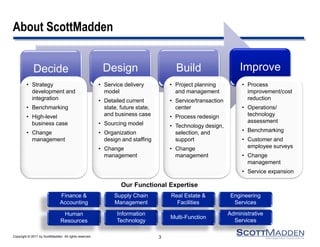
About ScottMadden
3
Our Functional Expertise
• Strategy
development and
integration
• Benchmarking
• High-level
business case
• Change
management
• Process
improvement/cost
reduction
• Operations/
technology
assessment
• Benchmarking
• Customer and
employee surveys
• Change
management
• Service expansion
Finance &
Accounting
Human
Resources
Supply Chain
Management
Information
Technology
Real Estate &
Facilities
Multi-Function
Engineering
Services
Administrative
Services
Design
• Service delivery
model
• Detailed current
state, future state,
and business case
• Sourcing model
• Organization
design and staffing
• Change
management
Build
• Project planning
and management
• Service/transaction
center
• Process redesign
• Technology design,
selection, and
support
• Change
management
II. Expansion is Good
Copyright © 2011 by ScottMadden. All rights reserved.
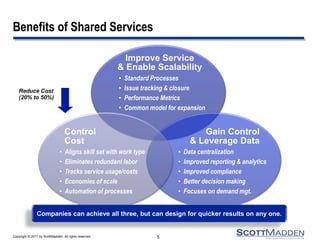
Benefits of Shared Services
5
Reduce Cost
(20% to 50%)
Companies can achieve all three, but can design for quicker results on any one.
• Aligns skill set with work type
• Eliminates redundant labor
• Tracks service usage/costs
• Economies of scale
• Automation of processes
• Data centralization
• Improved reporting & analytics
• Improved compliance
• Better decision making
• Focuses on demand mgt.
• Standard Processes
• Issue tracking & closure
• Performance Metrics
• Common model for expansion
Gain Control
& Leverage Data
Control
Cost
Improve Service
& Enable Scalability
Copyright © 2011 by ScottMadden. All rights reserved.
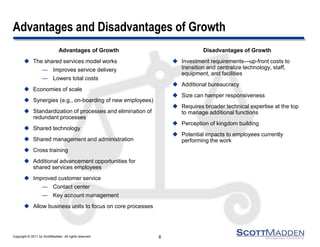
Advantages and Disadvantages of Growth
Advantages of Growth
 The shared services model works
— Improves service delivery
— Lowers total costs
 Economies of scale
 Synergies (e.g., on-boarding of new employees)
 Standardization of processes and elimination of
redundant processes
 Shared technology
 Shared management and administration
 Cross training
 Additional advancement opportunities for
shared services employees
 Improved customer service
— Contact center
— Key account management
 Allow business units to focus on core processes
Disadvantages of Growth
 Investment requirements—up-front costs to
transition and centralize technology, staff,
equipment, and facilities
 Additional bureaucracy
 Size can hamper responsiveness
 Requires broader technical expertise at the top
to manage additional functions
 Perception of kingdom building
 Potential impacts to employees currently
performing the work
6
III. Service Expansion Strategies
Copyright © 2011 by ScottMadden. All rights reserved. 8
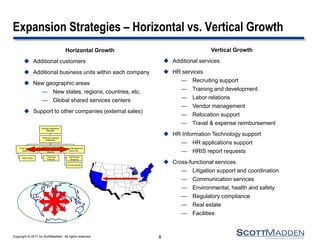
Expansion Strategies – Horizontal vs. Vertical Growth
Horizontal Growth
 Additional customers
 Additional business units within each company
 New geographic areas
— New states, regions, countries, etc.
— Global shared services centers
 Support to other companies (external sales)
Chemistry General
Supervisor
Shift Techs
Plant Chemistry
Supervisor
Chemistry Technical
Services Principal
Chemist
Chemical
Analysts
Nuclear Operations
Manager
Waste Management
Supervisor
Rad Waste
Shipping
Environmental
Vertical Growth
 Additional services
 HR services
— Recruiting support
— Training and development
— Labor relations
— Vendor management
— Relocation support
— Travel & expense reimbursement
 HR Information Technology support
— HR applications support
— HRIS report requests
 Cross-functional services
— Litigation support and coordination
— Communication services
— Environmental, health and safety
— Regulatory compliance
— Real estate
— Facilities
Copyright © 2011 by ScottMadden. All rights reserved.
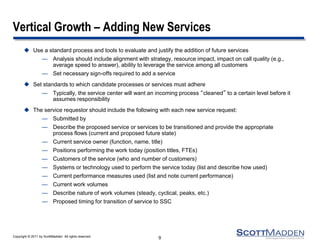
Vertical Growth – Adding New Services
 Use a standard process and tools to evaluate and justify the addition of future services
— Analysis should include alignment with strategy, resource impact, impact on call quality (e.g.,
average speed to answer), ability to leverage the service among all customers
— Set necessary sign-offs required to add a service
 Set standards to which candidate processes or services must adhere
— Typically, the service center will want an incoming process “cleaned” to a certain level before it
assumes responsibility
 The service requestor should include the following with each new service request:
— Submitted by
— Describe the proposed service or services to be transitioned and provide the appropriate
process flows (current and proposed future state)
— Current service owner (function, name, title)
— Positions performing the work today (position titles, FTEs)
— Customers of the service (who and number of customers)
— Systems or technology used to perform the service today (list and describe how used)
— Current performance measures used (list and note current performance)
— Current work volumes
— Describe nature of work volumes (steady, cyclical, peaks, etc.)
— Proposed timing for transition of service to SSC
9
Copyright © 2011 by ScottMadden. All rights reserved. 10
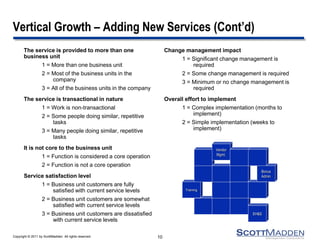
Vertical Growth – Adding New Services (Cont’d)
The service is provided to more than one
business unit
1 = More than one business unit
2 = Most of the business units in the
company
3 = All of the business units in the company
The service is transactional in nature
1 = Work is non-transactional
2 = Some people doing similar, repetitive
tasks
3 = Many people doing similar, repetitive
tasks
It is not core to the business unit
1 = Function is considered a core operation
2 = Function is not a core operation
Service satisfaction level
1 = Business unit customers are fully
satisfied with current service levels
2 = Business unit customers are somewhat
satisfied with current service levels
3 = Business unit customers are dissatisfied
with current service levels
EH&S
Training
Bonus
Admin
Vendor
Mgmt.
Change management impact
1 = Significant change management is
required
2 = Some change management is required
3 = Minimum or no change management is
required
Overall effort to implement
1 = Complex implementation (months to
implement)
2 = Simple implementation (weeks to
implement)
Copyright © 2011 by ScottMadden. All rights reserved. 11
Vertical Growth – Adding New Services (Cont’d)
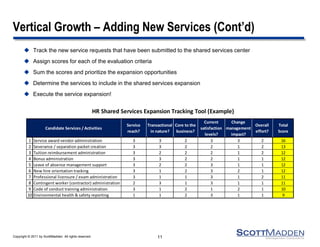
 Track the new service requests that have been submitted to the shared services center
 Assign scores for each of the evaluation criteria
 Sum the scores and prioritize the expansion opportunities
 Determine the services to include in the shared services expansion
 Execute the service expansion!
Service
reach?
Transactional
in nature?
Core to the
business?
Current
satisfaction
levels?
Change
management
impact?
Overall
effort?
Total
Score
1 Service award vendor administration 3 3 2 3 3 2 16
2 Severance / separation packet creation 3 3 2 2 1 2 13
3 Tuition reimbursement administration 3 2 2 2 1 2 12
4 Bonus administration 3 3 2 2 1 1 12
5 Leave of absence management support 3 2 2 3 1 1 12
6 New hire orientation tracking 3 1 2 3 2 1 12
7 Professional licensure / exam administration 3 1 1 3 1 2 11
8 Contingent worker (contractor) administration 2 3 1 3 1 1 11
9 Code of conduct training administration 3 1 2 1 2 1 10
10 Environmental health & safety reporting 1 1 2 3 1 1 9
HR Shared Services Expansion Tracking Tool (Example)
Candidate Services / Activities
IV. Executing the Service Expansion
Copyright © 2011 by ScottMadden. All rights reserved. 13
Key Steps to Executing the Service Expansion
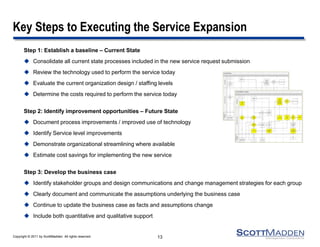
Step 1: Establish a baseline – Current State
 Consolidate all current state processes included in the new service request submission
 Review the technology used to perform the service today
 Evaluate the current organization design / staffing levels
 Determine the costs required to perform the service today
Step 2: Identify improvement opportunities – Future State
 Document process improvements / improved use of technology
 Identify Service level improvements
 Demonstrate organizational streamlining where available
 Estimate cost savings for implementing the new service
Step 3: Develop the business case
 Identify stakeholder groups and design communications and change management strategies for each group
 Clearly document and communicate the assumptions underlying the business case
 Continue to update the business case as facts and assumptions change
 Include both quantitative and qualitative support
Copyright © 2011 by ScottMadden. All rights reserved. 14
Key Steps to Executing the Service Expansion (Cont’d)
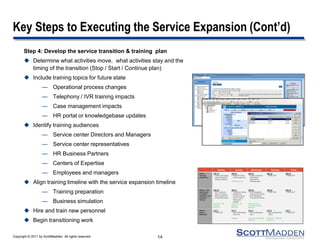
Step 4: Develop the service transition & training plan
 Determine what activities move, what activities stay and the
timing of the transition (Stop / Start / Continue plan)
 Include training topics for future state
— Operational process changes
— Telephony / IVR training impacts
— Case management impacts
— HR portal or knowledgebase updates
 Identify training audiences
— Service center Directors and Managers
— Service center representatives
— HR Business Partners
— Centers of Expertise
— Employees and managers
 Align training timeline with the service expansion timeline
— Training preparation
— Business simulation
 Hire and train new personnel
 Begin transitioning work
Copyright © 2011 by ScottMadden. All rights reserved.
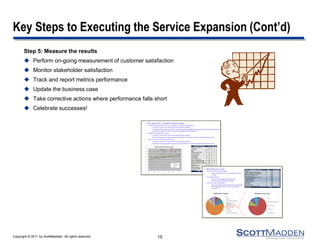
Step 5: Measure the results
 Perform on-going measurement of customer satisfaction
 Monitor stakeholder satisfaction
 Track and report metrics performance
 Update the business case
 Take corrective actions where performance falls short
 Celebrate successes!
15
Key Steps to Executing the Service Expansion (Cont’d)
Copyright © 2011 by ScottMadden. All rights reserved.
16
For more information on Shared Services Expansion, please contact us.
Contact Us
Benjamin Foster
Managing Associate
ScottMadden, Inc.
3495 Piedmont Rd, Bldg 10
Suite 805
Atlanta, GA 30305
Phone: 404-814-0020
benjaminfoster@scottmadden.com

HR Shared Service Expansion

  • 1.
    2011 HR Shared ServicesExpansion SSON Shared Services Learning Series
  • 2.
    Copyright © 2011by ScottMadden. All rights reserved. 1 Agenda I. About ScottMadden II. Expansion is Good III. Service Expansion Strategies IV. Executing the Service Expansion
  • 3.
  • 4.
    Copyright © 2011by ScottMadden. All rights reserved. ImproveDesign BuildDecide About ScottMadden 3 Our Functional Expertise • Strategy development and integration • Benchmarking • High-level business case • Change management • Process improvement/cost reduction • Operations/ technology assessment • Benchmarking • Customer and employee surveys • Change management • Service expansion Finance & Accounting Human Resources Supply Chain Management Information Technology Real Estate & Facilities Multi-Function Engineering Services Administrative Services Design • Service delivery model • Detailed current state, future state, and business case • Sourcing model • Organization design and staffing • Change management Build • Project planning and management • Service/transaction center • Process redesign • Technology design, selection, and support • Change management
  • 5.
  • 6.
    Copyright © 2011by ScottMadden. All rights reserved. Benefits of Shared Services 5 Reduce Cost (20% to 50%) Companies can achieve all three, but can design for quicker results on any one. • Aligns skill set with work type • Eliminates redundant labor • Tracks service usage/costs • Economies of scale • Automation of processes • Data centralization • Improved reporting & analytics • Improved compliance • Better decision making • Focuses on demand mgt. • Standard Processes • Issue tracking & closure • Performance Metrics • Common model for expansion Gain Control & Leverage Data Control Cost Improve Service & Enable Scalability
  • 7.
    Copyright © 2011by ScottMadden. All rights reserved. Advantages and Disadvantages of Growth Advantages of Growth  The shared services model works — Improves service delivery — Lowers total costs  Economies of scale  Synergies (e.g., on-boarding of new employees)  Standardization of processes and elimination of redundant processes  Shared technology  Shared management and administration  Cross training  Additional advancement opportunities for shared services employees  Improved customer service — Contact center — Key account management  Allow business units to focus on core processes Disadvantages of Growth  Investment requirements—up-front costs to transition and centralize technology, staff, equipment, and facilities  Additional bureaucracy  Size can hamper responsiveness  Requires broader technical expertise at the top to manage additional functions  Perception of kingdom building  Potential impacts to employees currently performing the work 6
  • 8.
  • 9.
    Copyright © 2011by ScottMadden. All rights reserved. 8 Expansion Strategies – Horizontal vs. Vertical Growth Horizontal Growth  Additional customers  Additional business units within each company  New geographic areas — New states, regions, countries, etc. — Global shared services centers  Support to other companies (external sales) Chemistry General Supervisor Shift Techs Plant Chemistry Supervisor Chemistry Technical Services Principal Chemist Chemical Analysts Nuclear Operations Manager Waste Management Supervisor Rad Waste Shipping Environmental Vertical Growth  Additional services  HR services — Recruiting support — Training and development — Labor relations — Vendor management — Relocation support — Travel & expense reimbursement  HR Information Technology support — HR applications support — HRIS report requests  Cross-functional services — Litigation support and coordination — Communication services — Environmental, health and safety — Regulatory compliance — Real estate — Facilities
  • 10.
    Copyright © 2011by ScottMadden. All rights reserved. Vertical Growth – Adding New Services  Use a standard process and tools to evaluate and justify the addition of future services — Analysis should include alignment with strategy, resource impact, impact on call quality (e.g., average speed to answer), ability to leverage the service among all customers — Set necessary sign-offs required to add a service  Set standards to which candidate processes or services must adhere — Typically, the service center will want an incoming process “cleaned” to a certain level before it assumes responsibility  The service requestor should include the following with each new service request: — Submitted by — Describe the proposed service or services to be transitioned and provide the appropriate process flows (current and proposed future state) — Current service owner (function, name, title) — Positions performing the work today (position titles, FTEs) — Customers of the service (who and number of customers) — Systems or technology used to perform the service today (list and describe how used) — Current performance measures used (list and note current performance) — Current work volumes — Describe nature of work volumes (steady, cyclical, peaks, etc.) — Proposed timing for transition of service to SSC 9
  • 11.
    Copyright © 2011by ScottMadden. All rights reserved. 10 Vertical Growth – Adding New Services (Cont’d) The service is provided to more than one business unit 1 = More than one business unit 2 = Most of the business units in the company 3 = All of the business units in the company The service is transactional in nature 1 = Work is non-transactional 2 = Some people doing similar, repetitive tasks 3 = Many people doing similar, repetitive tasks It is not core to the business unit 1 = Function is considered a core operation 2 = Function is not a core operation Service satisfaction level 1 = Business unit customers are fully satisfied with current service levels 2 = Business unit customers are somewhat satisfied with current service levels 3 = Business unit customers are dissatisfied with current service levels EH&S Training Bonus Admin Vendor Mgmt. Change management impact 1 = Significant change management is required 2 = Some change management is required 3 = Minimum or no change management is required Overall effort to implement 1 = Complex implementation (months to implement) 2 = Simple implementation (weeks to implement)
  • 12.
    Copyright © 2011by ScottMadden. All rights reserved. 11 Vertical Growth – Adding New Services (Cont’d)  Track the new service requests that have been submitted to the shared services center  Assign scores for each of the evaluation criteria  Sum the scores and prioritize the expansion opportunities  Determine the services to include in the shared services expansion  Execute the service expansion! Service reach? Transactional in nature? Core to the business? Current satisfaction levels? Change management impact? Overall effort? Total Score 1 Service award vendor administration 3 3 2 3 3 2 16 2 Severance / separation packet creation 3 3 2 2 1 2 13 3 Tuition reimbursement administration 3 2 2 2 1 2 12 4 Bonus administration 3 3 2 2 1 1 12 5 Leave of absence management support 3 2 2 3 1 1 12 6 New hire orientation tracking 3 1 2 3 2 1 12 7 Professional licensure / exam administration 3 1 1 3 1 2 11 8 Contingent worker (contractor) administration 2 3 1 3 1 1 11 9 Code of conduct training administration 3 1 2 1 2 1 10 10 Environmental health & safety reporting 1 1 2 3 1 1 9 HR Shared Services Expansion Tracking Tool (Example) Candidate Services / Activities
  • 13.
    IV. Executing theService Expansion
  • 14.
    Copyright © 2011by ScottMadden. All rights reserved. 13 Key Steps to Executing the Service Expansion Step 1: Establish a baseline – Current State  Consolidate all current state processes included in the new service request submission  Review the technology used to perform the service today  Evaluate the current organization design / staffing levels  Determine the costs required to perform the service today Step 2: Identify improvement opportunities – Future State  Document process improvements / improved use of technology  Identify Service level improvements  Demonstrate organizational streamlining where available  Estimate cost savings for implementing the new service Step 3: Develop the business case  Identify stakeholder groups and design communications and change management strategies for each group  Clearly document and communicate the assumptions underlying the business case  Continue to update the business case as facts and assumptions change  Include both quantitative and qualitative support
  • 15.
    Copyright © 2011by ScottMadden. All rights reserved. 14 Key Steps to Executing the Service Expansion (Cont’d) Step 4: Develop the service transition & training plan  Determine what activities move, what activities stay and the timing of the transition (Stop / Start / Continue plan)  Include training topics for future state — Operational process changes — Telephony / IVR training impacts — Case management impacts — HR portal or knowledgebase updates  Identify training audiences — Service center Directors and Managers — Service center representatives — HR Business Partners — Centers of Expertise — Employees and managers  Align training timeline with the service expansion timeline — Training preparation — Business simulation  Hire and train new personnel  Begin transitioning work
  • 16.
    Copyright © 2011by ScottMadden. All rights reserved. Step 5: Measure the results  Perform on-going measurement of customer satisfaction  Monitor stakeholder satisfaction  Track and report metrics performance  Update the business case  Take corrective actions where performance falls short  Celebrate successes! 15 Key Steps to Executing the Service Expansion (Cont’d)
  • 17.
    Copyright © 2011by ScottMadden. All rights reserved. 16 For more information on Shared Services Expansion, please contact us. Contact Us Benjamin Foster Managing Associate ScottMadden, Inc. 3495 Piedmont Rd, Bldg 10 Suite 805 Atlanta, GA 30305 Phone: 404-814-0020 benjaminfoster@scottmadden.com