Copyright © 2015 ScottMadden, Inc. All rights reserved. Report _2015
Strategic Cybersecurity
A Toolkit for Prioritizing, Coordinating, and
Transforming Your Cybersecurity Program
Copyright © 2015 by ScottMadden, Inc. All rights reserved.
Strategic Cybersecurity: A Toolkit for Prioritizing, Coordinating,
and Transforming Your Cybersecurity Program
If your company is like most, cybersecurity has become both a priority and a source of frustration:
■ Cyber risks are real and have the potential to be destructive to your organization’s ability to provide service to your customers
■ Yet, the efforts to address these risks often seem to have their own negative business impacts
• They are expensive
• They hurt productivity
• Their success is difficult to measure
Rather then continue to throw money at cybersecurity and hope that nothing bad happens, energy providers must pursue an
alternative approach:
■ A more business-like approach to identifying cyber risks and the appropriate response to these risks
■ An approach aligned with industry guidance and expectations to demonstrate appropriate diligence and rigor given today’s environment
■ An approach that establishes desired outcomes and measures progress against these outcomes
This report describes a strategic approach to cybersecurity that engages both security professionals and business stakeholders
in order to:
■ Answer four critical questions to establish the direction of their cybersecurity programs
■ Implement a cybersecurity program consistent with this direction
■ Sustain and continuously improve program performance based on key program performance indicators
This approach will help you target your most important enterprise risks and gain confidence in the ability of your cybersecurity
program to protect your critical assets.
1
Copyright © 2015 by ScottMadden, Inc. All rights reserved.
Energy Organizations Are Aware of Significant Cyber Threats
and Are Investing in Efforts to Manage Their Risks
Electric utilities’ core mission remains the same—delivering safe, reliable power to customers, but a new class of risks threatens
this mission. Cyber risks have the potential to impair power-producing assets and their ability to deliver critical services to
customers.
The industry is responding. In ScottMadden’s annual Energy Industry Cybersecurity Report, we identified the following key
findings:
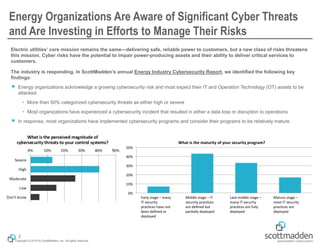
■ Energy organizations acknowledge a growing cybersecurity risk and most expect their IT and Operation Technology (OT) assets to be
attacked
• More than 50% categorized cybersecurity threats as either high or severe
• Most organizations have experienced a cybersecurity incident that resulted in either a data loss or disruption to operations
■ In response, most organizations have implemented cybersecurity programs and consider their programs to be relatively mature
2
Copyright © 2015 by ScottMadden, Inc. All rights reserved.
Despite These Efforts, Energy Leaders Are Not Confident That
They Are Really Improving the Security of Their Critical Assets
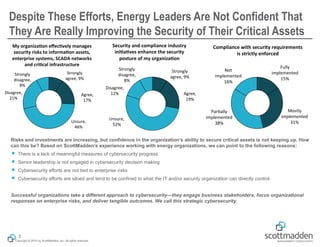
Risks and investments are increasing, but confidence in the organization’s ability to secure critical assets is not keeping up. How
can this be? Based on ScottMadden’s experience working with energy organizations, we can point to the following reasons:
■ There is a lack of meaningful measures of cybersecurity progress
■ Senior leadership is not engaged in cybersecurity decision making
■ Cybersecurity efforts are not tied to enterprise risks
■ Cybersecurity efforts are siloed and tend to be confined to what the IT and/or security organization can directly control
Successful organizations take a different approach to cybersecurity—they engage business stakeholders, focus organizational
responses on enterprise risks, and deliver tangible outcomes. We call this strategic cybersecurity.
3
Copyright © 2015 by ScottMadden, Inc. All rights reserved.
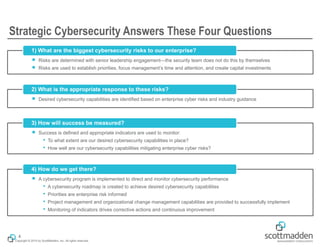
Strategic Cybersecurity Answers These Four Questions
■ Risks are determined with senior leadership engagement—the security team does not do this by themselves
■ Risks are used to establish priorities, focus management’s time and attention, and create capital investments
1) What are the biggest cybersecurity risks to our enterprise?
■ Desired cybersecurity capabilities are identified based on enterprise cyber risks and industry guidance
2) What is the appropriate response to these risks?
■ Success is defined and appropriate indicators are used to monitor:
• To what extent are our desired cybersecurity capabilities in place?
• How well are our cybersecurity capabilities mitigating enterprise cyber risks?
3) How will success be measured?
■ A cybersecurity program is implemented to direct and monitor cybersecurity performance
• A cybersecurity roadmap is created to achieve desired cybersecurity capabilities
• Priorities are enterprise risk informed
• Project management and organizational change management capabilities are provided to successfully implement
• Monitoring of indicators drives corrective actions and continuous improvement
4) How do we get there?
4
Copyright © 2015 by ScottMadden, Inc. All rights reserved.
Determine Your Most Important Assets
1) What are the biggest cybersecurity risks to our enterprise?
5
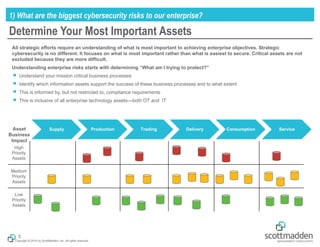
All strategic efforts require an understanding of what is most important to achieving enterprise objectives. Strategic
cybersecurity is no different. It focuses on what is most important rather than what is easiest to secure. Critical assets are not
excluded because they are more difficult.
Understanding enterprise risks starts with determining “What am I trying to protect?”
■ Understand your mission critical business processes
■ Identify which information assets support the success of these business processes and to what extent
■ This is informed by, but not restricted to, compliance requirements
■ This is inclusive of all enterprise technology assets—both OT and IT
High
Priority
Assets
Medium
Priority
Assets
Low
Priority
Assets
Supply Production Trading Delivery Consumption ServiceAsset
Business
Impact
Copyright © 2015 by ScottMadden, Inc. All rights reserved.
Engage Business Stakeholders in Enterprise Risk Discussion
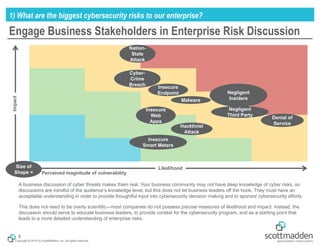
A business discussion of cyber threats makes them real. Your business community may not have deep knowledge of cyber risks, so
discussions are mindful of the audience’s knowledge level, but this does not let business leaders off the hook. They must have an
acceptable understanding in order to provide thoughtful input into cybersecurity decision making and to sponsor cybersecurity efforts.
This does not need to be overly scientific—most companies do not possess precise measures of likelihood and impact. Instead, the
discussion should serve to educate business leaders, to provide context for the cybersecurity program, and as a starting point that
leads to a more detailed understanding of enterprise risks.
1) What are the biggest cybersecurity risks to our enterprise?
6
Likelihood
Impact
Negligent
Insiders
Denial of
Service
Size of
Shape =
Negligent
Third Party
Insecure
Endpoint
Nation-
State
Attack
Insecure
Web
Apps
Malware
Insecure
Smart Meters
Perceived magnitude of vulnerability
Cyber-
Crime
Breach
Hacktivist
Attack
Copyright © 2015 by ScottMadden, Inc. All rights reserved.
Determine Desired Capabilities Based on Enterprise Risks
2) What is the appropriate response to these risks?
7
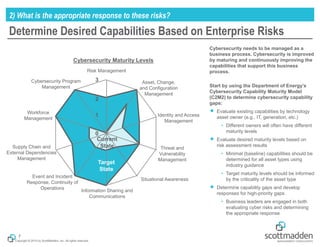
Cybersecurity needs to be managed as a
business process. Cybersecurity is improved
by maturing and continuously improving the
capabilities that support this business
process.
Start by using the Department of Energy’s
Cybersecurity Capability Maturity Model
(C2M2) to determine cybersecurity capability
gaps:
■ Evaluate existing capabilities by technology
asset owner (e.g., IT, generation, etc.)
• Different owners will often have different
maturity levels
■ Evaluate desired maturity levels based on
risk assessment results
• Minimal (baseline) capabilities should be
determined for all asset types using
industry guidance
• Target maturity levels should be informed
by the criticality of the asset type
■ Determine capability gaps and develop
responses for high-priority gaps
• Business leaders are engaged in both
evaluating cyber risks and determining
the appropriate response
Cybersecurity Maturity Levels
1
0
2
3
Risk Management
Asset, Change,
and Configuration
Management
Identity and Access
Management
Threat and
Vulnerability
Management
Situational Awareness
Information Sharing and
Communications
Event and Incident
Response, Continuity of
Operations
Supply Chain and
External Dependencies
Management
Workforce
Management
Cybersecurity Program
Management
Current
State
Target
State
Copyright © 2015 by ScottMadden, Inc. All rights reserved.
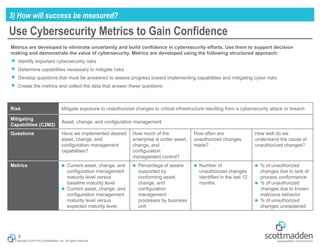
Use Cybersecurity Metrics to Gain Confidence
Metrics are developed to eliminate uncertainty and build confidence in cybersecurity efforts. Use them to support decision
making and demonstrate the value of cybersecurity. Metrics are developed using the following structured approach:
■ Identify important cybersecurity risks
■ Determine capabilities necessary to mitigate risks
■ Develop questions that must be answered to assess progress toward implementing capabilities and mitigating cyber risks
■ Create the metrics and collect the data that answer these questions
3) How will success be measured?
8
Risk Mitigate exposure to unauthorized changes to critical infrastructure resulting from a cybersecurity attack or breach
Mitigating
Capabilities (C2M2)
Asset, change, and configuration management
Questions Have we implemented desired
asset, change, and
configuration management
capabilities?
How much of the
enterprise is under asset,
change, and
configuration
management control?
How often are
unauthorized changes
made?
How well do we
understand the cause of
unauthorized changes?
Metrics  Current asset, change, and
configuration management
maturity level versus
baseline maturity level
 Current asset, change, and
configuration management
maturity level versus
expected maturity level
 Percentage of assets
supported by
conforming asset,
change, and
configuration
management
processes by business
unit
 Number of
unauthorized changes
identified in the last 12
months
 % of unauthorized
changes due to lack of
process conformance
 % of unauthorized
changes due to known
malicious behavior
 % of unauthorized
changes unexplained
Copyright © 2015 by ScottMadden, Inc. All rights reserved.
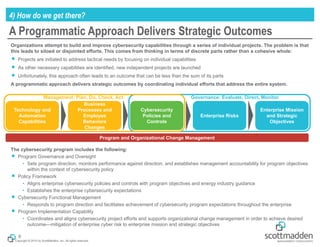
A Programmatic Approach Delivers Strategic Outcomes
Organizations attempt to build and improve cybersecurity capabilities through a series of individual projects. The problem is that
this leads to siloed or disjointed efforts. This comes from thinking in terms of discrete parts rather than a cohesive whole:
■ Projects are initiated to address tactical needs by focusing on individual capabilities
■ As other necessary capabilities are identified, new independent projects are launched
■ Unfortunately, this approach often leads to an outcome that can be less than the sum of its parts
A programmatic approach delivers strategic outcomes by coordinating individual efforts that address the entire system.
4) How do we get there?
Cybersecurity
Policies and
Controls
Technology and
Automation
Capabilities
Business
Processes and
Employee
Behaviors
Changes
Enterprise Mission
and Strategic
Objectives
Enterprise Risks
Governance: Evaluate, Direct, MonitorManagement: Plan, Do, Check, Act
Program and Organizational Change Management
The cybersecurity program includes the following:
■ Program Governance and Oversight
• Sets program direction, monitors performance against direction, and establishes management accountability for program objectives
within the context of cybersecurity policy
■ Policy Framework
• Aligns enterprise cybersecurity policies and controls with program objectives and energy industry guidance
• Establishes the enterprise cybersecurity expectations
■ Cybersecurity Functional Management
• Responds to program direction and facilitates achievement of cybersecurity program expectations throughout the enterprise
■ Program Implementation Capability
• Coordinates and aligns cybersecurity project efforts and supports organizational change management in order to achieve desired
outcome—mitigation of enterprise cyber risk to enterprise mission and strategic objectives
9
Copyright © 2015 by ScottMadden, Inc. All rights reserved.
Building and Sustaining a Cybersecurity Program
10
Establish Program
Direction
Define Program
Capabilities
Implement Program Sustain Program
■ Develop program charter
• Determine guiding
principles
• Define scope
• Design governance
• Design policy
framework
■ Evaluate enterprise risks
■ Assess current
capabilities
• C2M2 assessment
■ Define target state
■ Identify and prioritize
gaps based on:
• Risks
• Gap size
• Capability
dependencies
■ Determine required
business changes
■ Determine organizational
roles and responsibilities
■ Determine resource and
skill requirements
■ Create roadmap by:
• Control
• Asset
• Business unit
■ Launch and manage
program
■ Implement functional and
control ownership
■ Define and implement
measures
■ Implement assurance
and continuous
improvement processes
Engaging senior leadership in cybersecurity decision making is the single most important factor
in creating a successful cybersecurity program—more than technology or funding.
Putting It All Together
Copyright © 2015 by ScottMadden, Inc. All rights reserved.
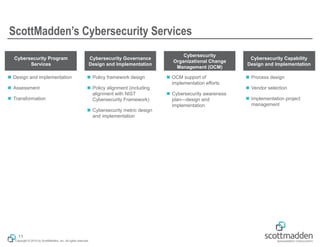
ScottMadden’s Cybersecurity Services
11
Cybersecurity Program
Services
Cybersecurity Governance
Design and Implementation
Cybersecurity
Organizational Change
Management (OCM)
Cybersecurity Capability
Design and Implementation
 Design and implementation
 Assessment
 Transformation
 Policy framework design
 Policy alignment (including
alignment with NIST
Cybersecurity Framework)
 Cybersecurity metric design
and implementation
 OCM support of
implementation efforts
 Cybersecurity awareness
plan—design and
implementation
 Process design
 Vendor selection
 Implementation project
management
Copyright © 2015 by ScottMadden, Inc. All rights reserved.
Jon D. Kerner
Partner and
Cybersecurity Practice Lead
ScottMadden, Inc.
3495 Piedmont Road
Building 10, Suite 805
Atlanta, GA 30305
jkerner@scottmadden.com
O: 678-702-8346
To Learn More About Strategic Cybersecurity, Contact Us
12

Strategic Cybersecurity

  • 1.
    Copyright © 2015ScottMadden, Inc. All rights reserved. Report _2015 Strategic Cybersecurity A Toolkit for Prioritizing, Coordinating, and Transforming Your Cybersecurity Program
  • 2.
    Copyright © 2015by ScottMadden, Inc. All rights reserved. Strategic Cybersecurity: A Toolkit for Prioritizing, Coordinating, and Transforming Your Cybersecurity Program If your company is like most, cybersecurity has become both a priority and a source of frustration: ■ Cyber risks are real and have the potential to be destructive to your organization’s ability to provide service to your customers ■ Yet, the efforts to address these risks often seem to have their own negative business impacts • They are expensive • They hurt productivity • Their success is difficult to measure Rather then continue to throw money at cybersecurity and hope that nothing bad happens, energy providers must pursue an alternative approach: ■ A more business-like approach to identifying cyber risks and the appropriate response to these risks ■ An approach aligned with industry guidance and expectations to demonstrate appropriate diligence and rigor given today’s environment ■ An approach that establishes desired outcomes and measures progress against these outcomes This report describes a strategic approach to cybersecurity that engages both security professionals and business stakeholders in order to: ■ Answer four critical questions to establish the direction of their cybersecurity programs ■ Implement a cybersecurity program consistent with this direction ■ Sustain and continuously improve program performance based on key program performance indicators This approach will help you target your most important enterprise risks and gain confidence in the ability of your cybersecurity program to protect your critical assets. 1
  • 3.
    Copyright © 2015by ScottMadden, Inc. All rights reserved. Energy Organizations Are Aware of Significant Cyber Threats and Are Investing in Efforts to Manage Their Risks Electric utilities’ core mission remains the same—delivering safe, reliable power to customers, but a new class of risks threatens this mission. Cyber risks have the potential to impair power-producing assets and their ability to deliver critical services to customers. The industry is responding. In ScottMadden’s annual Energy Industry Cybersecurity Report, we identified the following key findings: ■ Energy organizations acknowledge a growing cybersecurity risk and most expect their IT and Operation Technology (OT) assets to be attacked • More than 50% categorized cybersecurity threats as either high or severe • Most organizations have experienced a cybersecurity incident that resulted in either a data loss or disruption to operations ■ In response, most organizations have implemented cybersecurity programs and consider their programs to be relatively mature 2
  • 4.
    Copyright © 2015by ScottMadden, Inc. All rights reserved. Despite These Efforts, Energy Leaders Are Not Confident That They Are Really Improving the Security of Their Critical Assets Risks and investments are increasing, but confidence in the organization’s ability to secure critical assets is not keeping up. How can this be? Based on ScottMadden’s experience working with energy organizations, we can point to the following reasons: ■ There is a lack of meaningful measures of cybersecurity progress ■ Senior leadership is not engaged in cybersecurity decision making ■ Cybersecurity efforts are not tied to enterprise risks ■ Cybersecurity efforts are siloed and tend to be confined to what the IT and/or security organization can directly control Successful organizations take a different approach to cybersecurity—they engage business stakeholders, focus organizational responses on enterprise risks, and deliver tangible outcomes. We call this strategic cybersecurity. 3
  • 5.
    Copyright © 2015by ScottMadden, Inc. All rights reserved. Strategic Cybersecurity Answers These Four Questions ■ Risks are determined with senior leadership engagement—the security team does not do this by themselves ■ Risks are used to establish priorities, focus management’s time and attention, and create capital investments 1) What are the biggest cybersecurity risks to our enterprise? ■ Desired cybersecurity capabilities are identified based on enterprise cyber risks and industry guidance 2) What is the appropriate response to these risks? ■ Success is defined and appropriate indicators are used to monitor: • To what extent are our desired cybersecurity capabilities in place? • How well are our cybersecurity capabilities mitigating enterprise cyber risks? 3) How will success be measured? ■ A cybersecurity program is implemented to direct and monitor cybersecurity performance • A cybersecurity roadmap is created to achieve desired cybersecurity capabilities • Priorities are enterprise risk informed • Project management and organizational change management capabilities are provided to successfully implement • Monitoring of indicators drives corrective actions and continuous improvement 4) How do we get there? 4
  • 6.
    Copyright © 2015by ScottMadden, Inc. All rights reserved. Determine Your Most Important Assets 1) What are the biggest cybersecurity risks to our enterprise? 5 All strategic efforts require an understanding of what is most important to achieving enterprise objectives. Strategic cybersecurity is no different. It focuses on what is most important rather than what is easiest to secure. Critical assets are not excluded because they are more difficult. Understanding enterprise risks starts with determining “What am I trying to protect?” ■ Understand your mission critical business processes ■ Identify which information assets support the success of these business processes and to what extent ■ This is informed by, but not restricted to, compliance requirements ■ This is inclusive of all enterprise technology assets—both OT and IT High Priority Assets Medium Priority Assets Low Priority Assets Supply Production Trading Delivery Consumption ServiceAsset Business Impact
  • 7.
    Copyright © 2015by ScottMadden, Inc. All rights reserved. Engage Business Stakeholders in Enterprise Risk Discussion A business discussion of cyber threats makes them real. Your business community may not have deep knowledge of cyber risks, so discussions are mindful of the audience’s knowledge level, but this does not let business leaders off the hook. They must have an acceptable understanding in order to provide thoughtful input into cybersecurity decision making and to sponsor cybersecurity efforts. This does not need to be overly scientific—most companies do not possess precise measures of likelihood and impact. Instead, the discussion should serve to educate business leaders, to provide context for the cybersecurity program, and as a starting point that leads to a more detailed understanding of enterprise risks. 1) What are the biggest cybersecurity risks to our enterprise? 6 Likelihood Impact Negligent Insiders Denial of Service Size of Shape = Negligent Third Party Insecure Endpoint Nation- State Attack Insecure Web Apps Malware Insecure Smart Meters Perceived magnitude of vulnerability Cyber- Crime Breach Hacktivist Attack
  • 8.
    Copyright © 2015by ScottMadden, Inc. All rights reserved. Determine Desired Capabilities Based on Enterprise Risks 2) What is the appropriate response to these risks? 7 Cybersecurity needs to be managed as a business process. Cybersecurity is improved by maturing and continuously improving the capabilities that support this business process. Start by using the Department of Energy’s Cybersecurity Capability Maturity Model (C2M2) to determine cybersecurity capability gaps: ■ Evaluate existing capabilities by technology asset owner (e.g., IT, generation, etc.) • Different owners will often have different maturity levels ■ Evaluate desired maturity levels based on risk assessment results • Minimal (baseline) capabilities should be determined for all asset types using industry guidance • Target maturity levels should be informed by the criticality of the asset type ■ Determine capability gaps and develop responses for high-priority gaps • Business leaders are engaged in both evaluating cyber risks and determining the appropriate response Cybersecurity Maturity Levels 1 0 2 3 Risk Management Asset, Change, and Configuration Management Identity and Access Management Threat and Vulnerability Management Situational Awareness Information Sharing and Communications Event and Incident Response, Continuity of Operations Supply Chain and External Dependencies Management Workforce Management Cybersecurity Program Management Current State Target State
  • 9.
    Copyright © 2015by ScottMadden, Inc. All rights reserved. Use Cybersecurity Metrics to Gain Confidence Metrics are developed to eliminate uncertainty and build confidence in cybersecurity efforts. Use them to support decision making and demonstrate the value of cybersecurity. Metrics are developed using the following structured approach: ■ Identify important cybersecurity risks ■ Determine capabilities necessary to mitigate risks ■ Develop questions that must be answered to assess progress toward implementing capabilities and mitigating cyber risks ■ Create the metrics and collect the data that answer these questions 3) How will success be measured? 8 Risk Mitigate exposure to unauthorized changes to critical infrastructure resulting from a cybersecurity attack or breach Mitigating Capabilities (C2M2) Asset, change, and configuration management Questions Have we implemented desired asset, change, and configuration management capabilities? How much of the enterprise is under asset, change, and configuration management control? How often are unauthorized changes made? How well do we understand the cause of unauthorized changes? Metrics  Current asset, change, and configuration management maturity level versus baseline maturity level  Current asset, change, and configuration management maturity level versus expected maturity level  Percentage of assets supported by conforming asset, change, and configuration management processes by business unit  Number of unauthorized changes identified in the last 12 months  % of unauthorized changes due to lack of process conformance  % of unauthorized changes due to known malicious behavior  % of unauthorized changes unexplained
  • 10.
    Copyright © 2015by ScottMadden, Inc. All rights reserved. A Programmatic Approach Delivers Strategic Outcomes Organizations attempt to build and improve cybersecurity capabilities through a series of individual projects. The problem is that this leads to siloed or disjointed efforts. This comes from thinking in terms of discrete parts rather than a cohesive whole: ■ Projects are initiated to address tactical needs by focusing on individual capabilities ■ As other necessary capabilities are identified, new independent projects are launched ■ Unfortunately, this approach often leads to an outcome that can be less than the sum of its parts A programmatic approach delivers strategic outcomes by coordinating individual efforts that address the entire system. 4) How do we get there? Cybersecurity Policies and Controls Technology and Automation Capabilities Business Processes and Employee Behaviors Changes Enterprise Mission and Strategic Objectives Enterprise Risks Governance: Evaluate, Direct, MonitorManagement: Plan, Do, Check, Act Program and Organizational Change Management The cybersecurity program includes the following: ■ Program Governance and Oversight • Sets program direction, monitors performance against direction, and establishes management accountability for program objectives within the context of cybersecurity policy ■ Policy Framework • Aligns enterprise cybersecurity policies and controls with program objectives and energy industry guidance • Establishes the enterprise cybersecurity expectations ■ Cybersecurity Functional Management • Responds to program direction and facilitates achievement of cybersecurity program expectations throughout the enterprise ■ Program Implementation Capability • Coordinates and aligns cybersecurity project efforts and supports organizational change management in order to achieve desired outcome—mitigation of enterprise cyber risk to enterprise mission and strategic objectives 9
  • 11.
    Copyright © 2015by ScottMadden, Inc. All rights reserved. Building and Sustaining a Cybersecurity Program 10 Establish Program Direction Define Program Capabilities Implement Program Sustain Program ■ Develop program charter • Determine guiding principles • Define scope • Design governance • Design policy framework ■ Evaluate enterprise risks ■ Assess current capabilities • C2M2 assessment ■ Define target state ■ Identify and prioritize gaps based on: • Risks • Gap size • Capability dependencies ■ Determine required business changes ■ Determine organizational roles and responsibilities ■ Determine resource and skill requirements ■ Create roadmap by: • Control • Asset • Business unit ■ Launch and manage program ■ Implement functional and control ownership ■ Define and implement measures ■ Implement assurance and continuous improvement processes Engaging senior leadership in cybersecurity decision making is the single most important factor in creating a successful cybersecurity program—more than technology or funding. Putting It All Together
  • 12.
    Copyright © 2015by ScottMadden, Inc. All rights reserved. ScottMadden’s Cybersecurity Services 11 Cybersecurity Program Services Cybersecurity Governance Design and Implementation Cybersecurity Organizational Change Management (OCM) Cybersecurity Capability Design and Implementation  Design and implementation  Assessment  Transformation  Policy framework design  Policy alignment (including alignment with NIST Cybersecurity Framework)  Cybersecurity metric design and implementation  OCM support of implementation efforts  Cybersecurity awareness plan—design and implementation  Process design  Vendor selection  Implementation project management
  • 13.
    Copyright © 2015by ScottMadden, Inc. All rights reserved. Jon D. Kerner Partner and Cybersecurity Practice Lead ScottMadden, Inc. 3495 Piedmont Road Building 10, Suite 805 Atlanta, GA 30305 jkerner@scottmadden.com O: 678-702-8346 To Learn More About Strategic Cybersecurity, Contact Us 12