Copyright © 2014 by ScottMadden, Inc. All rights reserved.
Capital Program Assessment Overview
October 2014
Copyright © 2014 by ScottMadden, Inc. All rights reserved.
◼ Capital Projects – Increasingly Important
◼ But My Capital Program Is Already Good… Right?
◼ Capital Program Assessment
 Overview
 Step 1: Capital Program Analysis
 Step 2: Process Evaluation
 Step 3: Project Organization Analysis
 Step 4: Project Execution Assessment
 Step 5: Performance Reporting and Tools Evaluation
 Step 6: Final Report Issuance
◼ Typical Project Timeline
◼ Contact Us
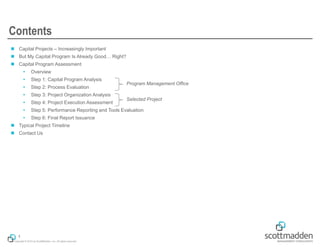
Contents
1
Program Management Office
Selected Project
Copyright © 2014 by ScottMadden, Inc. All rights reserved.
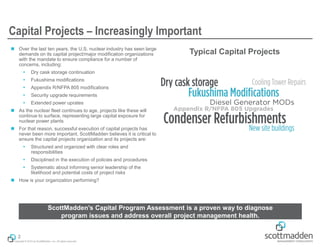
◼ Over the last ten years, the U.S. nuclear industry has seen large
demands on its capital project/major modification organizations
with the mandate to ensure compliance for a number of
concerns, including:
 Dry cask storage continuation
 Fukushima modifications
 Appendix R/NFPA 805 modifications
 Security upgrade requirements
 Extended power uprates
◼ As the nuclear fleet continues to age, projects like these will
continue to surface, representing large capital exposure for
nuclear power plants
◼ For that reason, successful execution of capital projects has
never been more important. ScottMadden believes it is critical to
ensure the capital projects organization and its projects are:
 Structured and organized with clear roles and
responsibilities
 Disciplined in the execution of policies and procedures
 Systematic about informing senior leadership of the
likelihood and potential costs of project risks
◼ How is your organization performing?
Capital Projects – Increasingly Important
2
Typical Capital Projects
ScottMadden’s Capital Program Assessment is a proven way to diagnose
program issues and address overall project management health.
Copyright © 2014 by ScottMadden, Inc. All rights reserved.
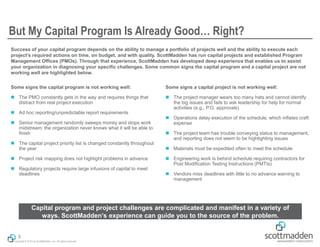
Some signs the capital program is not working well:
◼ The PMO constantly gets in the way and requires things that
distract from real project execution
◼ Ad hoc reporting/unpredictable report requirements
◼ Senior management randomly sweeps money and stops work
midstream; the organization never knows what it will be able to
finish
◼ The capital project priority list is changed constantly throughout
the year
◼ Project risk mapping does not highlight problems in advance
◼ Regulatory projects require large infusions of capital to meet
deadlines
Some signs a capital project is not working well:
◼ The project manager wears too many hats and cannot identify
the big issues and fails to ask leadership for help for normal
activities (e.g., P.O. approvals)
◼ Operations delay execution of the schedule, which inflates craft
expense
◼ The project team has trouble conveying status to management,
and reporting does not seem to be highlighting issues
◼ Materials must be expedited often to meet the schedule
◼ Engineering work is behind schedule requiring contractors for
Post Modification Testing Instructions (PMTIs)
◼ Vendors miss deadlines with little to no advance warning to
management
But My Capital Program Is Already Good… Right?
Success of your capital program depends on the ability to manage a portfolio of projects well and the ability to execute each
project’s required actions on time, on budget, and with quality. ScottMadden has run capital projects and established Program
Management Offices (PMOs). Through that experience, ScottMadden has developed deep experience that enables us to assist
your organization in diagnosing your specific challenges. Some common signs the capital program and a capital project are not
working well are highlighted below.
3
Capital program and project challenges are complicated and manifest in a variety of
ways. ScottMadden’s experience can guide you to the source of the problem.
Copyright © 2014 by ScottMadden, Inc. All rights reserved.
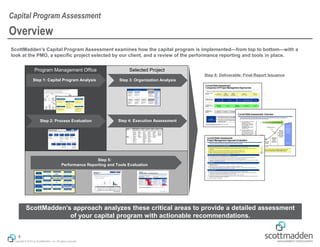
ScottMadden’s Capital Program Assessment examines how the capital program is implemented—from top to bottom—with a
look at the PMO, a specific project selected by our client, and a review of the performance reporting and tools in place.
Overview
Capital Program Assessment
4
Selected ProjectProgram Management Office
Step 6: Deliverable: Final Report Issuance
Step 1: Capital Program Analysis
Step 2: Process Evaluation Step 4: Execution Assessment
Step 5:
Performance Reporting and Tools Evaluation
Copyright © 2013 by ScottMadden. All rights reserved.
5
Constructability activities within alliance projects are being introduced later in the cradle to grave construction process
than is typical for large project management
Findings
Constructability – Cost Savings Driver
Current lack of a constructability process across all the elements of the construction cradle to grave process is a
significant driver in NEA cost estimates being high
Best In Class Projects Typical NEA Project
Step 3: Organization Analysis
ScottMadden’s approach analyzes these critical areas to provide a detailed assessment
of your capital program with actionable recommendations.
Copyright © 2014 by ScottMadden, Inc. All rights reserved.
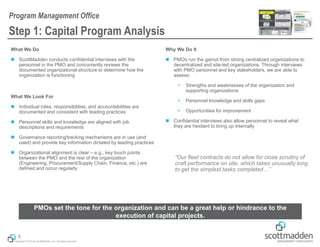
What We Do
◼ ScottMadden conducts confidential interviews with the
personnel in the PMO and concurrently reviews the
documented organizational structure to determine how the
organization is functioning
What We Look For
◼ Individual roles, responsibilities, and accountabilities are
documented and consistent with leading practices
◼ Personnel skills and knowledge are aligned with job
descriptions and requirements
◼ Governance reporting/tracking mechanisms are in use (and
used) and provide key information dictated by leading practices
◼ Organizational alignment is clear – e.g., key touch points
between the PMO and the rest of the organization
(Engineering, Procurement/Supply Chain, Finance, etc.) are
defined and occur regularly
Why We Do It
◼ PMOs run the gamut from strong centralized organizations to
decentralized and site-led organizations. Through interviews
with PMO personnel and key stakeholders, we are able to
assess:
 Strengths and weaknesses of the organization and
supporting organizations
 Personnel knowledge and skills gaps
 Opportunities for improvement
◼ Confidential interviews also allow personnel to reveal what
they are hesitant to bring up internally
Step 1: Capital Program Analysis
Program Management Office
5
“Our fleet contracts do not allow for close scrutiny of
craft performance on site, which takes unusually long
to get the simplest tasks completed…”
PMOs set the tone for the organization and can be a great help or hindrance to the
execution of capital projects.
Copyright © 2014 by ScottMadden, Inc. All rights reserved.
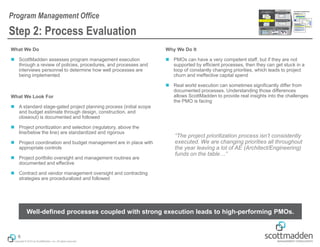
What We Do
◼ ScottMadden assesses program management execution
through a review of policies, procedures, and processes and
interviews personnel to determine how well processes are
being implemented
What We Look For
◼ A standard stage-gated project planning process (initial scope
and budget estimate through design, construction, and
closeout) is documented and followed
◼ Project prioritization and selection (regulatory, above the
line/below the line) are standardized and rigorous
◼ Project coordination and budget management are in place with
appropriate controls
◼ Project portfolio oversight and management routines are
documented and effective
◼ Contract and vendor management oversight and contracting
strategies are proceduralized and followed
Why We Do It
◼ PMOs can have a very competent staff, but if they are not
supported by efficient processes, then they can get stuck in a
loop of constantly changing priorities, which leads to project
churn and ineffective capital spend
◼ Real world execution can sometimes significantly differ from
documented processes. Understanding those differences
allows ScottMadden to provide real insights into the challenges
the PMO is facing
Step 2: Process Evaluation
Program Management Office
6
“The project prioritization process isn’t consistently
executed. We are changing priorities all throughout
the year leaving a lot of AE (Architect/Engineering)
funds on the table…”
Well-defined processes coupled with strong execution leads to high-performing PMOs.
Copyright © 2014 by ScottMadden, Inc. All rights reserved.
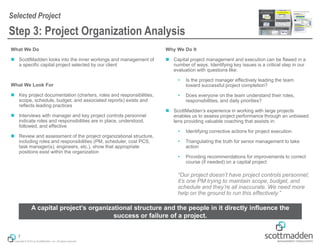
What We Do
◼ ScottMadden looks into the inner workings and management of
a specific capital project selected by our client
What We Look For
◼ Key project documentation (charters, roles and responsibilities,
scope, schedule, budget, and associated reports) exists and
reflects leading practices
◼ Interviews with manager and key project controls personnel
indicate roles and responsibilities are in place, understood,
followed, and effective
◼ Review and assessment of the project organizational structure,
including roles and responsibilities (PM, scheduler, cost PCS,
task manager(s), engineers, etc.), show that appropriate
positions exist within the organization
Why We Do It
◼ Capital project management and execution can be flawed in a
number of ways. Identifying key issues is a critical step in our
evaluation with questions like:
 Is the project manager effectively leading the team
toward successful project completion?
 Does everyone on the team understand their roles,
responsibilities, and daily priorities?
◼ ScottMadden’s experience in working with large projects
enables us to assess project performance through an unbiased
lens providing valuable coaching that assists in:
 Identifying corrective actions for project execution
 Triangulating the truth for senior management to take
action
 Providing recommendations for improvements to correct
course (if needed) on a capital project
Step 3: Project Organization Analysis
Selected Project
7
“Our project doesn’t have project controls personnel;
it’s one PM trying to maintain scope, budget, and
schedule and they’re all inaccurate. We need more
help on the ground to run this effectively.”
A capital project’s organizational structure and the people in it directly influence the
success or failure of a project.
Copyright © 2014 by ScottMadden, Inc. All rights reserved.
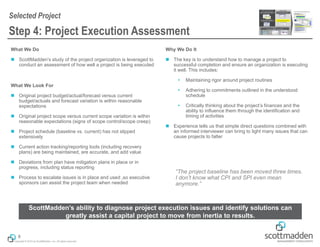
What We Do
◼ ScottMadden’s study of the project organization is leveraged to
conduct an assessment of how well a project is being executed
What We Look For
◼ Original project budget/actual/forecast versus current
budget/actuals and forecast variation is within reasonable
expectations
◼ Original project scope versus current scope variation is within
reasonable expectations (signs of scope control/scope creep)
◼ Project schedule (baseline vs. current) has not slipped
extensively
◼ Current action tracking/reporting tools (including recovery
plans) are being maintained, are accurate, and add value
◼ Deviations from plan have mitigation plans in place or in
progress, including status reporting
◼ Process to escalate issues is in place and used ,so executive
sponsors can assist the project team when needed
Why We Do It
◼ The key is to understand how to manage a project to
successful completion and ensure an organization is executing
it well. This includes:
 Maintaining rigor around project routines
 Adhering to commitments outlined in the understood
schedule
 Critically thinking about the project’s finances and the
ability to influence them through the identification and
timing of activities
◼ Experience tells us that simple direct questions combined with
an informed interviewer can bring to light many issues that can
cause projects to falter
Step 4: Project Execution Assessment
Selected Project
8
“The project baseline has been moved three times.
I don’t know what CPI and SPI even mean
anymore.”
ScottMadden’s ability to diagnose project execution issues and identify solutions can
greatly assist a capital project to move from inertia to results.
Copyright © 2014 by ScottMadden, Inc. All rights reserved.
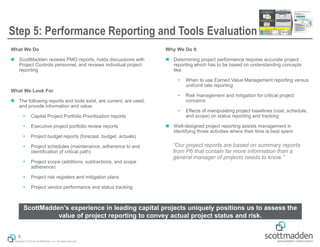
What We Do
◼ ScottMadden reviews PMO reports, holds discussions with
Project Controls personnel, and reviews individual project
reporting
What We Look For
◼ The following reports and tools exist, are current, are used,
and provide information and value:
 Capital Project Portfolio Prioritization reports
 Executive project portfolio review reports
 Project budget reports (forecast, budget, actuals)
 Project schedules (maintenance, adherence to and
identification of critical path)
 Project scope (additions, subtractions, and scope
adherence)
 Project risk registers and mitigation plans
 Project vendor performance and status tracking
Why We Do It
◼ Determining project performance requires accurate project
reporting which has to be based on understanding concepts
like:
 When to use Earned Value Management reporting versus
unit/unit rate reporting
 Risk management and mitigation for critical project
concerns
 Effects of manipulating project baselines (cost, schedule,
and scope) on status reporting and tracking
◼ Well-designed project reporting assists management in
identifying those activities where their time is best spent
Step 5: Performance Reporting and Tools Evaluation
9
“Our project reports are based on summary reports
from P6 that contain far more information than a
general manager of projects needs to know.”
ScottMadden’s experience in leading capital projects uniquely positions us to assess the
value of project reporting to convey actual project status and risk.
Copyright © 2014 by ScottMadden, Inc. All rights reserved.
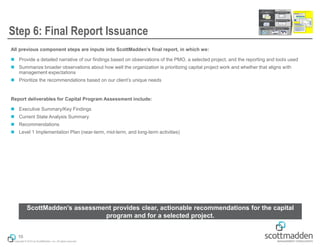
All previous component steps are inputs into ScottMadden’s final report, in which we:
◼ Provide a detailed narrative of our findings based on observations of the PMO, a selected project, and the reporting and tools used
◼ Summarize broader observations about how well the organization is prioritizing capital project work and whether that aligns with
management expectations
◼ Prioritize the recommendations based on our client’s unique needs
Report deliverables for Capital Program Assessment include:
◼ Executive Summary/Key Findings
◼ Current State Analysis Summary
◼ Recommendations
◼ Level 1 Implementation Plan (near-term, mid-term, and long-term activities)
Step 6: Final Report Issuance
10
ScottMadden’s assessment provides clear, actionable recommendations for the capital
program and for a selected project.
Copyright © 2014 by ScottMadden, Inc. All rights reserved.
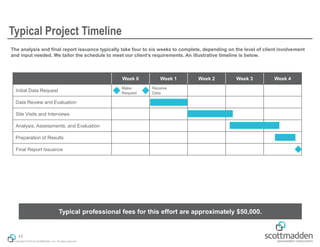
The analysis and final report issuance typically take four to six weeks to complete, depending on the level of client involvement
and input needed. We tailor the schedule to meet our client’s requirements. An illustrative timeline is below.
Typical Project Timeline
11
Week 0 Week 1 Week 2 Week 3 Week 4
Initial Data Request
Data Review and Evaluation
Site Visits and Interviews
Analysis, Assessments, and Evaluation
Preparation of Results
Final Report Issuance
Make
Request
Receive
Data
Typical professional fees for this effort are approximately $50,000.

Capital Program Assessment Overview

  • 1.
    Copyright © 2014by ScottMadden, Inc. All rights reserved. Capital Program Assessment Overview October 2014
  • 2.
    Copyright © 2014by ScottMadden, Inc. All rights reserved. ◼ Capital Projects – Increasingly Important ◼ But My Capital Program Is Already Good… Right? ◼ Capital Program Assessment  Overview  Step 1: Capital Program Analysis  Step 2: Process Evaluation  Step 3: Project Organization Analysis  Step 4: Project Execution Assessment  Step 5: Performance Reporting and Tools Evaluation  Step 6: Final Report Issuance ◼ Typical Project Timeline ◼ Contact Us Contents 1 Program Management Office Selected Project
  • 3.
    Copyright © 2014by ScottMadden, Inc. All rights reserved. ◼ Over the last ten years, the U.S. nuclear industry has seen large demands on its capital project/major modification organizations with the mandate to ensure compliance for a number of concerns, including:  Dry cask storage continuation  Fukushima modifications  Appendix R/NFPA 805 modifications  Security upgrade requirements  Extended power uprates ◼ As the nuclear fleet continues to age, projects like these will continue to surface, representing large capital exposure for nuclear power plants ◼ For that reason, successful execution of capital projects has never been more important. ScottMadden believes it is critical to ensure the capital projects organization and its projects are:  Structured and organized with clear roles and responsibilities  Disciplined in the execution of policies and procedures  Systematic about informing senior leadership of the likelihood and potential costs of project risks ◼ How is your organization performing? Capital Projects – Increasingly Important 2 Typical Capital Projects ScottMadden’s Capital Program Assessment is a proven way to diagnose program issues and address overall project management health.
  • 4.
    Copyright © 2014by ScottMadden, Inc. All rights reserved. Some signs the capital program is not working well: ◼ The PMO constantly gets in the way and requires things that distract from real project execution ◼ Ad hoc reporting/unpredictable report requirements ◼ Senior management randomly sweeps money and stops work midstream; the organization never knows what it will be able to finish ◼ The capital project priority list is changed constantly throughout the year ◼ Project risk mapping does not highlight problems in advance ◼ Regulatory projects require large infusions of capital to meet deadlines Some signs a capital project is not working well: ◼ The project manager wears too many hats and cannot identify the big issues and fails to ask leadership for help for normal activities (e.g., P.O. approvals) ◼ Operations delay execution of the schedule, which inflates craft expense ◼ The project team has trouble conveying status to management, and reporting does not seem to be highlighting issues ◼ Materials must be expedited often to meet the schedule ◼ Engineering work is behind schedule requiring contractors for Post Modification Testing Instructions (PMTIs) ◼ Vendors miss deadlines with little to no advance warning to management But My Capital Program Is Already Good… Right? Success of your capital program depends on the ability to manage a portfolio of projects well and the ability to execute each project’s required actions on time, on budget, and with quality. ScottMadden has run capital projects and established Program Management Offices (PMOs). Through that experience, ScottMadden has developed deep experience that enables us to assist your organization in diagnosing your specific challenges. Some common signs the capital program and a capital project are not working well are highlighted below. 3 Capital program and project challenges are complicated and manifest in a variety of ways. ScottMadden’s experience can guide you to the source of the problem.
  • 5.
    Copyright © 2014by ScottMadden, Inc. All rights reserved. ScottMadden’s Capital Program Assessment examines how the capital program is implemented—from top to bottom—with a look at the PMO, a specific project selected by our client, and a review of the performance reporting and tools in place. Overview Capital Program Assessment 4 Selected ProjectProgram Management Office Step 6: Deliverable: Final Report Issuance Step 1: Capital Program Analysis Step 2: Process Evaluation Step 4: Execution Assessment Step 5: Performance Reporting and Tools Evaluation Copyright © 2013 by ScottMadden. All rights reserved. 5 Constructability activities within alliance projects are being introduced later in the cradle to grave construction process than is typical for large project management Findings Constructability – Cost Savings Driver Current lack of a constructability process across all the elements of the construction cradle to grave process is a significant driver in NEA cost estimates being high Best In Class Projects Typical NEA Project Step 3: Organization Analysis ScottMadden’s approach analyzes these critical areas to provide a detailed assessment of your capital program with actionable recommendations.
  • 6.
    Copyright © 2014by ScottMadden, Inc. All rights reserved. What We Do ◼ ScottMadden conducts confidential interviews with the personnel in the PMO and concurrently reviews the documented organizational structure to determine how the organization is functioning What We Look For ◼ Individual roles, responsibilities, and accountabilities are documented and consistent with leading practices ◼ Personnel skills and knowledge are aligned with job descriptions and requirements ◼ Governance reporting/tracking mechanisms are in use (and used) and provide key information dictated by leading practices ◼ Organizational alignment is clear – e.g., key touch points between the PMO and the rest of the organization (Engineering, Procurement/Supply Chain, Finance, etc.) are defined and occur regularly Why We Do It ◼ PMOs run the gamut from strong centralized organizations to decentralized and site-led organizations. Through interviews with PMO personnel and key stakeholders, we are able to assess:  Strengths and weaknesses of the organization and supporting organizations  Personnel knowledge and skills gaps  Opportunities for improvement ◼ Confidential interviews also allow personnel to reveal what they are hesitant to bring up internally Step 1: Capital Program Analysis Program Management Office 5 “Our fleet contracts do not allow for close scrutiny of craft performance on site, which takes unusually long to get the simplest tasks completed…” PMOs set the tone for the organization and can be a great help or hindrance to the execution of capital projects.
  • 7.
    Copyright © 2014by ScottMadden, Inc. All rights reserved. What We Do ◼ ScottMadden assesses program management execution through a review of policies, procedures, and processes and interviews personnel to determine how well processes are being implemented What We Look For ◼ A standard stage-gated project planning process (initial scope and budget estimate through design, construction, and closeout) is documented and followed ◼ Project prioritization and selection (regulatory, above the line/below the line) are standardized and rigorous ◼ Project coordination and budget management are in place with appropriate controls ◼ Project portfolio oversight and management routines are documented and effective ◼ Contract and vendor management oversight and contracting strategies are proceduralized and followed Why We Do It ◼ PMOs can have a very competent staff, but if they are not supported by efficient processes, then they can get stuck in a loop of constantly changing priorities, which leads to project churn and ineffective capital spend ◼ Real world execution can sometimes significantly differ from documented processes. Understanding those differences allows ScottMadden to provide real insights into the challenges the PMO is facing Step 2: Process Evaluation Program Management Office 6 “The project prioritization process isn’t consistently executed. We are changing priorities all throughout the year leaving a lot of AE (Architect/Engineering) funds on the table…” Well-defined processes coupled with strong execution leads to high-performing PMOs.
  • 8.
    Copyright © 2014by ScottMadden, Inc. All rights reserved. What We Do ◼ ScottMadden looks into the inner workings and management of a specific capital project selected by our client What We Look For ◼ Key project documentation (charters, roles and responsibilities, scope, schedule, budget, and associated reports) exists and reflects leading practices ◼ Interviews with manager and key project controls personnel indicate roles and responsibilities are in place, understood, followed, and effective ◼ Review and assessment of the project organizational structure, including roles and responsibilities (PM, scheduler, cost PCS, task manager(s), engineers, etc.), show that appropriate positions exist within the organization Why We Do It ◼ Capital project management and execution can be flawed in a number of ways. Identifying key issues is a critical step in our evaluation with questions like:  Is the project manager effectively leading the team toward successful project completion?  Does everyone on the team understand their roles, responsibilities, and daily priorities? ◼ ScottMadden’s experience in working with large projects enables us to assess project performance through an unbiased lens providing valuable coaching that assists in:  Identifying corrective actions for project execution  Triangulating the truth for senior management to take action  Providing recommendations for improvements to correct course (if needed) on a capital project Step 3: Project Organization Analysis Selected Project 7 “Our project doesn’t have project controls personnel; it’s one PM trying to maintain scope, budget, and schedule and they’re all inaccurate. We need more help on the ground to run this effectively.” A capital project’s organizational structure and the people in it directly influence the success or failure of a project.
  • 9.
    Copyright © 2014by ScottMadden, Inc. All rights reserved. What We Do ◼ ScottMadden’s study of the project organization is leveraged to conduct an assessment of how well a project is being executed What We Look For ◼ Original project budget/actual/forecast versus current budget/actuals and forecast variation is within reasonable expectations ◼ Original project scope versus current scope variation is within reasonable expectations (signs of scope control/scope creep) ◼ Project schedule (baseline vs. current) has not slipped extensively ◼ Current action tracking/reporting tools (including recovery plans) are being maintained, are accurate, and add value ◼ Deviations from plan have mitigation plans in place or in progress, including status reporting ◼ Process to escalate issues is in place and used ,so executive sponsors can assist the project team when needed Why We Do It ◼ The key is to understand how to manage a project to successful completion and ensure an organization is executing it well. This includes:  Maintaining rigor around project routines  Adhering to commitments outlined in the understood schedule  Critically thinking about the project’s finances and the ability to influence them through the identification and timing of activities ◼ Experience tells us that simple direct questions combined with an informed interviewer can bring to light many issues that can cause projects to falter Step 4: Project Execution Assessment Selected Project 8 “The project baseline has been moved three times. I don’t know what CPI and SPI even mean anymore.” ScottMadden’s ability to diagnose project execution issues and identify solutions can greatly assist a capital project to move from inertia to results.
  • 10.
    Copyright © 2014by ScottMadden, Inc. All rights reserved. What We Do ◼ ScottMadden reviews PMO reports, holds discussions with Project Controls personnel, and reviews individual project reporting What We Look For ◼ The following reports and tools exist, are current, are used, and provide information and value:  Capital Project Portfolio Prioritization reports  Executive project portfolio review reports  Project budget reports (forecast, budget, actuals)  Project schedules (maintenance, adherence to and identification of critical path)  Project scope (additions, subtractions, and scope adherence)  Project risk registers and mitigation plans  Project vendor performance and status tracking Why We Do It ◼ Determining project performance requires accurate project reporting which has to be based on understanding concepts like:  When to use Earned Value Management reporting versus unit/unit rate reporting  Risk management and mitigation for critical project concerns  Effects of manipulating project baselines (cost, schedule, and scope) on status reporting and tracking ◼ Well-designed project reporting assists management in identifying those activities where their time is best spent Step 5: Performance Reporting and Tools Evaluation 9 “Our project reports are based on summary reports from P6 that contain far more information than a general manager of projects needs to know.” ScottMadden’s experience in leading capital projects uniquely positions us to assess the value of project reporting to convey actual project status and risk.
  • 11.
    Copyright © 2014by ScottMadden, Inc. All rights reserved. All previous component steps are inputs into ScottMadden’s final report, in which we: ◼ Provide a detailed narrative of our findings based on observations of the PMO, a selected project, and the reporting and tools used ◼ Summarize broader observations about how well the organization is prioritizing capital project work and whether that aligns with management expectations ◼ Prioritize the recommendations based on our client’s unique needs Report deliverables for Capital Program Assessment include: ◼ Executive Summary/Key Findings ◼ Current State Analysis Summary ◼ Recommendations ◼ Level 1 Implementation Plan (near-term, mid-term, and long-term activities) Step 6: Final Report Issuance 10 ScottMadden’s assessment provides clear, actionable recommendations for the capital program and for a selected project.
  • 12.
    Copyright © 2014by ScottMadden, Inc. All rights reserved. The analysis and final report issuance typically take four to six weeks to complete, depending on the level of client involvement and input needed. We tailor the schedule to meet our client’s requirements. An illustrative timeline is below. Typical Project Timeline 11 Week 0 Week 1 Week 2 Week 3 Week 4 Initial Data Request Data Review and Evaluation Site Visits and Interviews Analysis, Assessments, and Evaluation Preparation of Results Final Report Issuance Make Request Receive Data Typical professional fees for this effort are approximately $50,000.