SHRM Poll: Shared Services and Centers of
Excellence


                                     July 23, 2010
SHRM Poll: Shared Services and Centers of Excellence


Contents:

           Introduction

           Shared Services Centers

           Centers of Excellence

      Results by Organizations That Do Not Use a Shared Services/Centers of Excellence
     HR Transaction Model

           Methodology


                                                     Shared Services & Centers of Excellence | ©SHRM 2010   2
Introduction


This study examined the shared services centers (consolidated administrative HR
    functions) and centers of excellence (localized areas of in-depth HR expertise)
    models used for administering HR transactions and services. The shared services
    model, as envisioned by Dave Ulrich, is a way to promote HR expertise and deliver
    improved services companywide through the division of tasks and expertise.


                                                   Shared Services & Centers of Excellence | ©SHRM 2010   3
Shared Services Centers


               Shared Services & Centers of Excellence | ©SHRM 2010   4
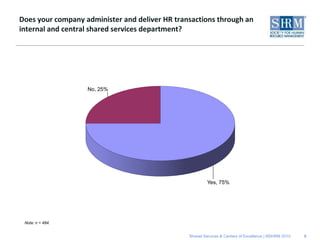
Does your company administer and deliver HR transactions through an
internal and central shared services department?


                   No, 25%


                                                         Yes, 75%


 Note: n = 484.


                                                Shared Services & Centers of Excellence | ©SHRM 2010   5
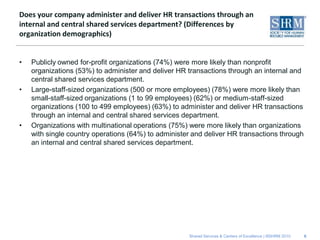
Does your company administer and deliver HR transactions through an
internal and central shared services department? (Differences by
organization demographics)


•   Publicly owned for-profit organizations (74%) were more likely than nonprofit
    organizations (53%) to administer and deliver HR transactions through an internal and
    central shared services department.
•   Large-staff-sized organizations (500 or more employees) (78%) were more likely than
    small-staff-sized organizations (1 to 99 employees) (62%) or medium-staff-sized
    organizations (100 to 499 employees) (63%) to administer and deliver HR transactions
    through an internal and central shared services department.
•   Organizations with multinational operations (75%) were more likely than organizations
    with single country operations (64%) to administer and deliver HR transactions through
    an internal and central shared services department.


                                                     Shared Services & Centers of Excellence | ©SHRM 2010   6
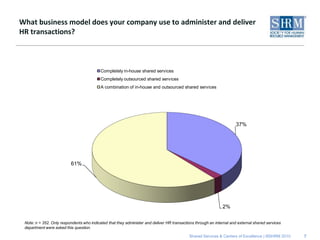
What business model does your company use to administer and deliver
HR transactions?


                                           Completely in-house shared services
                                           Completely outsourced shared services
                                           A combination of in-house and outsourced shared services


                                                                                                                      37%


                          61%


                                                                                                               2%

 Note: n = 352. Only respondents who indicated that they administer and deliver HR transactions through an internal and external shared services
 department were asked this question.

                                                                                            Shared Services & Centers of Excellence | ©SHRM 2010   7
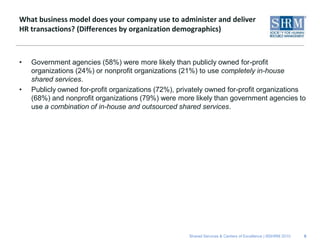
What business model does your company use to administer and deliver
HR transactions? (Differences by organization demographics)


•   Government agencies (58%) were more likely than publicly owned for-profit
    organizations (24%) or nonprofit organizations (21%) to use completely in-house
    shared services.
•   Publicly owned for-profit organizations (72%), privately owned for-profit organizations
    (68%) and nonprofit organizations (79%) were more likely than government agencies to
    use a combination of in-house and outsourced shared services.


                                                      Shared Services & Centers of Excellence | ©SHRM 2010   8
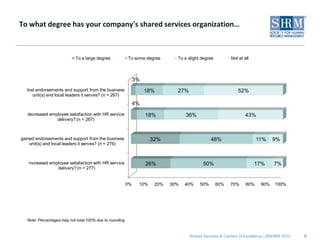
To what degree has your company's shared services organization…


                            To a large degree              To some degree     To a slight degree         Not at all


                                                            3%
   lost endorsements and support from the business               18%          27%                            52%
      unit(s) and local leaders it serves? (n = 267)
                                                            4%
   decreased employee satisfaction with HR service                18%             36%                            43%
                delivery? (n = 267)


gained endorsements and support from the business                    32%                       48%                     11%    9%
    unit(s) and local leaders it serves? (n = 276)


   increased employee satisfaction with HR service                26%                      50%                        17%      7%
                delivery? (n = 277)


                                                       0%      10%    20%   30%   40%    50%       60%   70%     80%    90%    100%


   Note: Percentages may not total 100% due to rounding.


                                                                                    Shared Services & Centers of Excellence | ©SHRM 2010   9
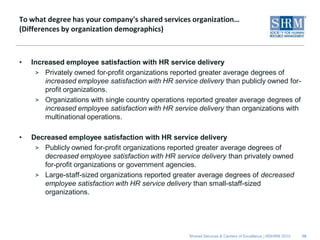
To what degree has your company's shared services organization…
(Differences by organization demographics)


•   Increased employee satisfaction with HR service delivery
     > Privately owned for-profit organizations reported greater average degrees of
        increased employee satisfaction with HR service delivery than publicly owned for-
        profit organizations.
     > Organizations with single country operations reported greater average degrees of
        increased employee satisfaction with HR service delivery than organizations with
        multinational operations.

•   Decreased employee satisfaction with HR service delivery
     > Publicly owned for-profit organizations reported greater average degrees of
       decreased employee satisfaction with HR service delivery than privately owned
       for-profit organizations or government agencies.
     > Large-staff-sized organizations reported greater average degrees of decreased
       employee satisfaction with HR service delivery than small-staff-sized
       organizations.


                                                     Shared Services & Centers of Excellence | ©SHRM 2010   10
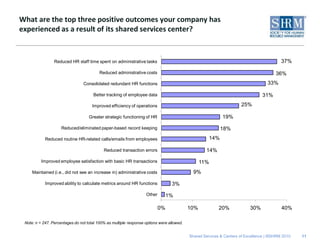
What are the top three positive outcomes your company has
experienced as a result of its shared services center?


                 Reduced HR staff time spent on administrative tasks                                                                      37%

                                          Reduced administrative costs                                                                 36%
                                 Consolidated redundant HR functions                                                               33%

                                      Better tracking of employee data                                                          31%
                                      Improved efficiency of operations                                              25%

                                    Greater strategic functioning of HR                                     19%

                     Reduced/eliminated paper-based record keeping                                         18%
            Reduced routine HR-related calls/emails from employees                                   14%

                                            Reduced transaction errors                             14%

          Improved employee satisfaction with basic HR transactions                              11%
     Maintained (i.e., did not see an increase in) administrative costs                      9%

            Improved ability to calculate metrics around HR functions             3%
                                                                   Other        1%

                                                                           0%              10%            20%             30%             40%

 Note: n = 247. Percentages do not total 100% as multiple response options were allowed.


                                                                                           Shared Services & Centers of Excellence | ©SHRM 2010   11
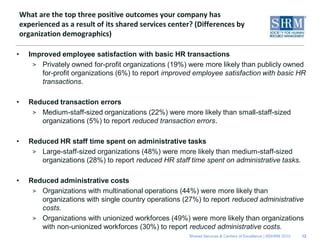
What are the top three positive outcomes your company has
    experienced as a result of its shared services center? (Differences by
    organization demographics)

•     Improved employee satisfaction with basic HR transactions
       > Privately owned for-profit organizations (19%) were more likely than publicly owned
         for-profit organizations (6%) to report improved employee satisfaction with basic HR
         transactions.

•     Reduced transaction errors
       > Medium-staff-sized organizations (22%) were more likely than small-staff-sized
         organizations (5%) to report reduced transaction errors.

•     Reduced HR staff time spent on administrative tasks
       > Large-staff-sized organizations (48%) were more likely than medium-staff-sized
         organizations (28%) to report reduced HR staff time spent on administrative tasks.

•     Reduced administrative costs
       > Organizations with multinational operations (44%) were more likely than
         organizations with single country operations (27%) to report reduced administrative
         costs.
       > Organizations with unionized workforces (49%) were more likely than organizations
         with non-unionized workforces (30%) to report reduced administrative costs.
                                                        Shared Services & Centers of Excellence | ©SHRM 2010   12
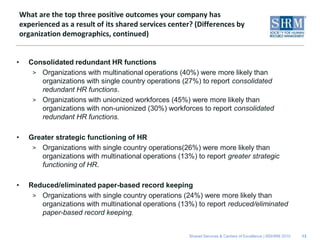
What are the top three positive outcomes your company has
    experienced as a result of its shared services center? (Differences by
    organization demographics, continued)


•     Consolidated redundant HR functions
       > Organizations with multinational operations (40%) were more likely than
         organizations with single country operations (27%) to report consolidated
         redundant HR functions.
       > Organizations with unionized workforces (45%) were more likely than
         organizations with non-unionized (30%) workforces to report consolidated
         redundant HR functions.

•     Greater strategic functioning of HR
       > Organizations with single country operations(26%) were more likely than
         organizations with multinational operations (13%) to report greater strategic
         functioning of HR.

•     Reduced/eliminated paper-based record keeping
       > Organizations with single country operations (24%) were more likely than
         organizations with multinational operations (13%) to report reduced/eliminated
         paper-based record keeping.


                                                         Shared Services & Centers of Excellence | ©SHRM 2010   13
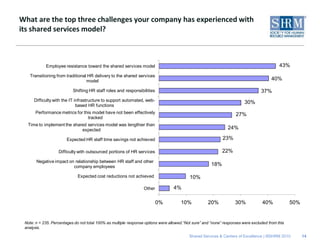
What are the top three challenges your company has experienced with
its shared services model?


            Employee resistance toward the shared services model                                                                            43%
   Transitioning from traditional HR delivery to the shared services
                                 model                                                                                                  40%

                           Shifting HR staff roles and responsibilities                                                           37%
      Difficulty with the IT infrastructure to support automated, web-                                                   30%
                              based HR functions
      Performance metrics for this model have not been effectively                                                  27%
                                tracked
  Time to implement the shared services model was lengthier than
                            expected                                                                            24%

                        Expected HR staff time savings not achieved                                          23%

                   Difficulty with outsourced portions of HR services                                        22%
       Negative impact on relationship between HR staff and other
                         company employees                                                             18%

                              Expected cost reductions not achieved                        10%

                                                                  Other           4%

                                                                          0%          10%            20%            30%            40%            50%


 Note: n = 235. Percentages do not total 100% as multiple response options were allowed.“Not sure” and “none” responses were excluded from this
 analysis.

                                                                                           Shared Services & Centers of Excellence | ©SHRM 2010         14
What are the top three challenges your company has experienced with
    its shared services model? (Differences by organization demographics)


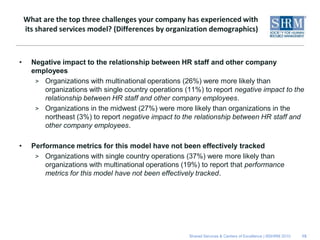
•     Negative impact to the relationship between HR staff and other company
      employees
       > Organizations with multinational operations (26%) were more likely than
         organizations with single country operations (11%) to report negative impact to the
         relationship between HR staff and other company employees.
       > Organizations in the midwest (27%) were more likely than organizations in the
         northeast (3%) to report negative impact to the relationship between HR staff and
         other company employees.

•     Performance metrics for this model have not been effectively tracked
       > Organizations with single country operations (37%) were more likely than
          organizations with multinational operations (19%) to report that performance
          metrics for this model have not been effectively tracked.


                                                       Shared Services & Centers of Excellence | ©SHRM 2010   15
What are the top three challenges your company has experienced with
its shared services model? (Differences by organization demographics,
continued)


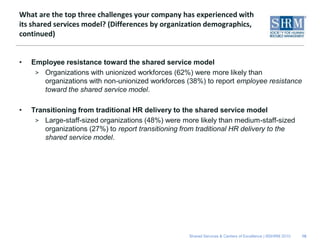
•   Employee resistance toward the shared service model
     > Organizations with unionized workforces (62%) were more likely than
       organizations with non-unionized workforces (38%) to report employee resistance
       toward the shared service model.

•   Transitioning from traditional HR delivery to the shared service model
     > Large-staff-sized organizations (48%) were more likely than medium-staff-sized
        organizations (27%) to report transitioning from traditional HR delivery to the
        shared service model.


                                                     Shared Services & Centers of Excellence | ©SHRM 2010   16
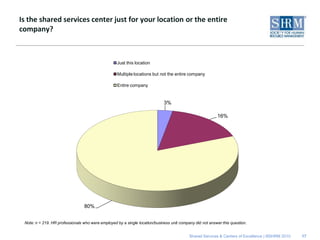
Is the shared services center just for your location or the entire
company?


                                                   Just this location

                                                   Multiple locations but not the entire company

                                                   Entire company


                                                                             3%

                                                                                                          16%


                                 80%


 Note: n = 219. HR professionals who were employed by a single location/business unit company did not answer this question.


                                                                                           Shared Services & Centers of Excellence | ©SHRM 2010   17
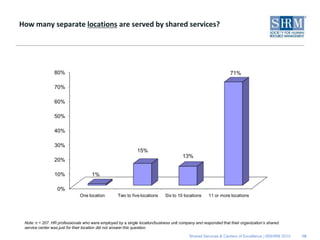
How many separate locations are served by shared services?


                 80%                                                                                             71%

                 70%

                 60%

                 50%

                 40%

                 30%
                                                              15%
                                                                                       13%
                 20%

                 10%                 1%

                  0%
                               One location         Two to five locations    Six to 10 locations     11 or more locations


 Note: n = 207. HR professionals who were employed by a single location/business unit company and responded that their organization’s shared
 service center was just for their location did not answer this question.

                                                                                           Shared Services & Centers of Excellence | ©SHRM 2010   18
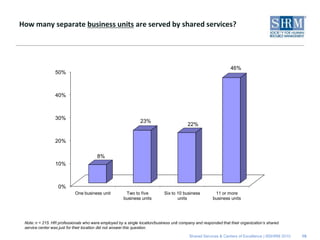
How many separate business units are served by shared services?


                                                                                                                 46%
                 50%


                 40%


                 30%
                                                                23%
                                                                                          22%


                 20%

                                        8%
                 10%


                   0%
                            One business unit           Two to five          Six to 10 business         11 or more
                                                       business units               units              business units


 Note: n = 215. HR professionals who were employed by a single location/business unit company and responded that their organization’s shared
 service center was just for their location did not answer this question.

                                                                                           Shared Services & Centers of Excellence | ©SHRM 2010   19
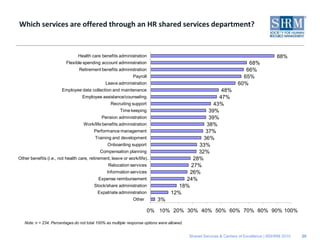
Which services are offered through an HR shared services department?


                                Health care benefits administration                                                                       88%
                         Flexible spending account administration                                                        68%
                                 Retirement benefits administration                                                     66%
                                                              Payroll                                                  65%
                                               Leave administration                                                  60%
                       Employee data collection and maintenance                                       48%
                                  Employee assistance/counseling                                     47%
                                                  Recruiting support                               43%
                                                       Time keeping                              39%
                                             Pension administration                              39%
                                   Work/life benefits administration                            38%
                                         Performance management                                 37%
                                         Training and development                              36%
                                                Onboarding support                           33%
                                            Compensation planning                            32%
Other benefits (i.e., not health care, retirement, leave or work/life)…                    28%
                                                 Relocation services                      27%
                                                Information services                      26%
                                           Expense reimbursement                        24%
                                         Stock/share administration                   18%
                                           Expatriate administration               12%
                                                              Other         3%

                                                                        0% 10% 20% 30% 40% 50% 60% 70% 80% 90% 100%

   Note: n = 234. Percentages do not total 100% as multiple response options were allowed.


                                                                                             Shared Services & Centers of Excellence | ©SHRM 2010   20
Which services are offered through an HR shared services department?
(Differences by organization demographics)


•   Relocation services
     > Publicly owned for-profit organizations (40%) were more likely than government
        agencies (12%) to report offering relocation services through an HR shared
        services department.
     > Organizations with multinational operations (38%) were more likely than
        organizations with single country operations (16%) to report offering relocation
        services through an HR shared services department

•   Stock/share administration
     > Publicly owned for-profit organizations (30%) were more likely than nonprofit
        organizations (7%) to report offering stock/share administration through an HR
        shared services department.
     > Organizations with multinational operations (24%) were more likely than
        organizations with single country operations (14%) to report offering stock/share
        administration through an HR shared services department


                                                      Shared Services & Centers of Excellence | ©SHRM 2010   21
Which services are offered through an HR shared services department?
(Differences by organization demographics)


•   Pension administration
     > Organizations with unionized workforces (58%) were more likely than
       organizations with non-unionized workforces (32%) to report offering pension
       administration through an HR shared services department.
     > Medium- and large-staff-sized organizations were more likely than small-staff-sized
       organizations to report offering pension administration through an HR shared
       services department.

•   Other benefits administration
     > Large-staff-sized organizations were more likely than medium-staff-sized
       organizations to report offering other benefits (i.e., not health care, retirement,
       leave or work/life) administration through an HR shared services department.

•   Payroll
     > Organizations with multinational operations (73%) were more likely than
        organizations with single country operations (58%) to report offering payroll
        through an HR shared services department.


                                                        Shared Services & Centers of Excellence | ©SHRM 2010   22
Which services are offered through an HR shared services department?
(Differences by organization demographics)


•   Retirement benefits administration
     > Organizations in the southeast (80%) were more likely than organizations in the
        northeast (52%) to report offering retirement benefits administration through an HR
        shared services department.

•   Flexible spending account administration
     > Publicly owned for-profit organizations (75%) were more likely than government
        agencies (44%) to report offering flexible spending account administration through
        an HR shared services department.


                                                      Shared Services & Centers of Excellence | ©SHRM 2010   23
Centers of Excellence


              Shared Services & Centers of Excellence | ©SHRM 2010   24
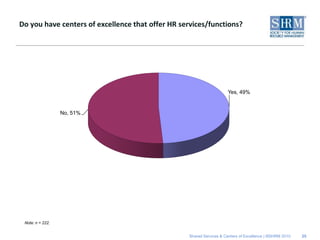
Do you have centers of excellence that offer HR services/functions?


                                                                     Yes, 49%


                  No, 51%


 Note: n = 222.


                                                  Shared Services & Centers of Excellence | ©SHRM 2010   25
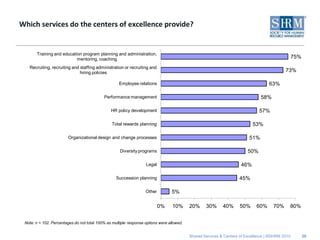
Which services do the centers of excellence provide?


       Training and education program planning and administration,
                           mentoring, coaching                                                                                                    75%
   Recruiting, recruiting and staffing administration or recruiting and
                              hiring policies                                                                                               73%

                                                     Employee relations                                                             63%

                                            Performance management                                                             58%

                                                HR policy development                                                          57%

                                                 Total rewards planning                                                    53%

                        Organizational design and change processes                                                       51%

                                                     Diversity programs                                                  50%

                                                                   Legal                                             46%

                                                   Succession planning                                              45%

                                                                   Other          5%

                                                                           0%     10%      20%     30%      40%     50%      60%      70%     80%


 Note: n = 102. Percentages do not total 100% as multiple response options were allowed.


                                                                                           Shared Services & Centers of Excellence | ©SHRM 2010         26
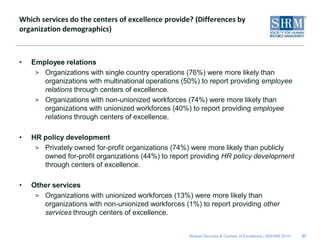
Which services do the centers of excellence provide? (Differences by
organization demographics)


•   Employee relations
     > Organizations with single country operations (76%) were more likely than
       organizations with multinational operations (50%) to report providing employee
       relations through centers of excellence.
     > Organizations with non-unionized workforces (74%) were more likely than
       organizations with unionized workforces (40%) to report providing employee
       relations through centers of excellence.

•   HR policy development
     > Privately owned for-profit organizations (74%) were more likely than publicly
       owned for-profit organizations (44%) to report providing HR policy development
       through centers of excellence.

•   Other services
     > Organizations with unionized workforces (13%) were more likely than
       organizations with non-unionized workforces (1%) to report providing other
       services through centers of excellence.


                                                     Shared Services & Centers of Excellence | ©SHRM 2010   27
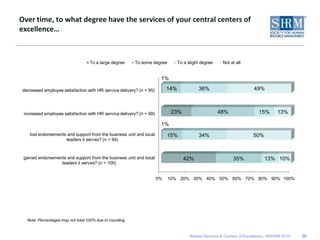
Over time, to what degree have the services of your central centers of
excellence…


                                   To a large degree      To some degree         To a slight degree     Not at all


                                                                       1%

decreased employee satisfaction with HR service delivery? (n = 95)         14%             36%                          49%


 increased employee satisfaction with HR service delivery? (n = 99)         23%                       48%                 15%       13%

                                                                       1%
    lost endorsements and support from the business unit and local         15%             34%                         50%
                     leaders it serves? (n = 94)


 gained endorsements and support from the business unit and local                  42%                       35%             13% 10%
                  leaders it serves? (n = 100)


                                                                      0%   10% 20% 30% 40% 50% 60% 70% 80% 90% 100%


  Note: Percentages may not total 100% due to rounding.


                                                                                       Shared Services & Centers of Excellence | ©SHRM 2010   28
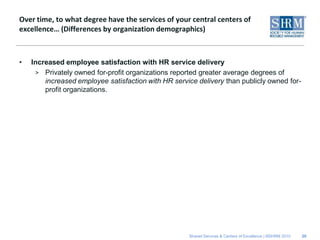
Over time, to what degree have the services of your central centers of
excellence… (Differences by organization demographics)


•   Increased employee satisfaction with HR service delivery
     > Privately owned for-profit organizations reported greater average degrees of
        increased employee satisfaction with HR service delivery than publicly owned for-
        profit organizations.


                                                     Shared Services & Centers of Excellence | ©SHRM 2010   29
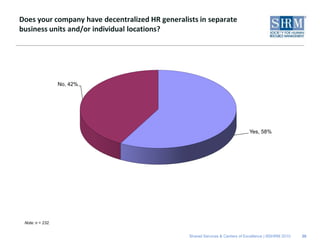
Does your company have decentralized HR generalists in separate
business units and/or individual locations?


                  No, 42%


                                                                               Yes, 58%


 Note: n = 232.


                                                 Shared Services & Centers of Excellence | ©SHRM 2010   30
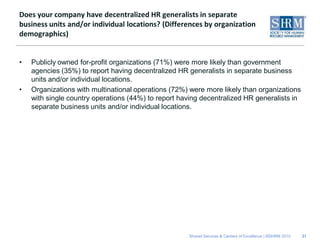
Does your company have decentralized HR generalists in separate
business units and/or individual locations? (Differences by organization
demographics)


•   Publicly owned for-profit organizations (71%) were more likely than government
    agencies (35%) to report having decentralized HR generalists in separate business
    units and/or individual locations.
•   Organizations with multinational operations (72%) were more likely than organizations
    with single country operations (44%) to report having decentralized HR generalists in
    separate business units and/or individual locations.


                                                     Shared Services & Centers of Excellence | ©SHRM 2010   31
Organizations That Do Not Use a Shared
   Services/Centers of Excellence HR
            Transaction Model


                      Shared Services & Centers of Excellence | ©SHRM 2010   32
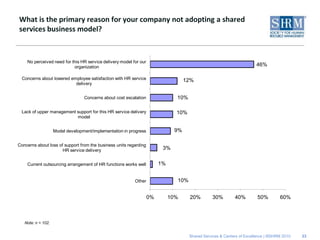
What is the primary reason for your company not adopting a shared
services business model?


    No perceived need for this HR service delivery model for our
                           organization                                                                                46%

  Concerns about lowered employee satisfaction with HR service                     12%
                           delivery


                                  Concerns about cost escalation               10%

  Lack of upper management support for this HR service delivery                10%
                           model


                    Model development/implementation in progress              9%

Concerns about loss of support from the business units regarding
                      HR service delivery                                3%


    Current outsourcing arrangement of HR functions works well          1%


                                                          Other                10%


                                                                   0%        10%     20%        30%         40%         50%        60%


   Note: n = 102.


                                                                                     Shared Services & Centers of Excellence | ©SHRM 2010   33
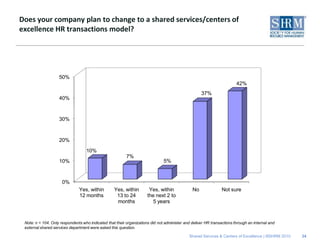
Does your company plan to change to a shared services/centers of
excellence HR transactions model?


                    50%
                                                                                                                        42%
                                                                                                    37%
                    40%


                    30%


                    20%

                                   10%
                                                          7%
                    10%                                                        5%


                      0%
                               Yes, within         Yes, within         Yes, within             No               Not sure
                               12 months            13 to 24          the next 2 to
                                                    months               5 years


 Note: n = 104. Only respondents who indicated that their organizations did not administer and deliver HR transactions through an internal and
 external shared services department were asked this question.

                                                                                             Shared Services & Centers of Excellence | ©SHRM 2010   34
Does your company plan to change to a shared services/centers of
excellence HR transactions model? (Differences by organization
demographics)


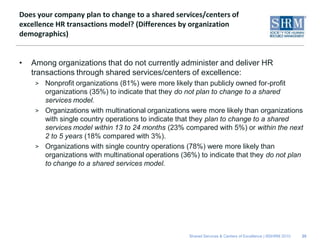
•   Among organizations that do not currently administer and deliver HR
    transactions through shared services/centers of excellence:
     > Nonprofit organizations (81%) were more likely than publicly owned for-profit
       organizations (35%) to indicate that they do not plan to change to a shared
       services model.
     > Organizations with multinational organizations were more likely than organizations
       with single country operations to indicate that they plan to change to a shared
       services model within 13 to 24 months (23% compared with 5%) or within the next
       2 to 5 years (18% compared with 3%).
     > Organizations with single country operations (78%) were more likely than
       organizations with multinational operations (36%) to indicate that they do not plan
       to change to a shared services model.


                                                     Shared Services & Centers of Excellence | ©SHRM 2010   35
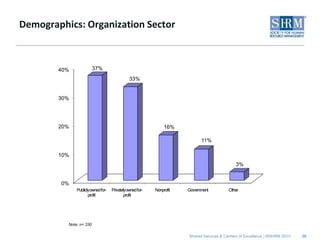
Demographics: Organization Sector


        40%              37%
                                             33%


        30%


        20%                                                   16%

                                                                           11%

        10%
                                                                                            3%


        0%
              Publiclyowned for-   Privatelyowned for-   Nonprofit   Government          Other
                     profit                profit


          Note: n= 330

                                                                     Shared Services & Centers of Excellence | ©SHRM 2010   36
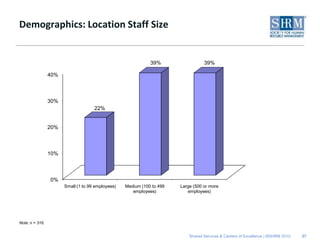
Demographics: Location Staff Size


                                                              39%                  39%

                 40%


                 30%
                                     22%


                 20%


                 10%


                 0%
                       Small (1 to 99 employees)   Medium (100 to 499   Large (500 or more
                                                      employees)           employees)


Note: n = 316.


                                                                            Shared Services & Centers of Excellence | ©SHRM 2010   37
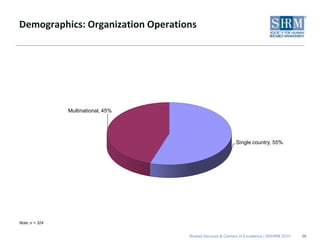
Demographics: Organization Operations


                Multinational, 45%


                                                             Single country, 55%


Note: n = 324


                                     Shared Services & Centers of Excellence | ©SHRM 2010   38
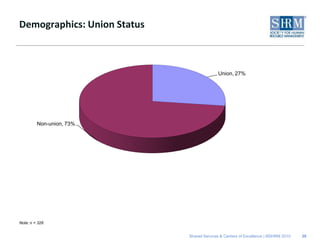
Demographics: Union Status


                                           Union, 27%


         Non-union, 73%


Note: n = 328


                             Shared Services & Centers of Excellence | ©SHRM 2010   39
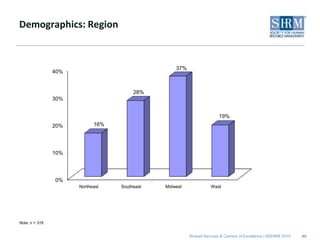
Demographics: Region


                                                  37%
                40%


                                       28%
                30%


                                                                       19%
                20%         16%


                10%


                0%
                      Northeast   Southeast   Midwest              West


Note: n = 316


                                                        Shared Services & Centers of Excellence | ©SHRM 2010   40
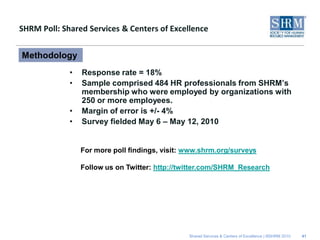
SHRM Poll: Shared Services & Centers of Excellence


Methodology
             •   Response rate = 18%
             •   Sample comprised 484 HR professionals from SHRM’s
                 membership who were employed by organizations with
                 250 or more employees.
             •   Margin of error is +/- 4%
             •   Survey fielded May 6 – May 12, 2010


                 For more poll findings, visit: www.shrm.org/surveys

                 Follow us on Twitter: http://twitter.com/SHRM_Research


                                                Shared Services & Centers of Excellence | ©SHRM 2010   41

Shrm poll shared_servicesfinal

  • 1.
    SHRM Poll: SharedServices and Centers of Excellence July 23, 2010
  • 2.
    SHRM Poll: SharedServices and Centers of Excellence Contents:  Introduction  Shared Services Centers  Centers of Excellence  Results by Organizations That Do Not Use a Shared Services/Centers of Excellence HR Transaction Model  Methodology Shared Services & Centers of Excellence | ©SHRM 2010 2
  • 3.
    Introduction This study examinedthe shared services centers (consolidated administrative HR functions) and centers of excellence (localized areas of in-depth HR expertise) models used for administering HR transactions and services. The shared services model, as envisioned by Dave Ulrich, is a way to promote HR expertise and deliver improved services companywide through the division of tasks and expertise. Shared Services & Centers of Excellence | ©SHRM 2010 3
  • 4.
    Shared Services Centers Shared Services & Centers of Excellence | ©SHRM 2010 4
  • 5.
    Does your companyadminister and deliver HR transactions through an internal and central shared services department? No, 25% Yes, 75% Note: n = 484. Shared Services & Centers of Excellence | ©SHRM 2010 5
  • 6.
    Does your companyadminister and deliver HR transactions through an internal and central shared services department? (Differences by organization demographics) • Publicly owned for-profit organizations (74%) were more likely than nonprofit organizations (53%) to administer and deliver HR transactions through an internal and central shared services department. • Large-staff-sized organizations (500 or more employees) (78%) were more likely than small-staff-sized organizations (1 to 99 employees) (62%) or medium-staff-sized organizations (100 to 499 employees) (63%) to administer and deliver HR transactions through an internal and central shared services department. • Organizations with multinational operations (75%) were more likely than organizations with single country operations (64%) to administer and deliver HR transactions through an internal and central shared services department. Shared Services & Centers of Excellence | ©SHRM 2010 6
  • 7.
    What business modeldoes your company use to administer and deliver HR transactions? Completely in-house shared services Completely outsourced shared services A combination of in-house and outsourced shared services 37% 61% 2% Note: n = 352. Only respondents who indicated that they administer and deliver HR transactions through an internal and external shared services department were asked this question. Shared Services & Centers of Excellence | ©SHRM 2010 7
  • 8.
    What business modeldoes your company use to administer and deliver HR transactions? (Differences by organization demographics) • Government agencies (58%) were more likely than publicly owned for-profit organizations (24%) or nonprofit organizations (21%) to use completely in-house shared services. • Publicly owned for-profit organizations (72%), privately owned for-profit organizations (68%) and nonprofit organizations (79%) were more likely than government agencies to use a combination of in-house and outsourced shared services. Shared Services & Centers of Excellence | ©SHRM 2010 8
  • 9.
    To what degreehas your company's shared services organization… To a large degree To some degree To a slight degree Not at all 3% lost endorsements and support from the business 18% 27% 52% unit(s) and local leaders it serves? (n = 267) 4% decreased employee satisfaction with HR service 18% 36% 43% delivery? (n = 267) gained endorsements and support from the business 32% 48% 11% 9% unit(s) and local leaders it serves? (n = 276) increased employee satisfaction with HR service 26% 50% 17% 7% delivery? (n = 277) 0% 10% 20% 30% 40% 50% 60% 70% 80% 90% 100% Note: Percentages may not total 100% due to rounding. Shared Services & Centers of Excellence | ©SHRM 2010 9
  • 10.
    To what degreehas your company's shared services organization… (Differences by organization demographics) • Increased employee satisfaction with HR service delivery > Privately owned for-profit organizations reported greater average degrees of increased employee satisfaction with HR service delivery than publicly owned for- profit organizations. > Organizations with single country operations reported greater average degrees of increased employee satisfaction with HR service delivery than organizations with multinational operations. • Decreased employee satisfaction with HR service delivery > Publicly owned for-profit organizations reported greater average degrees of decreased employee satisfaction with HR service delivery than privately owned for-profit organizations or government agencies. > Large-staff-sized organizations reported greater average degrees of decreased employee satisfaction with HR service delivery than small-staff-sized organizations. Shared Services & Centers of Excellence | ©SHRM 2010 10
  • 11.
    What are thetop three positive outcomes your company has experienced as a result of its shared services center? Reduced HR staff time spent on administrative tasks 37% Reduced administrative costs 36% Consolidated redundant HR functions 33% Better tracking of employee data 31% Improved efficiency of operations 25% Greater strategic functioning of HR 19% Reduced/eliminated paper-based record keeping 18% Reduced routine HR-related calls/emails from employees 14% Reduced transaction errors 14% Improved employee satisfaction with basic HR transactions 11% Maintained (i.e., did not see an increase in) administrative costs 9% Improved ability to calculate metrics around HR functions 3% Other 1% 0% 10% 20% 30% 40% Note: n = 247. Percentages do not total 100% as multiple response options were allowed. Shared Services & Centers of Excellence | ©SHRM 2010 11
  • 12.
    What are thetop three positive outcomes your company has experienced as a result of its shared services center? (Differences by organization demographics) • Improved employee satisfaction with basic HR transactions > Privately owned for-profit organizations (19%) were more likely than publicly owned for-profit organizations (6%) to report improved employee satisfaction with basic HR transactions. • Reduced transaction errors > Medium-staff-sized organizations (22%) were more likely than small-staff-sized organizations (5%) to report reduced transaction errors. • Reduced HR staff time spent on administrative tasks > Large-staff-sized organizations (48%) were more likely than medium-staff-sized organizations (28%) to report reduced HR staff time spent on administrative tasks. • Reduced administrative costs > Organizations with multinational operations (44%) were more likely than organizations with single country operations (27%) to report reduced administrative costs. > Organizations with unionized workforces (49%) were more likely than organizations with non-unionized workforces (30%) to report reduced administrative costs. Shared Services & Centers of Excellence | ©SHRM 2010 12
  • 13.
    What are thetop three positive outcomes your company has experienced as a result of its shared services center? (Differences by organization demographics, continued) • Consolidated redundant HR functions > Organizations with multinational operations (40%) were more likely than organizations with single country operations (27%) to report consolidated redundant HR functions. > Organizations with unionized workforces (45%) were more likely than organizations with non-unionized (30%) workforces to report consolidated redundant HR functions. • Greater strategic functioning of HR > Organizations with single country operations(26%) were more likely than organizations with multinational operations (13%) to report greater strategic functioning of HR. • Reduced/eliminated paper-based record keeping > Organizations with single country operations (24%) were more likely than organizations with multinational operations (13%) to report reduced/eliminated paper-based record keeping. Shared Services & Centers of Excellence | ©SHRM 2010 13
  • 14.
    What are thetop three challenges your company has experienced with its shared services model? Employee resistance toward the shared services model 43% Transitioning from traditional HR delivery to the shared services model 40% Shifting HR staff roles and responsibilities 37% Difficulty with the IT infrastructure to support automated, web- 30% based HR functions Performance metrics for this model have not been effectively 27% tracked Time to implement the shared services model was lengthier than expected 24% Expected HR staff time savings not achieved 23% Difficulty with outsourced portions of HR services 22% Negative impact on relationship between HR staff and other company employees 18% Expected cost reductions not achieved 10% Other 4% 0% 10% 20% 30% 40% 50% Note: n = 235. Percentages do not total 100% as multiple response options were allowed.“Not sure” and “none” responses were excluded from this analysis. Shared Services & Centers of Excellence | ©SHRM 2010 14
  • 15.
    What are thetop three challenges your company has experienced with its shared services model? (Differences by organization demographics) • Negative impact to the relationship between HR staff and other company employees > Organizations with multinational operations (26%) were more likely than organizations with single country operations (11%) to report negative impact to the relationship between HR staff and other company employees. > Organizations in the midwest (27%) were more likely than organizations in the northeast (3%) to report negative impact to the relationship between HR staff and other company employees. • Performance metrics for this model have not been effectively tracked > Organizations with single country operations (37%) were more likely than organizations with multinational operations (19%) to report that performance metrics for this model have not been effectively tracked. Shared Services & Centers of Excellence | ©SHRM 2010 15
  • 16.
    What are thetop three challenges your company has experienced with its shared services model? (Differences by organization demographics, continued) • Employee resistance toward the shared service model > Organizations with unionized workforces (62%) were more likely than organizations with non-unionized workforces (38%) to report employee resistance toward the shared service model. • Transitioning from traditional HR delivery to the shared service model > Large-staff-sized organizations (48%) were more likely than medium-staff-sized organizations (27%) to report transitioning from traditional HR delivery to the shared service model. Shared Services & Centers of Excellence | ©SHRM 2010 16
  • 17.
    Is the sharedservices center just for your location or the entire company? Just this location Multiple locations but not the entire company Entire company 3% 16% 80% Note: n = 219. HR professionals who were employed by a single location/business unit company did not answer this question. Shared Services & Centers of Excellence | ©SHRM 2010 17
  • 18.
    How many separatelocations are served by shared services? 80% 71% 70% 60% 50% 40% 30% 15% 13% 20% 10% 1% 0% One location Two to five locations Six to 10 locations 11 or more locations Note: n = 207. HR professionals who were employed by a single location/business unit company and responded that their organization’s shared service center was just for their location did not answer this question. Shared Services & Centers of Excellence | ©SHRM 2010 18
  • 19.
    How many separatebusiness units are served by shared services? 46% 50% 40% 30% 23% 22% 20% 8% 10% 0% One business unit Two to five Six to 10 business 11 or more business units units business units Note: n = 215. HR professionals who were employed by a single location/business unit company and responded that their organization’s shared service center was just for their location did not answer this question. Shared Services & Centers of Excellence | ©SHRM 2010 19
  • 20.
    Which services areoffered through an HR shared services department? Health care benefits administration 88% Flexible spending account administration 68% Retirement benefits administration 66% Payroll 65% Leave administration 60% Employee data collection and maintenance 48% Employee assistance/counseling 47% Recruiting support 43% Time keeping 39% Pension administration 39% Work/life benefits administration 38% Performance management 37% Training and development 36% Onboarding support 33% Compensation planning 32% Other benefits (i.e., not health care, retirement, leave or work/life)… 28% Relocation services 27% Information services 26% Expense reimbursement 24% Stock/share administration 18% Expatriate administration 12% Other 3% 0% 10% 20% 30% 40% 50% 60% 70% 80% 90% 100% Note: n = 234. Percentages do not total 100% as multiple response options were allowed. Shared Services & Centers of Excellence | ©SHRM 2010 20
  • 21.
    Which services areoffered through an HR shared services department? (Differences by organization demographics) • Relocation services > Publicly owned for-profit organizations (40%) were more likely than government agencies (12%) to report offering relocation services through an HR shared services department. > Organizations with multinational operations (38%) were more likely than organizations with single country operations (16%) to report offering relocation services through an HR shared services department • Stock/share administration > Publicly owned for-profit organizations (30%) were more likely than nonprofit organizations (7%) to report offering stock/share administration through an HR shared services department. > Organizations with multinational operations (24%) were more likely than organizations with single country operations (14%) to report offering stock/share administration through an HR shared services department Shared Services & Centers of Excellence | ©SHRM 2010 21
  • 22.
    Which services areoffered through an HR shared services department? (Differences by organization demographics) • Pension administration > Organizations with unionized workforces (58%) were more likely than organizations with non-unionized workforces (32%) to report offering pension administration through an HR shared services department. > Medium- and large-staff-sized organizations were more likely than small-staff-sized organizations to report offering pension administration through an HR shared services department. • Other benefits administration > Large-staff-sized organizations were more likely than medium-staff-sized organizations to report offering other benefits (i.e., not health care, retirement, leave or work/life) administration through an HR shared services department. • Payroll > Organizations with multinational operations (73%) were more likely than organizations with single country operations (58%) to report offering payroll through an HR shared services department. Shared Services & Centers of Excellence | ©SHRM 2010 22
  • 23.
    Which services areoffered through an HR shared services department? (Differences by organization demographics) • Retirement benefits administration > Organizations in the southeast (80%) were more likely than organizations in the northeast (52%) to report offering retirement benefits administration through an HR shared services department. • Flexible spending account administration > Publicly owned for-profit organizations (75%) were more likely than government agencies (44%) to report offering flexible spending account administration through an HR shared services department. Shared Services & Centers of Excellence | ©SHRM 2010 23
  • 24.
    Centers of Excellence Shared Services & Centers of Excellence | ©SHRM 2010 24
  • 25.
    Do you havecenters of excellence that offer HR services/functions? Yes, 49% No, 51% Note: n = 222. Shared Services & Centers of Excellence | ©SHRM 2010 25
  • 26.
    Which services dothe centers of excellence provide? Training and education program planning and administration, mentoring, coaching 75% Recruiting, recruiting and staffing administration or recruiting and hiring policies 73% Employee relations 63% Performance management 58% HR policy development 57% Total rewards planning 53% Organizational design and change processes 51% Diversity programs 50% Legal 46% Succession planning 45% Other 5% 0% 10% 20% 30% 40% 50% 60% 70% 80% Note: n = 102. Percentages do not total 100% as multiple response options were allowed. Shared Services & Centers of Excellence | ©SHRM 2010 26
  • 27.
    Which services dothe centers of excellence provide? (Differences by organization demographics) • Employee relations > Organizations with single country operations (76%) were more likely than organizations with multinational operations (50%) to report providing employee relations through centers of excellence. > Organizations with non-unionized workforces (74%) were more likely than organizations with unionized workforces (40%) to report providing employee relations through centers of excellence. • HR policy development > Privately owned for-profit organizations (74%) were more likely than publicly owned for-profit organizations (44%) to report providing HR policy development through centers of excellence. • Other services > Organizations with unionized workforces (13%) were more likely than organizations with non-unionized workforces (1%) to report providing other services through centers of excellence. Shared Services & Centers of Excellence | ©SHRM 2010 27
  • 28.
    Over time, towhat degree have the services of your central centers of excellence… To a large degree To some degree To a slight degree Not at all 1% decreased employee satisfaction with HR service delivery? (n = 95) 14% 36% 49% increased employee satisfaction with HR service delivery? (n = 99) 23% 48% 15% 13% 1% lost endorsements and support from the business unit and local 15% 34% 50% leaders it serves? (n = 94) gained endorsements and support from the business unit and local 42% 35% 13% 10% leaders it serves? (n = 100) 0% 10% 20% 30% 40% 50% 60% 70% 80% 90% 100% Note: Percentages may not total 100% due to rounding. Shared Services & Centers of Excellence | ©SHRM 2010 28
  • 29.
    Over time, towhat degree have the services of your central centers of excellence… (Differences by organization demographics) • Increased employee satisfaction with HR service delivery > Privately owned for-profit organizations reported greater average degrees of increased employee satisfaction with HR service delivery than publicly owned for- profit organizations. Shared Services & Centers of Excellence | ©SHRM 2010 29
  • 30.
    Does your companyhave decentralized HR generalists in separate business units and/or individual locations? No, 42% Yes, 58% Note: n = 232. Shared Services & Centers of Excellence | ©SHRM 2010 30
  • 31.
    Does your companyhave decentralized HR generalists in separate business units and/or individual locations? (Differences by organization demographics) • Publicly owned for-profit organizations (71%) were more likely than government agencies (35%) to report having decentralized HR generalists in separate business units and/or individual locations. • Organizations with multinational operations (72%) were more likely than organizations with single country operations (44%) to report having decentralized HR generalists in separate business units and/or individual locations. Shared Services & Centers of Excellence | ©SHRM 2010 31
  • 32.
    Organizations That DoNot Use a Shared Services/Centers of Excellence HR Transaction Model Shared Services & Centers of Excellence | ©SHRM 2010 32
  • 33.
    What is theprimary reason for your company not adopting a shared services business model? No perceived need for this HR service delivery model for our organization 46% Concerns about lowered employee satisfaction with HR service 12% delivery Concerns about cost escalation 10% Lack of upper management support for this HR service delivery 10% model Model development/implementation in progress 9% Concerns about loss of support from the business units regarding HR service delivery 3% Current outsourcing arrangement of HR functions works well 1% Other 10% 0% 10% 20% 30% 40% 50% 60% Note: n = 102. Shared Services & Centers of Excellence | ©SHRM 2010 33
  • 34.
    Does your companyplan to change to a shared services/centers of excellence HR transactions model? 50% 42% 37% 40% 30% 20% 10% 7% 10% 5% 0% Yes, within Yes, within Yes, within No Not sure 12 months 13 to 24 the next 2 to months 5 years Note: n = 104. Only respondents who indicated that their organizations did not administer and deliver HR transactions through an internal and external shared services department were asked this question. Shared Services & Centers of Excellence | ©SHRM 2010 34
  • 35.
    Does your companyplan to change to a shared services/centers of excellence HR transactions model? (Differences by organization demographics) • Among organizations that do not currently administer and deliver HR transactions through shared services/centers of excellence: > Nonprofit organizations (81%) were more likely than publicly owned for-profit organizations (35%) to indicate that they do not plan to change to a shared services model. > Organizations with multinational organizations were more likely than organizations with single country operations to indicate that they plan to change to a shared services model within 13 to 24 months (23% compared with 5%) or within the next 2 to 5 years (18% compared with 3%). > Organizations with single country operations (78%) were more likely than organizations with multinational operations (36%) to indicate that they do not plan to change to a shared services model. Shared Services & Centers of Excellence | ©SHRM 2010 35
  • 36.
    Demographics: Organization Sector 40% 37% 33% 30% 20% 16% 11% 10% 3% 0% Publiclyowned for- Privatelyowned for- Nonprofit Government Other profit profit Note: n= 330 Shared Services & Centers of Excellence | ©SHRM 2010 36
  • 37.
    Demographics: Location StaffSize 39% 39% 40% 30% 22% 20% 10% 0% Small (1 to 99 employees) Medium (100 to 499 Large (500 or more employees) employees) Note: n = 316. Shared Services & Centers of Excellence | ©SHRM 2010 37
  • 38.
    Demographics: Organization Operations Multinational, 45% Single country, 55% Note: n = 324 Shared Services & Centers of Excellence | ©SHRM 2010 38
  • 39.
    Demographics: Union Status Union, 27% Non-union, 73% Note: n = 328 Shared Services & Centers of Excellence | ©SHRM 2010 39
  • 40.
    Demographics: Region 37% 40% 28% 30% 19% 20% 16% 10% 0% Northeast Southeast Midwest West Note: n = 316 Shared Services & Centers of Excellence | ©SHRM 2010 40
  • 41.
    SHRM Poll: SharedServices & Centers of Excellence Methodology • Response rate = 18% • Sample comprised 484 HR professionals from SHRM’s membership who were employed by organizations with 250 or more employees. • Margin of error is +/- 4% • Survey fielded May 6 – May 12, 2010 For more poll findings, visit: www.shrm.org/surveys Follow us on Twitter: http://twitter.com/SHRM_Research Shared Services & Centers of Excellence | ©SHRM 2010 41