March HCM Webinar Part 2: Next
Generation Shared Services Centers
Brad DeMent, Partner, ScottMadden
Jerred Crosby, Partner, ScottMadden
Copyright © 2013 by ScottMadden. All rights reserved.
Introduction to ScottMadden
Your Hosts
Brad DeMent
Partner
Multi-Function
Global Business Services
1
Jerred Crosby
Partner
Transformation and Change
Management
Copyright © 2013 by ScottMadden. All rights reserved.
Agenda
 Speaker Introductions
 The current SSO environment
 The case for transformational change
 5 guiding principles
2
Copyright © 2013 by ScottMadden. All rights reserved.
Introduction to ScottMadden
What We Do – Corporate & Shared Services
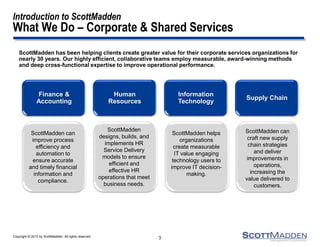
ScottMadden has been helping clients create greater value for their corporate services organizations for
nearly 30 years. Our highly efficient, collaborative teams employ measurable, award-winning methods
and deep cross-functional expertise to improve operational performance.
3
Finance &
Accounting
Human
Resources
Information
Technology
Supply Chain
ScottMadden can
improve process
efficiency and
automation to
ensure accurate
and timely financial
information and
compliance.
ScottMadden
designs, builds, and
implements HR
Service Delivery
models to ensure
efficient and
effective HR
operations that meet
business needs.
ScottMadden helps
organizations
create measurable
IT value engaging
technology users to
improve IT decision-
making.
ScottMadden can
craft new supply
chain strategies
and deliver
improvements in
operations,
increasing the
value delivered to
customers.
Copyright © 2013 by ScottMadden. All rights reserved.
Introduction to ScottMadden
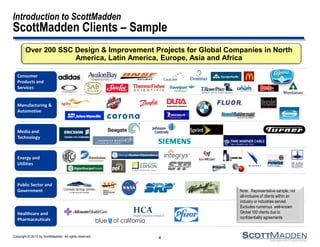
ScottMadden Clients – Sample
4
Consumer
Products and
Services
Manufacturing &
Automotive
Media and
Technology
Energy and
Utilities
Healthcare and
Pharmaceuticals
Public Sector and
Government Note: Representative sample; not
all-inclusive of clients within an
industry or industries served.
Excludes numerous well-known
Global 100 clients due to
confidentiality agreements
Over 200 SSC Design & Improvement Projects for Global Companies in North
America, Latin America, Europe, Asia and Africa
The Current SSO Environment
Copyright © 2013 by ScottMadden. All rights reserved.
The Current Environment
Shared Services Has Gone Mainstream
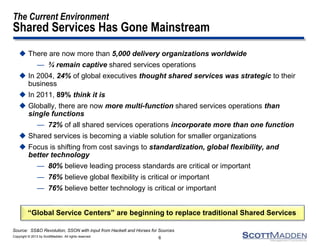
 There are now more than 5,000 delivery organizations worldwide
— ¾ remain captive shared services operations
 In 2004, 24% of global executives thought shared services was strategic to their
business
 In 2011, 89% think it is
 Globally, there are now more multi-function shared services operations than
single functions
— 72% of all shared services operations incorporate more than one function
 Shared services is becoming a viable solution for smaller organizations
 Focus is shifting from cost savings to standardization, global flexibility, and
better technology
— 80% believe leading process standards are critical or important
— 76% believe global flexibility is critical or important
— 76% believe better technology is critical or important
6
Source: SS&O Revolution, SSON with input from Hackett and Horses for Sources
“Global Service Centers” are beginning to replace traditional Shared Services
Copyright © 2013 by ScottMadden. All rights reserved.
The Current Environment
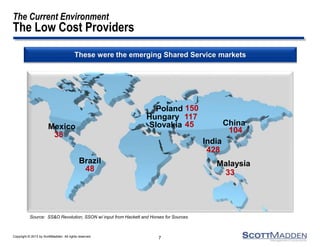
The Low Cost Providers
7
Mexico
Brazil
Hungary
Poland
Slovakia China
India
Malaysia
38
48
117
150
45
428
104
33
Source: SS&O Revolution, SSON w/ input from Hackett and Horses for Sources
These were the emerging Shared Service markets
Copyright © 2013 by ScottMadden. All rights reserved.
The Current Environment
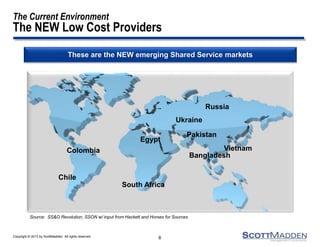
The NEW Low Cost Providers
8
Ukraine
Russia
Egypt
South Africa
Bangladesh
Vietnam
Pakistan
Colombia
Chile
Source: SS&O Revolution, SSON w/ input from Hackett and Horses for Sources
These are the NEW emerging Shared Service markets
Copyright © 2013 by ScottMadden. All rights reserved.
The Current Environment
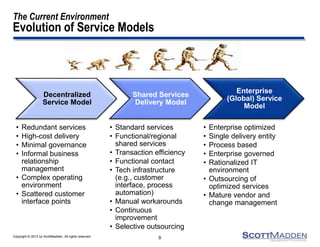
Evolution of Service Models
Decentralized
Service Model
• Redundant services
• High-cost delivery
• Minimal governance
• Informal business
relationship
management
• Complex operating
environment
• Scattered customer
interface points
Shared Services
Delivery Model
• Standard services
• Functional/regional
shared services
• Transaction efficiency
• Functional contact
• Tech infrastructure
(e.g., customer
interface, process
automation)
• Manual workarounds
• Continuous
improvement
• Selective outsourcing
Enterprise
(Global) Service
Model
• Enterprise optimized
• Single delivery entity
• Process based
• Enterprise governed
• Rationalized IT
environment
• Outsourcing of
optimized services
• Mature vendor and
change management
9
The Case For Transformational Change
Copyright © 2013 by ScottMadden. All rights reserved.
The Case for Change
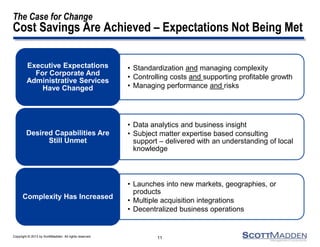
Cost Savings Are Achieved – Expectations Not Being Met
• Standardization and managing complexity
• Controlling costs and supporting profitable growth
• Managing performance and risks
Executive Expectations
For Corporate And
Administrative Services
Have Changed
• Data analytics and business insight
• Subject matter expertise based consulting
support – delivered with an understanding of local
knowledge
Desired Capabilities Are
Still Unmet
• Launches into new markets, geographies, or
products
• Multiple acquisition integrations
• Decentralized business operations
Complexity Has Increased
11
Copyright © 2013 by ScottMadden. All rights reserved.
The Case for Change
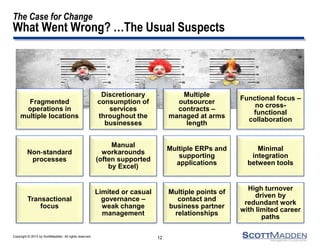
What Went Wrong? …The Usual Suspects
Fragmented
operations in
multiple locations
Discretionary
consumption of
services
throughout the
businesses
Multiple
outsourcer
contracts –
managed at arms
length
Functional focus –
no cross-
functional
collaboration
Non‐standard
processes
Manual
workarounds
(often supported
by Excel)
Multiple ERPs and
supporting
applications
Minimal
integration
between tools
Transactional
focus
Limited or casual
governance –
weak change
management
Multiple points of
contact and
business partner
relationships
High turnover
driven by
redundant work
with limited career
paths
12
Copyright © 2013 by ScottMadden. All rights reserved.
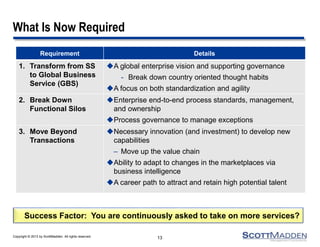
What Is Now Required
13
Requirement Details
1. Transform from SS
to Global Business
Service (GBS)
A global enterprise vision and supporting governance
- Break down country oriented thought habits
A focus on both standardization and agility
2. Break Down
Functional Silos
Enterprise end-to-end process standards, management,
and ownership
Process governance to manage exceptions
3. Move Beyond
Transactions
Necessary innovation (and investment) to develop new
capabilities
– Move up the value chain
Ability to adapt to changes in the marketplaces via
business intelligence
A career path to attract and retain high potential talent
Success Factor: You are continuously asked to take on more services?
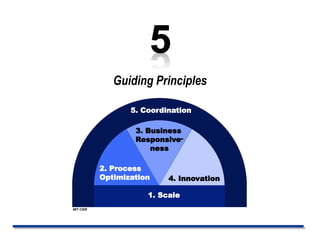
Guiding Principles
5. Coordination
1. Scale
2. Process
Optimization
3. Business
Responsive-
ness
4. Innovation
MIT CISR
Copyright © 2013 by ScottMadden. All rights reserved.
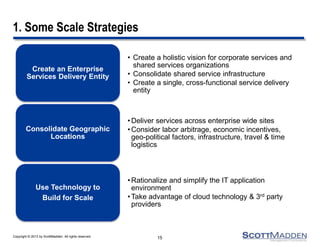
1. Some Scale Strategies
• Create a holistic vision for corporate services and
shared services organizations
• Consolidate shared service infrastructure
• Create a single, cross-functional service delivery
entity
Create an Enterprise
Services Delivery Entity
•Deliver services across enterprise wide sites
•Consider labor arbitrage, economic incentives,
geo-political factors, infrastructure, travel & time
logistics
Consolidate Geographic
Locations
•Rationalize and simplify the IT application
environment
•Take advantage of cloud technology & 3rd party
providers
Use Technology to
Build for Scale
15
Copyright © 2013 by ScottMadden. All rights reserved.
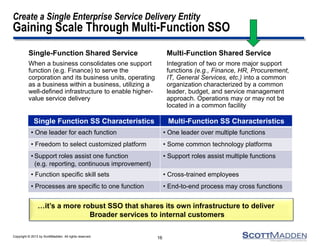
Create a Single Enterprise Service Delivery Entity
Gaining Scale Through Multi-Function SSO
16
Single-Function Shared Service
When a business consolidates one support
function (e.g. Finance) to serve the
corporation and its business units, operating
as a business within a business, utilizing a
well-defined infrastructure to enable higher-
value service delivery
Multi-Function Shared Service
Integration of two or more major support
functions (e.g., Finance, HR, Procurement,
IT, General Services, etc.) into a common
organization characterized by a common
leader, budget, and service management
approach. Operations may or may not be
located in a common facility
Single Function SS Characteristics Multi-Function SS Characteristics
• One leader for each function • One leader over multiple functions
• Freedom to select customized platform • Some common technology platforms
• Support roles assist one function
(e.g. reporting, continuous improvement)
• Support roles assist multiple functions
• Function specific skill sets • Cross-trained employees
• Processes are specific to one function • End-to-end process may cross functions
…it’s a more robust SSO that shares its own infrastructure to deliver
Broader services to internal customers
Copyright © 2013 by ScottMadden. All rights reserved.
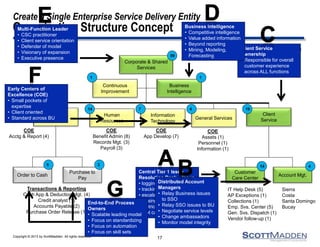
Create a Single Enterprise Service Delivery Entity
Organization Structure Concept
17
Corporate & Shared
Services
Accounting General Services
Client
Service
Account Mgt.
Customer
Care Center
Order to Cash
COE
Assets (1)
Personnel (1)
Information (1)
IT Help Desk (5)
AP Exceptions (1)
Collections (1)
Emp. Svs. Center (5)
Gen. Svs. Dispatch (1)
Vendor follow-up (1)
Sierra
Costa
Santa Domingo
Bucay
Transactions & Reporting
Cash App & Deduction Mgt. (4)
Credit analyst (1)
Accounts Payable (2)
Purchase Order Release (1)
Continuous
Improvement
Business
Intelligence
Human
Resources
COE
Benefit Admin (8)
Records Mgt. (3)
Payroll (3)
59
11
12 14 4 19
5 4
Purchase to
Pay
3 14
Information
Technology
COE
App Develop (7)
7
COE
Acctg & Report (4)
New SSC position
COE Leadership
Transactional
Central Tier 1 Issue
Resolution Desk – Issue
• logging
• tracking
• escalating
• closing
• metrics
• root cause analysis
Distributed Account
Managers
• Relay Business issues
to SSO
• Relay SSO issues to BU
• Negotiate service levels
• Change ambassadors
• Monitor model integrity
Client Service
Ownership
• Responsible for overall
customer experience
across ALL functions
Business Intelligence
• Competitive intelligence
• Value added information
• Beyond reporting
• Mining, Modeling,
Forecasting
Multi-Function Leader
• CSC practitioner
• Client service orientation
• Defender of model
• Visionary of expansion
• Executive presence
Early Centers of
Excellence (COE)
• Small pockets of
expertise
• Client oriented
• Standard across BU
End-to-End Process
Owners
• Scalable leading model
• Focus on standardizing
• Focus on automation
• Focus on skill sets
Copyright © 2013 by ScottMadden. All rights reserved.
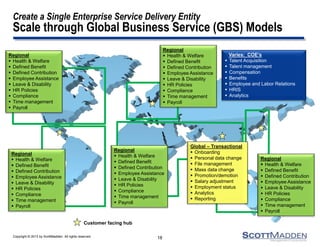
Create a Single Enterprise Service Delivery Entity
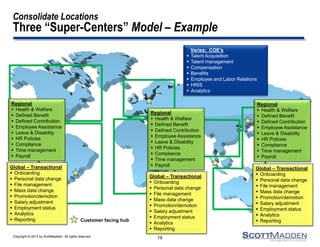
Scale through Global Business Service (GBS) Models
Global – Transactional
 Onboarding
 Personal data change
 File management
 Mass data change
 Promotion/demotion
 Salary adjustment
 Employment status
 Analytics
 Reporting
Regional
 Health & Welfare
 Defined Benefit
 Defined Contribution
 Employee Assistance
 Leave & Disability
 HR Policies
 Compliance
 Time management
 Payroll
Customer facing hub
Varies: COE’s
 Talent Acquisition
 Talent management
 Compensation
 Benefits
 Employee and Labor Relations
 HRIS
 Analytics
18
Regional
 Health & Welfare
 Defined Benefit
 Defined Contribution
 Employee Assistance
 Leave & Disability
 HR Policies
 Compliance
 Time management
 Payroll
Regional
 Health & Welfare
 Defined Benefit
 Defined Contribution
 Employee Assistance
 Leave & Disability
 HR Policies
 Compliance
 Time management
 Payroll
Regional
 Health & Welfare
 Defined Benefit
 Defined Contribution
 Employee Assistance
 Leave & Disability
 HR Policies
 Compliance
 Time management
 Payroll
Regional
 Health & Welfare
 Defined Benefit
 Defined Contribution
 Employee Assistance
 Leave & Disability
 HR Policies
 Compliance
 Time management
 Payroll
Copyright © 2013 by ScottMadden. All rights reserved.
Consolidate Locations
Three “Super-Centers” Model – Example
Customer facing hub
19
Varies: COE’s
 Talent Acquisition
 Talent management
 Compensation
 Benefits
 Employee and Labor Relations
 HRIS
 Analytics
Global – Transactional
 Onboarding
 Personal data change
 File management
 Mass data change
 Promotion/demotion
 Salary adjustment
 Employment status
 Analytics
 Reporting
Regional
 Health & Welfare
 Defined Benefit
 Defined Contribution
 Employee Assistance
 Leave & Disability
 HR Policies
 Compliance
 Time management
 Payroll
Global – Transactional
 Onboarding
 Personal data change
 File management
 Mass data change
 Promotion/demotion
 Salary adjustment
 Employment status
 Analytics
 Reporting
Global – Transactional
 Onboarding
 Personal data change
 File management
 Mass data change
 Promotion/demotion
 Salary adjustment
 Employment status
 Analytics
 Reporting
Regional
 Health & Welfare
 Defined Benefit
 Defined Contribution
 Employee Assistance
 Leave & Disability
 HR Policies
 Compliance
 Time management
 Payroll
Regional
 Health & Welfare
 Defined Benefit
 Defined Contribution
 Employee Assistance
 Leave & Disability
 HR Policies
 Compliance
 Time management
 Payroll
Copyright © 2013 by ScottMadden. All rights reserved.
Consolidate Locations
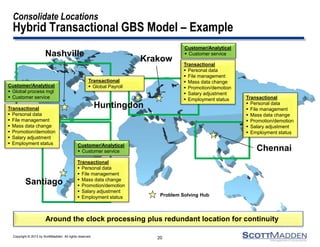
Hybrid Transactional GBS Model – Example
Customer/Analytical
 Global process mgt
 Customer service
Problem Solving Hub
Transactional
 Global Payroll
Krakow
Chennai
Santiago
Nashville
Huntingdon
Customer/Analytical
 Customer service
Customer/Analytical
 Customer service
20
Around the clock processing plus redundant location for continuity
Transactional
 Personal data
 File management
 Mass data change
 Promotion/demotion
 Salary adjustment
 Employment status Transactional
 Personal data
 File management
 Mass data change
 Promotion/demotion
 Salary adjustment
 Employment status
Transactional
 Personal data
 File management
 Mass data change
 Promotion/demotion
 Salary adjustment
 Employment status
Transactional
 Personal data
 File management
 Mass data change
 Promotion/demotion
 Salary adjustment
 Employment status
Copyright © 2013 by ScottMadden. All rights reserved.
Survey Question
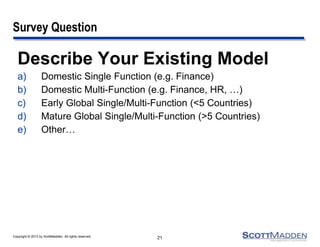
Describe Your Existing Model
a) Domestic Single Function (e.g. Finance)
b) Domestic Multi-Function (e.g. Finance, HR, …)
c) Early Global Single/Multi-Function (<5 Countries)
d) Mature Global Single/Multi-Function (>5 Countries)
e) Other…
21
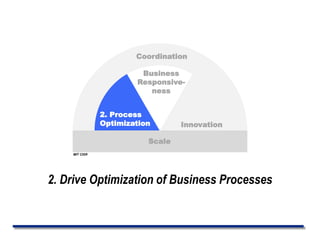
2. Drive Optimization of Business Processes
Coordination
Scale
2. Process
Optimization
Business
Responsive-
ness
Innovation
MIT CISR
Copyright © 2013 by ScottMadden. All rights reserved.
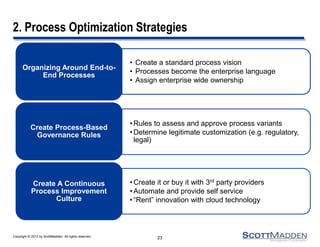
2. Process Optimization Strategies
• Create a standard process vision
• Processes become the enterprise language
• Assign enterprise wide ownership
Organizing Around End-to-
End Processes
•Rules to assess and approve process variants
•Determine legitimate customization (e.g. regulatory,
legal)
Create Process-Based
Governance Rules
•Create it or buy it with 3rd party providers
•Automate and provide self service
•“Rent” innovation with cloud technology
Create A Continuous
Process Improvement
Culture
23
Copyright © 2013 by ScottMadden. All rights reserved.
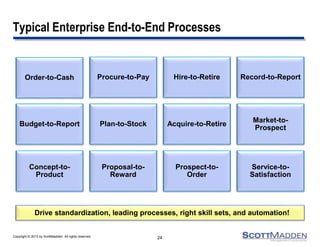
Typical Enterprise End-to-End Processes
Order-to-Cash Procure-to-Pay Hire-to-Retire Record-to-Report
Budget-to-Report Plan-to-Stock Acquire-to-Retire
Market-to-
Prospect
Concept-to-
Product
Proposal-to-
Reward
Prospect-to-
Order
Service-to-
Satisfaction
24
Drive standardization, leading processes, right skill sets, and automation!
Copyright © 2013 by ScottMadden. All rights reserved.
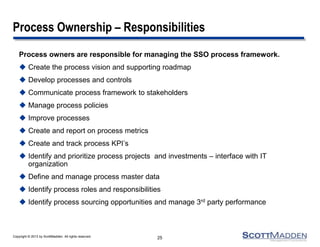
Process Ownership – Responsibilities
Process owners are responsible for managing the SSO process framework.
 Create the process vision and supporting roadmap
 Develop processes and controls
 Communicate process framework to stakeholders
 Manage process policies
 Improve processes
 Create and report on process metrics
 Create and track process KPI’s
 Identify and prioritize process projects and investments – interface with IT
organization
 Define and manage process master data
 Identify process roles and responsibilities
 Identify process sourcing opportunities and manage 3rd party performance
25
Copyright © 2013 by ScottMadden. All rights reserved.
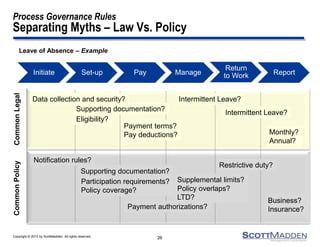
Process Governance Rules
Separating Myths – Law Vs. Policy
Leave of Absence – Example
26
Initiate Set-up Pay Manage
Return
to Work Report
Data collection and security?
Supporting documentation?
Eligibility?
Intermittent Leave?
Notification rules?
Supporting documentation?
Participation requirements?
Policy coverage?
Payment authorizations?
Business?
Insurance?
Supplemental limits?
Policy overlaps?
LTD?
CommonLegalCommonPolicy
Payment terms?
Pay deductions?
Intermittent Leave?
Restrictive duty?
Monthly?
Annual?
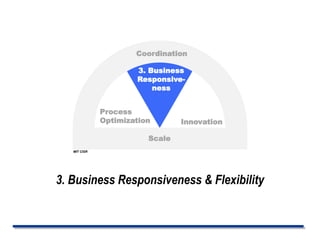
3. Business Responsiveness & Flexibility
Coordination
Scale
Process
Optimization
3. Business
Responsive-
ness
Innovation
MIT CISR
Copyright © 2013 by ScottMadden. All rights reserved.
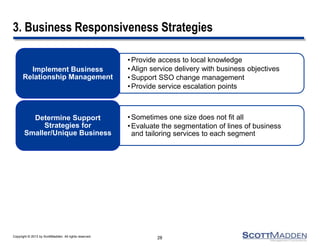
3. Business Responsiveness Strategies
•Provide access to local knowledge
•Align service delivery with business objectives
•Support SSO change management
•Provide service escalation points
Implement Business
Relationship Management
•Sometimes one size does not fit all
•Evaluate the segmentation of lines of business
and tailoring services to each segment
Determine Support
Strategies for
Smaller/Unique Business
28
Copyright © 2013 by ScottMadden. All rights reserved.
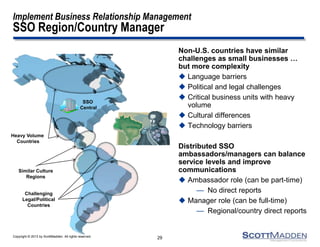
Implement Business Relationship Management
SSO Region/Country Manager
Non-U.S. countries have similar
challenges as small businesses …
but more complexity
 Language barriers
 Political and legal challenges
 Critical business units with heavy
volume
 Cultural differences
 Technology barriers
Distributed SSO
ambassadors/managers can balance
service levels and improve
communications
 Ambassador role (can be part-time)
— No direct reports
 Manager role (can be full-time)
— Regional/country direct reports
29
Heavy Volume
Countries
Similar Culture
Regions
Challenging
Legal/Political
Countries
SSO
Central
Copyright © 2013 by ScottMadden. All rights reserved.
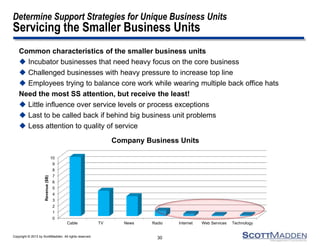
Determine Support Strategies for Unique Business Units
Servicing the Smaller Business Units
Common characteristics of the smaller business units
 Incubator businesses that need heavy focus on the core business
 Challenged businesses with heavy pressure to increase top line
 Employees trying to balance core work while wearing multiple back office hats
Need the most SS attention, but receive the least!
 Little influence over service levels or process exceptions
 Last to be called back if behind big business unit problems
 Less attention to quality of service
30
0
1
2
3
4
5
6
7
8
9
10
Cable TV News Radio Internet Web Services Technology
Revenue($B)
Company Business Units
Copyright © 2013 by ScottMadden. All rights reserved.
Determine Support Strategies for Unique Business Units
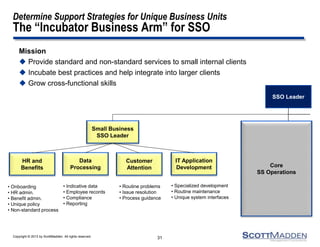
The “Incubator Business Arm” for SSO
Mission
 Provide standard and non-standard services to small internal clients
 Incubate best practices and help integrate into larger clients
 Grow cross-functional skills
31
Small Business
SSO Leader
HR and
Benefits
Data
Processing
Customer
Attention
IT Application
Development
SSO Leader
Core
SS Operations
• Routine problems
• Issue resolution
• Process guidance
• Specialized development
• Routine maintenance
• Unique system interfaces
• Indicative data
• Employee records
• Compliance
• Reporting
• Onboarding
• HR admin.
• Benefit admin.
• Unique policy
• Non-standard process
Copyright © 2013 by ScottMadden. All rights reserved.
32
91%
75%
83%
60%
70%
88%
70%
69%
43%
49%
0% 20% 40% 60% 80% 100%
Information Systems is available during the
hours customers need assistance.
All things considered, I am satisfied with
shared services.
PC Management performance
I am more satisfied with Information
Systems now than I was a year ago.
I am excited by the changes our business
is going through.
2008 % Favorable 2009 % Favorable
35%
29%
22%
52%
13%
53%
48%
42%
73%
35%
0% 20% 40% 60% 80% 100%
Offering competitive pricing
I am recognized and appropriately
rewarded for satisfying customers
Educating and communicating with
customers about service offerings and
changes and billing practices
Information Systems delivers services
accurately and correctly
Customers understand how and what
they were charged with respect
to services they received
2008 % Favorable 2009 % Favorable
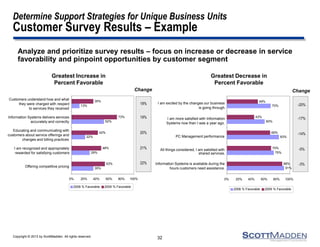
Determine Support Strategies for Unique Business Units
Customer Survey Results – Example
Analyze and prioritize survey results – focus on increase or decrease in service
favorability and pinpoint opportunities by customer segment
Change
18%
20%
19%
21%
22%
Greatest Increase in
Percent Favorable
Change
-20%
-14%
-17%
-5%
-3%
Greatest Decrease in
Percent Favorable
4. Foster Innovation
Coordination
Scale
Process
Optimization
Business
Responsive-
ness
4. Innovation
MIT CISR
Copyright © 2013 by ScottMadden. All rights reserved.
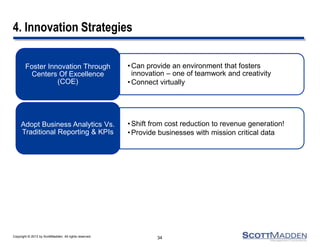
4. Innovation Strategies
•Can provide an environment that fosters
innovation – one of teamwork and creativity
•Connect virtually
Foster Innovation Through
Centers Of Excellence
(COE)
•Shift from cost reduction to revenue generation!
•Provide businesses with mission critical data
Adopt Business Analytics Vs.
Traditional Reporting & KPIs
34
Copyright © 2013 by ScottMadden. All rights reserved.
Foster Innovation Through Centers of Excellence (COE)
Expand to Smaller Higher Value Services
35
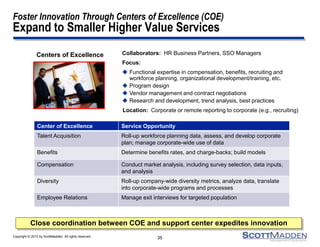
Center of Excellence Service Opportunity
Talent Acquisition Roll-up workforce planning data, assess, and develop corporate
plan; manage corporate-wide use of data
Benefits Determine benefits rates, and charge-backs; build models
Compensation Conduct market analysis, including survey selection, data inputs,
and analysis
Diversity Roll-up company-wide diversity metrics, analyze data, translate
into corporate-wide programs and processes
Employee Relations Manage exit interviews for targeted population
Centers of Excellence Collaborators: HR Business Partners, SSO Managers
Focus:
 Functional expertise in compensation, benefits, recruiting and
workforce planning, organizational development/training, etc.
 Program design
 Vendor management and contract negotiations
 Research and development, trend analysis, best practices
Location: Corporate or remote reporting to corporate (e.g., recruiting)
Close coordination between COE and support center expedites innovation
Copyright © 2013 by ScottMadden. All rights reserved.
Foster Innovation Through Centers of Excellence (COE)
Virtual Problem Solving
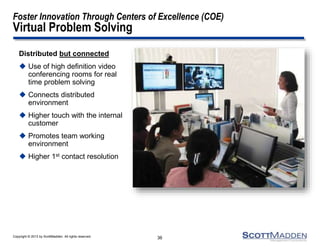
Distributed but connected
 Use of high definition video
conferencing rooms for real
time problem solving
 Connects distributed
environment
 Higher touch with the internal
customer
 Promotes team working
environment
 Higher 1st contact resolution
36
Copyright © 2013 by ScottMadden. All rights reserved.
Adopt Business Analytics
Expand from Metrics to Analytics
37
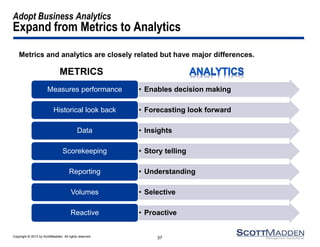
Metrics and analytics are closely related but have major differences.
• Enables decision makingMeasures performance
• Forecasting look forwardHistorical look back
• InsightsData
• Story tellingScorekeeping
• UnderstandingReporting
• SelectiveVolumes
• ProactiveReactive
METRICS
Copyright © 2013 by ScottMadden. All rights reserved.
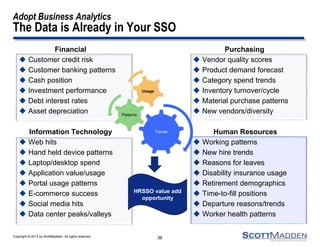
Financial
 Customer credit risk
 Customer banking patterns
 Cash position
 Investment performance
 Debt interest rates
 Asset depreciation
Purchasing
 Vendor quality scores
 Product demand forecast
 Category spend trends
 Inventory turnover/cycle
 Material purchase patterns
 New vendors/diversity
Human Resources
 Working patterns
 New hire trends
 Reasons for leaves
 Disability insurance usage
 Retirement demographics
 Time-to-fill positions
 Departure reasons/trends
 Worker health patterns
Information Technology
 Web hits
 Hand held device patterns
 Laptop/desktop spend
 Application value/usage
 Portal usage patterns
 E-commerce success
 Social media hits
 Data center peaks/valleys
Trends
Patterns
Usage
Adopt Business Analytics
The Data is Already in Your SSO
38
HRSSO value add
opportunity
Copyright © 2013 by ScottMadden. All rights reserved.
Adopt Business Analytics
Example: Workforce Analytics
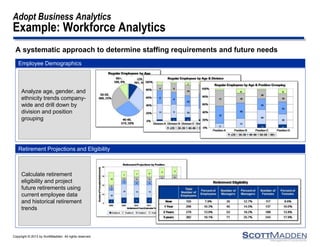
A systematic approach to determine staffing requirements and future needs
Analyze age, gender, and
ethnicity trends company-
wide and drill down by
division and position
grouping
Employee Demographics
Retirement Projections and Eligibility
Calculate retirement
eligibility and project
future retirements using
current employee data
and historical retirement
trends
Copyright © 2013 by ScottMadden. All rights reserved.
Adopt Business Analytics
Where Does the Market Stand with Business Analytics?
40
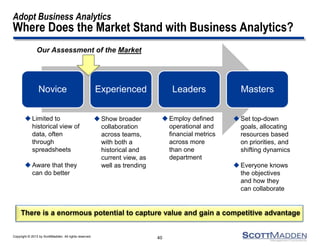
 Limited to
historical view of
data, often
through
spreadsheets
 Aware that they
can do better
Novice Experienced Leaders Masters
 Show broader
collaboration
across teams,
with both a
historical and
current view, as
well as trending
 Employ defined
operational and
financial metrics
across more
than one
department
 Set top-down
goals, allocating
resources based
on priorities, and
shifting dynamics
 Everyone knows
the objectives
and how they
can collaborate
Our Assessment of the Market
There is a enormous potential to capture value and gain a competitive advantage
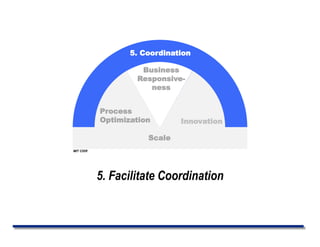
5. Facilitate Coordination
5. Coordination
Scale
Process
Optimization
Business
Responsive-
ness
Innovation
MIT CISR
Copyright © 2013 by ScottMadden. All rights reserved.
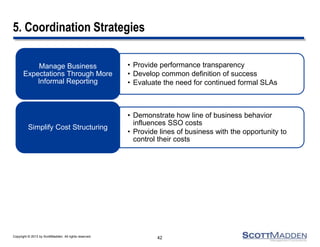
5. Coordination Strategies
• Provide performance transparency
• Develop common definition of success
• Evaluate the need for continued formal SLAs
Manage Business
Expectations Through More
Informal Reporting
• Demonstrate how line of business behavior
influences SSO costs
• Provide lines of business with the opportunity to
control their costs
Simplify Cost Structuring
42
Copyright © 2013 by ScottMadden. All rights reserved.
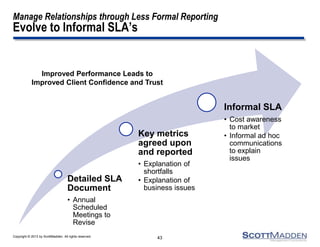
Manage Relationships through Less Formal Reporting
Evolve to Informal SLA’s
Detailed SLA
Document
• Annual
Scheduled
Meetings to
Revise
Key metrics
agreed upon
and reported
• Explanation of
shortfalls
• Explanation of
business issues
Informal SLA
• Cost awareness
to market
• Informal ad hoc
communications
to explain
issues
43
Improved Performance Leads to
Improved Client Confidence and Trust
Copyright © 2013 by ScottMadden. All rights reserved.
Simplify Cost Structure
Tie Chargebacks to Easy Logical Work Drivers
44
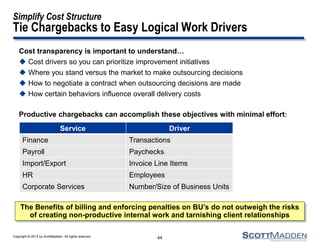
Cost transparency is important to understand…
 Cost drivers so you can prioritize improvement initiatives
 Where you stand versus the market to make outsourcing decisions
 How to negotiate a contract when outsourcing decisions are made
 How certain behaviors influence overall delivery costs
Productive chargebacks can accomplish these objectives with minimal effort:
Service Driver
Finance Transactions
Payroll Paychecks
Import/Export Invoice Line Items
HR Employees
Corporate Services Number/Size of Business Units
The Benefits of billing and enforcing penalties on BU’s do not outweigh the risks
of creating non-productive internal work and tarnishing client relationships
Copyright © 2013 by ScottMadden. All rights reserved.
Summary
Plan Your Vision for “Next Generation” SSC Operations!
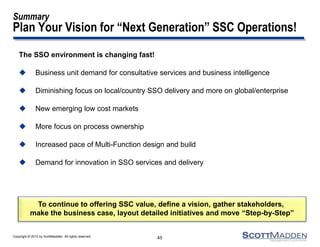
The SSO environment is changing fast!
 Business unit demand for consultative services and business intelligence
 Diminishing focus on local/country SSO delivery and more on global/enterprise
 New emerging low cost markets
 More focus on process ownership
 Increased pace of Multi-Function design and build
 Demand for innovation in SSO services and delivery
45
To continue to offering SSC value, define a vision, gather stakeholders,
make the business case, layout detailed initiatives and move “Step-by-Step”
Copyright © 2013 by ScottMadden. All rights reserved.
Summary
Allow Time and Move in “Digestible” Stages - Example
46
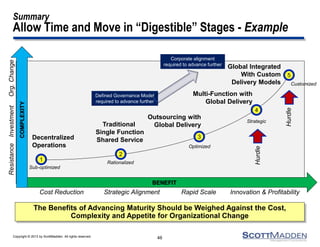
The Benefits of Advancing Maturity Should be Weighed Against the Cost,
Complexity and Appetite for Organizational Change
BENEFIT
COMPLEXITY
5
1
2
3
4
Decentralized
Operations
Traditional
Single Function
Shared Service
Outsourcing with
Global Delivery
Multi-Function with
Global Delivery
Global Integrated
With Custom
Delivery Models
Cost Reduction Strategic Alignment Rapid Scale Innovation & Profitability
ResistanceInvestmentOrg.Change
Hurdle
Sub-optimized
Rationalized
Defined Governance Model
required to advance further
Optimized
Customized
Strategic
Hurdle
Corporate alignment
required to advance further
Copyright © 2013 by ScottMadden. All rights reserved.
Faculty Contact Information
47
Thank You!
Questions?
48©2013 APQC. ALL RIGHTS RESERVED.
Process Optimization
 Process Management Short Presentations
(Collection)
 Building Strong Process Management
Capabilities (Collection)
 6.0 Develop and Manage Human Capital
Definitions and Key Measures PCF version
6.0.0
49©2013 APQC. ALL RIGHTS RESERVED.
HR Business Partner Role
 HR Sees Five Areas of Focus in Its Future
 Survey Identifies Future HR Competencies
 Strategic HR Partnerships Survey Results
Summary
50©2013 APQC. ALL RIGHTS RESERVED.
Ongoing and Upcoming APQC
Research Studies
 Strategic HR Partnerships Case Studies
 HR Process Improvement
 HR Measurement and Analytics in Practice
Sign up to be notified about APQC’s research on these and
other topics.
And follow our progress on
http://www2.apqc.org/allthingshcm

Next Generation Shared Services Centers

  • 1.
    March HCM WebinarPart 2: Next Generation Shared Services Centers Brad DeMent, Partner, ScottMadden Jerred Crosby, Partner, ScottMadden
  • 2.
    Copyright © 2013by ScottMadden. All rights reserved. Introduction to ScottMadden Your Hosts Brad DeMent Partner Multi-Function Global Business Services 1 Jerred Crosby Partner Transformation and Change Management
  • 3.
    Copyright © 2013by ScottMadden. All rights reserved. Agenda  Speaker Introductions  The current SSO environment  The case for transformational change  5 guiding principles 2
  • 4.
    Copyright © 2013by ScottMadden. All rights reserved. Introduction to ScottMadden What We Do – Corporate & Shared Services ScottMadden has been helping clients create greater value for their corporate services organizations for nearly 30 years. Our highly efficient, collaborative teams employ measurable, award-winning methods and deep cross-functional expertise to improve operational performance. 3 Finance & Accounting Human Resources Information Technology Supply Chain ScottMadden can improve process efficiency and automation to ensure accurate and timely financial information and compliance. ScottMadden designs, builds, and implements HR Service Delivery models to ensure efficient and effective HR operations that meet business needs. ScottMadden helps organizations create measurable IT value engaging technology users to improve IT decision- making. ScottMadden can craft new supply chain strategies and deliver improvements in operations, increasing the value delivered to customers.
  • 5.
    Copyright © 2013by ScottMadden. All rights reserved. Introduction to ScottMadden ScottMadden Clients – Sample 4 Consumer Products and Services Manufacturing & Automotive Media and Technology Energy and Utilities Healthcare and Pharmaceuticals Public Sector and Government Note: Representative sample; not all-inclusive of clients within an industry or industries served. Excludes numerous well-known Global 100 clients due to confidentiality agreements Over 200 SSC Design & Improvement Projects for Global Companies in North America, Latin America, Europe, Asia and Africa
  • 6.
    The Current SSOEnvironment
  • 7.
    Copyright © 2013by ScottMadden. All rights reserved. The Current Environment Shared Services Has Gone Mainstream  There are now more than 5,000 delivery organizations worldwide — ¾ remain captive shared services operations  In 2004, 24% of global executives thought shared services was strategic to their business  In 2011, 89% think it is  Globally, there are now more multi-function shared services operations than single functions — 72% of all shared services operations incorporate more than one function  Shared services is becoming a viable solution for smaller organizations  Focus is shifting from cost savings to standardization, global flexibility, and better technology — 80% believe leading process standards are critical or important — 76% believe global flexibility is critical or important — 76% believe better technology is critical or important 6 Source: SS&O Revolution, SSON with input from Hackett and Horses for Sources “Global Service Centers” are beginning to replace traditional Shared Services
  • 8.
    Copyright © 2013by ScottMadden. All rights reserved. The Current Environment The Low Cost Providers 7 Mexico Brazil Hungary Poland Slovakia China India Malaysia 38 48 117 150 45 428 104 33 Source: SS&O Revolution, SSON w/ input from Hackett and Horses for Sources These were the emerging Shared Service markets
  • 9.
    Copyright © 2013by ScottMadden. All rights reserved. The Current Environment The NEW Low Cost Providers 8 Ukraine Russia Egypt South Africa Bangladesh Vietnam Pakistan Colombia Chile Source: SS&O Revolution, SSON w/ input from Hackett and Horses for Sources These are the NEW emerging Shared Service markets
  • 10.
    Copyright © 2013by ScottMadden. All rights reserved. The Current Environment Evolution of Service Models Decentralized Service Model • Redundant services • High-cost delivery • Minimal governance • Informal business relationship management • Complex operating environment • Scattered customer interface points Shared Services Delivery Model • Standard services • Functional/regional shared services • Transaction efficiency • Functional contact • Tech infrastructure (e.g., customer interface, process automation) • Manual workarounds • Continuous improvement • Selective outsourcing Enterprise (Global) Service Model • Enterprise optimized • Single delivery entity • Process based • Enterprise governed • Rationalized IT environment • Outsourcing of optimized services • Mature vendor and change management 9
  • 11.
    The Case ForTransformational Change
  • 12.
    Copyright © 2013by ScottMadden. All rights reserved. The Case for Change Cost Savings Are Achieved – Expectations Not Being Met • Standardization and managing complexity • Controlling costs and supporting profitable growth • Managing performance and risks Executive Expectations For Corporate And Administrative Services Have Changed • Data analytics and business insight • Subject matter expertise based consulting support – delivered with an understanding of local knowledge Desired Capabilities Are Still Unmet • Launches into new markets, geographies, or products • Multiple acquisition integrations • Decentralized business operations Complexity Has Increased 11
  • 13.
    Copyright © 2013by ScottMadden. All rights reserved. The Case for Change What Went Wrong? …The Usual Suspects Fragmented operations in multiple locations Discretionary consumption of services throughout the businesses Multiple outsourcer contracts – managed at arms length Functional focus – no cross- functional collaboration Non‐standard processes Manual workarounds (often supported by Excel) Multiple ERPs and supporting applications Minimal integration between tools Transactional focus Limited or casual governance – weak change management Multiple points of contact and business partner relationships High turnover driven by redundant work with limited career paths 12
  • 14.
    Copyright © 2013by ScottMadden. All rights reserved. What Is Now Required 13 Requirement Details 1. Transform from SS to Global Business Service (GBS) A global enterprise vision and supporting governance - Break down country oriented thought habits A focus on both standardization and agility 2. Break Down Functional Silos Enterprise end-to-end process standards, management, and ownership Process governance to manage exceptions 3. Move Beyond Transactions Necessary innovation (and investment) to develop new capabilities – Move up the value chain Ability to adapt to changes in the marketplaces via business intelligence A career path to attract and retain high potential talent Success Factor: You are continuously asked to take on more services?
  • 15.
    Guiding Principles 5. Coordination 1.Scale 2. Process Optimization 3. Business Responsive- ness 4. Innovation MIT CISR
  • 16.
    Copyright © 2013by ScottMadden. All rights reserved. 1. Some Scale Strategies • Create a holistic vision for corporate services and shared services organizations • Consolidate shared service infrastructure • Create a single, cross-functional service delivery entity Create an Enterprise Services Delivery Entity •Deliver services across enterprise wide sites •Consider labor arbitrage, economic incentives, geo-political factors, infrastructure, travel & time logistics Consolidate Geographic Locations •Rationalize and simplify the IT application environment •Take advantage of cloud technology & 3rd party providers Use Technology to Build for Scale 15
  • 17.
    Copyright © 2013by ScottMadden. All rights reserved. Create a Single Enterprise Service Delivery Entity Gaining Scale Through Multi-Function SSO 16 Single-Function Shared Service When a business consolidates one support function (e.g. Finance) to serve the corporation and its business units, operating as a business within a business, utilizing a well-defined infrastructure to enable higher- value service delivery Multi-Function Shared Service Integration of two or more major support functions (e.g., Finance, HR, Procurement, IT, General Services, etc.) into a common organization characterized by a common leader, budget, and service management approach. Operations may or may not be located in a common facility Single Function SS Characteristics Multi-Function SS Characteristics • One leader for each function • One leader over multiple functions • Freedom to select customized platform • Some common technology platforms • Support roles assist one function (e.g. reporting, continuous improvement) • Support roles assist multiple functions • Function specific skill sets • Cross-trained employees • Processes are specific to one function • End-to-end process may cross functions …it’s a more robust SSO that shares its own infrastructure to deliver Broader services to internal customers
  • 18.
    Copyright © 2013by ScottMadden. All rights reserved. Create a Single Enterprise Service Delivery Entity Organization Structure Concept 17 Corporate & Shared Services Accounting General Services Client Service Account Mgt. Customer Care Center Order to Cash COE Assets (1) Personnel (1) Information (1) IT Help Desk (5) AP Exceptions (1) Collections (1) Emp. Svs. Center (5) Gen. Svs. Dispatch (1) Vendor follow-up (1) Sierra Costa Santa Domingo Bucay Transactions & Reporting Cash App & Deduction Mgt. (4) Credit analyst (1) Accounts Payable (2) Purchase Order Release (1) Continuous Improvement Business Intelligence Human Resources COE Benefit Admin (8) Records Mgt. (3) Payroll (3) 59 11 12 14 4 19 5 4 Purchase to Pay 3 14 Information Technology COE App Develop (7) 7 COE Acctg & Report (4) New SSC position COE Leadership Transactional Central Tier 1 Issue Resolution Desk – Issue • logging • tracking • escalating • closing • metrics • root cause analysis Distributed Account Managers • Relay Business issues to SSO • Relay SSO issues to BU • Negotiate service levels • Change ambassadors • Monitor model integrity Client Service Ownership • Responsible for overall customer experience across ALL functions Business Intelligence • Competitive intelligence • Value added information • Beyond reporting • Mining, Modeling, Forecasting Multi-Function Leader • CSC practitioner • Client service orientation • Defender of model • Visionary of expansion • Executive presence Early Centers of Excellence (COE) • Small pockets of expertise • Client oriented • Standard across BU End-to-End Process Owners • Scalable leading model • Focus on standardizing • Focus on automation • Focus on skill sets
  • 19.
    Copyright © 2013by ScottMadden. All rights reserved. Create a Single Enterprise Service Delivery Entity Scale through Global Business Service (GBS) Models Global – Transactional  Onboarding  Personal data change  File management  Mass data change  Promotion/demotion  Salary adjustment  Employment status  Analytics  Reporting Regional  Health & Welfare  Defined Benefit  Defined Contribution  Employee Assistance  Leave & Disability  HR Policies  Compliance  Time management  Payroll Customer facing hub Varies: COE’s  Talent Acquisition  Talent management  Compensation  Benefits  Employee and Labor Relations  HRIS  Analytics 18 Regional  Health & Welfare  Defined Benefit  Defined Contribution  Employee Assistance  Leave & Disability  HR Policies  Compliance  Time management  Payroll Regional  Health & Welfare  Defined Benefit  Defined Contribution  Employee Assistance  Leave & Disability  HR Policies  Compliance  Time management  Payroll Regional  Health & Welfare  Defined Benefit  Defined Contribution  Employee Assistance  Leave & Disability  HR Policies  Compliance  Time management  Payroll Regional  Health & Welfare  Defined Benefit  Defined Contribution  Employee Assistance  Leave & Disability  HR Policies  Compliance  Time management  Payroll
  • 20.
    Copyright © 2013by ScottMadden. All rights reserved. Consolidate Locations Three “Super-Centers” Model – Example Customer facing hub 19 Varies: COE’s  Talent Acquisition  Talent management  Compensation  Benefits  Employee and Labor Relations  HRIS  Analytics Global – Transactional  Onboarding  Personal data change  File management  Mass data change  Promotion/demotion  Salary adjustment  Employment status  Analytics  Reporting Regional  Health & Welfare  Defined Benefit  Defined Contribution  Employee Assistance  Leave & Disability  HR Policies  Compliance  Time management  Payroll Global – Transactional  Onboarding  Personal data change  File management  Mass data change  Promotion/demotion  Salary adjustment  Employment status  Analytics  Reporting Global – Transactional  Onboarding  Personal data change  File management  Mass data change  Promotion/demotion  Salary adjustment  Employment status  Analytics  Reporting Regional  Health & Welfare  Defined Benefit  Defined Contribution  Employee Assistance  Leave & Disability  HR Policies  Compliance  Time management  Payroll Regional  Health & Welfare  Defined Benefit  Defined Contribution  Employee Assistance  Leave & Disability  HR Policies  Compliance  Time management  Payroll
  • 21.
    Copyright © 2013by ScottMadden. All rights reserved. Consolidate Locations Hybrid Transactional GBS Model – Example Customer/Analytical  Global process mgt  Customer service Problem Solving Hub Transactional  Global Payroll Krakow Chennai Santiago Nashville Huntingdon Customer/Analytical  Customer service Customer/Analytical  Customer service 20 Around the clock processing plus redundant location for continuity Transactional  Personal data  File management  Mass data change  Promotion/demotion  Salary adjustment  Employment status Transactional  Personal data  File management  Mass data change  Promotion/demotion  Salary adjustment  Employment status Transactional  Personal data  File management  Mass data change  Promotion/demotion  Salary adjustment  Employment status Transactional  Personal data  File management  Mass data change  Promotion/demotion  Salary adjustment  Employment status
  • 22.
    Copyright © 2013by ScottMadden. All rights reserved. Survey Question Describe Your Existing Model a) Domestic Single Function (e.g. Finance) b) Domestic Multi-Function (e.g. Finance, HR, …) c) Early Global Single/Multi-Function (<5 Countries) d) Mature Global Single/Multi-Function (>5 Countries) e) Other… 21
  • 23.
    2. Drive Optimizationof Business Processes Coordination Scale 2. Process Optimization Business Responsive- ness Innovation MIT CISR
  • 24.
    Copyright © 2013by ScottMadden. All rights reserved. 2. Process Optimization Strategies • Create a standard process vision • Processes become the enterprise language • Assign enterprise wide ownership Organizing Around End-to- End Processes •Rules to assess and approve process variants •Determine legitimate customization (e.g. regulatory, legal) Create Process-Based Governance Rules •Create it or buy it with 3rd party providers •Automate and provide self service •“Rent” innovation with cloud technology Create A Continuous Process Improvement Culture 23
  • 25.
    Copyright © 2013by ScottMadden. All rights reserved. Typical Enterprise End-to-End Processes Order-to-Cash Procure-to-Pay Hire-to-Retire Record-to-Report Budget-to-Report Plan-to-Stock Acquire-to-Retire Market-to- Prospect Concept-to- Product Proposal-to- Reward Prospect-to- Order Service-to- Satisfaction 24 Drive standardization, leading processes, right skill sets, and automation!
  • 26.
    Copyright © 2013by ScottMadden. All rights reserved. Process Ownership – Responsibilities Process owners are responsible for managing the SSO process framework.  Create the process vision and supporting roadmap  Develop processes and controls  Communicate process framework to stakeholders  Manage process policies  Improve processes  Create and report on process metrics  Create and track process KPI’s  Identify and prioritize process projects and investments – interface with IT organization  Define and manage process master data  Identify process roles and responsibilities  Identify process sourcing opportunities and manage 3rd party performance 25
  • 27.
    Copyright © 2013by ScottMadden. All rights reserved. Process Governance Rules Separating Myths – Law Vs. Policy Leave of Absence – Example 26 Initiate Set-up Pay Manage Return to Work Report Data collection and security? Supporting documentation? Eligibility? Intermittent Leave? Notification rules? Supporting documentation? Participation requirements? Policy coverage? Payment authorizations? Business? Insurance? Supplemental limits? Policy overlaps? LTD? CommonLegalCommonPolicy Payment terms? Pay deductions? Intermittent Leave? Restrictive duty? Monthly? Annual?
  • 28.
    3. Business Responsiveness& Flexibility Coordination Scale Process Optimization 3. Business Responsive- ness Innovation MIT CISR
  • 29.
    Copyright © 2013by ScottMadden. All rights reserved. 3. Business Responsiveness Strategies •Provide access to local knowledge •Align service delivery with business objectives •Support SSO change management •Provide service escalation points Implement Business Relationship Management •Sometimes one size does not fit all •Evaluate the segmentation of lines of business and tailoring services to each segment Determine Support Strategies for Smaller/Unique Business 28
  • 30.
    Copyright © 2013by ScottMadden. All rights reserved. Implement Business Relationship Management SSO Region/Country Manager Non-U.S. countries have similar challenges as small businesses … but more complexity  Language barriers  Political and legal challenges  Critical business units with heavy volume  Cultural differences  Technology barriers Distributed SSO ambassadors/managers can balance service levels and improve communications  Ambassador role (can be part-time) — No direct reports  Manager role (can be full-time) — Regional/country direct reports 29 Heavy Volume Countries Similar Culture Regions Challenging Legal/Political Countries SSO Central
  • 31.
    Copyright © 2013by ScottMadden. All rights reserved. Determine Support Strategies for Unique Business Units Servicing the Smaller Business Units Common characteristics of the smaller business units  Incubator businesses that need heavy focus on the core business  Challenged businesses with heavy pressure to increase top line  Employees trying to balance core work while wearing multiple back office hats Need the most SS attention, but receive the least!  Little influence over service levels or process exceptions  Last to be called back if behind big business unit problems  Less attention to quality of service 30 0 1 2 3 4 5 6 7 8 9 10 Cable TV News Radio Internet Web Services Technology Revenue($B) Company Business Units
  • 32.
    Copyright © 2013by ScottMadden. All rights reserved. Determine Support Strategies for Unique Business Units The “Incubator Business Arm” for SSO Mission  Provide standard and non-standard services to small internal clients  Incubate best practices and help integrate into larger clients  Grow cross-functional skills 31 Small Business SSO Leader HR and Benefits Data Processing Customer Attention IT Application Development SSO Leader Core SS Operations • Routine problems • Issue resolution • Process guidance • Specialized development • Routine maintenance • Unique system interfaces • Indicative data • Employee records • Compliance • Reporting • Onboarding • HR admin. • Benefit admin. • Unique policy • Non-standard process
  • 33.
    Copyright © 2013by ScottMadden. All rights reserved. 32 91% 75% 83% 60% 70% 88% 70% 69% 43% 49% 0% 20% 40% 60% 80% 100% Information Systems is available during the hours customers need assistance. All things considered, I am satisfied with shared services. PC Management performance I am more satisfied with Information Systems now than I was a year ago. I am excited by the changes our business is going through. 2008 % Favorable 2009 % Favorable 35% 29% 22% 52% 13% 53% 48% 42% 73% 35% 0% 20% 40% 60% 80% 100% Offering competitive pricing I am recognized and appropriately rewarded for satisfying customers Educating and communicating with customers about service offerings and changes and billing practices Information Systems delivers services accurately and correctly Customers understand how and what they were charged with respect to services they received 2008 % Favorable 2009 % Favorable Determine Support Strategies for Unique Business Units Customer Survey Results – Example Analyze and prioritize survey results – focus on increase or decrease in service favorability and pinpoint opportunities by customer segment Change 18% 20% 19% 21% 22% Greatest Increase in Percent Favorable Change -20% -14% -17% -5% -3% Greatest Decrease in Percent Favorable
  • 34.
  • 35.
    Copyright © 2013by ScottMadden. All rights reserved. 4. Innovation Strategies •Can provide an environment that fosters innovation – one of teamwork and creativity •Connect virtually Foster Innovation Through Centers Of Excellence (COE) •Shift from cost reduction to revenue generation! •Provide businesses with mission critical data Adopt Business Analytics Vs. Traditional Reporting & KPIs 34
  • 36.
    Copyright © 2013by ScottMadden. All rights reserved. Foster Innovation Through Centers of Excellence (COE) Expand to Smaller Higher Value Services 35 Center of Excellence Service Opportunity Talent Acquisition Roll-up workforce planning data, assess, and develop corporate plan; manage corporate-wide use of data Benefits Determine benefits rates, and charge-backs; build models Compensation Conduct market analysis, including survey selection, data inputs, and analysis Diversity Roll-up company-wide diversity metrics, analyze data, translate into corporate-wide programs and processes Employee Relations Manage exit interviews for targeted population Centers of Excellence Collaborators: HR Business Partners, SSO Managers Focus:  Functional expertise in compensation, benefits, recruiting and workforce planning, organizational development/training, etc.  Program design  Vendor management and contract negotiations  Research and development, trend analysis, best practices Location: Corporate or remote reporting to corporate (e.g., recruiting) Close coordination between COE and support center expedites innovation
  • 37.
    Copyright © 2013by ScottMadden. All rights reserved. Foster Innovation Through Centers of Excellence (COE) Virtual Problem Solving Distributed but connected  Use of high definition video conferencing rooms for real time problem solving  Connects distributed environment  Higher touch with the internal customer  Promotes team working environment  Higher 1st contact resolution 36
  • 38.
    Copyright © 2013by ScottMadden. All rights reserved. Adopt Business Analytics Expand from Metrics to Analytics 37 Metrics and analytics are closely related but have major differences. • Enables decision makingMeasures performance • Forecasting look forwardHistorical look back • InsightsData • Story tellingScorekeeping • UnderstandingReporting • SelectiveVolumes • ProactiveReactive METRICS
  • 39.
    Copyright © 2013by ScottMadden. All rights reserved. Financial  Customer credit risk  Customer banking patterns  Cash position  Investment performance  Debt interest rates  Asset depreciation Purchasing  Vendor quality scores  Product demand forecast  Category spend trends  Inventory turnover/cycle  Material purchase patterns  New vendors/diversity Human Resources  Working patterns  New hire trends  Reasons for leaves  Disability insurance usage  Retirement demographics  Time-to-fill positions  Departure reasons/trends  Worker health patterns Information Technology  Web hits  Hand held device patterns  Laptop/desktop spend  Application value/usage  Portal usage patterns  E-commerce success  Social media hits  Data center peaks/valleys Trends Patterns Usage Adopt Business Analytics The Data is Already in Your SSO 38 HRSSO value add opportunity
  • 40.
    Copyright © 2013by ScottMadden. All rights reserved. Adopt Business Analytics Example: Workforce Analytics A systematic approach to determine staffing requirements and future needs Analyze age, gender, and ethnicity trends company- wide and drill down by division and position grouping Employee Demographics Retirement Projections and Eligibility Calculate retirement eligibility and project future retirements using current employee data and historical retirement trends
  • 41.
    Copyright © 2013by ScottMadden. All rights reserved. Adopt Business Analytics Where Does the Market Stand with Business Analytics? 40  Limited to historical view of data, often through spreadsheets  Aware that they can do better Novice Experienced Leaders Masters  Show broader collaboration across teams, with both a historical and current view, as well as trending  Employ defined operational and financial metrics across more than one department  Set top-down goals, allocating resources based on priorities, and shifting dynamics  Everyone knows the objectives and how they can collaborate Our Assessment of the Market There is a enormous potential to capture value and gain a competitive advantage
  • 42.
    5. Facilitate Coordination 5.Coordination Scale Process Optimization Business Responsive- ness Innovation MIT CISR
  • 43.
    Copyright © 2013by ScottMadden. All rights reserved. 5. Coordination Strategies • Provide performance transparency • Develop common definition of success • Evaluate the need for continued formal SLAs Manage Business Expectations Through More Informal Reporting • Demonstrate how line of business behavior influences SSO costs • Provide lines of business with the opportunity to control their costs Simplify Cost Structuring 42
  • 44.
    Copyright © 2013by ScottMadden. All rights reserved. Manage Relationships through Less Formal Reporting Evolve to Informal SLA’s Detailed SLA Document • Annual Scheduled Meetings to Revise Key metrics agreed upon and reported • Explanation of shortfalls • Explanation of business issues Informal SLA • Cost awareness to market • Informal ad hoc communications to explain issues 43 Improved Performance Leads to Improved Client Confidence and Trust
  • 45.
    Copyright © 2013by ScottMadden. All rights reserved. Simplify Cost Structure Tie Chargebacks to Easy Logical Work Drivers 44 Cost transparency is important to understand…  Cost drivers so you can prioritize improvement initiatives  Where you stand versus the market to make outsourcing decisions  How to negotiate a contract when outsourcing decisions are made  How certain behaviors influence overall delivery costs Productive chargebacks can accomplish these objectives with minimal effort: Service Driver Finance Transactions Payroll Paychecks Import/Export Invoice Line Items HR Employees Corporate Services Number/Size of Business Units The Benefits of billing and enforcing penalties on BU’s do not outweigh the risks of creating non-productive internal work and tarnishing client relationships
  • 46.
    Copyright © 2013by ScottMadden. All rights reserved. Summary Plan Your Vision for “Next Generation” SSC Operations! The SSO environment is changing fast!  Business unit demand for consultative services and business intelligence  Diminishing focus on local/country SSO delivery and more on global/enterprise  New emerging low cost markets  More focus on process ownership  Increased pace of Multi-Function design and build  Demand for innovation in SSO services and delivery 45 To continue to offering SSC value, define a vision, gather stakeholders, make the business case, layout detailed initiatives and move “Step-by-Step”
  • 47.
    Copyright © 2013by ScottMadden. All rights reserved. Summary Allow Time and Move in “Digestible” Stages - Example 46 The Benefits of Advancing Maturity Should be Weighed Against the Cost, Complexity and Appetite for Organizational Change BENEFIT COMPLEXITY 5 1 2 3 4 Decentralized Operations Traditional Single Function Shared Service Outsourcing with Global Delivery Multi-Function with Global Delivery Global Integrated With Custom Delivery Models Cost Reduction Strategic Alignment Rapid Scale Innovation & Profitability ResistanceInvestmentOrg.Change Hurdle Sub-optimized Rationalized Defined Governance Model required to advance further Optimized Customized Strategic Hurdle Corporate alignment required to advance further
  • 48.
    Copyright © 2013by ScottMadden. All rights reserved. Faculty Contact Information 47 Thank You! Questions?
  • 49.
    48©2013 APQC. ALLRIGHTS RESERVED. Process Optimization  Process Management Short Presentations (Collection)  Building Strong Process Management Capabilities (Collection)  6.0 Develop and Manage Human Capital Definitions and Key Measures PCF version 6.0.0
  • 50.
    49©2013 APQC. ALLRIGHTS RESERVED. HR Business Partner Role  HR Sees Five Areas of Focus in Its Future  Survey Identifies Future HR Competencies  Strategic HR Partnerships Survey Results  Strategic HR Partnerships Survey Results Summary
  • 51.
    50©2013 APQC. ALLRIGHTS RESERVED. Ongoing and Upcoming APQC Research Studies  Strategic HR Partnerships Case Studies  HR Process Improvement  HR Measurement and Analytics in Practice Sign up to be notified about APQC’s research on these and other topics. And follow our progress on http://www2.apqc.org/allthingshcm