Copyright © 2020 by ScottMadden, Inc. All rights reserved.
Finance Shared Services Benchmark
Highlights
2020 ScottMadden and APQC Finance Shared Services Benchmarking Study
October 2020
Copyright © 2020 by ScottMadden, Inc. All rights reserved.
1
About the Study
Introduction
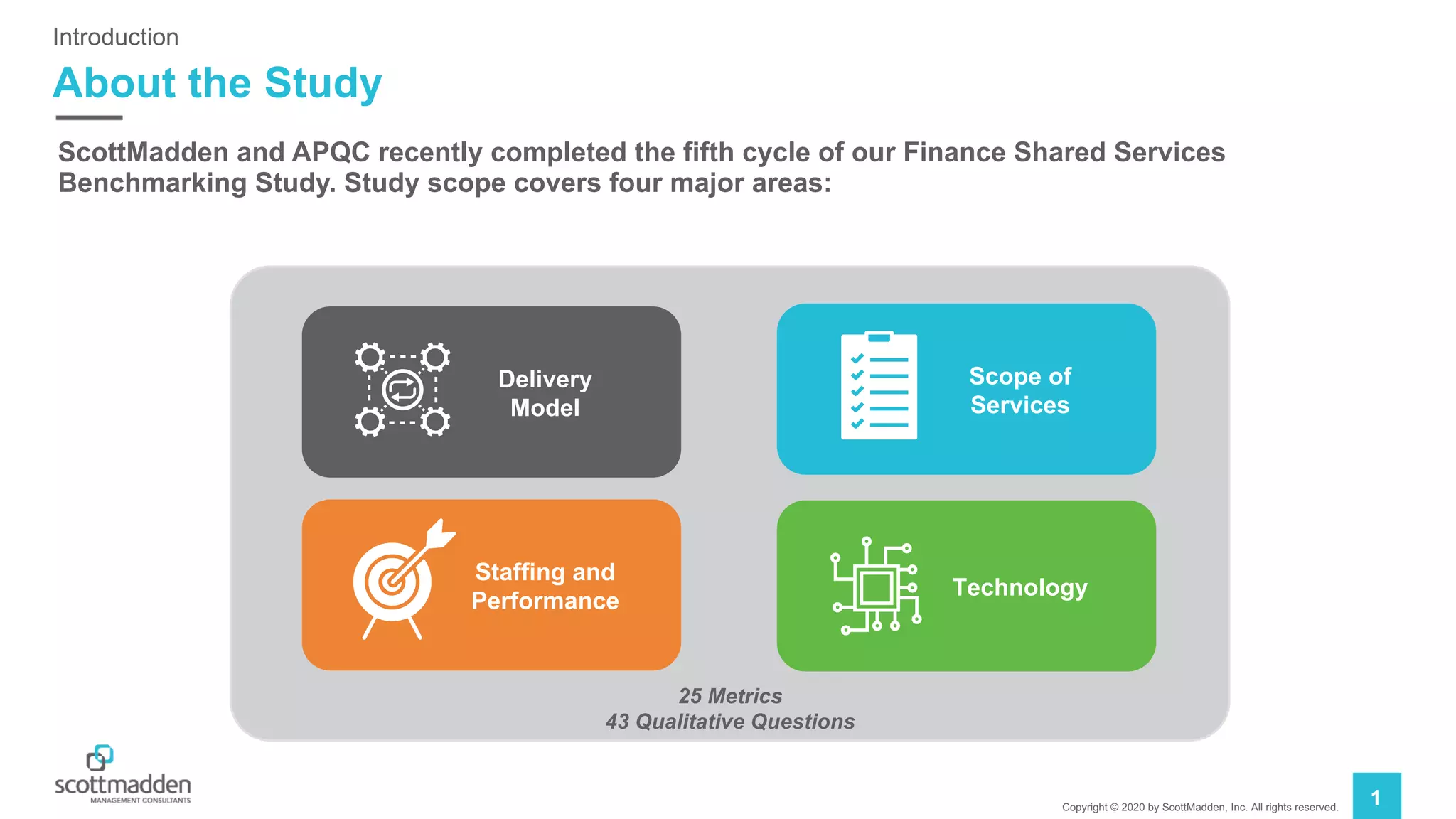
ScottMadden and APQC recently completed the fifth cycle of our Finance Shared Services
Benchmarking Study. Study scope covers four major areas:
25 Metrics
43 Qualitative Questions
Scope of
Services
Technology
Delivery
Model
Staffing and
Performance
Copyright © 2020 by ScottMadden, Inc. All rights reserved.
2
Participant Characteristics
Introduction
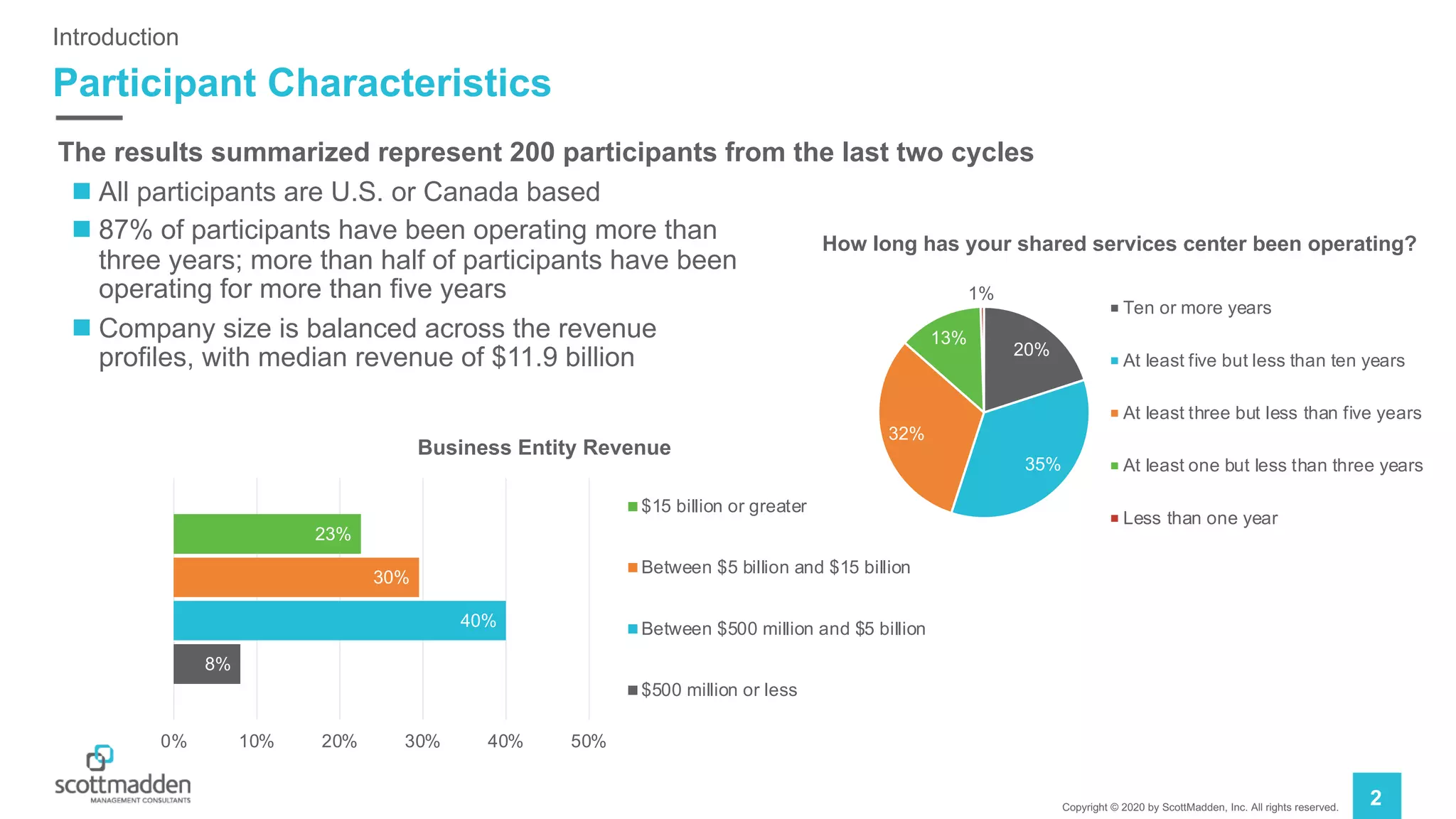
The results summarized represent 200 participants from the last two cycles
n All participants are U.S. or Canada based
n 87% of participants have been operating more than
three years; more than half of participants have been
operating for more than five years
n Company size is balanced across the revenue
profiles, with median revenue of $11.9 billion
8%
40%
30%
23%
0% 10% 20% 30% 40% 50%
Business Entity Revenue
$15 billion or greater
Between $5 billion and $15 billion
Between $500 million and $5 billion
$500 million or less
20%
35%
32%
13%
1%
Ten or more years
At least five but less than ten years
At least three but less than five years
At least one but less than three years
Less than one year
How long has your shared services center been operating?
Copyright © 2020 by ScottMadden, Inc. All rights reserved.
Geographic Model and Governance
Study Highlights
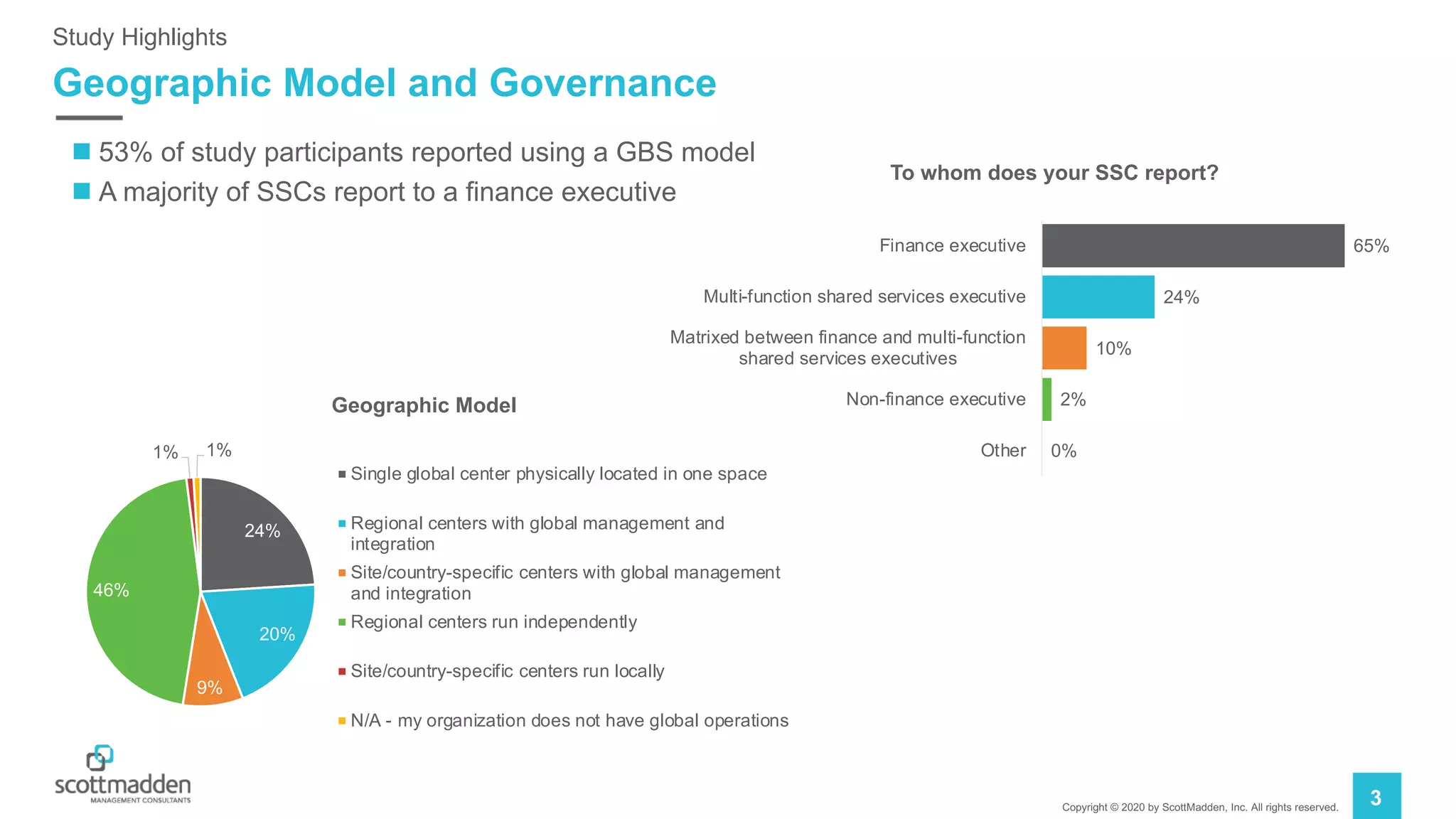
n 53% of study participants reported using a GBS model
n A majority of SSCs report to a finance executive
0%
2%
10%
24%
65%
Other
Non-finance executive
Matrixed between finance and multi-function
shared services executives
Multi-function shared services executive
Finance executive
To whom does your SSC report?
24%
20%
9%
46%
1% 1%
Geographic Model
Single global center physically located in one space
Regional centers with global management and
integration
Site/country-specific centers with global management
and integration
Regional centers run independently
Site/country-specific centers run locally
N/A - my organization does not have global operations
3
Copyright © 2020 by ScottMadden, Inc. All rights reserved.
4
Global Locations
Study Highlights
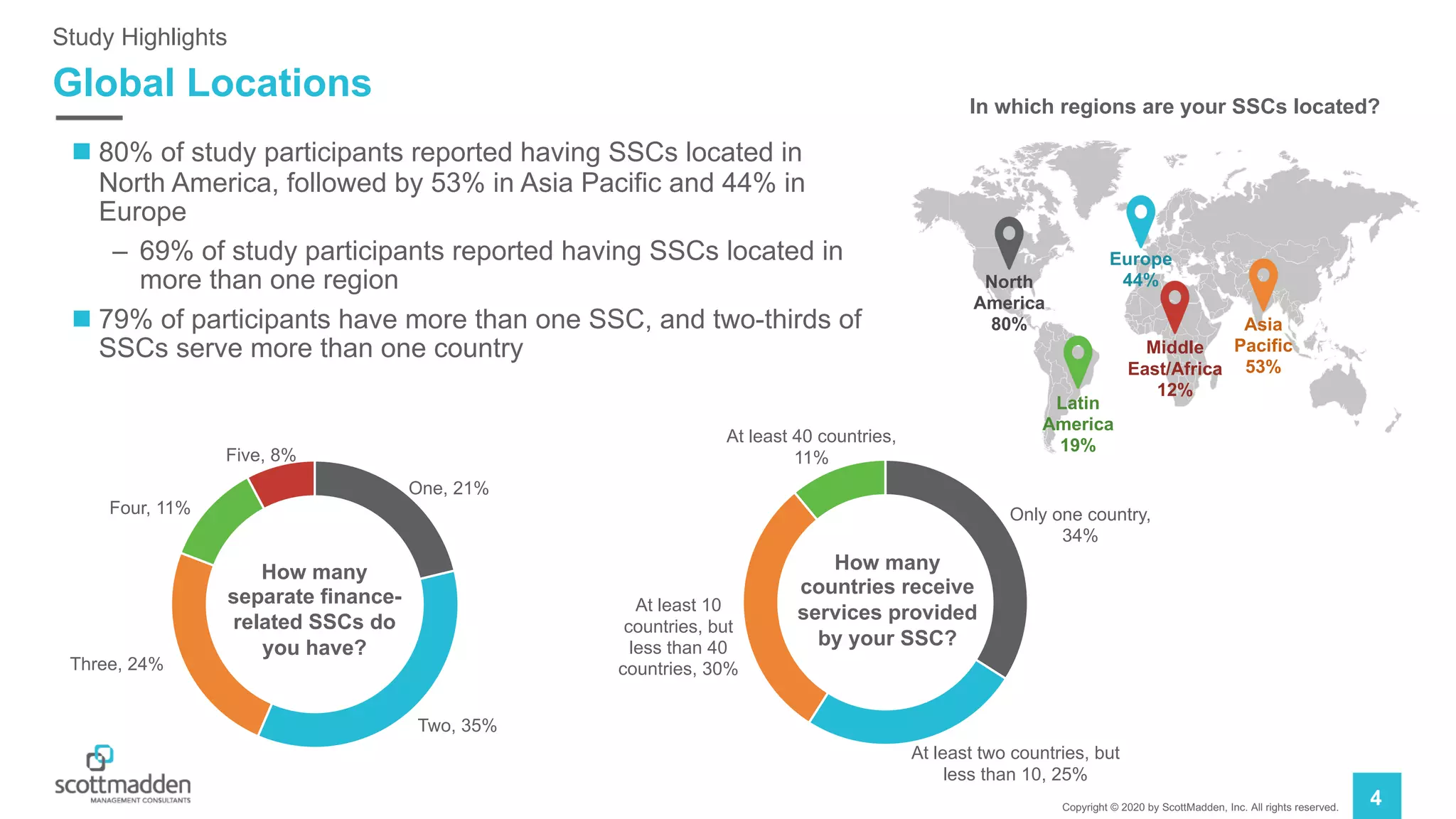
n 80% of study participants reported having SSCs located in
North America, followed by 53% in Asia Pacific and 44% in
Europe
– 69% of study participants reported having SSCs located in
more than one region
n 79% of participants have more than one SSC, and two-thirds of
SSCs serve more than one country
In which regions are your SSCs located?
North
America
80%
Europe
44%
Asia
Pacific
53%
Latin
America
19%
Middle
East/Africa
12%
Only one country,
34%
At least two countries, but
less than 10, 25%
At least 10
countries, but
less than 40
countries, 30%
At least 40 countries,
11%
How many
countries receive
services provided
by your SSC?
One, 21%
Two, 35%
Three, 24%
Four, 11%
Five, 8%
How many
separate finance-
related SSCs do
you have?
Copyright © 2020 by ScottMadden, Inc. All rights reserved.
5
Scope of Shared Services
Study Highlights
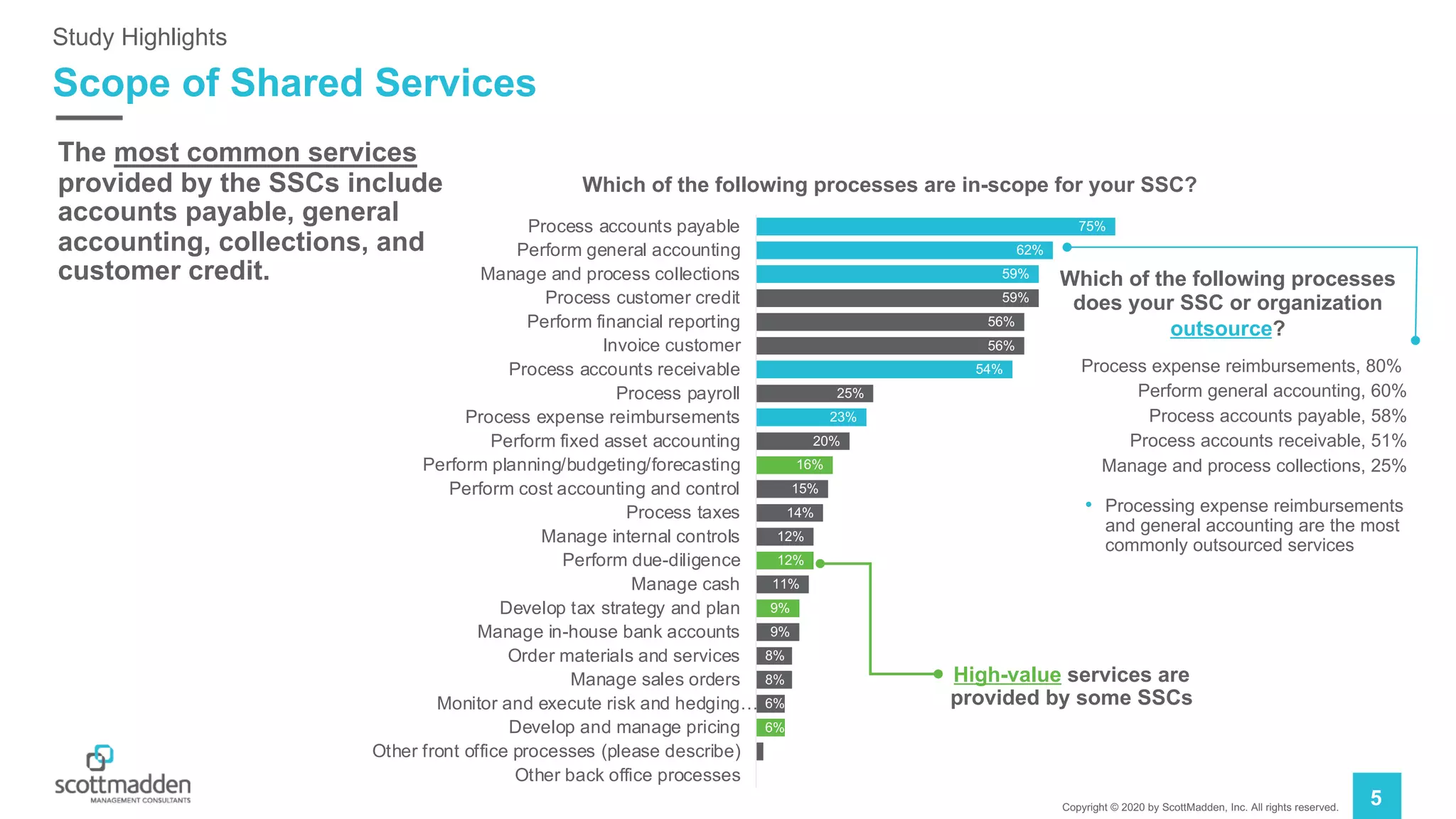
The most common services
provided by the SSCs include
accounts payable, general
accounting, collections, and
customer credit.
0%
2%
6%
6%
8%
8%
9%
9%
11%
12%
12%
14%
15%
16%
20%
23%
25%
54%
56%
56%
59%
59%
62%
75%
Other back office processes
Other front office processes (please describe)
Develop and manage pricing
Monitor and execute risk and hedging…
Manage sales orders
Order materials and services
Manage in-house bank accounts
Develop tax strategy and plan
Manage cash
Perform due-diligence
Manage internal controls
Process taxes
Perform cost accounting and control
Perform planning/budgeting/forecasting
Perform fixed asset accounting
Process expense reimbursements
Process payroll
Process accounts receivable
Invoice customer
Perform financial reporting
Process customer credit
Manage and process collections
Perform general accounting
Process accounts payable
Which of the following processes are in-scope for your SSC?
High-value services are
provided by some SSCs
• Processing expense reimbursements
and general accounting are the most
commonly outsourced services
Process expense reimbursements, 80%
Perform general accounting, 60%
Process accounts payable, 58%
Process accounts receivable, 51%
Manage and process collections, 25%
Which of the following processes
does your SSC or organization
outsource?
Copyright © 2020 by ScottMadden, Inc. All rights reserved.
6
E2E Process Adoption and Timing
Study Highlights
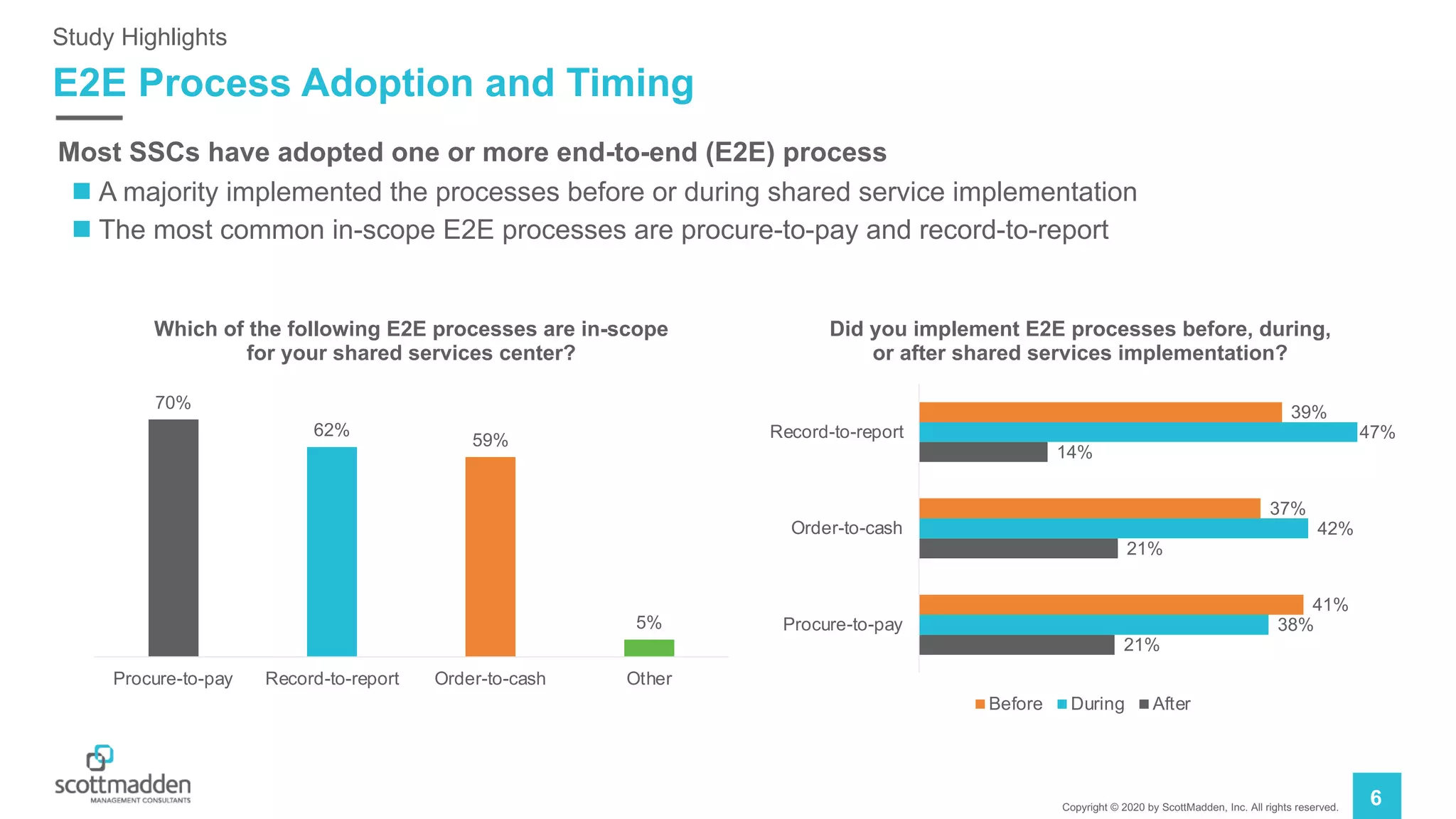
Most SSCs have adopted one or more end-to-end (E2E) process
n A majority implemented the processes before or during shared service implementation
n The most common in-scope E2E processes are procure-to-pay and record-to-report
21%
21%
14%
38%
42%
47%
41%
37%
39%
Procure-to-pay
Order-to-cash
Record-to-report
Did you implement E2E processes before, during,
or after shared services implementation?
Before During After
70%
62%
59%
5%
Procure-to-pay Record-to-report Order-to-cash Other
Which of the following E2E processes are in-scope
for your shared services center?
Copyright © 2020 by ScottMadden, Inc. All rights reserved.
7
RPA and Intelligent Automation Applications
Study Highlights
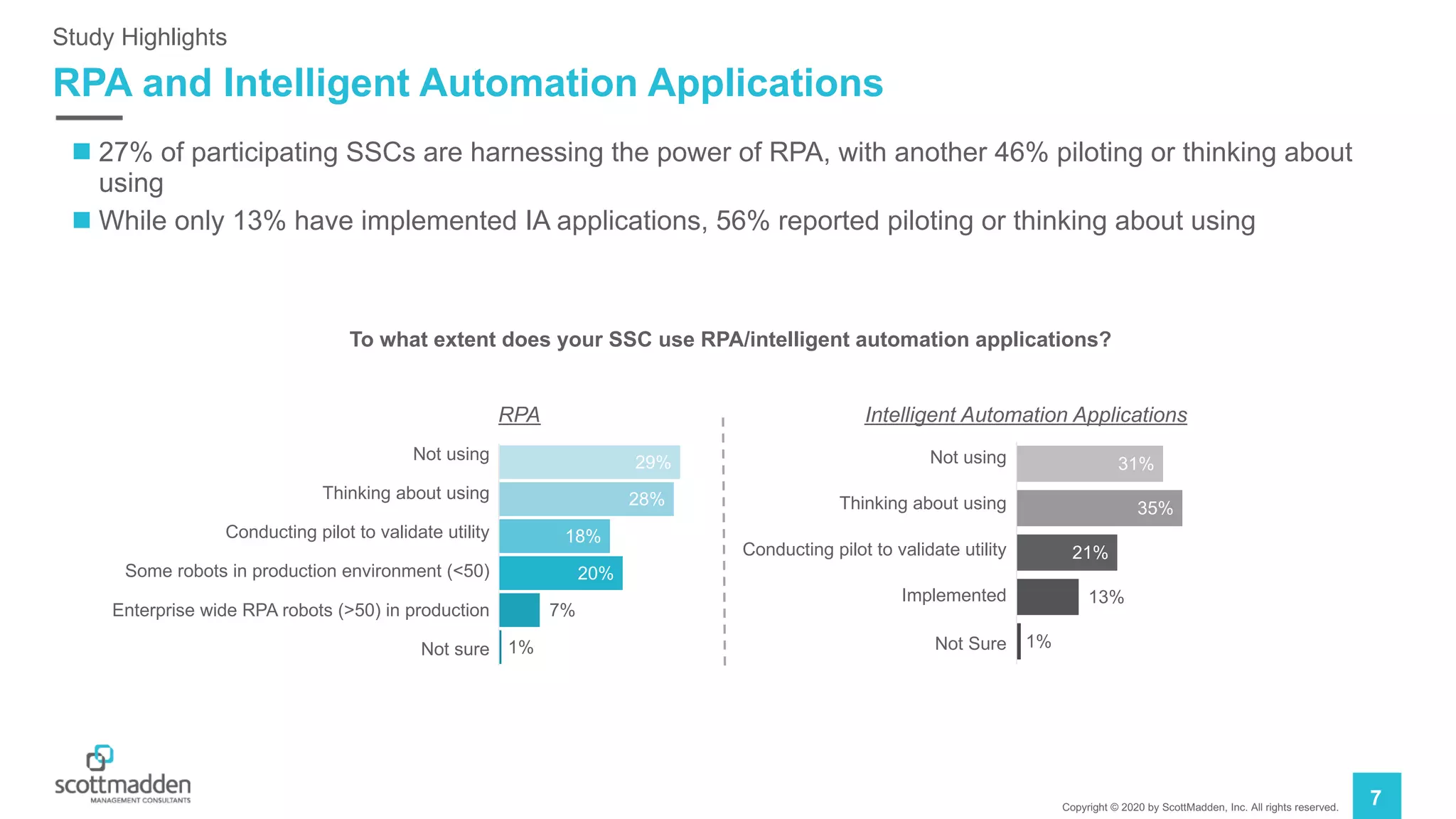
n 27% of participating SSCs are harnessing the power of RPA, with another 46% piloting or thinking about
using
n While only 13% have implemented IA applications, 56% reported piloting or thinking about using
31%
35%
21%
13%
1%
29%
28%
18%
20%
7%
1%
To what extent does your SSC use RPA/intelligent automation applications?
Not using
Thinking about using
Conducting pilot to validate utility
Some robots in production environment (<50)
Enterprise wide RPA robots (>50) in production
Not sure
Not using
Thinking about using
Conducting pilot to validate utility
Implemented
Not Sure
RPA Intelligent Automation Applications
Copyright © 2020 by ScottMadden, Inc. All rights reserved.
8
RPA and Intelligent Automation Applications (Cont’d)
Study Highlights
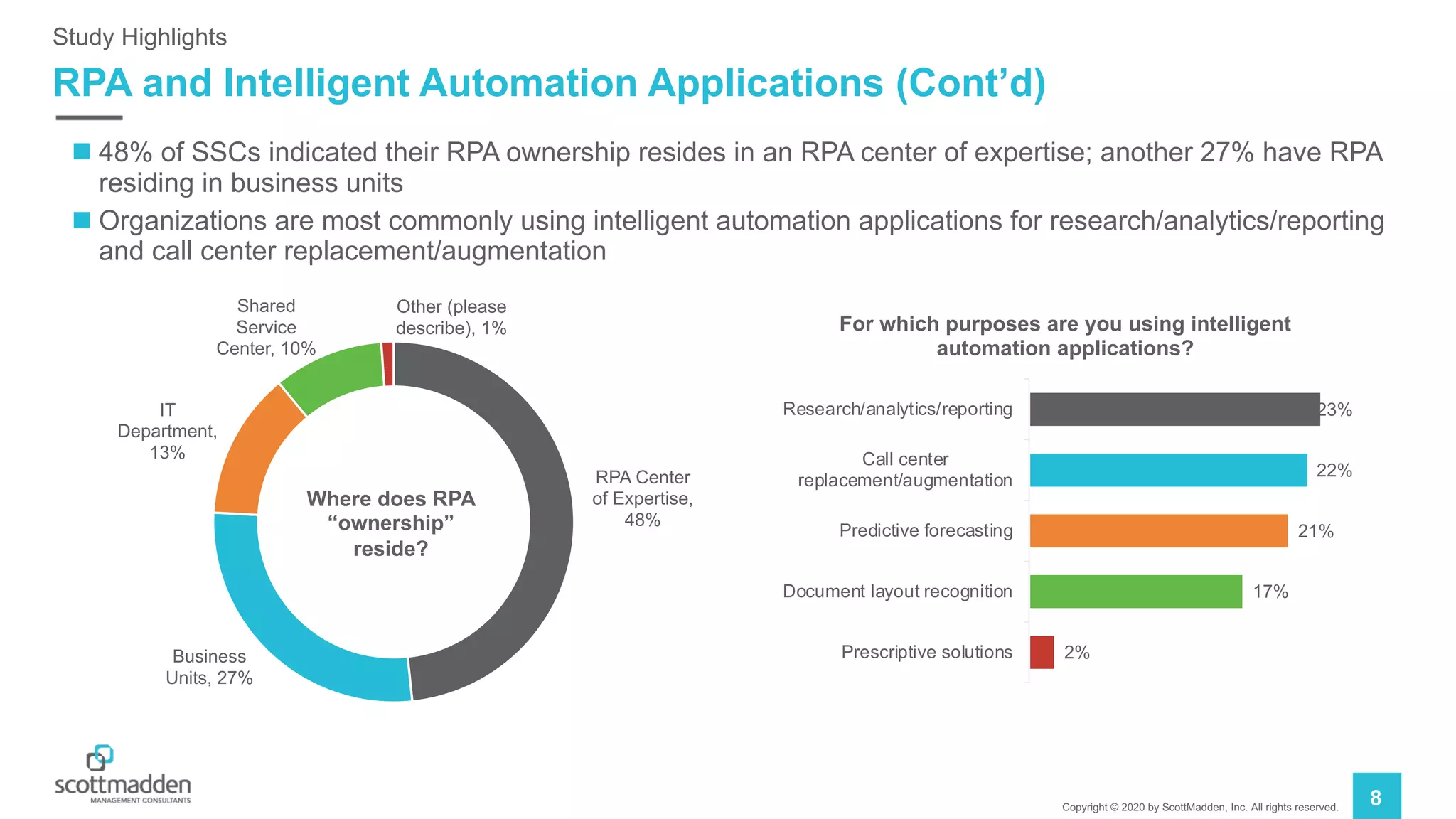
n 48% of SSCs indicated their RPA ownership resides in an RPA center of expertise; another 27% have RPA
residing in business units
n Organizations are most commonly using intelligent automation applications for research/analytics/reporting
and call center replacement/augmentation
RPA Center
of Expertise,
48%
Business
Units, 27%
IT
Department,
13%
Shared
Service
Center, 10%
Other (please
describe), 1%
Where does RPA
“ownership”
reside?
2%
17%
21%
22%
23%
Prescriptive solutions
Document layout recognition
Predictive forecasting
Call center
replacement/augmentation
Research/analytics/reporting
For which purposes are you using intelligent
automation applications?
Copyright © 2020 by ScottMadden, Inc. All rights reserved.
9
Who Are the Top Performers?
Top-Performer Analysis
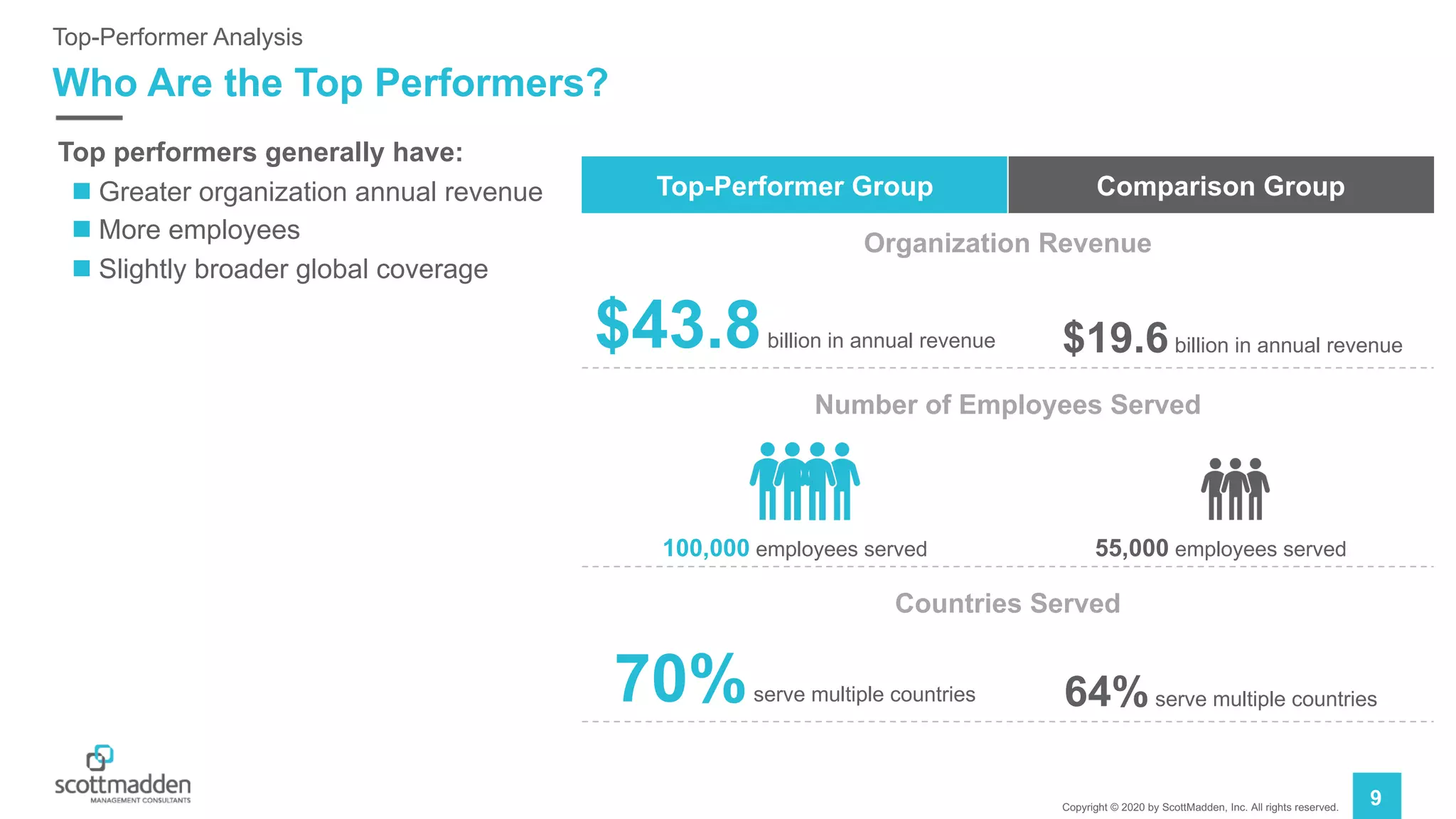
Top performers generally have:
n Greater organization annual revenue
n More employees
n Slightly broader global coverage
Top-Performer Group Comparison Group
Organization Revenue
$43.8billion in annual revenue $19.6billion in annual revenue
Number of Employees Served
100,000 employees served 55,000 employees served
Countries Served
70%serve multiple countries 64%serve multiple countries
Copyright © 2020 by ScottMadden, Inc. All rights reserved.
42.2
86.3
0
10
20
30
40
50
60
70
80
90
100
Top-Performer Group Comparison Group
Median number of finance function FTEs
across the entire organization per
$1 billion revenue
Invoice customer
Perform general accounting
Manage taxes
Process accounts receivable (AR)
Manage treasury operations
Process accounts payable (AP)
Manage internal controls
Perform
planning/budgeting/forecasting
10
Staffing Metrics Comparison
Top-Performer Analysis
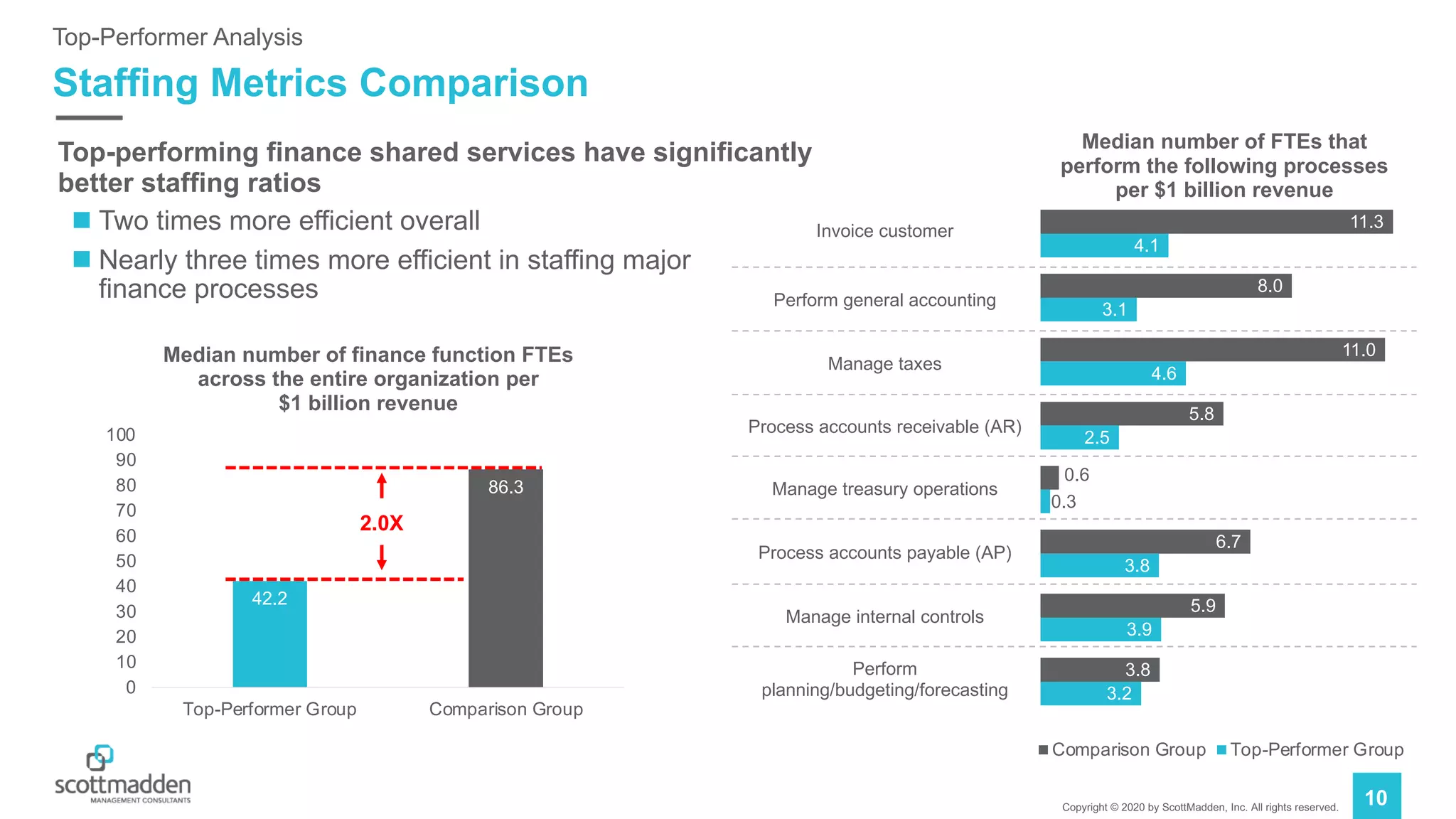
Top-performing finance shared services have significantly
better staffing ratios
n Two times more efficient overall
n Nearly three times more efficient in staffing major
finance processes
2.0X
3.2
3.9
3.8
0.3
2.5
4.6
3.1
4.1
3.8
5.9
6.7
0.6
5.8
11.0
8.0
11.3
Median number of FTEs that
perform the following processes
per $1 billion revenue
Comparison Group Top-Performer Group
Copyright © 2020 by ScottMadden, Inc. All rights reserved.
$2.08
$4.21
$0
$2
$4
$6
$8
$10
$12
$14
$16
Top-Performer Group Comparison Group
Median total cost to operate the shared
services center(s) per $1,000 revenue
$6.94
$12.83
$0
$2
$4
$6
$8
$10
$12
$14
$16
Top-Performer Group Comparison Group
Median total cost to perform the finance
function per $1,000 revenue
11
Cost Metrics Comparison
Top-Performer Analysis
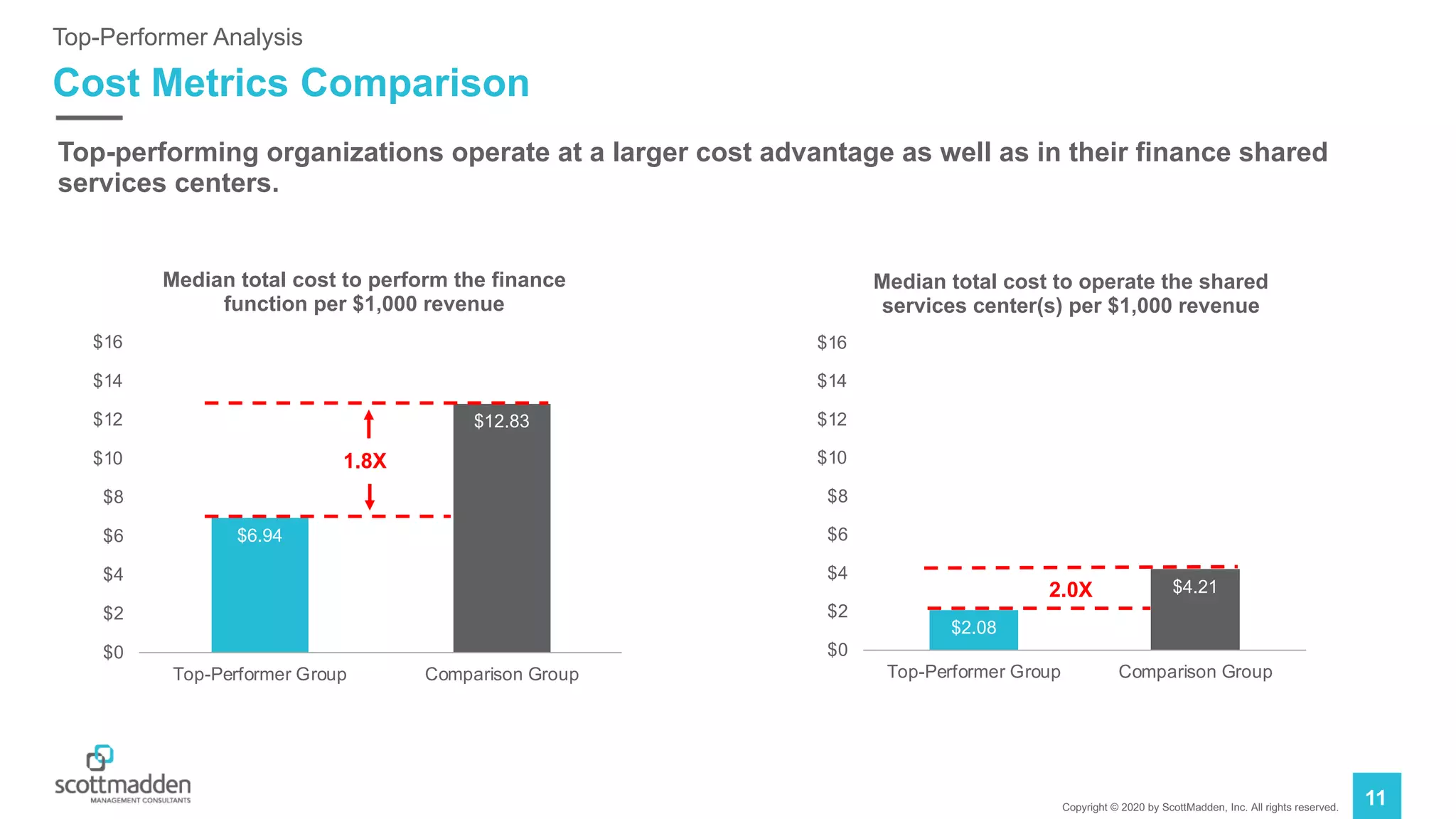
Top-performing organizations operate at a larger cost advantage as well as in their finance shared
services centers.
1.8X
2.0X
Copyright © 2020 by ScottMadden, Inc. All rights reserved.
12
Characteristics of Top Performers: Governance and Structure
Top-Performer Analysis
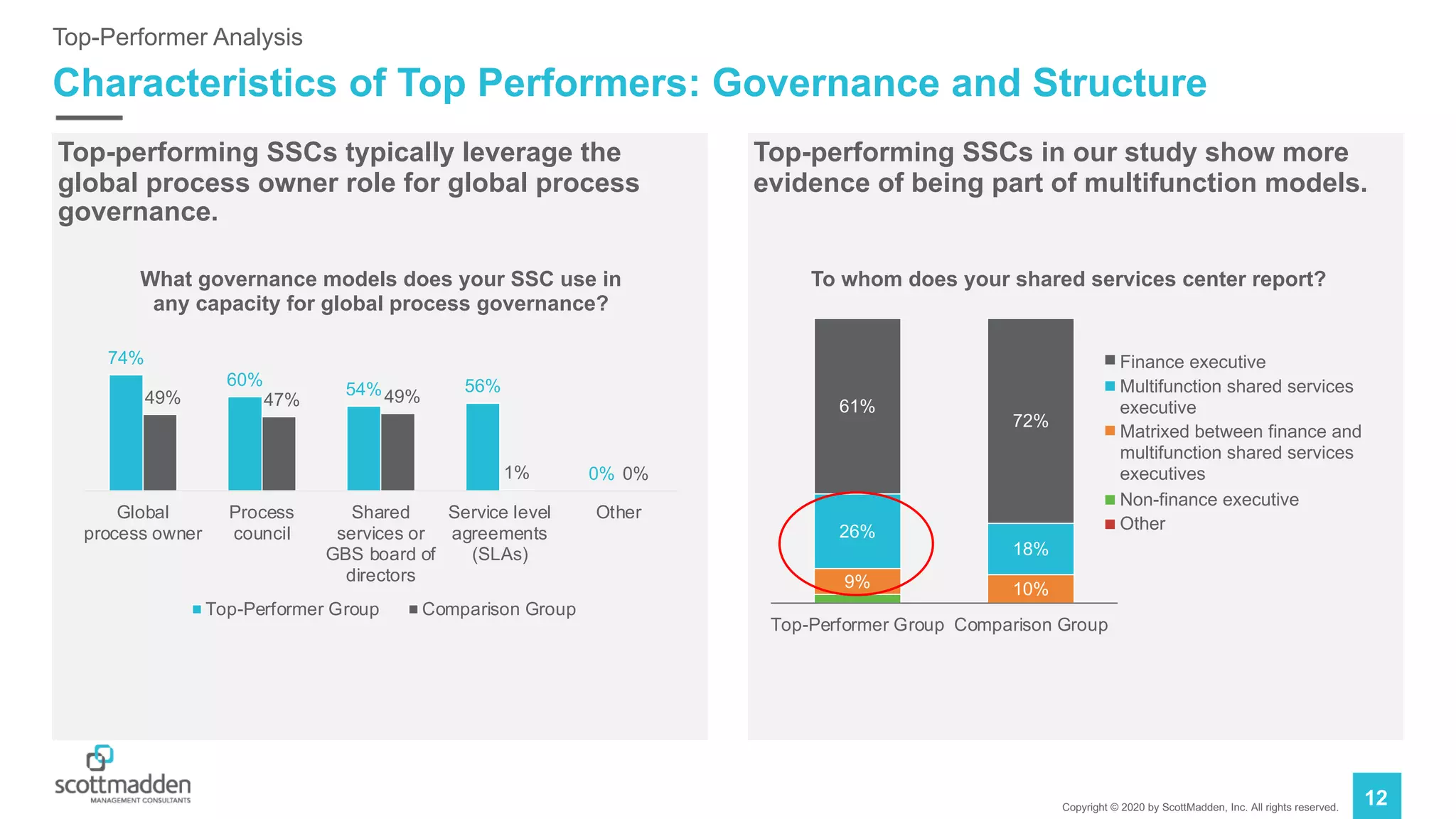
Top-performing SSCs typically leverage the
global process owner role for global process
governance.
Top-performing SSCs in our study show more
evidence of being part of multifunction models.
74%
60%
54% 56%
0%
49% 47% 49%
1% 0%
Global
process owner
Process
council
Shared
services or
GBS board of
directors
Service level
agreements
(SLAs)
Other
What governance models does your SSC use in
any capacity for global process governance?
Top-Performer Group Comparison Group
61%
72%
26%
18%
9% 10%
Top-Performer Group Comparison Group
To whom does your shared services center report?
Finance executive
Multifunction shared services
executive
Matrixed between finance and
multifunction shared services
executives
Non-finance executive
Other
Copyright © 2020 by ScottMadden, Inc. All rights reserved.
13
Summary
Top-Performer Analysis
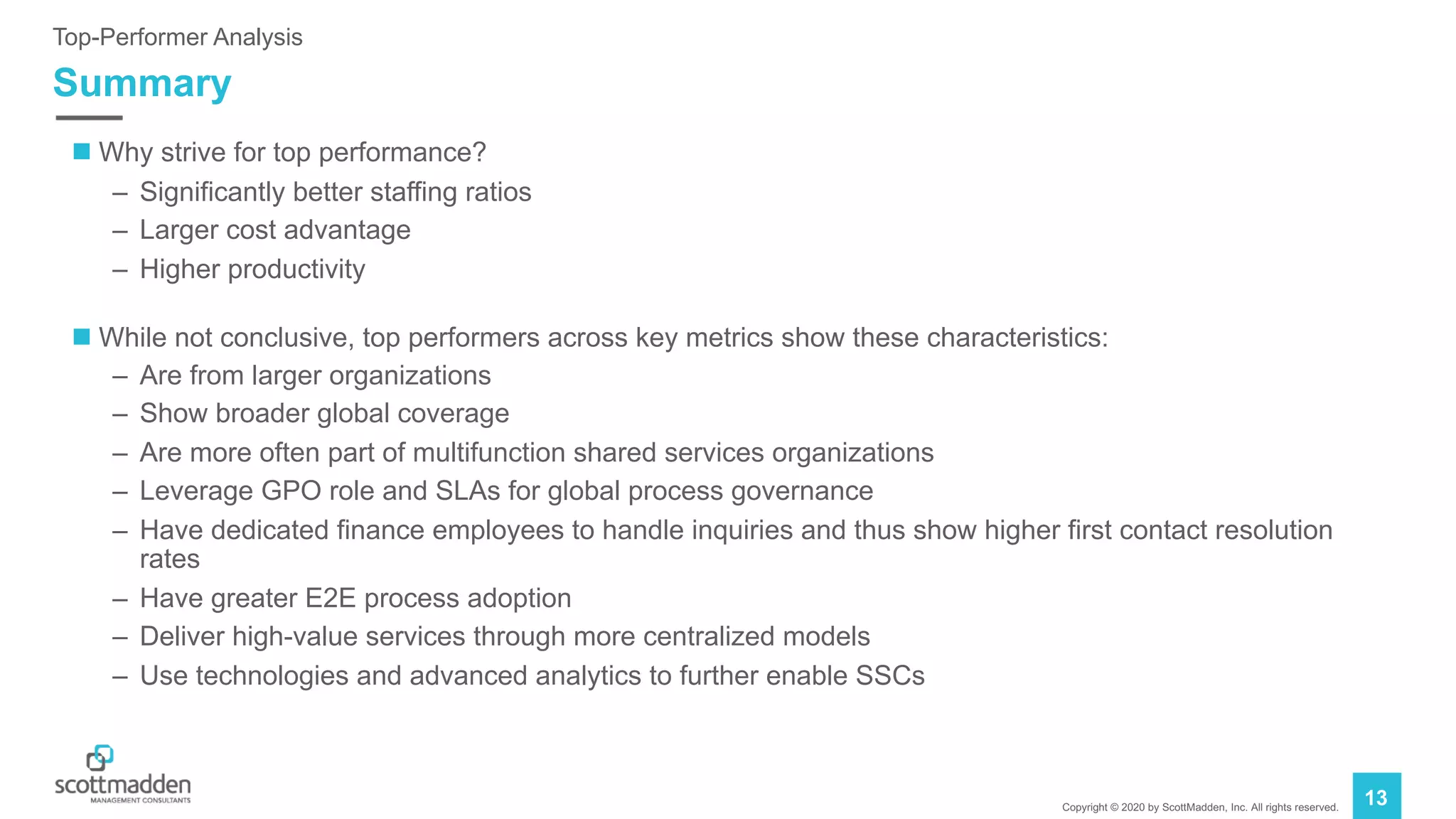
n Why strive for top performance?
– Significantly better staffing ratios
– Larger cost advantage
– Higher productivity
n While not conclusive, top performers across key metrics show these characteristics:
– Are from larger organizations
– Show broader global coverage
– Are more often part of multifunction shared services organizations
– Leverage GPO role and SLAs for global process governance
– Have dedicated finance employees to handle inquiries and thus show higher first contact resolution
rates
– Have greater E2E process adoption
– Deliver high-value services through more centralized models
– Use technologies and advanced analytics to further enable SSCs
Copyright © 2020 by ScottMadden, Inc. All rights reserved.
14
Want to Learn More?
The benchmarking study is open for participation through December 2020
n Access this study through this link to receive a customized participant report from APQC
– https://www.apqc.org/SMaddenFMSSO2020
If you’d like to learn more about how ScottMadden can help you optimize your
Finance Shared Services delivery model or if you are interested in a custom
benchmarking assessment of your organization, please contact us.

ScottMadden Finance Shared Services Benchmark Highlights 2020

  • 1.
    Copyright © 2020by ScottMadden, Inc. All rights reserved. Finance Shared Services Benchmark Highlights 2020 ScottMadden and APQC Finance Shared Services Benchmarking Study October 2020
  • 2.
    Copyright © 2020by ScottMadden, Inc. All rights reserved. 1 About the Study Introduction ScottMadden and APQC recently completed the fifth cycle of our Finance Shared Services Benchmarking Study. Study scope covers four major areas: 25 Metrics 43 Qualitative Questions Scope of Services Technology Delivery Model Staffing and Performance
  • 3.
    Copyright © 2020by ScottMadden, Inc. All rights reserved. 2 Participant Characteristics Introduction The results summarized represent 200 participants from the last two cycles n All participants are U.S. or Canada based n 87% of participants have been operating more than three years; more than half of participants have been operating for more than five years n Company size is balanced across the revenue profiles, with median revenue of $11.9 billion 8% 40% 30% 23% 0% 10% 20% 30% 40% 50% Business Entity Revenue $15 billion or greater Between $5 billion and $15 billion Between $500 million and $5 billion $500 million or less 20% 35% 32% 13% 1% Ten or more years At least five but less than ten years At least three but less than five years At least one but less than three years Less than one year How long has your shared services center been operating?
  • 4.
    Copyright © 2020by ScottMadden, Inc. All rights reserved. Geographic Model and Governance Study Highlights n 53% of study participants reported using a GBS model n A majority of SSCs report to a finance executive 0% 2% 10% 24% 65% Other Non-finance executive Matrixed between finance and multi-function shared services executives Multi-function shared services executive Finance executive To whom does your SSC report? 24% 20% 9% 46% 1% 1% Geographic Model Single global center physically located in one space Regional centers with global management and integration Site/country-specific centers with global management and integration Regional centers run independently Site/country-specific centers run locally N/A - my organization does not have global operations 3
  • 5.
    Copyright © 2020by ScottMadden, Inc. All rights reserved. 4 Global Locations Study Highlights n 80% of study participants reported having SSCs located in North America, followed by 53% in Asia Pacific and 44% in Europe – 69% of study participants reported having SSCs located in more than one region n 79% of participants have more than one SSC, and two-thirds of SSCs serve more than one country In which regions are your SSCs located? North America 80% Europe 44% Asia Pacific 53% Latin America 19% Middle East/Africa 12% Only one country, 34% At least two countries, but less than 10, 25% At least 10 countries, but less than 40 countries, 30% At least 40 countries, 11% How many countries receive services provided by your SSC? One, 21% Two, 35% Three, 24% Four, 11% Five, 8% How many separate finance- related SSCs do you have?
  • 6.
    Copyright © 2020by ScottMadden, Inc. All rights reserved. 5 Scope of Shared Services Study Highlights The most common services provided by the SSCs include accounts payable, general accounting, collections, and customer credit. 0% 2% 6% 6% 8% 8% 9% 9% 11% 12% 12% 14% 15% 16% 20% 23% 25% 54% 56% 56% 59% 59% 62% 75% Other back office processes Other front office processes (please describe) Develop and manage pricing Monitor and execute risk and hedging… Manage sales orders Order materials and services Manage in-house bank accounts Develop tax strategy and plan Manage cash Perform due-diligence Manage internal controls Process taxes Perform cost accounting and control Perform planning/budgeting/forecasting Perform fixed asset accounting Process expense reimbursements Process payroll Process accounts receivable Invoice customer Perform financial reporting Process customer credit Manage and process collections Perform general accounting Process accounts payable Which of the following processes are in-scope for your SSC? High-value services are provided by some SSCs • Processing expense reimbursements and general accounting are the most commonly outsourced services Process expense reimbursements, 80% Perform general accounting, 60% Process accounts payable, 58% Process accounts receivable, 51% Manage and process collections, 25% Which of the following processes does your SSC or organization outsource?
  • 7.
    Copyright © 2020by ScottMadden, Inc. All rights reserved. 6 E2E Process Adoption and Timing Study Highlights Most SSCs have adopted one or more end-to-end (E2E) process n A majority implemented the processes before or during shared service implementation n The most common in-scope E2E processes are procure-to-pay and record-to-report 21% 21% 14% 38% 42% 47% 41% 37% 39% Procure-to-pay Order-to-cash Record-to-report Did you implement E2E processes before, during, or after shared services implementation? Before During After 70% 62% 59% 5% Procure-to-pay Record-to-report Order-to-cash Other Which of the following E2E processes are in-scope for your shared services center?
  • 8.
    Copyright © 2020by ScottMadden, Inc. All rights reserved. 7 RPA and Intelligent Automation Applications Study Highlights n 27% of participating SSCs are harnessing the power of RPA, with another 46% piloting or thinking about using n While only 13% have implemented IA applications, 56% reported piloting or thinking about using 31% 35% 21% 13% 1% 29% 28% 18% 20% 7% 1% To what extent does your SSC use RPA/intelligent automation applications? Not using Thinking about using Conducting pilot to validate utility Some robots in production environment (<50) Enterprise wide RPA robots (>50) in production Not sure Not using Thinking about using Conducting pilot to validate utility Implemented Not Sure RPA Intelligent Automation Applications
  • 9.
    Copyright © 2020by ScottMadden, Inc. All rights reserved. 8 RPA and Intelligent Automation Applications (Cont’d) Study Highlights n 48% of SSCs indicated their RPA ownership resides in an RPA center of expertise; another 27% have RPA residing in business units n Organizations are most commonly using intelligent automation applications for research/analytics/reporting and call center replacement/augmentation RPA Center of Expertise, 48% Business Units, 27% IT Department, 13% Shared Service Center, 10% Other (please describe), 1% Where does RPA “ownership” reside? 2% 17% 21% 22% 23% Prescriptive solutions Document layout recognition Predictive forecasting Call center replacement/augmentation Research/analytics/reporting For which purposes are you using intelligent automation applications?
  • 10.
    Copyright © 2020by ScottMadden, Inc. All rights reserved. 9 Who Are the Top Performers? Top-Performer Analysis Top performers generally have: n Greater organization annual revenue n More employees n Slightly broader global coverage Top-Performer Group Comparison Group Organization Revenue $43.8billion in annual revenue $19.6billion in annual revenue Number of Employees Served 100,000 employees served 55,000 employees served Countries Served 70%serve multiple countries 64%serve multiple countries
  • 11.
    Copyright © 2020by ScottMadden, Inc. All rights reserved. 42.2 86.3 0 10 20 30 40 50 60 70 80 90 100 Top-Performer Group Comparison Group Median number of finance function FTEs across the entire organization per $1 billion revenue Invoice customer Perform general accounting Manage taxes Process accounts receivable (AR) Manage treasury operations Process accounts payable (AP) Manage internal controls Perform planning/budgeting/forecasting 10 Staffing Metrics Comparison Top-Performer Analysis Top-performing finance shared services have significantly better staffing ratios n Two times more efficient overall n Nearly three times more efficient in staffing major finance processes 2.0X 3.2 3.9 3.8 0.3 2.5 4.6 3.1 4.1 3.8 5.9 6.7 0.6 5.8 11.0 8.0 11.3 Median number of FTEs that perform the following processes per $1 billion revenue Comparison Group Top-Performer Group
  • 12.
    Copyright © 2020by ScottMadden, Inc. All rights reserved. $2.08 $4.21 $0 $2 $4 $6 $8 $10 $12 $14 $16 Top-Performer Group Comparison Group Median total cost to operate the shared services center(s) per $1,000 revenue $6.94 $12.83 $0 $2 $4 $6 $8 $10 $12 $14 $16 Top-Performer Group Comparison Group Median total cost to perform the finance function per $1,000 revenue 11 Cost Metrics Comparison Top-Performer Analysis Top-performing organizations operate at a larger cost advantage as well as in their finance shared services centers. 1.8X 2.0X
  • 13.
    Copyright © 2020by ScottMadden, Inc. All rights reserved. 12 Characteristics of Top Performers: Governance and Structure Top-Performer Analysis Top-performing SSCs typically leverage the global process owner role for global process governance. Top-performing SSCs in our study show more evidence of being part of multifunction models. 74% 60% 54% 56% 0% 49% 47% 49% 1% 0% Global process owner Process council Shared services or GBS board of directors Service level agreements (SLAs) Other What governance models does your SSC use in any capacity for global process governance? Top-Performer Group Comparison Group 61% 72% 26% 18% 9% 10% Top-Performer Group Comparison Group To whom does your shared services center report? Finance executive Multifunction shared services executive Matrixed between finance and multifunction shared services executives Non-finance executive Other
  • 14.
    Copyright © 2020by ScottMadden, Inc. All rights reserved. 13 Summary Top-Performer Analysis n Why strive for top performance? – Significantly better staffing ratios – Larger cost advantage – Higher productivity n While not conclusive, top performers across key metrics show these characteristics: – Are from larger organizations – Show broader global coverage – Are more often part of multifunction shared services organizations – Leverage GPO role and SLAs for global process governance – Have dedicated finance employees to handle inquiries and thus show higher first contact resolution rates – Have greater E2E process adoption – Deliver high-value services through more centralized models – Use technologies and advanced analytics to further enable SSCs
  • 15.
    Copyright © 2020by ScottMadden, Inc. All rights reserved. 14 Want to Learn More? The benchmarking study is open for participation through December 2020 n Access this study through this link to receive a customized participant report from APQC – https://www.apqc.org/SMaddenFMSSO2020 If you’d like to learn more about how ScottMadden can help you optimize your Finance Shared Services delivery model or if you are interested in a custom benchmarking assessment of your organization, please contact us.