HR Function
Session – 2
Whose Job is HRM? – Line Manager
• A line manager is a person who is located directly above an employee on the next hierarchical level
in the organizational structure. He is responsible for daily management of his subordinates.
• Line managers have direct authority over other people whom they supervise, making decisions and
allocating resources within the hierarchy of an organization. For example, Sales Manager has a
formal line of authority over Sales Representatives of the different products that the firm sells.
• Additionally, each and every line manager is responsible for achieving specific business objectives.
─ Directly responsible for the production of goods or services. They oversee the work of non-managerial
employees and are accountable for their team’s performance.
─ Focus on operational tasks and problem-solving. They handle day-to-day issues, delegate tasks, and ensure
their team meets deadlines and goals.
─ Typically have a strong understanding of the specific work their team does. They may have come up
through the ranks themselves and have hands-on experience.
─ Develop and manage individual employee performance. They provide feedback, conduct performance
reviews, and help employees grow in their roles.
─ Examples: supervisor, production manager, team leader, shift leader
Whose Job is HRM? – Staff Manager
• A staff manager is a person who is a specialist in his field. He is responsible for providing
information, advice, assistance and support to a senior line manager.
• Staff managers do not have direct line of authority over other people nor make any
decisions
─ Provide support and guidance to line managers and other departments. They offer expertise in
specific areas, such as human resources, finance, or marketing.
─ Focus on strategic planning and long-term goals. They help line managers make informed
decisions, develop policies, and implement initiatives.
─ May not have direct reports or supervisory authority. They influence outcomes through
collaboration and consultation.
─ Specialize in a particular function or area of knowledge. They bring valuable expertise to the
table and help line managers navigate complex issues.
─ Examples: human resources manager, marketing director, training specialist, financial analyst
Competencies of HR Professional: Basic
1. HRM Proficiency – Knowledge of HR functions
2. Business Proficiency – strategic role in business partnership
3. Leadership Proficiency – leading groups & driving change as required
4. Learning Proficiency – updated with the latest knowledge of related areas
Competencies of HR Professional: Advanced
5. Strategic Contribution – business IQ, strategic decision-making, responsive to market
demands
6. Personal Credibility- ability to deliver results, make & maintain effective relationships,
effective communication
7. HR Delivery – delivering on basic HR functions, but, with overarching cultural, or,
change agenda
8. Business Knowledge – knowledge of the value chain of business
9. HR Technology – ability to apply technology to HR functions
HR Shared Services
What is HR service delivery?
• HR is responsible for providing an array of information and services to
an organization’s entire employee population, including onboarding,
payroll processing, employee benefits, and many others.
• The practice of providing these services is HR service delivery, and it is
an opportunity to instill the HR strategy into every step of the
workforce life cycle.
• The effectiveness with which these HR services are implemented by HR,
impacts the employee experience
HR
service
delivery
Traditional Multi-tiered
1. Traditional HR service delivery model
• It revolves around a decentralized, generalist HR staff.
• They report to and meet the needs of each business unit directly at the local level.
• They provide customized, hands-on service for employees, managers, and executives.
• HR managers can be overburdened when they are responsible for providing all HR services
and must spend time on relentless administrative tasks.
• This leads to frustration for employees when they aren’t able to get quick responses to
their questions or problems and have limited visibility into their cases.
2. Multi-tiered HR service delivery model
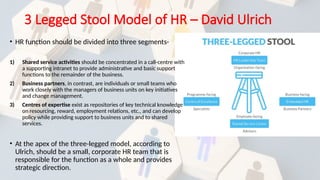
• It is based on the “three-legged stool” model developed by David Ulrich.
• This centralized option involves handling employee issues through three groups of HR professionals
with unique skill sets.
1. Shared services – This centralized team is the first point of contact for employees and managers.
The team is responsible for administrating the transactions for day-to-day requests and inquiries.
Employees access this via phones and online portals.
2. HR business partners – These strategic HR professionals consult directly with business-unit
managers on people issues that affect the business’s bottom line. This can include designing plans
and programs for handling recruiting, succession planning, etc.
3. Centers of excellence – HR specialists handle more complex situations. They offer services to
management for implementing programs and policies for areas such as compensation, benefits,
training, performance counseling, and staffing.
3 Legged Stool Model of HR – David Ulrich
• HR function should be divided into three segments-
1) Shared service activities should be concentrated in a call-centre with
a supporting intranet to provide administrative and basic support
functions to the remainder of the business.
2) Business partners, in contrast, are individuals or small teams who
work closely with the managers of business units on key initiatives
and change management.
3) Centres of expertise exist as repositories of key technical knowledge
on resourcing, reward, employment relations, etc., and can develop
policy while providing support to business units and to shared
services.
• At the apex of the three-legged model, according to
Ulrich, should be a small, corporate HR team that is
responsible for the function as a whole and provides
strategic direction.
HR delivery service model
• Tier 0 support falls under HR shared services. It provides employees and line managers
with the efficiency of self-service technology. They can find their own information or
solutions without having to contact HR directly.
• Tier 1 support is handled in the HR shared services team. This is when employees can’t find
what they’re looking for or don’t have a self-service option. They submit a request which is
routed to an HR representative who can provide answers and methods. If the issue is too
complex for Tier 1, it is escalated to the next tier.
• Tier 2 support offers subject matter experts who have specialized knowledge and
techniques to resolve more complex situations.
• Tier 3 support is reserved for employee relations cases that call for direct interaction or
intervention from a strategic HR professional.
HR shared services
• Large organizations with complex HR departments outsource HR processes,
reporting, and software solutions to companies that are positioned to handle
these very specific and often difficult tasks.
• This third-party management is often referred to as HR shared services or HR
Service Delivery (HRSD).
• By using the latest technology, AI and ML, automation, it also enables employee
self-service for the HR functions
• It enables the other parts of the HR department to focus on strategic initiatives
Activities that are mostly taken
by HR shared services:
• Payroll
• Employee information
management
• Time and schedule information
• Relocation services
• HR Information system
• Recruitment functions
• Learning and development
• Reporting and analytics
• HR service center
Functionalities required for implementation of
HR shared services:
• Ticketing
• Policy and knowledge management
• Incident routing
• SLA monitoring
• Employee self-service
What can be automated in HR shared services:
• E-mails
• Candidate assessments
• On-boarding documents
• Expense claims
• Leave tracking
Benefits of HR shared services
1. HR becomes more strategic. The division of responsibilities frees up the more experienced HR
professionals to focus on strategy.
2. Consistency and compliance. HR matters are always handled in the same, consistent way, which helps
ensure that you’re compliant with rules and regulations.
3. Operational excellence. By assigning clear responsibilities for administrative processes, organizations can
reach operational excellence.
4. Improved employee experience. Employees get their issues resolved and find relevant information
quickly and conveniently.
5. Cost reduction. HR shared services can help organizations cut costs in several ways
Challenges of HR shared services
1. A lack of a digital roadmap for the majority of organizations
2. Creating urgency for investments in shared services and/ or HR technology
3. One size doesn’t fit all
4. Knowledge transition
5. Collaboration within the HR team and across the organization can suffer
HR Shared Services Maturity Models
HR Shared Services Best Practices
1. Transform
a) Determine which activities will fall under HR shared services
b) Define roles and responsibilities
c) Choose the right technology to support you and your workforce
2) Maximize its capabilities
d) Offer new or expanded services
e) Expand on automation capabilities
f) Maximize the use of reporting and analytics
3) Enhance
g) Process automation
h) Continuous improvement by taking feedback
i) Create a digital roadmap
j) Invest in the continuous development of employees working in HR shared services
HR Strategies
What is HR Strategy?
• It articulates the organization’s intention about its HRM policies, its fitment
with business strategy, and how it shall reinforce itself to achieve the
business objectives
• It summarizes the beliefs and philosophy of the organization regarding its
people’s practices, policies, and procedures
• It can be classified in 2 categories –
i) Overall strategies
ii) Specific Strategies
i) Overall Strategies
1) High Performance Management
2) High Involvement Management
3) High Commitment Management
High Performance Work System
Some common HR Strategies for HPWS:
1. Targeted recruitment and selection
2. Formal training as indicator of employer’s commitment to invest in human capital
3. Internal promotions or selections to fill vacancy
4. Employee participation programs
5. Teams as a fundamental unit of organization
6. Formal performance appraisal
7. Development appraisal
8. Performance based pay system
9. Merit based promotions
10. Formal communication programs for keeping employees informed
11. Reduced differential status between managers and employees
12. Formal grievance or complaint resolution systems
13. Employee job security policies such as no compulsory redundancies
14. Formal job analysis, job design and safety
ii) Specific HR Strategies
1. Human capital management strategy
2. High-performance management strategy
3. Organizational development strategy
4. Employee engagement strategy
5. Knowledge management strategy
6. Talent management strategy
7. Learning & development strategy
8. Reward & recognition strategy
Developing HR Strategy
Analyze
the
business
Strategy
Define the
objectives
Analyze
the current
situation
Identify
gaps
List
practices
to be
developed
, improved
Make bundles of
complementary
practices
Assess
practicality
Prioritize
Define
project
objectives
Get buy in
Plan
implementation
Execute

Human Resource Function - Roles and Responsibilities.pptx

  • 1.
  • 2.
    Whose Job isHRM? – Line Manager • A line manager is a person who is located directly above an employee on the next hierarchical level in the organizational structure. He is responsible for daily management of his subordinates. • Line managers have direct authority over other people whom they supervise, making decisions and allocating resources within the hierarchy of an organization. For example, Sales Manager has a formal line of authority over Sales Representatives of the different products that the firm sells. • Additionally, each and every line manager is responsible for achieving specific business objectives. ─ Directly responsible for the production of goods or services. They oversee the work of non-managerial employees and are accountable for their team’s performance. ─ Focus on operational tasks and problem-solving. They handle day-to-day issues, delegate tasks, and ensure their team meets deadlines and goals. ─ Typically have a strong understanding of the specific work their team does. They may have come up through the ranks themselves and have hands-on experience. ─ Develop and manage individual employee performance. They provide feedback, conduct performance reviews, and help employees grow in their roles. ─ Examples: supervisor, production manager, team leader, shift leader
  • 3.
    Whose Job isHRM? – Staff Manager • A staff manager is a person who is a specialist in his field. He is responsible for providing information, advice, assistance and support to a senior line manager. • Staff managers do not have direct line of authority over other people nor make any decisions ─ Provide support and guidance to line managers and other departments. They offer expertise in specific areas, such as human resources, finance, or marketing. ─ Focus on strategic planning and long-term goals. They help line managers make informed decisions, develop policies, and implement initiatives. ─ May not have direct reports or supervisory authority. They influence outcomes through collaboration and consultation. ─ Specialize in a particular function or area of knowledge. They bring valuable expertise to the table and help line managers navigate complex issues. ─ Examples: human resources manager, marketing director, training specialist, financial analyst
  • 5.
    Competencies of HRProfessional: Basic 1. HRM Proficiency – Knowledge of HR functions 2. Business Proficiency – strategic role in business partnership 3. Leadership Proficiency – leading groups & driving change as required 4. Learning Proficiency – updated with the latest knowledge of related areas
  • 6.
    Competencies of HRProfessional: Advanced 5. Strategic Contribution – business IQ, strategic decision-making, responsive to market demands 6. Personal Credibility- ability to deliver results, make & maintain effective relationships, effective communication 7. HR Delivery – delivering on basic HR functions, but, with overarching cultural, or, change agenda 8. Business Knowledge – knowledge of the value chain of business 9. HR Technology – ability to apply technology to HR functions
  • 7.
  • 8.
    What is HRservice delivery? • HR is responsible for providing an array of information and services to an organization’s entire employee population, including onboarding, payroll processing, employee benefits, and many others. • The practice of providing these services is HR service delivery, and it is an opportunity to instill the HR strategy into every step of the workforce life cycle. • The effectiveness with which these HR services are implemented by HR, impacts the employee experience
  • 9.
  • 10.
    1. Traditional HRservice delivery model • It revolves around a decentralized, generalist HR staff. • They report to and meet the needs of each business unit directly at the local level. • They provide customized, hands-on service for employees, managers, and executives. • HR managers can be overburdened when they are responsible for providing all HR services and must spend time on relentless administrative tasks. • This leads to frustration for employees when they aren’t able to get quick responses to their questions or problems and have limited visibility into their cases.
  • 11.
    2. Multi-tiered HRservice delivery model • It is based on the “three-legged stool” model developed by David Ulrich. • This centralized option involves handling employee issues through three groups of HR professionals with unique skill sets. 1. Shared services – This centralized team is the first point of contact for employees and managers. The team is responsible for administrating the transactions for day-to-day requests and inquiries. Employees access this via phones and online portals. 2. HR business partners – These strategic HR professionals consult directly with business-unit managers on people issues that affect the business’s bottom line. This can include designing plans and programs for handling recruiting, succession planning, etc. 3. Centers of excellence – HR specialists handle more complex situations. They offer services to management for implementing programs and policies for areas such as compensation, benefits, training, performance counseling, and staffing.
  • 12.
    3 Legged StoolModel of HR – David Ulrich • HR function should be divided into three segments- 1) Shared service activities should be concentrated in a call-centre with a supporting intranet to provide administrative and basic support functions to the remainder of the business. 2) Business partners, in contrast, are individuals or small teams who work closely with the managers of business units on key initiatives and change management. 3) Centres of expertise exist as repositories of key technical knowledge on resourcing, reward, employment relations, etc., and can develop policy while providing support to business units and to shared services. • At the apex of the three-legged model, according to Ulrich, should be a small, corporate HR team that is responsible for the function as a whole and provides strategic direction.
  • 13.
    HR delivery servicemodel • Tier 0 support falls under HR shared services. It provides employees and line managers with the efficiency of self-service technology. They can find their own information or solutions without having to contact HR directly. • Tier 1 support is handled in the HR shared services team. This is when employees can’t find what they’re looking for or don’t have a self-service option. They submit a request which is routed to an HR representative who can provide answers and methods. If the issue is too complex for Tier 1, it is escalated to the next tier. • Tier 2 support offers subject matter experts who have specialized knowledge and techniques to resolve more complex situations. • Tier 3 support is reserved for employee relations cases that call for direct interaction or intervention from a strategic HR professional.
  • 14.
    HR shared services •Large organizations with complex HR departments outsource HR processes, reporting, and software solutions to companies that are positioned to handle these very specific and often difficult tasks. • This third-party management is often referred to as HR shared services or HR Service Delivery (HRSD). • By using the latest technology, AI and ML, automation, it also enables employee self-service for the HR functions • It enables the other parts of the HR department to focus on strategic initiatives
  • 15.
    Activities that aremostly taken by HR shared services: • Payroll • Employee information management • Time and schedule information • Relocation services • HR Information system • Recruitment functions • Learning and development • Reporting and analytics • HR service center Functionalities required for implementation of HR shared services: • Ticketing • Policy and knowledge management • Incident routing • SLA monitoring • Employee self-service What can be automated in HR shared services: • E-mails • Candidate assessments • On-boarding documents • Expense claims • Leave tracking
  • 16.
    Benefits of HRshared services 1. HR becomes more strategic. The division of responsibilities frees up the more experienced HR professionals to focus on strategy. 2. Consistency and compliance. HR matters are always handled in the same, consistent way, which helps ensure that you’re compliant with rules and regulations. 3. Operational excellence. By assigning clear responsibilities for administrative processes, organizations can reach operational excellence. 4. Improved employee experience. Employees get their issues resolved and find relevant information quickly and conveniently. 5. Cost reduction. HR shared services can help organizations cut costs in several ways
  • 17.
    Challenges of HRshared services 1. A lack of a digital roadmap for the majority of organizations 2. Creating urgency for investments in shared services and/ or HR technology 3. One size doesn’t fit all 4. Knowledge transition 5. Collaboration within the HR team and across the organization can suffer
  • 18.
    HR Shared ServicesMaturity Models
  • 19.
    HR Shared ServicesBest Practices 1. Transform a) Determine which activities will fall under HR shared services b) Define roles and responsibilities c) Choose the right technology to support you and your workforce 2) Maximize its capabilities d) Offer new or expanded services e) Expand on automation capabilities f) Maximize the use of reporting and analytics 3) Enhance g) Process automation h) Continuous improvement by taking feedback i) Create a digital roadmap j) Invest in the continuous development of employees working in HR shared services
  • 20.
  • 21.
    What is HRStrategy? • It articulates the organization’s intention about its HRM policies, its fitment with business strategy, and how it shall reinforce itself to achieve the business objectives • It summarizes the beliefs and philosophy of the organization regarding its people’s practices, policies, and procedures • It can be classified in 2 categories – i) Overall strategies ii) Specific Strategies
  • 22.
    i) Overall Strategies 1)High Performance Management 2) High Involvement Management 3) High Commitment Management High Performance Work System
  • 23.
    Some common HRStrategies for HPWS: 1. Targeted recruitment and selection 2. Formal training as indicator of employer’s commitment to invest in human capital 3. Internal promotions or selections to fill vacancy 4. Employee participation programs 5. Teams as a fundamental unit of organization 6. Formal performance appraisal 7. Development appraisal 8. Performance based pay system 9. Merit based promotions 10. Formal communication programs for keeping employees informed 11. Reduced differential status between managers and employees 12. Formal grievance or complaint resolution systems 13. Employee job security policies such as no compulsory redundancies 14. Formal job analysis, job design and safety
  • 24.
    ii) Specific HRStrategies 1. Human capital management strategy 2. High-performance management strategy 3. Organizational development strategy 4. Employee engagement strategy 5. Knowledge management strategy 6. Talent management strategy 7. Learning & development strategy 8. Reward & recognition strategy
  • 25.
    Developing HR Strategy Analyze the business Strategy Definethe objectives Analyze the current situation Identify gaps List practices to be developed , improved Make bundles of complementary practices Assess practicality Prioritize Define project objectives Get buy in Plan implementation Execute