A 2h30 crash-course on
Scientific visualisation
Nicolas P. Rougier

Advanced Scientific Programming in Python, University of Reading, 2016
Image © 2015 Imeka Solutions Inc.
What is scientific visualisation ?
C R A S H C O U R S E O N S C I E N T I F I C V I S U A L I S A T I O N
“Visualisation is a method of computing. It transforms the symbolic into the
geometric, enabling researchers to observe their simulations and computations.
Visualisation offers a method for seeing the unseen. It enriches the process of
scientific discovery and fosters profound and unexpected insights.”


Visualisation in Scientific Computing, NSF report, 1987
“For example, about 50 percent of the cerebral cortex of primates is devoted
exclusively to visual processing, and the estimated territory for humans is nearly
comparable.”
The MIT Encyclopedia of the Cognitive Sciences
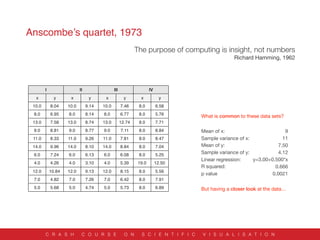
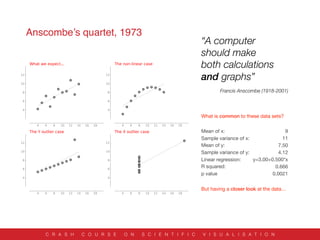
Anscombe’s quartet, 1973
C R A S H C O U R S E O N S C I E N T I F I C V I S U A L I S A T I O N
What is common to these data sets?
Mean of x: 9
Sample variance of x: 11
Mean of y: 7.50
Sample variance of y: 4.12
Linear regression: y=3.00+0.500*x
R squared: 0.666
p value 0.0021
But having a closer look at the data…
I II III IV
x y x y x y x y
10.0 8.04 10.0 9.14 10.0 7.46 8.0 6.58
8.0 6.95 8.0 8.14 8.0 6.77 8.0 5.76
13.0 7.58 13.0 8.74 13.0 12.74 8.0 7.71
9.0 8.81 9.0 8.77 9.0 7.11 8.0 8.84
11.0 8.33 11.0 9.26 11.0 7.81 8.0 8.47
14.0 9.96 14.0 8.10 14.0 8.84 8.0 7.04
6.0 7.24 6.0 6.13 6.0 6.08 8.0 5.25
4.0 4.26 4.0 3.10 4.0 5.39 19.0 12.50
12.0 10.84 12.0 9.13 12.0 8.15 8.0 5.56
7.0 4.82 7.0 7.26 7.0 6.42 8.0 7.91
5.0 5.68 5.0 4.74 5.0 5.73 8.0 6.89
The purpose of computing is insight, not numbers
Richard Hamming, 1962
Anscombe’s quartet, 1973
C R A S H C O U R S E O N S C I E N T I F I C V I S U A L I S A T I O N
What is common to these data sets?
Mean of x: 9
Sample variance of x: 11
Mean of y: 7.50
Sample variance of y: 4.12
Linear regression: y=3.00+0.500*x
R squared: 0.666
p value 0.0021
But having a closer look at the data…
“A computer
should make
both calculations
and graphs”
Francis Anscombe (1918-2001)
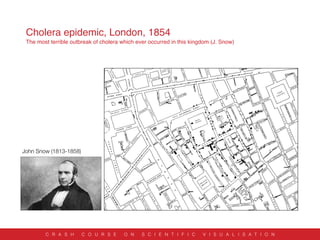
Cholera epidemic, London, 1854
The most terrible outbreak of cholera which ever occurred in this kingdom (J. Snow)
C R A S H C O U R S E O N S C I E N T I F I C V I S U A L I S A T I O N
John Snow (1813-1858)
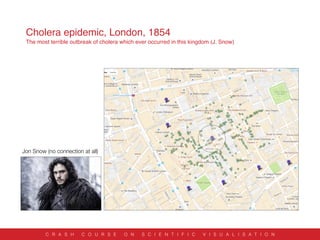
Cholera epidemic, London, 1854
The most terrible outbreak of cholera which ever occurred in this kingdom (J. Snow)
C R A S H C O U R S E O N S C I E N T I F I C V I S U A L I S A T I O N
Jon Snow (no connection at all)
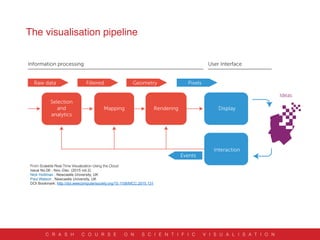
The visualisation pipeline
C R A S H C O U R S E O N S C I E N T I F I C V I S U A L I S A T I O N
From Scalable Real-Time Visualization Using the Cloud
Issue No.06 - Nov.-Dec. (2015 vol.2)
Nick Holliman , Newcastle University, UK
Paul Watson , Newcastle University, UK
DOI Bookmark: http://doi.ieeecomputersociety.org/10.1109/MCC.2015.131
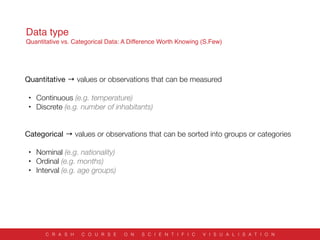
Quantitative → values or observations that can be measured

	 •	 Continuous (e.g. temperature)
	 •	 Discrete (e.g. number of inhabitants)

Categorical → values or observations that can be sorted into groups or categories
	 •	 Nominal (e.g. nationality)

	 •	 Ordinal (e.g. months)

	 •	 Interval (e.g. age groups)

Data type
Quantitative vs. Categorical Data: A Difference Worth Knowing (S.Few)
C R A S H C O U R S E O N S C I E N T I F I C V I S U A L I S A T I O N
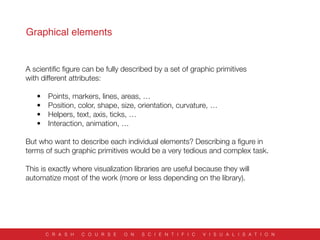
A scientific figure can be fully described by a set of graphic primitives
with different attributes:
	 •	 Points, markers, lines, areas, …
	 •	 Position, color, shape, size, orientation, curvature, …
	 •	 Helpers, text, axis, ticks, …
	 •	 Interaction, animation, …
But who want to describe each individual elements? Describing a figure in
terms of such graphic primitives would be a very tedious and complex task.
This is exactly where visualization libraries are useful because they will
automatize most of the work (more or less depending on the library).
Graphical elements
C R A S H C O U R S E O N S C I E N T I F I C V I S U A L I S A T I O N
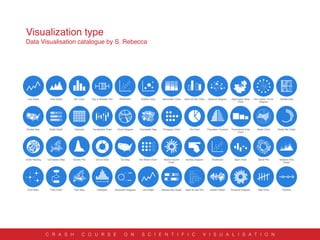
Visualization type
Data Visualisation catalogue by S. Rebecca
C R A S H C O U R S E O N S C I E N T I F I C V I S U A L I S A T I O N
10 Simple Rules for Better Figures
C R A S H C O U R S E O N S C I E N T I F I C V I S U A L I S A T I O N
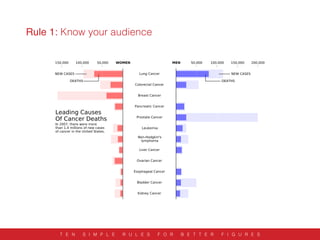
Rule 1: Know your audience
T E N S I M P L E R U L E S F O R B E T T E R F I G U R E S
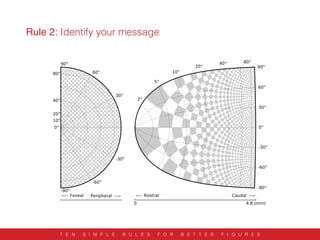
Rule 2: Identify your message
T E N S I M P L E R U L E S F O R B E T T E R F I G U R E S
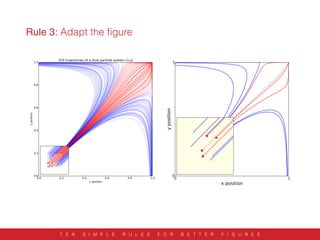
Rule 3: Adapt the figure
T E N S I M P L E R U L E S F O R B E T T E R F I G U R E S
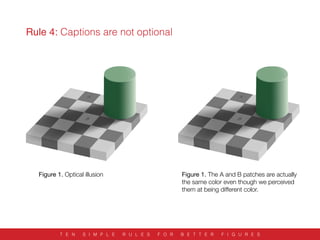
Rule 4: Captions are not optional
T E N S I M P L E R U L E S F O R B E T T E R F I G U R E S
Figure 1. Optical illusion Figure 1. The A and B patches are actually
the same color even though we perceived
them at being different color.
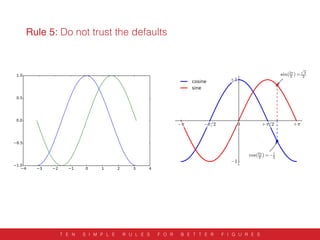
Rule 5: Do not trust the defaults
T E N S I M P L E R U L E S F O R B E T T E R F I G U R E S
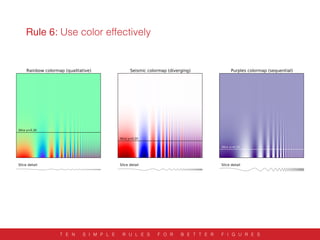
Rule 6: Use color effectively
T E N S I M P L E R U L E S F O R B E T T E R F I G U R E S
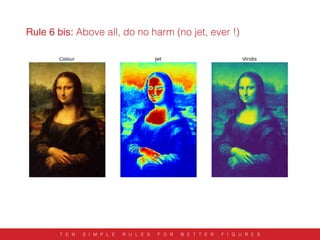
Rule 6 bis: Above all, do no harm (no jet, ever !)
T E N S I M P L E R U L E S F O R B E T T E R F I G U R E S
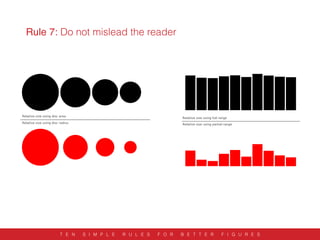
Rule 7: Do not mislead the reader
T E N S I M P L E R U L E S F O R B E T T E R F I G U R E S
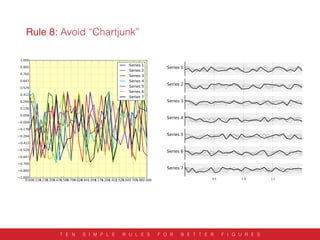
Rule 8: Avoid “Chartjunk”
T E N S I M P L E R U L E S F O R B E T T E R F I G U R E S
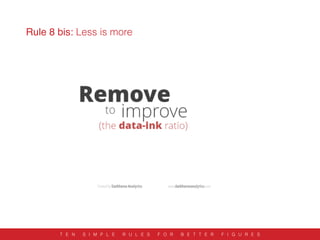
Rule 8 bis: Less is more
T E N S I M P L E R U L E S F O R B E T T E R F I G U R E S
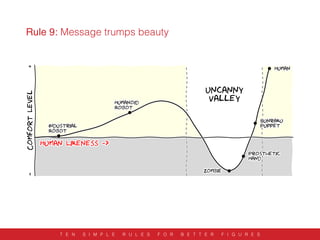
Rule 9: Message trumps beauty
T E N S I M P L E R U L E S F O R B E T T E R F I G U R E S
Rule 10: Get the right tool
T E N S I M P L E R U L E S F O R B E T T E R F I G U R E S
• PDFCrop (remove white borders)

http://pdfcrop.sourceforge.net

• GraphViz (easy graph)

http://www.graphviz.org

• ImageMagick (scripted image processing)

http://www.imagemagick.org/script/index.php

• Gimp (bitmap image manipulation)

https://www.gimp.org

• Inkscape (vector image manipulation)

https://www.inkscape.org

• Tikz (scripted vector art)

http://www.texample.net/tikz/examples/all/

• And many, many, many others …
Enough, theory, let’s practice !
github.com/rougier/matplotlib-tutorial
github.com/rougier/ASPP-2016
C R A S H C O U R S E O N S C I E N T I F I C V I S U A L I S A T I O N

Scientific visualization

  • 1.
    A 2h30 crash-courseon Scientific visualisation Nicolas P. Rougier Advanced Scientific Programming in Python, University of Reading, 2016 Image © 2015 Imeka Solutions Inc.
  • 2.
    What is scientificvisualisation ? C R A S H C O U R S E O N S C I E N T I F I C V I S U A L I S A T I O N “Visualisation is a method of computing. It transforms the symbolic into the geometric, enabling researchers to observe their simulations and computations. Visualisation offers a method for seeing the unseen. It enriches the process of scientific discovery and fosters profound and unexpected insights.” Visualisation in Scientific Computing, NSF report, 1987 “For example, about 50 percent of the cerebral cortex of primates is devoted exclusively to visual processing, and the estimated territory for humans is nearly comparable.” The MIT Encyclopedia of the Cognitive Sciences
  • 3.
    Anscombe’s quartet, 1973 CR A S H C O U R S E O N S C I E N T I F I C V I S U A L I S A T I O N What is common to these data sets? Mean of x: 9 Sample variance of x: 11 Mean of y: 7.50 Sample variance of y: 4.12 Linear regression: y=3.00+0.500*x R squared: 0.666 p value 0.0021 But having a closer look at the data… I II III IV x y x y x y x y 10.0 8.04 10.0 9.14 10.0 7.46 8.0 6.58 8.0 6.95 8.0 8.14 8.0 6.77 8.0 5.76 13.0 7.58 13.0 8.74 13.0 12.74 8.0 7.71 9.0 8.81 9.0 8.77 9.0 7.11 8.0 8.84 11.0 8.33 11.0 9.26 11.0 7.81 8.0 8.47 14.0 9.96 14.0 8.10 14.0 8.84 8.0 7.04 6.0 7.24 6.0 6.13 6.0 6.08 8.0 5.25 4.0 4.26 4.0 3.10 4.0 5.39 19.0 12.50 12.0 10.84 12.0 9.13 12.0 8.15 8.0 5.56 7.0 4.82 7.0 7.26 7.0 6.42 8.0 7.91 5.0 5.68 5.0 4.74 5.0 5.73 8.0 6.89 The purpose of computing is insight, not numbers Richard Hamming, 1962
  • 4.
    Anscombe’s quartet, 1973 CR A S H C O U R S E O N S C I E N T I F I C V I S U A L I S A T I O N What is common to these data sets? Mean of x: 9 Sample variance of x: 11 Mean of y: 7.50 Sample variance of y: 4.12 Linear regression: y=3.00+0.500*x R squared: 0.666 p value 0.0021 But having a closer look at the data… “A computer should make both calculations and graphs” Francis Anscombe (1918-2001)
  • 5.
    Cholera epidemic, London,1854 The most terrible outbreak of cholera which ever occurred in this kingdom (J. Snow) C R A S H C O U R S E O N S C I E N T I F I C V I S U A L I S A T I O N John Snow (1813-1858)
  • 6.
    Cholera epidemic, London,1854 The most terrible outbreak of cholera which ever occurred in this kingdom (J. Snow) C R A S H C O U R S E O N S C I E N T I F I C V I S U A L I S A T I O N Jon Snow (no connection at all)
  • 7.
    The visualisation pipeline CR A S H C O U R S E O N S C I E N T I F I C V I S U A L I S A T I O N From Scalable Real-Time Visualization Using the Cloud Issue No.06 - Nov.-Dec. (2015 vol.2) Nick Holliman , Newcastle University, UK Paul Watson , Newcastle University, UK DOI Bookmark: http://doi.ieeecomputersociety.org/10.1109/MCC.2015.131
  • 8.
    Quantitative → valuesor observations that can be measured
 • Continuous (e.g. temperature) • Discrete (e.g. number of inhabitants) Categorical → values or observations that can be sorted into groups or categories • Nominal (e.g. nationality) • Ordinal (e.g. months) • Interval (e.g. age groups) Data type Quantitative vs. Categorical Data: A Difference Worth Knowing (S.Few) C R A S H C O U R S E O N S C I E N T I F I C V I S U A L I S A T I O N
  • 9.
    A scientific figurecan be fully described by a set of graphic primitives with different attributes: • Points, markers, lines, areas, … • Position, color, shape, size, orientation, curvature, … • Helpers, text, axis, ticks, … • Interaction, animation, … But who want to describe each individual elements? Describing a figure in terms of such graphic primitives would be a very tedious and complex task. This is exactly where visualization libraries are useful because they will automatize most of the work (more or less depending on the library). Graphical elements C R A S H C O U R S E O N S C I E N T I F I C V I S U A L I S A T I O N
  • 10.
    Visualization type Data Visualisationcatalogue by S. Rebecca C R A S H C O U R S E O N S C I E N T I F I C V I S U A L I S A T I O N
  • 11.
    10 Simple Rulesfor Better Figures C R A S H C O U R S E O N S C I E N T I F I C V I S U A L I S A T I O N
  • 12.
    Rule 1: Knowyour audience T E N S I M P L E R U L E S F O R B E T T E R F I G U R E S
  • 13.
    Rule 2: Identifyyour message T E N S I M P L E R U L E S F O R B E T T E R F I G U R E S
  • 14.
    Rule 3: Adaptthe figure T E N S I M P L E R U L E S F O R B E T T E R F I G U R E S
  • 15.
    Rule 4: Captionsare not optional T E N S I M P L E R U L E S F O R B E T T E R F I G U R E S Figure 1. Optical illusion Figure 1. The A and B patches are actually the same color even though we perceived them at being different color.
  • 16.
    Rule 5: Donot trust the defaults T E N S I M P L E R U L E S F O R B E T T E R F I G U R E S
  • 17.
    Rule 6: Usecolor effectively T E N S I M P L E R U L E S F O R B E T T E R F I G U R E S
  • 18.
    Rule 6 bis:Above all, do no harm (no jet, ever !) T E N S I M P L E R U L E S F O R B E T T E R F I G U R E S
  • 19.
    Rule 7: Donot mislead the reader T E N S I M P L E R U L E S F O R B E T T E R F I G U R E S
  • 20.
    Rule 8: Avoid“Chartjunk” T E N S I M P L E R U L E S F O R B E T T E R F I G U R E S
  • 21.
    Rule 8 bis:Less is more T E N S I M P L E R U L E S F O R B E T T E R F I G U R E S
  • 22.
    Rule 9: Messagetrumps beauty T E N S I M P L E R U L E S F O R B E T T E R F I G U R E S
  • 23.
    Rule 10: Getthe right tool T E N S I M P L E R U L E S F O R B E T T E R F I G U R E S • PDFCrop (remove white borders)
 http://pdfcrop.sourceforge.net
 • GraphViz (easy graph)
 http://www.graphviz.org
 • ImageMagick (scripted image processing)
 http://www.imagemagick.org/script/index.php
 • Gimp (bitmap image manipulation)
 https://www.gimp.org
 • Inkscape (vector image manipulation)
 https://www.inkscape.org
 • Tikz (scripted vector art)
 http://www.texample.net/tikz/examples/all/
 • And many, many, many others …
  • 24.
    Enough, theory, let’spractice ! github.com/rougier/matplotlib-tutorial github.com/rougier/ASPP-2016 C R A S H C O U R S E O N S C I E N T I F I C V I S U A L I S A T I O N