Machine Learning
Nicolas P. Rougier
July 2, 2018
Inria – Institute of Neurodegenerative Diseases – Bordeaux
What to learn?
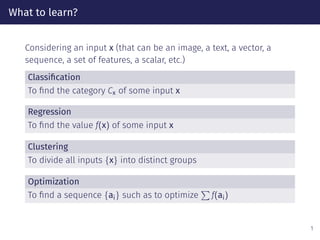
Considering an input x (that can be an image, a text, a vector, a
sequence, a set of features, a scalar, etc.)
Classification
To find the category Cx of some input x
Regression
To find the value f(x) of some input x
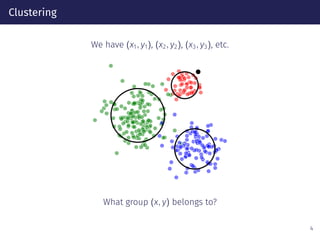
Clustering
To divide all inputs {x} into distinct groups
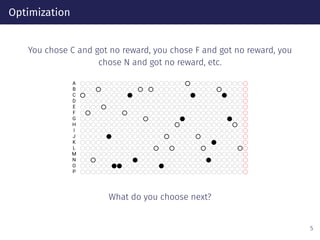
Optimization
To find a sequence {ai} such as to optimize
∑
f(ai)
1
Classification
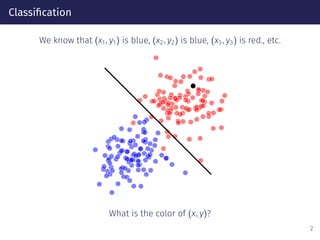
We know that (x1, y1) is blue, (x2, y2) is blue, (x3, y3) is red., etc.
What is the color of (x, y)?
2
Regression
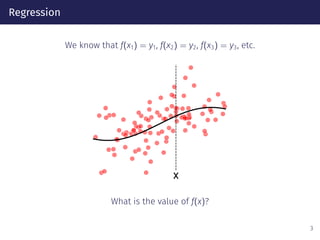
We know that f(x1) = y1, f(x2) = y2, f(x3) = y3, etc.
x
What is the value of f(x)?
3
Clustering
We have (x1, y1), (x2, y2), (x3, y3), etc.
What group (x, y) belongs to?
4
Optimization
You chose C and got no reward, you chose F and got no reward, you
chose N and got no reward, etc.
A
B
C
D
E
F
G
H
I
J
K
L
M
N
O
P
What do you choose next?
5
How to learn?
Supervised learning
To learn a function that maps an input to an output based on
example input-output pairs
Reinforcement learning
To find a policy that maps states to action such as to maximize
long-term reward
Unsupervised learning
To infer a function that describes the structure of some (unlabeled)
data
6
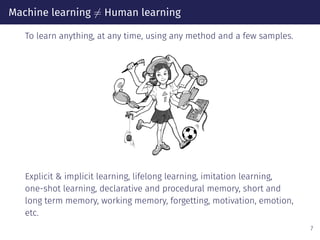
Machine learning ̸= Human learning
To learn anything, at any time, using any method and a few samples.
Explicit & implicit learning, lifelong learning, imitation learning,
one-shot learning, declarative and procedural memory, short and
long term memory, working memory, forgetting, motivation, emotion,
etc.
7
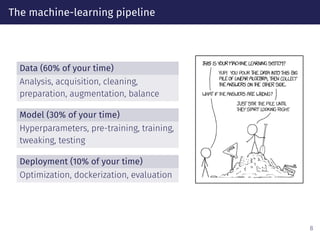
The machine-learning pipeline
Data (60% of your time)
Analysis, acquisition, cleaning,
preparation, augmentation, balance
Model (30% of your time)
Hyperparameters, pre-training, training,
tweaking, testing
Deployment (10% of your time)
Optimization, dockerization, evaluation
8
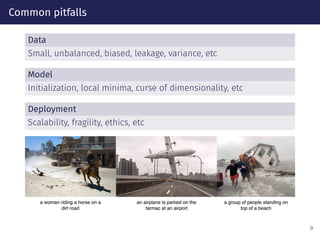
Common pitfalls
Data
Small, unbalanced, biased, leakage, variance, etc
Model
Initialization, local minima, curse of dimensionality, etc
Deployment
Scalability, fragility, ethics, etc
9
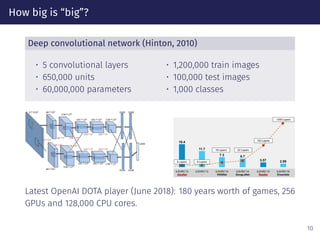
How big is “big”?
Deep convolutional network (Hinton, 2010)
• 5 convolutional layers
• 650,000 units
• 60,000,000 parameters
• 1,200,000 train images
• 100,000 test images
• 1,000 classes
Latest OpenAI DOTA player (June 2018): 180 years worth of games, 256
GPUs and 128,000 CPU cores.
10
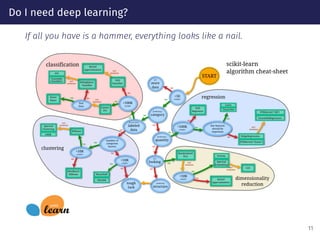
Do I need deep learning?
If all you have is a hammer, everything looks like a nail.
11
Conclusion
Lot of challenges ahead
• Learn with a few samples
• Lifelong learning
• Transfer learning
• Unbiased learning
• Robust learning
• Unsupervised learning
• Reinforcement learning
Lot of opportunities as well...
12

Machine learning

  • 1.
    Machine Learning Nicolas P.Rougier July 2, 2018 Inria – Institute of Neurodegenerative Diseases – Bordeaux
  • 2.
    What to learn? Consideringan input x (that can be an image, a text, a vector, a sequence, a set of features, a scalar, etc.) Classification To find the category Cx of some input x Regression To find the value f(x) of some input x Clustering To divide all inputs {x} into distinct groups Optimization To find a sequence {ai} such as to optimize ∑ f(ai) 1
  • 3.
    Classification We know that(x1, y1) is blue, (x2, y2) is blue, (x3, y3) is red., etc. What is the color of (x, y)? 2
  • 4.
    Regression We know thatf(x1) = y1, f(x2) = y2, f(x3) = y3, etc. x What is the value of f(x)? 3
  • 5.
    Clustering We have (x1,y1), (x2, y2), (x3, y3), etc. What group (x, y) belongs to? 4
  • 6.
    Optimization You chose Cand got no reward, you chose F and got no reward, you chose N and got no reward, etc. A B C D E F G H I J K L M N O P What do you choose next? 5
  • 7.
    How to learn? Supervisedlearning To learn a function that maps an input to an output based on example input-output pairs Reinforcement learning To find a policy that maps states to action such as to maximize long-term reward Unsupervised learning To infer a function that describes the structure of some (unlabeled) data 6
  • 8.
    Machine learning ̸=Human learning To learn anything, at any time, using any method and a few samples. Explicit & implicit learning, lifelong learning, imitation learning, one-shot learning, declarative and procedural memory, short and long term memory, working memory, forgetting, motivation, emotion, etc. 7
  • 9.
    The machine-learning pipeline Data(60% of your time) Analysis, acquisition, cleaning, preparation, augmentation, balance Model (30% of your time) Hyperparameters, pre-training, training, tweaking, testing Deployment (10% of your time) Optimization, dockerization, evaluation 8
  • 10.
    Common pitfalls Data Small, unbalanced,biased, leakage, variance, etc Model Initialization, local minima, curse of dimensionality, etc Deployment Scalability, fragility, ethics, etc 9
  • 11.
    How big is“big”? Deep convolutional network (Hinton, 2010) • 5 convolutional layers • 650,000 units • 60,000,000 parameters • 1,200,000 train images • 100,000 test images • 1,000 classes Latest OpenAI DOTA player (June 2018): 180 years worth of games, 256 GPUs and 128,000 CPU cores. 10
  • 12.
    Do I needdeep learning? If all you have is a hammer, everything looks like a nail. 11
  • 13.
    Conclusion Lot of challengesahead • Learn with a few samples • Lifelong learning • Transfer learning • Unbiased learning • Robust learning • Unsupervised learning • Reinforcement learning Lot of opportunities as well... 12