RESEARCH
METHODOLOGY
1
Dr. Amitabh Mishra, giBS Rohini,
New Delhi
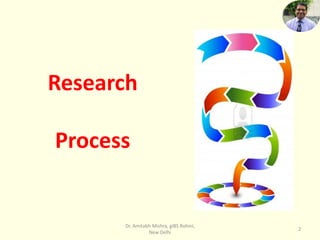
Research
Process
Dr. Amitabh Mishra, giBS Rohini,
New Delhi
2
• “Research process consist of a series of
actions or steps necessary to effectively carry
out research”.
• Research requires completion of each step
before going to next.
Dr. Amitabh Mishra, giBS Rohini,
New Delhi
3
Dr. Amitabh Mishra, giBS Rohini,
New Delhi
4
Dr. Amitabh Mishra, giBS Rohini,
New Delhi
5
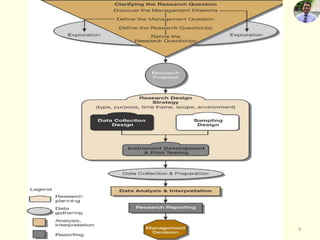
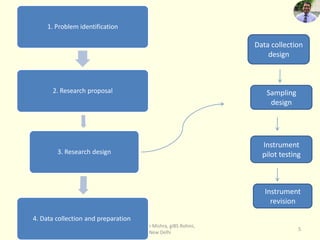
1. Problem identification
2. Research proposal
3. Research design
4. Data collection and preparation
Instrument
pilot testing
Sampling
design
Instrument
revision
Data collection
design
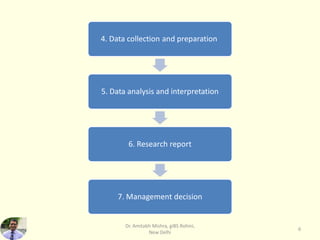
4. Data collection and preparation
5. Data analysis and interpretation
6. Research report
7. Management decision
Dr. Amitabh Mishra, giBS Rohini,
New Delhi
6
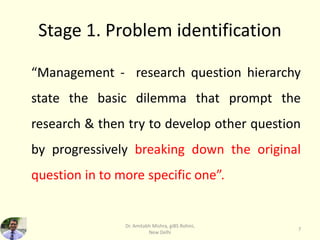
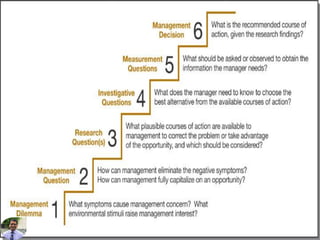
Stage 1. Problem identification
“Management - research question hierarchy
state the basic dilemma that prompt the
research & then try to develop other question
by progressively breaking down the original
question in to more specific one”.
Dr. Amitabh Mishra, giBS Rohini,
New Delhi
7
Dr. Amitabh Mishra, giBS Rohini,
New Delhi
8
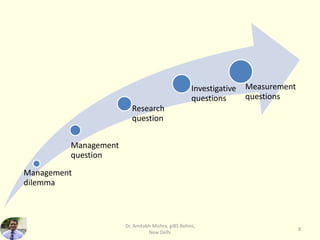
Management
dilemma
Management
question
Research
question
Investigative
questions
Measurement
questions
Dr. Amitabh Mishra, giBS Rohini,
New Delhi
9
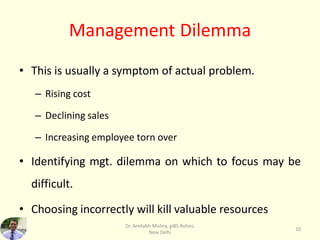
Management Dilemma
• This is usually a symptom of actual problem.
– Rising cost
– Declining sales
– Increasing employee torn over
• Identifying mgt. dilemma on which to focus may be
difficult.
• Choosing incorrectly will kill valuable resources
Dr. Amitabh Mishra, giBS Rohini,
New Delhi
10
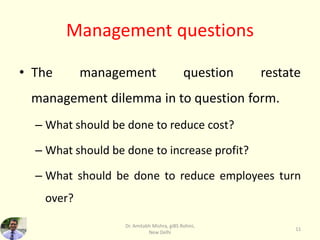
Management questions
• The management question restate
management dilemma in to question form.
– What should be done to reduce cost?
– What should be done to increase profit?
– What should be done to reduce employees turn
over?
Dr. Amitabh Mishra, giBS Rohini,
New Delhi
11
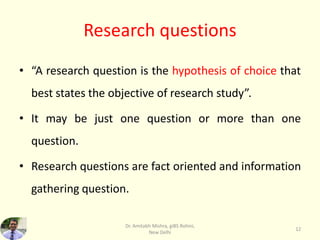
Research questions
• “A research question is the hypothesis of choice that
best states the objective of research study”.
• It may be just one question or more than one
question.
• Research questions are fact oriented and information
gathering question.
Dr. Amitabh Mishra, giBS Rohini,
New Delhi
12
Investigative questions
• Once the research questions have been
selected, researcher thinking moves to a more
specific level, that of investigative question.
• Investigative questions are the questions the
researcher must answer to satisfactorily arrive
at a conclusion about research question.
Dr. Amitabh Mishra, giBS Rohini,
New Delhi
13
• To formulate investigative questions,
researcher takes a general research question
and break it in to more specific questions
about which to gather data.
Dr. Amitabh Mishra, giBS Rohini,
New Delhi
14
Measurement questions
• Measurement questions are the questions we
actually ask to the respondents.
• Measurement questions appear on the
questionnaire.
Dr. Amitabh Mishra, giBS Rohini,
New Delhi
15
Srage 2. Research proposal
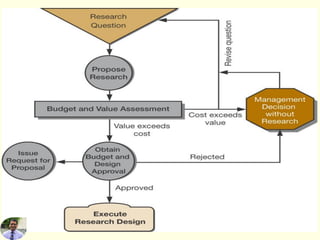
• Once the research is defined, the research must be
proposed in order to allocate resources to the
project.
• “Proposal tells what, why, how, where and to whom
the research will be done. It must also show the
benefits of doing the research”.
Dr. Amitabh Mishra, giBS Rohini,
New Delhi
16
• A written proposal is often required and is desirable
for establishing agreement on a number of issues.
• A research proposal may also be oral. This is more
likely when a manager directs his or her own
research.
• Proposal is also known as work plan, prospectus, out
line, statement of intent or draft plan.
Dr. Amitabh Mishra, giBS Rohini,
New Delhi
17
3-18
3-19
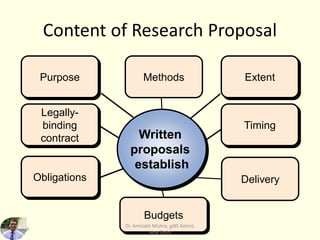
Content of Research Proposal
Delivery
Legally-
binding
contract
Obligations
Written
proposals
establish
Methods
Timing
Budgets
ExtentPurpose
Dr. Amitabh Mishra, giBS Rohini,
New Delhi
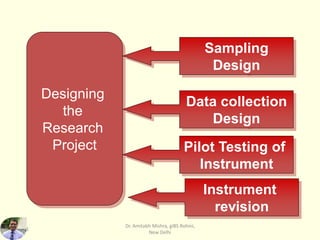
Stage 3. Research Design
• Research design is the blueprint for fulfilling
objectives and providing the insight to answer the
management dilemma. There are many methods,
techniques, procedures, and protocols possible.
Dr. Amitabh Mishra, giBS Rohini,
New Delhi
20
3-21
Designing
the
Research
Project
Sampling
Design
Data collection
Design
Pilot Testing of
Instrument
Instrument
revision
Dr. Amitabh Mishra, giBS Rohini,
New Delhi
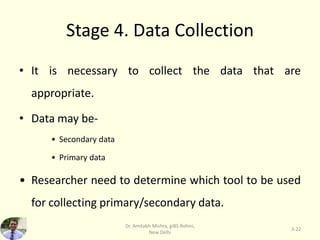
Stage 4. Data Collection
• It is necessary to collect the data that are
appropriate.
• Data may be-
• Secondary data
• Primary data
• Researcher need to determine which tool to be used
for collecting primary/secondary data.
3-22
Dr. Amitabh Mishra, giBS Rohini,
New Delhi
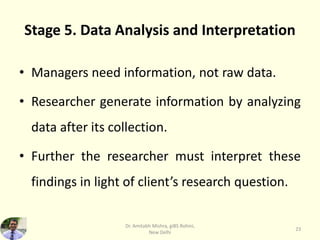
Stage 5. Data Analysis and Interpretation
• Managers need information, not raw data.
• Researcher generate information by analyzing
data after its collection.
• Further the researcher must interpret these
findings in light of client’s research question.
Dr. Amitabh Mishra, giBS Rohini,
New Delhi
23
3-24
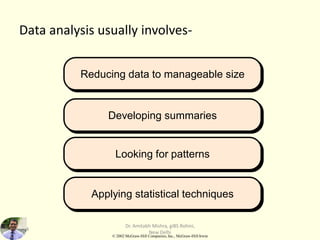
Reducing data to manageable size
© 2002 McGraw-Hill Companies, Inc., McGraw-Hill/Irwin
Data analysis usually involves-
Developing summaries
Looking for patterns
Applying statistical techniques
Dr. Amitabh Mishra, giBS Rohini,
New Delhi
Pilot
Testing
Dr. Amitabh Mishra, giBS Rohini,
New Delhi
25
• “Pilot testing involves conducting a preliminary test
of data collection tools and procedures to identify
and eliminate problems, allowing researchers to
make corrective changes or adjustments before
actually collecting data from the target population”.
Dr. Amitabh Mishra, giBS Rohini,
New Delhi
26
• A pilot test usually involves simulating the actual data
collection process on a small scale to get feedback on whether
or not the instruments are likely to work as expected in a "real
world" situation.
• A pilot test is a method used to test the design and/or
methods and/or instrument prior to carrying out the research.
Dr. Amitabh Mishra, giBS Rohini,
New Delhi
27
Objectives of Pilot testing
• Pilot testing gives researchers an opportunity-
– To make revisions to instruments and data collection
procedures
– To ensure that appropriate questions are being asked,
– To ensure that the right data will be collected, and
– To ensure that the data collection methods will work.
Dr. Amitabh Mishra, giBS Rohini,
New Delhi
28
Importance of Pilot testing
• Pilot testing provides an opportunity to detect and remedy a
wide range of potential problems with an instrument.
• Researchers that neglect pilot testing run the risk of collecting
useless data.
Dr. Amitabh Mishra, giBS Rohini,
New Delhi
29
• Pilot testing is done -
– To detect and remedy questions that respondents don't
understand.
– To detect and remedy ambiguous questions.
– To detect and remedy questions that combine two or more
issues in a single question (double-barreled questions)
– To detect and remedy questions that make respondents
uncomfortable.
– To identify ways to improve how an instrument is administered.
Dr. Amitabh Mishra, giBS Rohini,
New Delhi
30

Business Research Process

  • 1.
  • 2.
    Research Process Dr. Amitabh Mishra,giBS Rohini, New Delhi 2
  • 3.
    • “Research processconsist of a series of actions or steps necessary to effectively carry out research”. • Research requires completion of each step before going to next. Dr. Amitabh Mishra, giBS Rohini, New Delhi 3
  • 4.
    Dr. Amitabh Mishra,giBS Rohini, New Delhi 4
  • 5.
    Dr. Amitabh Mishra,giBS Rohini, New Delhi 5 1. Problem identification 2. Research proposal 3. Research design 4. Data collection and preparation Instrument pilot testing Sampling design Instrument revision Data collection design
  • 6.
    4. Data collectionand preparation 5. Data analysis and interpretation 6. Research report 7. Management decision Dr. Amitabh Mishra, giBS Rohini, New Delhi 6
  • 7.
    Stage 1. Problemidentification “Management - research question hierarchy state the basic dilemma that prompt the research & then try to develop other question by progressively breaking down the original question in to more specific one”. Dr. Amitabh Mishra, giBS Rohini, New Delhi 7
  • 8.
    Dr. Amitabh Mishra,giBS Rohini, New Delhi 8 Management dilemma Management question Research question Investigative questions Measurement questions
  • 9.
    Dr. Amitabh Mishra,giBS Rohini, New Delhi 9
  • 10.
    Management Dilemma • Thisis usually a symptom of actual problem. – Rising cost – Declining sales – Increasing employee torn over • Identifying mgt. dilemma on which to focus may be difficult. • Choosing incorrectly will kill valuable resources Dr. Amitabh Mishra, giBS Rohini, New Delhi 10
  • 11.
    Management questions • Themanagement question restate management dilemma in to question form. – What should be done to reduce cost? – What should be done to increase profit? – What should be done to reduce employees turn over? Dr. Amitabh Mishra, giBS Rohini, New Delhi 11
  • 12.
    Research questions • “Aresearch question is the hypothesis of choice that best states the objective of research study”. • It may be just one question or more than one question. • Research questions are fact oriented and information gathering question. Dr. Amitabh Mishra, giBS Rohini, New Delhi 12
  • 13.
    Investigative questions • Oncethe research questions have been selected, researcher thinking moves to a more specific level, that of investigative question. • Investigative questions are the questions the researcher must answer to satisfactorily arrive at a conclusion about research question. Dr. Amitabh Mishra, giBS Rohini, New Delhi 13
  • 14.
    • To formulateinvestigative questions, researcher takes a general research question and break it in to more specific questions about which to gather data. Dr. Amitabh Mishra, giBS Rohini, New Delhi 14
  • 15.
    Measurement questions • Measurementquestions are the questions we actually ask to the respondents. • Measurement questions appear on the questionnaire. Dr. Amitabh Mishra, giBS Rohini, New Delhi 15
  • 16.
    Srage 2. Researchproposal • Once the research is defined, the research must be proposed in order to allocate resources to the project. • “Proposal tells what, why, how, where and to whom the research will be done. It must also show the benefits of doing the research”. Dr. Amitabh Mishra, giBS Rohini, New Delhi 16
  • 17.
    • A writtenproposal is often required and is desirable for establishing agreement on a number of issues. • A research proposal may also be oral. This is more likely when a manager directs his or her own research. • Proposal is also known as work plan, prospectus, out line, statement of intent or draft plan. Dr. Amitabh Mishra, giBS Rohini, New Delhi 17
  • 18.
  • 19.
    3-19 Content of ResearchProposal Delivery Legally- binding contract Obligations Written proposals establish Methods Timing Budgets ExtentPurpose Dr. Amitabh Mishra, giBS Rohini, New Delhi
  • 20.
    Stage 3. ResearchDesign • Research design is the blueprint for fulfilling objectives and providing the insight to answer the management dilemma. There are many methods, techniques, procedures, and protocols possible. Dr. Amitabh Mishra, giBS Rohini, New Delhi 20
  • 21.
    3-21 Designing the Research Project Sampling Design Data collection Design Pilot Testingof Instrument Instrument revision Dr. Amitabh Mishra, giBS Rohini, New Delhi
  • 22.
    Stage 4. DataCollection • It is necessary to collect the data that are appropriate. • Data may be- • Secondary data • Primary data • Researcher need to determine which tool to be used for collecting primary/secondary data. 3-22 Dr. Amitabh Mishra, giBS Rohini, New Delhi
  • 23.
    Stage 5. DataAnalysis and Interpretation • Managers need information, not raw data. • Researcher generate information by analyzing data after its collection. • Further the researcher must interpret these findings in light of client’s research question. Dr. Amitabh Mishra, giBS Rohini, New Delhi 23
  • 24.
    3-24 Reducing data tomanageable size © 2002 McGraw-Hill Companies, Inc., McGraw-Hill/Irwin Data analysis usually involves- Developing summaries Looking for patterns Applying statistical techniques Dr. Amitabh Mishra, giBS Rohini, New Delhi
  • 25.
    Pilot Testing Dr. Amitabh Mishra,giBS Rohini, New Delhi 25
  • 26.
    • “Pilot testinginvolves conducting a preliminary test of data collection tools and procedures to identify and eliminate problems, allowing researchers to make corrective changes or adjustments before actually collecting data from the target population”. Dr. Amitabh Mishra, giBS Rohini, New Delhi 26
  • 27.
    • A pilottest usually involves simulating the actual data collection process on a small scale to get feedback on whether or not the instruments are likely to work as expected in a "real world" situation. • A pilot test is a method used to test the design and/or methods and/or instrument prior to carrying out the research. Dr. Amitabh Mishra, giBS Rohini, New Delhi 27
  • 28.
    Objectives of Pilottesting • Pilot testing gives researchers an opportunity- – To make revisions to instruments and data collection procedures – To ensure that appropriate questions are being asked, – To ensure that the right data will be collected, and – To ensure that the data collection methods will work. Dr. Amitabh Mishra, giBS Rohini, New Delhi 28
  • 29.
    Importance of Pilottesting • Pilot testing provides an opportunity to detect and remedy a wide range of potential problems with an instrument. • Researchers that neglect pilot testing run the risk of collecting useless data. Dr. Amitabh Mishra, giBS Rohini, New Delhi 29
  • 30.
    • Pilot testingis done - – To detect and remedy questions that respondents don't understand. – To detect and remedy ambiguous questions. – To detect and remedy questions that combine two or more issues in a single question (double-barreled questions) – To detect and remedy questions that make respondents uncomfortable. – To identify ways to improve how an instrument is administered. Dr. Amitabh Mishra, giBS Rohini, New Delhi 30