MODERN & INTERACTIVE SCIENTIFIC VISUALIZATION
USING SHADER BASED RENDERING
Nicolas P. Rougier
Luke Campagola - Almar Klein - Cyrille Rossant - Eric Larson
X.Org Developer Conference 2014
Bordeaux, October 8–10
A Bit of Context
The Python Scientific Stack
→ Python, modern computing script language
→ IPython, an advanced Python shell
→ Numpy, powerful numerical arrays objects.
→ Scipy, high-level data processing routines.
→ Matplotlib, 2-D visualization plots
Python
Matplotlib
NumPy
SciPy
IPython
IP[y]:
SymPy
Σ ∫dx
[1
00
1]
SciKits
Versatile, beautiful but... slow !
Matplotlib is a python plotting library, primarily for 2-D plotting, but with some 3-D support,
which produces publication-quality figures in a variety of hardcopy formats and interactive
environments across platforms.
→ Antigrain geometry, High Fidelity 2D Graphics (www.antigrain.com)
→ Ten Simple Rules for Better Figures, Nicolas P. Rougier, Michael Droettboom, Philip E.
Bourne PLoS Computational Biology, Vol. 10, No. 9.
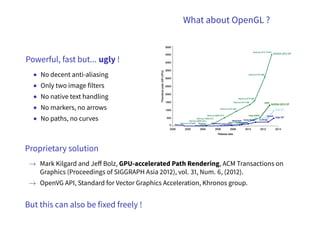
What about OpenGL ?
Powerful, fast but... ugly !
• No decent anti-aliasing
• Only two image filters
• No native text handling
• No markers, no arrows
• No paths, no curves
Proprietary solution
→ Mark Kilgard and Jeff Bolz, GPU-accelerated Path Rendering, ACM Transactions on
Graphics (Proceedings of SIGGRAPH Asia 2012), vol. 31, Num. 6, (2012).
→ OpenVG API, Standard for Vector Graphics Acceleration, Khronos group.
But this can also be fixed freely !
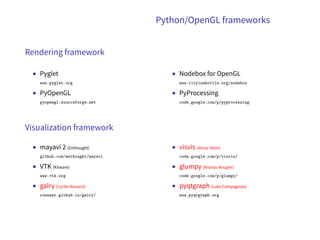
Python/OpenGL frameworks
Rendering framework
• Pyglet
www.pyglet.org
• PyOpenGL
pyopengl.sourceforge.net
• Nodebox for OpenGL
www.cityinabottle.org/nodebox
• PyProcessing
code.google.com/p/pyprocessing
Visualization framework
• mayavi 2 (Enthought)
github.com/enthought/mayavi
• VTK (Kitware)
www.vtk.org
• galry (Cyrille Rossant)
rossant.github.io/galry/
• visvis (Almar Klein)
code.google.com/p/visvis/
• glumpy (Nicolas Rougier)
code.google.com/p/glumpy/
• pyqtgraph (Luke Campagnola)
www.pyqtgraph.org
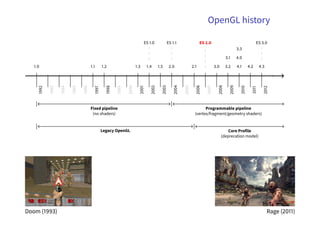
OpenGL history
ES 1.0 ES 1.1 ES 3.0ES 2.0
1992
1.0
1997
1.1
1998
1.2
2001
1.3
2002
1.4
2003
1.5
2004
2.0
2006
2.1
2008
3.0
2009
3.2
2010
4.1
2011
4.2
2012
4.3
1993
1994
1995
1996
1999
2000
2005
2007
3.1 4.0
3.3
Fixed pipeline
(no shaders)
Programmable pipeline
(vertex/fragment/geometry shaders)
Legacy OpenGL Core Profile
(deprecation model)
Doom (1993) Rage (2011)
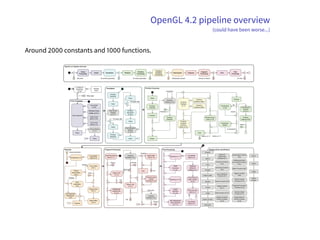
OpenGL 4.2 pipeline overview
(could have been worse...)
Around 2000 constants and 1000 functions.
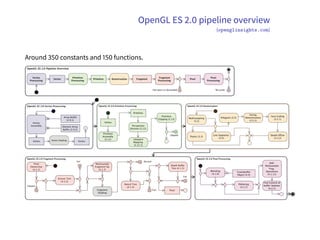
OpenGL ES 2.0 pipeline overview
(openglinsights.com)
Around 350 constants and 150 functions.
Pipeline overview
Data centered
CPU(python)
GPU(shaders)
Raw
Data
Baked
Data
Transformed
Data
Rendered
Data
Critical parts are the baking process and the transfer to GPU memory.
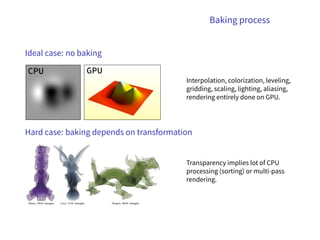
Baking process
Ideal case: no baking
Interpolation, colorization, leveling,
gridding, scaling, lighting, aliasing,
rendering entirely done on GPU.
Hard case: baking depends on transformation
Transparency implies lot of CPU
processing (sorting) or multi-pass
rendering.
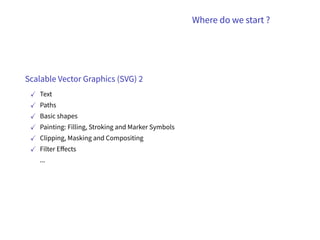
Where do we start ?
Scalable Vector Graphics (SVG) 2
Text
Paths
Basic shapes
Painting: Filling, Stroking and Marker Symbols
Clipping, Masking and Compositing
Filter Effects
...
Text rendering
Different techniques
Bitmap, stroke, texture, sdf, vector...
→ Nicolas P. Rougier, Higher Quality 2D Text Rendering, Journal of Computer Graphics
Techniques (JCGT), vol. 2, no. 1, 50-64, 2013.
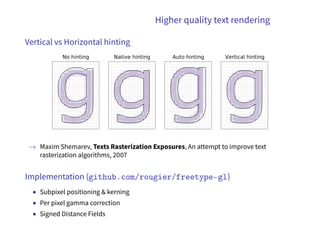
Higher quality text rendering
Vertical vs Horizontal hinting
No hinting Native hinting Auto hinting Vertical hinting
→ Maxim Shemarev, Texts Rasterization Exposures, An attempt to improve text
rasterization algorithms, 2007
Implementation (github.com/rougier/freetype-gl)
• Subpixel positioning & kerning
• Per pixel gamma correction
• Signed Distance Fields
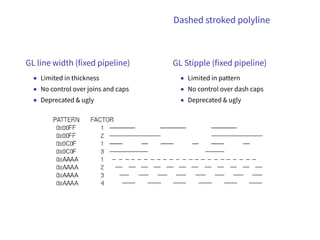
Dashed stroked polyline
GL line width (fixed pipeline)
• Limited in thickness
• No control over joins and caps
• Deprecated & ugly
GL Stipple (fixed pipeline)
• Limited in pattern
• No control over dash caps
• Deprecated & ugly
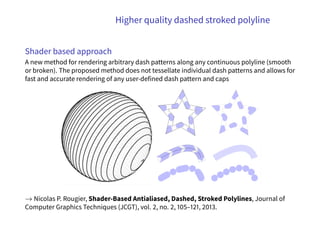
Higher quality dashed stroked polyline
Shader based approach
A new method for rendering arbitrary dash patterns along any continuous polyline (smooth
or broken). The proposed method does not tessellate individual dash patterns and allows for
fast and accurate rendering of any user-defined dash pattern and caps
→ Nicolas P. Rougier, Shader-Based Antialiased, Dashed, Stroked Polylines, Journal of
Computer Graphics Techniques (JCGT), vol. 2, no. 2, 105–121, 2013.
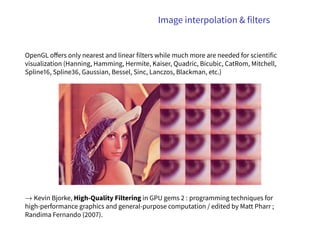
Image interpolation & filters
OpenGL offers only nearest and linear filters while much more are needed for scientific
visualization (Hanning, Hamming, Hermite, Kaiser, Quadric, Bicubic, CatRom, Mitchell,
Spline16, Spline36, Gaussian, Bessel, Sinc, Lanczos, Blackman, etc.)
→ Kevin Bjorke, High-Quality Filtering in GPU gems 2 : programming techniques for
high-performance graphics and general-purpose computation / edited by Matt Pharr ;
Randima Fernando (2007).
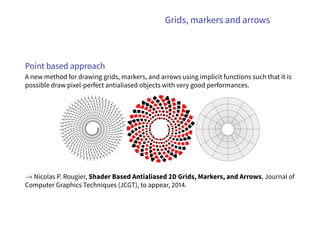
Grids, markers and arrows
Point based approach
A new method for drawing grids, markers, and arrows using implicit functions such that it is
possible draw pixel-perfect antialiased objects with very good performances.
→ Nicolas P. Rougier, Shader Based Antialiased 2D Grids, Markers, and Arrows, Journal of
Computer Graphics Techniques (JCGT), to appear, 2014.
Still lot of problems ahead...
...but work is in progress
Shader composition
How to define a shader format that allow easy composition/templating ?
Level of details
How to set automatic level of details ?
Very big data
How to render data that doesn’t even fit into GPU memory ?
Complex data transformation
How to handle user-supplied exotic transformation ?
From DesktopGL to WebGL
How to render in browser from a python session ?
...
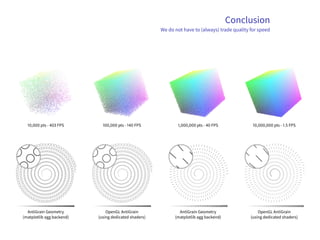
Conclusion
We do not have to (always) trade quality for speed
10,000 pts - 403 FPS 100,000 pts - 140 FPS 1,000,000 pts - 40 FPS 10,000,000 pts - 1.5 FPS
AntiGrain Geometry
(matplotlib agg backend)
OpenGL AntiGrain
(using dedicated shaders)
AntiGrain Geometry
(matplotlib agg backend)
OpenGL AntiGrain
(using dedicated shaders)
Informations & links
The code is spread in several projects but should be soon integrated in the master vispy
project.
Projects page
• vispy.org
• vispy.org/gallery.html
• glumpy.github.io
• glumpy.github.io/gallery.html
Code repositories
• github.com/vispy/vispy
• github.com/glumpy/glumpy
• github.com/rougier/gl-agg
• github.com/rougier/freetype-gl
Demo pages
• Markers: https://www.shadertoy.com/view/XsXXDX
• Arrows: https://www.shadertoy.com/view/ldlSWj
• Transverse Mercator grid: https://www.shadertoy.com/view/lsSXzm
• Cartesian grid: https://www.shadertoy.com/view/MdSXRm
• Polar grid: https://www.shadertoy.com/view/MsBSRm
Modern OpenGL scientific visualization

Modern OpenGL scientific visualization

  • 1.
    MODERN & INTERACTIVESCIENTIFIC VISUALIZATION USING SHADER BASED RENDERING Nicolas P. Rougier Luke Campagola - Almar Klein - Cyrille Rossant - Eric Larson X.Org Developer Conference 2014 Bordeaux, October 8–10
  • 2.
    A Bit ofContext The Python Scientific Stack → Python, modern computing script language → IPython, an advanced Python shell → Numpy, powerful numerical arrays objects. → Scipy, high-level data processing routines. → Matplotlib, 2-D visualization plots Python Matplotlib NumPy SciPy IPython IP[y]: SymPy Σ ∫dx [1 00 1] SciKits Versatile, beautiful but... slow ! Matplotlib is a python plotting library, primarily for 2-D plotting, but with some 3-D support, which produces publication-quality figures in a variety of hardcopy formats and interactive environments across platforms. → Antigrain geometry, High Fidelity 2D Graphics (www.antigrain.com) → Ten Simple Rules for Better Figures, Nicolas P. Rougier, Michael Droettboom, Philip E. Bourne PLoS Computational Biology, Vol. 10, No. 9.
  • 3.
    What about OpenGL? Powerful, fast but... ugly ! • No decent anti-aliasing • Only two image filters • No native text handling • No markers, no arrows • No paths, no curves Proprietary solution → Mark Kilgard and Jeff Bolz, GPU-accelerated Path Rendering, ACM Transactions on Graphics (Proceedings of SIGGRAPH Asia 2012), vol. 31, Num. 6, (2012). → OpenVG API, Standard for Vector Graphics Acceleration, Khronos group. But this can also be fixed freely !
  • 4.
    Python/OpenGL frameworks Rendering framework •Pyglet www.pyglet.org • PyOpenGL pyopengl.sourceforge.net • Nodebox for OpenGL www.cityinabottle.org/nodebox • PyProcessing code.google.com/p/pyprocessing Visualization framework • mayavi 2 (Enthought) github.com/enthought/mayavi • VTK (Kitware) www.vtk.org • galry (Cyrille Rossant) rossant.github.io/galry/ • visvis (Almar Klein) code.google.com/p/visvis/ • glumpy (Nicolas Rougier) code.google.com/p/glumpy/ • pyqtgraph (Luke Campagnola) www.pyqtgraph.org
  • 5.
    OpenGL history ES 1.0ES 1.1 ES 3.0ES 2.0 1992 1.0 1997 1.1 1998 1.2 2001 1.3 2002 1.4 2003 1.5 2004 2.0 2006 2.1 2008 3.0 2009 3.2 2010 4.1 2011 4.2 2012 4.3 1993 1994 1995 1996 1999 2000 2005 2007 3.1 4.0 3.3 Fixed pipeline (no shaders) Programmable pipeline (vertex/fragment/geometry shaders) Legacy OpenGL Core Profile (deprecation model) Doom (1993) Rage (2011)
  • 6.
    OpenGL 4.2 pipelineoverview (could have been worse...) Around 2000 constants and 1000 functions.
  • 7.
    OpenGL ES 2.0pipeline overview (openglinsights.com) Around 350 constants and 150 functions.
  • 8.
  • 9.
    Baking process Ideal case:no baking Interpolation, colorization, leveling, gridding, scaling, lighting, aliasing, rendering entirely done on GPU. Hard case: baking depends on transformation Transparency implies lot of CPU processing (sorting) or multi-pass rendering.
  • 10.
    Where do westart ? Scalable Vector Graphics (SVG) 2 Text Paths Basic shapes Painting: Filling, Stroking and Marker Symbols Clipping, Masking and Compositing Filter Effects ...
  • 11.
    Text rendering Different techniques Bitmap,stroke, texture, sdf, vector... → Nicolas P. Rougier, Higher Quality 2D Text Rendering, Journal of Computer Graphics Techniques (JCGT), vol. 2, no. 1, 50-64, 2013.
  • 12.
    Higher quality textrendering Vertical vs Horizontal hinting No hinting Native hinting Auto hinting Vertical hinting → Maxim Shemarev, Texts Rasterization Exposures, An attempt to improve text rasterization algorithms, 2007 Implementation (github.com/rougier/freetype-gl) • Subpixel positioning & kerning • Per pixel gamma correction • Signed Distance Fields
  • 13.
    Dashed stroked polyline GLline width (fixed pipeline) • Limited in thickness • No control over joins and caps • Deprecated & ugly GL Stipple (fixed pipeline) • Limited in pattern • No control over dash caps • Deprecated & ugly
  • 14.
    Higher quality dashedstroked polyline Shader based approach A new method for rendering arbitrary dash patterns along any continuous polyline (smooth or broken). The proposed method does not tessellate individual dash patterns and allows for fast and accurate rendering of any user-defined dash pattern and caps → Nicolas P. Rougier, Shader-Based Antialiased, Dashed, Stroked Polylines, Journal of Computer Graphics Techniques (JCGT), vol. 2, no. 2, 105–121, 2013.
  • 15.
    Image interpolation &filters OpenGL offers only nearest and linear filters while much more are needed for scientific visualization (Hanning, Hamming, Hermite, Kaiser, Quadric, Bicubic, CatRom, Mitchell, Spline16, Spline36, Gaussian, Bessel, Sinc, Lanczos, Blackman, etc.) → Kevin Bjorke, High-Quality Filtering in GPU gems 2 : programming techniques for high-performance graphics and general-purpose computation / edited by Matt Pharr ; Randima Fernando (2007).
  • 16.
    Grids, markers andarrows Point based approach A new method for drawing grids, markers, and arrows using implicit functions such that it is possible draw pixel-perfect antialiased objects with very good performances. → Nicolas P. Rougier, Shader Based Antialiased 2D Grids, Markers, and Arrows, Journal of Computer Graphics Techniques (JCGT), to appear, 2014.
  • 17.
    Still lot ofproblems ahead... ...but work is in progress Shader composition How to define a shader format that allow easy composition/templating ? Level of details How to set automatic level of details ? Very big data How to render data that doesn’t even fit into GPU memory ? Complex data transformation How to handle user-supplied exotic transformation ? From DesktopGL to WebGL How to render in browser from a python session ? ...
  • 18.
    Conclusion We do nothave to (always) trade quality for speed 10,000 pts - 403 FPS 100,000 pts - 140 FPS 1,000,000 pts - 40 FPS 10,000,000 pts - 1.5 FPS AntiGrain Geometry (matplotlib agg backend) OpenGL AntiGrain (using dedicated shaders) AntiGrain Geometry (matplotlib agg backend) OpenGL AntiGrain (using dedicated shaders)
  • 19.
    Informations & links Thecode is spread in several projects but should be soon integrated in the master vispy project. Projects page • vispy.org • vispy.org/gallery.html • glumpy.github.io • glumpy.github.io/gallery.html Code repositories • github.com/vispy/vispy • github.com/glumpy/glumpy • github.com/rougier/gl-agg • github.com/rougier/freetype-gl Demo pages • Markers: https://www.shadertoy.com/view/XsXXDX • Arrows: https://www.shadertoy.com/view/ldlSWj • Transverse Mercator grid: https://www.shadertoy.com/view/lsSXzm • Cartesian grid: https://www.shadertoy.com/view/MdSXRm • Polar grid: https://www.shadertoy.com/view/MsBSRm