The Scientific Method
The Awareness Test
http://youtu.be/Ahg6qcgoay4
What is the Scientific Method?
• An organized plan for gathering,
organizing and communicating data
• The basic steps that scientists follow in
uncovering facts and solving scientific
problems ( a plan for solving a problem).
• Six or Seven Steps - depends on source
What is the Scientific Method?
• Make an Observation
• Ask a Question
• Complete Background Research
• Develop a Hypothesis
• Test your Hypothesis
• Analyze the Data
• Conclusion (Report and Share)
Step 1: Observation
• Everything starts with an observation
• What you perceive with your senses
What can you
observe about a
piece of paper?
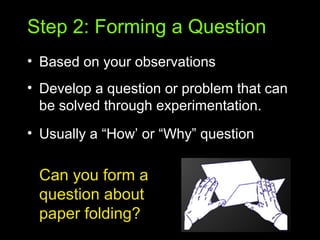
Step 2: Forming a Question
• Based on your observations
• Develop a question or problem that can
be solved through experimentation.
Can you form a
question about
paper folding?
• Usually a “How’ or “Why” question
Step 2: Forming a Question
How many times
can you fold a
piece of paper?
Step 3: Complete Background
Research
• Collect knowledge needed to know
about the subject of the experiment
• It will be used to form a
hypothesis
Step 4: Develop a Hypothesis
• Hypothesis = an educated prediction to
the answer of the stated problem
• Based on research and prior knowledge
Not a W.U.G. !
(Wild
Uneducated
Guess)
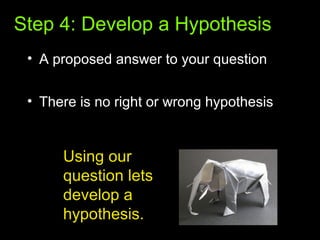
Step 4: Develop a Hypothesis
• A proposed answer to your question
• There is no right or wrong hypothesis
Using our
question lets
develop a
hypothesis.
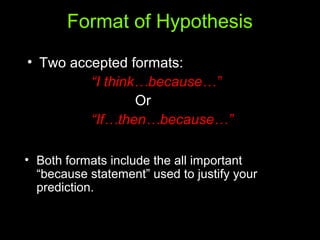
Format of Hypothesis
• Two accepted formats:
“I think…because…”
Or
“If…then…because…”
• Both formats include the all important
“because statement” used to justify your
prediction.
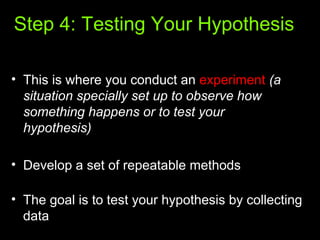
Step 4: Testing Your Hypothesis
• This is where you conduct an experiment (a
situation specially set up to observe how
something happens or to test your
hypothesis)
• Develop a set of repeatable methods
• The goal is to test your hypothesis by collecting
data
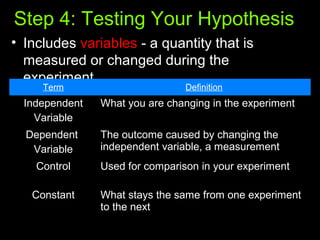
Step 4: Testing Your Hypothesis
• Includes variables - a quantity that is
measured or changed during the
experiment
Term Definition
Independent
Variable
What you are changing in the experiment
Dependent
Variable
The outcome caused by changing the
independent variable, a measurement
Control Used for comparison in your experiment
Constant What stays the same from one experiment
to the next
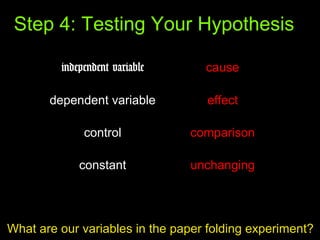
Step 4: Testing Your Hypothesis
What are our variables in the paper folding experiment?
independent variable cause
dependent variable effect
control comparison
constant unchanging
Step 5: Collect and Analyze the
Data
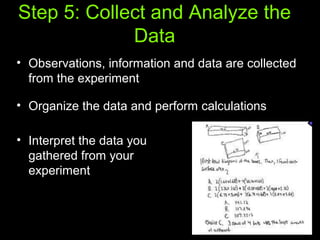
• Interpret the data you
gathered from your
experiment
• Observations, information and data are collected
from the experiment
• Organize the data and perform calculations
Step 5: Collect and Analyze the
Data
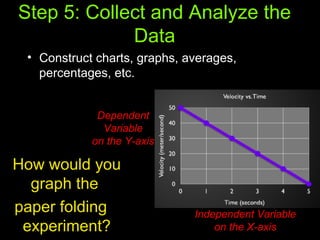
• Construct charts, graphs, averages,
percentages, etc.
Dependent
Variable
on the Y-axis
Independent Variable
on the X-axis
How would you
graph the
paper folding
experiment?
Step 6: Conclusion
• Does your data support your
hypothesis?
You just made a
scientific discovery.
YES
Revise or make a
new hypothesis and
test again.
NO
Step 6: Conclusion (Sharing)
• A summary of results,
the answer to your
question.
• What were the possible
sources of error?
• Does your data (answer)
support your hypothesis?
Why or why not?
What conclusion can you make about paper folding?
What about a huge sheet of paper?
http://www.youtube.com/watch?v=kRAEBbotuIE&feature=share&list=TLWRT4dnDchcU
Why use the Scientific Method?
• A logical way to problem solve - in all
aspects of life.
• A way to share information that can be
proved or disproved.
• A way to find new information

Scientific method PPT 2013 for notes

  • 1.
  • 2.
  • 3.
    What is theScientific Method? • An organized plan for gathering, organizing and communicating data • The basic steps that scientists follow in uncovering facts and solving scientific problems ( a plan for solving a problem). • Six or Seven Steps - depends on source
  • 4.
    What is theScientific Method? • Make an Observation • Ask a Question • Complete Background Research • Develop a Hypothesis • Test your Hypothesis • Analyze the Data • Conclusion (Report and Share)
  • 5.
    Step 1: Observation •Everything starts with an observation • What you perceive with your senses What can you observe about a piece of paper?
  • 6.
    Step 2: Forminga Question • Based on your observations • Develop a question or problem that can be solved through experimentation. Can you form a question about paper folding? • Usually a “How’ or “Why” question
  • 7.
    Step 2: Forminga Question How many times can you fold a piece of paper?
  • 8.
    Step 3: CompleteBackground Research • Collect knowledge needed to know about the subject of the experiment • It will be used to form a hypothesis
  • 9.
    Step 4: Developa Hypothesis • Hypothesis = an educated prediction to the answer of the stated problem • Based on research and prior knowledge Not a W.U.G. ! (Wild Uneducated Guess)
  • 10.
    Step 4: Developa Hypothesis • A proposed answer to your question • There is no right or wrong hypothesis Using our question lets develop a hypothesis.
  • 11.
    Format of Hypothesis •Two accepted formats: “I think…because…” Or “If…then…because…” • Both formats include the all important “because statement” used to justify your prediction.
  • 12.
    Step 4: TestingYour Hypothesis • This is where you conduct an experiment (a situation specially set up to observe how something happens or to test your hypothesis) • Develop a set of repeatable methods • The goal is to test your hypothesis by collecting data
  • 13.
    Step 4: TestingYour Hypothesis • Includes variables - a quantity that is measured or changed during the experiment Term Definition Independent Variable What you are changing in the experiment Dependent Variable The outcome caused by changing the independent variable, a measurement Control Used for comparison in your experiment Constant What stays the same from one experiment to the next
  • 14.
    Step 4: TestingYour Hypothesis What are our variables in the paper folding experiment? independent variable cause dependent variable effect control comparison constant unchanging
  • 15.
    Step 5: Collectand Analyze the Data • Interpret the data you gathered from your experiment • Observations, information and data are collected from the experiment • Organize the data and perform calculations
  • 16.
    Step 5: Collectand Analyze the Data • Construct charts, graphs, averages, percentages, etc. Dependent Variable on the Y-axis Independent Variable on the X-axis How would you graph the paper folding experiment?
  • 17.
    Step 6: Conclusion •Does your data support your hypothesis? You just made a scientific discovery. YES Revise or make a new hypothesis and test again. NO
  • 18.
    Step 6: Conclusion(Sharing) • A summary of results, the answer to your question. • What were the possible sources of error? • Does your data (answer) support your hypothesis? Why or why not? What conclusion can you make about paper folding?
  • 19.
    What about ahuge sheet of paper? http://www.youtube.com/watch?v=kRAEBbotuIE&feature=share&list=TLWRT4dnDchcU
  • 20.
    Why use theScientific Method? • A logical way to problem solve - in all aspects of life. • A way to share information that can be proved or disproved. • A way to find new information

Editor's Notes

  • #12 If a paper is folded in half, then it can only be folded ________ times because it will become too thick to fold.
  • #15 Independent - folding the paper Dependent - how many times it actually is folded
  • #19 We conclude that our hypothesis was supported or not supported based on our data.