What is Scientific method?
The scientific method is a body of techniques for investigating
phenomena, acquiring new knowledge, or correcting and integrating
previous knowledge.
Research Method
Research
Formulating questions, collecting data, testing
hypotheses.
Experimental Research
Experimental research is commonly used in sciences such as
sociology and psychology, physics, chemistry, biology and medicine etc.
Research Designs
Research Design is the structure of any scientific work. It gives direction
and systematizes the research.
Statistics in research
A guide to statistics in research that understand a phenomenon by confirming
or rejecting a hypothesis.
1. Observe something and ask questions about a natural
phenomenon (scientific observation).
2. Conduct research on you topic.
3. Make predictions about logical consequences of the
hypothesis.
4. Test your predictions by controlled experiment or an
observational study.
5. Perform a analysis to understand a phenomenon by
confirming or rejecting a hypothesis.
6. Create your conclusion on the basis of data or
information gathered in your experiment.
So how it works?
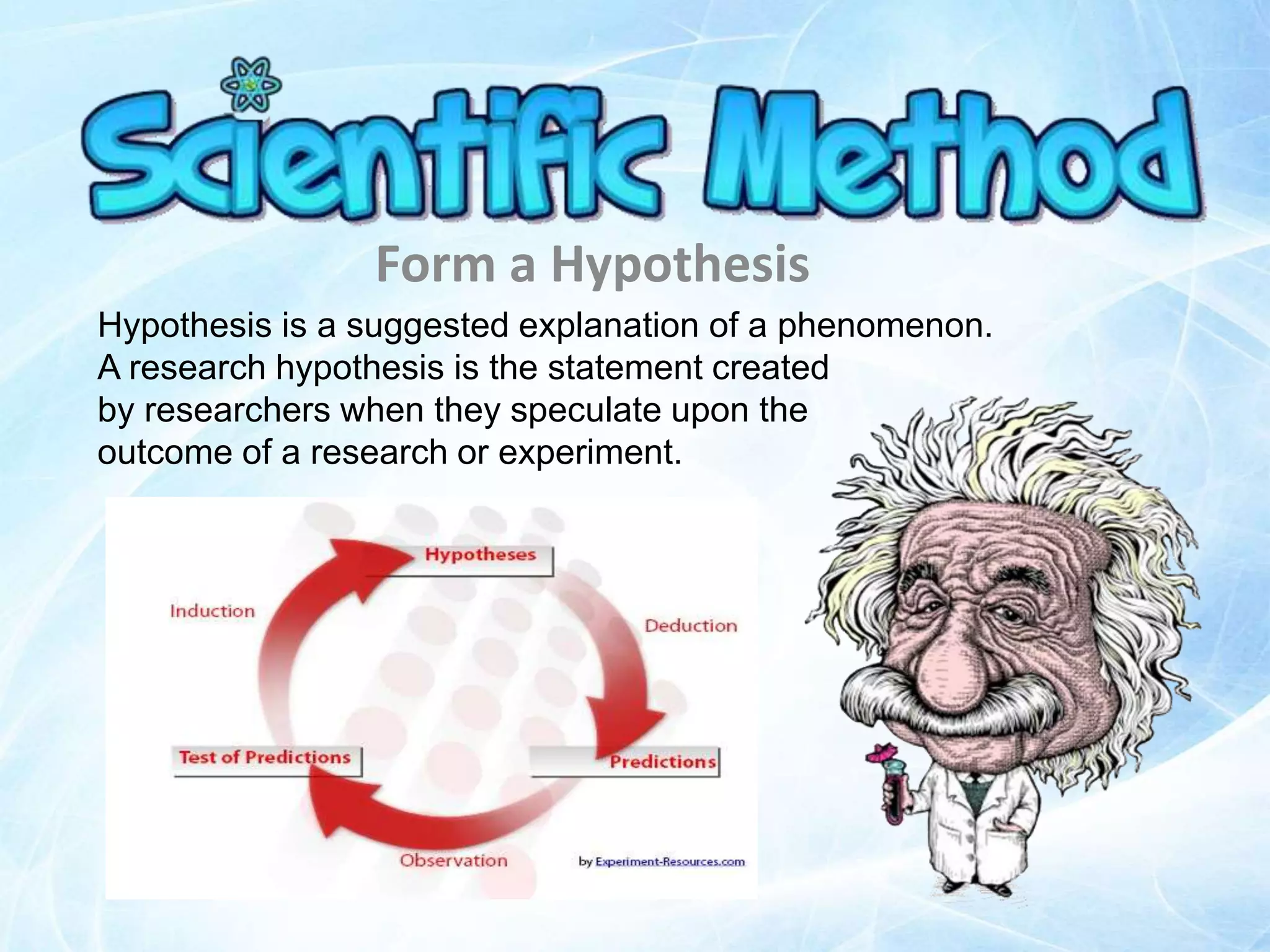
Hypothesis is a suggested explanation of a phenomenon.
A research hypothesis is the statement created
by researchers when they speculate upon the
outcome of a research or experiment.
Form a Hypothesis
You and your friend observed that white cats were found to be playing
with white cats and black with black cats.
You form a hypothesis that "Cats like to play
with cats same color as theirs."
The prediction is what you think will
happened if the hypothesis is true.
Let's Take an Example:
Let's Experiment
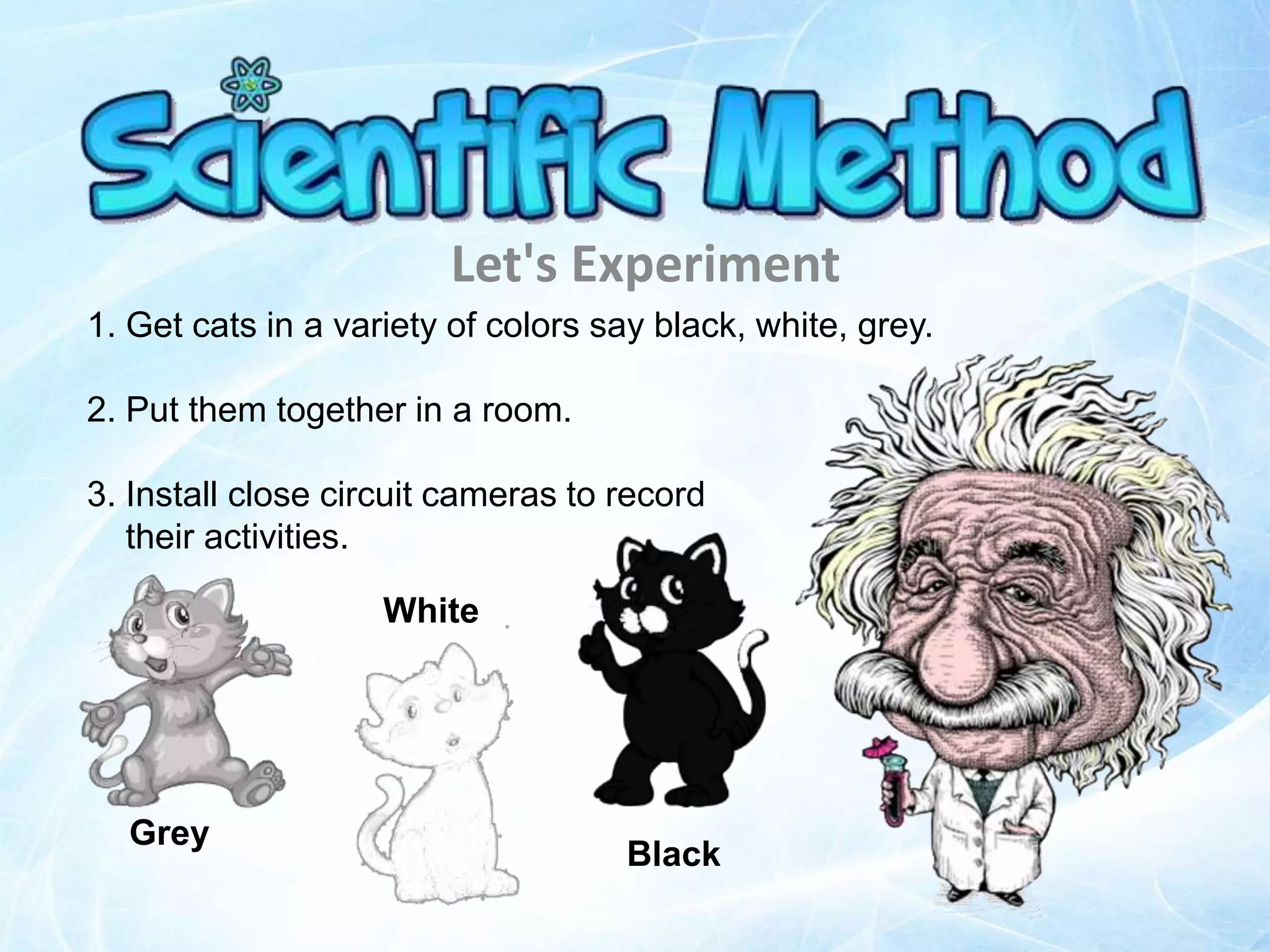
1. Get cats in a variety of colors say black, white, grey.
2. Put them together in a room.
3. Install close circuit cameras to record
their activities.
Grey
White
Black
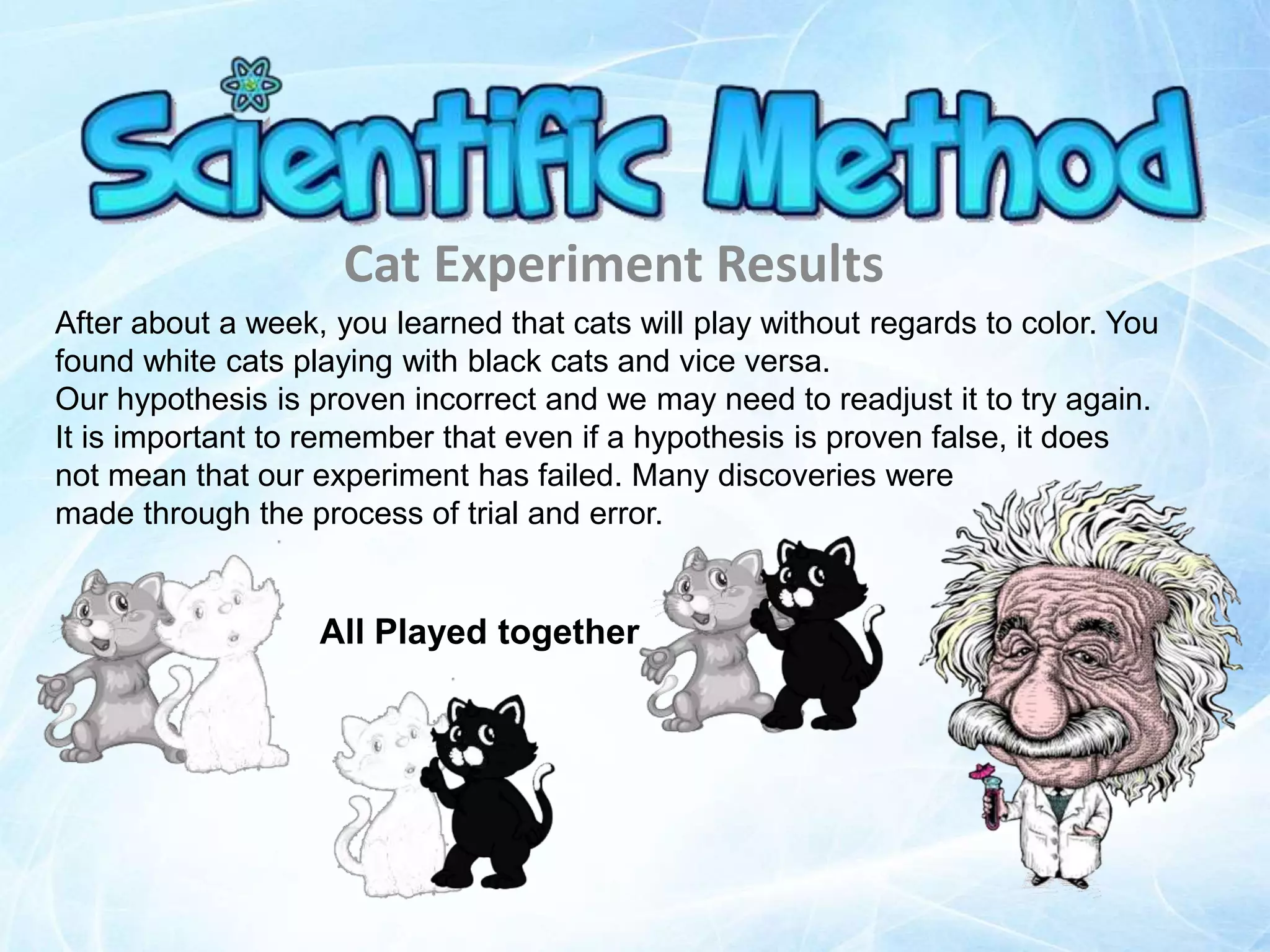
After about a week, you learned that cats will play without regards to color. You
found white cats playing with black cats and vice versa.
Our hypothesis is proven incorrect and we may need to readjust it to try again.
It is important to remember that even if a hypothesis is proven false, it does
not mean that our experiment has failed. Many discoveries were
made through the process of trial and error.
Cat Experiment Results
All Played together
The scientific method has evolved
over many centuries to ensure that
scientists make meaningful
discoveries, founded upon logic and
reason rather than emotion.
The exact process varies between
scientific disciplines but they all
follow the above principle of:
-observe
-predict
-test
-generalize
Summary:
What is scientific method?
Let’s Review
It is a body of techniques for
investigating phenomena,
acquiring new knowledge, or
correcting and integrating
previous knowledge.
What is Research?
Review
Any gathering of data,
information and facts for the
advancement of knowledge.
What are the key concepts of
Scientific Method?
Review
There are 6 concepts:
Questions, Research,
Hypothesis, Experiment,
Analysis and Conclusion.
What are the key concepts of
Scientific Method?
Review
"Imagination is more important than knowledge.“
Albert Einstein
In conclusion

Scientific Method Explainer

  • 2.
    What is Scientificmethod? The scientific method is a body of techniques for investigating phenomena, acquiring new knowledge, or correcting and integrating previous knowledge.
  • 3.
    Research Method Research Formulating questions,collecting data, testing hypotheses. Experimental Research Experimental research is commonly used in sciences such as sociology and psychology, physics, chemistry, biology and medicine etc. Research Designs Research Design is the structure of any scientific work. It gives direction and systematizes the research. Statistics in research A guide to statistics in research that understand a phenomenon by confirming or rejecting a hypothesis.
  • 4.
    1. Observe somethingand ask questions about a natural phenomenon (scientific observation). 2. Conduct research on you topic. 3. Make predictions about logical consequences of the hypothesis. 4. Test your predictions by controlled experiment or an observational study. 5. Perform a analysis to understand a phenomenon by confirming or rejecting a hypothesis. 6. Create your conclusion on the basis of data or information gathered in your experiment. So how it works?
  • 5.
    Hypothesis is asuggested explanation of a phenomenon. A research hypothesis is the statement created by researchers when they speculate upon the outcome of a research or experiment. Form a Hypothesis
  • 6.
    You and yourfriend observed that white cats were found to be playing with white cats and black with black cats. You form a hypothesis that "Cats like to play with cats same color as theirs." The prediction is what you think will happened if the hypothesis is true. Let's Take an Example:
  • 7.
    Let's Experiment 1. Getcats in a variety of colors say black, white, grey. 2. Put them together in a room. 3. Install close circuit cameras to record their activities. Grey White Black
  • 8.
    After about aweek, you learned that cats will play without regards to color. You found white cats playing with black cats and vice versa. Our hypothesis is proven incorrect and we may need to readjust it to try again. It is important to remember that even if a hypothesis is proven false, it does not mean that our experiment has failed. Many discoveries were made through the process of trial and error. Cat Experiment Results All Played together
  • 9.
    The scientific methodhas evolved over many centuries to ensure that scientists make meaningful discoveries, founded upon logic and reason rather than emotion. The exact process varies between scientific disciplines but they all follow the above principle of: -observe -predict -test -generalize Summary:
  • 10.
    What is scientificmethod? Let’s Review It is a body of techniques for investigating phenomena, acquiring new knowledge, or correcting and integrating previous knowledge.
  • 11.
    What is Research? Review Anygathering of data, information and facts for the advancement of knowledge.
  • 12.
    What are thekey concepts of Scientific Method? Review There are 6 concepts: Questions, Research, Hypothesis, Experiment, Analysis and Conclusion.
  • 13.
    What are thekey concepts of Scientific Method? Review "Imagination is more important than knowledge.“ Albert Einstein In conclusion