The Scientific
Method involves a
series of steps that
are used to find an
answer to a
problem.
Do you remember the
steps of the scientific
method?
1)Observation
AH—Look at this!
Observe a problem or
anything around you
Example:
Observe the 2 pennies in front
of you.
Record your observation.
Observation Penny 1 Penny 2
Color Dull Shiny
2) Question
Develop a question or
problem that can be
solved through an
experiment.
Q) Will lemon juice clean
the dull coin?
3) Research
After you search the internet
and the books for information
you find out that:
Lemon, vinegar and tomato sauce
can be use to clean silver and
metal objects
Can you guess an answer to
your question?
After you made your
research,
3) Hypothesis
An educated guess.
Lemon juice can be
used to clean the dull coin.
NOW, lets test
whether our
hypothesis is right
or wrong.
4) Experiment
Make a test to test
whether the hypothesis
is correct.
1)Put the coin in the
lemon juice.
2) Wait for 5 min. and
record the results.
5) Record results
Dull coin
After 5 min.
in the lemon
juice
Shiny
In tables, graphs.
6) Conclusion
The answer to the
question (you state
whether your hypothesis
was right or wrong)..
The lemon juice cleans
the dull coin.
Any experiment has
Variables
WHAT ARE
Variables?
Variables
Variables are
things that
vary and change
In any experiment there are 3 variables:
Independent
variables
Dependent
variables
Controlled
variables
Let’s look at each type….
Independent (input) variable
This is the thing that you decide to change.
Example 1:
Investigating how a weight
affects the length of an elastic band.
You decide the weight to put,
so:
Weight is the independent
variable.
Example 2:
Investigating how the rate of cooling of a
beaker depends on the initial temperature.
You decide the initial temperature,
so:
initial temperature is the
independent variable.
Students of different ages were given the
same jigsaw puzzle to put together. They
were timed to see how long it took to finish
the puzzle.
Example 3:
You decide the ages of the students,
so:
Different ages of the students is the
independent variable.
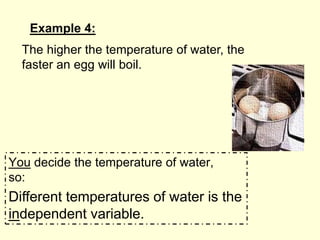
The higher the temperature of water, the
faster an egg will boil.
Example 4:
You decide the temperature of water,
so:
Different temperatures of water is the
independent variable.
The temperature of water was measured at
different depths of a pond.
Example 5:
You decide the depth of water,
so:
Depth of water is the independent
variable.
This is the variable that changes as a result.
It is the variable that you measure.
Example 1:
Investigating how a weight
affects the length of an elastic band.
You measure the resulting length
of the elastic band, so:
Length is the dependent
variable.
Dependent (outcome) variable
Example 2:
Investigating how the rate of cooling of a
beaker depends on the initial temperature.
You measure the temperature
every minute as it cools, so:
temperature is the dependent
variable.
Students of different ages were given the
same jigsaw puzzle to put together. They
were timed to see how long it took to finish
the puzzle.
Example 3:
You measured time, so:
Time taken to finish the puzzle is the
dependent variable.
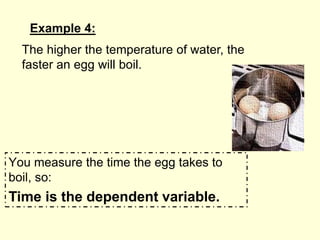
The higher the temperature of water, the
faster an egg will boil.
Example 4:
You measure the time the egg takes to
boil, so:
Time is the dependent variable.
The temperature of water was measured at
different depths of a pond.
Example 5:
You measure the temperature,
so:
Temperature is the dependent
variable.

Scientific method

  • 2.
    The Scientific Method involvesa series of steps that are used to find an answer to a problem.
  • 3.
    Do you rememberthe steps of the scientific method?
  • 4.
    1)Observation AH—Look at this! Observea problem or anything around you
  • 5.
  • 6.
    Observe the 2pennies in front of you. Record your observation. Observation Penny 1 Penny 2 Color Dull Shiny
  • 7.
    2) Question Develop aquestion or problem that can be solved through an experiment. Q) Will lemon juice clean the dull coin?
  • 8.
  • 9.
    After you searchthe internet and the books for information you find out that: Lemon, vinegar and tomato sauce can be use to clean silver and metal objects
  • 10.
    Can you guessan answer to your question? After you made your research,
  • 11.
    3) Hypothesis An educatedguess. Lemon juice can be used to clean the dull coin.
  • 12.
    NOW, lets test whetherour hypothesis is right or wrong.
  • 13.
    4) Experiment Make atest to test whether the hypothesis is correct. 1)Put the coin in the lemon juice. 2) Wait for 5 min. and record the results.
  • 14.
    5) Record results Dullcoin After 5 min. in the lemon juice Shiny In tables, graphs.
  • 15.
    6) Conclusion The answerto the question (you state whether your hypothesis was right or wrong).. The lemon juice cleans the dull coin.
  • 16.
  • 17.
  • 18.
  • 19.
    In any experimentthere are 3 variables: Independent variables Dependent variables Controlled variables Let’s look at each type….
  • 20.
    Independent (input) variable Thisis the thing that you decide to change. Example 1: Investigating how a weight affects the length of an elastic band. You decide the weight to put, so: Weight is the independent variable.
  • 21.
    Example 2: Investigating howthe rate of cooling of a beaker depends on the initial temperature. You decide the initial temperature, so: initial temperature is the independent variable.
  • 22.
    Students of differentages were given the same jigsaw puzzle to put together. They were timed to see how long it took to finish the puzzle. Example 3: You decide the ages of the students, so: Different ages of the students is the independent variable.
  • 23.
    The higher thetemperature of water, the faster an egg will boil. Example 4: You decide the temperature of water, so: Different temperatures of water is the independent variable.
  • 24.
    The temperature ofwater was measured at different depths of a pond. Example 5: You decide the depth of water, so: Depth of water is the independent variable.
  • 25.
    This is thevariable that changes as a result. It is the variable that you measure. Example 1: Investigating how a weight affects the length of an elastic band. You measure the resulting length of the elastic band, so: Length is the dependent variable. Dependent (outcome) variable
  • 26.
    Example 2: Investigating howthe rate of cooling of a beaker depends on the initial temperature. You measure the temperature every minute as it cools, so: temperature is the dependent variable.
  • 27.
    Students of differentages were given the same jigsaw puzzle to put together. They were timed to see how long it took to finish the puzzle. Example 3: You measured time, so: Time taken to finish the puzzle is the dependent variable.
  • 28.
    The higher thetemperature of water, the faster an egg will boil. Example 4: You measure the time the egg takes to boil, so: Time is the dependent variable.
  • 29.
    The temperature ofwater was measured at different depths of a pond. Example 5: You measure the temperature, so: Temperature is the dependent variable.