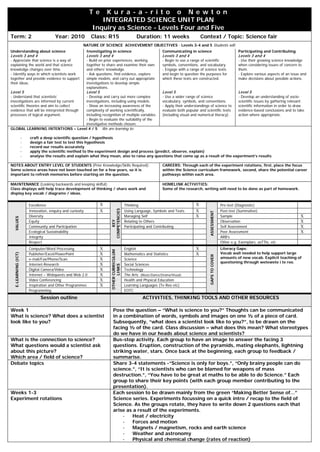
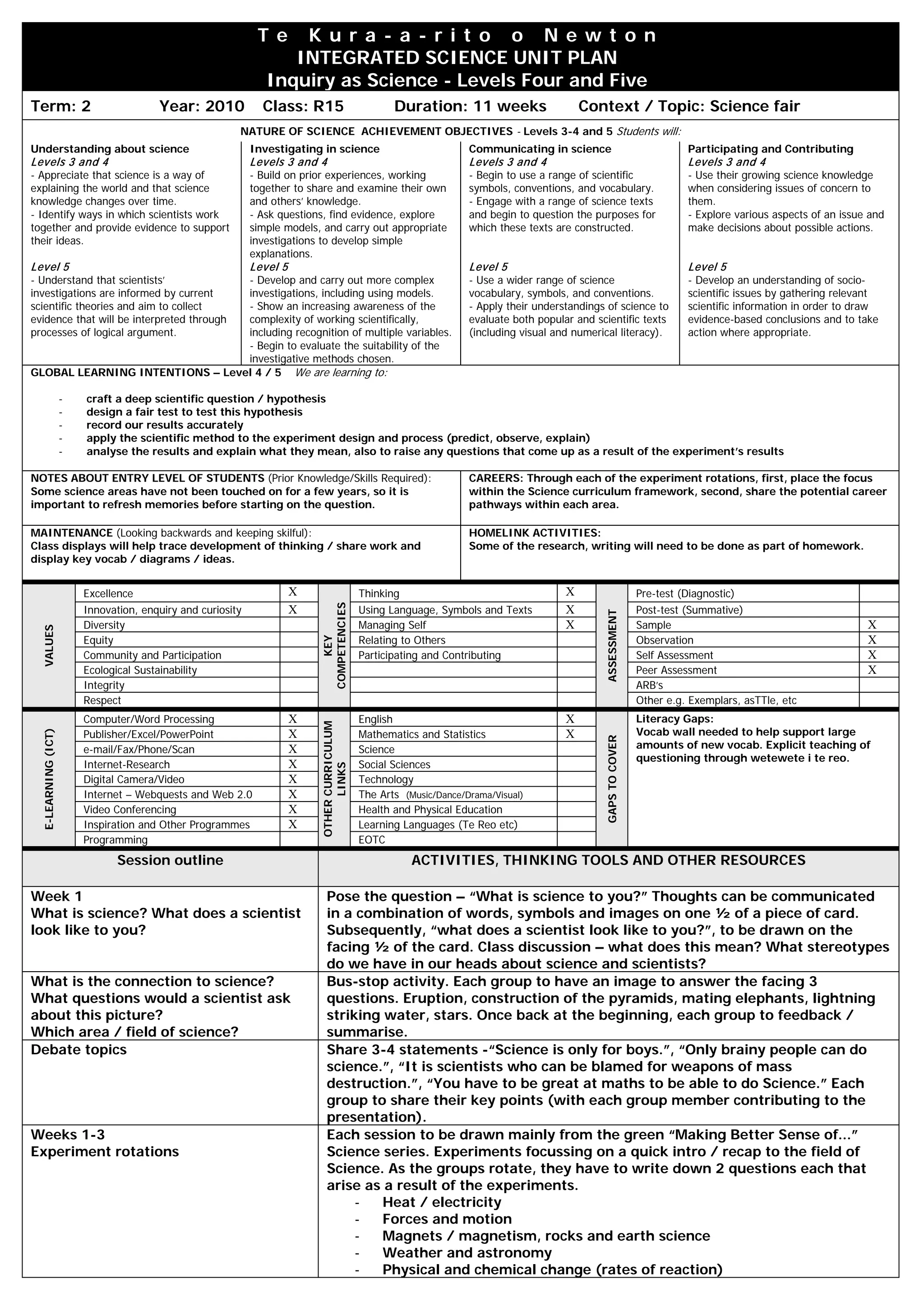
T e K u r a - a - r i t o o N e w t o n
INTEGRATED SCIENCE UNIT PLAN
Inquiry as Science - Levels Four and Five
Term: 2 Year: 2010 Class: R15 Duration: 11 weeks Context / Topic: Science fair
NATURE OF SCIENCE ACHIEVEMENT OBJECTIVES - Levels 3-4 and 5 Students will:
Understanding about science
Levels 3 and 4
- Appreciate that science is a way of
explaining the world and that science
knowledge changes over time.
- Identify ways in which scientists work
together and provide evidence to support
their ideas.
Level 5
- Understand that scientists’
investigations are informed by current
scientific theories and aim to collect
evidence that will be interpreted through
processes of logical argument.
Investigating in science
Levels 3 and 4
- Build on prior experiences, working
together to share and examine their own
and others’ knowledge.
- Ask questions, find evidence, explore
simple models, and carry out appropriate
investigations to develop simple
explanations.
Level 5
- Develop and carry out more complex
investigations, including using models.
- Show an increasing awareness of the
complexity of working scientifically,
including recognition of multiple variables.
- Begin to evaluate the suitability of the
investigative methods chosen.
Communicating in science
Levels 3 and 4
- Begin to use a range of scientific
symbols, conventions, and vocabulary.
- Engage with a range of science texts
and begin to question the purposes for
which these texts are constructed.
Level 5
- Use a wider range of science
vocabulary, symbols, and conventions.
- Apply their understandings of science to
evaluate both popular and scientific texts
(including visual and numerical literacy).
Participating and Contributing
Levels 3 and 4
- Use their growing science knowledge
when considering issues of concern to
them.
- Explore various aspects of an issue and
make decisions about possible actions.
Level 5
- Develop an understanding of socio-
scientific issues by gathering relevant
scientific information in order to draw
evidence-based conclusions and to take
action where appropriate.
GLOBAL LEARNING INTENTIONS – Level 4 / 5 We are learning to:
- craft a deep scientific question / hypothesis
- design a fair test to test this hypothesis
- record our results accurately
- apply the scientific method to the experiment design and process (predict, observe, explain)
- analyse the results and explain what they mean, also to raise any questions that come up as a result of the experiment’s results
NOTES ABOUT ENTRY LEVEL OF STUDENTS (Prior Knowledge/Skills Required):
Some science areas have not been touched on for a few years, so it is
important to refresh memories before starting on the question.
CAREERS: Through each of the experiment rotations, first, place the focus
within the Science curriculum framework, second, share the potential career
pathways within each area.
MAINTENANCE (Looking backwards and keeping skilful):
Class displays will help trace development of thinking / share work and
display key vocab / diagrams / ideas.
HOMELINK ACTIVITIES:
Some of the research, writing will need to be done as part of homework.
VALUES
Excellence X
KEY
COMPETENCIES
Thinking X
ASSESSMENT
Pre-test (Diagnostic)
Innovation, enquiry and curiosity X Using Language, Symbols and Texts X Post-test (Summative)
Diversity Managing Self X Sample X
Equity Relating to Others Observation X
Community and Participation Participating and Contributing Self Assessment X
Ecological Sustainability Peer Assessment X
Integrity ARB’s
Respect Other e.g. Exemplars, asTTle, etc
E-LEARNING(ICT)
Computer/Word Processing X
OTHERCURRICULUM
LINKS
English X
GAPSTOCOVER
Literacy Gaps:
Vocab wall needed to help support large
amounts of new vocab. Explicit teaching of
questioning through wetewete i te reo.
Publisher/Excel/PowerPoint X Mathematics and Statistics X
e-mail/Fax/Phone/Scan X Science
Internet-Research X Social Sciences
Digital Camera/Video X Technology
Internet – Webquests and Web 2.0 X The Arts (Music/Dance/Drama/Visual)
Video Conferencing X Health and Physical Education
Inspiration and Other Programmes X Learning Languages (Te Reo etc)
Programming EOTC
Session outline ACTIVITIES, THINKING TOOLS AND OTHER RESOURCES
Week 1
What is science? What does a scientist
look like to you?
Pose the question – “What is science to you?” Thoughts can be communicated
in a combination of words, symbols and images on one ½ of a piece of card.
Subsequently, “what does a scientist look like to you?”, to be drawn on the
facing ½ of the card. Class discussion – what does this mean? What stereotypes
do we have in our heads about science and scientists?
What is the connection to science?
What questions would a scientist ask
about this picture?
Which area / field of science?
Bus-stop activity. Each group to have an image to answer the facing 3
questions. Eruption, construction of the pyramids, mating elephants, lightning
striking water, stars. Once back at the beginning, each group to feedback /
summarise.
Debate topics Share 3-4 statements -“Science is only for boys.”, “Only brainy people can do
science.”, “It is scientists who can be blamed for weapons of mass
destruction.”, “You have to be great at maths to be able to do Science.” Each
group to share their key points (with each group member contributing to the
presentation).
Weeks 1-3
Experiment rotations
Each session to be drawn mainly from the green “Making Better Sense of...”
Science series. Experiments focussing on a quick intro / recap to the field of
Science. As the groups rotate, they have to write down 2 questions each that
arise as a result of the experiments.
- Heat / electricity
- Forces and motion
- Magnets / magnetism, rocks and earth science
- Weather and astronomy
- Physical and chemical change (rates of reaction)
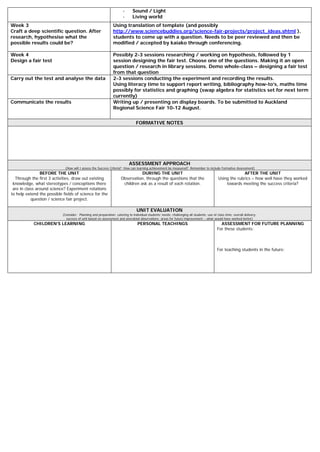
- Sound / Light
- Living world
Week 3
Craft a deep scientific question. After
research, hypothesise what the
possible results could be?
Using translation of template (and possibly
http://www.sciencebuddies.org/science-fair-projects/project_ideas.shtml ),
students to come up with a question. Needs to be peer reviewed and then be
modified / accepted by kaiako through conferencing.
Week 4
Design a fair test
Possibly 2-3 sessions researching / working on hypothesis, followed by 1
session designing the fair test. Choose one of the questions. Making it an open
question / research in library sessions. Demo whole-class – designing a fair test
from that question
Carry out the test and analyse the data 2-3 sessions conducting the experiment and recording the results.
Using literacy time to support report writing, bibliography how-to’s, maths time
possibly for statistics and graphing (swap algebra for statistics set for next term
currently)
Communicate the results Writing up / presenting on display boards. To be submitted to Auckland
Regional Science Fair 10-12 August.
FORMATIVE NOTES
ASSESSMENT APPROACH
(How will I assess the Success Criteria? How can learning achievement be measured? Remember to include Formative Assessment)
BEFORE THE UNIT
Through the first 3 activities, draw out existing
knowledge, what stereotypes / conceptions there
are in class around science? Experiment rotations
to help extend the possible fields of science for the
question / science fair project.
DURING THE UNIT
Observation, through the questions that the
children ask as a result of each rotation.
AFTER THE UNIT
Using the rubrics – how well have they worked
towards meeting the success criteria?
UNIT EVALUATION
(Consider: Planning and preparation; catering to individual students’ needs; challenging all students; use of class time; overall delivery;
success of unit based on assessment and anecdotal observations; areas for future improvement – what would have worked better)
CHILDREN’S LEARNING PERSONAL TEACHINGS ASSESSMENT FOR FUTURE PLANNING
For these students:
For teaching students in the future:

Science fair Level 4 & 5

  • 1.
    T e Ku r a - a - r i t o o N e w t o n INTEGRATED SCIENCE UNIT PLAN Inquiry as Science - Levels Four and Five Term: 2 Year: 2010 Class: R15 Duration: 11 weeks Context / Topic: Science fair NATURE OF SCIENCE ACHIEVEMENT OBJECTIVES - Levels 3-4 and 5 Students will: Understanding about science Levels 3 and 4 - Appreciate that science is a way of explaining the world and that science knowledge changes over time. - Identify ways in which scientists work together and provide evidence to support their ideas. Level 5 - Understand that scientists’ investigations are informed by current scientific theories and aim to collect evidence that will be interpreted through processes of logical argument. Investigating in science Levels 3 and 4 - Build on prior experiences, working together to share and examine their own and others’ knowledge. - Ask questions, find evidence, explore simple models, and carry out appropriate investigations to develop simple explanations. Level 5 - Develop and carry out more complex investigations, including using models. - Show an increasing awareness of the complexity of working scientifically, including recognition of multiple variables. - Begin to evaluate the suitability of the investigative methods chosen. Communicating in science Levels 3 and 4 - Begin to use a range of scientific symbols, conventions, and vocabulary. - Engage with a range of science texts and begin to question the purposes for which these texts are constructed. Level 5 - Use a wider range of science vocabulary, symbols, and conventions. - Apply their understandings of science to evaluate both popular and scientific texts (including visual and numerical literacy). Participating and Contributing Levels 3 and 4 - Use their growing science knowledge when considering issues of concern to them. - Explore various aspects of an issue and make decisions about possible actions. Level 5 - Develop an understanding of socio- scientific issues by gathering relevant scientific information in order to draw evidence-based conclusions and to take action where appropriate. GLOBAL LEARNING INTENTIONS – Level 4 / 5 We are learning to: - craft a deep scientific question / hypothesis - design a fair test to test this hypothesis - record our results accurately - apply the scientific method to the experiment design and process (predict, observe, explain) - analyse the results and explain what they mean, also to raise any questions that come up as a result of the experiment’s results NOTES ABOUT ENTRY LEVEL OF STUDENTS (Prior Knowledge/Skills Required): Some science areas have not been touched on for a few years, so it is important to refresh memories before starting on the question. CAREERS: Through each of the experiment rotations, first, place the focus within the Science curriculum framework, second, share the potential career pathways within each area. MAINTENANCE (Looking backwards and keeping skilful): Class displays will help trace development of thinking / share work and display key vocab / diagrams / ideas. HOMELINK ACTIVITIES: Some of the research, writing will need to be done as part of homework. VALUES Excellence X KEY COMPETENCIES Thinking X ASSESSMENT Pre-test (Diagnostic) Innovation, enquiry and curiosity X Using Language, Symbols and Texts X Post-test (Summative) Diversity Managing Self X Sample X Equity Relating to Others Observation X Community and Participation Participating and Contributing Self Assessment X Ecological Sustainability Peer Assessment X Integrity ARB’s Respect Other e.g. Exemplars, asTTle, etc E-LEARNING(ICT) Computer/Word Processing X OTHERCURRICULUM LINKS English X GAPSTOCOVER Literacy Gaps: Vocab wall needed to help support large amounts of new vocab. Explicit teaching of questioning through wetewete i te reo. Publisher/Excel/PowerPoint X Mathematics and Statistics X e-mail/Fax/Phone/Scan X Science Internet-Research X Social Sciences Digital Camera/Video X Technology Internet – Webquests and Web 2.0 X The Arts (Music/Dance/Drama/Visual) Video Conferencing X Health and Physical Education Inspiration and Other Programmes X Learning Languages (Te Reo etc) Programming EOTC Session outline ACTIVITIES, THINKING TOOLS AND OTHER RESOURCES Week 1 What is science? What does a scientist look like to you? Pose the question – “What is science to you?” Thoughts can be communicated in a combination of words, symbols and images on one ½ of a piece of card. Subsequently, “what does a scientist look like to you?”, to be drawn on the facing ½ of the card. Class discussion – what does this mean? What stereotypes do we have in our heads about science and scientists? What is the connection to science? What questions would a scientist ask about this picture? Which area / field of science? Bus-stop activity. Each group to have an image to answer the facing 3 questions. Eruption, construction of the pyramids, mating elephants, lightning striking water, stars. Once back at the beginning, each group to feedback / summarise. Debate topics Share 3-4 statements -“Science is only for boys.”, “Only brainy people can do science.”, “It is scientists who can be blamed for weapons of mass destruction.”, “You have to be great at maths to be able to do Science.” Each group to share their key points (with each group member contributing to the presentation). Weeks 1-3 Experiment rotations Each session to be drawn mainly from the green “Making Better Sense of...” Science series. Experiments focussing on a quick intro / recap to the field of Science. As the groups rotate, they have to write down 2 questions each that arise as a result of the experiments. - Heat / electricity - Forces and motion - Magnets / magnetism, rocks and earth science - Weather and astronomy - Physical and chemical change (rates of reaction)
  • 2.
    - Sound /Light - Living world Week 3 Craft a deep scientific question. After research, hypothesise what the possible results could be? Using translation of template (and possibly http://www.sciencebuddies.org/science-fair-projects/project_ideas.shtml ), students to come up with a question. Needs to be peer reviewed and then be modified / accepted by kaiako through conferencing. Week 4 Design a fair test Possibly 2-3 sessions researching / working on hypothesis, followed by 1 session designing the fair test. Choose one of the questions. Making it an open question / research in library sessions. Demo whole-class – designing a fair test from that question Carry out the test and analyse the data 2-3 sessions conducting the experiment and recording the results. Using literacy time to support report writing, bibliography how-to’s, maths time possibly for statistics and graphing (swap algebra for statistics set for next term currently) Communicate the results Writing up / presenting on display boards. To be submitted to Auckland Regional Science Fair 10-12 August. FORMATIVE NOTES ASSESSMENT APPROACH (How will I assess the Success Criteria? How can learning achievement be measured? Remember to include Formative Assessment) BEFORE THE UNIT Through the first 3 activities, draw out existing knowledge, what stereotypes / conceptions there are in class around science? Experiment rotations to help extend the possible fields of science for the question / science fair project. DURING THE UNIT Observation, through the questions that the children ask as a result of each rotation. AFTER THE UNIT Using the rubrics – how well have they worked towards meeting the success criteria? UNIT EVALUATION (Consider: Planning and preparation; catering to individual students’ needs; challenging all students; use of class time; overall delivery; success of unit based on assessment and anecdotal observations; areas for future improvement – what would have worked better) CHILDREN’S LEARNING PERSONAL TEACHINGS ASSESSMENT FOR FUTURE PLANNING For these students: For teaching students in the future: