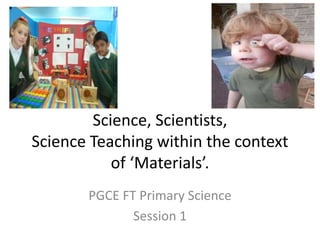
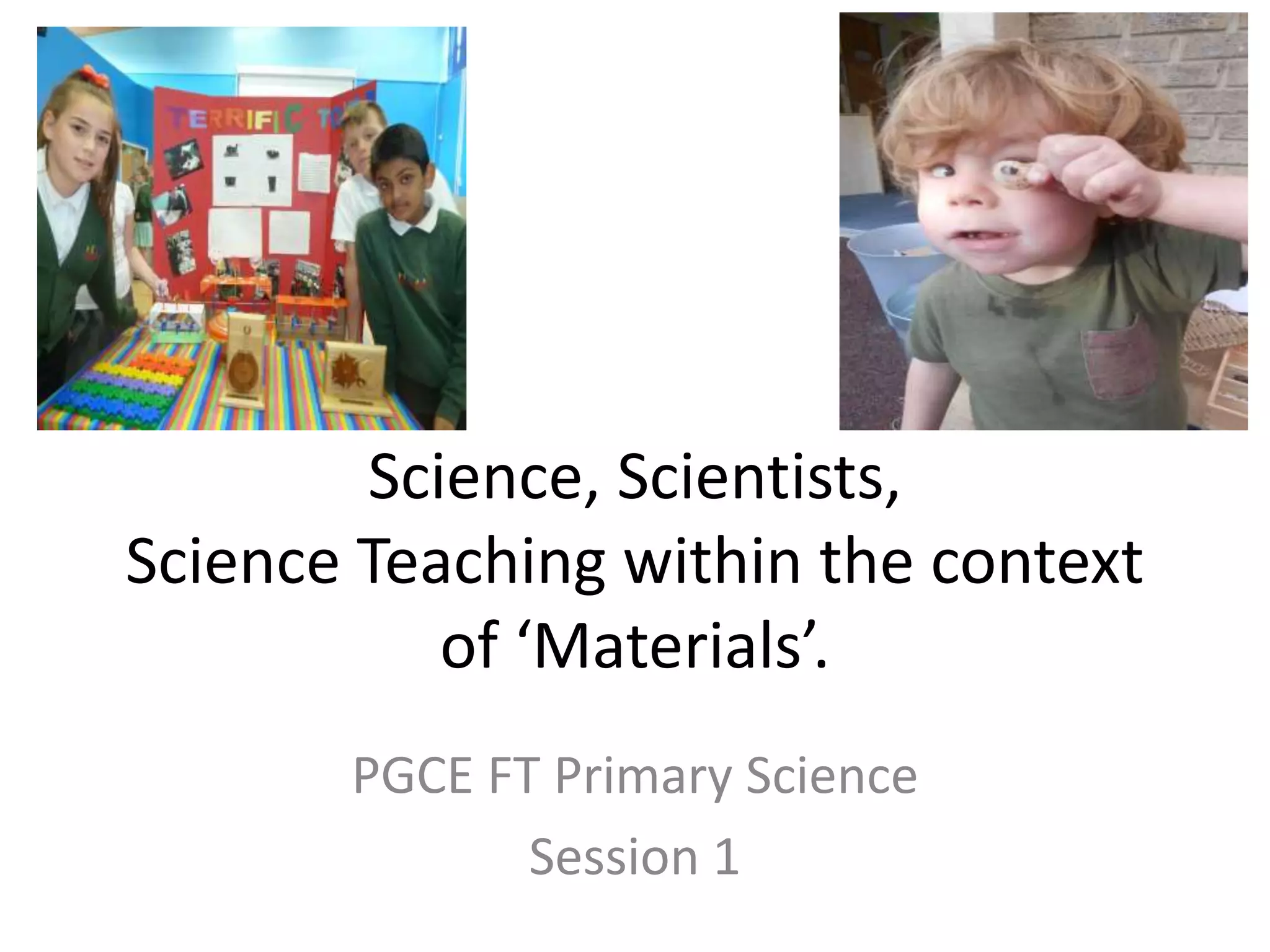
Science, Scientists,
Science Teaching within the context
of ‘Materials’.
PGCE FT Primary Science
Session 1
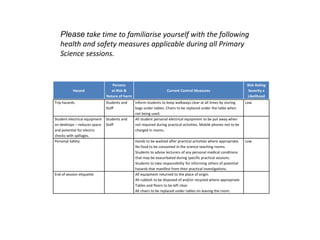
Hazard
Persons
at Risk &
Nature of harm
Current Control Measures
Risk Rating
Severity x
Likelihood
Trip hazards. Students and
Staff
Inform students to keep walkways clear at all times by storing
bags under tables. Chairs to be replaced under the table when
not being used.
Low
Student electrical equipment
on desktops – reduces space
and potential for electric
shocks with spillages.
Students and
Staff
All student personal electrical equipment to be put away when
not required during practical activities. Mobile phones not to be
charged in rooms.
Personal Safety Hands to be washed after practical activities where appropriate.
No food to be consumed in the science teaching rooms.
Students to advise lecturers of any personal medical conditions
that may be exacerbated during specific practical sessions.
Students to take responsibility for informing others of potential
hazards that manifest from their practical investigations.
Low
End of session etiquette All equipment returned to the place of origin.
All rubbish to be disposed of and/or recycled where appropriate.
Tables and floors to be left clear.
All chairs to be replaced under tables on leaving the room.
Please take time to familiarise yourself with the following
health and safety measures applicable during all Primary
Science sessions.
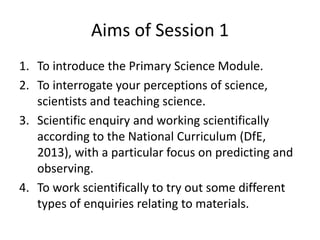
Aims of Session 1
1. To introduce the Primary Science Module.
2. To interrogate your perceptions of science,
scientists and teaching science.
3. Scientific enquiry and working scientifically
according to the National Curriculum (DfE,
2013), with a particular focus on predicting and
observing.
4. To work scientifically to try out some different
types of enquiries relating to materials.
What does science mean to you?
Together, in groups of 4 create
mind-maps to show what science
means to you.
Drawing Tasks (Chambers 1983)
Draw a group of scientists working.
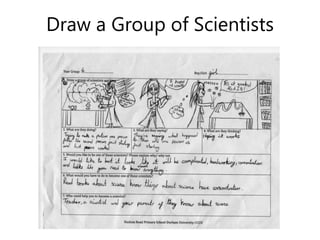
Draw a Group of Scientists
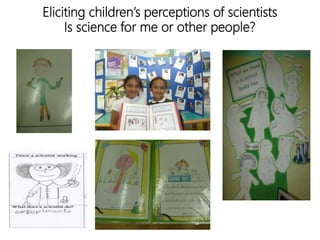
Eliciting children’s perceptions of scientists
Is science for me or other people?
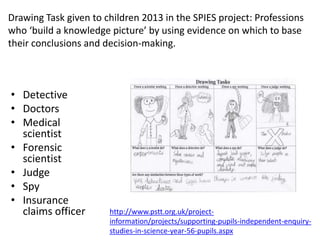
• Detective
• Doctors
• Medical
scientist
• Forensic
scientist
• Judge
• Spy
• Insurance
claims officer
Drawing Task given to children 2013 in the SPIES project: Professions
who ‘build a knowledge picture’ by using evidence on which to base
their conclusions and decision-making.
http://www.pstt.org.uk/project-
information/projects/supporting-pupils-independent-enquiry-
studies-in-science-year-56-pupils.aspx
• The negative image of a scientist as a ‘mad
scientist’ or a ‘man in lab coat’ in cartoons and
TV programs may be the cause of the
formation of negative images of scientists….
• The formation of this negative image in
students could prevent students not only in
becoming a scientist and in aspiring to having a
career in science.
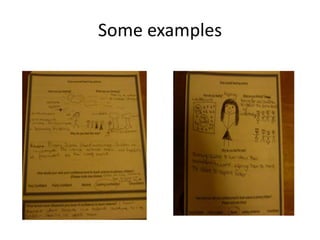
Some examples
How is science education organised for
delivery to children?
• Early Years Foundation Stage
– Seven areas of learning: Science = UTW
– Understanding the World
– Early Learning Goals
• National Curriculum (DfE, 2013) England: Programmes of
Study:
– Key Stage 1: Y1 and Y2
– Lower Key Stage 2: Y3 and Y4
– Upper Key Stage 2: Y5 and Y6
Science is a core subject like English and mathematics but it
is now marginalised (CBI, 2015).
Children are required to work scientifically and in doing so to
gain experience of a broad range of scientific enquiries.
Developing children’s experience of engaging in
broad categories of scientific enquiry (DfE, 2013)
• Exploring phenomena/Observing changes over
time
• Identifying and classifying
• Surveys and pattern-seeking
• Identifying and controlling variables (Fair-test,
comparative tests)
• Research and synthesis using secondary sources
• Using and creating models to explain phenomena
(USA, Australia and New Zealand)
But to work scientifically…
We should encourage children to take part in the social
practices of science:
• Discussion
• Constructing evidence based explanations
• Articulating evidence-based arguments
• Debate
Aufschnaiter von, C., Erduran, S., Osborne, J. & Simon, S.
(2008) ‘Arguing to Learn and Learning to Argue: Case
Studies of How Students’ Argumentation Relates to Their
Scientific Knowledge’ Journal of Research in Science
Teaching, 45( 1), p 101–131.
But to work scientifically……
What revisited…..
• Teachers develop children’s knowledge by supporting
them to work scientifically,
• Enabling them to construct understanding by raising
questions,
• Enabling them to think of ways to investigate these
questions
• Requiring them to generate ideas based on
observations,
• Test ideas,
• To collect data and to reflect on what their
observations/data mean.
What revisited………….
Historical Context
• Education Reform Act (1988) established science as a core
subject with English and mathematics.
• Advocated a focus on the development of scientific knowledge
as a result of children engaging in scientific enquiry
• BUT emphasis was placed on acquisition of content (ontological)
and procedural knowledge.
• 1991 KS1 and KS2 Standard Assessment Tests measured
children’s ability to recall facts – teaching to the test.
• 1998 QCA Scheme of Work prescriptive
• 2009 KS1 and KS2 compulsory Standard Assessment Tests
abolished for science
• Some dependence on commercial schemes of work - recipe
science – restricting opportunities for children to follow their
interests.
Historical Context
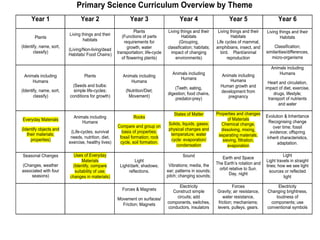
Primary Science Curriculum Overview by Theme
Year 1 Year 2 Year 3 Year 4 Year 5 Year 6
Plants
(Identify, name, sort,
classify)
Living things and their
habitats
(Living/Non-living/dead
Habitats/ Food Chains)
Plants
(Functions of parts
requirements for
growth, water
transportation; life-cycle
of flowering plants)
Living things and their
Habitats
(Grouping,
classification; habitats;
impact of changing
environments)
Living things and their
Habitats
Life cycles of mammal,
amphibians, insect, and
bird. Plant/animal
reproduction
Living things and their
Habitats
Classification;
similarities/differences,
micro-organisms
Animals including
Humans
(Identify, name, sort,
classify)
Plants
(Seeds and bulbs:
simple life-cycles;
conditions for growth)
Animals including
Humans
(Nutrition/Diet;
Movement)
Animals including
Humans
(Teeth, eating,
digestion; food chains,
predator-prey)
Animals including
Humans
Human growth and
development from
pregnancy
Animals including
Humans
Heart and circulation,
impact of diet, exercise,
drugs, lifestyle;
transport of nutrients
and water
Everyday Materials
(Identify objects and
their materials;
properties)
Animals including
Humans
(Life-cycles, survival
needs, nutrition, diet,
exercise, healthy lives)
Rocks
Compare and group on
basis of properties;
fossil formation; rock
cycle, soil formation.
States of Matter
Solids, liquids, gases;
physical changes and
temperature; water
cycle: evaporation/
condensation
Properties and changes
of Materials
Chemical change,
dissolving, mixing,
separating materials,
sieving, filtration,
evaporation
Evolution & Inheritance
Recognising change
over time; fossil
evidence; offspring
inherit characteristics,
adaptation.
Seasonal Changes
(Changes, weather
associated with four
seasons)
Uses of Everyday
Materials
(Identify, compare
suitability of use;
changes in materials)
Light
Light/dark; shadows;
reflections.
Sound
Vibrations; media, the
ear; patterns in sounds;
pitch; changing sounds;
Earth and Space
The Earth’s rotation and
orbit relative to Sun.
Day, night
Light
Light travels in straight
lines; how we see light
sources or reflected
light
Forces & Magnets
Movement on surfaces/
Friction; Magnets
Electricity
Construct simple
circuits; add
components, switches,
conductors, insulators
Forces
Gravity; air resistance,
water resistance,
friction; mechanisms;
levers, pulleys, gears.
Electricity
Changing brightness,
loudness of
components; use
conventional symbols
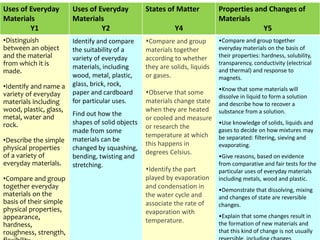
Uses of Everyday
Materials
Y1
Uses of Everyday
Materials
Y2
States of Matter
Y4
Properties and Changes of
Materials
Y5
•Distinguish
between an object
and the material
from which it is
made.
•Identify and name a
variety of everyday
materials including
wood, plastic, glass,
metal, water and
rock.
•Describe the simple
physical properties
of a variety of
everyday materials.
•Compare and group
together everyday
materials on the
basis of their simple
physical properties,
appearance,
hardness,
roughness, strength,
Identify and compare
the suitability of a
variety of everyday
materials, including
wood, metal, plastic,
glass, brick, rock,
paper and cardboard
for particular uses.
Find out how the
shapes of solid objects
made from some
materials can be
changed by squashing,
bending, twisting and
stretching.
Compare and group
materials together
according to whether
they are solids, liquids
or gases.
Observe that some
materials change state
when they are heated
or cooled and measure
or research the
temperature at which
this happens in
degrees Celsius.
Identify the part
played by evaporation
and condensation in
the water cycle and
associate the rate of
evaporation with
temperature.
•Compare and group together
everyday materials on the basis of
their properties: hardness, solubility,
transparency, conductivity (electrical
and thermal) and response to
magnets.
•Know that some materials will
dissolve in liquid to form a solution
and describe how to recover a
substance from a solution.
•Use knowledge of solids, liquids and
gases to decide on how mixtures may
be separated: filtering, sieving and
evaporating.
•Give reasons, based on evidence
from comparative and fair tests for the
particular uses of everyday materials
including metals, wood and plastic.
•Demonstrate that dissolving, mixing
and changes of state are reversible
changes.
•Explain that some changes result in
the formation of new materials and
that this kind of change is not usually
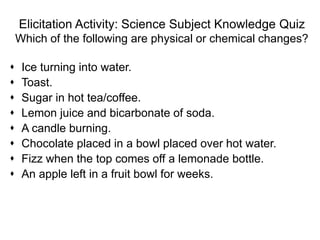
Elicitation Activity: Science Subject Knowledge Quiz
Which of the following are physical or chemical changes?
 Ice turning into water.
 Toast.
 Sugar in hot tea/coffee.
 Lemon juice and bicarbonate of soda.
 A candle burning.
 Chocolate placed in a bowl placed over hot water.
 Fizz when the top comes off a lemonade bottle.
 An apple left in a fruit bowl for weeks.
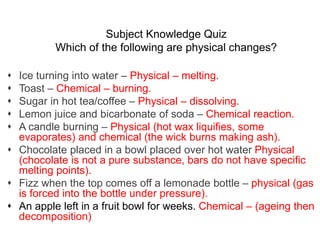
Subject Knowledge Quiz
Which of the following are physical changes?
 Ice turning into water – Physical – melting.
 Toast – Chemical – burning.
 Sugar in hot tea/coffee – Physical – dissolving.
 Lemon juice and bicarbonate of soda – Chemical reaction.
 A candle burning – Physical (hot wax liquifies, some
evaporates) and chemical (the wick burns making ash).
 Chocolate placed in a bowl placed over hot water Physical
(chocolate is not a pure substance, bars do not have specific
melting points).
 Fizz when the top comes off a lemonade bottle – physical (gas
is forced into the bottle under pressure).
 An apple left in a fruit bowl for weeks. Chemical – (ageing then
decomposition)
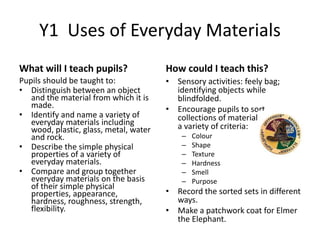
Y1 Uses of Everyday Materials
What will I teach pupils?
Pupils should be taught to:
• Distinguish between an object
and the material from which it is
made.
• Identify and name a variety of
everyday materials including
wood, plastic, glass, metal, water
and rock.
• Describe the simple physical
properties of a variety of
everyday materials.
• Compare and group together
everyday materials on the basis
of their simple physical
properties, appearance,
hardness, roughness, strength,
flexibility.
How could I teach this?
• Sensory activities: feely bag;
identifying objects while
blindfolded.
• Encourage pupils to sort
collections of materials based on
a variety of criteria:
– Colour
– Shape
– Texture
– Hardness
– Smell
– Purpose
• Record the sorted sets in different
ways.
• Make a patchwork coat for Elmer
the Elephant.
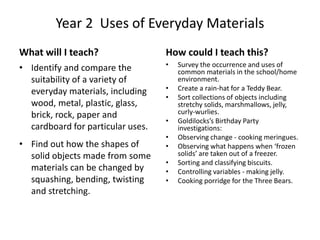
Year 2 Uses of Everyday Materials
What will I teach?
• Identify and compare the
suitability of a variety of
everyday materials, including
wood, metal, plastic, glass,
brick, rock, paper and
cardboard for particular uses.
• Find out how the shapes of
solid objects made from some
materials can be changed by
squashing, bending, twisting
and stretching.
How could I teach this?
• Survey the occurrence and uses of
common materials in the school/home
environment.
• Create a rain-hat for a Teddy Bear.
• Sort collections of objects including
stretchy solids, marshmallows, jelly,
curly-wurlies.
• Goldilocks’s Birthday Party
investigations:
• Observing change - cooking meringues.
• Observing what happens when ‘frozen
solids’ are taken out of a freezer.
• Sorting and classifying biscuits.
• Controlling variables - making jelly.
• Cooking porridge for the Three Bears.
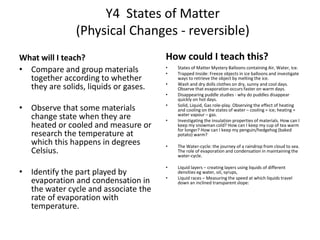
Y4 States of Matter
(Physical Changes - reversible)
What will I teach?
• Compare and group materials
together according to whether
they are solids, liquids or gases.
• Observe that some materials
change state when they are
heated or cooled and measure or
research the temperature at
which this happens in degrees
Celsius.
• Identify the part played by
evaporation and condensation in
the water cycle and associate the
rate of evaporation with
temperature.
How could I teach this?
• States of Matter Mystery Balloons containing Air, Water, Ice.
• Trapped Inside: Freeze objects in ice balloons and investigate
ways to retrieve the object by melting the ice.
• Wash and dry dolls clothes on dry, sunny and cool days.
Observe that evaporation occurs faster on warm days.
• Disappearing puddle studies - why do puddles disappear
quickly on hot days.
• Solid, Liquid, Gas role-play. Observing the effect of heating
and cooling on the states of water – cooling = ice; heating =
water vapour – gas.
• Investigating the insulation properties of materials. How can I
keep my snowman cold? How can I keep my cup of tea warm
for longer? How can I keep my penguin/hedgehog (baked
potato) warm?
• The Water-cycle: the journey of a raindrop from cloud to sea.
The role of evaporation and condensation in maintaining the
water-cycle.
• Liquid layers – creating layers using liquids of different
densities eg water, oil, syrups,
• Liquid races – Measuring the speed at which liquids travel
down an inclined transparent slope:
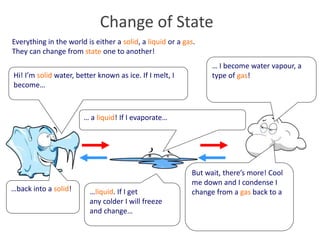
Everything in the world is either a solid, a liquid or a gas.
They can change from state one to another!
Hi! I’m solid water, better known as ice. If I melt, I
become…
… a liquid! If I evaporate…
… I become water vapour, a
type of gas!
But wait, there’s more! Cool
me down and I condense I
change from a gas back to a…liquid. If I get
any colder I will freeze
and change…
…back into a solid!
Change of State
• Consider whether you are completing an
investigative or illustrative activity.
• Use your senses to explore the mystery parcels.
• Record your observations in your note-book.
• Predict what they could contain – give
explanations for your ideas.
• Unwrap and explore further.
• How could you now make this investigative-
where could the science go…..
Task 1: Investigating ice balloons
?
• The skittles challenge-Is this a chemical or physical change? How could you make it
investigative
• Place a petri dish on white paper
• Add 2 skittles
• What do you think will happen if you add water to cover the skittles?
• Record your predictions and compare these with those of peers.
• Cover with water and observe what happens.
• Draw what you see.
• What might be happening?
• What evidence do you have to support your hypothesis?
• You have observed change over a short time using data gained from your senses.
From your observations you have tried to develop simple evidence based
explanations about the effect of water on confectionary.
• Link to Charlie and the Chocolate Factory or Sweetie making in Chitty-Chitty Bang
Bang.
Task 2 :Developing observation skills and
completing and illustrative activity.
Design an investigation
• How can you alter the previous experiment to make it
investigative?
• Use Post-it notes to identify variables affecting the
dissolving of the skittles.
• Identify what you could change, what you could measure
and what variables you will keep the same.
• Make a prediction – if I alter ? My skittle/s will…
• Form a hypothesis to explain what is happening.
Carrying out a comparative test
• Decide on one variable to study
– Eg I will change the xxx.
– I will measure the
– I will ensure all other variables are
controlled
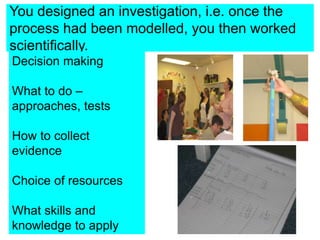
You designed an investigation, i.e. once the
process had been modelled, you then worked
scientifically.
Decision making
What to do –
approaches, tests
How to collect
evidence
Choice of resources
What skills and
knowledge to apply
Y5 Properties and Changes of Materials
Chemical Changes – often irreversible
What should I teach?
• Compare and group together everyday
materials on the basis of their properties:
hardness, solubility, transparency,
conductivity (electrical and thermal) and
response to magnets.
• Know that some materials will dissolve in
liquid to form a solution and describe how to
recover a substance from a solution.
• Use knowledge of solids, liquids and gases to
decide on how mixtures may be separated:
filtering, sieving and evaporating.
• Give reasons, based on evidence from
comparative and fair tests for the particular
uses of everyday materials including metals,
wood and plastic.
• Demonstrate that dissolving, mixing and
changes of state are reversible changes.
• Explain that some changes result in the
formation of new materials and that this
kind of change is not usually reversible,
including changes associated with burning
and the action of acid on bicarbonate of
soda.
How could I teach this?
Sort and classify objects on the basis of:
• Mechanical – strength, elasticity, flexibility,
stretchiness.
• Thermal - keeps things warm/cold.
• Electrical – conductivity.
• Chemical – soluble (dissolves).
• Optical – transparent, translucent, opaque.
• Magnetic/non-magnetic
Separate mixtures of materials:
• magnetic/non-magnetic.
• sieving to separate sand and stones (particle size).
• filtration to separate sand and water. heating and
evaporation to separate sand and salt.
• chromatography to separate pigments in ink
markers.
• by dissolving materials and heating.
Create new materials by mixing reactive materials:
Eg volcano fizz from ingredients A and B.
Create a bath bomb recipe: from ingredients C and D.
Make quicksand from ??? and water.
Make a dream bottle (BFG).
…..
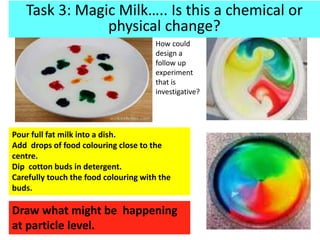
But what’s happening at particle level?
Draw what might be happening
at particle level.
Pour full fat milk into a dish.
Add drops of food colouring close to the
centre.
Dip cotton buds in detergent.
Carefully touch the food colouring with the
buds.
Task 3: Magic Milk….. Is this a chemical or
physical change?
How could
design a
follow up
experiment
that is
investigative?
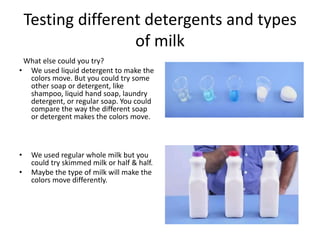
Testing different detergents and types
of milk
What else could you try?
• We used liquid detergent to make the
colors move. But you could try some
other soap or detergent, like
shampoo, liquid hand soap, laundry
detergent, or regular soap. You could
compare the way the different soap
or detergent makes the colors move.
• We used regular whole milk but you
could try skimmed milk or half & half.
• Maybe the type of milk will make the
colors move differently.
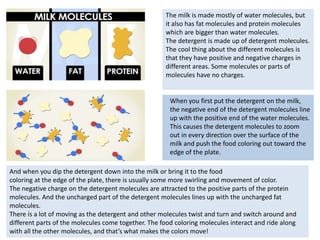
When you first put the detergent on the milk,
the negative end of the detergent molecules line
up with the positive end of the water molecules.
This causes the detergent molecules to zoom
out in every direction over the surface of the
milk and push the food coloring out toward the
edge of the plate.
The milk is made mostly of water molecules, but
it also has fat molecules and protein molecules
which are bigger than water molecules.
The detergent is made up of detergent molecules.
The cool thing about the different molecules is
that they have positive and negative charges in
different areas. Some molecules or parts of
molecules have no charges.
And when you dip the detergent down into the milk or bring it to the food
coloring at the edge of the plate, there is usually some more swirling and movement of color.
The negative charge on the detergent molecules are attracted to the positive parts of the protein
molecules. And the uncharged part of the detergent molecules lines up with the uncharged fat
molecules.
There is a lot of moving as the detergent and other molecules twist and turn and switch around and
different parts of the molecules come together. The food coloring molecules interact and ride along
with all the other molecules, and that’s what makes the colors move!
Chemical changes in the world around us
Natural Man-made
Mapping your ideas:
• What is a chemical change?
• How do we know when a chemical change
takes place?
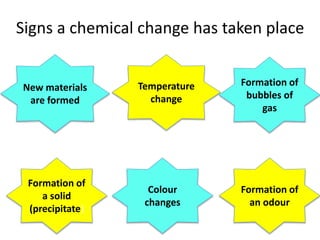
Signs a chemical change has taken place
New materials
are formed
Formation of
a solid
(precipitate)
Temperature
change
Colour
changes
Formation of
an odour
Formation of
bubbles of
gas
Reflect on Particle Theory
• All substances are made up of particles: atoms
and molecules.
• The particles in a solid are tightly packed and
movement is limited to vibration at a fixed point.
• The particles in a liquid are in contact with each
other but arranged randomly. They can roll over
each other and pour/flow.
• The particles in a gas can move around freely.
There are spaces between them so they can be
pushed closer together – this is why a gas can be
compressed.
Conservation of Mass
• Within a closed system the amount of mass
remains constant.
• Mass cannot be created or destroyed but it
can be rearranged in space and changed into
different types of particles!
• Can we catch a gas? Yes we can!
So, what is science?
• Science is about everyday things and events.
• Children need to be excited and enjoy the subject.
• Teachers should provide experiences that provoke
cognitive dissonance.
• Science is doing as well as knowing and both must
happen at once.
• Skills and practices are not carried out discretely and
separately but are integrated to generate conceptual
knowledge in an area of interest.
• Science is one way of looking at the world, it is not the
only one. However it is a core subject in the primary
classroom.
For tomorrow
• Reflect on how different questions can
encourage different levels of thinking.
• Where else could you find predict/predicting
in the NC?
Suggested Readings
• Black, P & Harrison, C. (2010) ‘How science
works’, Chapter 2 in Osborne, J. & Dillon (2010)
Good Practice in Science Teaching: What research
has to say (2nd edition). Maidenhead: Open
University Press, p183-210 eBook.
• Allen, M. (2010) Misconceptions in primary
science. Chapter 9 Chemical Change; Chapter 10
Particles; Chapter 11 States of Matter. eBook
For next week (not tomorrow)
• Please undertake the science audit available
on BlackBoard.
• For those who enjoy a challenge there is also
an on-line science audit hosted by Learning
Matters Sage.

PGCE FT Session 1 What is science?

  • 1.
    Science, Scientists, Science Teachingwithin the context of ‘Materials’. PGCE FT Primary Science Session 1
  • 2.
    Hazard Persons at Risk & Natureof harm Current Control Measures Risk Rating Severity x Likelihood Trip hazards. Students and Staff Inform students to keep walkways clear at all times by storing bags under tables. Chairs to be replaced under the table when not being used. Low Student electrical equipment on desktops – reduces space and potential for electric shocks with spillages. Students and Staff All student personal electrical equipment to be put away when not required during practical activities. Mobile phones not to be charged in rooms. Personal Safety Hands to be washed after practical activities where appropriate. No food to be consumed in the science teaching rooms. Students to advise lecturers of any personal medical conditions that may be exacerbated during specific practical sessions. Students to take responsibility for informing others of potential hazards that manifest from their practical investigations. Low End of session etiquette All equipment returned to the place of origin. All rubbish to be disposed of and/or recycled where appropriate. Tables and floors to be left clear. All chairs to be replaced under tables on leaving the room. Please take time to familiarise yourself with the following health and safety measures applicable during all Primary Science sessions.
  • 3.
    Aims of Session1 1. To introduce the Primary Science Module. 2. To interrogate your perceptions of science, scientists and teaching science. 3. Scientific enquiry and working scientifically according to the National Curriculum (DfE, 2013), with a particular focus on predicting and observing. 4. To work scientifically to try out some different types of enquiries relating to materials.
  • 4.
    What does sciencemean to you? Together, in groups of 4 create mind-maps to show what science means to you.
  • 5.
    Drawing Tasks (Chambers1983) Draw a group of scientists working.
  • 6.
    Draw a Groupof Scientists
  • 7.
    Eliciting children’s perceptionsof scientists Is science for me or other people?
  • 8.
    • Detective • Doctors •Medical scientist • Forensic scientist • Judge • Spy • Insurance claims officer Drawing Task given to children 2013 in the SPIES project: Professions who ‘build a knowledge picture’ by using evidence on which to base their conclusions and decision-making. http://www.pstt.org.uk/project- information/projects/supporting-pupils-independent-enquiry- studies-in-science-year-56-pupils.aspx
  • 9.
    • The negativeimage of a scientist as a ‘mad scientist’ or a ‘man in lab coat’ in cartoons and TV programs may be the cause of the formation of negative images of scientists…. • The formation of this negative image in students could prevent students not only in becoming a scientist and in aspiring to having a career in science.
  • 10.
  • 11.
    How is scienceeducation organised for delivery to children? • Early Years Foundation Stage – Seven areas of learning: Science = UTW – Understanding the World – Early Learning Goals • National Curriculum (DfE, 2013) England: Programmes of Study: – Key Stage 1: Y1 and Y2 – Lower Key Stage 2: Y3 and Y4 – Upper Key Stage 2: Y5 and Y6 Science is a core subject like English and mathematics but it is now marginalised (CBI, 2015). Children are required to work scientifically and in doing so to gain experience of a broad range of scientific enquiries.
  • 12.
    Developing children’s experienceof engaging in broad categories of scientific enquiry (DfE, 2013) • Exploring phenomena/Observing changes over time • Identifying and classifying • Surveys and pattern-seeking • Identifying and controlling variables (Fair-test, comparative tests) • Research and synthesis using secondary sources • Using and creating models to explain phenomena (USA, Australia and New Zealand)
  • 13.
    But to workscientifically… We should encourage children to take part in the social practices of science: • Discussion • Constructing evidence based explanations • Articulating evidence-based arguments • Debate Aufschnaiter von, C., Erduran, S., Osborne, J. & Simon, S. (2008) ‘Arguing to Learn and Learning to Argue: Case Studies of How Students’ Argumentation Relates to Their Scientific Knowledge’ Journal of Research in Science Teaching, 45( 1), p 101–131. But to work scientifically……
  • 14.
    What revisited….. • Teachersdevelop children’s knowledge by supporting them to work scientifically, • Enabling them to construct understanding by raising questions, • Enabling them to think of ways to investigate these questions • Requiring them to generate ideas based on observations, • Test ideas, • To collect data and to reflect on what their observations/data mean. What revisited………….
  • 15.
    Historical Context • EducationReform Act (1988) established science as a core subject with English and mathematics. • Advocated a focus on the development of scientific knowledge as a result of children engaging in scientific enquiry • BUT emphasis was placed on acquisition of content (ontological) and procedural knowledge. • 1991 KS1 and KS2 Standard Assessment Tests measured children’s ability to recall facts – teaching to the test. • 1998 QCA Scheme of Work prescriptive • 2009 KS1 and KS2 compulsory Standard Assessment Tests abolished for science • Some dependence on commercial schemes of work - recipe science – restricting opportunities for children to follow their interests. Historical Context
  • 16.
    Primary Science CurriculumOverview by Theme Year 1 Year 2 Year 3 Year 4 Year 5 Year 6 Plants (Identify, name, sort, classify) Living things and their habitats (Living/Non-living/dead Habitats/ Food Chains) Plants (Functions of parts requirements for growth, water transportation; life-cycle of flowering plants) Living things and their Habitats (Grouping, classification; habitats; impact of changing environments) Living things and their Habitats Life cycles of mammal, amphibians, insect, and bird. Plant/animal reproduction Living things and their Habitats Classification; similarities/differences, micro-organisms Animals including Humans (Identify, name, sort, classify) Plants (Seeds and bulbs: simple life-cycles; conditions for growth) Animals including Humans (Nutrition/Diet; Movement) Animals including Humans (Teeth, eating, digestion; food chains, predator-prey) Animals including Humans Human growth and development from pregnancy Animals including Humans Heart and circulation, impact of diet, exercise, drugs, lifestyle; transport of nutrients and water Everyday Materials (Identify objects and their materials; properties) Animals including Humans (Life-cycles, survival needs, nutrition, diet, exercise, healthy lives) Rocks Compare and group on basis of properties; fossil formation; rock cycle, soil formation. States of Matter Solids, liquids, gases; physical changes and temperature; water cycle: evaporation/ condensation Properties and changes of Materials Chemical change, dissolving, mixing, separating materials, sieving, filtration, evaporation Evolution & Inheritance Recognising change over time; fossil evidence; offspring inherit characteristics, adaptation. Seasonal Changes (Changes, weather associated with four seasons) Uses of Everyday Materials (Identify, compare suitability of use; changes in materials) Light Light/dark; shadows; reflections. Sound Vibrations; media, the ear; patterns in sounds; pitch; changing sounds; Earth and Space The Earth’s rotation and orbit relative to Sun. Day, night Light Light travels in straight lines; how we see light sources or reflected light Forces & Magnets Movement on surfaces/ Friction; Magnets Electricity Construct simple circuits; add components, switches, conductors, insulators Forces Gravity; air resistance, water resistance, friction; mechanisms; levers, pulleys, gears. Electricity Changing brightness, loudness of components; use conventional symbols
  • 17.
    Uses of Everyday Materials Y1 Usesof Everyday Materials Y2 States of Matter Y4 Properties and Changes of Materials Y5 •Distinguish between an object and the material from which it is made. •Identify and name a variety of everyday materials including wood, plastic, glass, metal, water and rock. •Describe the simple physical properties of a variety of everyday materials. •Compare and group together everyday materials on the basis of their simple physical properties, appearance, hardness, roughness, strength, Identify and compare the suitability of a variety of everyday materials, including wood, metal, plastic, glass, brick, rock, paper and cardboard for particular uses. Find out how the shapes of solid objects made from some materials can be changed by squashing, bending, twisting and stretching. Compare and group materials together according to whether they are solids, liquids or gases. Observe that some materials change state when they are heated or cooled and measure or research the temperature at which this happens in degrees Celsius. Identify the part played by evaporation and condensation in the water cycle and associate the rate of evaporation with temperature. •Compare and group together everyday materials on the basis of their properties: hardness, solubility, transparency, conductivity (electrical and thermal) and response to magnets. •Know that some materials will dissolve in liquid to form a solution and describe how to recover a substance from a solution. •Use knowledge of solids, liquids and gases to decide on how mixtures may be separated: filtering, sieving and evaporating. •Give reasons, based on evidence from comparative and fair tests for the particular uses of everyday materials including metals, wood and plastic. •Demonstrate that dissolving, mixing and changes of state are reversible changes. •Explain that some changes result in the formation of new materials and that this kind of change is not usually
  • 18.
    Elicitation Activity: ScienceSubject Knowledge Quiz Which of the following are physical or chemical changes?  Ice turning into water.  Toast.  Sugar in hot tea/coffee.  Lemon juice and bicarbonate of soda.  A candle burning.  Chocolate placed in a bowl placed over hot water.  Fizz when the top comes off a lemonade bottle.  An apple left in a fruit bowl for weeks.
  • 19.
    Subject Knowledge Quiz Whichof the following are physical changes?  Ice turning into water – Physical – melting.  Toast – Chemical – burning.  Sugar in hot tea/coffee – Physical – dissolving.  Lemon juice and bicarbonate of soda – Chemical reaction.  A candle burning – Physical (hot wax liquifies, some evaporates) and chemical (the wick burns making ash).  Chocolate placed in a bowl placed over hot water Physical (chocolate is not a pure substance, bars do not have specific melting points).  Fizz when the top comes off a lemonade bottle – physical (gas is forced into the bottle under pressure).  An apple left in a fruit bowl for weeks. Chemical – (ageing then decomposition)
  • 20.
    Y1 Uses ofEveryday Materials What will I teach pupils? Pupils should be taught to: • Distinguish between an object and the material from which it is made. • Identify and name a variety of everyday materials including wood, plastic, glass, metal, water and rock. • Describe the simple physical properties of a variety of everyday materials. • Compare and group together everyday materials on the basis of their simple physical properties, appearance, hardness, roughness, strength, flexibility. How could I teach this? • Sensory activities: feely bag; identifying objects while blindfolded. • Encourage pupils to sort collections of materials based on a variety of criteria: – Colour – Shape – Texture – Hardness – Smell – Purpose • Record the sorted sets in different ways. • Make a patchwork coat for Elmer the Elephant.
  • 21.
    Year 2 Usesof Everyday Materials What will I teach? • Identify and compare the suitability of a variety of everyday materials, including wood, metal, plastic, glass, brick, rock, paper and cardboard for particular uses. • Find out how the shapes of solid objects made from some materials can be changed by squashing, bending, twisting and stretching. How could I teach this? • Survey the occurrence and uses of common materials in the school/home environment. • Create a rain-hat for a Teddy Bear. • Sort collections of objects including stretchy solids, marshmallows, jelly, curly-wurlies. • Goldilocks’s Birthday Party investigations: • Observing change - cooking meringues. • Observing what happens when ‘frozen solids’ are taken out of a freezer. • Sorting and classifying biscuits. • Controlling variables - making jelly. • Cooking porridge for the Three Bears.
  • 22.
    Y4 States ofMatter (Physical Changes - reversible) What will I teach? • Compare and group materials together according to whether they are solids, liquids or gases. • Observe that some materials change state when they are heated or cooled and measure or research the temperature at which this happens in degrees Celsius. • Identify the part played by evaporation and condensation in the water cycle and associate the rate of evaporation with temperature. How could I teach this? • States of Matter Mystery Balloons containing Air, Water, Ice. • Trapped Inside: Freeze objects in ice balloons and investigate ways to retrieve the object by melting the ice. • Wash and dry dolls clothes on dry, sunny and cool days. Observe that evaporation occurs faster on warm days. • Disappearing puddle studies - why do puddles disappear quickly on hot days. • Solid, Liquid, Gas role-play. Observing the effect of heating and cooling on the states of water – cooling = ice; heating = water vapour – gas. • Investigating the insulation properties of materials. How can I keep my snowman cold? How can I keep my cup of tea warm for longer? How can I keep my penguin/hedgehog (baked potato) warm? • The Water-cycle: the journey of a raindrop from cloud to sea. The role of evaporation and condensation in maintaining the water-cycle. • Liquid layers – creating layers using liquids of different densities eg water, oil, syrups, • Liquid races – Measuring the speed at which liquids travel down an inclined transparent slope:
  • 23.
    Everything in theworld is either a solid, a liquid or a gas. They can change from state one to another! Hi! I’m solid water, better known as ice. If I melt, I become… … a liquid! If I evaporate… … I become water vapour, a type of gas! But wait, there’s more! Cool me down and I condense I change from a gas back to a…liquid. If I get any colder I will freeze and change… …back into a solid! Change of State
  • 24.
    • Consider whetheryou are completing an investigative or illustrative activity. • Use your senses to explore the mystery parcels. • Record your observations in your note-book. • Predict what they could contain – give explanations for your ideas. • Unwrap and explore further. • How could you now make this investigative- where could the science go….. Task 1: Investigating ice balloons
  • 25.
    ? • The skittleschallenge-Is this a chemical or physical change? How could you make it investigative • Place a petri dish on white paper • Add 2 skittles • What do you think will happen if you add water to cover the skittles? • Record your predictions and compare these with those of peers. • Cover with water and observe what happens. • Draw what you see. • What might be happening? • What evidence do you have to support your hypothesis? • You have observed change over a short time using data gained from your senses. From your observations you have tried to develop simple evidence based explanations about the effect of water on confectionary. • Link to Charlie and the Chocolate Factory or Sweetie making in Chitty-Chitty Bang Bang. Task 2 :Developing observation skills and completing and illustrative activity.
  • 26.
    Design an investigation •How can you alter the previous experiment to make it investigative? • Use Post-it notes to identify variables affecting the dissolving of the skittles. • Identify what you could change, what you could measure and what variables you will keep the same. • Make a prediction – if I alter ? My skittle/s will… • Form a hypothesis to explain what is happening.
  • 27.
    Carrying out acomparative test • Decide on one variable to study – Eg I will change the xxx. – I will measure the – I will ensure all other variables are controlled
  • 28.
    You designed aninvestigation, i.e. once the process had been modelled, you then worked scientifically. Decision making What to do – approaches, tests How to collect evidence Choice of resources What skills and knowledge to apply
  • 29.
    Y5 Properties andChanges of Materials Chemical Changes – often irreversible What should I teach? • Compare and group together everyday materials on the basis of their properties: hardness, solubility, transparency, conductivity (electrical and thermal) and response to magnets. • Know that some materials will dissolve in liquid to form a solution and describe how to recover a substance from a solution. • Use knowledge of solids, liquids and gases to decide on how mixtures may be separated: filtering, sieving and evaporating. • Give reasons, based on evidence from comparative and fair tests for the particular uses of everyday materials including metals, wood and plastic. • Demonstrate that dissolving, mixing and changes of state are reversible changes. • Explain that some changes result in the formation of new materials and that this kind of change is not usually reversible, including changes associated with burning and the action of acid on bicarbonate of soda. How could I teach this? Sort and classify objects on the basis of: • Mechanical – strength, elasticity, flexibility, stretchiness. • Thermal - keeps things warm/cold. • Electrical – conductivity. • Chemical – soluble (dissolves). • Optical – transparent, translucent, opaque. • Magnetic/non-magnetic Separate mixtures of materials: • magnetic/non-magnetic. • sieving to separate sand and stones (particle size). • filtration to separate sand and water. heating and evaporation to separate sand and salt. • chromatography to separate pigments in ink markers. • by dissolving materials and heating. Create new materials by mixing reactive materials: Eg volcano fizz from ingredients A and B. Create a bath bomb recipe: from ingredients C and D. Make quicksand from ??? and water. Make a dream bottle (BFG).
  • 30.
    ….. But what’s happeningat particle level? Draw what might be happening at particle level. Pour full fat milk into a dish. Add drops of food colouring close to the centre. Dip cotton buds in detergent. Carefully touch the food colouring with the buds. Task 3: Magic Milk….. Is this a chemical or physical change? How could design a follow up experiment that is investigative?
  • 31.
    Testing different detergentsand types of milk What else could you try? • We used liquid detergent to make the colors move. But you could try some other soap or detergent, like shampoo, liquid hand soap, laundry detergent, or regular soap. You could compare the way the different soap or detergent makes the colors move. • We used regular whole milk but you could try skimmed milk or half & half. • Maybe the type of milk will make the colors move differently.
  • 32.
    When you firstput the detergent on the milk, the negative end of the detergent molecules line up with the positive end of the water molecules. This causes the detergent molecules to zoom out in every direction over the surface of the milk and push the food coloring out toward the edge of the plate. The milk is made mostly of water molecules, but it also has fat molecules and protein molecules which are bigger than water molecules. The detergent is made up of detergent molecules. The cool thing about the different molecules is that they have positive and negative charges in different areas. Some molecules or parts of molecules have no charges. And when you dip the detergent down into the milk or bring it to the food coloring at the edge of the plate, there is usually some more swirling and movement of color. The negative charge on the detergent molecules are attracted to the positive parts of the protein molecules. And the uncharged part of the detergent molecules lines up with the uncharged fat molecules. There is a lot of moving as the detergent and other molecules twist and turn and switch around and different parts of the molecules come together. The food coloring molecules interact and ride along with all the other molecules, and that’s what makes the colors move!
  • 33.
    Chemical changes inthe world around us Natural Man-made Mapping your ideas: • What is a chemical change? • How do we know when a chemical change takes place?
  • 34.
    Signs a chemicalchange has taken place New materials are formed Formation of a solid (precipitate) Temperature change Colour changes Formation of an odour Formation of bubbles of gas
  • 35.
    Reflect on ParticleTheory • All substances are made up of particles: atoms and molecules. • The particles in a solid are tightly packed and movement is limited to vibration at a fixed point. • The particles in a liquid are in contact with each other but arranged randomly. They can roll over each other and pour/flow. • The particles in a gas can move around freely. There are spaces between them so they can be pushed closer together – this is why a gas can be compressed.
  • 36.
    Conservation of Mass •Within a closed system the amount of mass remains constant. • Mass cannot be created or destroyed but it can be rearranged in space and changed into different types of particles! • Can we catch a gas? Yes we can!
  • 37.
    So, what isscience? • Science is about everyday things and events. • Children need to be excited and enjoy the subject. • Teachers should provide experiences that provoke cognitive dissonance. • Science is doing as well as knowing and both must happen at once. • Skills and practices are not carried out discretely and separately but are integrated to generate conceptual knowledge in an area of interest. • Science is one way of looking at the world, it is not the only one. However it is a core subject in the primary classroom.
  • 38.
    For tomorrow • Reflecton how different questions can encourage different levels of thinking. • Where else could you find predict/predicting in the NC?
  • 39.
    Suggested Readings • Black,P & Harrison, C. (2010) ‘How science works’, Chapter 2 in Osborne, J. & Dillon (2010) Good Practice in Science Teaching: What research has to say (2nd edition). Maidenhead: Open University Press, p183-210 eBook. • Allen, M. (2010) Misconceptions in primary science. Chapter 9 Chemical Change; Chapter 10 Particles; Chapter 11 States of Matter. eBook
  • 40.
    For next week(not tomorrow) • Please undertake the science audit available on BlackBoard. • For those who enjoy a challenge there is also an on-line science audit hosted by Learning Matters Sage.