What is
Action Research?
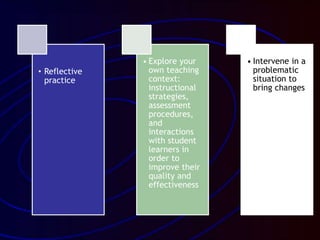
• Reflective
practice
• Explore your
own teaching
context:
instructional
strategies,
assessment
procedures,
and
interactions
with student
learners in
order to
improve their
quality and
effectiveness
• Intervene in a
problematic
situation to
bring changes
According to some experts . . .
it is . . .
Eileen Ferrance, "Action Research," Providence, RI: The Education
Alliance, 2000, available from
www.alliance.brown.edu/pubs/themes_ed/act_research.pdf
“a cycle
of posing questions,
gathering data,
reflection,
and deciding on a
course of action.”
Why should I do action
research? If…
I am
teacher
I am not
paid for
that
It is not in
my teaching
schedule
I do not
have
resources
You should do action research
because…
You are reflective You are committed
to developing as a
thinking professional
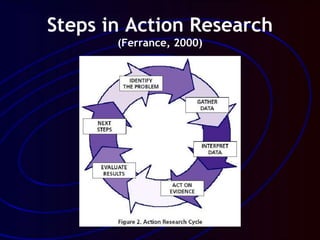
Steps in Action Research
(Ferrance, 2000)
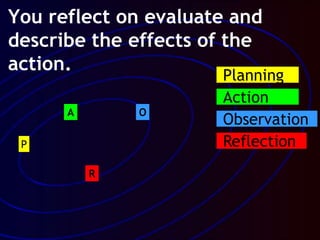
According to Kemmis and
McTaggart (1988),
AR is a cyclical process which
typically involves four broad
phases in a cycle of research
P
Planning
You start out identifying a problem or
issue and develop a plan of action in
order to bring about improvements
Action
A
P
Planning
It involves intervention which means you
take action on your solution
Action
A O
P
Planning
Observation
This phase involves you in observing
systematically the effects of the action
and documenting the context, actions
and opinions of those involved
Action
A
R
O
P
Planning
Reflection
Observation
You reflect on evaluate and
describe the effects of the
action.
Action
D
R
A
P
P
D A
R
Planning
Reflection
Observation
Then, you repeat the process.
Action
A
R
O
P
P
A O
R
PlanningP
Reflection
Observstion
A O
R
P
Again and again …
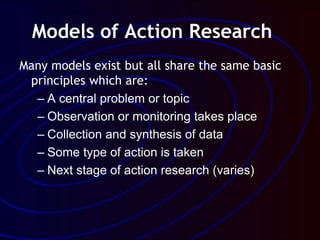
Models of Action Research
Many models exist but all share the same basic
principles which are:
– A central problem or topic
– Observation or monitoring takes place
– Collection and synthesis of data
– Some type of action is taken
– Next stage of action research (varies)
Calhoun’s Action Research
Cycle
(Mertler, 2009)
Piggot-Irvine’s Action Research Model
Mertler (2009)
Some AR features..
It involves
evaluation and
reflection
It is a small scale
project
It gives the
opportunity to
investigate about
inmmediate
concerns
It collects and
analyze data
systematically
ACTIVITY
IDENTIFY AND DESCRIBE
-The pros and cons of being an action researcher
-The kinds of topics that are investigated in AR
-The main differences between AR and applied
research
-The relationships of AR to reflecting teaching
REFERENCES
Burns, A. (2003). Collaborative action research for English
language teachers. Cambridge: Cambridge
University Press.
Ferrance, E. (2000). Action Research. Providence, RI,
USA. Retrieved November 14, 2012 from
http://www.lab.brown.edu/pubs/themes_ed/act_rese
arch.pdf
Kemmis, S. & McTaggart, R. (1988). The action research
reader. Victoria: Deakin University Press.
Mertler, C. (2009). Action Research. Thousand Oaks,
California, USA: Sage Publications, Inc.

Action research