Science Fair
       Transformation:


                             Alissa Royal
                      K-12 Engineering Coordinator
                         aroyal@melissaisd.org
                             Dollie Green
                       5th Grade Science Teacher
                        dgreen@melissaisd.org
                              Kelli Gobel
                       5th Grade Science Teacher
                        kgobel@melissaisd.org

The Next Generation of Science Fair Webpage
How has the student’s understanding of
 scientific literacy been develop through
 this process?
 Question Boards
 Types of Investigation
 Data Collection Posters
 Inquiry
 Claims, Evidence & Reasoning
 Embedded Process Skills
 Cross curricular connections
 Technology
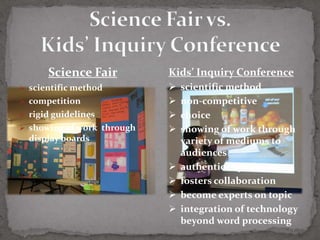
Science Fair          Kids’ Inquiry Conference
 scientific method            scientific method
 competition                  non-competitive
 rigid guidelines             choice
 showing of work through      showing of work through
  display boards                variety of mediums to
                                audiences
                               authentic experiences
                               fosters collaboration
                               become experts on topic
                               integration of technology
                                beyond word processing
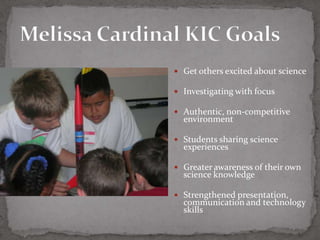
 Get others excited about science

 Investigating with focus

 Authentic, non-competitive
  environment

 Students sharing science
  experiences

 Greater awareness of their own
  science knowledge

 Strengthened presentation,
  communication and technology
  skills
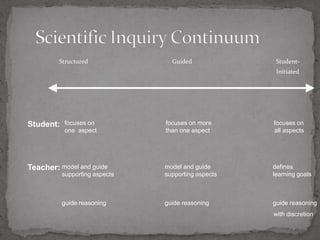
Structured               Guided              Student-
                                                      Initiated


Student:   focuses on           focuses on more      focuses on
           one aspect           than one aspect      all aspects


Teacher: model and guide        model and guide      defines
           supporting aspects   supporting aspects   learning goals


           guide reasoning      guide reasoning      guide reasoning
                                                     with discretion
How does changing the applied force
 affect how high the cork flies?


FOSS Scientific Reasoning/Variables
 What is a question board?
 Setting the stage…
 Start with an investigation where
 the question is provided
 (structured or guided inquiry)

      Testable vs. Researchable Card Sort
Choosing the testable questions
  1. Choose from the question board
  2. Last year’s KIC question and change variable
  3. Differentiated for students with deep content
     knowledge on a specific topic

 Part 1: Choose the testable question
Sorting Activity
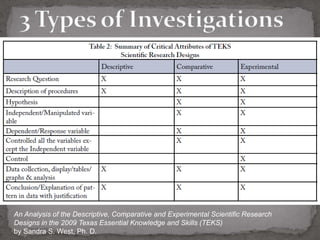
An Analysis of the Descriptive, Comparative and Experimental Scientific Research
Designs in the 2009 Texas Essential Knowledge and Skills (TEKS)
by Sandra S. West, Ph. D.
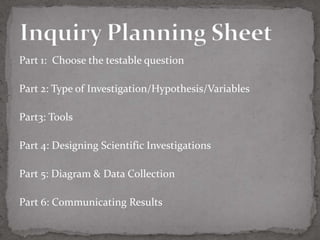
Part 1: Choose the testable question

Part 2: Type of Investigation/Hypothesis/Variables

Part3: Tools

Part 4: Designing Scientific Investigations

Part 5: Diagram & Data Collection

Part 6: Communicating Results
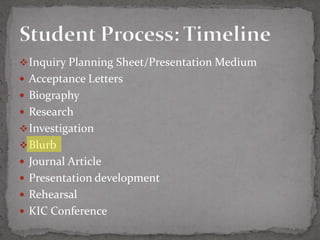
 Inquiry Planning Sheet/Presentation Medium
 Acceptance Letters
 Biography
 Research
 Investigation
 Blurb
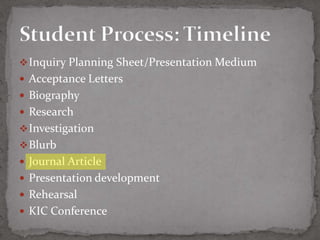
 Journal Article
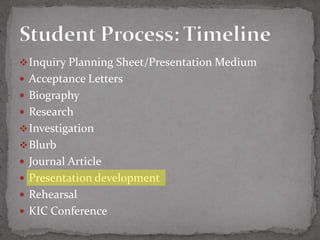
 Presentation development
 Rehearsal
 KIC Conference
 Inquiry Planning Sheet/Presentation Medium
 Acceptance Letters
 Biography
 Research
 Investigation
 Blurb
 Journal Article
 Presentation development
 Rehearsal
 KIC Conference
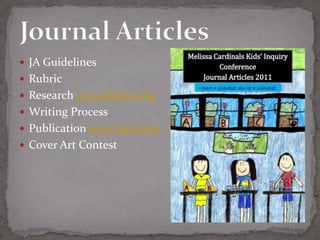
 JA Guidelines
 Rubric
 Research www.bibme.org
 Writing Process
 Publication www.lulu.com
 Cover Art Contest
 Inquiry Planning Sheet/Presentation Medium
 Acceptance Letters
 Biography
 Research
 Investigation
 Blurb
 Journal Article
 Presentation development
 Rehearsal
 KIC Conference
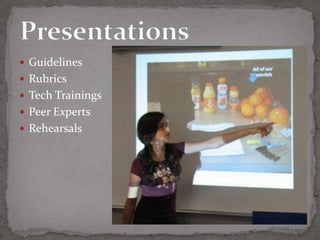
 Guidelines
 Rubrics
 Tech Trainings
 Peer Experts
 Rehearsals
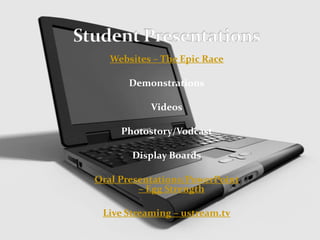
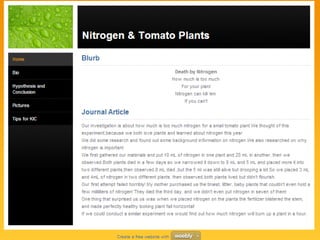
Websites – The Epic Race

       Demonstrations

           Videos

     Photostory/Vodcast

       Display Boards

Oral Presentations/PowerPoint
         – Egg Strength

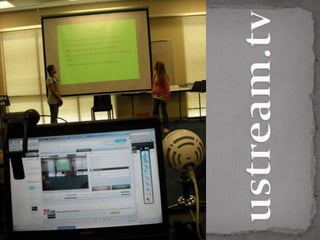
 Live Streaming – ustream.tv
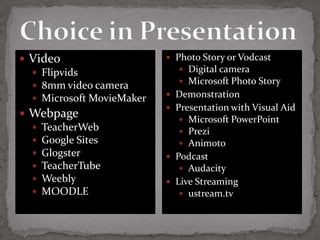
 Video                     Photo Story or Vodcast
   Flipvids                   Digital camera
                               Microsoft Photo Story
   8mm video camera
                            Demonstration
   Microsoft MovieMaker
                            Presentation with Visual Aid
 Webpage
                               Microsoft PowerPoint
   TeacherWeb                 Prezi
   Google Sites               Animoto
   Glogster                Podcast
   TeacherTube                Audacity
   Weebly                  Live Streaming
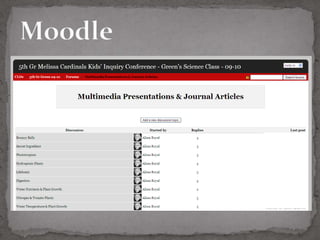
   MOODLE                     ustream.tv
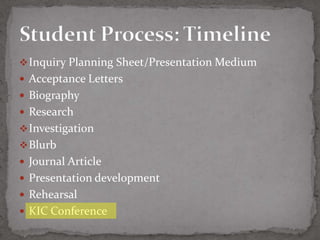
 Inquiry Planning Sheet/Presentation Medium
 Acceptance Letters
 Biography
 Research
 Investigation
 Blurb
 Journal Article
 Presentation development
 Rehearsal
 KIC Conference
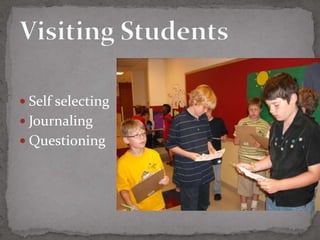
 Self selecting
 Journaling
 Questioning
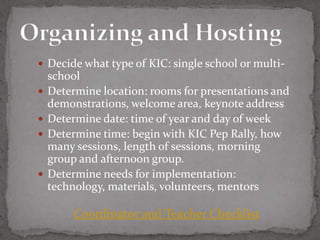
 Decide what type of KIC: single school or multi-
    school
   Determine location: rooms for presentations and
    demonstrations, welcome area, keynote address
   Determine date: time of year and day of week
   Determine time: begin with KIC Pep Rally, how
    many sessions, length of sessions, morning
    group and afternoon group.
   Determine needs for implementation:
    technology, materials, volunteers, mentors

         Coordinator and Teacher Checklist
How has the student’s understanding of
 scientific literacy been develop through
 this process?
Dieckman, Dona, Charles R. Pearce, and Wendy Saul. Beyond the Science
   Fair: Creating a Kids' Inquiry Conference. Chicago: Heinemann, 2005.
   Print.


"The Kids' Inquiry Conference Homepage." The Elementary Science
   Integration Projects. N.p., n.d. Web. 1 Nov. 2010.
   <http://www.esiponline.org/kic/


Flippers Investigation. FOSS Field test unit. Delta Education.

Kic cast 2012 3hr

  • 1.
    Science Fair Transformation: Alissa Royal K-12 Engineering Coordinator aroyal@melissaisd.org Dollie Green 5th Grade Science Teacher dgreen@melissaisd.org Kelli Gobel 5th Grade Science Teacher kgobel@melissaisd.org The Next Generation of Science Fair Webpage
  • 2.
    How has thestudent’s understanding of scientific literacy been develop through this process?
  • 3.
     Question Boards Types of Investigation  Data Collection Posters  Inquiry  Claims, Evidence & Reasoning  Embedded Process Skills  Cross curricular connections  Technology
  • 4.
    Science Fair Kids’ Inquiry Conference  scientific method  scientific method  competition  non-competitive  rigid guidelines  choice  showing of work through  showing of work through display boards variety of mediums to audiences  authentic experiences  fosters collaboration  become experts on topic  integration of technology beyond word processing
  • 5.
     Get othersexcited about science  Investigating with focus  Authentic, non-competitive environment  Students sharing science experiences  Greater awareness of their own science knowledge  Strengthened presentation, communication and technology skills
  • 8.
    Structured Guided Student- Initiated Student: focuses on focuses on more focuses on one aspect than one aspect all aspects Teacher: model and guide model and guide defines supporting aspects supporting aspects learning goals guide reasoning guide reasoning guide reasoning with discretion
  • 9.
    How does changingthe applied force affect how high the cork flies? FOSS Scientific Reasoning/Variables
  • 10.
     What isa question board?  Setting the stage…  Start with an investigation where the question is provided (structured or guided inquiry) Testable vs. Researchable Card Sort
  • 11.
    Choosing the testablequestions 1. Choose from the question board 2. Last year’s KIC question and change variable 3. Differentiated for students with deep content knowledge on a specific topic Part 1: Choose the testable question
  • 12.
  • 13.
    An Analysis ofthe Descriptive, Comparative and Experimental Scientific Research Designs in the 2009 Texas Essential Knowledge and Skills (TEKS) by Sandra S. West, Ph. D.
  • 14.
    Part 1: Choosethe testable question Part 2: Type of Investigation/Hypothesis/Variables Part3: Tools Part 4: Designing Scientific Investigations Part 5: Diagram & Data Collection Part 6: Communicating Results
  • 15.
     Inquiry PlanningSheet/Presentation Medium  Acceptance Letters  Biography  Research  Investigation  Blurb  Journal Article  Presentation development  Rehearsal  KIC Conference
  • 17.
     Inquiry PlanningSheet/Presentation Medium  Acceptance Letters  Biography  Research  Investigation  Blurb  Journal Article  Presentation development  Rehearsal  KIC Conference
  • 18.
     JA Guidelines Rubric  Research www.bibme.org  Writing Process  Publication www.lulu.com  Cover Art Contest
  • 19.
     Inquiry PlanningSheet/Presentation Medium  Acceptance Letters  Biography  Research  Investigation  Blurb  Journal Article  Presentation development  Rehearsal  KIC Conference
  • 20.
     Guidelines  Rubrics Tech Trainings  Peer Experts  Rehearsals
  • 21.
    Websites – TheEpic Race Demonstrations Videos Photostory/Vodcast Display Boards Oral Presentations/PowerPoint – Egg Strength Live Streaming – ustream.tv
  • 22.
     Video  Photo Story or Vodcast  Flipvids  Digital camera  Microsoft Photo Story  8mm video camera  Demonstration  Microsoft MovieMaker  Presentation with Visual Aid  Webpage  Microsoft PowerPoint  TeacherWeb  Prezi  Google Sites  Animoto  Glogster  Podcast  TeacherTube  Audacity  Weebly  Live Streaming  MOODLE  ustream.tv
  • 23.
     Inquiry PlanningSheet/Presentation Medium  Acceptance Letters  Biography  Research  Investigation  Blurb  Journal Article  Presentation development  Rehearsal  KIC Conference
  • 28.
     Self selecting Journaling  Questioning
  • 30.
     Decide whattype of KIC: single school or multi- school  Determine location: rooms for presentations and demonstrations, welcome area, keynote address  Determine date: time of year and day of week  Determine time: begin with KIC Pep Rally, how many sessions, length of sessions, morning group and afternoon group.  Determine needs for implementation: technology, materials, volunteers, mentors Coordinator and Teacher Checklist
  • 31.
    How has thestudent’s understanding of scientific literacy been develop through this process?
  • 32.
    Dieckman, Dona, CharlesR. Pearce, and Wendy Saul. Beyond the Science Fair: Creating a Kids' Inquiry Conference. Chicago: Heinemann, 2005. Print. "The Kids' Inquiry Conference Homepage." The Elementary Science Integration Projects. N.p., n.d. Web. 1 Nov. 2010. <http://www.esiponline.org/kic/ Flippers Investigation. FOSS Field test unit. Delta Education.

Editor's Notes

  • #2 Alissa
  • #3 AlissaBuild background knowledge of inquiry…what are the skills needed?Scientific literacy: language, writing, reading, validity, claims evidence and reasoning, data collection
  • #4 All of these instructional strategies will be embedded throughout the day and our investigation
  • #5 KelliNew Expectations in TEKS: K-4 descriptive investigations, 5 descriptive and experimental (but we need to include comparative), 6-12 all 3What similarities and differences do you see?We know that students really develop the conceptual understanding of the concept if they can teach it to others. This also allows for the concept to go into the long term memory bank.Digital literacy skills are the vehicle for preparation and presentations
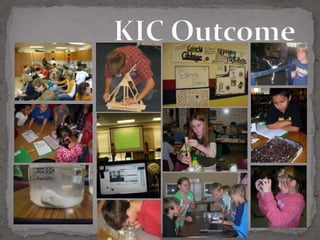
  • #6 Kellithink, act, speak like scientistsDr. Ballard
  • #7 KelliThese are picture of students preparing for and presenting at a KIC conference…What process skills do you see in these pictures?What you will see preparing for and on the day of the conference: Measuring Observing collecting identifying analyzing interpreting modeling demonstrating evaluating organizing creating synthesizing presenting designing testing controlling variables controlling testing standards researching communicating concluding inferring classifying predicting formulating hypotheses
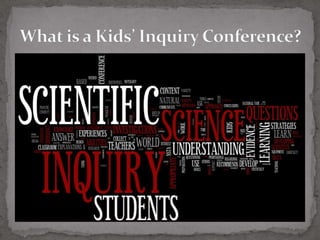
  • #8 Which words stand out the most to you?Explain research and wordleA Kids’ Inquiry Conference provides students with opportunities to share their excitement about discoveries with other students, to critically evaluate the credibility of their own research and testing, and to draw on the discoveries of other students to further their interest in science, math, engineering and technology. Beyond the Science Fair. Creating a Kids’ Inquiry Conference by Dieckman, Neutze, Pearce &amp; SaulEvolution of KIC for Melissa ISD
  • #9 Difference between deductive inquiry (cook book labs where student do very little thinking) and inductive inquiry (where students develop conceptual understanding through questioning and hypothesizing.)Rote memorization does not promote conceptual understanding.Students can be moved through the continuum with just one investigation as we do with KIC or gradually throughout the year with many investigations. For example, we will do an investigation with flippers today where we will investigate force. The first investigation that we do will be more of a structured/guided investigation but students will more quickly to the student-initiated investigation because they will do further testing on the same topic, with the same materials with background knowledge already established from the first investigation.
  • #10 Set stage with what our testable question will be for the dayGive a few details of how they will be investigating….this is a more guided approach to inquiryDetermine best way to collect data by using data collection postersBegin investigationTeacher asks questions to help facilitate student understanding. Students must provide evidence and reasoning when making a claim about their investigation.5. After investigation, develop testable questions and record on post its variables: mass of the object being launched, force applied, length of the flipperPut post it questions on the question boardDo not feel compelled to answer all questions on board. Students can test at home, research on own, or use a question for KIC.Supplies: black paper, sidewalk chalk
  • #11 Testable vs. research sortMystery substance investigation as an example of what not to do for a questionStudents have 3 options for how they develop their testable question for KIC:Use a question off the question boardDevelop a new testable question from something that we have investigated this yearChange a variable in last year’s KIC question and test it further
  • #12 To speak the same language we will all select the same question for the inquiry planning sheet.3 Questions to determine if groups have a grasp on what they will be testing:How will you measure it?How are you going to test it?
  • #13 Cut up
  • #14 Cut up
  • #15 Rubric. Self evaluate plan. Conference w/ peer evaluate before turning in to teacher so they have time to make adjustments.I wonder….It might be helpful if…
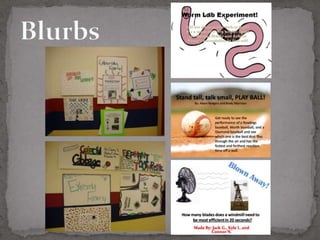
  • #17 Advertise for their session. They create posters for the hallway that goes on their home spot, a power point slide converted to a jpg to go on the digital picture frames that go in the front office of both campuses and the libraries of both campuses. Students can also just print their power point slide to advertise in the hallway.Share experiences of past year’s with blurbs
  • #21 Provide students with guidelines and rubrics prior to startingTrain the trainer model for technology trainings. Only train the groups that plan on doing that type of technology, provide click sheets, how to videosStudent process for what to do if they don’t know how to do something after the trainings… 1. watch the how videos again 2. look at the click sheets 3. ask your partner/s 4. ask another group of students 5. ask the teacher 6. ask Mrs. Royal
  • #23 What we have triedGoogle sitesEducation.Weebly.comMoodleGlogsterTeacher webPreziFlip vids8 mm video cameraDigital cameraLive streaming: ustream.tv, camera quality, band width, micsNetbooksComputer labWhat we use now:Flip vids, digital cameras, weebly, photostory, ppt, ustream, moodle
  • #26 Limitationsto education.weebly.comAudio playerVideoEmbedded documents All require weebly pro
  • #32 Build background knowledge of inquiry…what are the skills needed?Scientific literacy: language, writing, reading, validity, claims evidence and reasoning, data collectionUntouchables of KIC:Question developmentVariablesPrior experiencesInvestigation with focusValid conclusionsKnowing audience and explaining resultsLanguage of science – vocabularyScientific writingData collection and organizationReading nonfiction textAnalyzing for validity*SEE TEK ALIGNMENT