LESSON
objectives
a. Explain the history of atomic
models of an atom.
c. appreciate the contributions of
scientists in the development
atomic models.
b. Illustrate the development of
atomic models of an atom.
elicit
Arrange the jumbled letters to form a
word related to the topic.
1.RMTAET =
2.MOTA =
3.TROPONS =
4.TRELCEONS =
5.UETONTRS =
Let the students arrange the jumbled
letters to form a word related to the
topic.
1.RMTAET = MATTER
2.MOTA = ATOM
3.TROPONS = PROTONS
4.TRELCEONS = ELECTRONS
5.UETONTRS = NEUTRONS
The atomic model has evolved significantly
over time, reflecting advancements in
scientific understanding and technology.
Atomic models include Dalton's, Thomson's,
Rutherford's, Bohr's, and the modern
quantum mechanical model. Each new model
addressed limitations of previous models and
incorporated new experimental evidence.
The development of atomic models
demonstrates the nature of scientific
progress and the importance of revising
theories based on new evidence. Modern
atomic theory combines aspects of
previous models with quantum mechanics
to explain atomic structure and behavior.
The atom, once thought to be the smallest
indivisible unit of matter, has a complex history of
scientific discovery. Over time, scientists have
proposed various models to describe the structure
of the atom, and each model has brought us closer
to understanding how atoms work.
The History of Atomic
Models
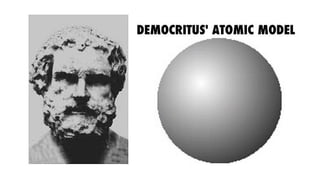
1. Democritus' Atomic Theory (Around 400
BCE)
The idea of atoms began with Democritus, a Greek
philosopher, who was one of the first to propose
that all matter is made up of tiny, indivisible particles
called atoms (from the Greek word "atomos,"
meaning indivisible). According to Democritus:
• Atoms are solid and indestructible.
• Atoms differ in size, shape, and mass.
• Atoms are constantly in motion in a void (empty space).
While Democritus' ideas were
philosophically interesting, there
was no experimental evidence to
support them. His theory was
largely ignored for many centuries.
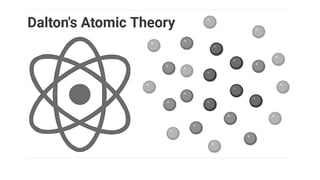
2. John Dalton’s Atomic Theory (1803)
In the early 19th century, John Dalton, a British
chemist, revived the idea of the atom based on
scientific experiments. Dalton’s model proposed the
following:
• All matter is made up of tiny, indivisible atoms.
• Atoms of a given element are identical in mass and
properties, while atoms of different elements are
different.
• Atoms combine in fixed ratios to form compounds.
• Chemical reactions involve the rearrangement of
atoms, but the atoms themselves are neither created
nor destroyed (law of conservation of mass).
Dalton’s atomic theory laid the groundwork for
modern chemistry, but it didn’t explain how
atoms are structured internally.
In 1897, J.J. Thomson discovered the electron while
experimenting with cathode rays. This was the first
evidence that atoms were not indivisible but made
up of smaller particles. Thomson proposed the
plum pudding model:
3. J.J. Thomson’s Plum Pudding Model (1897)
• Atoms are composed of a positively charged
substance with negatively charged electrons
embedded in it, much like raisins in a pudding or
plums in a cake.
• The overall charge of the atom is neutral because the
positive and negative charges balance each other out.
Although Thomson's model introduced the idea of
subatomic particles, it did not explain the arrangement
of electrons or the presence of a nucleus.
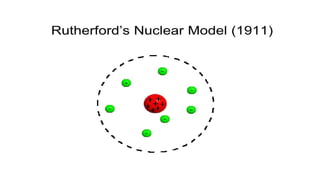
In 1911, Ernest Rutherford conducted his famous
gold foil experiment, where he bombarded a thin
sheet of gold foil with alpha particles (positively
charged particles). Most of the particles passed
through the foil, but some were deflected at large
angles. Based on this experiment, Rutherford
proposed a new model of the atom:
4. Ernest Rutherford’s Nuclear Model (1911)
• The atom is mostly empty space.
• At the center of the atom is a tiny, dense, positively
charged nucleus, which contains most of the atom's
mass.
• Electrons orbit the nucleus, like planets orbiting the
sun.
Rutherford’s model was a major breakthrough, introducing
the idea of a nucleus, but it couldn’t explain why the
electrons didn’t spiral into the nucleus due to their negative
charge and attraction to the positively charged nucleus.
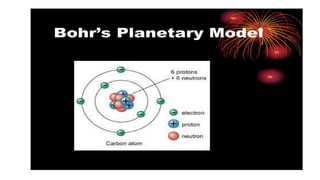
Building on Rutherford’s model, Niels
Bohr introduced the concept of energy
levels in 1913. Bohr’s model explained
how electrons could orbit the nucleus
without collapsing into it:
5. Niels Bohr’s Planetary Model (1913)
• Electrons orbit the nucleus in specific energy levels or
shells.
• Electrons can only exist in these fixed orbits, and each
orbit corresponds to a specific energy level.
• When electrons absorb or emit energy, they can jump
between energy levels, which explains the emission
spectra of elements (the light emitted when atoms are
heated).
Bohr’s model was successful in explaining the structure of the
hydrogen atom but had limitations when applied to more
complex atoms.
6. Erwin Schrödinger’s Quantum Mechanical
Model (1926)
The most advanced and accepted model of the
atom today is the quantum mechanical model,
developed by Erwin Schrödinger and other
scientists in the 1920s. This model is based on
quantum theory and is much more complex than
the previous models:
• Electrons don’t travel in fixed orbits but exist in
regions of space called orbitals, where there is a
high probability of finding an electron.
• The location of an electron cannot be
pinpointed exactly; instead, there are certain
regions where it is more likely to be found.
• Electrons have properties of both particles and
waves, which explains their behavior in an
atom.
The quantum mechanical model
provides a highly accurate description of
atomic structure, especially for more
complex atoms and molecules. It also
introduced the idea that electrons are
described by mathematical equations
called wavefunctions.
Here’s a chart of the history of the atom:
Theory and Models
Guide Questions:
1.What is the purpose of atomic models?
2.Which scientist proposed the plum pudding
model of the atom?
3.Describe the key features of Bohr's atomic
model.
4.Explain how the modern atomic model is
different from Dalton's atomic model.

SCI-9-Quarter-2-.pptx...................

  • 2.
    LESSON objectives a. Explain thehistory of atomic models of an atom. c. appreciate the contributions of scientists in the development atomic models. b. Illustrate the development of atomic models of an atom.
  • 3.
  • 4.
    Arrange the jumbledletters to form a word related to the topic. 1.RMTAET = 2.MOTA = 3.TROPONS = 4.TRELCEONS = 5.UETONTRS =
  • 5.
    Let the studentsarrange the jumbled letters to form a word related to the topic. 1.RMTAET = MATTER 2.MOTA = ATOM 3.TROPONS = PROTONS 4.TRELCEONS = ELECTRONS 5.UETONTRS = NEUTRONS
  • 6.
    The atomic modelhas evolved significantly over time, reflecting advancements in scientific understanding and technology. Atomic models include Dalton's, Thomson's, Rutherford's, Bohr's, and the modern quantum mechanical model. Each new model addressed limitations of previous models and incorporated new experimental evidence.
  • 7.
    The development ofatomic models demonstrates the nature of scientific progress and the importance of revising theories based on new evidence. Modern atomic theory combines aspects of previous models with quantum mechanics to explain atomic structure and behavior.
  • 8.
    The atom, oncethought to be the smallest indivisible unit of matter, has a complex history of scientific discovery. Over time, scientists have proposed various models to describe the structure of the atom, and each model has brought us closer to understanding how atoms work. The History of Atomic Models
  • 10.
    1. Democritus' AtomicTheory (Around 400 BCE) The idea of atoms began with Democritus, a Greek philosopher, who was one of the first to propose that all matter is made up of tiny, indivisible particles called atoms (from the Greek word "atomos," meaning indivisible). According to Democritus: • Atoms are solid and indestructible. • Atoms differ in size, shape, and mass. • Atoms are constantly in motion in a void (empty space).
  • 11.
    While Democritus' ideaswere philosophically interesting, there was no experimental evidence to support them. His theory was largely ignored for many centuries.
  • 13.
    2. John Dalton’sAtomic Theory (1803) In the early 19th century, John Dalton, a British chemist, revived the idea of the atom based on scientific experiments. Dalton’s model proposed the following: • All matter is made up of tiny, indivisible atoms. • Atoms of a given element are identical in mass and properties, while atoms of different elements are different.
  • 14.
    • Atoms combinein fixed ratios to form compounds. • Chemical reactions involve the rearrangement of atoms, but the atoms themselves are neither created nor destroyed (law of conservation of mass). Dalton’s atomic theory laid the groundwork for modern chemistry, but it didn’t explain how atoms are structured internally.
  • 16.
    In 1897, J.J.Thomson discovered the electron while experimenting with cathode rays. This was the first evidence that atoms were not indivisible but made up of smaller particles. Thomson proposed the plum pudding model: 3. J.J. Thomson’s Plum Pudding Model (1897)
  • 17.
    • Atoms arecomposed of a positively charged substance with negatively charged electrons embedded in it, much like raisins in a pudding or plums in a cake. • The overall charge of the atom is neutral because the positive and negative charges balance each other out. Although Thomson's model introduced the idea of subatomic particles, it did not explain the arrangement of electrons or the presence of a nucleus.
  • 19.
    In 1911, ErnestRutherford conducted his famous gold foil experiment, where he bombarded a thin sheet of gold foil with alpha particles (positively charged particles). Most of the particles passed through the foil, but some were deflected at large angles. Based on this experiment, Rutherford proposed a new model of the atom: 4. Ernest Rutherford’s Nuclear Model (1911)
  • 20.
    • The atomis mostly empty space. • At the center of the atom is a tiny, dense, positively charged nucleus, which contains most of the atom's mass. • Electrons orbit the nucleus, like planets orbiting the sun. Rutherford’s model was a major breakthrough, introducing the idea of a nucleus, but it couldn’t explain why the electrons didn’t spiral into the nucleus due to their negative charge and attraction to the positively charged nucleus.
  • 22.
    Building on Rutherford’smodel, Niels Bohr introduced the concept of energy levels in 1913. Bohr’s model explained how electrons could orbit the nucleus without collapsing into it: 5. Niels Bohr’s Planetary Model (1913)
  • 23.
    • Electrons orbitthe nucleus in specific energy levels or shells. • Electrons can only exist in these fixed orbits, and each orbit corresponds to a specific energy level. • When electrons absorb or emit energy, they can jump between energy levels, which explains the emission spectra of elements (the light emitted when atoms are heated). Bohr’s model was successful in explaining the structure of the hydrogen atom but had limitations when applied to more complex atoms.
  • 25.
    6. Erwin Schrödinger’sQuantum Mechanical Model (1926) The most advanced and accepted model of the atom today is the quantum mechanical model, developed by Erwin Schrödinger and other scientists in the 1920s. This model is based on quantum theory and is much more complex than the previous models:
  • 26.
    • Electrons don’ttravel in fixed orbits but exist in regions of space called orbitals, where there is a high probability of finding an electron. • The location of an electron cannot be pinpointed exactly; instead, there are certain regions where it is more likely to be found. • Electrons have properties of both particles and waves, which explains their behavior in an atom.
  • 27.
    The quantum mechanicalmodel provides a highly accurate description of atomic structure, especially for more complex atoms and molecules. It also introduced the idea that electrons are described by mathematical equations called wavefunctions.
  • 28.
    Here’s a chartof the history of the atom: Theory and Models
  • 29.
    Guide Questions: 1.What isthe purpose of atomic models? 2.Which scientist proposed the plum pudding model of the atom? 3.Describe the key features of Bohr's atomic model. 4.Explain how the modern atomic model is different from Dalton's atomic model.

Editor's Notes

  • #5 Matter- physical substance in general that occupies space and possesses rest mass especially as distinct from energy. Atom –is basic building blocks of chemistry and smallest unit of matter Protons –it is positively charged particle. Electrons – is the negative charged particles Neutrons- is the neutral charged or no charged particles
  • #9 The idea of atoms began with Democritus, a Greek philosopher, who was one of the first to propose that all matter is made up of tiny, indivisible particles called atoms (from the Greek word "atomos," meaning indivisible).
  • #13 Dalton’s model proposed the following: All matter is made up of tiny, indivisible atoms. Atoms of a given element are identical in mass and properties, while atoms of different elements are different.
  • #15  , J.J. Thomson discovered the electron while experimenting with cathode rays. Cathode rays or electron beams (e-beam) are streams of electrons observed in discharge tubes.
  • #18 Rutherford’s model was a major breakthrough, introducing the idea of a nucleus, but it couldn’t explain why the electrons didn’t spiral into the nucleus due to their negative charge and attraction to the positively charged nucleus.
  • #21 Building on Rutherford’s model, Niels Bohr introduced the concept of energy levels in 1913. Bohr’s model explained how electrons could orbit the nucleus without collapsing into it:
  • #24 Electrons don’t travel in fixed orbits but exist in regions of space called orbitals, where there is a high probability of finding an electron. The location of an electron cannot be pinpointed exactly; instead, there are certain regions where it is more likely to be found. Electrons have properties of both particles and waves, which explains their behavior in an atom.