Lesson Objectives
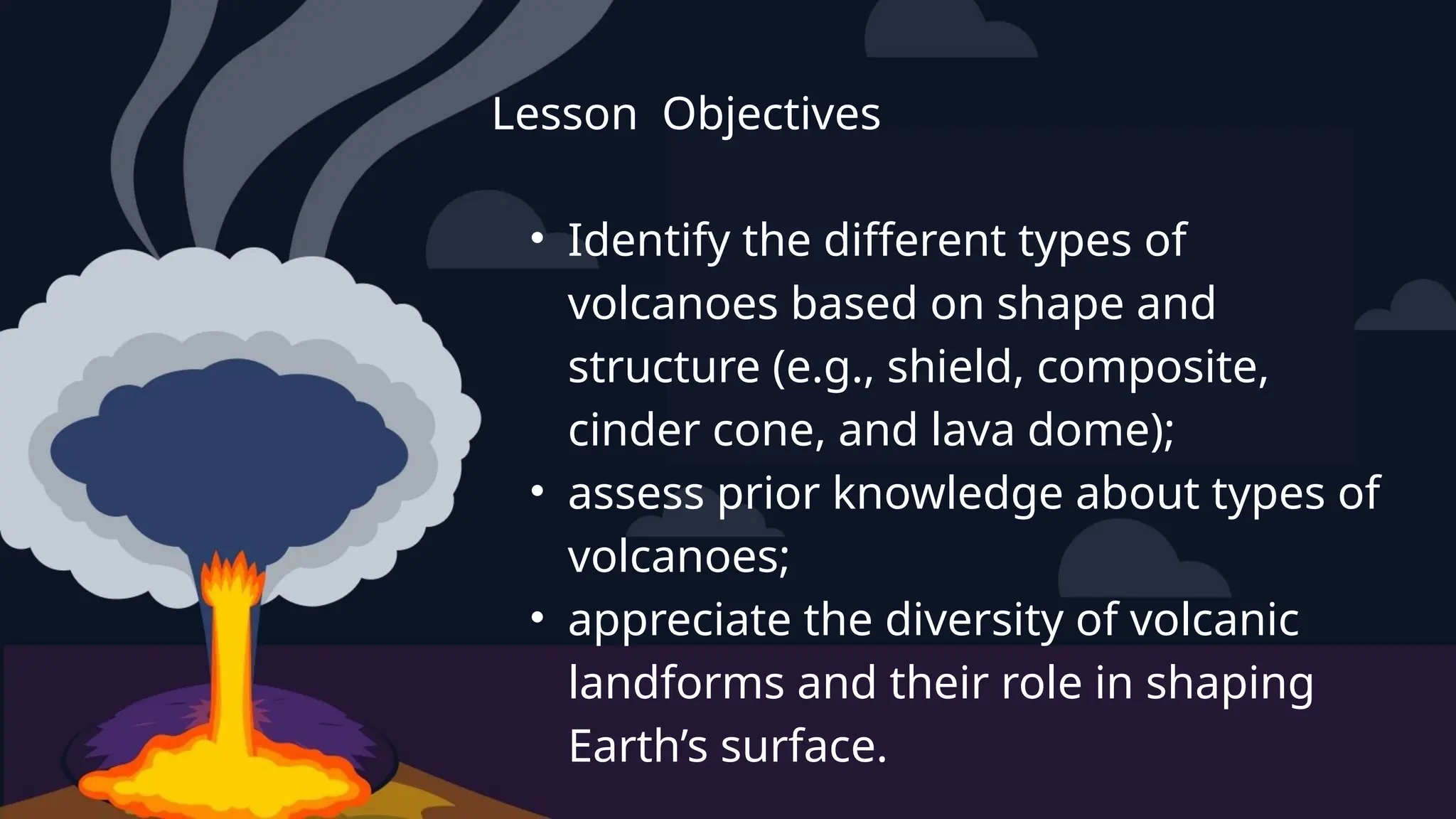
• Identify the different types of
volcanoes based on shape and
structure (e.g., shield, composite,
cinder cone, and lava dome);
• assess prior knowledge about types of
volcanoes;
• appreciate the diversity of volcanic
landforms and their role in shaping
Earth’s surface.
Source:
britanicca
hivesse
l
_hivesse
l
info.hivessel@gmail.co
m
Hivessel.com
Have you ever heard of Mount
Mayon or Mount Pinatubo? What
comes to mind when you think of
volcanoes?
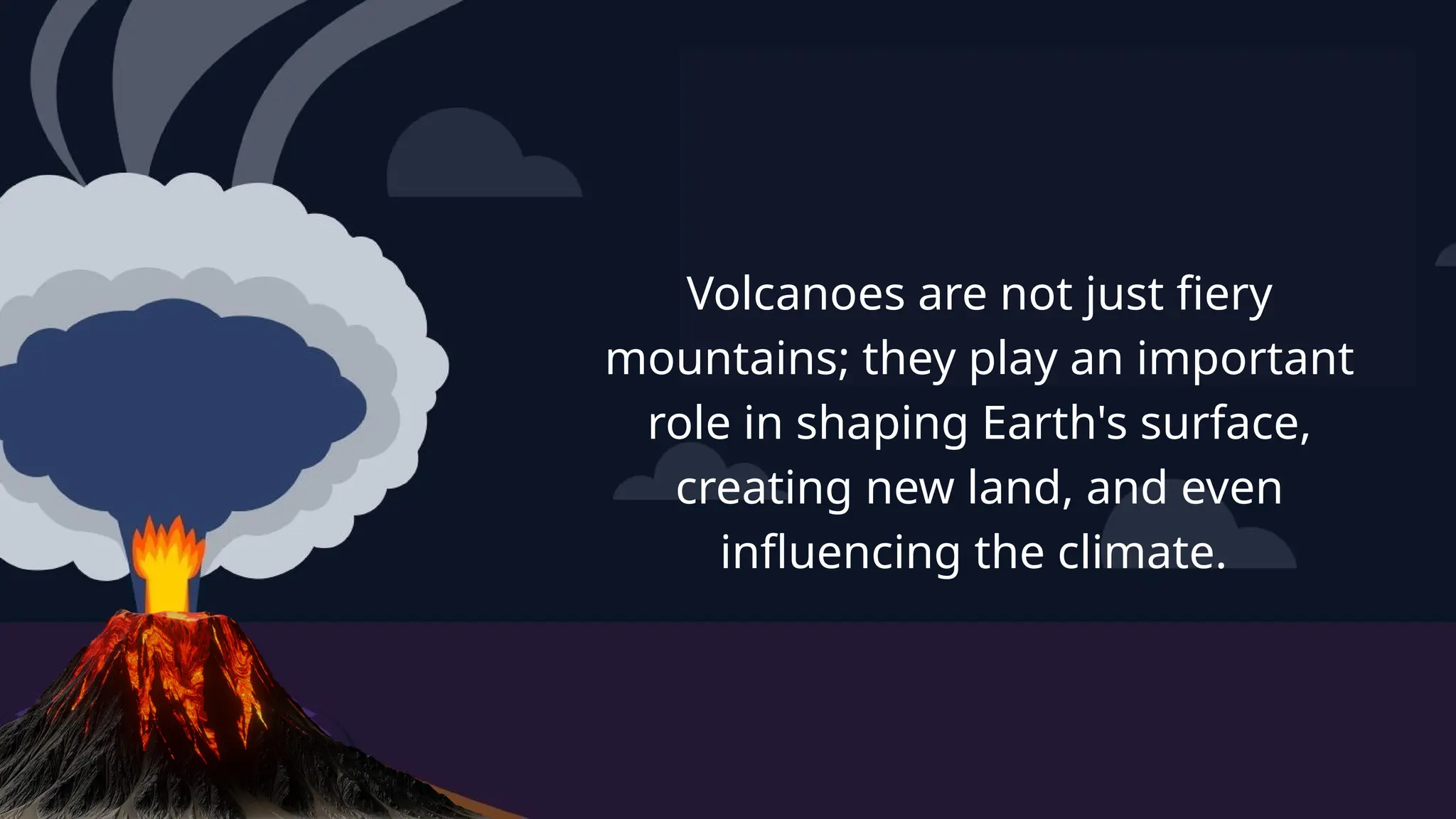
Volcanoes are not just fiery
mountains; they play an important
role in shaping Earth's surface,
creating new land, and even
influencing the climate.
Did you know that the Philippines is
part of the Pacific Ring of Fire, a
region known for its many volcanoes?
hivesse
l
_hivesse
l
info.hivessel@gmail.co
m
Hivessel.com
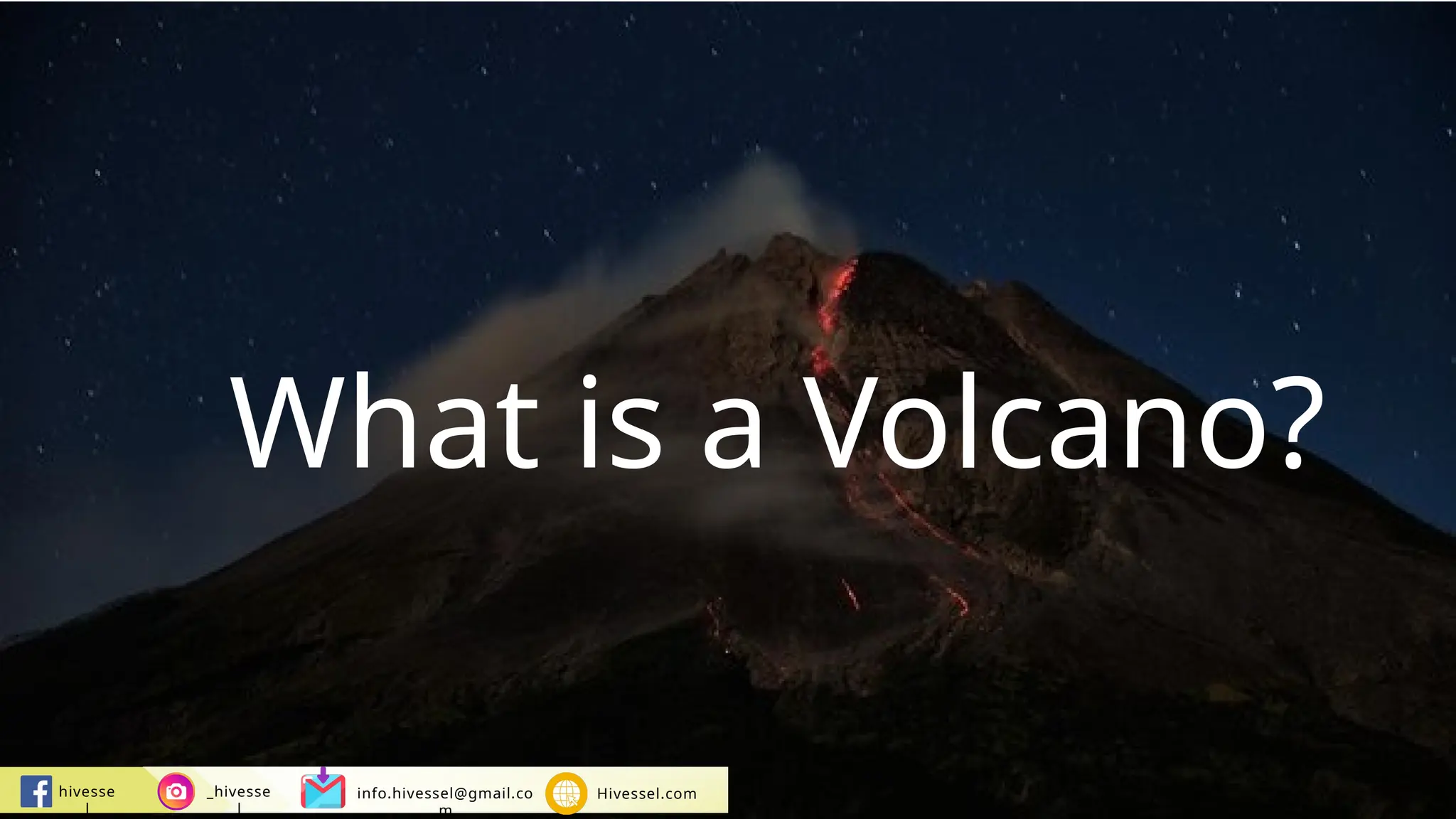
What is a Volcano?
Unauthorized resale is prohibited.Please support educators
and students by purchasing exclusively from our official
hivesse
l
_hivesse
l
info.hivessel@gmail.co
m
Hivessel.com
A volcano is a landform that allows
magma, gases, and ash to escape
from beneath Earth's crust. When
magma reaches the surface, it is
called lava.
Unauthorized resale is prohibited.Please support educators
and students by purchasing exclusively from our official
hivesse
l
_hivesse
l
info.hivessel@gmail.co
m
Hivessel.com
The Four Types of
Volcanoes
Unauthorized resale is prohibited.Please support educators
and students by purchasing exclusively from our official
hivesse
l
_hivesse
l
info.hivessel@gmail.co
m
Hivessel.com
1.Shield Volcanoes
⚬ These are broad and dome-
shaped with gentle slopes,
resembling a warrior's shield
lying on the ground.
⚬ Formed by low-viscosity lava
that flows easily over long
distances.
Unauthorized resale is prohibited.Please support educators
and students by purchasing exclusively from our official
hivesse
l
_hivesse
l
info.hivessel@gmail.co
m
Hivessel.com
• Example:
⚬ Mauna Loa in Hawaii, the largest
volcano on Earth.
• Key Features:
⚬ Eruptions are usually calm and
effusive.
⚬ Build up layers of lava over time.
Unauthorized resale is prohibited.Please support educators
and students by purchasing exclusively from our official
hivesse
l
_hivesse
l
info.hivessel@gmail.co
m
Hivessel.com
2. Composite Volcanoes
(Stratovolcanoes)
• Description:
⚬ Tall, cone-shaped, and steep-
sided volcanoes formed by
alternating layers of lava and
ash.
Unauthorized resale is prohibited.Please support educators
and students by purchasing exclusively from our official
hivesse
l
_hivesse
l
info.hivessel@gmail.co
m
Hivessel.com
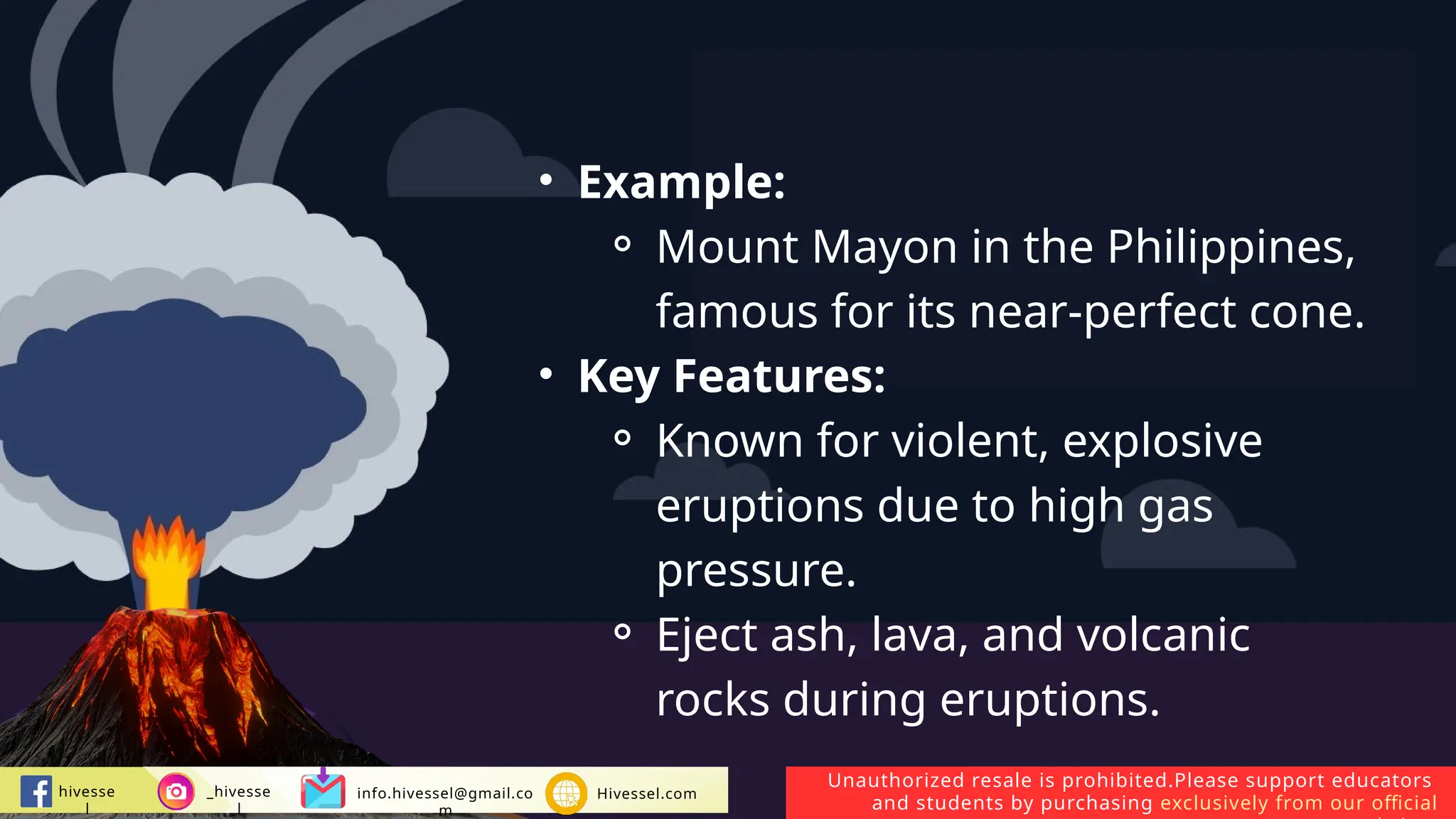
• Example:
⚬ Mount Mayon in the Philippines,
famous for its near-perfect cone.
• Key Features:
⚬ Known for violent, explosive
eruptions due to high gas
pressure.
⚬ Eject ash, lava, and volcanic
rocks during eruptions.
Unauthorized resale is prohibited.Please support educators
and students by purchasing exclusively from our official
hivesse
l
_hivesse
l
info.hivessel@gmail.co
m
Hivessel.com
3. Cinder Cone Volcanoes
⚬ Description:
■ Small, steep-sided
volcanoes made of loose
volcanic fragments called
cinders.
Unauthorized resale is prohibited.Please support educators
and students by purchasing exclusively from our official
hivesse
l
_hivesse
l
info.hivessel@gmail.co
m
Hivessel.com
• Example:
⚬ Parícutin in Mexico, which grew
from a farmer's cornfield in
1943.
• Key Features:
⚬ Eruptions are short-lived and
mostly involve the ejection of
lava fragments.
⚬ These volcanoes are usually
smaller and less destructive.
Unauthorized resale is prohibited.Please support educators
and students by purchasing exclusively from our official
hivesse
l
_hivesse
l
info.hivessel@gmail.co
m
Hivessel.com
4. Lava Dome Volcanoes
• Description:
■ Small, steep-sided domes
formed by slow, thick lava
that piles up near the
vent.
Unauthorized resale is prohibited.Please support educators
and students by purchasing exclusively from our official
hivesse
l
_hivesse
l
info.hivessel@gmail.co
m
Hivessel.com
• Example:
⚬ The lava dome at Mount St.
Helens in the United States.
• Key Features:
⚬ Lava is highly viscous and
doesn’t flow far.
⚬ Can build up pressure and cause
explosive eruptions.
Unauthorized resale is prohibited.Please support educators
and students by purchasing exclusively from our official
hivesse
l
_hivesse
l
info.hivessel@gmail.co
m
Hivessel.com
Volcanic activity can be very fascinating.
After an explosive eruption, a scenic
cone-shaped structure may be
produced or changes on its slope can
be observed.
The emissions of a volcano provide us
with clues on what materials are found
inside
the Earth. Some eruptions are very
explosive, while many others are not.
Unauthorized resale is prohibited.Please support educators
and students by purchasing exclusively from our official
hivesse
l
_hivesse
l
info.hivessel@gmail.co
m
Hivessel.com
What determines the nature of
eruption? There are primary factors
affecting the
volcanoes’ eruptive style, namely: the
magma’s temperature, its chemical
composition, and the amount of
dissolved gases it contains. These
factors can affect
the magma’s viscosity in different ways.
Unauthorized resale is prohibited.Please support educators
and students by purchasing exclusively from our official
hivesse
l
_hivesse
l
info.hivessel@gmail.co
m
Hivessel.com
Viscosity is the property of the
material’s
resistance to flow. It is also described as
the liquid’s thickness and stickiness. The
more viscous and thicker the material
is, the greater is its resistance to flow.
For instance, syrup is more viscous than
water.
Unauthorized resale is prohibited.Please support educators
and students by purchasing exclusively from our official
hivesse
l
_hivesse
l
info.hivessel@gmail.co
m
Hivessel.com
Let us discuss how each factor affects the
viscosity of magma. First, let us look
into how temperature of magma affects its
viscosity. The viscosity of magma
decreases with temperature. The higher the
temperature of magma is, the lower is its
viscosity. As lava flows, it cools and begins
to harden, its ability to flow decreases and
eventually it stops.
Unauthorized resale is prohibited.Please support educators
and students by purchasing exclusively from our official
hivesse
l
_hivesse
l
info.hivessel@gmail.co
m
Hivessel.com
Next, let us look at how the composition of
magma affects its viscosity. Magmas
with high silica content are more viscous
than those with low silica content. The
magma that contains less silica is relatively
fluid and travels far before Solidifying.
Unauthorized resale is prohibited.Please support educators
and students by purchasing exclusively from our official
hivesse
l
_hivesse
l
info.hivessel@gmail.co
m
Hivessel.com
Lastly, the amount of gases
contained in the magma affects its
viscosity. Other factors being equal,
gas (mainly water vapor) dissolved in
magma tends to increase its ability
to flow. Therefore, in near-surface
environments, the loss of gases
makes magma more viscous,
forming a dome or a columnar
Unauthorized resale is prohibited.Please support educators
and students by purchasing exclusively from our official
hivesse
l
_hivesse
l
info.hivessel@gmail.co
m
Hivessel.com
Unauthorized resale is prohibited.Please support educators
and students by purchasing exclusively from our official
hivesse
l
_hivesse
l
info.hivessel@gmail.co
m
Hivessel.com
hivesse
l
_hivesse
l
info.hivessel@gmail.co
m
Hivessel.com
Why Are Volcanoes
Different?
Unauthorized resale is prohibited.Please support educators
and students by purchasing exclusively from our official
hivesse
l
_hivesse
l
info.hivessel@gmail.co
m
Hivessel.com
The shape and structure of a volcano
depend on three main factors:
1.Type of Lava:
⚬ Runny lava (low viscosity) creates
wide, flat volcanoes like shield
volcanoes.
⚬ Thick lava (high viscosity) forms
steep-sided volcanoes like lava
domes.
Unauthorized resale is prohibited.Please support educators
and students by purchasing exclusively from our official
hivesse
l
_hivesse
l
info.hivessel@gmail.co
m
Hivessel.com
2. Eruption Style:
⚬ Quiet eruptions result in gentle
slopes.
⚬ Explosive eruptions lead to steep-
sided volcanoes.
3. Eruption Frequency:
⚬ Frequent eruptions create larger
and more developed volcanoes.

Presentation1.pptx volcano..............

  • 2.
    Lesson Objectives • Identifythe different types of volcanoes based on shape and structure (e.g., shield, composite, cinder cone, and lava dome); • assess prior knowledge about types of volcanoes; • appreciate the diversity of volcanic landforms and their role in shaping Earth’s surface.
  • 3.
  • 4.
    Have you everheard of Mount Mayon or Mount Pinatubo? What comes to mind when you think of volcanoes?
  • 5.
    Volcanoes are notjust fiery mountains; they play an important role in shaping Earth's surface, creating new land, and even influencing the climate.
  • 6.
    Did you knowthat the Philippines is part of the Pacific Ring of Fire, a region known for its many volcanoes?
  • 7.
  • 8.
    Unauthorized resale isprohibited.Please support educators and students by purchasing exclusively from our official hivesse l _hivesse l info.hivessel@gmail.co m Hivessel.com A volcano is a landform that allows magma, gases, and ash to escape from beneath Earth's crust. When magma reaches the surface, it is called lava.
  • 9.
    Unauthorized resale isprohibited.Please support educators and students by purchasing exclusively from our official hivesse l _hivesse l info.hivessel@gmail.co m Hivessel.com The Four Types of Volcanoes
  • 10.
    Unauthorized resale isprohibited.Please support educators and students by purchasing exclusively from our official hivesse l _hivesse l info.hivessel@gmail.co m Hivessel.com 1.Shield Volcanoes ⚬ These are broad and dome- shaped with gentle slopes, resembling a warrior's shield lying on the ground. ⚬ Formed by low-viscosity lava that flows easily over long distances.
  • 11.
    Unauthorized resale isprohibited.Please support educators and students by purchasing exclusively from our official hivesse l _hivesse l info.hivessel@gmail.co m Hivessel.com • Example: ⚬ Mauna Loa in Hawaii, the largest volcano on Earth. • Key Features: ⚬ Eruptions are usually calm and effusive. ⚬ Build up layers of lava over time.
  • 12.
    Unauthorized resale isprohibited.Please support educators and students by purchasing exclusively from our official hivesse l _hivesse l info.hivessel@gmail.co m Hivessel.com 2. Composite Volcanoes (Stratovolcanoes) • Description: ⚬ Tall, cone-shaped, and steep- sided volcanoes formed by alternating layers of lava and ash.
  • 13.
    Unauthorized resale isprohibited.Please support educators and students by purchasing exclusively from our official hivesse l _hivesse l info.hivessel@gmail.co m Hivessel.com • Example: ⚬ Mount Mayon in the Philippines, famous for its near-perfect cone. • Key Features: ⚬ Known for violent, explosive eruptions due to high gas pressure. ⚬ Eject ash, lava, and volcanic rocks during eruptions.
  • 14.
    Unauthorized resale isprohibited.Please support educators and students by purchasing exclusively from our official hivesse l _hivesse l info.hivessel@gmail.co m Hivessel.com 3. Cinder Cone Volcanoes ⚬ Description: ■ Small, steep-sided volcanoes made of loose volcanic fragments called cinders.
  • 15.
    Unauthorized resale isprohibited.Please support educators and students by purchasing exclusively from our official hivesse l _hivesse l info.hivessel@gmail.co m Hivessel.com • Example: ⚬ Parícutin in Mexico, which grew from a farmer's cornfield in 1943. • Key Features: ⚬ Eruptions are short-lived and mostly involve the ejection of lava fragments. ⚬ These volcanoes are usually smaller and less destructive.
  • 16.
    Unauthorized resale isprohibited.Please support educators and students by purchasing exclusively from our official hivesse l _hivesse l info.hivessel@gmail.co m Hivessel.com 4. Lava Dome Volcanoes • Description: ■ Small, steep-sided domes formed by slow, thick lava that piles up near the vent.
  • 17.
    Unauthorized resale isprohibited.Please support educators and students by purchasing exclusively from our official hivesse l _hivesse l info.hivessel@gmail.co m Hivessel.com • Example: ⚬ The lava dome at Mount St. Helens in the United States. • Key Features: ⚬ Lava is highly viscous and doesn’t flow far. ⚬ Can build up pressure and cause explosive eruptions.
  • 18.
    Unauthorized resale isprohibited.Please support educators and students by purchasing exclusively from our official hivesse l _hivesse l info.hivessel@gmail.co m Hivessel.com Volcanic activity can be very fascinating. After an explosive eruption, a scenic cone-shaped structure may be produced or changes on its slope can be observed. The emissions of a volcano provide us with clues on what materials are found inside the Earth. Some eruptions are very explosive, while many others are not.
  • 19.
    Unauthorized resale isprohibited.Please support educators and students by purchasing exclusively from our official hivesse l _hivesse l info.hivessel@gmail.co m Hivessel.com What determines the nature of eruption? There are primary factors affecting the volcanoes’ eruptive style, namely: the magma’s temperature, its chemical composition, and the amount of dissolved gases it contains. These factors can affect the magma’s viscosity in different ways.
  • 20.
    Unauthorized resale isprohibited.Please support educators and students by purchasing exclusively from our official hivesse l _hivesse l info.hivessel@gmail.co m Hivessel.com Viscosity is the property of the material’s resistance to flow. It is also described as the liquid’s thickness and stickiness. The more viscous and thicker the material is, the greater is its resistance to flow. For instance, syrup is more viscous than water.
  • 21.
    Unauthorized resale isprohibited.Please support educators and students by purchasing exclusively from our official hivesse l _hivesse l info.hivessel@gmail.co m Hivessel.com Let us discuss how each factor affects the viscosity of magma. First, let us look into how temperature of magma affects its viscosity. The viscosity of magma decreases with temperature. The higher the temperature of magma is, the lower is its viscosity. As lava flows, it cools and begins to harden, its ability to flow decreases and eventually it stops.
  • 22.
    Unauthorized resale isprohibited.Please support educators and students by purchasing exclusively from our official hivesse l _hivesse l info.hivessel@gmail.co m Hivessel.com Next, let us look at how the composition of magma affects its viscosity. Magmas with high silica content are more viscous than those with low silica content. The magma that contains less silica is relatively fluid and travels far before Solidifying.
  • 23.
    Unauthorized resale isprohibited.Please support educators and students by purchasing exclusively from our official hivesse l _hivesse l info.hivessel@gmail.co m Hivessel.com Lastly, the amount of gases contained in the magma affects its viscosity. Other factors being equal, gas (mainly water vapor) dissolved in magma tends to increase its ability to flow. Therefore, in near-surface environments, the loss of gases makes magma more viscous, forming a dome or a columnar
  • 24.
    Unauthorized resale isprohibited.Please support educators and students by purchasing exclusively from our official hivesse l _hivesse l info.hivessel@gmail.co m Hivessel.com
  • 25.
    Unauthorized resale isprohibited.Please support educators and students by purchasing exclusively from our official hivesse l _hivesse l info.hivessel@gmail.co m Hivessel.com
  • 26.
  • 27.
    Unauthorized resale isprohibited.Please support educators and students by purchasing exclusively from our official hivesse l _hivesse l info.hivessel@gmail.co m Hivessel.com The shape and structure of a volcano depend on three main factors: 1.Type of Lava: ⚬ Runny lava (low viscosity) creates wide, flat volcanoes like shield volcanoes. ⚬ Thick lava (high viscosity) forms steep-sided volcanoes like lava domes.
  • 28.
    Unauthorized resale isprohibited.Please support educators and students by purchasing exclusively from our official hivesse l _hivesse l info.hivessel@gmail.co m Hivessel.com 2. Eruption Style: ⚬ Quiet eruptions result in gentle slopes. ⚬ Explosive eruptions lead to steep- sided volcanoes.
  • 29.
    3. Eruption Frequency: ⚬Frequent eruptions create larger and more developed volcanoes.