Jadranka Lasic-Lazic  jlazic @ ffzg.hr Mihaela Banek Zorica  mbanek @ ffzg.hr Sonja Spiranec  [email_address] Department of Information sciences, Faculty of Humanities and Social Sciences, Universtiy of Zagreb, Croatia School librarians coping   with electronic environment
 
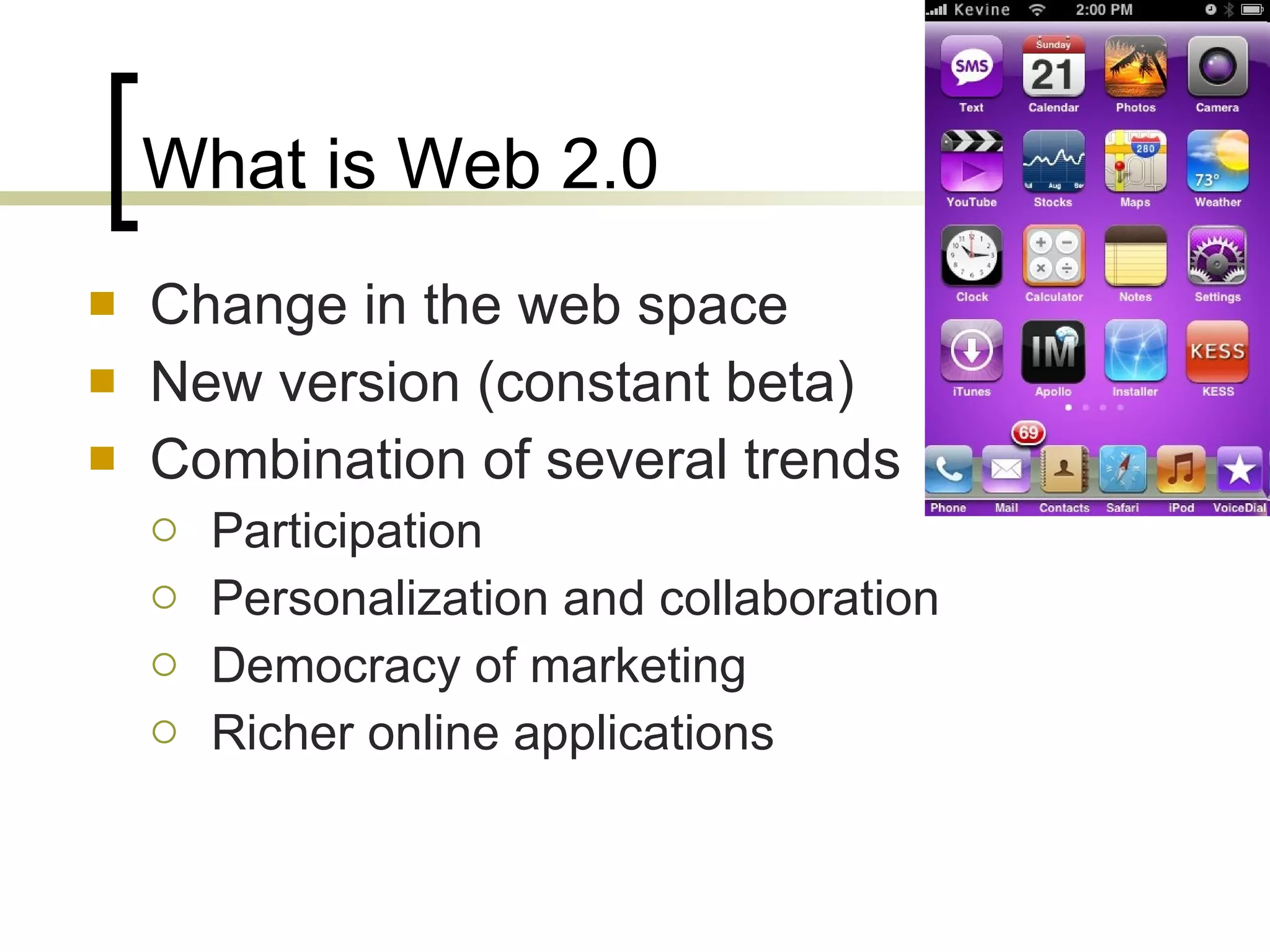
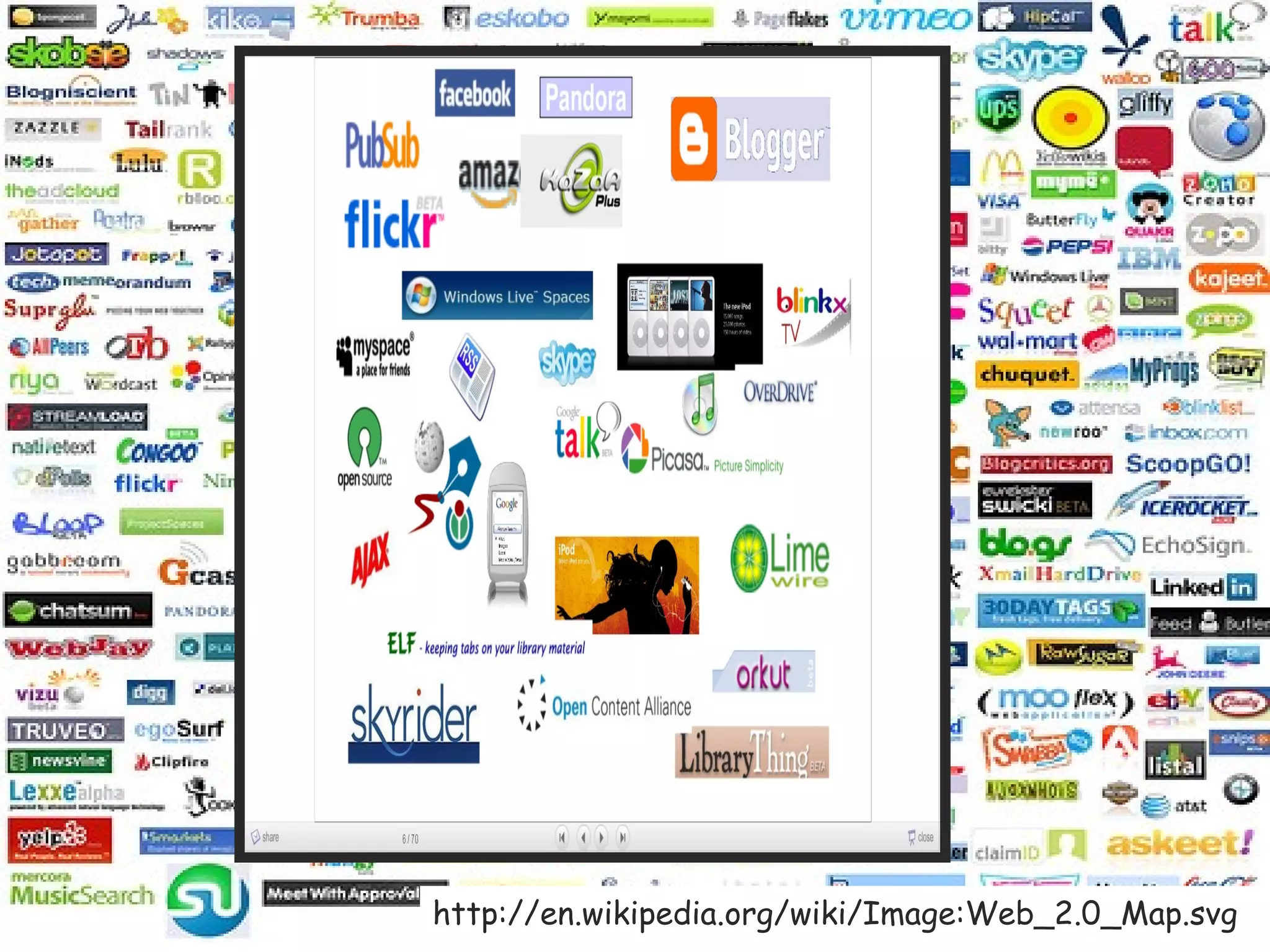
What is Web 2.0 Change in the web space New version (constant beta) Combination of several trends Participation Personalization and collaboration Democracy of marketing Richer online applications
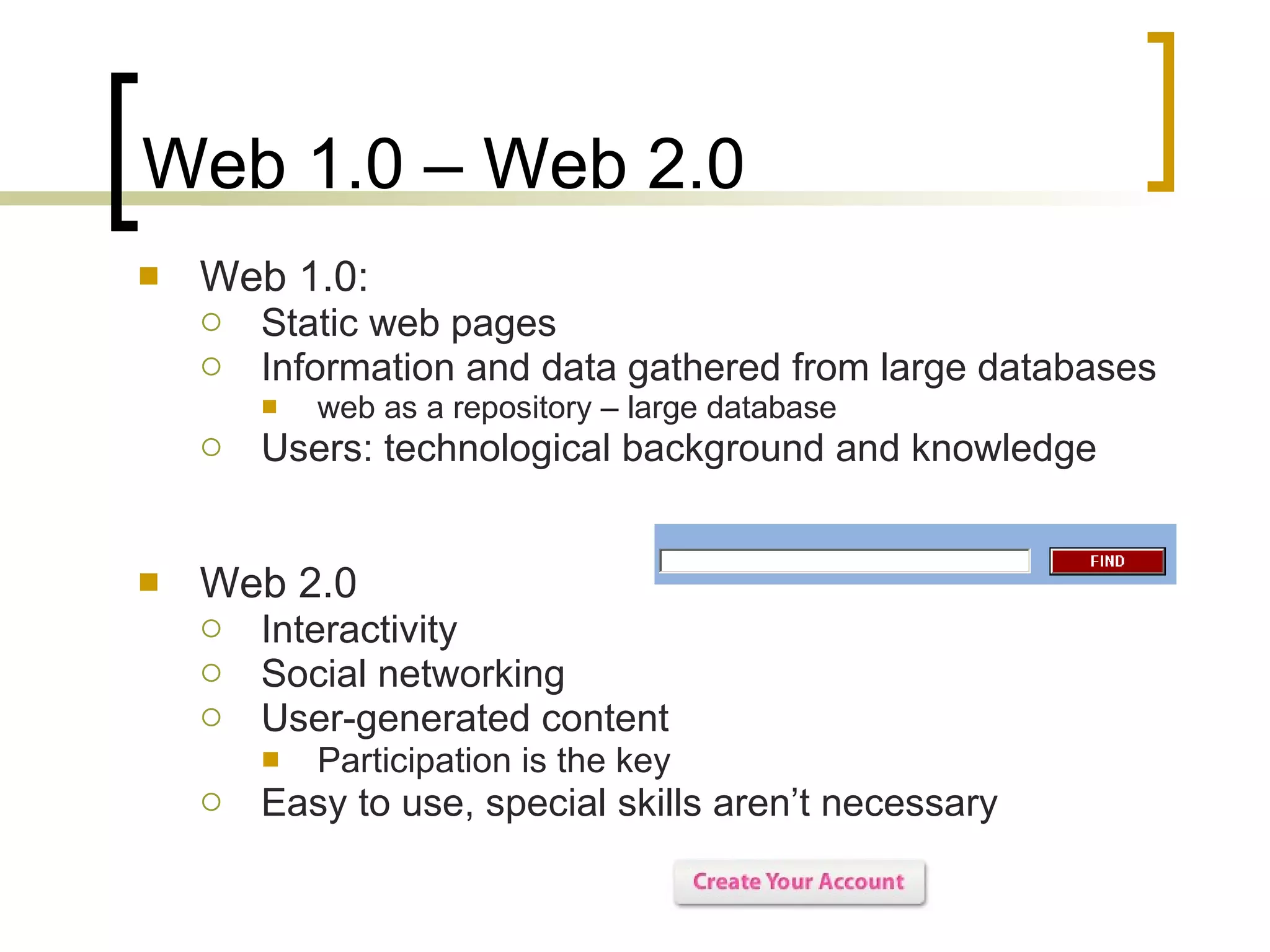
Web 1.0 – Web 2.0 Web 1.0:  Static web pages  Information and data gathered from large databases  web as a repository – large database Users: technological background and knowledge Web 2.0 Interactivity Social networking User-generated content Participation is the key  Easy to use, special skills aren’t necessary
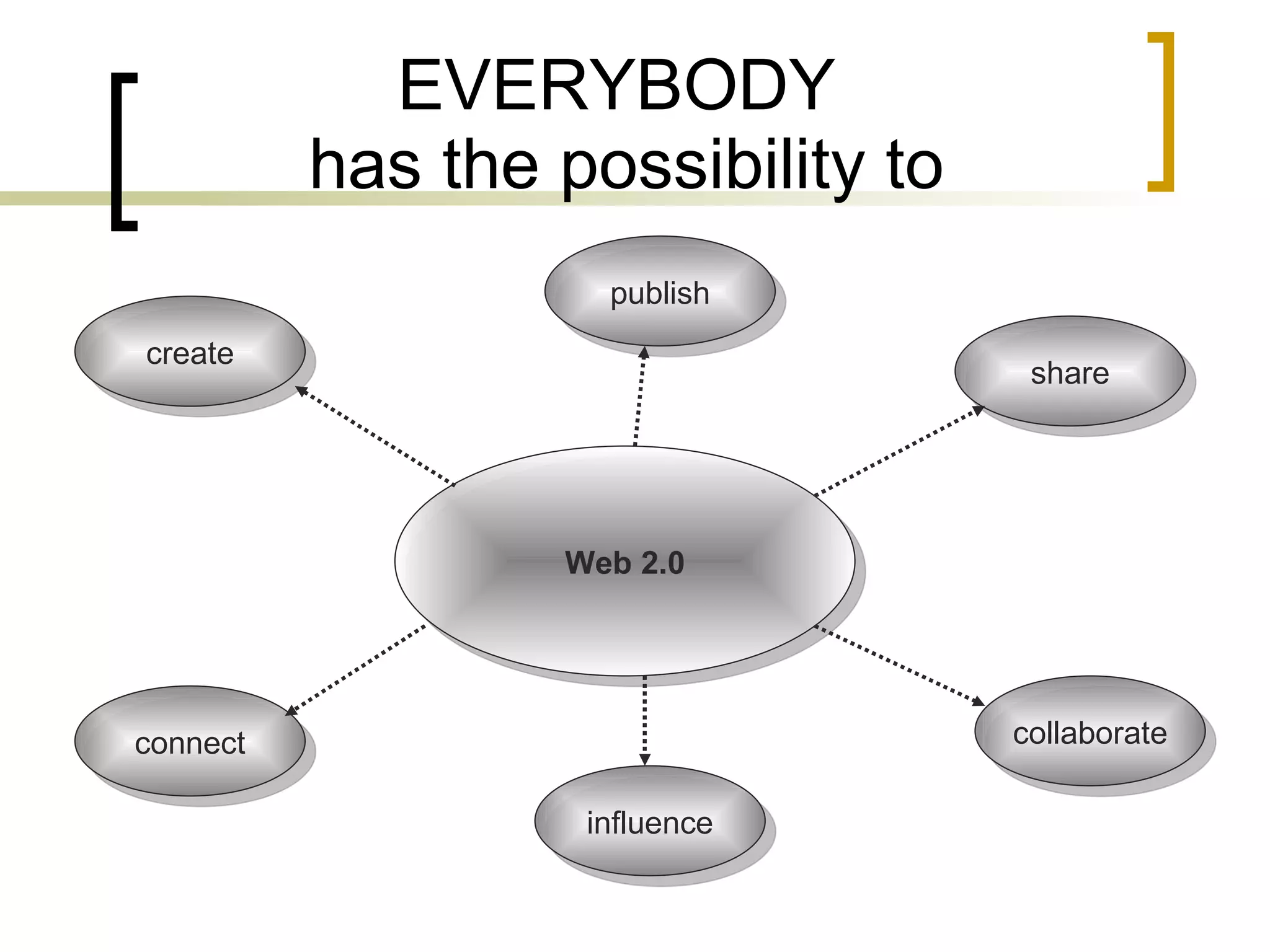
EVERYBODY   has the  possibility  to Web 2.0 create publish share collaborate influence connect
http://en.wikipedia.org/wiki/Image:Web_2.0_Map.svg
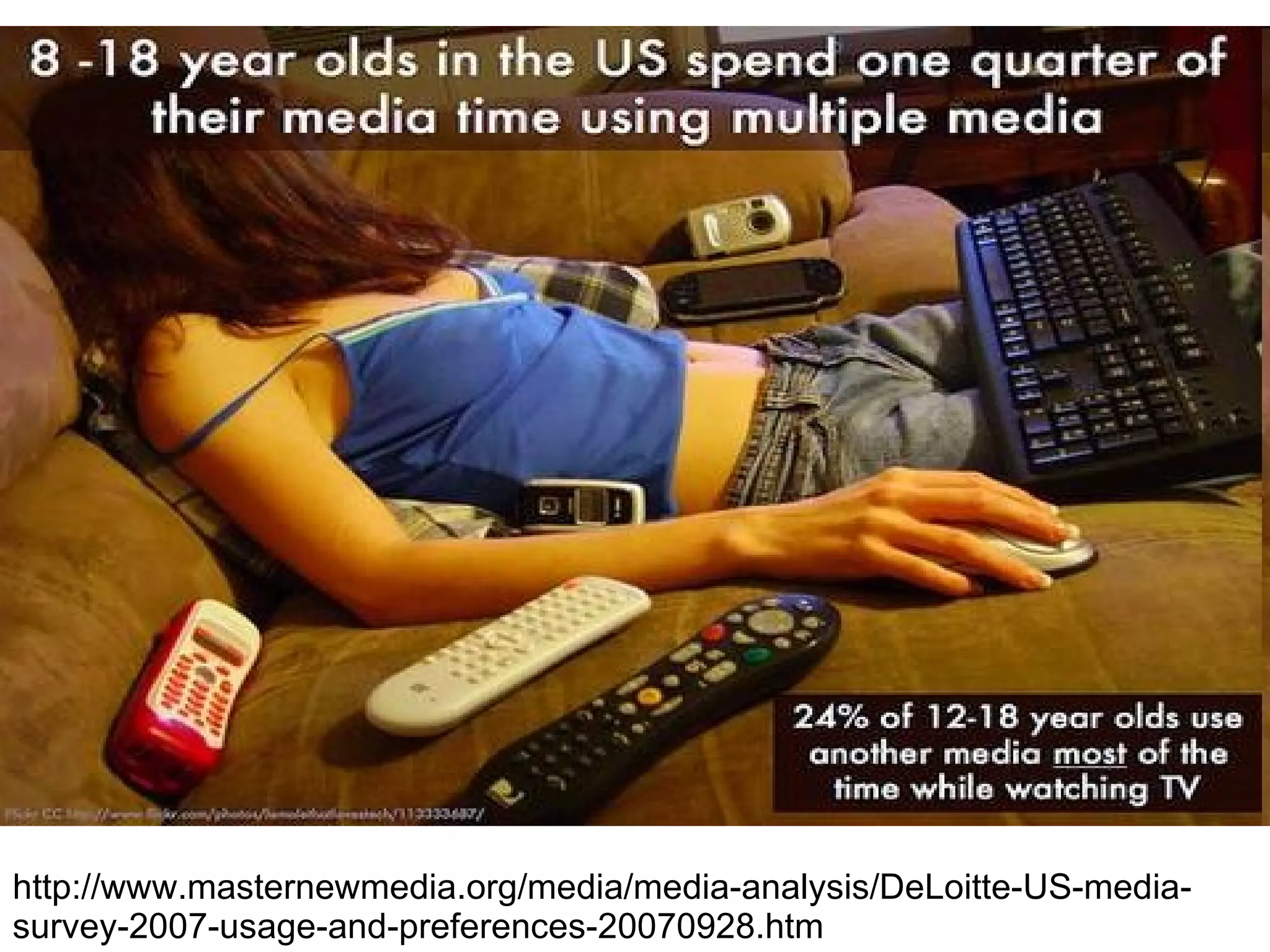
http://www.masternewmedia.org/media/media-analysis/DeLoitte-US-media-survey-2007-usage-and-preferences-20070928.htm
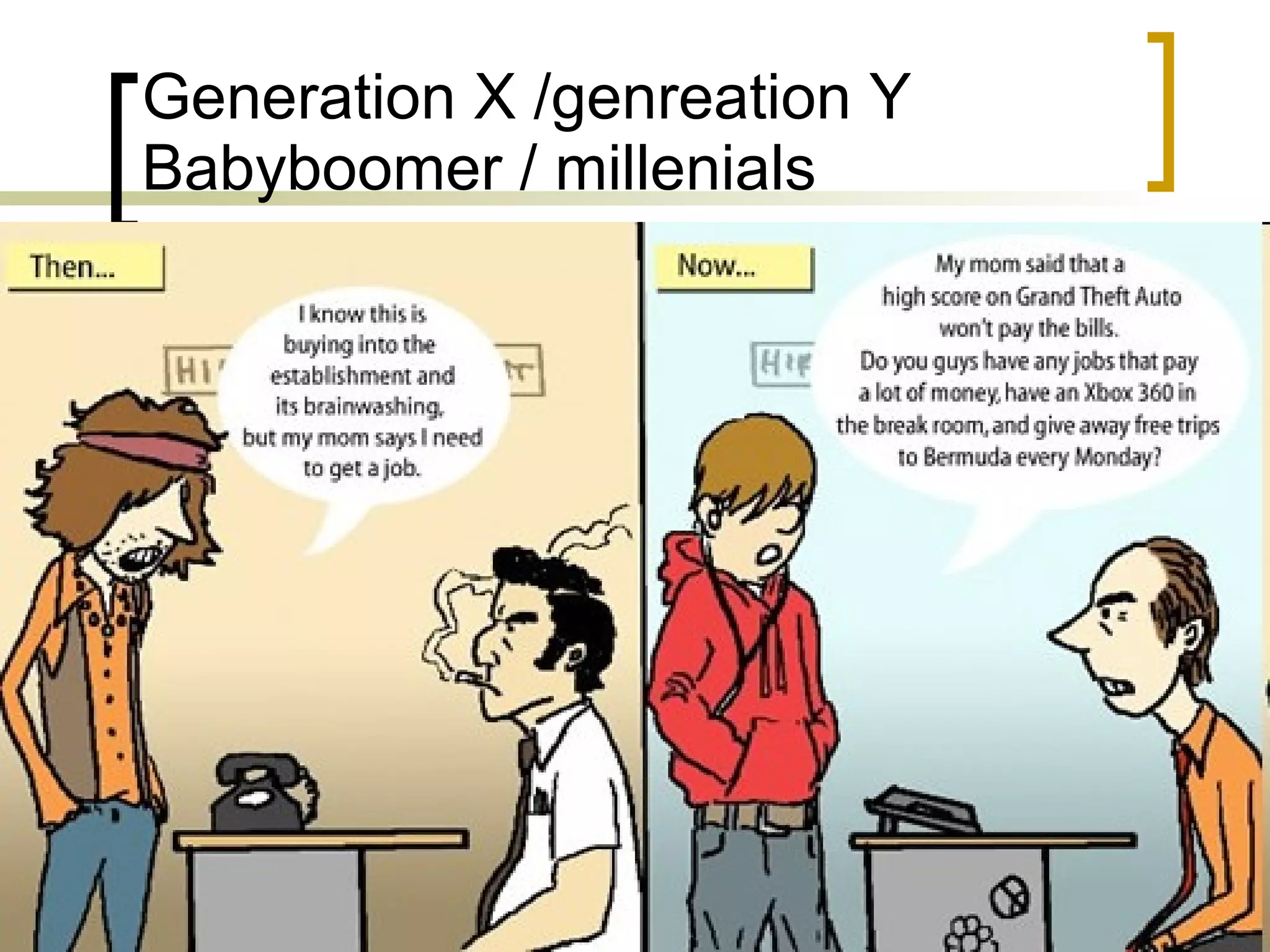
Generation X /genreation Y Babyboomer / millenials
Library 2.0 reaction to the web-based developments in ICT and the widespread use of social software Curran et al., 2007
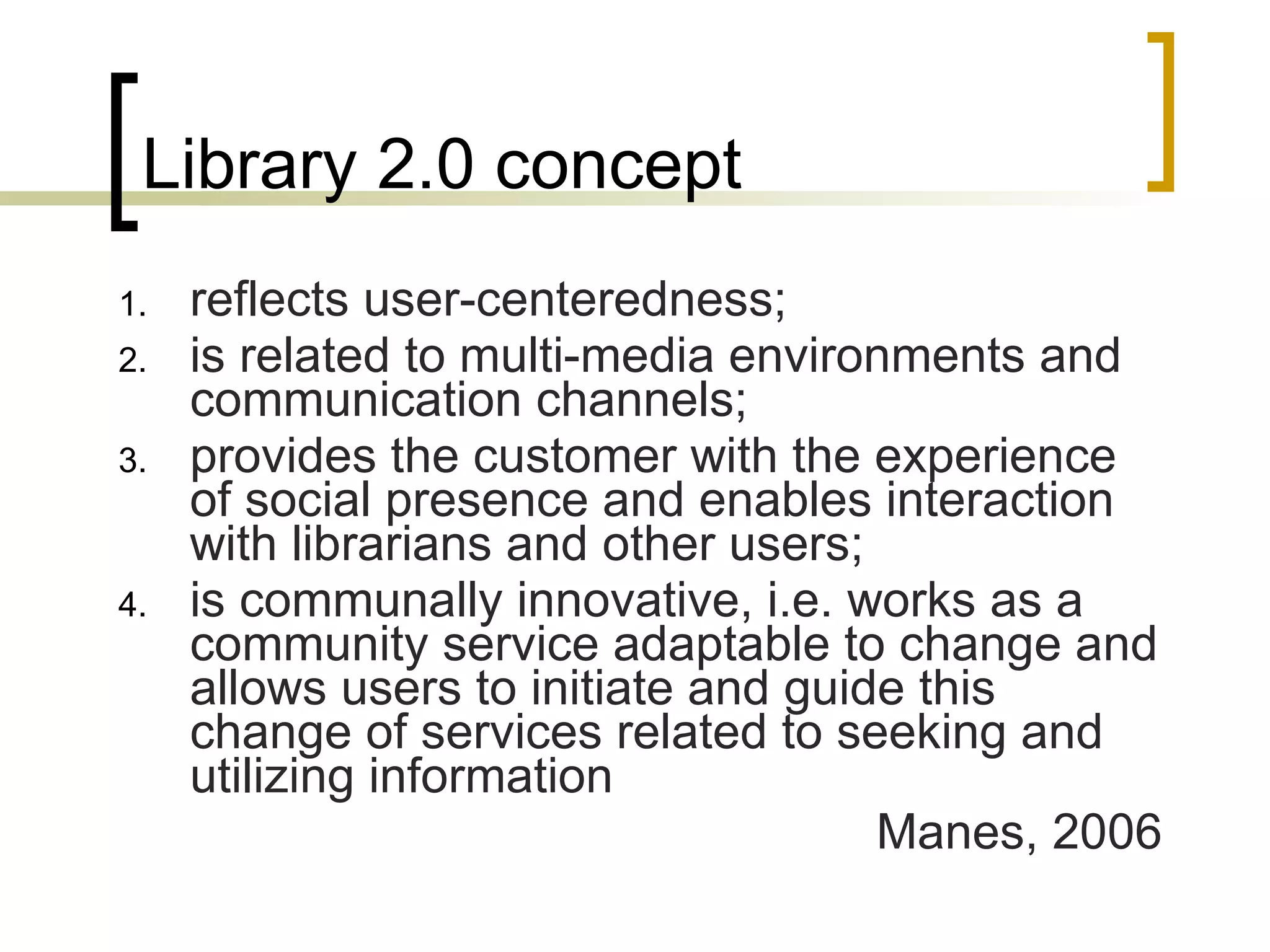
Library 2.0 concept reflects user-centeredness;  is related to multi-media environments and communication channels;  provides the customer with the experience of social presence and enables interaction with librarians and other users;  is communally innovative, i.e. works as a community service adaptable to change and allows users to initiate and guide this change of services related to seeking and utilizing information Manes, 2006
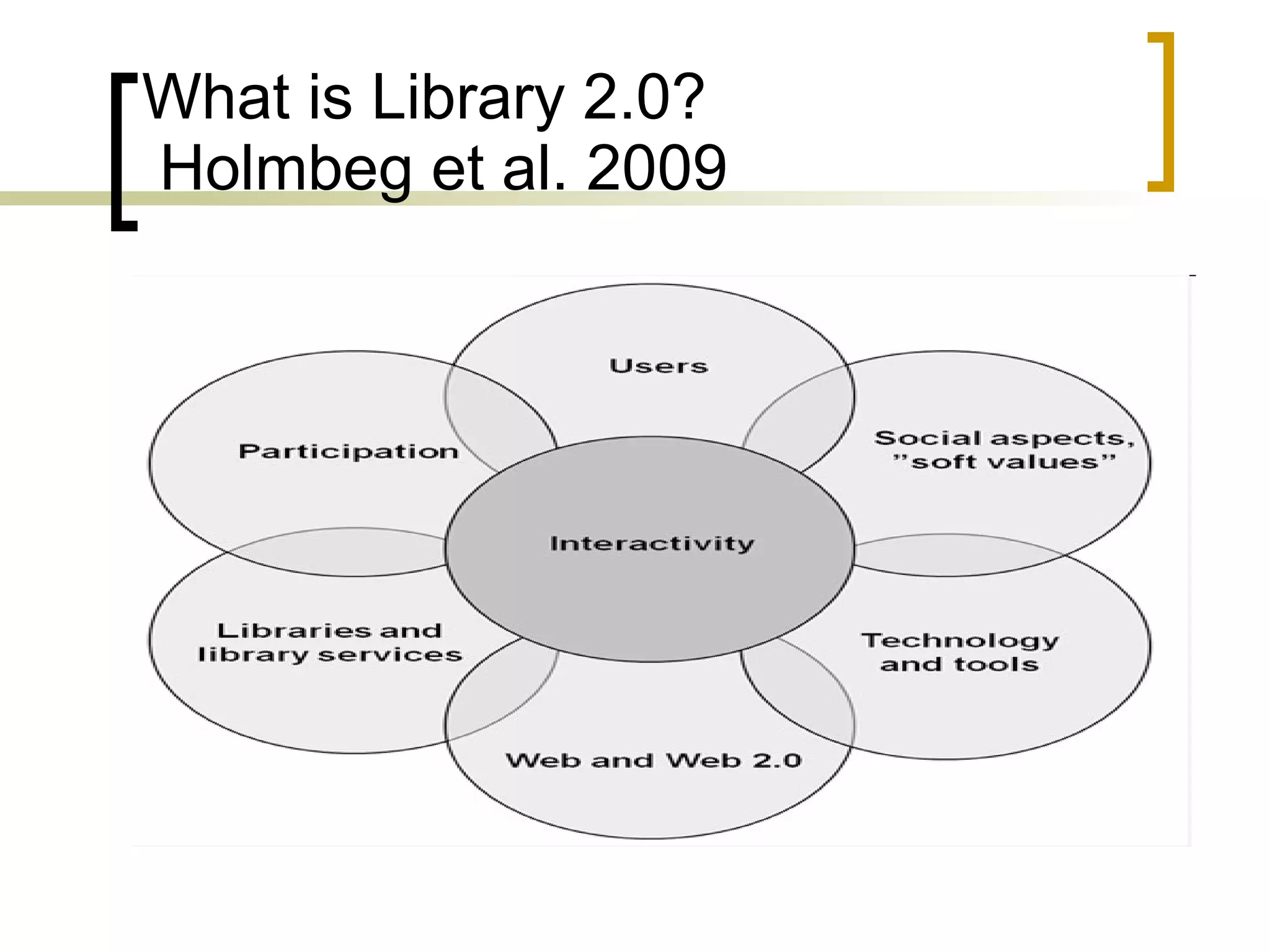
What is Library 2.0?  Holmbeg et al. 2009
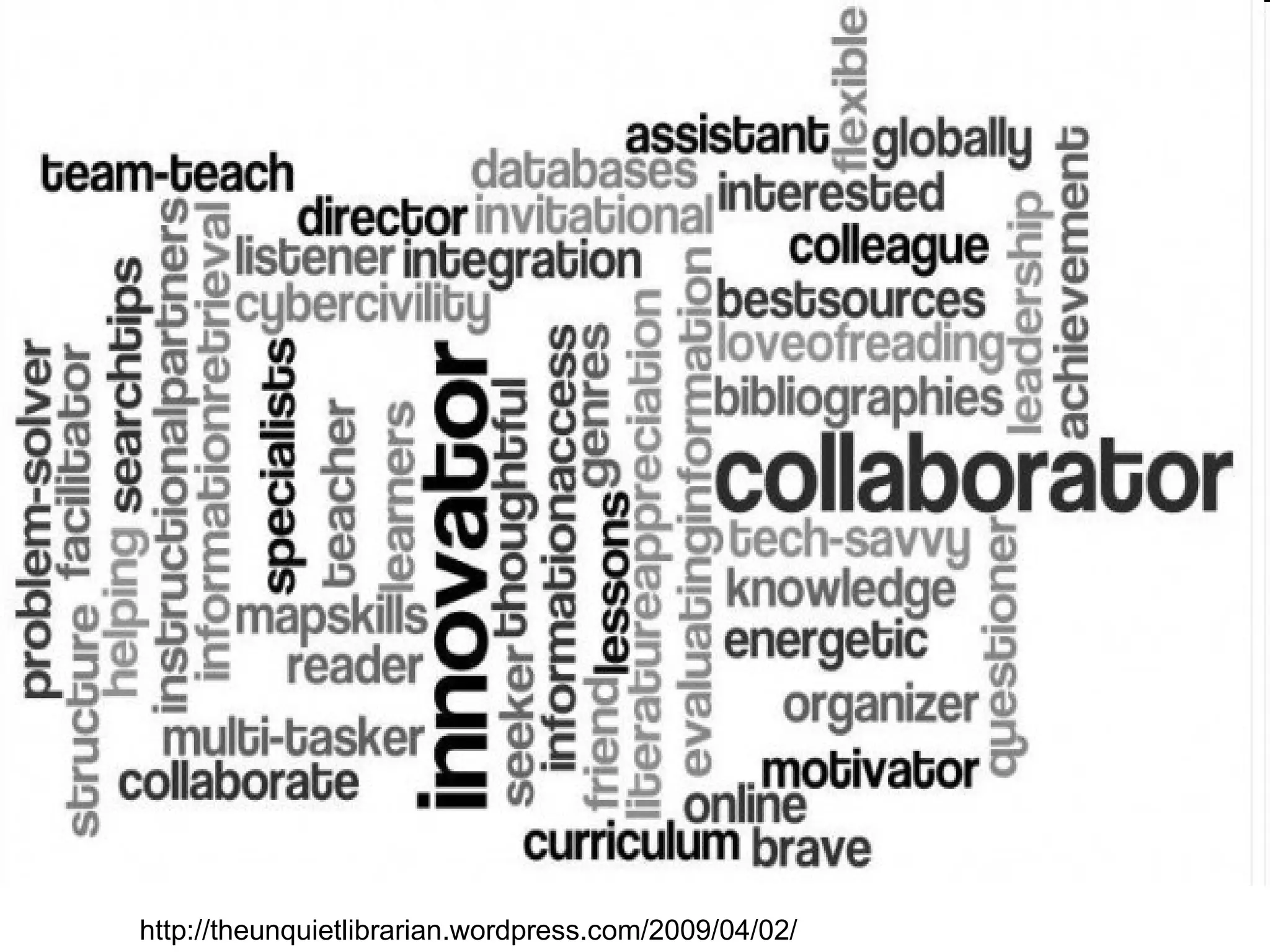
http://theunquietlibrarian.wordpress.com/2009/04/02/
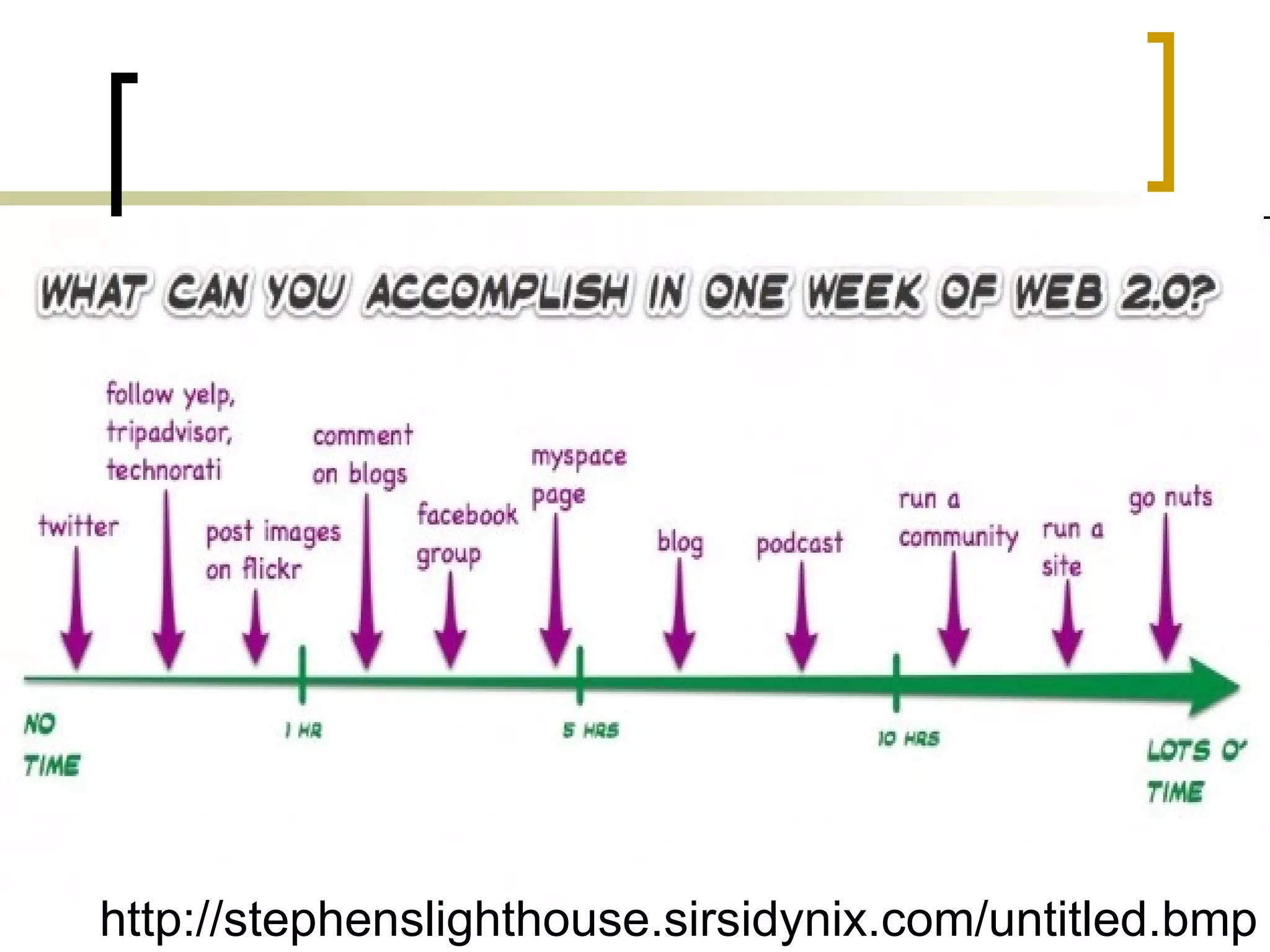
http://stephenslighthouse.sirsidynix.com/untitled.bmp
 
 
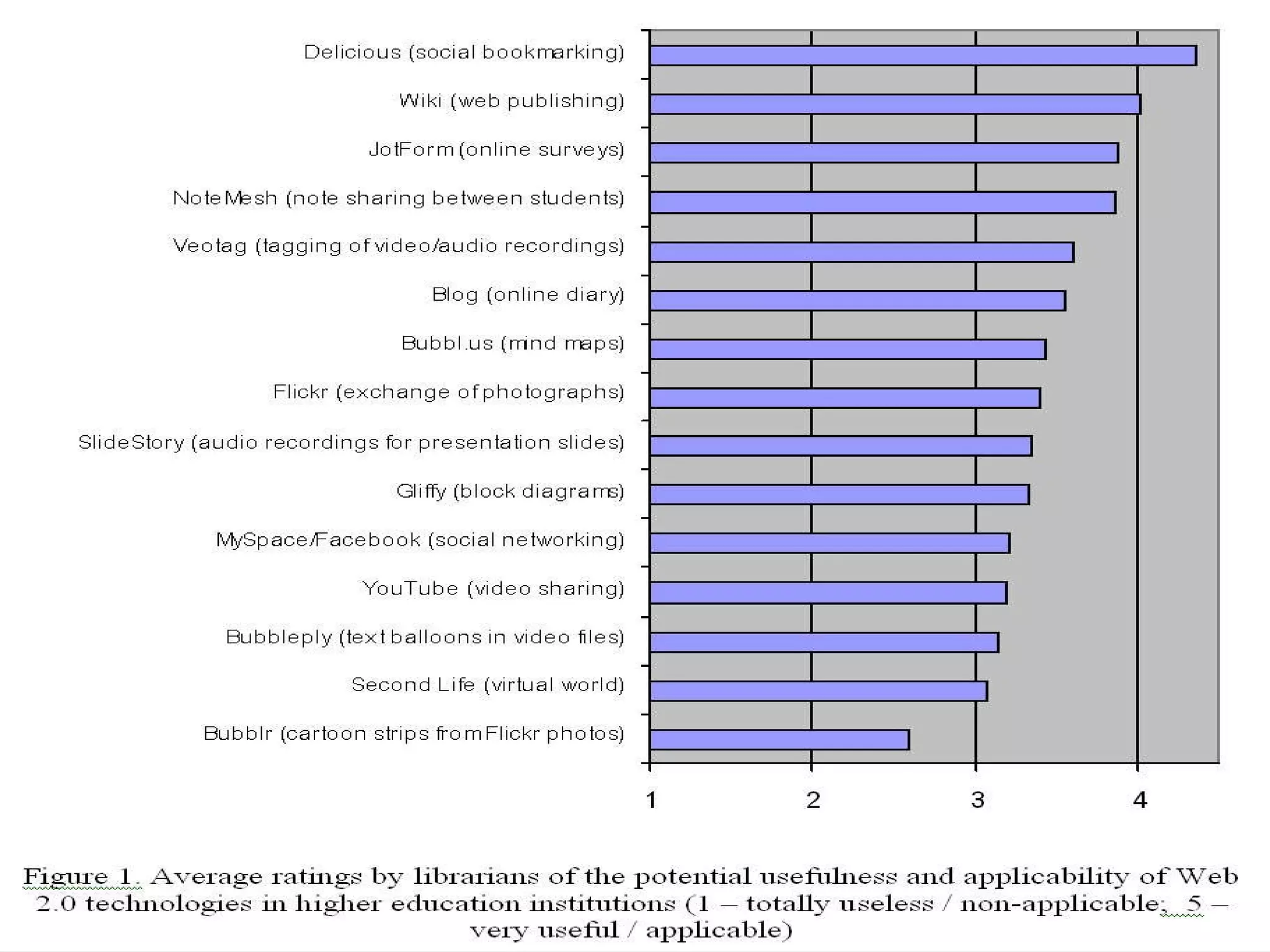
Research Students  familliarity with Web 2.0 tools Librarians at higher education institutions find Web 2.0 tools to be potentially useful in their libraries. Lasic-Lazic, Banek Zorica, Bubas 2009.
Results most of  students  were familiar with popular tools/services like wikis, blogs, YouTube and MySpace/Facebook  less than 50% had more than scarce knowledge of a Flickr, Delicious  or even  Second Life.
 
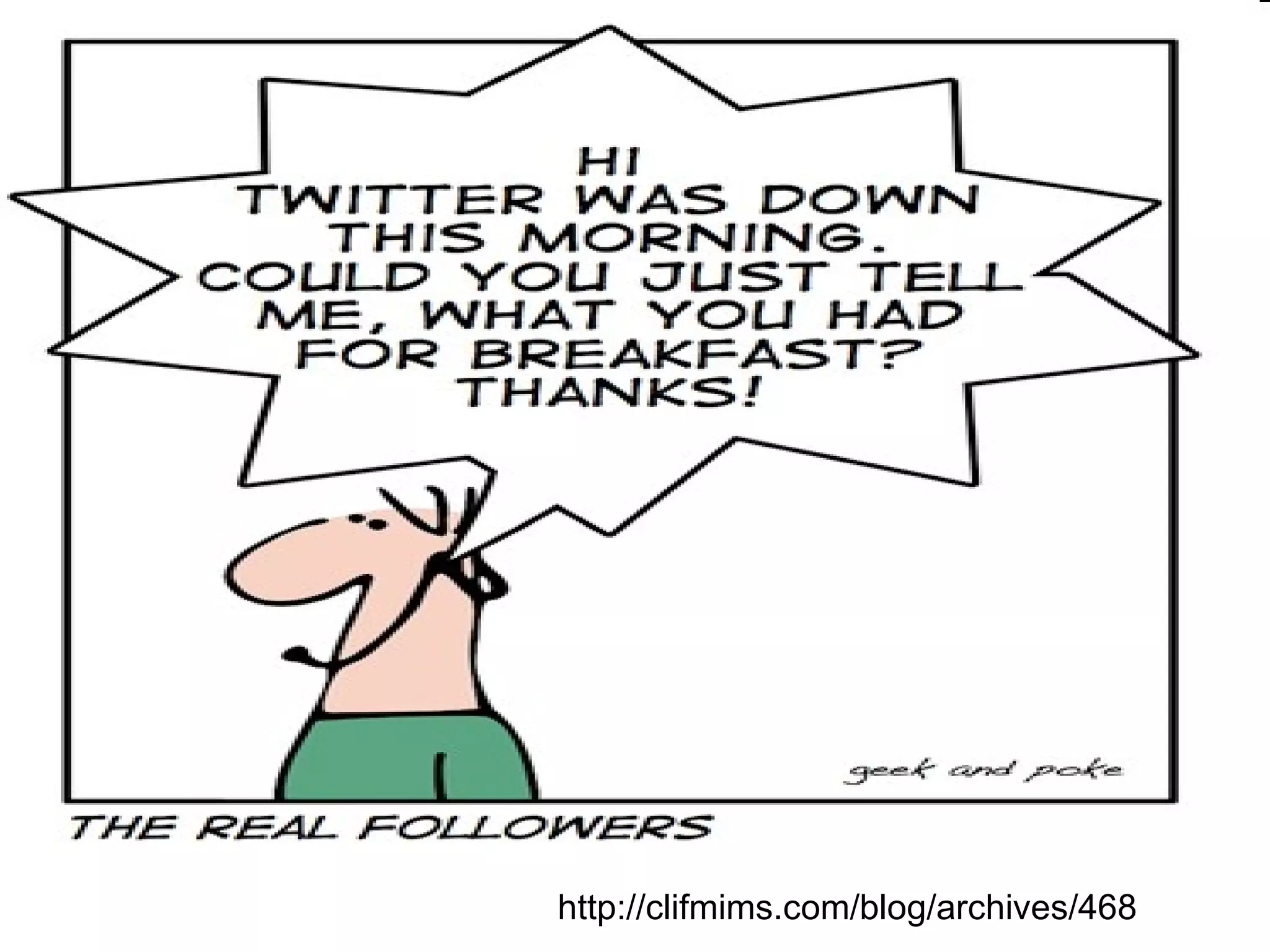
http://clifmims.com/blog/archives/468
Curriculum change Department of Information Sciences, Faculty of Humanities and Social Sciences, University of Zagreb  Two new courses introduced:  Information literacy  (theoretical approach) E-learning  (practical)
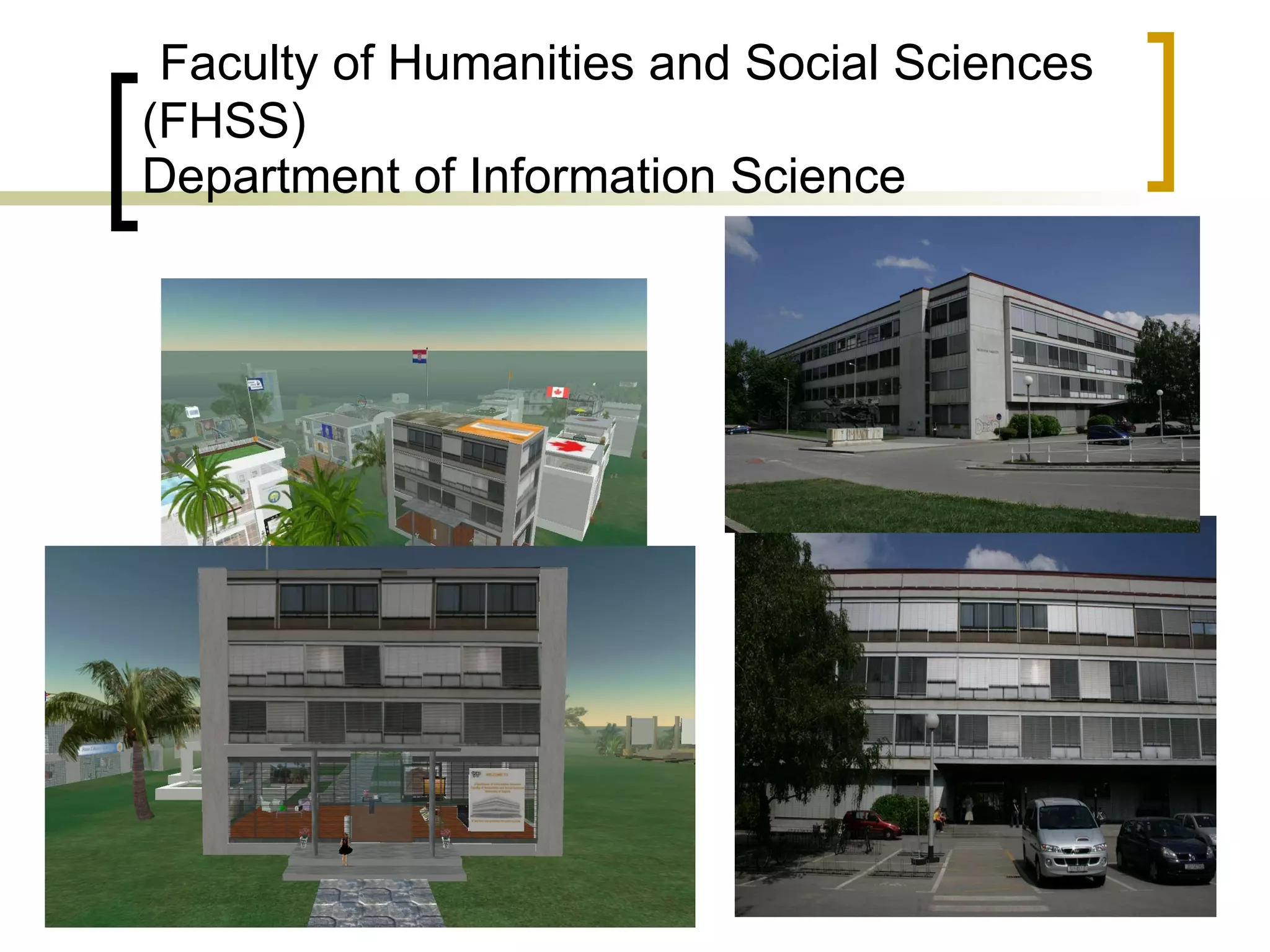
Faculty of Humanities and Social Sciences (FHSS)  Department of Information Science
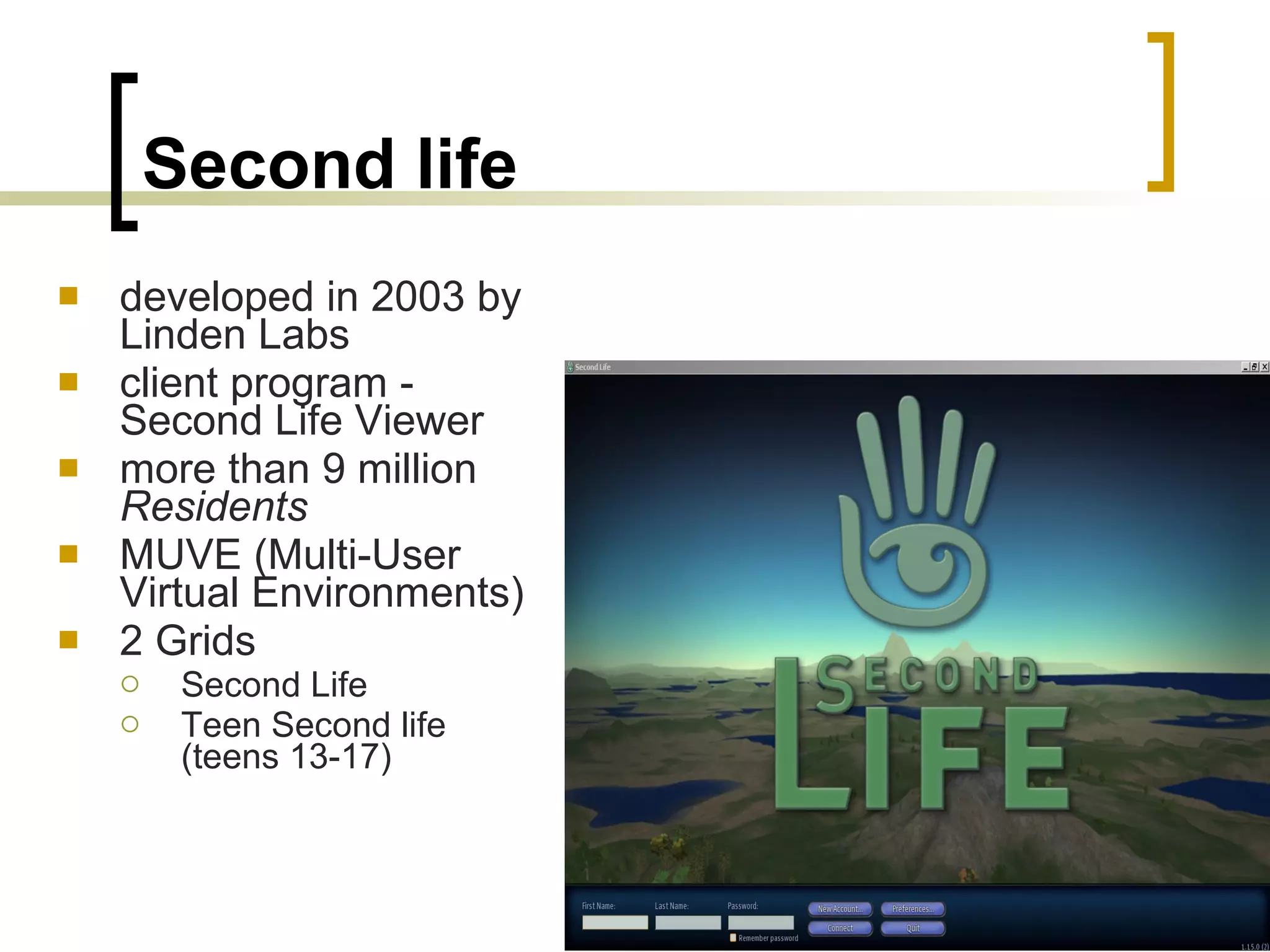
Second life developed in  2003  by  Linden Lab s client program  -  Second Life Viewer   more than 9 million  Residents   MUVE (Multi-User Virtual Environments) 2 Grids Second Life Teen Second life (teens 13-17)
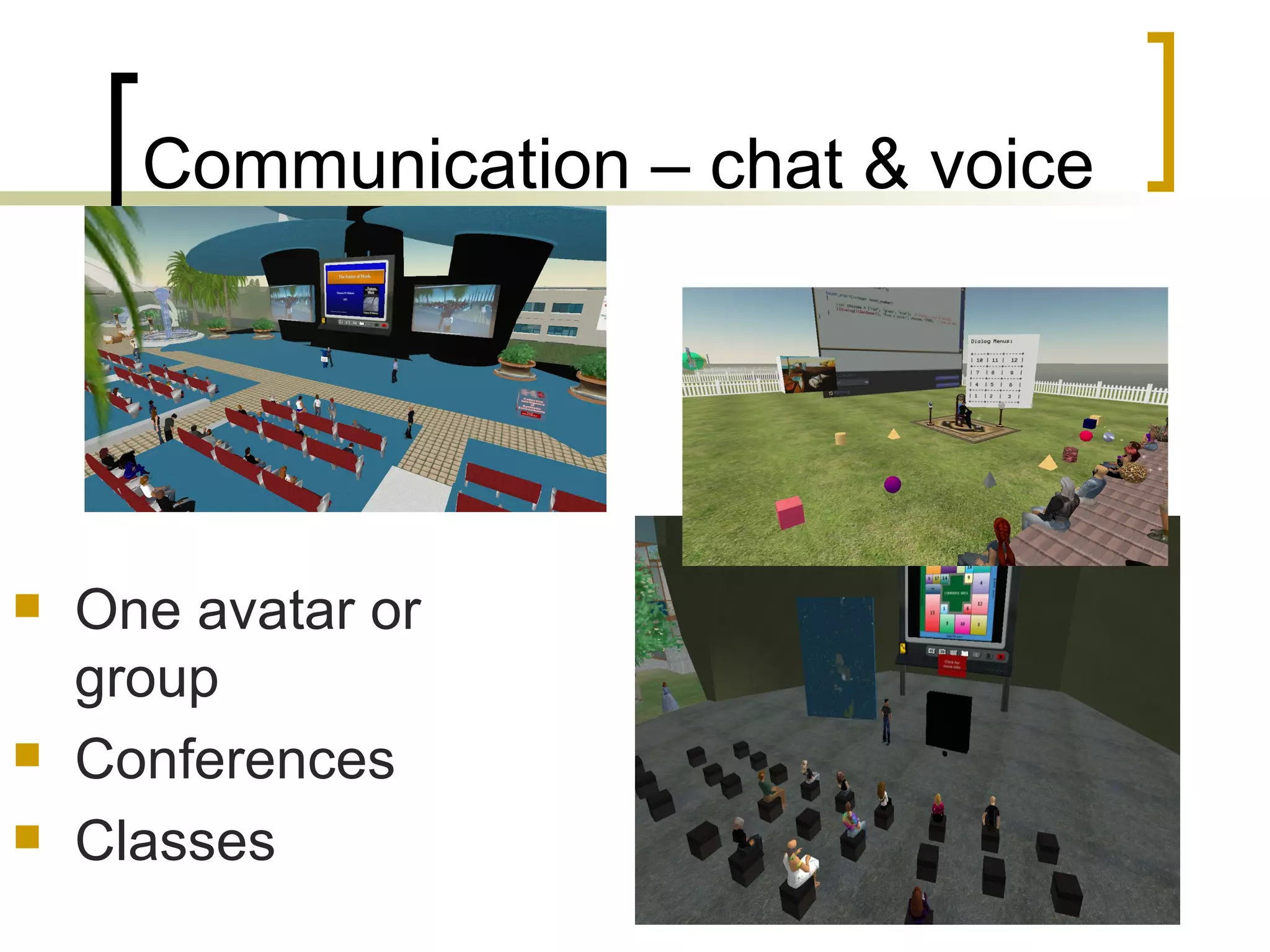
Communication – chat & voice One avatar or group Conferences Classes
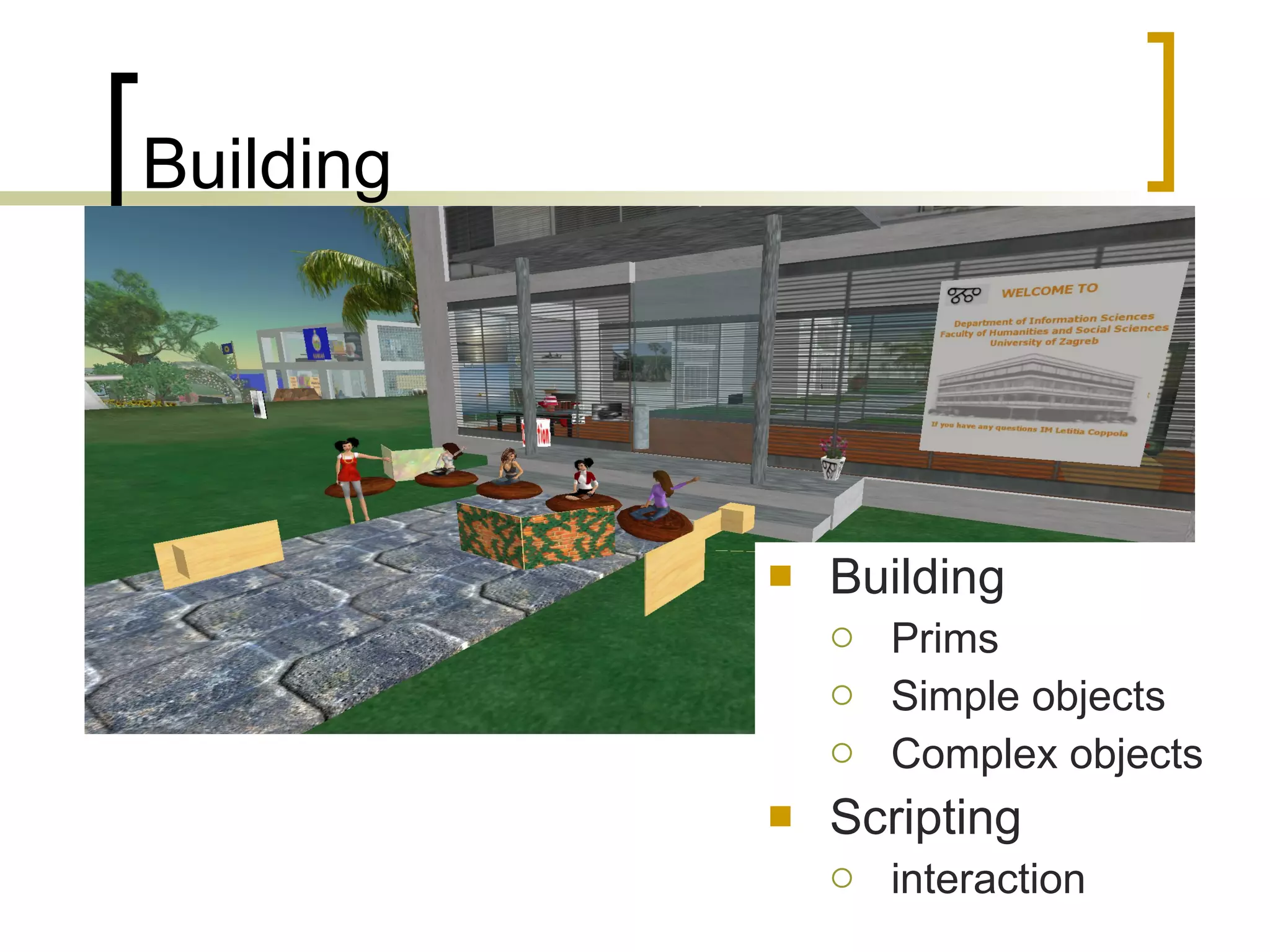
Building Building Prims Simple objects Complex objects Scripting interaction
Education & Culture many universities, colleges, schools and other educational institutions researching the use of Second Life as an environment for teaching and learning   Open University  ( UK ),  Princeton, MIT, University of Derby (UK), Vassar, Harvard, University of North Carolina at Chapel Hill, Ohio University, New York University, Australian Film Television and Radio School, etc.   Cybrary Islands – Library Alliance  Second life library 2.0 Eduisland, InfoIsland Museums  - International Space Flight museum, Louvre Second life - visual
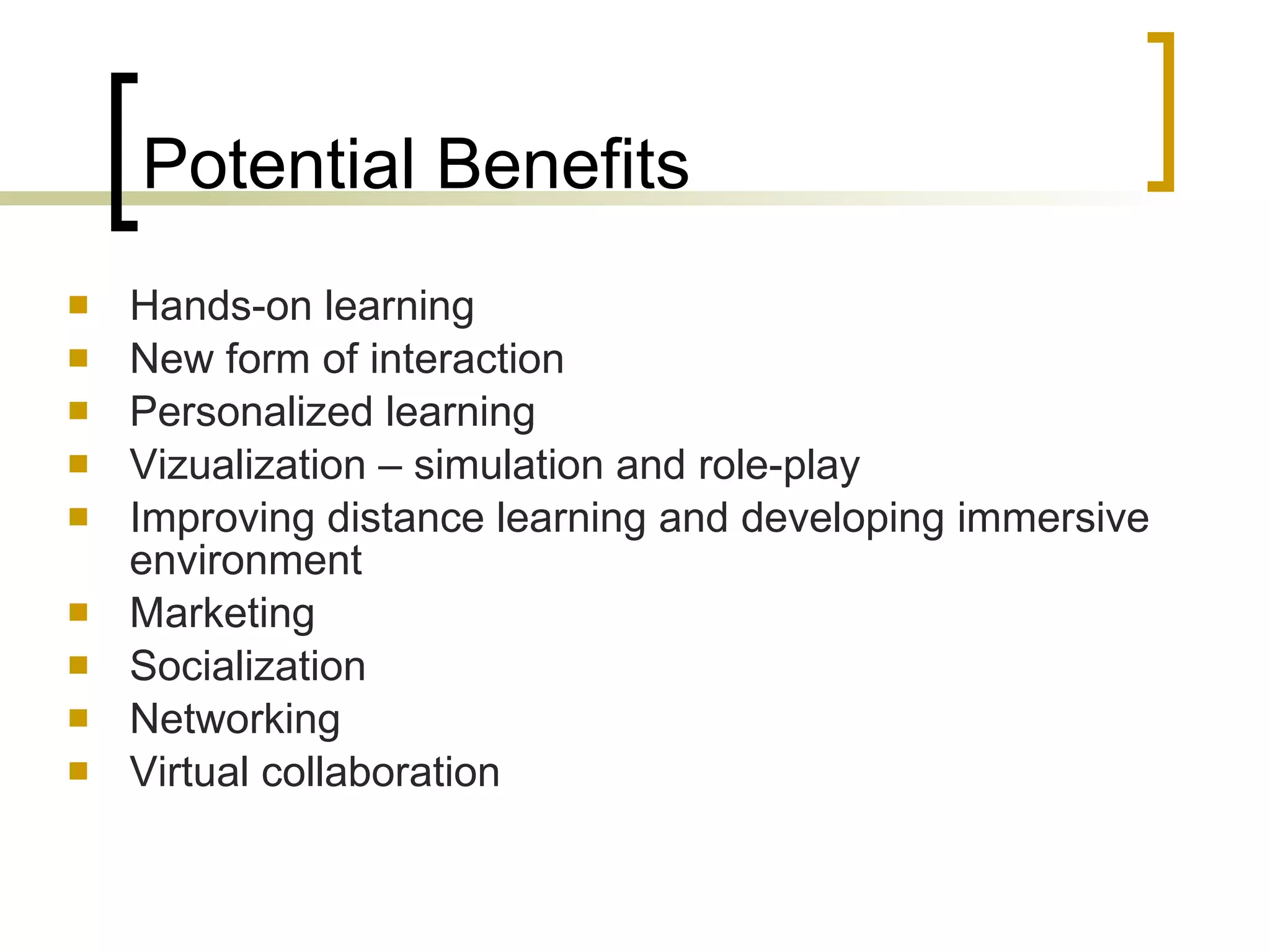
Potential Benefits Hands-on learning New form of interaction Personalized learning Vi z u a l iza tion  –  simulation and role - play Improving distance   learning and developing immersive environment Marketing  Socialization   Networking Virtual collaboration
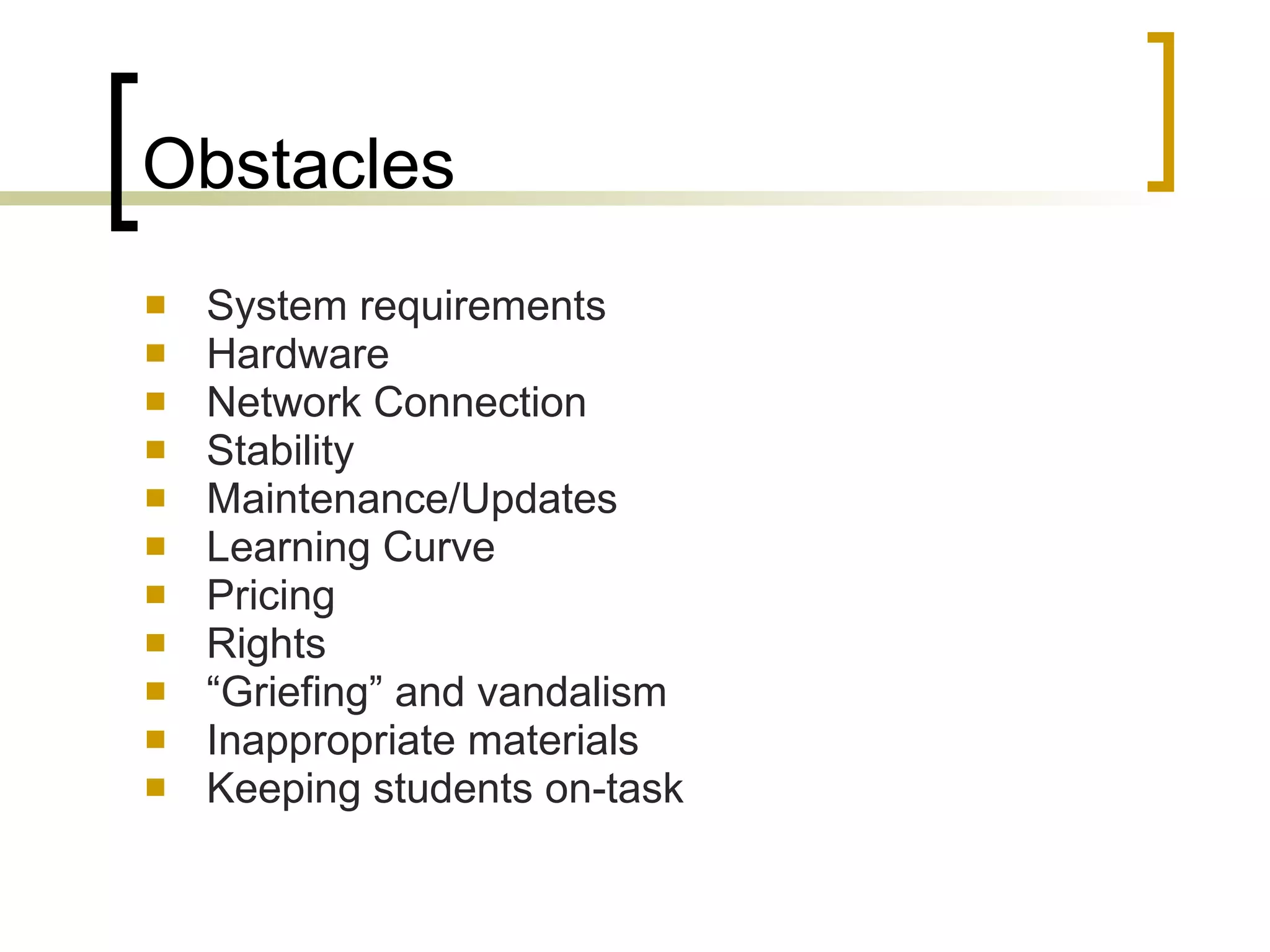
Obstacles System requirements Hardware Network Connection Stability Maintenance/Updates Learning Curve Pricing Rights “ Griefing” and vandalism Inappropriate materials Keeping students on-task
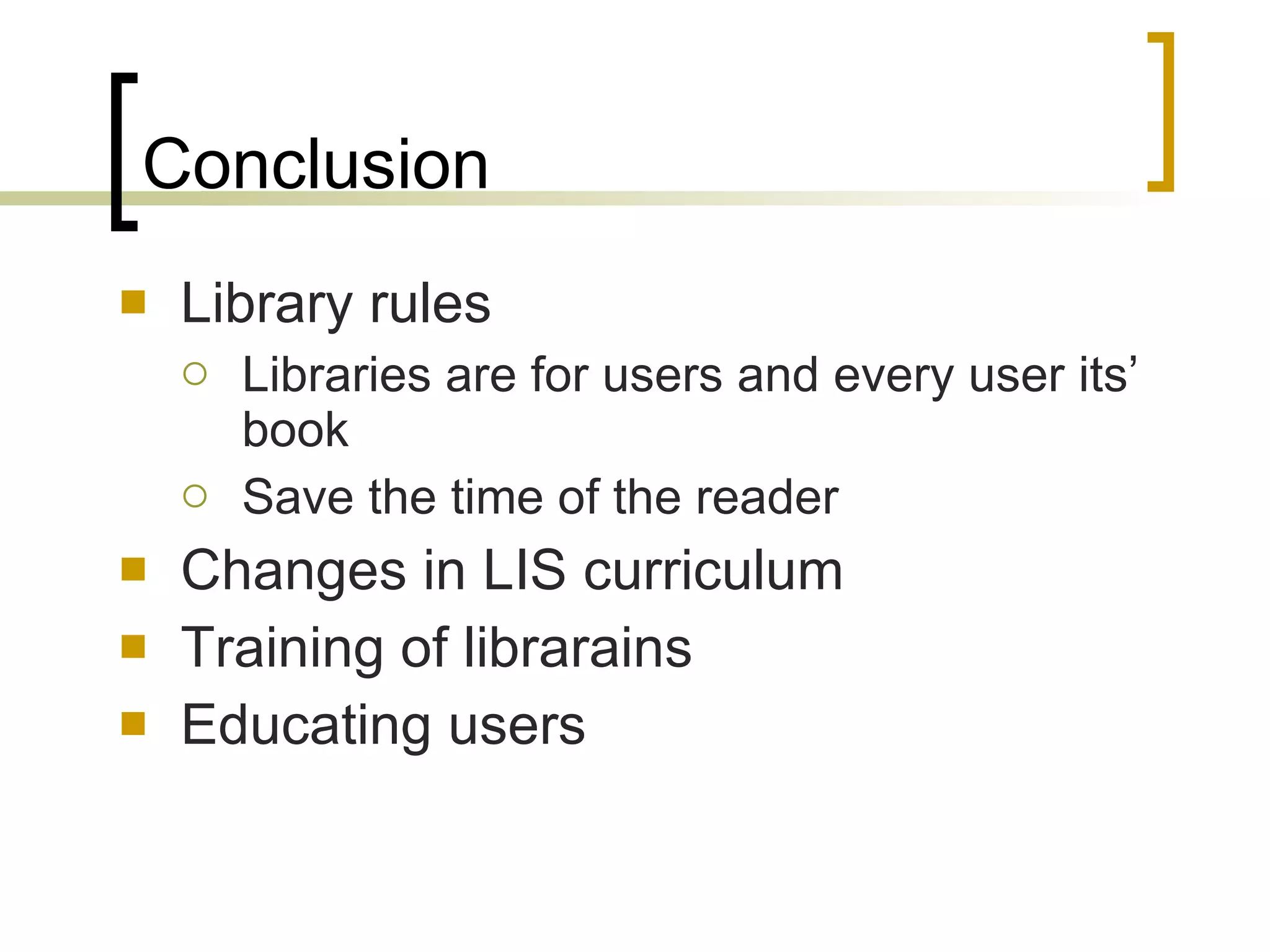
Conclusion Library rules L ibraries are for users and every user its’ book Save the time of the reader Changes in LIS curriculum Training of librarains  Educating users

School librarians coping with electronic environment

  • 1.
    Jadranka Lasic-Lazic jlazic @ ffzg.hr Mihaela Banek Zorica mbanek @ ffzg.hr Sonja Spiranec [email_address] Department of Information sciences, Faculty of Humanities and Social Sciences, Universtiy of Zagreb, Croatia School librarians coping with electronic environment
  • 2.
  • 3.
    What is Web2.0 Change in the web space New version (constant beta) Combination of several trends Participation Personalization and collaboration Democracy of marketing Richer online applications
  • 4.
    Web 1.0 –Web 2.0 Web 1.0: Static web pages Information and data gathered from large databases web as a repository – large database Users: technological background and knowledge Web 2.0 Interactivity Social networking User-generated content Participation is the key Easy to use, special skills aren’t necessary
  • 5.
    EVERYBODY has the possibility to Web 2.0 create publish share collaborate influence connect
  • 6.
  • 7.
  • 8.
    Generation X /genreationY Babyboomer / millenials
  • 9.
    Library 2.0 reactionto the web-based developments in ICT and the widespread use of social software Curran et al., 2007
  • 10.
    Library 2.0 conceptreflects user-centeredness; is related to multi-media environments and communication channels; provides the customer with the experience of social presence and enables interaction with librarians and other users; is communally innovative, i.e. works as a community service adaptable to change and allows users to initiate and guide this change of services related to seeking and utilizing information Manes, 2006
  • 11.
    What is Library2.0? Holmbeg et al. 2009
  • 12.
  • 13.
  • 14.
  • 15.
  • 16.
    Research Students familliarity with Web 2.0 tools Librarians at higher education institutions find Web 2.0 tools to be potentially useful in their libraries. Lasic-Lazic, Banek Zorica, Bubas 2009.
  • 17.
    Results most of students were familiar with popular tools/services like wikis, blogs, YouTube and MySpace/Facebook less than 50% had more than scarce knowledge of a Flickr, Delicious or even Second Life.
  • 18.
  • 19.
  • 20.
    Curriculum change Departmentof Information Sciences, Faculty of Humanities and Social Sciences, University of Zagreb Two new courses introduced: Information literacy (theoretical approach) E-learning (practical)
  • 21.
    Faculty of Humanitiesand Social Sciences (FHSS) Department of Information Science
  • 22.
    Second life developedin 2003 by Linden Lab s client program - Second Life Viewer more than 9 million Residents MUVE (Multi-User Virtual Environments) 2 Grids Second Life Teen Second life (teens 13-17)
  • 23.
    Communication – chat& voice One avatar or group Conferences Classes
  • 24.
    Building Building PrimsSimple objects Complex objects Scripting interaction
  • 25.
    Education & Culturemany universities, colleges, schools and other educational institutions researching the use of Second Life as an environment for teaching and learning Open University ( UK ), Princeton, MIT, University of Derby (UK), Vassar, Harvard, University of North Carolina at Chapel Hill, Ohio University, New York University, Australian Film Television and Radio School, etc. Cybrary Islands – Library Alliance Second life library 2.0 Eduisland, InfoIsland Museums - International Space Flight museum, Louvre Second life - visual
  • 26.
    Potential Benefits Hands-onlearning New form of interaction Personalized learning Vi z u a l iza tion – simulation and role - play Improving distance learning and developing immersive environment Marketing Socialization Networking Virtual collaboration
  • 27.
    Obstacles System requirementsHardware Network Connection Stability Maintenance/Updates Learning Curve Pricing Rights “ Griefing” and vandalism Inappropriate materials Keeping students on-task
  • 28.
    Conclusion Library rulesL ibraries are for users and every user its’ book Save the time of the reader Changes in LIS curriculum Training of librarains Educating users