Information literacy 2.0 Mihaela Banek Zorica  [email_address] Sonja Špiranec  [email_address]   University of Zagreb, Faculty of Humanities and Social Sciences Department of Information Sciences
What is Information Literacy the ability to locate, evaluate and use information In the knowledge/information society Information literacy is fundamental for educated individuals
Information literacy has  always been influenced and determined by the current information environment.  the concept of IL is seen as advancing from the practice of teaching tool-based skills toward teaching competencies that are applicable in diverse environments.  as a prerequisite for lifelong learning
Characteristics of the contemporary information environment Information is networked Information is digital Information is in abundance (Warlick, 2006)
Successful surviving in todays’ information space ACCESSING INFORMATION Find PROCESSING INFORMATION Decode Critically evaluate Organize COMMUNICATING INFORMATION Present Apply
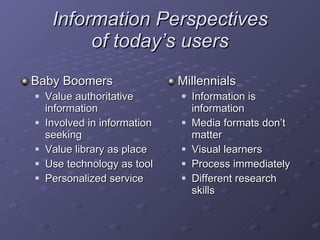
Information Perspectives of today ’ s users Baby Boomers Value authoritative information Involved in information seeking Value library as place Use technology as tool Personalized service Millennials Information is information Media formats don’t matter Visual learners Process immediately Different research skills
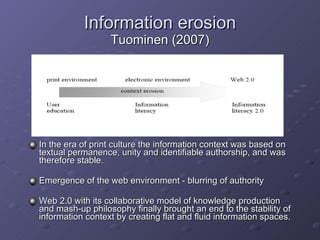
Information erosion Tuominen  (2007) In the era of print culture the information context was based on textual permanence, unity and identifiable authorship, and was therefore stable. Emergence of the web environment - blurring of authority  Web 2.0 with its collaborative model of knowledge production and mash-up philosophy finally brought an end to the stability of information context by creating flat and fluid information spaces .
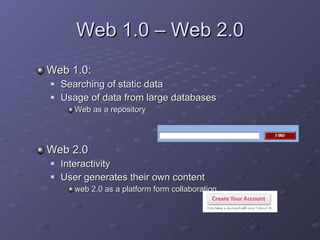
Web 1.0 – Web 2.0 Web 1.0:  Searching of static data  Usage of da t a from large databases Web as a repository  Web 2.0 I nteractivity User generates their own content web 2.0 as a platform form collaboration
 
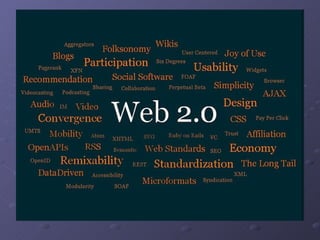
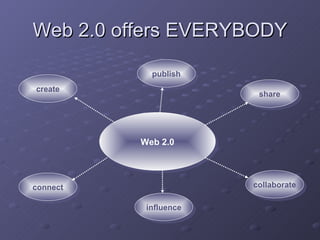
Web 2.0 offers EVERYBODY Web 2.0 create publish share collaborate influence connect
http://www.andybudd.com/presentations/dcontruct05
Library 2.0 reaction to the web-based developments in ICT and the widespread use of social software Curran et al., 2007 Web 2.0 largely focuses on information-based services which naturally have an impact on IL.
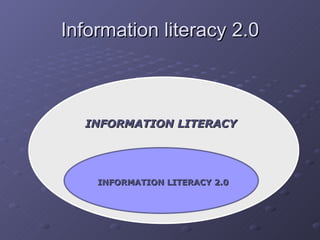
Information literacy 2.0 INFORMATION LITERACY INFORMATION LITERACY 2.0
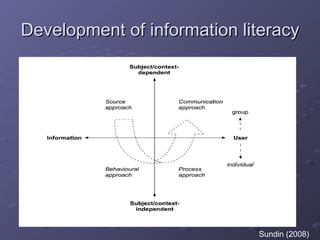
Development of information literacy Sundin (2008)
Teaching IL does not merely involve  library or bibliographic instruction (library skills) or user education the ability to use different information sources effectively (information skills).  It also includes teaching critical and analytical thinking skills regarding the use of information as well as the ability to generate new ideas from current information and prior knowledge.  Abdullah, A. 2008.
How to teach  IL 2.0 Usage of tools and services Educate teachers and students Teaching the importance of the context in which information is found and applied
…  and school libraries The social networking literate librarian possesses the skills necessary for providing services in and with online social networking sites. Librarians need a new branch of skill sets specific to utilizing and leveraging social networking sites to provide quality services and maintain their role as information experts in a Web2.0 world.
Further steps The only way for educational institutions to control or influence information behavior of students in these new realms is indirectly through IL programs.  We need to go towards the integration of tagging issues, the issues of reliability, authenticity and privacy, including various other questions related to learning communities in IL programs Librarians and teachers have to use Web 2.0 services and applications, not as isolated tools, but within their IL programs and sessions.

Information Literacy 2.0

  • 1.
    Information literacy 2.0Mihaela Banek Zorica [email_address] Sonja Špiranec [email_address] University of Zagreb, Faculty of Humanities and Social Sciences Department of Information Sciences
  • 2.
    What is InformationLiteracy the ability to locate, evaluate and use information In the knowledge/information society Information literacy is fundamental for educated individuals
  • 3.
    Information literacy has always been influenced and determined by the current information environment. the concept of IL is seen as advancing from the practice of teaching tool-based skills toward teaching competencies that are applicable in diverse environments. as a prerequisite for lifelong learning
  • 4.
    Characteristics of thecontemporary information environment Information is networked Information is digital Information is in abundance (Warlick, 2006)
  • 5.
    Successful surviving intodays’ information space ACCESSING INFORMATION Find PROCESSING INFORMATION Decode Critically evaluate Organize COMMUNICATING INFORMATION Present Apply
  • 6.
    Information Perspectives oftoday ’ s users Baby Boomers Value authoritative information Involved in information seeking Value library as place Use technology as tool Personalized service Millennials Information is information Media formats don’t matter Visual learners Process immediately Different research skills
  • 7.
    Information erosion Tuominen (2007) In the era of print culture the information context was based on textual permanence, unity and identifiable authorship, and was therefore stable. Emergence of the web environment - blurring of authority Web 2.0 with its collaborative model of knowledge production and mash-up philosophy finally brought an end to the stability of information context by creating flat and fluid information spaces .
  • 8.
    Web 1.0 –Web 2.0 Web 1.0: Searching of static data Usage of da t a from large databases Web as a repository Web 2.0 I nteractivity User generates their own content web 2.0 as a platform form collaboration
  • 9.
  • 10.
    Web 2.0 offersEVERYBODY Web 2.0 create publish share collaborate influence connect
  • 11.
  • 12.
    Library 2.0 reactionto the web-based developments in ICT and the widespread use of social software Curran et al., 2007 Web 2.0 largely focuses on information-based services which naturally have an impact on IL.
  • 13.
    Information literacy 2.0INFORMATION LITERACY INFORMATION LITERACY 2.0
  • 14.
    Development of informationliteracy Sundin (2008)
  • 15.
    Teaching IL doesnot merely involve library or bibliographic instruction (library skills) or user education the ability to use different information sources effectively (information skills). It also includes teaching critical and analytical thinking skills regarding the use of information as well as the ability to generate new ideas from current information and prior knowledge. Abdullah, A. 2008.
  • 16.
    How to teach IL 2.0 Usage of tools and services Educate teachers and students Teaching the importance of the context in which information is found and applied
  • 17.
    … andschool libraries The social networking literate librarian possesses the skills necessary for providing services in and with online social networking sites. Librarians need a new branch of skill sets specific to utilizing and leveraging social networking sites to provide quality services and maintain their role as information experts in a Web2.0 world.
  • 18.
    Further steps Theonly way for educational institutions to control or influence information behavior of students in these new realms is indirectly through IL programs. We need to go towards the integration of tagging issues, the issues of reliability, authenticity and privacy, including various other questions related to learning communities in IL programs Librarians and teachers have to use Web 2.0 services and applications, not as isolated tools, but within their IL programs and sessions.

Editor's Notes

  • #4 Why are we talking about IL 2.0…