Potential Uses of Web 2.0 Tools for Library Client Communication and Relationship Development Jadranka Lasic-Lazic   [email_address] Mihaela Banek Zorica  [email_address]   Goran Bubas  [email_address]   University of Zagreb, Croatia
What is Web 2.0 Change in the web space New version (constant beta) Combination of several trends Participation Personalization and collaboration Democracy of marketing Richer online applications QQML, May 2009 Mihaela Banek Zorica UNIZG/FHSS/DIS  mbanek @ ffzg .hr
 
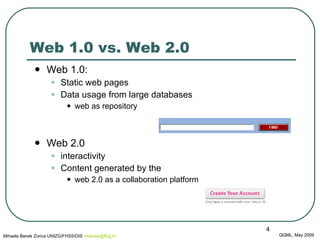
Web 1.0 vs. Web 2.0 Web 1.0:  Static web pages Data usage from large databases web as repository Web 2.0 interactivity Content generated by the  web 2.0 as a collaboration platform QQML, May 2009 Mihaela Banek Zorica UNIZG/FHSS/DIS  mbanek @ ffzg .hr
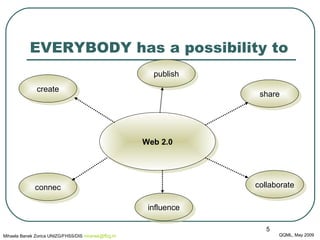
EVERYBODY  has a  possibility  to Web 2.0 create publish share collaborate influence connec QQML, May 2009 Mihaela Banek Zorica UNIZG/FHSS/DIS  mbanek @ ffzg .hr
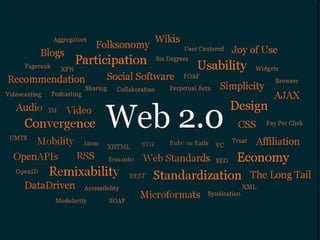
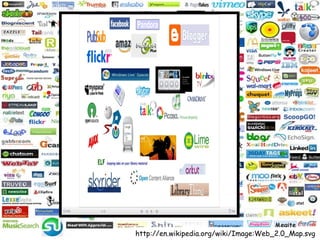
http://en.wikipedia.org/wiki/Image:Web_2.0_Map.svg
Library 2.0 reaction to the web-based developments in ICT and the widespread use of social software Curran et al., 2007 QQML, May 2009 Mihaela Banek Zorica UNIZG/FHSS/DIS  mbanek @ ffzg .hr
Library 2.0 concept reflects user-centeredness;  is related to multi-media environments and communication channels;  provides the customer with the experience of social presence and enables interaction with librarians and other users;  is communally innovative, i.e. works as a community service adaptable to change and allows users to initiate and guide this change of services related to seeking and utilizing information Manes, 2006 QQML, May 2009 Mihaela Banek Zorica UNIZG/FHSS/DIS  mbanek @ ffzg .hr
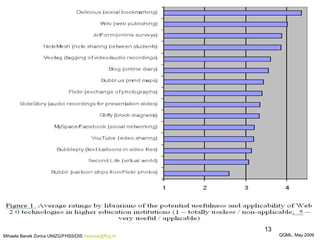
Research hypotheses  H1:  Students of informatics are familiar with Web 2.0 tools. H2a:  Librarians at higher education institutions have sufficient computer/information literacy to use Web 2.0 tools. H2b:  Librarians at higher education institutions find Web 2.0 tools to be potentially useful in their libraries. H3:  Public libraries in Croatia use Web 2.0 tools on their websites for interaction with clients/users. QQML, May 2009 Mihaela Banek Zorica UNIZG/FHSS/DIS  mbanek @ ffzg .hr
Methods First study  - use of Web 2.0 tools by students of Informatics - rate their knowledge of various Web 2.0 tools  285 students  20-25 years of age; 75% male and 25% female.  Second study  - use of Internet by librarians and their computer/Internet literacy and usage of Web 2.0 tools 51 librarians (higher education institutions in Croatia). 1 to 35 years of work experience in a library (14 years on average);  92% of them female.  Third study  -public libraries websites and implementation of Web 2.0 tools 124 cities and towns in Croatia 41 cities and towns and they were searched for the use of Web 2.0 tools QQML, May 2009 Mihaela Banek Zorica UNIZG/FHSS/DIS  mbanek @ ffzg .hr
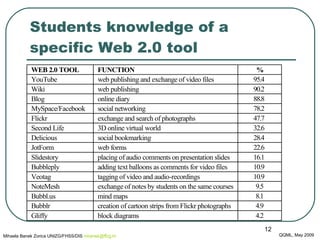
Results most of  students  were familiar with popular tools/services like wikis, blogs, YouTube and MySpace/Facebook  less than 50% had more than scarce knowledge of a Flickr, Delicious  or even  Second Life.  QQML, May 2009 Mihaela Banek Zorica UNIZG/FHSS/DIS  mbanek @ ffzg .hr
S tudents  knowledge of  a specific Web 2.0 tool  QQML, May 2009 Mihaela Banek Zorica UNIZG/FHSS/DIS  mbanek @ ffzg .hr
QQML, May 2009 Mihaela Banek Zorica UNIZG/FHSS/DIS  mbanek @ ffzg .hr
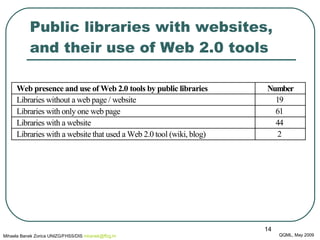
Public libraries with websites, and their use of Web 2.0 tools  QQML, May 2009 Mihaela Banek Zorica UNIZG/FHSS/DIS  mbanek @ ffzg .hr
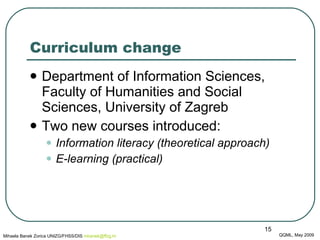
Curriculum change Department of Information Sciences, Faculty of Humanities and Social Sciences, University of Zagreb  Two new courses introduced:  Information literacy  (theoretical approach) E-learning  (practical) QQML, May 2009 Mihaela Banek Zorica UNIZG/FHSS/DIS  mbanek @ ffzg .hr
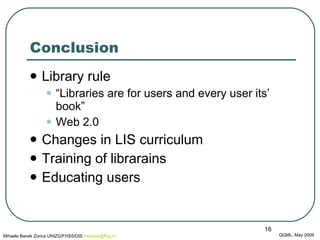
Conclusion Library rule “ L ibraries are for users and every user its’ book ” Web 2.0 Changes in LIS curriculum Training of librarains  Educating users QQML, May 2009 Mihaela Banek Zorica UNIZG/FHSS/DIS  mbanek @ ffzg .hr

QQML conference presentation

  • 1.
    Potential Uses ofWeb 2.0 Tools for Library Client Communication and Relationship Development Jadranka Lasic-Lazic [email_address] Mihaela Banek Zorica [email_address] Goran Bubas [email_address] University of Zagreb, Croatia
  • 2.
    What is Web2.0 Change in the web space New version (constant beta) Combination of several trends Participation Personalization and collaboration Democracy of marketing Richer online applications QQML, May 2009 Mihaela Banek Zorica UNIZG/FHSS/DIS mbanek @ ffzg .hr
  • 3.
  • 4.
    Web 1.0 vs.Web 2.0 Web 1.0: Static web pages Data usage from large databases web as repository Web 2.0 interactivity Content generated by the web 2.0 as a collaboration platform QQML, May 2009 Mihaela Banek Zorica UNIZG/FHSS/DIS mbanek @ ffzg .hr
  • 5.
    EVERYBODY hasa possibility to Web 2.0 create publish share collaborate influence connec QQML, May 2009 Mihaela Banek Zorica UNIZG/FHSS/DIS mbanek @ ffzg .hr
  • 6.
  • 7.
    Library 2.0 reactionto the web-based developments in ICT and the widespread use of social software Curran et al., 2007 QQML, May 2009 Mihaela Banek Zorica UNIZG/FHSS/DIS mbanek @ ffzg .hr
  • 8.
    Library 2.0 conceptreflects user-centeredness; is related to multi-media environments and communication channels; provides the customer with the experience of social presence and enables interaction with librarians and other users; is communally innovative, i.e. works as a community service adaptable to change and allows users to initiate and guide this change of services related to seeking and utilizing information Manes, 2006 QQML, May 2009 Mihaela Banek Zorica UNIZG/FHSS/DIS mbanek @ ffzg .hr
  • 9.
    Research hypotheses H1: Students of informatics are familiar with Web 2.0 tools. H2a: Librarians at higher education institutions have sufficient computer/information literacy to use Web 2.0 tools. H2b: Librarians at higher education institutions find Web 2.0 tools to be potentially useful in their libraries. H3: Public libraries in Croatia use Web 2.0 tools on their websites for interaction with clients/users. QQML, May 2009 Mihaela Banek Zorica UNIZG/FHSS/DIS mbanek @ ffzg .hr
  • 10.
    Methods First study - use of Web 2.0 tools by students of Informatics - rate their knowledge of various Web 2.0 tools 285 students 20-25 years of age; 75% male and 25% female. Second study - use of Internet by librarians and their computer/Internet literacy and usage of Web 2.0 tools 51 librarians (higher education institutions in Croatia). 1 to 35 years of work experience in a library (14 years on average); 92% of them female. Third study -public libraries websites and implementation of Web 2.0 tools 124 cities and towns in Croatia 41 cities and towns and they were searched for the use of Web 2.0 tools QQML, May 2009 Mihaela Banek Zorica UNIZG/FHSS/DIS mbanek @ ffzg .hr
  • 11.
    Results most of students were familiar with popular tools/services like wikis, blogs, YouTube and MySpace/Facebook less than 50% had more than scarce knowledge of a Flickr, Delicious or even Second Life. QQML, May 2009 Mihaela Banek Zorica UNIZG/FHSS/DIS mbanek @ ffzg .hr
  • 12.
    S tudents knowledge of a specific Web 2.0 tool QQML, May 2009 Mihaela Banek Zorica UNIZG/FHSS/DIS mbanek @ ffzg .hr
  • 13.
    QQML, May 2009Mihaela Banek Zorica UNIZG/FHSS/DIS mbanek @ ffzg .hr
  • 14.
    Public libraries withwebsites, and their use of Web 2.0 tools QQML, May 2009 Mihaela Banek Zorica UNIZG/FHSS/DIS mbanek @ ffzg .hr
  • 15.
    Curriculum change Departmentof Information Sciences, Faculty of Humanities and Social Sciences, University of Zagreb Two new courses introduced: Information literacy (theoretical approach) E-learning (practical) QQML, May 2009 Mihaela Banek Zorica UNIZG/FHSS/DIS mbanek @ ffzg .hr
  • 16.
    Conclusion Library rule“ L ibraries are for users and every user its’ book ” Web 2.0 Changes in LIS curriculum Training of librarains Educating users QQML, May 2009 Mihaela Banek Zorica UNIZG/FHSS/DIS mbanek @ ffzg .hr