
what if ……
on scenario thinking
scenario thinking

    why & when?

•   setting strategic direction
•   catalyze bold action
•   accelerate collaborative learning
•   alignment & visioning
scenarios

    basic principles
•   re-perception
•   the status quo is not an option
•   understand and manage uncertainty
•   the long view
•   outside-in thinking
•   multiple perspectives
scenarios

    conditions for success
•   openness for multiple perspectives & for
    challenging common assumptions
•   positioned to change in a meaningful way
•   have a well-positioned leader for the process
•   willingness to commit the necessary
    resources
on scenario building

    5 conditions for scenarios
    to be useful and credible:
•   relevance
•   coherence
•   plausibility
•   importance
•   transparency
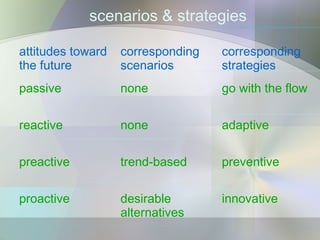
scenarios & strategies

attitudes toward   corresponding   corresponding
the future         scenarios       strategies
passive            none            go with the flow

reactive           none            adaptive

preactive          trend-based     preventive

proactive          desirable       innovative
                   alternatives
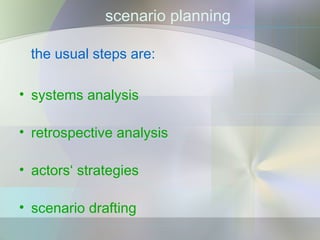
scenario planning

 the usual steps are:

• systems analysis

• retrospective analysis

• actors‘ strategies

• scenario drafting
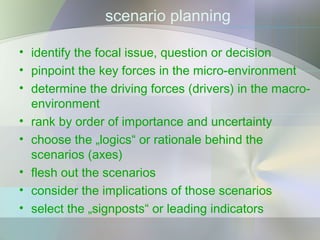
scenario planning

• identify the focal issue, question or decision
• pinpoint the key forces in the micro-environment
• determine the driving forces (drivers) in the macro-
  environment
• rank by order of importance and uncertainty
• choose the „logics“ or rationale behind the
  scenarios (axes)
• flesh out the scenarios
• consider the implications of those scenarios
• select the „signposts“ or leading indicators
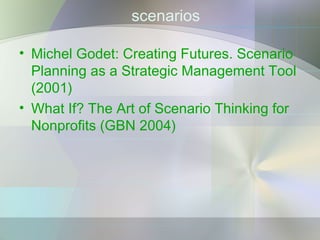
scenarios

• Michel Godet: Creating Futures. Scenario
  Planning as a Strategic Management Tool
  (2001)
• What If? The Art of Scenario Thinking for
  Nonprofits (GBN 2004)

On scenario thinking

  • 1.
    what if …… onscenario thinking
  • 2.
    scenario thinking why & when? • setting strategic direction • catalyze bold action • accelerate collaborative learning • alignment & visioning
  • 3.
    scenarios basic principles • re-perception • the status quo is not an option • understand and manage uncertainty • the long view • outside-in thinking • multiple perspectives
  • 4.
    scenarios conditions for success • openness for multiple perspectives & for challenging common assumptions • positioned to change in a meaningful way • have a well-positioned leader for the process • willingness to commit the necessary resources
  • 5.
    on scenario building 5 conditions for scenarios to be useful and credible: • relevance • coherence • plausibility • importance • transparency
  • 6.
    scenarios & strategies attitudestoward corresponding corresponding the future scenarios strategies passive none go with the flow reactive none adaptive preactive trend-based preventive proactive desirable innovative alternatives
  • 7.
    scenario planning theusual steps are: • systems analysis • retrospective analysis • actors‘ strategies • scenario drafting
  • 8.
    scenario planning • identifythe focal issue, question or decision • pinpoint the key forces in the micro-environment • determine the driving forces (drivers) in the macro- environment • rank by order of importance and uncertainty • choose the „logics“ or rationale behind the scenarios (axes) • flesh out the scenarios • consider the implications of those scenarios • select the „signposts“ or leading indicators
  • 9.
    scenarios • Michel Godet:Creating Futures. Scenario Planning as a Strategic Management Tool (2001) • What If? The Art of Scenario Thinking for Nonprofits (GBN 2004)