Wednesday,
April 12, 2023
1
Scar
DR. HIWA OMER AHMED
PROFESSOR IN GENERAL AND BARIATRIC SURGERY
UNIVERSITY OF SULAIMANI
COLLEGE OF MEDICINE – SULAIMANI CITY-
KURDISTAN
Wednesday,
April 12, 2023
2
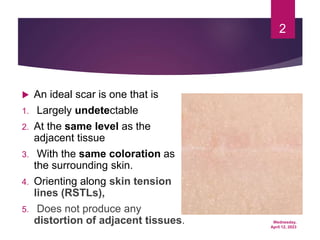
 An ideal scar is one that is
1. Largely undetectable
2. At the same level as the
adjacent tissue
3. With the same coloration as
the surrounding skin.
4. Orienting along skin tension
lines (RSTLs),
5. Does not produce any
distortion of adjacent tissues.
Wednesday,
April 12, 2023
3
 Scars are an integral part of human life. They find
mention in history as well as literature. Gladiators
innumerable scars were testimony to the many
battles they fought and survived.
 Harry Potter's “lightning bolt“ scar captured the
imagination of an entire generation.
 Indeed, one scar borne by the entire humanity – the
umbilical cicatrix is not just acceptable but highly
desirable.
Wednesday,
April 12, 2023
4
Impact of scars
 A scar may impede function – as in case of a contracture running
across a joint.
 A scar may cause discomfort, even pain.
 A scar may cause cosmetic deformity and the patient may seek
treatment merely to “look more normal.“
 The scar may be an unpleasant reminder of a traumatic past and
the patient may seek to erase its memories by erasing the scar.
 The patient may associate the scar with a personal failure –
inability to impress a girlfriend or inability to get promoted – and
may be looking at treatment of the scar as a means of success in
his/her endeavors.
Wednesday,
April 12, 2023
5
Healing
 Our understanding now is beyond simply categorizing the
process of the into its three stages:
1. Inflammation. first 3 to 5 days
2. Proliferation. 5-15 days
3. Remodeling.
A multitude of growth factors and inflammatory mediators
secreted by numerous cell lines play crucial and specialized
roles in the healing process, such as
1. Angiogenesis,
2. Fibroblast proliferation
3. Wound contraction.
Wednesday,
April 12, 2023
6
Inflammation
 First few seconds to minutes after a wound occurs, >>
vasoconstriction and activation of the coagulation
cascade.
 This causes platelet aggregation and formation of the
fibrin-platelet plug, which not only provides hemostasis, but
also provides a platform for the progression of wound
healing.
 After this initial period, vasodilation and increased
vascular permeability leads to localized edema and an
influx of important inflammatory mediators, which through
chemotaxis, cause neutrophil transmigration to the
wound site.
Wednesday,
April 12, 2023
7
 Neutrophils are the dominant cell type around 24 hours.
 Macrophages become the predominant cell type around 2
to 3 days
1. Releasing anti-inflammatory cytokines and growth
factors signaling resolution of inflammation and progression
of wound healing to the proliferative phase,
2. OR Releasing inflammatory cytokines that recruit
additional neutrophils and prolong the inflammatory
process, causing damage to viable tissue and eventually
causing a chronic wound.
Wednesday,
April 12, 2023
8
Proliferative phase
 lasts approximately 5 to 15 days and is characterized by
1. Re-epithelialization
2. Angiogenesis
3. Fibroblast migration
4. Collagen deposition
Re-epithelialization occurs through proliferation and migration of
epithelial cells from the wound edges to the center of the wound at a
rate of 0.5 to 1 mm/d until the wound is completely covered and a
protective epithelial layer is established. This process can also occur from
dermal structures such as sebaceous glands and hair follicles.
Wednesday,
April 12, 2023
9
 Some fibroblasts in the wound secrete disorganized
type III collagen, whereas others differentiate into
myofibroblasts that cause contraction of the wound.
 Simultaneously, new blood vessels begin forming in
poorly perfused wounds with low oxygen tensions.
 These combined processes form the red granular-
appearing tissue made of blood vessels and newly
formed connective tissue commonly referred to as
“granulation tissue.”
Wednesday,
April 12, 2023
10
Remodeling phase
 The third and final phase, known as the remodeling phase,
lasts up to 1 year .
 involves collagen cross-linking and replacement of the
disorganized type III collagen by organized type I collagen.
 This remodeling restores the normal dermal composition
and provides greater tensile strength to the wound over time.
 At 6 weeks after wounding, 50% tensile strength of the
original skin is regained; at 3 months, 80% is regained.
Wednesday,
April 12, 2023
11
Factors affect healing
 Wound factors
1. Wide wounds that are primarily closed give a poorer scar due to tension
on the suture line.
2. Infected wounds give a poorer scar.
3. Traumatic and excisional wounds fare poorer than surgical incisional
wounds.
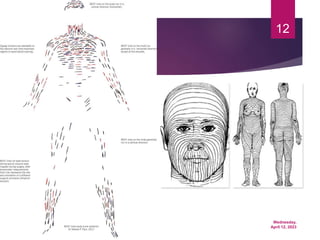
4. Wounds oriented across the RSTLs fare poorer than those along the
RSTLs.
5. Location on trunk and extremities give poorer scar than the head and
neck region.
Wednesday,
April 12, 2023
12
Wednesday,
April 12, 2023
13
Patient factors
1. Children develop poorer scars than older patients
due to higher elastin content of their skin leading
to higher tension at the skin edges.[8]
2. Patients with systemic diseases like Diabetes
Mellitus, Chronic Renal Failure, or those on
Immunosuppresants are more susceptible to
wound infections and poor wound healing.
Wednesday,
April 12, 2023
14
Surgeon factors
1. Inappropriate technique – Traumatizing
the edges, Use of electrocautery, Suturing
under tension etc.
2. Level of training of the surgeon.
3. Inappropriate post-operative care).
Wednesday,
April 12, 2023
15
Postoperative factors
1. The wound can be cleaned with saline or tap-water, but alcohol or
iodide is cytotoxic to the cells trying to do the work of healing within the
wound. These cleaning products from a by-gone era should not be
used to clean a wound that is healing well without any signs of
infection.
2. When any non-absorbable sutures are removed, and skin tape is
applied to reduce tension.
3. At one week after the surgery, the tensile strength across an incision is
only 3% of that of uninterrupted skin. This figure increases to 20% by the
third week when remodeling begins and to 80% after three months.
Skin tape should be applied across the incision for at least three months
to reduce the tension the remodeling wound must bear
Wednesday,
April 12, 2023
16
4. Newly formed scars less than 18 months old are
highly susceptible to damage from ultraviolet
radiation from the sun, causing hyperpigmentation and
structural changes to the collagen matrix. This leads to
a thickened and discolored scar.
Wednesday,
April 12, 2023
17
Types and sequelae of scars
 Mature scar – A light colored flat scar.
 Immature scar – A red, sometimes itchy or painful, and slightly elevated
scar in the process of remodeling. Many of these will mature normally over
time.
 Linear hypertrophic scar A red, raised, sometimes itchy scar confined
to the border of the original incision. These scars may increase in size
rapidly for 3-6 months and then, after a static phase, begin to regress.
After maturation, they may have an elevated, slightly rope like appearance
with the increased width.
 Widespread hypertrophic scar (e.g. due to burns): A widespread red,
raised, sometimes itchy scar that remains within the borders of the
original injury.
Wednesday,
April 12, 2023
18
 Minor keloid – A focally raised, itchy scar extending over
normal tissue. This may develop up to 1 year after injury and
does not regress on its own.
 Major keloid – A large raised (>0.5 cm) scar, possibly painful or
pruritic and extending over normal tissue. This may result from
minor trauma and can continue to spread over years.
 Atrophic, Depressed, Hypopigmented, Hyperpigmented.
irregular with nodularity.

scar.ppt

  • 1.
    Wednesday, April 12, 2023 1 Scar DR.HIWA OMER AHMED PROFESSOR IN GENERAL AND BARIATRIC SURGERY UNIVERSITY OF SULAIMANI COLLEGE OF MEDICINE – SULAIMANI CITY- KURDISTAN
  • 2.
    Wednesday, April 12, 2023 2 An ideal scar is one that is 1. Largely undetectable 2. At the same level as the adjacent tissue 3. With the same coloration as the surrounding skin. 4. Orienting along skin tension lines (RSTLs), 5. Does not produce any distortion of adjacent tissues.
  • 3.
    Wednesday, April 12, 2023 3 Scars are an integral part of human life. They find mention in history as well as literature. Gladiators innumerable scars were testimony to the many battles they fought and survived.  Harry Potter's “lightning bolt“ scar captured the imagination of an entire generation.  Indeed, one scar borne by the entire humanity – the umbilical cicatrix is not just acceptable but highly desirable.
  • 4.
    Wednesday, April 12, 2023 4 Impactof scars  A scar may impede function – as in case of a contracture running across a joint.  A scar may cause discomfort, even pain.  A scar may cause cosmetic deformity and the patient may seek treatment merely to “look more normal.“  The scar may be an unpleasant reminder of a traumatic past and the patient may seek to erase its memories by erasing the scar.  The patient may associate the scar with a personal failure – inability to impress a girlfriend or inability to get promoted – and may be looking at treatment of the scar as a means of success in his/her endeavors.
  • 5.
    Wednesday, April 12, 2023 5 Healing Our understanding now is beyond simply categorizing the process of the into its three stages: 1. Inflammation. first 3 to 5 days 2. Proliferation. 5-15 days 3. Remodeling. A multitude of growth factors and inflammatory mediators secreted by numerous cell lines play crucial and specialized roles in the healing process, such as 1. Angiogenesis, 2. Fibroblast proliferation 3. Wound contraction.
  • 6.
    Wednesday, April 12, 2023 6 Inflammation First few seconds to minutes after a wound occurs, >> vasoconstriction and activation of the coagulation cascade.  This causes platelet aggregation and formation of the fibrin-platelet plug, which not only provides hemostasis, but also provides a platform for the progression of wound healing.  After this initial period, vasodilation and increased vascular permeability leads to localized edema and an influx of important inflammatory mediators, which through chemotaxis, cause neutrophil transmigration to the wound site.
  • 7.
    Wednesday, April 12, 2023 7 Neutrophils are the dominant cell type around 24 hours.  Macrophages become the predominant cell type around 2 to 3 days 1. Releasing anti-inflammatory cytokines and growth factors signaling resolution of inflammation and progression of wound healing to the proliferative phase, 2. OR Releasing inflammatory cytokines that recruit additional neutrophils and prolong the inflammatory process, causing damage to viable tissue and eventually causing a chronic wound.
  • 8.
    Wednesday, April 12, 2023 8 Proliferativephase  lasts approximately 5 to 15 days and is characterized by 1. Re-epithelialization 2. Angiogenesis 3. Fibroblast migration 4. Collagen deposition Re-epithelialization occurs through proliferation and migration of epithelial cells from the wound edges to the center of the wound at a rate of 0.5 to 1 mm/d until the wound is completely covered and a protective epithelial layer is established. This process can also occur from dermal structures such as sebaceous glands and hair follicles.
  • 9.
    Wednesday, April 12, 2023 9 Some fibroblasts in the wound secrete disorganized type III collagen, whereas others differentiate into myofibroblasts that cause contraction of the wound.  Simultaneously, new blood vessels begin forming in poorly perfused wounds with low oxygen tensions.  These combined processes form the red granular- appearing tissue made of blood vessels and newly formed connective tissue commonly referred to as “granulation tissue.”
  • 10.
    Wednesday, April 12, 2023 10 Remodelingphase  The third and final phase, known as the remodeling phase, lasts up to 1 year .  involves collagen cross-linking and replacement of the disorganized type III collagen by organized type I collagen.  This remodeling restores the normal dermal composition and provides greater tensile strength to the wound over time.  At 6 weeks after wounding, 50% tensile strength of the original skin is regained; at 3 months, 80% is regained.
  • 11.
    Wednesday, April 12, 2023 11 Factorsaffect healing  Wound factors 1. Wide wounds that are primarily closed give a poorer scar due to tension on the suture line. 2. Infected wounds give a poorer scar. 3. Traumatic and excisional wounds fare poorer than surgical incisional wounds. 4. Wounds oriented across the RSTLs fare poorer than those along the RSTLs. 5. Location on trunk and extremities give poorer scar than the head and neck region.
  • 12.
  • 13.
    Wednesday, April 12, 2023 13 Patientfactors 1. Children develop poorer scars than older patients due to higher elastin content of their skin leading to higher tension at the skin edges.[8] 2. Patients with systemic diseases like Diabetes Mellitus, Chronic Renal Failure, or those on Immunosuppresants are more susceptible to wound infections and poor wound healing.
  • 14.
    Wednesday, April 12, 2023 14 Surgeonfactors 1. Inappropriate technique – Traumatizing the edges, Use of electrocautery, Suturing under tension etc. 2. Level of training of the surgeon. 3. Inappropriate post-operative care).
  • 15.
    Wednesday, April 12, 2023 15 Postoperativefactors 1. The wound can be cleaned with saline or tap-water, but alcohol or iodide is cytotoxic to the cells trying to do the work of healing within the wound. These cleaning products from a by-gone era should not be used to clean a wound that is healing well without any signs of infection. 2. When any non-absorbable sutures are removed, and skin tape is applied to reduce tension. 3. At one week after the surgery, the tensile strength across an incision is only 3% of that of uninterrupted skin. This figure increases to 20% by the third week when remodeling begins and to 80% after three months. Skin tape should be applied across the incision for at least three months to reduce the tension the remodeling wound must bear
  • 16.
    Wednesday, April 12, 2023 16 4.Newly formed scars less than 18 months old are highly susceptible to damage from ultraviolet radiation from the sun, causing hyperpigmentation and structural changes to the collagen matrix. This leads to a thickened and discolored scar.
  • 17.
    Wednesday, April 12, 2023 17 Typesand sequelae of scars  Mature scar – A light colored flat scar.  Immature scar – A red, sometimes itchy or painful, and slightly elevated scar in the process of remodeling. Many of these will mature normally over time.  Linear hypertrophic scar A red, raised, sometimes itchy scar confined to the border of the original incision. These scars may increase in size rapidly for 3-6 months and then, after a static phase, begin to regress. After maturation, they may have an elevated, slightly rope like appearance with the increased width.  Widespread hypertrophic scar (e.g. due to burns): A widespread red, raised, sometimes itchy scar that remains within the borders of the original injury.
  • 18.
    Wednesday, April 12, 2023 18 Minor keloid – A focally raised, itchy scar extending over normal tissue. This may develop up to 1 year after injury and does not regress on its own.  Major keloid – A large raised (>0.5 cm) scar, possibly painful or pruritic and extending over normal tissue. This may result from minor trauma and can continue to spread over years.  Atrophic, Depressed, Hypopigmented, Hyperpigmented. irregular with nodularity.