
PRESENTED BY
DR.CH RAKESH SINGHA
PGT ORTHOPAEDICS, SMCH
 “Soft tissue” is a broad term that includes -
skin, subcutaneous tissue, fasciae, muscles,
tendons, ligaments, neurovascular structures
& other connective tissues.
 It holds very pivotal & undisputed role in the
overall orthopaedic management.
 Fractures with soft-tissue injury considered
as surgical emergencies.
 It needs a sophisticated management
protocol and an excellent grading system to
achieve uncomplicated healing with complete
restitution of function.
 Evaluation of fracture must determine the
extent of soft tissue injury, which will be a
key factor in management.
 This impinges upon the need of soft tissue
injury classification.
 A classification of the soft-tissue injury
should consider all essential factors and
guide treatment.
 It decreases complications by preventing
avoidable treatment errors
 For prognostic value of wounds
 To monitor and compare standardized
treatment protocols.
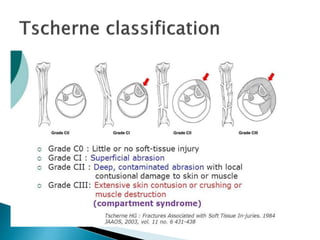
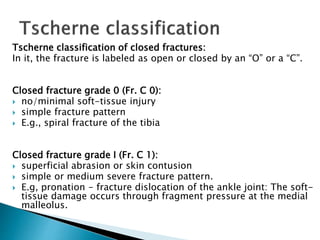
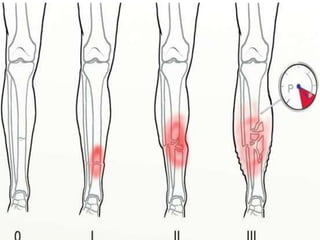
Tscherne classification of closed fractures:
In it, the fracture is labeled as open or closed by an “O” or a “C”.
Closed fracture grade 0 (Fr. C 0):
 no/minimal soft-tissue injury
 simple fracture pattern
 E.g., spiral fracture of the tibia
Closed fracture grade I (Fr. C 1):
 superficial abrasion or skin contusion
 simple or medium severe fracture pattern.
 E.g, pronation - fracture dislocation of the ankle joint: The soft-
tissue damage occurs through fragment pressure at the medial
malleolus.
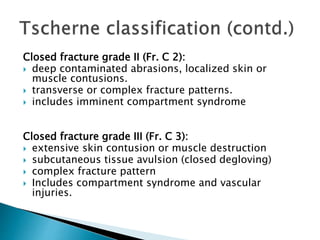
Closed fracture grade II (Fr. C 2):
 deep contaminated abrasions, localized skin or
muscle contusions.
 transverse or complex fracture patterns.
 includes imminent compartment syndrome
Closed fracture grade III (Fr. C 3):
 extensive skin contusion or muscle destruction
 subcutaneous tissue avulsion (closed degloving)
 complex fracture pattern
 Includes compartment syndrome and vascular
injuries.
Tscherne classification of open soft-tissue injuries:
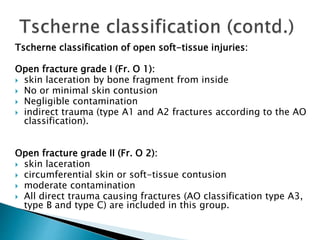
Open fracture grade I (Fr. O 1):
 skin laceration by bone fragment from inside
 No or minimal skin contusion
 Negligible contamination
 indirect trauma (type A1 and A2 fractures according to the AO
classification).
Open fracture grade II (Fr. O 2):
 skin laceration
 circumferential skin or soft-tissue contusion
 moderate contamination
 All direct trauma causing fractures (AO classification type A3,
type B and type C) are included in this group.
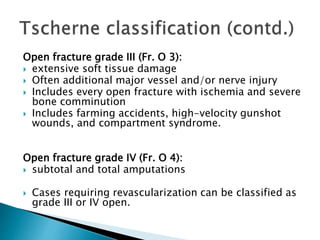
Open fracture grade III (Fr. O 3):
 extensive soft tissue damage
 Often additional major vessel and/or nerve injury
 Includes every open fracture with ischemia and severe
bone comminution
 Includes farming accidents, high-velocity gunshot
wounds, and compartment syndrome.
Open fracture grade IV (Fr. O 4):
 subtotal and total amputations
 Cases requiring revascularization can be classified as
grade III or IV open.
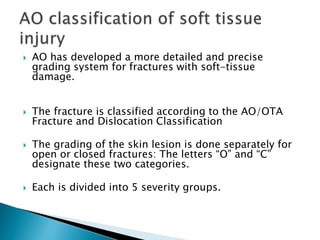
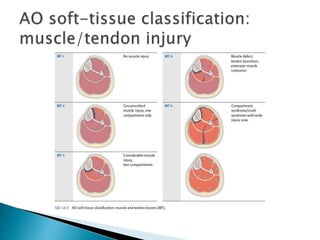
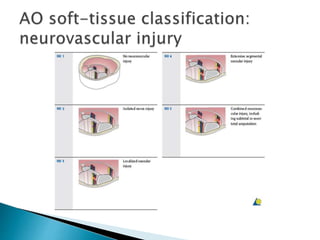
 AO has developed a more detailed and precise
grading system for fractures with soft-tissue
damage.
 The fracture is classified according to the AO/OTA
Fracture and Dislocation Classification
 The grading of the skin lesion is done separately for
open or closed fractures: The letters “O” and “C”
designate these two categories.
 Each is divided into 5 severity groups.
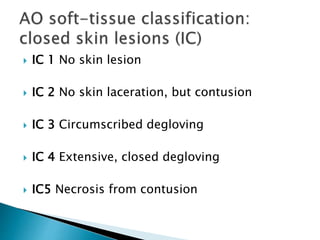
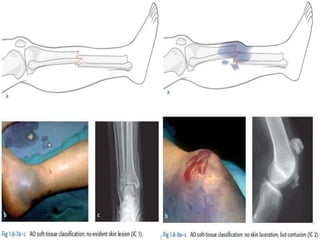
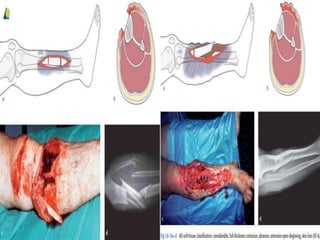
 IC 1 No skin lesion
 IC 2 No skin laceration, but contusion
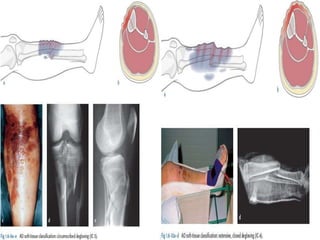
 IC 3 Circumscribed degloving
 IC 4 Extensive, closed degloving
 IC5 Necrosis from contusion
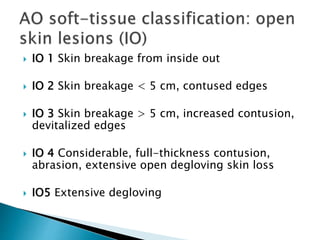
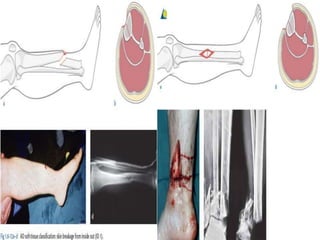
 IO 1 Skin breakage from inside out
 IO 2 Skin breakage < 5 cm, contused edges
 IO 3 Skin breakage > 5 cm, increased contusion,
devitalized edges
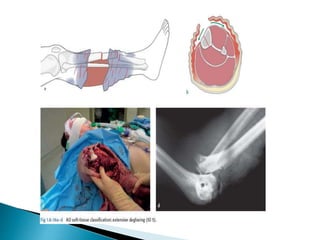
 IO 4 Considerable, full-thickness contusion,
abrasion, extensive open degloving skin loss
 IO5 Extensive degloving
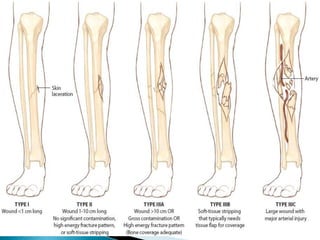
Gustilo classification of open fractures: Gustilo
and Anderson developed their classification
on the basis of a retrospective and
prospective analysis of 1,025 open fractures.
 Initially three types, but clinical application
led Gustilo, Mendoza, and Williams to extend
and subdivide the classification of the severe
(type III) injuries into subgroups A, B, and C.
Definition
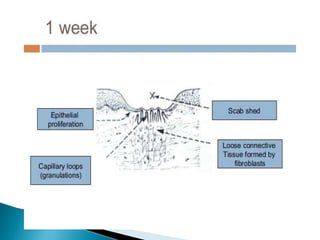
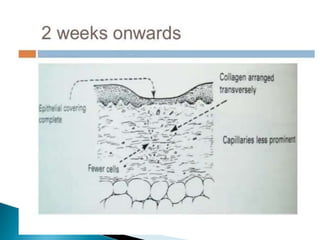
 The body's natural process of restoring normal
function and structure after injury
 complex series of events that begins at the
moment of injury and can continue for months to
years
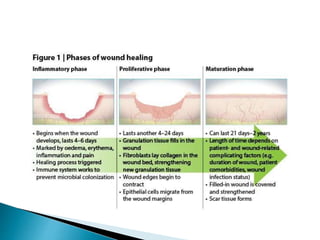
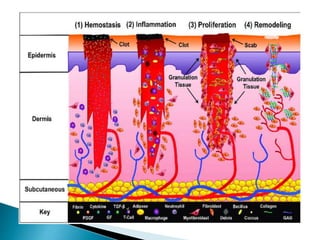
Phases of wound healing
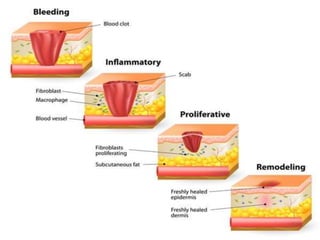
Three phases:-
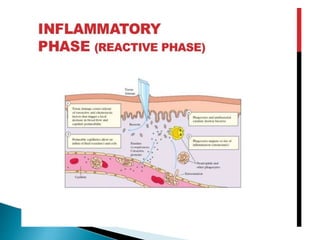
 Inflammatory or Exudative phase
 Proliferative phase
 Maturation and remodeling phase
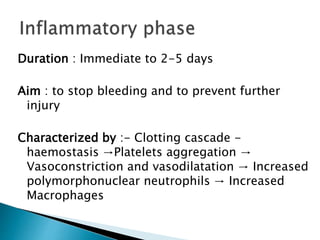
Duration : Immediate to 2-5 days
Aim : to stop bleeding and to prevent further
injury
Characterized by :- Clotting cascade -
haemostasis →Platelets aggregation →
Vasoconstriction and vasodilatation → Increased
polymorphonuclear neutrophils → Increased
Macrophages
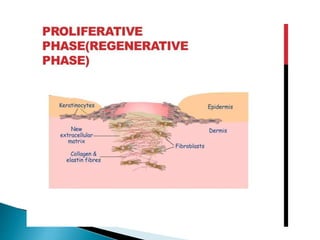
 After the inflammatory stage, the proliferative
stage lasts about 3 weeks (or longer, depending
on the severity of the wound)
 Aim: repair of wounded tissue
 Characterized by: Angiogenesis → Fibroplasia
and granulation tissue formation → Epithelization
→ Wound contraction
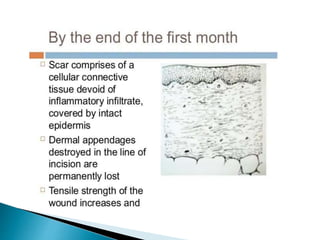
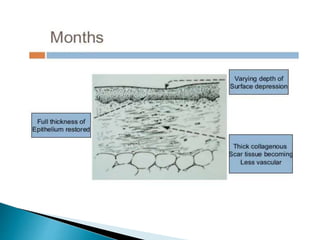
 It begins when the levels of collagen
production and degradation equalize
 can last for a year or longer.
 Healing by primary intention (Primary closure)
 Healing by secondary intention (Secondary
closure)
 Healing by tertiary intention (Delayed primary
closure)
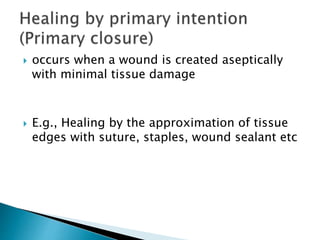
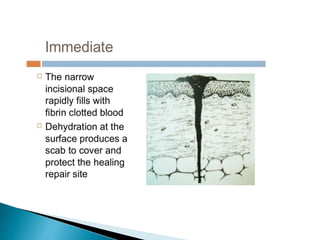
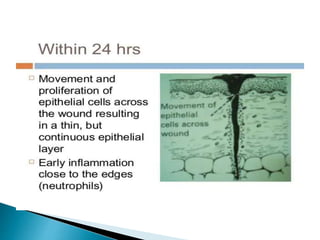
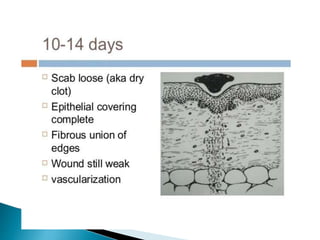
 occurs when a wound is created aseptically
with minimal tissue damage
 E.g., Healing by the approximation of tissue
edges with suture, staples, wound sealant etc
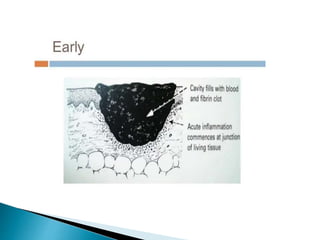
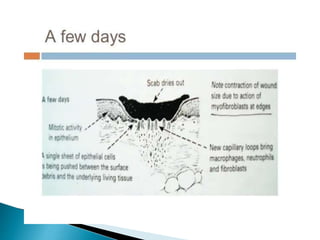
 Occurs in wounds that are already infected
and are usually left open and allowed to heal
by epithelialization and wound contraction
 May be caused by infection, excessive
trauma, tissue loss, or inability to re-
approximate the tissue
 It is a slow process
 Wounds that are heavily contaminated and
are likely to develop an infection if closed
primarily may be left open for 3-5 days
 This allows the wound to be cleaned and
allows the body’s natural defenses to
decrease bacterial count
 The wound can then be closed and allowed to
heal, producing a wound with characteristics
similar to primary closure
Local factors affecting wound healing
 Infection
 Necrotic tissue
 Movement
 Hematoma formation
 Venous or lymph stasis
 Tissue ischemia
 Presence of foreign body
 Exposure to radiation
 Site of wound :over bones and joints
 Underlying disease: osteomyelitis, malignancy
Systemic factors affecting wound healing
 Ageing, obesity
 Nutritional status
 Vitamin deficiency (vit C, vit A)
 Diseases states: ○ Uremia ○ Jaundice ○
Diabetes ○ Malignancy ○
Immunosuppression
 Smoking
 Drugs: ○ Steroids ○ anti-neoplastics ○
NSAIDs ○ bisphosphonates
 Careful evaluation of the injury by systematically
examining each structure that could be damaged: the skin,
subcutaneous tissue, muscle and tendons, nerves, vessels,
and bones.
 Possibility of compartment syndrome should always be
considered
 Closed injuries may be associated with as much soft-
tissue damage as open injuries.
 Careful evaluation to classify fracture using one grading
system such as AO system or Hanover fracture scale.
 Guide decision making, allow clear communication, and
give an indication of potential complications and outcome.
SOFT TISSUE INJURY [Recovered].pptx

SOFT TISSUE INJURY [Recovered].pptx

  • 1.
    PRESENTED BY DR.CH RAKESHSINGHA PGT ORTHOPAEDICS, SMCH
  • 2.
     “Soft tissue”is a broad term that includes - skin, subcutaneous tissue, fasciae, muscles, tendons, ligaments, neurovascular structures & other connective tissues.  It holds very pivotal & undisputed role in the overall orthopaedic management.
  • 3.
     Fractures withsoft-tissue injury considered as surgical emergencies.  It needs a sophisticated management protocol and an excellent grading system to achieve uncomplicated healing with complete restitution of function.
  • 4.
     Evaluation offracture must determine the extent of soft tissue injury, which will be a key factor in management.  This impinges upon the need of soft tissue injury classification.  A classification of the soft-tissue injury should consider all essential factors and guide treatment.
  • 5.
     It decreasescomplications by preventing avoidable treatment errors  For prognostic value of wounds  To monitor and compare standardized treatment protocols.
  • 7.
    Tscherne classification ofclosed fractures: In it, the fracture is labeled as open or closed by an “O” or a “C”. Closed fracture grade 0 (Fr. C 0):  no/minimal soft-tissue injury  simple fracture pattern  E.g., spiral fracture of the tibia Closed fracture grade I (Fr. C 1):  superficial abrasion or skin contusion  simple or medium severe fracture pattern.  E.g, pronation - fracture dislocation of the ankle joint: The soft- tissue damage occurs through fragment pressure at the medial malleolus.
  • 8.
    Closed fracture gradeII (Fr. C 2):  deep contaminated abrasions, localized skin or muscle contusions.  transverse or complex fracture patterns.  includes imminent compartment syndrome Closed fracture grade III (Fr. C 3):  extensive skin contusion or muscle destruction  subcutaneous tissue avulsion (closed degloving)  complex fracture pattern  Includes compartment syndrome and vascular injuries.
  • 10.
    Tscherne classification ofopen soft-tissue injuries: Open fracture grade I (Fr. O 1):  skin laceration by bone fragment from inside  No or minimal skin contusion  Negligible contamination  indirect trauma (type A1 and A2 fractures according to the AO classification). Open fracture grade II (Fr. O 2):  skin laceration  circumferential skin or soft-tissue contusion  moderate contamination  All direct trauma causing fractures (AO classification type A3, type B and type C) are included in this group.
  • 11.
    Open fracture gradeIII (Fr. O 3):  extensive soft tissue damage  Often additional major vessel and/or nerve injury  Includes every open fracture with ischemia and severe bone comminution  Includes farming accidents, high-velocity gunshot wounds, and compartment syndrome. Open fracture grade IV (Fr. O 4):  subtotal and total amputations  Cases requiring revascularization can be classified as grade III or IV open.
  • 12.
     AO hasdeveloped a more detailed and precise grading system for fractures with soft-tissue damage.  The fracture is classified according to the AO/OTA Fracture and Dislocation Classification  The grading of the skin lesion is done separately for open or closed fractures: The letters “O” and “C” designate these two categories.  Each is divided into 5 severity groups.
  • 13.
     IC 1No skin lesion  IC 2 No skin laceration, but contusion  IC 3 Circumscribed degloving  IC 4 Extensive, closed degloving  IC5 Necrosis from contusion
  • 16.
     IO 1Skin breakage from inside out  IO 2 Skin breakage < 5 cm, contused edges  IO 3 Skin breakage > 5 cm, increased contusion, devitalized edges  IO 4 Considerable, full-thickness contusion, abrasion, extensive open degloving skin loss  IO5 Extensive degloving
  • 22.
    Gustilo classification ofopen fractures: Gustilo and Anderson developed their classification on the basis of a retrospective and prospective analysis of 1,025 open fractures.  Initially three types, but clinical application led Gustilo, Mendoza, and Williams to extend and subdivide the classification of the severe (type III) injuries into subgroups A, B, and C.
  • 24.
    Definition  The body'snatural process of restoring normal function and structure after injury  complex series of events that begins at the moment of injury and can continue for months to years Phases of wound healing Three phases:-  Inflammatory or Exudative phase  Proliferative phase  Maturation and remodeling phase
  • 28.
    Duration : Immediateto 2-5 days Aim : to stop bleeding and to prevent further injury Characterized by :- Clotting cascade - haemostasis →Platelets aggregation → Vasoconstriction and vasodilatation → Increased polymorphonuclear neutrophils → Increased Macrophages
  • 30.
     After theinflammatory stage, the proliferative stage lasts about 3 weeks (or longer, depending on the severity of the wound)  Aim: repair of wounded tissue  Characterized by: Angiogenesis → Fibroplasia and granulation tissue formation → Epithelization → Wound contraction
  • 32.
     It beginswhen the levels of collagen production and degradation equalize  can last for a year or longer.
  • 33.
     Healing byprimary intention (Primary closure)  Healing by secondary intention (Secondary closure)  Healing by tertiary intention (Delayed primary closure)
  • 34.
     occurs whena wound is created aseptically with minimal tissue damage  E.g., Healing by the approximation of tissue edges with suture, staples, wound sealant etc
  • 39.
     Occurs inwounds that are already infected and are usually left open and allowed to heal by epithelialization and wound contraction  May be caused by infection, excessive trauma, tissue loss, or inability to re- approximate the tissue  It is a slow process
  • 45.
     Wounds thatare heavily contaminated and are likely to develop an infection if closed primarily may be left open for 3-5 days  This allows the wound to be cleaned and allows the body’s natural defenses to decrease bacterial count  The wound can then be closed and allowed to heal, producing a wound with characteristics similar to primary closure
  • 46.
    Local factors affectingwound healing  Infection  Necrotic tissue  Movement  Hematoma formation  Venous or lymph stasis  Tissue ischemia  Presence of foreign body  Exposure to radiation  Site of wound :over bones and joints  Underlying disease: osteomyelitis, malignancy
  • 47.
    Systemic factors affectingwound healing  Ageing, obesity  Nutritional status  Vitamin deficiency (vit C, vit A)  Diseases states: ○ Uremia ○ Jaundice ○ Diabetes ○ Malignancy ○ Immunosuppression  Smoking  Drugs: ○ Steroids ○ anti-neoplastics ○ NSAIDs ○ bisphosphonates
  • 48.
     Careful evaluationof the injury by systematically examining each structure that could be damaged: the skin, subcutaneous tissue, muscle and tendons, nerves, vessels, and bones.  Possibility of compartment syndrome should always be considered  Closed injuries may be associated with as much soft- tissue damage as open injuries.  Careful evaluation to classify fracture using one grading system such as AO system or Hanover fracture scale.  Guide decision making, allow clear communication, and give an indication of potential complications and outcome.