SBC322 Ecological and
Evolutionary Genomics
y.wurm@qmul.ac.uk
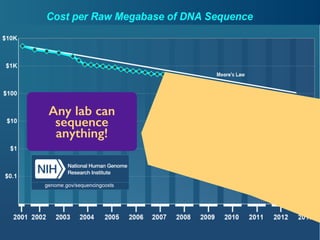
This changes
everything.454
Illumina
Solid...
Any lab can
sequence
anything!
How does this change affect us
regarding ecology & evolution
research?
(1/2) Merging of molecular and
eco/evo approaches
• identifying genes & mechanisms underlying:
• phenotypes (behaviors, morphologies, physiologies…)
• constraints
• responses to changing environments
• …
(2/2) Novel approaches for
• relationships between species
• relationships within species
• species distributions
• life histories
• biodiversity assessments
• evolutionary histories
Very challenging.exciting.
Aims (1/2)
To understand and critically evaluate:
• research questions
• methods
• experimental designs
• applications
in ecological and evolutionary genomics.
Aims (2/2)
Improving skills:
•critically reading scientific literature
•understanding interdisciplinary science
•oral scientific communication (formal & informal)
•written scientific communication (blog & exam)
Understanding:
•the peer review process for scientific publication
Science-driven.
Interactive
• Small groups - informal presentations
• Formal presentations in pairs
• Blog posts
• Peer review
ok?
Yannick Wurm
YW
Christophe Eizaguirre
CE
Main themes
1. Methods
2. Social evolution
3. Conservation
4. Genome dynamics
5. Speciation
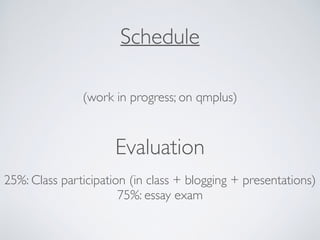
Schedule
(work in progress; on qmplus)
Evaluation
25%: Class participation (in class + blogging + presentations)
75%: essay exam
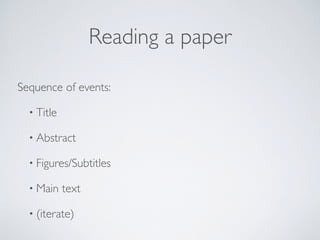
Reading a paper
Reading a paper
Sequence of events:
• Title
• Abstract
• Figures/Subtitles
• Main text
• (iterate)
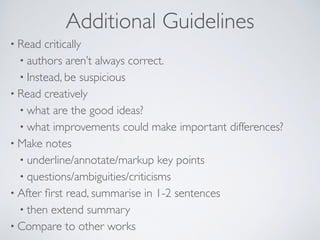
Additional Guidelines
• Read critically
• authors aren’t always correct.
• Instead, be suspicious
• Read creatively
• what are the good ideas?
• what improvements could make important differences?
• Make notes
• underline/annotate/markup key points
• questions/ambiguities/criticisms
• After first read, summarise in 1-2 sentences
• then extend summary
• Compare to other works
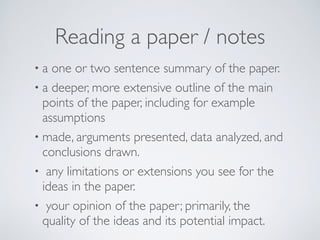
• a one or two sentence summary of the paper.
• a deeper, more extensive outline of the main
points of the paper, including for example
assumptions
• made, arguments presented, data analyzed, and
conclusions drawn.
• any limitations or extensions you see for the
ideas in the paper.
• your opinion of the paper; primarily, the
quality of the ideas and its potential impact.
Reading a paper / notes
Sbc322 intro.key

Sbc322 intro.key

  • 1.
    SBC322 Ecological and EvolutionaryGenomics y.wurm@qmul.ac.uk
  • 3.
  • 4.
    How does thischange affect us regarding ecology & evolution research?
  • 5.
    (1/2) Merging ofmolecular and eco/evo approaches • identifying genes & mechanisms underlying: • phenotypes (behaviors, morphologies, physiologies…) • constraints • responses to changing environments • …
  • 6.
    (2/2) Novel approachesfor • relationships between species • relationships within species • species distributions • life histories • biodiversity assessments • evolutionary histories
  • 7.
  • 8.
    Aims (1/2) To understandand critically evaluate: • research questions • methods • experimental designs • applications in ecological and evolutionary genomics.
  • 9.
    Aims (2/2) Improving skills: •criticallyreading scientific literature •understanding interdisciplinary science •oral scientific communication (formal & informal) •written scientific communication (blog & exam) Understanding: •the peer review process for scientific publication
  • 10.
  • 11.
    Interactive • Small groups- informal presentations • Formal presentations in pairs • Blog posts • Peer review
  • 12.
  • 13.
  • 14.
    Main themes 1. Methods 2.Social evolution 3. Conservation 4. Genome dynamics 5. Speciation
  • 16.
    Schedule (work in progress;on qmplus) Evaluation 25%: Class participation (in class + blogging + presentations) 75%: essay exam
  • 17.
  • 18.
    Reading a paper Sequenceof events: • Title • Abstract • Figures/Subtitles • Main text • (iterate)
  • 19.
    Additional Guidelines • Readcritically • authors aren’t always correct. • Instead, be suspicious • Read creatively • what are the good ideas? • what improvements could make important differences? • Make notes • underline/annotate/markup key points • questions/ambiguities/criticisms • After first read, summarise in 1-2 sentences • then extend summary • Compare to other works
  • 20.
    • a oneor two sentence summary of the paper. • a deeper, more extensive outline of the main points of the paper, including for example assumptions • made, arguments presented, data analyzed, and conclusions drawn. • any limitations or extensions you see for the ideas in the paper. • your opinion of the paper; primarily, the quality of the ideas and its potential impact. Reading a paper / notes