BUILDING COMMISSIONING:
The Value of Commissioning
CaGBC Building Advisor Program
John Kokko, P.Eng., CCP, LEED AP Doron Weiss, P. Eng. M. Sc

kokkoJ@mmm.ca weissd@mmm.ca
519-743-8777 x2424 905-882-4211 x 3026
LEARNING OBJECTIVES
 What is building
commissioning
 What are the steps required by
LEED
 Why is it important
 What results can we expect
NEW BUILDING CX
LEED Credits
EAp1 – Fundamental Cx (Prerequisite)
 Deals mainly with construction and getting the building operating before
hand-over
EAc3 - Enhanced Cx (Credit)
 Deals with design and post occupancy operation
WHAT IS NEW BUILD COMMISSIONING
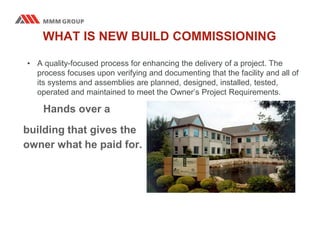
• A quality-focused process for enhancing the delivery of a project. The
process focuses upon verifying and documenting that the facility and all of
its systems and assemblies are planned, designed, installed, tested,
operated and maintained to meet the Owner’s Project Requirements.
Hands over a
building that gives the
owner what he paid for.
EPPUR SI MUOVE - And yet it moves
Despite its 30-year history in the United States, and
hundreds of millions of square feet of floor area
commissioned, most mainstream industry professionals
would be hard-pressed to define building
commissioning. A vanishingly small fraction of
building owners/managers know what it is. Even
efforts to explain it can leave many listener mystified.
.
NAME FROM SHIP BUILDING
 A commissioned ship is one deemed ready for service.
 Must pass several milestones.
 Equipment is installed and tested, problems are identified and
corrected, and staff are extensively trained.
 A commissioned ship is one whose materials, systems, and staff have
successfully completed a thorough quality assurance process.
 Commissioned ship is one ready to sail safely and reliably
VISION OF COMMISSIONING
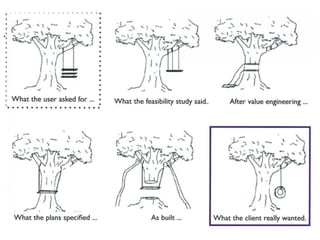
Take the owner’s needs and wants
► Ensure requirements properly articulated
Through the minds of the consultants
► Ensure designs properly reflect OPR
Through the hands of suppliers and contractors
► Ensure building is properly built
Deliver a properly performing building
► Ensure all systems operate as intended
Expectations
Owner
Is receiving the best project that money spent can buy
Complete the project on time and on budget
Consultant
Construction documents are comprehensible and easy to build
Contractor
Complete the project efficiently and with no call-backs
Commissioning Authority
To get the support and cooperation needed from all stakeholders
for a successful project
O&M Personnel
To get the training and documentation needed to easily and
effectively operate and maintain the building
WHY IS COMMISSIONING NEEDED
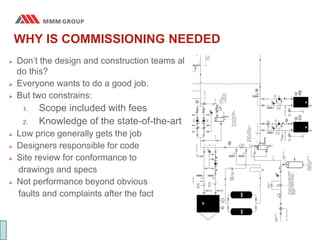
 Don’t the design and construction teams already
do this?
 Everyone wants to do a good job.
 But two constrains:
1. Scope included with fees
2. Knowledge of the state-of-the-art
 Low price generally gets the job
 Designers responsible for code
 Site review for conformance to
drawings and specs
 Not performance beyond obvious
faults and complaints after the fact
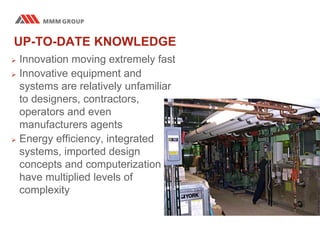
UP-TO-DATE KNOWLEDGE
 Innovation moving extremely fast
 Innovative equipment and
systems are relatively unfamiliar
to designers, contractors,
operators and even
manufacturers agents
 Energy efficiency, integrated
systems, imported design
concepts and computerization
have multiplied levels of
complexity
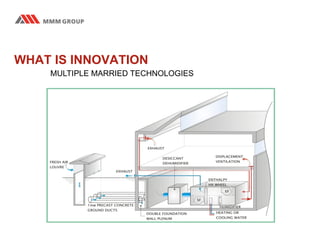
WHAT IS INNOVATION
MULTIPLE MARRIED TECHNOLOGIES
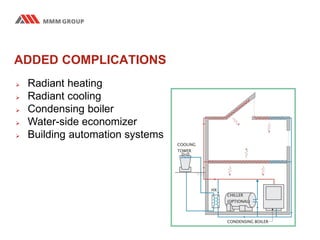
ADDED COMPLICATIONS
 Radiant heating
 Radiant cooling
 Condensing boiler
 Water-side economizer
 Building automation systems
INNOVATION INCREASING EXPONENTIALLY
Direct and indirect evaporative cooling
Optimum start
Cascading PID loops
Stratified thermal storage
Day lighting control
Integration
And on and on and on ….
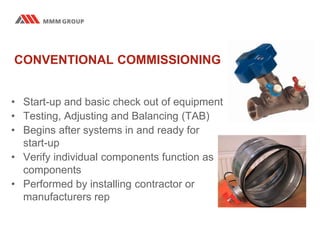
CONVENTIONAL COMMISSIONING
• Start-up and basic check out of equipment
• Testing, Adjusting and Balancing (TAB)
• Begins after systems in and ready for
start-up
• Verify individual components function as
components
• Performed by installing contractor or
manufacturers rep
TOTAL COMMISSIONING (LEED™)
A systematic quality assurance program
Starts at concept design and concludes at end of
warranty
Includes all phases concept design, detailed design,
construction, start-up, 1 year operation
Commissioning verifies energy performance and
comfort maintenance
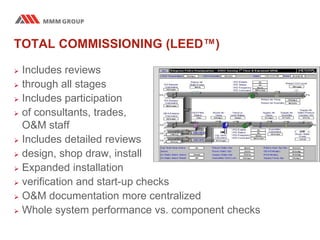
TOTAL COMMISSIONING (LEED™)
 Includes reviews
 through all stages
 Includes participation
 of consultants, trades,
O&M staff
 Includes detailed reviews
 design, shop draw, install
 Expanded installation
 verification and start-up checks
 O&M documentation more centralized
 Whole system performance vs. component checks
VALUE OF Cx
 Largest study to date
 Evan Mills, Ph.D LBNL July 2009
 http://cx.lbl.gov/2009-assessment.html
 643 buildings, 26 US states
 561 existing and 82 new buildings
 37 Cx firms
 99 M ft2, $2.2 B construct
 90.4 M ft2 existing, 8.8 M ft2 new construction
 $43 M Cx costs
Lawrence Berkeley National Laboratory
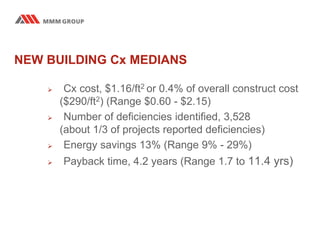
NEW BUILDING Cx MEDIANS
 Cx cost, $1.16/ft2 or 0.4% of overall construct cost
($290/ft2) (Range $0.60 - $2.15)
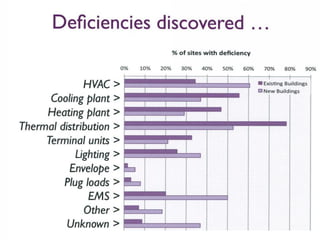
 Number of deficiencies identified, 3,528
(about 1/3 of projects reported deficiencies)
 Energy savings 13% (Range 9% - 29%)
 Payback time, 4.2 years (Range 1.7 to 11.4 yrs)
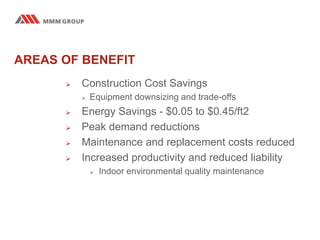
AREAS OF BENEFIT
 Construction Cost Savings
 Equipment downsizing and trade-offs
 Energy Savings - $0.05 to $0.45/ft2
 Peak demand reductions
 Maintenance and replacement costs reduced
 Increased productivity and reduced liability
 Indoor environmental quality maintenance
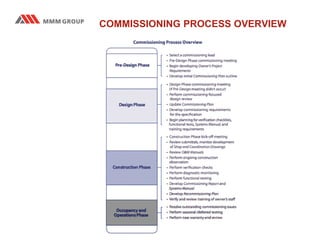
COMMISSIONING PROCESS OVERVIEW
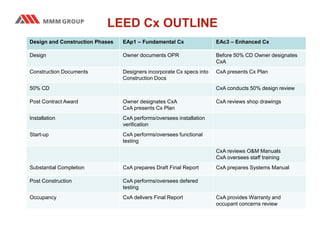
LEED Cx OUTLINE
Design and Construction Phases EAp1 – Fundamental Cx EAc3 – Enhanced Cx
Design Owner documents OPR Before 50% CD Owner designates
CxA
Construction Documents Designers incorporate Cx specs into
Construction Docs
CxA presents Cx Plan
50% CD CxA conducts 50% design review
Post Contract Award Owner designates CxA
CxA presents Cx Plan
CxA reviews shop drawings
Installation CxA performs/oversees installation
verification
Start-up CxA performs/oversees functional
testing
CxA reviews O&M Manuals
CxA oversees staff training
Substantial Completion CxA prepares Draft Final Report CxA prepares Systems Manual
Post Construction CxA performs/oversees defered
testing
Occupancy CxA delivers Final Report CxA provides Warranty and
occupant concerns review
OWNER & DESIGN TEAM DOCUMENTATION
Owners Project Requirements (OPR)
► Owner and User requirements
► Environmental sustainability goals
► Energy efficiency goals
► Indoor environmental quality requirements
► Equipment and systems expectations
► Building occupant & O&M personnel requirements
Basis of Design (BoD)
► Primary design assumptions
► Standards
► Narrative descriptions
Cx DURING DESIGN
 Work with design team to define measurable energy and
indoor environmental quality goals
 Discuss alternatives to traditional design solutions
 Provide support for unfamiliar technologies
 Review to verify design meets objectives and technologies
properly implemented
 Review to verify equipment specified meets goals and
objectives
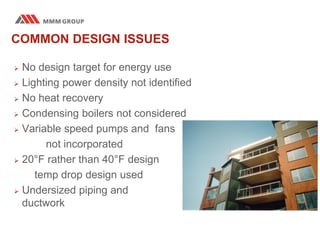
COMMON DESIGN ISSUES
 No design target for energy use
 Lighting power density not identified
 No heat recovery
 Condensing boilers not considered
 Variable speed pumps and fans
not incorporated
 20°F rather than 40°F design
temp drop design used
 Undersized piping and
ductwork
Cx PLAN
 Overview of Cx Process
 List of equipment and systems to be Cx
 Cx Team and responsibilities
 Management, Communication and Reporting Overview
 Cx Process Overview (Outline above)
 List of deliverables
 Milestones
Cx MEMBERS & RESPONSIBILITIES
COMMISSIONING AGENT
 Owner’s rep leading commissioning
 Reviews and produces most paperwork
 Directs testing
 Ensures LEED™ requirements are met
OWNER
 Provide support as required to ensure Cx
proceeds smoothly
 FM Staff?
Consultants
 Provide documentation as required for review
 Attend commissioning meetings as required
GENERAL CONTRACTOR
► Ensures contractors meet commissioning
requirements
M&E CONTRACTORS
► Completes start-up, installation verification lists
► Operates equipment for Performance Testing
► Produces O&M manuals, Provides owner training
CONTROLS CONTRACTOR
► Operate controls for Performance Testing, produce
O&M materials for controls
Cx MEMBERS & RESPONSIBILITIES
Cx SPECIFICATIONS
 Contractor responsibilities
 Submittal review process
 Meetings
 IVC process
 Start-up process
 Balancing reviews
 FPT process
 O&M manuals requirements
 Training requirements
 Warranty review
Cx DURING CONSTRUCTION
 Verify equipment installed per drawings and
specs, manuf’rs requirements and proper
industry practice and standards
 Verify equipment is, set-up, adjusted,
balanced, controlled and operated to provide
expected comfort and energy performance
 Provide owner complete systems O&M docs
 Provide owner’s operating personnel
adequate training to understand, operate and
maintain equipment
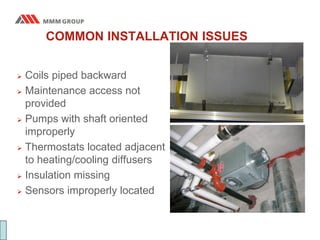
COMMON INSTALLATION ISSUES
 Coils piped backward
 Maintenance access not
provided
 Pumps with shaft oriented
improperly
 Thermostats located adjacent
to heating/cooling diffusers
 Insulation missing
 Sensors improperly located
COMMON FUNCTIONAL TESTING ISSUES
 Controls functions not
matching sequence
 VFDs do not modulate
 Outdoor damper minimum
position
 Control valve action reversed
TRAINING TOPICS
 General purpose of system
 Use of O&M manuals
 Operation of systems under all conditions
 Interaction with other systems
 Adjustments and optimization for efficiency
 Health and safety
 Special maintenance and replacement resources
 Occupant interaction
 Controls training
SYSTEMS MANUAL
 Final BoD
 System single line diagrams
 As-Built sequences, set-points, etc.
 System operating instructions
 Maintenance schedule
 Retesting schedule
Cx AFTER OCCUPANCY
 Follow trends on BAS to ensure ongoing operation
 Completion of deficiencies remaining after
construction
 Follow-up on warranty issues arising
 Follow up on occupant concerns during warranty
and first year occupancy
 Verify that issues are cleaned up by the end of
warranty
FINAL REPORT
 OPR
 Design and shops review summary
 Cx specifications
 IVC results
 FPT results
 O&M evaluation
 Value achieved through Cx
 Outstanding issues
MMM Group Limited
100 Commerce Valley Drive West
Thornhill, ON Canada L3T 0A1
t: 905.882.1100 | f: 905.882.0055
e: mmm@mmm.ca

Sbai value of commissioning

  • 1.
    BUILDING COMMISSIONING: The Valueof Commissioning CaGBC Building Advisor Program John Kokko, P.Eng., CCP, LEED AP Doron Weiss, P. Eng. M. Sc kokkoJ@mmm.ca weissd@mmm.ca 519-743-8777 x2424 905-882-4211 x 3026
  • 2.
    LEARNING OBJECTIVES  Whatis building commissioning  What are the steps required by LEED  Why is it important  What results can we expect
  • 3.
    NEW BUILDING CX LEEDCredits EAp1 – Fundamental Cx (Prerequisite)  Deals mainly with construction and getting the building operating before hand-over EAc3 - Enhanced Cx (Credit)  Deals with design and post occupancy operation
  • 4.
    WHAT IS NEWBUILD COMMISSIONING • A quality-focused process for enhancing the delivery of a project. The process focuses upon verifying and documenting that the facility and all of its systems and assemblies are planned, designed, installed, tested, operated and maintained to meet the Owner’s Project Requirements. Hands over a building that gives the owner what he paid for.
  • 5.
    EPPUR SI MUOVE- And yet it moves Despite its 30-year history in the United States, and hundreds of millions of square feet of floor area commissioned, most mainstream industry professionals would be hard-pressed to define building commissioning. A vanishingly small fraction of building owners/managers know what it is. Even efforts to explain it can leave many listener mystified.
  • 6.
  • 9.
    NAME FROM SHIPBUILDING  A commissioned ship is one deemed ready for service.  Must pass several milestones.  Equipment is installed and tested, problems are identified and corrected, and staff are extensively trained.  A commissioned ship is one whose materials, systems, and staff have successfully completed a thorough quality assurance process.  Commissioned ship is one ready to sail safely and reliably
  • 10.
    VISION OF COMMISSIONING Takethe owner’s needs and wants ► Ensure requirements properly articulated Through the minds of the consultants ► Ensure designs properly reflect OPR Through the hands of suppliers and contractors ► Ensure building is properly built Deliver a properly performing building ► Ensure all systems operate as intended
  • 11.
    Expectations Owner Is receiving thebest project that money spent can buy Complete the project on time and on budget Consultant Construction documents are comprehensible and easy to build Contractor Complete the project efficiently and with no call-backs Commissioning Authority To get the support and cooperation needed from all stakeholders for a successful project O&M Personnel To get the training and documentation needed to easily and effectively operate and maintain the building
  • 12.
    WHY IS COMMISSIONINGNEEDED  Don’t the design and construction teams already do this?  Everyone wants to do a good job.  But two constrains: 1. Scope included with fees 2. Knowledge of the state-of-the-art  Low price generally gets the job  Designers responsible for code  Site review for conformance to drawings and specs  Not performance beyond obvious faults and complaints after the fact
  • 13.
    UP-TO-DATE KNOWLEDGE  Innovationmoving extremely fast  Innovative equipment and systems are relatively unfamiliar to designers, contractors, operators and even manufacturers agents  Energy efficiency, integrated systems, imported design concepts and computerization have multiplied levels of complexity
  • 14.
    WHAT IS INNOVATION MULTIPLEMARRIED TECHNOLOGIES
  • 15.
    ADDED COMPLICATIONS  Radiantheating  Radiant cooling  Condensing boiler  Water-side economizer  Building automation systems
  • 16.
    INNOVATION INCREASING EXPONENTIALLY Directand indirect evaporative cooling Optimum start Cascading PID loops Stratified thermal storage Day lighting control Integration And on and on and on ….
  • 17.
    CONVENTIONAL COMMISSIONING • Start-upand basic check out of equipment • Testing, Adjusting and Balancing (TAB) • Begins after systems in and ready for start-up • Verify individual components function as components • Performed by installing contractor or manufacturers rep
  • 18.
    TOTAL COMMISSIONING (LEED™) Asystematic quality assurance program Starts at concept design and concludes at end of warranty Includes all phases concept design, detailed design, construction, start-up, 1 year operation Commissioning verifies energy performance and comfort maintenance
  • 19.
    TOTAL COMMISSIONING (LEED™) Includes reviews  through all stages  Includes participation  of consultants, trades, O&M staff  Includes detailed reviews  design, shop draw, install  Expanded installation  verification and start-up checks  O&M documentation more centralized  Whole system performance vs. component checks
  • 20.
    VALUE OF Cx Largest study to date  Evan Mills, Ph.D LBNL July 2009  http://cx.lbl.gov/2009-assessment.html  643 buildings, 26 US states  561 existing and 82 new buildings  37 Cx firms  99 M ft2, $2.2 B construct  90.4 M ft2 existing, 8.8 M ft2 new construction  $43 M Cx costs Lawrence Berkeley National Laboratory
  • 21.
    NEW BUILDING CxMEDIANS  Cx cost, $1.16/ft2 or 0.4% of overall construct cost ($290/ft2) (Range $0.60 - $2.15)  Number of deficiencies identified, 3,528 (about 1/3 of projects reported deficiencies)  Energy savings 13% (Range 9% - 29%)  Payback time, 4.2 years (Range 1.7 to 11.4 yrs)
  • 22.
    AREAS OF BENEFIT Construction Cost Savings  Equipment downsizing and trade-offs  Energy Savings - $0.05 to $0.45/ft2  Peak demand reductions  Maintenance and replacement costs reduced  Increased productivity and reduced liability  Indoor environmental quality maintenance
  • 23.
  • 24.
    LEED Cx OUTLINE Designand Construction Phases EAp1 – Fundamental Cx EAc3 – Enhanced Cx Design Owner documents OPR Before 50% CD Owner designates CxA Construction Documents Designers incorporate Cx specs into Construction Docs CxA presents Cx Plan 50% CD CxA conducts 50% design review Post Contract Award Owner designates CxA CxA presents Cx Plan CxA reviews shop drawings Installation CxA performs/oversees installation verification Start-up CxA performs/oversees functional testing CxA reviews O&M Manuals CxA oversees staff training Substantial Completion CxA prepares Draft Final Report CxA prepares Systems Manual Post Construction CxA performs/oversees defered testing Occupancy CxA delivers Final Report CxA provides Warranty and occupant concerns review
  • 25.
    OWNER & DESIGNTEAM DOCUMENTATION Owners Project Requirements (OPR) ► Owner and User requirements ► Environmental sustainability goals ► Energy efficiency goals ► Indoor environmental quality requirements ► Equipment and systems expectations ► Building occupant & O&M personnel requirements Basis of Design (BoD) ► Primary design assumptions ► Standards ► Narrative descriptions
  • 26.
    Cx DURING DESIGN Work with design team to define measurable energy and indoor environmental quality goals  Discuss alternatives to traditional design solutions  Provide support for unfamiliar technologies  Review to verify design meets objectives and technologies properly implemented  Review to verify equipment specified meets goals and objectives
  • 27.
    COMMON DESIGN ISSUES No design target for energy use  Lighting power density not identified  No heat recovery  Condensing boilers not considered  Variable speed pumps and fans not incorporated  20°F rather than 40°F design temp drop design used  Undersized piping and ductwork
  • 28.
    Cx PLAN  Overviewof Cx Process  List of equipment and systems to be Cx  Cx Team and responsibilities  Management, Communication and Reporting Overview  Cx Process Overview (Outline above)  List of deliverables  Milestones
  • 29.
    Cx MEMBERS &RESPONSIBILITIES COMMISSIONING AGENT  Owner’s rep leading commissioning  Reviews and produces most paperwork  Directs testing  Ensures LEED™ requirements are met OWNER  Provide support as required to ensure Cx proceeds smoothly  FM Staff? Consultants  Provide documentation as required for review  Attend commissioning meetings as required
  • 30.
    GENERAL CONTRACTOR ► Ensurescontractors meet commissioning requirements M&E CONTRACTORS ► Completes start-up, installation verification lists ► Operates equipment for Performance Testing ► Produces O&M manuals, Provides owner training CONTROLS CONTRACTOR ► Operate controls for Performance Testing, produce O&M materials for controls Cx MEMBERS & RESPONSIBILITIES
  • 31.
    Cx SPECIFICATIONS  Contractorresponsibilities  Submittal review process  Meetings  IVC process  Start-up process  Balancing reviews  FPT process  O&M manuals requirements  Training requirements  Warranty review
  • 32.
    Cx DURING CONSTRUCTION Verify equipment installed per drawings and specs, manuf’rs requirements and proper industry practice and standards  Verify equipment is, set-up, adjusted, balanced, controlled and operated to provide expected comfort and energy performance  Provide owner complete systems O&M docs  Provide owner’s operating personnel adequate training to understand, operate and maintain equipment
  • 33.
    COMMON INSTALLATION ISSUES Coils piped backward  Maintenance access not provided  Pumps with shaft oriented improperly  Thermostats located adjacent to heating/cooling diffusers  Insulation missing  Sensors improperly located
  • 34.
    COMMON FUNCTIONAL TESTINGISSUES  Controls functions not matching sequence  VFDs do not modulate  Outdoor damper minimum position  Control valve action reversed
  • 35.
    TRAINING TOPICS  Generalpurpose of system  Use of O&M manuals  Operation of systems under all conditions  Interaction with other systems  Adjustments and optimization for efficiency  Health and safety  Special maintenance and replacement resources  Occupant interaction  Controls training
  • 36.
    SYSTEMS MANUAL  FinalBoD  System single line diagrams  As-Built sequences, set-points, etc.  System operating instructions  Maintenance schedule  Retesting schedule
  • 37.
    Cx AFTER OCCUPANCY Follow trends on BAS to ensure ongoing operation  Completion of deficiencies remaining after construction  Follow-up on warranty issues arising  Follow up on occupant concerns during warranty and first year occupancy  Verify that issues are cleaned up by the end of warranty
  • 38.
    FINAL REPORT  OPR Design and shops review summary  Cx specifications  IVC results  FPT results  O&M evaluation  Value achieved through Cx  Outstanding issues
  • 39.
    MMM Group Limited 100Commerce Valley Drive West Thornhill, ON Canada L3T 0A1 t: 905.882.1100 | f: 905.882.0055 e: mmm@mmm.ca