LEED TM  Commissioning Presented by  Phil Welker Portland Energy Conservation Inc.
Technology Must be Properly Applied to Provide Benefit  -  06/03/09
Why Commission? Owners do not typically receive fully functional building systems Owners face increasing numbers of performance problems Buildings have more complex life safety, security, communication, and comfort control systems Building systems are becoming increasingly specialized and integrated
Why Commission? Multiple trades and contracts are involved Increasing costs (change orders, call backs) Emphasis on cost cutting, low bid and first cost focus (fast tracking) Conflicting loyalties and objectives Design fees do not reflect reality
1994 Study of 60 Commercial Buildings  More than half suffered from control problems 40% had problems with HVAC equipment one-third had HVAC sensors that were not operating properly 15% were missing specified equipment 1/4 had energy management systems, economizers, or variable speed drives that did not run properly
So, What is Commissioning? Commissioning is a quality assurance strategy.  It is a  systematic process   that extends through all phases of  a construction, renovation, or retrofit project  from concept through occupancy  According to ASHRAE Guideline 1-1996, commissioning is  the process of ensuring that systems are designed, installed, functionally tested, and capable of being operated and maintained to perform in conformity with the design intent.
Commissioning at its Highest Level is a systematic process of ensuring, through documented verification, that all building systems perform interactively according to the documented design intent and the owner’s operational needs
LEED TM  Intent Verify and ensure that fundamental building elements  and systems are designed, installed, and calibrated to operate as intended Ensure that design intent is achieved Ensure persistence of the design intent  -  06/03/09
Cx is  NOT  Standard Process Goes beyond normal practice Design intent & basis of design documentation Selected design reviews Comprehensive QA/QC requirements in specs Strategic site visits Prefunctional checks at or near start-up Functional performance testing (interactive) Team effort--cooperation, not blame Comprehensive documentation Enhanced O&M manuals and training Catches problems early (at least cost)
Typical Findings New EMS’s have improper or incomplete programming  Equipment and lighting schedules are not optimized New equipment functions poorly or not at all Equipment and instrumentation are not marked
Findings Cont. Air flow problems result in too much or too little ventilation Building documentation is big on volume, small on content Components and equipment are missing or incorrectly installed
Without Commissioning: Design documentation  may be poor Some  installed systems won’t work  properly Some specified equipment or features  won’t be installed at all Documentation  on some important equipment  will be erroneous , missing, incomplete or unclear Training will be less  organized, not done as well, and some not done at all
Commissioning Results in: Improved designs Smoother turnover (fewer  call backs) Tenant satisfaction (productivity) Lower utility bills Avoided O&M costs Increased equipment reliability Improved profit margin for owners  $$$
Prerequisite LEED TM  Cx Requirements Engage a commissioning agent Develop design intent and the basis of design documentation  Incorporate clear and complete commissioning requirements in the construction specifications or with an explicit change order Develop and use a commissioning plan Verify that the installation, functional performance, training, and documentation meet the goals of the project  Complete a final commissioning report
Additional Cx Point Requirements Conduct a focused design review prior to development of construction documents by a qualified third party other than a member of design team  Conduct a construction document review when close to completion by a qualified party other than the design team Conduct a selective review of contractor submittals of the commissioned equipment   Develop a recommissioning management manual Have a contract in place for a near-warranty end or post occupancy review
Design Phase Commissioning Erasing lines and changing words are generally easier than: Modifying machinery Re-configuring welded assemblies Re-routing sheet metal Cutting concrete This may require spending a little more time in design  -  06/03/09
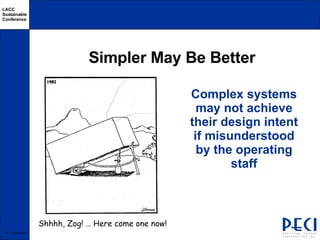
Simpler May Be Better Complex systems may not achieve their design intent if misunderstood by the operating staff  -  06/03/09 Shhhh, Zog! … Here come one now!
LEED TM  Points with Strong Commissioning Interrelationships Envelope Measurement and Verification Indoor Air Quality Credits that depend on machinery for success Storm water and waste water reclaim/reuse On site green power  -  06/03/09
Non- LEED TM  Issues  that Need Commissioning Input Electrical Systems Fire Alarm  and Life Safety Systems Lighting Control Systems Emergency Power Systems Plumbing Systems  -  06/03/09
Commissioning vs. LEED TM  Coordination The commissioning agent is not necessarily the LEED Coordinator Many LEED credits are achieved via: Passive building elements Materials selection Documentation of process  -  06/03/09
What Does This All Cost? General rules: Design Phase .1-.3% of the total construction cost Construction Phase HVAC and controls - 2.0% to 3.0% of total mechanical cost Electrical system - 1.0% to 2.0% of total electrical cost HVAC, controls and electrical - 0.5% to 1.5% of total construction cost  -  06/03/09  -  06/03/09
Rule Breakers Duration of construction Project meeting requirements Site inspection and testing requirements System complexity Commissioning Agent vs. LEED Coordinator Issues  -  06/03/09  -  06/03/09
Estimates of Const. Phase Commissioning Costs  (Costs for Commissioning Authority, New Construction, per sf)  $0.00 $0.50 $1.00 $1.50 $2.00 $2.50 $3.00 0 50 100 150 200 250 300 350 400 450 500 550 600 Floor Area ('000's sf) Commissioning Cost ($/sf) Simple Moderate Complex Specialty
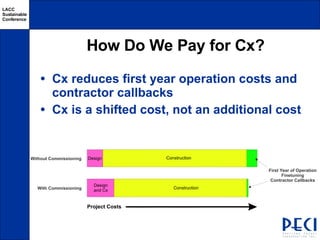
How Do We Pay for Cx? Cx reduces first year operation costs and contractor callbacks Cx is a shifted cost, not an additional cost
Creative Handling of Costs Use in-house staff for review Use operations staff for construction observation Involve the operations staff with the systems manual development Budget for post occupancy items out of operating funds  -  06/03/09
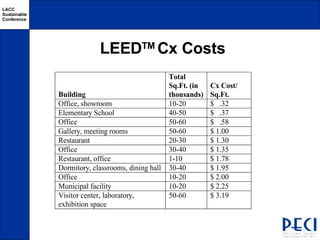
LEED TM  Cx Costs Currently ½ of the registered projects are under 60,000 Ft. 2  Perception that for smaller LEED TM  projects, the commissioning process is expensive-is it?
LEED TM  Cx Costs
LEED TM  Cx Costs-What Could be Driving Them Higher? Prerequisite and or Additional Point requirements that may not be part of a non-LEED Cx process: Development of new documentation formats for LEED TM   submittals Recommissioning manual End of warranty review etc Complexity of LEED TM  projects – New technologies, Design intent documentation, design reviews, Cx specifications, development of component and system functional tests, etc
LEED TM  Cx Costs-What Could be Driving Them Higher? -Cont. Timeframe for beginning Cx - delays in starting process LEED TM  team members may have never been involved with a Cx process  Cx Responsibilities - Independent Third Party, Owner, Designer, Contractor LEED TM  coordination and point interpretation
LEED TM  Cx Costs Reduction Strategies Clearly define LEED TM   goals/points as early as possible Understand the abilities of your LEED team members that don’t have commissioning experience and whether they capable of delivering a high quality commissioning process for the complexities of your project Understand the value an experienced Cx provider could bring to your project – outside perspective, operational expertise, system integration
LEED TM  Cx Costs Reduction Strategies - Cont. Define the scope of commissioning  and then develop clear solicitations for Cx services if looking to hire a commissioning provider On simple projects consider which Cx tasks an experienced and trusted member of the owner’s/designer’s/ or contractor’s team could undertake-yet acknowledge and plan for conflict of interest
LEED TM  Cx Costs Reduction Strategies - Cont. Start planning Cx early in the project-even if the the Cx “extra” point requirements are not being sought-change orders are expensive  Ensure adequate budget for an appropriate commissioning process
The Future of LEED TM  and Commissioning Continual education about the value of a high quality commissioning process Case studies on process and documentation examples will help those who are new to Cx Proper planning, execution, and documentation of the LEED TM  requirements will improve process and reduce costs on subsequent projects

Phil Welker Commissioning

  • 1.
    LEED TM Commissioning Presented by Phil Welker Portland Energy Conservation Inc.
  • 2.
    Technology Must beProperly Applied to Provide Benefit - 06/03/09
  • 3.
    Why Commission? Ownersdo not typically receive fully functional building systems Owners face increasing numbers of performance problems Buildings have more complex life safety, security, communication, and comfort control systems Building systems are becoming increasingly specialized and integrated
  • 4.
    Why Commission? Multipletrades and contracts are involved Increasing costs (change orders, call backs) Emphasis on cost cutting, low bid and first cost focus (fast tracking) Conflicting loyalties and objectives Design fees do not reflect reality
  • 5.
    1994 Study of60 Commercial Buildings More than half suffered from control problems 40% had problems with HVAC equipment one-third had HVAC sensors that were not operating properly 15% were missing specified equipment 1/4 had energy management systems, economizers, or variable speed drives that did not run properly
  • 6.
    So, What isCommissioning? Commissioning is a quality assurance strategy. It is a systematic process that extends through all phases of a construction, renovation, or retrofit project from concept through occupancy According to ASHRAE Guideline 1-1996, commissioning is the process of ensuring that systems are designed, installed, functionally tested, and capable of being operated and maintained to perform in conformity with the design intent.
  • 7.
    Commissioning at itsHighest Level is a systematic process of ensuring, through documented verification, that all building systems perform interactively according to the documented design intent and the owner’s operational needs
  • 8.
    LEED TM Intent Verify and ensure that fundamental building elements and systems are designed, installed, and calibrated to operate as intended Ensure that design intent is achieved Ensure persistence of the design intent - 06/03/09
  • 9.
    Cx is NOT Standard Process Goes beyond normal practice Design intent & basis of design documentation Selected design reviews Comprehensive QA/QC requirements in specs Strategic site visits Prefunctional checks at or near start-up Functional performance testing (interactive) Team effort--cooperation, not blame Comprehensive documentation Enhanced O&M manuals and training Catches problems early (at least cost)
  • 10.
    Typical Findings NewEMS’s have improper or incomplete programming Equipment and lighting schedules are not optimized New equipment functions poorly or not at all Equipment and instrumentation are not marked
  • 11.
    Findings Cont. Airflow problems result in too much or too little ventilation Building documentation is big on volume, small on content Components and equipment are missing or incorrectly installed
  • 12.
    Without Commissioning: Designdocumentation may be poor Some installed systems won’t work properly Some specified equipment or features won’t be installed at all Documentation on some important equipment will be erroneous , missing, incomplete or unclear Training will be less organized, not done as well, and some not done at all
  • 13.
    Commissioning Results in:Improved designs Smoother turnover (fewer call backs) Tenant satisfaction (productivity) Lower utility bills Avoided O&M costs Increased equipment reliability Improved profit margin for owners $$$
  • 14.
    Prerequisite LEED TM Cx Requirements Engage a commissioning agent Develop design intent and the basis of design documentation Incorporate clear and complete commissioning requirements in the construction specifications or with an explicit change order Develop and use a commissioning plan Verify that the installation, functional performance, training, and documentation meet the goals of the project Complete a final commissioning report
  • 15.
    Additional Cx PointRequirements Conduct a focused design review prior to development of construction documents by a qualified third party other than a member of design team Conduct a construction document review when close to completion by a qualified party other than the design team Conduct a selective review of contractor submittals of the commissioned equipment Develop a recommissioning management manual Have a contract in place for a near-warranty end or post occupancy review
  • 16.
    Design Phase CommissioningErasing lines and changing words are generally easier than: Modifying machinery Re-configuring welded assemblies Re-routing sheet metal Cutting concrete This may require spending a little more time in design - 06/03/09
  • 17.
    Simpler May BeBetter Complex systems may not achieve their design intent if misunderstood by the operating staff - 06/03/09 Shhhh, Zog! … Here come one now!
  • 18.
    LEED TM Points with Strong Commissioning Interrelationships Envelope Measurement and Verification Indoor Air Quality Credits that depend on machinery for success Storm water and waste water reclaim/reuse On site green power - 06/03/09
  • 19.
    Non- LEED TM Issues that Need Commissioning Input Electrical Systems Fire Alarm and Life Safety Systems Lighting Control Systems Emergency Power Systems Plumbing Systems - 06/03/09
  • 20.
    Commissioning vs. LEEDTM Coordination The commissioning agent is not necessarily the LEED Coordinator Many LEED credits are achieved via: Passive building elements Materials selection Documentation of process - 06/03/09
  • 21.
    What Does ThisAll Cost? General rules: Design Phase .1-.3% of the total construction cost Construction Phase HVAC and controls - 2.0% to 3.0% of total mechanical cost Electrical system - 1.0% to 2.0% of total electrical cost HVAC, controls and electrical - 0.5% to 1.5% of total construction cost - 06/03/09 - 06/03/09
  • 22.
    Rule Breakers Durationof construction Project meeting requirements Site inspection and testing requirements System complexity Commissioning Agent vs. LEED Coordinator Issues - 06/03/09 - 06/03/09
  • 23.
    Estimates of Const.Phase Commissioning Costs (Costs for Commissioning Authority, New Construction, per sf) $0.00 $0.50 $1.00 $1.50 $2.00 $2.50 $3.00 0 50 100 150 200 250 300 350 400 450 500 550 600 Floor Area ('000's sf) Commissioning Cost ($/sf) Simple Moderate Complex Specialty
  • 24.
    How Do WePay for Cx? Cx reduces first year operation costs and contractor callbacks Cx is a shifted cost, not an additional cost
  • 25.
    Creative Handling ofCosts Use in-house staff for review Use operations staff for construction observation Involve the operations staff with the systems manual development Budget for post occupancy items out of operating funds - 06/03/09
  • 26.
    LEED TM Cx Costs Currently ½ of the registered projects are under 60,000 Ft. 2 Perception that for smaller LEED TM projects, the commissioning process is expensive-is it?
  • 27.
    LEED TM Cx Costs
  • 28.
    LEED TM Cx Costs-What Could be Driving Them Higher? Prerequisite and or Additional Point requirements that may not be part of a non-LEED Cx process: Development of new documentation formats for LEED TM submittals Recommissioning manual End of warranty review etc Complexity of LEED TM projects – New technologies, Design intent documentation, design reviews, Cx specifications, development of component and system functional tests, etc
  • 29.
    LEED TM Cx Costs-What Could be Driving Them Higher? -Cont. Timeframe for beginning Cx - delays in starting process LEED TM team members may have never been involved with a Cx process Cx Responsibilities - Independent Third Party, Owner, Designer, Contractor LEED TM coordination and point interpretation
  • 30.
    LEED TM Cx Costs Reduction Strategies Clearly define LEED TM goals/points as early as possible Understand the abilities of your LEED team members that don’t have commissioning experience and whether they capable of delivering a high quality commissioning process for the complexities of your project Understand the value an experienced Cx provider could bring to your project – outside perspective, operational expertise, system integration
  • 31.
    LEED TM Cx Costs Reduction Strategies - Cont. Define the scope of commissioning and then develop clear solicitations for Cx services if looking to hire a commissioning provider On simple projects consider which Cx tasks an experienced and trusted member of the owner’s/designer’s/ or contractor’s team could undertake-yet acknowledge and plan for conflict of interest
  • 32.
    LEED TM Cx Costs Reduction Strategies - Cont. Start planning Cx early in the project-even if the the Cx “extra” point requirements are not being sought-change orders are expensive Ensure adequate budget for an appropriate commissioning process
  • 33.
    The Future ofLEED TM and Commissioning Continual education about the value of a high quality commissioning process Case studies on process and documentation examples will help those who are new to Cx Proper planning, execution, and documentation of the LEED TM requirements will improve process and reduce costs on subsequent projects