General Guidelines for Handing over
& Taking over
Utility requirement– Electrical systems.
Un interrupted power supply is a critical factor in any building
whether it is a residential building ,software hub or
commercial building for fail free operations
For achieving this the transformer capacity , DG set capacity
and LT panels to be designed such that there must not be any
power interruption at any time to the facility
Transformer and DG set to be designed for 200 % of load so
that standby equipment is always available
Critical panel supply to be supplied from 2 different sources
Other Utility requirement
Lifts
UPS
Plumbing system
HVAC system
STP, WTP
Waste management
Fire Hydrant system
Security surveillance system
What is building commissioning?
Commissioning is the process of ensuring that
systems are designed, installed, functionally tested,
and capable of being operated and maintained to
perform in conformity with the design intent.
Building Commissioning is a systematic and
documented process of ensuring that the owner’s
operational needs are met, building systems perform
efficiently, and building operators are properly
trained.
What is the goal of building commissioning
To deliver a facility that operates as it was intended.
To provide a facility that meets the needs of the building owner
To provide appropriate training for facility operators on the operation
Benefits of building commissioning process starts early
Design review.
Better building commissioning specifications.
Clear building commissioning expectations.
Better bids.
Commissioning agency selection
Commissioning agency experience
Their profile
Their exposure to same type of industry
Their previous record in same type of industry
Competitive pricing with out compromising on
quality
Quality of commissioning
Client list and client feed back
Commissioning agency requirement
Acted as the principal Commissioning Agent for at least three projects
of comparable size, type and scope.
Extensive experience in the operation and troubleshooting of HVAC
system
A minimum of five full years in this type of work is required.
Knowledgeable in building O&M training.
Knowledgeable in national building & fire codes
Experienced in energy-efficient equipment design and control strategy
optimization.
.
Commissioning Handover and take over
By external team By internal team
This will be done by
common guidelines and
standard procedure
This will done as per
requirement of the facility
team and more effective
and maintenance friendly
They may not be
understanding facility
requirement and
operational friendly
Hence our team is already
having operation exposer
they will demand what they
require
It is better to go with internal facility team if available
which has got familiarity in existing operation challenges
Both GSA & ORAT recommends the facility team
to be consulted at the design time itself
• Facility team to be consulted from design stage and there
after can be consulted if required by the design team
• Facility team or any other external team can be used for
commissioning and testing
• In normal cases if facility team available it is better to go with
internal team for commissioning & testing
• Facility should not involve in project activity and not to give
snag report until the project takes proper shape and nearing
completion
• But the pre commissioning, commissioning and testing should
only done with coordination with Facility only
Benefits of Commissioning of Buildings with
facility team and according to building
guidelines
• Improved building operation and maintenance
• Improved building occupant productivity
• Increased occupant safety
• Improved system and equipment function
• Better building documentation
• Shortened occupancy transition period
Commissioning and Testing
• Commissioning and testing to be done stage by stage with Facility
team
• Each component to be tested then and there it is completed, and not
to wait for all components to be completed (For ex. If Fire hydrant
system is completed that can be tested with commissioning team and
can be handover)
• Testing and commissioning to be done before vendor leaves the
project site for carrying out any modification. (For ex. Pipe line welding
or new drain line provision)
• Repeated test to be done till the facility team is satisfied and got
familiarized (For ex. LT panel auto change over & DG sync panel)
Commissioning stages
Pre-commissioning - Making the system and/or equipment's
ready for putting into service.
Commissioning - Is putting into service.
Testing -Performance as required by owner
Rectification - Minor changes ,modifications
Re-testing - After attending to issue
Documentation -Differed test ,snag points to
be signed by project and facility
Example for Commissioning stages
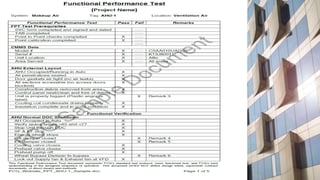
Here we have taken Commissioning of AHU as an
example for better understanding of Commissioning plan
AHU Commissioning can be easily understandable for all
people engaged in erection and Commissioning team
irrespective of their profile and area of work
And it has all components like mechanical ,electrical and
instruments and interlocks
It doesn't need spinalization any in a field to understand
the procedure
AHU Commissioning stages
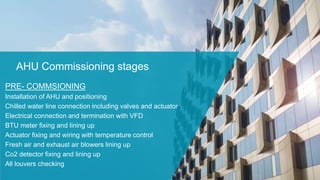
PRE- COMMSIONING
Installation of AHU and positioning
Chilled water line connection including valves and actuator
Electrical connection and termination with VFD
BTU meter fixing and lining up
Actuator fixing and wiring with temperature control
Fresh air and exhaust air blowers lining up
Co2 detector fixing and lining up
All louvers checking
AHU Commissioning stages
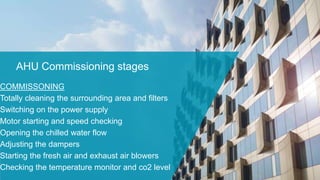
COMMISSONING
Totally cleaning the surrounding area and filters
Switching on the power supply
Motor starting and speed checking
Opening the chilled water flow
Adjusting the dampers
Starting the fresh air and exhaust air blowers
Checking the temperature monitor and co2 level
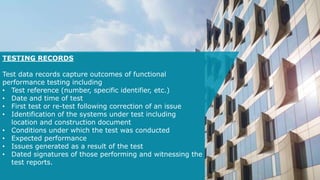
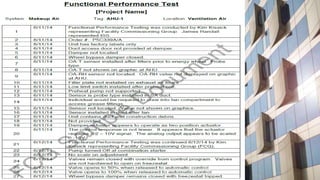
TESTING RECORDS
Test data records capture outcomes of functional
performance testing including
• Test reference (number, specific identifier, etc.)
• Date and time of test
• First test or re-test following correction of an issue
• Identification of the systems under test including
location and construction document
• Conditions under which the test was conducted
• Expected performance
• Issues generated as a result of the test
• Dated signatures of those performing and witnessing the
test reports.
AHU Commissioning stages
TESTING
All test to be done with check list
Air flow velocity and adequacy
Vibration or noise in AHU
BTU meter temperature with actual temperature
BTU meter flow and actuator closing as per set temperature
AHU motor VFD speed as per the set temperature
Fresh air and exhaust air blower speed as per the CO2 level
Occupant area temperature is adequate
Temperature gauge & pressure gauge showing correct value
AHU Commissioning stages
Rectification
Any abnormalities to be set right like vibration to be
attended
Any deviation with normal parameter to be set right like
temperature flow and co2 level
Any non operating mechanism to be made functional like
louvers
Any control loop is not responding to be checked VFD
speed control and actuator controls
AHU Commissioning stages
Retesting
Observed Abnormalities to be rechecked after attending
the issue
Observed deviation to be rechecked after attending the
issue (temperature co2 level)
Observed non operating mechanism to be rechecked after
attending the issue (louvers)
Observed non responding control loop to be rechecked
after attending the issue (VFD speed control and actuator
controls)
DIFFERED TEST
• Due to weather conditions, not all systems can be tested at or
near full load
• Allow for testing of certain equipment under the best possible
conditions
• The initial testing for a number of reasons including
prerequisite activities not complete, phased occupancy issues
and improper testing conditions.
• Re-inspect/Review Performance before End of Warranty Period
• Identification of systems or assemblies that do not perform in
accordance with Project Requirements
AHU Commissioning stages
Differed Test
Differed test to be logged with reason
Seasonal test – can not be performed due to climate
condition (AHU full capacity can not be checked during
winter)
Occupancy capacity – C02 level and fresh air fan can not
be checked with out full occupancy
Requirements for deferred and seasonal testing must be
clearly defined in the contract documents as it will require
some contractor personnel to return to the site after the
project is completed.
AHU Commissioning stages
Documentation
After re testing documentation to be done with check list
Any parameter which is out of allowable tolerance limit to
be recorded
Differed test to be mentioned with reason
All the documents to be signed by project and
commissioning team.
Training must specifically address:
• Step-by-step procedures required for normal day-to-day
operation of the facility
• Adjustment instructions including information for
maintaining operational parameters
• Troubleshooting procedures including instructions for
diagnosing operating
• Maintenance and inspection procedures
• Repair procedures including disassembly, component
removal and replacement
• Emergency instructions for operating the facility during
various nonstandard
Statutory requirement
• All the statutory documents to be processed by
project team for operation before HOTO
• The documents to be for minimum one year of
operation
any statutory documents which or not obtained or
delayed to be informed to facility team
• The required fund for getting statutory approval to
be allotted from project funding
• Any statutory document to be done then and there
will be taken care of facility
Warranty
During the first year of the building’s operation it is important
to assure that the performance of the system is maintained,
particularly before the warranty period expires.
Facility to identify any items that must be repaired or
replaced under warranty.
Warranty items performance to be with Owner’s Project
Requirements.
Discrepancies between predicted performance and actual
performance if observed may indicate a need for minor
system modification.
Warranty
During the first year of the building’s operation it is important
to assure that the performance of the system is maintained,
particularly before the warranty period expires.
Facility to identify any items that must be repaired or
replaced under warranty.
Warranty items performance to be with Owner’s Project
Requirements.
Discrepancies between predicted performance and actual
performance if observed may indicate a need for minor
system modification.
Complete Final Commissioning Report
A statement that system completed in accordance with the contract
documents that the systems are performing in accordance with the
final owner's Project Requirements document
Identification and discussion of any substitutions, compromises
Description of components and systems that exceed Owner’s Project
requirements and those which do not meet the requirements
Summary of all issues resolved and unresolved and any
recommendations for resolution
Post-Construction activities and results including
Deferred & seasonal testing results,
Conclusion
When any building is to be handed over to facility all the
equipment's to be in good working condition
All the facility team to be trained and made familiar with the
system
Full vendor support must be available for the facility to
operate
The project to facility transition to be smooth and hassle free
Minimum required spares to be with facility for maintenance
Any differed test not completed to be finished before HOTO

General guidelines for building commissioning ppt

  • 1.
    General Guidelines forHanding over & Taking over
  • 2.
    Utility requirement– Electricalsystems. Un interrupted power supply is a critical factor in any building whether it is a residential building ,software hub or commercial building for fail free operations For achieving this the transformer capacity , DG set capacity and LT panels to be designed such that there must not be any power interruption at any time to the facility Transformer and DG set to be designed for 200 % of load so that standby equipment is always available Critical panel supply to be supplied from 2 different sources
  • 3.
    Other Utility requirement Lifts UPS Plumbingsystem HVAC system STP, WTP Waste management Fire Hydrant system Security surveillance system
  • 4.
    What is buildingcommissioning? Commissioning is the process of ensuring that systems are designed, installed, functionally tested, and capable of being operated and maintained to perform in conformity with the design intent. Building Commissioning is a systematic and documented process of ensuring that the owner’s operational needs are met, building systems perform efficiently, and building operators are properly trained.
  • 5.
    What is thegoal of building commissioning To deliver a facility that operates as it was intended. To provide a facility that meets the needs of the building owner To provide appropriate training for facility operators on the operation Benefits of building commissioning process starts early Design review. Better building commissioning specifications. Clear building commissioning expectations. Better bids.
  • 6.
    Commissioning agency selection Commissioningagency experience Their profile Their exposure to same type of industry Their previous record in same type of industry Competitive pricing with out compromising on quality Quality of commissioning Client list and client feed back
  • 7.
    Commissioning agency requirement Actedas the principal Commissioning Agent for at least three projects of comparable size, type and scope. Extensive experience in the operation and troubleshooting of HVAC system A minimum of five full years in this type of work is required. Knowledgeable in building O&M training. Knowledgeable in national building & fire codes Experienced in energy-efficient equipment design and control strategy optimization.
  • 8.
    . Commissioning Handover andtake over By external team By internal team This will be done by common guidelines and standard procedure This will done as per requirement of the facility team and more effective and maintenance friendly They may not be understanding facility requirement and operational friendly Hence our team is already having operation exposer they will demand what they require It is better to go with internal facility team if available which has got familiarity in existing operation challenges
  • 9.
    Both GSA &ORAT recommends the facility team to be consulted at the design time itself • Facility team to be consulted from design stage and there after can be consulted if required by the design team • Facility team or any other external team can be used for commissioning and testing • In normal cases if facility team available it is better to go with internal team for commissioning & testing • Facility should not involve in project activity and not to give snag report until the project takes proper shape and nearing completion • But the pre commissioning, commissioning and testing should only done with coordination with Facility only
  • 10.
    Benefits of Commissioningof Buildings with facility team and according to building guidelines • Improved building operation and maintenance • Improved building occupant productivity • Increased occupant safety • Improved system and equipment function • Better building documentation • Shortened occupancy transition period
  • 11.
    Commissioning and Testing •Commissioning and testing to be done stage by stage with Facility team • Each component to be tested then and there it is completed, and not to wait for all components to be completed (For ex. If Fire hydrant system is completed that can be tested with commissioning team and can be handover) • Testing and commissioning to be done before vendor leaves the project site for carrying out any modification. (For ex. Pipe line welding or new drain line provision) • Repeated test to be done till the facility team is satisfied and got familiarized (For ex. LT panel auto change over & DG sync panel)
  • 12.
    Commissioning stages Pre-commissioning -Making the system and/or equipment's ready for putting into service. Commissioning - Is putting into service. Testing -Performance as required by owner Rectification - Minor changes ,modifications Re-testing - After attending to issue Documentation -Differed test ,snag points to be signed by project and facility
  • 13.
    Example for Commissioningstages Here we have taken Commissioning of AHU as an example for better understanding of Commissioning plan AHU Commissioning can be easily understandable for all people engaged in erection and Commissioning team irrespective of their profile and area of work And it has all components like mechanical ,electrical and instruments and interlocks It doesn't need spinalization any in a field to understand the procedure
  • 14.
    AHU Commissioning stages PRE-COMMSIONING Installation of AHU and positioning Chilled water line connection including valves and actuator Electrical connection and termination with VFD BTU meter fixing and lining up Actuator fixing and wiring with temperature control Fresh air and exhaust air blowers lining up Co2 detector fixing and lining up All louvers checking
  • 15.
    AHU Commissioning stages COMMISSONING Totallycleaning the surrounding area and filters Switching on the power supply Motor starting and speed checking Opening the chilled water flow Adjusting the dampers Starting the fresh air and exhaust air blowers Checking the temperature monitor and co2 level
  • 16.
    TESTING RECORDS Test datarecords capture outcomes of functional performance testing including • Test reference (number, specific identifier, etc.) • Date and time of test • First test or re-test following correction of an issue • Identification of the systems under test including location and construction document • Conditions under which the test was conducted • Expected performance • Issues generated as a result of the test • Dated signatures of those performing and witnessing the test reports.
  • 19.
    AHU Commissioning stages TESTING Alltest to be done with check list Air flow velocity and adequacy Vibration or noise in AHU BTU meter temperature with actual temperature BTU meter flow and actuator closing as per set temperature AHU motor VFD speed as per the set temperature Fresh air and exhaust air blower speed as per the CO2 level Occupant area temperature is adequate Temperature gauge & pressure gauge showing correct value
  • 20.
    AHU Commissioning stages Rectification Anyabnormalities to be set right like vibration to be attended Any deviation with normal parameter to be set right like temperature flow and co2 level Any non operating mechanism to be made functional like louvers Any control loop is not responding to be checked VFD speed control and actuator controls
  • 21.
    AHU Commissioning stages Retesting ObservedAbnormalities to be rechecked after attending the issue Observed deviation to be rechecked after attending the issue (temperature co2 level) Observed non operating mechanism to be rechecked after attending the issue (louvers) Observed non responding control loop to be rechecked after attending the issue (VFD speed control and actuator controls)
  • 22.
    DIFFERED TEST • Dueto weather conditions, not all systems can be tested at or near full load • Allow for testing of certain equipment under the best possible conditions • The initial testing for a number of reasons including prerequisite activities not complete, phased occupancy issues and improper testing conditions. • Re-inspect/Review Performance before End of Warranty Period • Identification of systems or assemblies that do not perform in accordance with Project Requirements
  • 23.
    AHU Commissioning stages DifferedTest Differed test to be logged with reason Seasonal test – can not be performed due to climate condition (AHU full capacity can not be checked during winter) Occupancy capacity – C02 level and fresh air fan can not be checked with out full occupancy Requirements for deferred and seasonal testing must be clearly defined in the contract documents as it will require some contractor personnel to return to the site after the project is completed.
  • 24.
    AHU Commissioning stages Documentation Afterre testing documentation to be done with check list Any parameter which is out of allowable tolerance limit to be recorded Differed test to be mentioned with reason All the documents to be signed by project and commissioning team.
  • 25.
    Training must specificallyaddress: • Step-by-step procedures required for normal day-to-day operation of the facility • Adjustment instructions including information for maintaining operational parameters • Troubleshooting procedures including instructions for diagnosing operating • Maintenance and inspection procedures • Repair procedures including disassembly, component removal and replacement • Emergency instructions for operating the facility during various nonstandard
  • 26.
    Statutory requirement • Allthe statutory documents to be processed by project team for operation before HOTO • The documents to be for minimum one year of operation any statutory documents which or not obtained or delayed to be informed to facility team • The required fund for getting statutory approval to be allotted from project funding • Any statutory document to be done then and there will be taken care of facility
  • 27.
    Warranty During the firstyear of the building’s operation it is important to assure that the performance of the system is maintained, particularly before the warranty period expires. Facility to identify any items that must be repaired or replaced under warranty. Warranty items performance to be with Owner’s Project Requirements. Discrepancies between predicted performance and actual performance if observed may indicate a need for minor system modification.
  • 28.
    Warranty During the firstyear of the building’s operation it is important to assure that the performance of the system is maintained, particularly before the warranty period expires. Facility to identify any items that must be repaired or replaced under warranty. Warranty items performance to be with Owner’s Project Requirements. Discrepancies between predicted performance and actual performance if observed may indicate a need for minor system modification.
  • 29.
    Complete Final CommissioningReport A statement that system completed in accordance with the contract documents that the systems are performing in accordance with the final owner's Project Requirements document Identification and discussion of any substitutions, compromises Description of components and systems that exceed Owner’s Project requirements and those which do not meet the requirements Summary of all issues resolved and unresolved and any recommendations for resolution Post-Construction activities and results including Deferred & seasonal testing results,
  • 30.
    Conclusion When any buildingis to be handed over to facility all the equipment's to be in good working condition All the facility team to be trained and made familiar with the system Full vendor support must be available for the facility to operate The project to facility transition to be smooth and hassle free Minimum required spares to be with facility for maintenance Any differed test not completed to be finished before HOTO