Total Building Commissioning Integrated Design & Performance
What is Commissioning? A quality-focused process for enhancing the delivery of a project. The process focuses upon verifying and documenting that the facility and  all of its systems  and assemblies are planned, designed, installed, tested, operated, and maintained to meet the Owner’s Project Requirements (OPR).
The “Status Quo” Mechanical Systems ONLY commissioning TAB as commissioning Upgrading mechanical systems as sole means to energy savings Putting in bigger systems to deal with comfort complaints Commissioning as a paper driven process
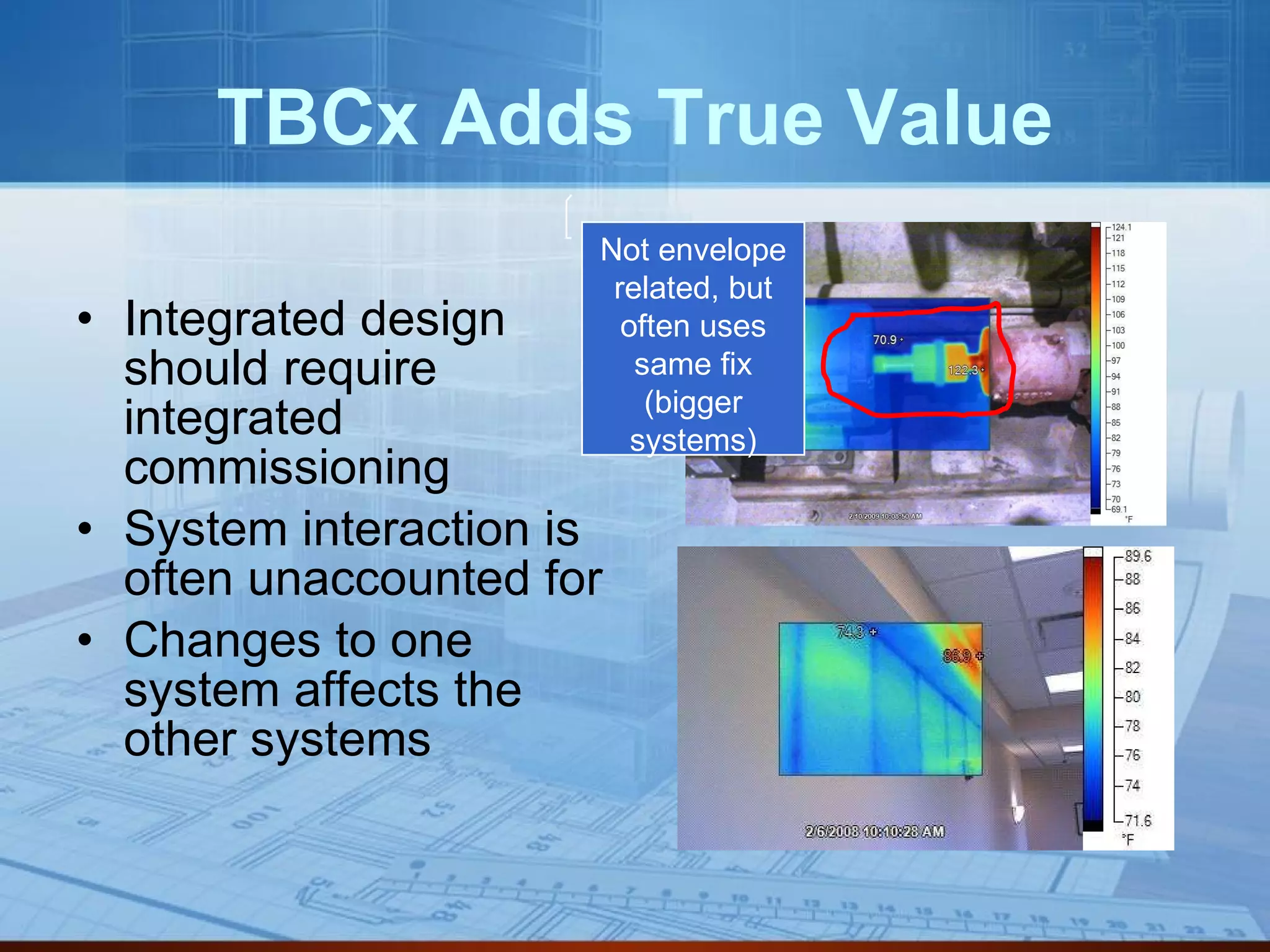
TBCx Adds True Value Integrated design should require integrated commissioning System interaction is often unaccounted for Changes to one system affects the other systems Not envelope related, but often uses same fix (bigger systems)
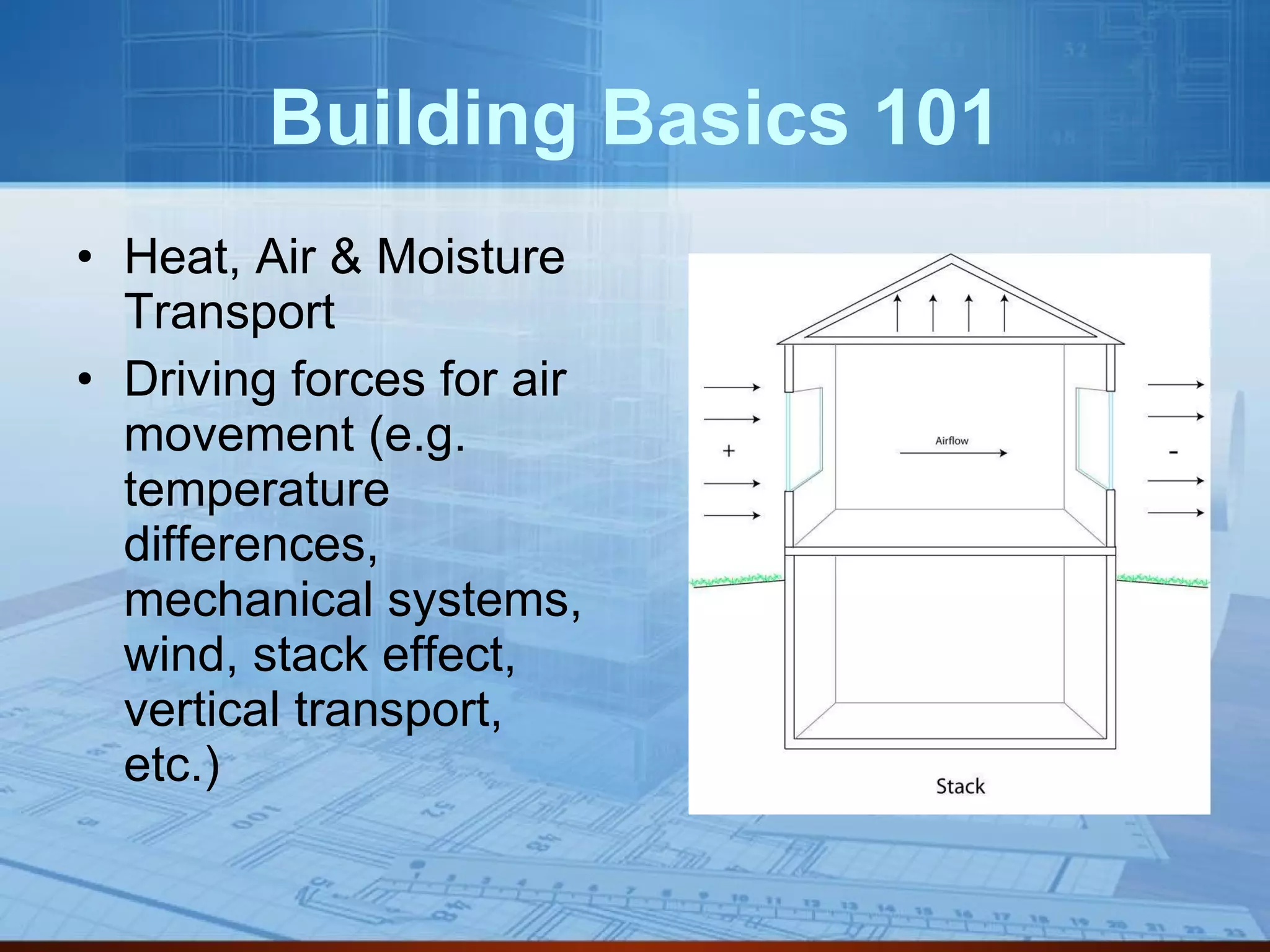
Building Basics 101 Heat, Air & Moisture Transport Driving forces for air movement (e.g. temperature differences, mechanical systems, wind, stack effect, vertical transport, etc.)
Driving Force Control? Can we design these driving forces out of buildings? Not likely. Can we build to mitigate the effects? Maybe, with the proper oversight and commissioning. Is it worth it?
Moisture Related Facts “ Moisture Damage Contributes to 90% of All Building and Building Material Failures” (ASHRAE) “ Moisture Leading Cause of Building Problems Costing More Than $9 Billion Annually in U.S.” (ASTM) “ Moisture Will Replace Asbestos as the Most Frequently Mentioned Topic in Building Litigation” (C. Gaal, NJ Investigation Commission Counsel) A 2007 study found that out of 17,000 construction defect claims examined, 69% were due to moisture related defects in the building enclosure systems. (July 2008 ASHRAE Journal)
The True Cost? The facts on the previous slide consider only the cost of litigation and moisture damage.  What is the cost when we add energy, long term building degradation, premature system failures, comfort, productivity? If owner’s really understood the costs, we would not have to sell “TBCx”.
Public Awareness Do the HVAC contractors, T&B contractors and Mechanical Engineers have good reason to sell TBCx? NO. Would TBCx actually lead to less work in these areas? This is probably an unjustified fear. Are engineers truly qualified to be commissioning agents? How many have hands on experience? Cx is NOT a paper driven process. It requires field and systems expertise.
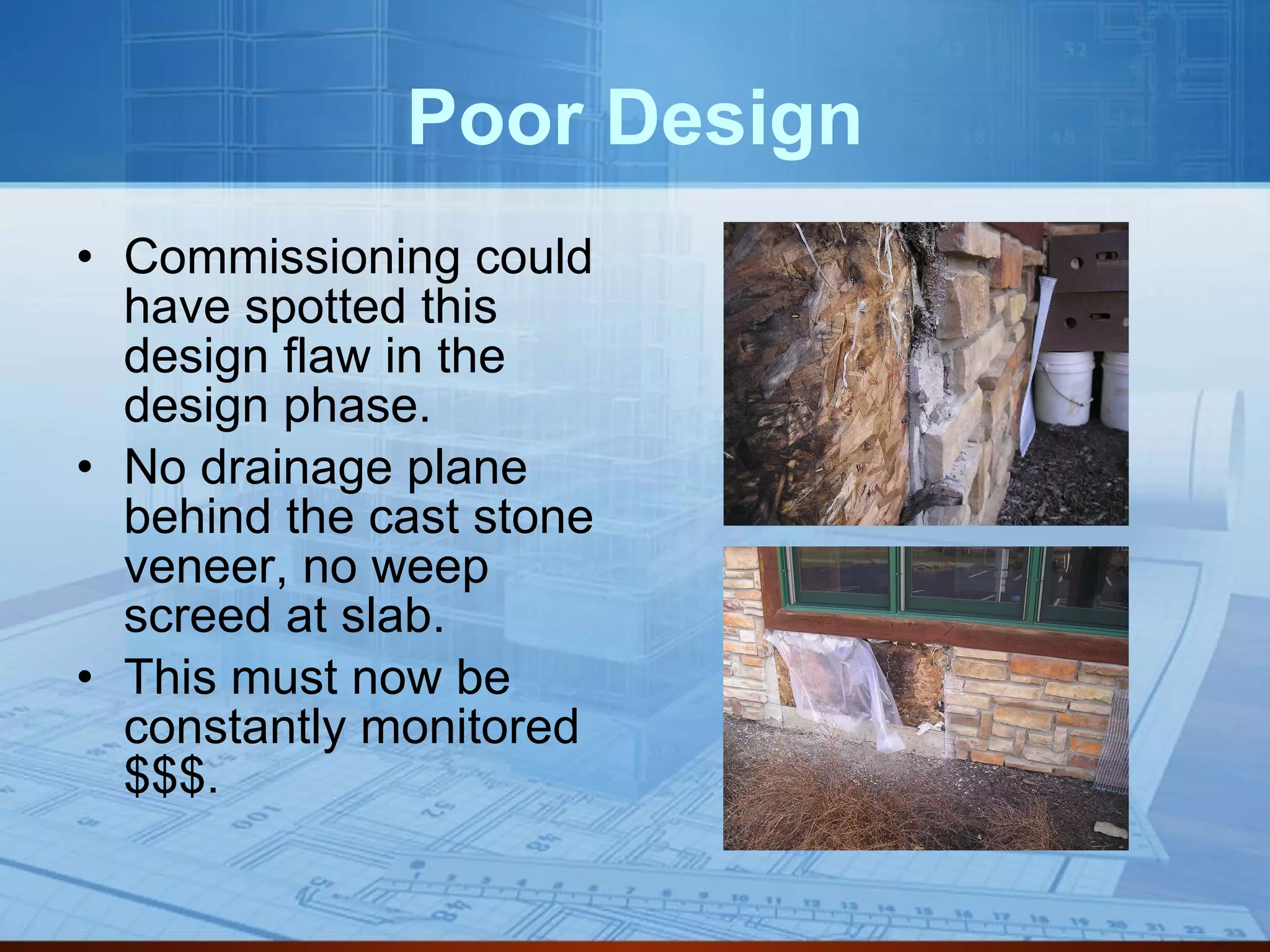
Poor Design Commissioning could have spotted this design flaw in the design phase.  No drainage plane behind the cast stone veneer, no weep screed at slab. This must now be constantly monitored $$$.
Poor Installation This building was suffering from frozen piping for sprinkler system. Extensive thermal bridging and air leakage created serious comfort issues for the owner.  This is NEW construction.
Poor Design & Installation Visual and infrared inspection revealed the installation flaws. Modeling and visual inspection revealed the design flaws. This is “new construction”. We do not need commissioning.
No Easy Fix Extensive thermal bridging caused by both design and installation.  Steel Stud framing, minimal exterior insulation, extensive air leakage, fiberglass batt insulation between steel studs.
Wind Washing = Frozen Sprinkler Piping
Heat Loss, Energy Loss, Comfort The commissioning of the past left all of these issues after commissioning was completed. You may have been left with a functional and/or balanced HVAC system and little more. This mentality is what has led building construction to the top of the litigation list.
INTEGRATED SYSTEMS Requires integrated design & integrated Cx. Requires that Cx return to a field driven process. Requires talented, experienced technicians.
Cx Discovers Design Defects The moisture issues shown on previous slide were traced back to flaws in the original design. TBCx on this building could have saved owner from expensive repairs and more expensive litigation.
Lighting & Cx The leading cause of problems in lighting controls is Not Commissioning. Lighting consumes 25-30% of energy in commercial buildings. Lighting is a major source of heat gain in buildings (this is especially true in older, antiquated systems). GSA Study discovered that Cx is vital to success of lighting controls projects.
The Total is Greater Than the Sum of All Parts This is where a true understanding of building system integration is critical. Systems that do not perform as intended affect all other systems. This detracts from performance of all systems (including those that have been commissioned). The greatest benefit from Cx to the owner will come from TBCx.
Start With a Clear OPR The OPR document explicitly calls out the minimum characteristics that will define a successful project from the owner’s perspective  Must address quality as well as quantity  Must include verifiable benchmarks (criteria)  OPR is completed during pre-design  This document becomes the basis for all commissioning verification efforts—and is thus critical to a successful commissioning outcome
Call Us to Discuss Your Requirements 440-946-7191 Email:  [email_address] Web:  www.cligroup.net

Tb Cx

  • 1.
    Total Building CommissioningIntegrated Design & Performance
  • 2.
    What is Commissioning?A quality-focused process for enhancing the delivery of a project. The process focuses upon verifying and documenting that the facility and all of its systems and assemblies are planned, designed, installed, tested, operated, and maintained to meet the Owner’s Project Requirements (OPR).
  • 3.
    The “Status Quo”Mechanical Systems ONLY commissioning TAB as commissioning Upgrading mechanical systems as sole means to energy savings Putting in bigger systems to deal with comfort complaints Commissioning as a paper driven process
  • 4.
    TBCx Adds TrueValue Integrated design should require integrated commissioning System interaction is often unaccounted for Changes to one system affects the other systems Not envelope related, but often uses same fix (bigger systems)
  • 5.
    Building Basics 101Heat, Air & Moisture Transport Driving forces for air movement (e.g. temperature differences, mechanical systems, wind, stack effect, vertical transport, etc.)
  • 6.
    Driving Force Control?Can we design these driving forces out of buildings? Not likely. Can we build to mitigate the effects? Maybe, with the proper oversight and commissioning. Is it worth it?
  • 7.
    Moisture Related Facts“ Moisture Damage Contributes to 90% of All Building and Building Material Failures” (ASHRAE) “ Moisture Leading Cause of Building Problems Costing More Than $9 Billion Annually in U.S.” (ASTM) “ Moisture Will Replace Asbestos as the Most Frequently Mentioned Topic in Building Litigation” (C. Gaal, NJ Investigation Commission Counsel) A 2007 study found that out of 17,000 construction defect claims examined, 69% were due to moisture related defects in the building enclosure systems. (July 2008 ASHRAE Journal)
  • 8.
    The True Cost?The facts on the previous slide consider only the cost of litigation and moisture damage. What is the cost when we add energy, long term building degradation, premature system failures, comfort, productivity? If owner’s really understood the costs, we would not have to sell “TBCx”.
  • 9.
    Public Awareness Dothe HVAC contractors, T&B contractors and Mechanical Engineers have good reason to sell TBCx? NO. Would TBCx actually lead to less work in these areas? This is probably an unjustified fear. Are engineers truly qualified to be commissioning agents? How many have hands on experience? Cx is NOT a paper driven process. It requires field and systems expertise.
  • 10.
    Poor Design Commissioningcould have spotted this design flaw in the design phase. No drainage plane behind the cast stone veneer, no weep screed at slab. This must now be constantly monitored $$$.
  • 11.
    Poor Installation Thisbuilding was suffering from frozen piping for sprinkler system. Extensive thermal bridging and air leakage created serious comfort issues for the owner. This is NEW construction.
  • 12.
    Poor Design &Installation Visual and infrared inspection revealed the installation flaws. Modeling and visual inspection revealed the design flaws. This is “new construction”. We do not need commissioning.
  • 13.
    No Easy FixExtensive thermal bridging caused by both design and installation. Steel Stud framing, minimal exterior insulation, extensive air leakage, fiberglass batt insulation between steel studs.
  • 14.
    Wind Washing =Frozen Sprinkler Piping
  • 15.
    Heat Loss, EnergyLoss, Comfort The commissioning of the past left all of these issues after commissioning was completed. You may have been left with a functional and/or balanced HVAC system and little more. This mentality is what has led building construction to the top of the litigation list.
  • 16.
    INTEGRATED SYSTEMS Requiresintegrated design & integrated Cx. Requires that Cx return to a field driven process. Requires talented, experienced technicians.
  • 17.
    Cx Discovers DesignDefects The moisture issues shown on previous slide were traced back to flaws in the original design. TBCx on this building could have saved owner from expensive repairs and more expensive litigation.
  • 18.
    Lighting & CxThe leading cause of problems in lighting controls is Not Commissioning. Lighting consumes 25-30% of energy in commercial buildings. Lighting is a major source of heat gain in buildings (this is especially true in older, antiquated systems). GSA Study discovered that Cx is vital to success of lighting controls projects.
  • 19.
    The Total isGreater Than the Sum of All Parts This is where a true understanding of building system integration is critical. Systems that do not perform as intended affect all other systems. This detracts from performance of all systems (including those that have been commissioned). The greatest benefit from Cx to the owner will come from TBCx.
  • 20.
    Start With aClear OPR The OPR document explicitly calls out the minimum characteristics that will define a successful project from the owner’s perspective Must address quality as well as quantity Must include verifiable benchmarks (criteria) OPR is completed during pre-design This document becomes the basis for all commissioning verification efforts—and is thus critical to a successful commissioning outcome
  • 21.
    Call Us toDiscuss Your Requirements 440-946-7191 Email: [email_address] Web: www.cligroup.net