SATURN
How Was Saturn Named?
Saturn was named after the Roman god
of agriculture. According to myth,
Saturn introduced agriculture to his
people by teaching them how to farm
the land. Cronus (Saturn) In Greek
mythology, Cronus was the son of
Uranus and Gaea. He lead his brothers
and sisters, the Titans, in a revolt
Orbit and Rotation of Saturn
Saturn's average distance from the Sun
is 1,400,000,000 km. The average
orbital speed of Saturn is 9.69 km/s. It
takes the earth 365 days to orbit the
sun, Saturn takes 10,759 Earth days (or
about 29½ years), to revolve around the
sun; a year on Saturn is equivalent to
29.5 Earth years.
Characteristics of Saturn
• Rings
Saturn is the only planet in our planet
that has rings that are visible with a
simple telescope. Other planets, like
Uranus and Neptune, also have rings,
but they require a more powerful
telescope in order to see them.
• Time
Saturn’s orbit is extremely slow. 1 year
of Saturn is the same as 29 years on
earth. However, despite its slow orbit,
Saturn rotates extremely fast the
average day on Saturn is just under 11
earth hours. The fast rotation of Saturn
might also explain how the winds can
reach speeds of over 1800 km/h.
• Density
Even though Saturn is the second
largest planet in the solar system, it is
surprisingly light. This is because the
planet is made almost entirely out of
gas, primarily helium. It is impossible to
stand on the surface of Saturn, because
there is virtually no surface to stand on.
• Moons
The moons of Saturn are just as
interesting as the planet itself. Titan,
the largest of Saturn’s moons, is one of
very few moons that has its own dense
atmosphere. Iapetus is interesting
because one side of its surface is
covered with really dark material, while
the other side is covered with blindingly
• Chemical Composition
Saturn is predominantly composed of
hydrogen and helium, the two basic
gases of the universe. The planet also
bears traces of ices containing
ammonia, methane, and water
Spacecraft Saturn
Pioneer 11 1979 flyby
Voyager 1 1980 flyby
Voyager 2 1981 flyby
Cassini - Huygens 2004- 2017 orbiter
2005 Titan lander
Visits
• Pioneer 11
Spacecraft launched from Cape
Canaveral forty years ago, on April 5,
1973. Pioneer 11's path through
Saturn's outer rings took it within
21,000 km of the planet, where it
discovered two new moons (almost
smacking into one of them in
September 1979) and a new "F" ring.
The spacecraft also discovered and
charted the magnetosphere, magnetic
radiation from Saturn's interior and
found that its planet-sized moon, Titan,
was too cold to support life.
PIONEER
11
• Voyager
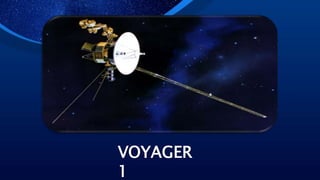
In November 1980, the Voyager 1 probe
visited the Saturn system. It sent back
the first high-resolution images of the
planet, rings, and satellites. Surface
features of various moons were seen for
the first time. Because of the earlier
discovery of a thick atmosphere on
Titan, the Voyager controllers at the Jet
Propulsion Laboratory elected for
Almost a year later, in August
1981, Voyager 2 continued the study of
the Saturn system. More close-up
images of Saturn's moons were
acquired, as well as evidence of
changes in the rings. Voyager 2 probed
Saturn's upper atmosphere with its
radar, to measure temperature and
density profiles. Voyager 2found that at
70 K (−203 °C) (i.e. 70 degrees above
absolute zero), while at the deepest
levels measured (120 kilopascals) the
temperature increased to
143 K (−130 °C). The north pole was
found to be 10 K cooler, although this
may be seasonal.
VOYAGER
1
VOYAGER
2
• Cassini–Huygens
On July 1, 2004, the Cassini–Huygens
spacecraft performed the SOI (Saturn
Orbit Insertion) maneuver and entered
into orbit around Saturn. Before the SOI,
Cassini had already studied the system
extensively. In June 2004, it had
conducted a close flyby of Phoebe,
sending back high-resolution images
CASSINI -
HUYGENS
Trivia’s
• Saturn is a flattened ball – Saturn
spins so quickly that the planet
flattens itself out into an oblate
spheroid.
• The first astronomers thought the
rings were moons – it wasn’t until
1655 that the Dutch astronomer
Christian Huygens used a better
• Saturn has only been visited 4 times
by spacecraft – Only 4 spacecraft sent
from Earth have ever visited Saturn,
and three were just brief flybys.
• Saturn has 62 moons - Saturn has 62
confirmed moons of which 9 are waiting to be
officially named. Saturn's largest
moon Titan is bigger than both Mercury
and Pluto. Titan has a very thick atmosphere
which is mostly nitrogen.
• The length of a day on Saturn was a
mystery until recently – Determining
the rotation speed of Saturn was
actually very difficult to do, because
the planet doesn’t have a solid
surface.
• You can see Saturn with your own
eyes – Saturn appears as one of the 5
planets visible with the unaided eye.
• Saturn’s rings are actually much
younger than the planet itself And
they most likely formed in the last 100
million years.
• There could be life near Saturn – Not
life on Saturn; the planet is way too
hostile to support life. But there could
be life on 1 of Saturn’s moon:
Enceladus.

Saturn

  • 1.
  • 2.
    How Was SaturnNamed? Saturn was named after the Roman god of agriculture. According to myth, Saturn introduced agriculture to his people by teaching them how to farm the land. Cronus (Saturn) In Greek mythology, Cronus was the son of Uranus and Gaea. He lead his brothers and sisters, the Titans, in a revolt
  • 3.
    Orbit and Rotationof Saturn Saturn's average distance from the Sun is 1,400,000,000 km. The average orbital speed of Saturn is 9.69 km/s. It takes the earth 365 days to orbit the sun, Saturn takes 10,759 Earth days (or about 29½ years), to revolve around the sun; a year on Saturn is equivalent to 29.5 Earth years.
  • 4.
    Characteristics of Saturn •Rings Saturn is the only planet in our planet that has rings that are visible with a simple telescope. Other planets, like Uranus and Neptune, also have rings, but they require a more powerful telescope in order to see them.
  • 6.
    • Time Saturn’s orbitis extremely slow. 1 year of Saturn is the same as 29 years on earth. However, despite its slow orbit, Saturn rotates extremely fast the average day on Saturn is just under 11 earth hours. The fast rotation of Saturn might also explain how the winds can reach speeds of over 1800 km/h.
  • 8.
    • Density Even thoughSaturn is the second largest planet in the solar system, it is surprisingly light. This is because the planet is made almost entirely out of gas, primarily helium. It is impossible to stand on the surface of Saturn, because there is virtually no surface to stand on.
  • 10.
    • Moons The moonsof Saturn are just as interesting as the planet itself. Titan, the largest of Saturn’s moons, is one of very few moons that has its own dense atmosphere. Iapetus is interesting because one side of its surface is covered with really dark material, while the other side is covered with blindingly
  • 12.
    • Chemical Composition Saturnis predominantly composed of hydrogen and helium, the two basic gases of the universe. The planet also bears traces of ices containing ammonia, methane, and water
  • 14.
    Spacecraft Saturn Pioneer 111979 flyby Voyager 1 1980 flyby Voyager 2 1981 flyby Cassini - Huygens 2004- 2017 orbiter 2005 Titan lander Visits
  • 15.
    • Pioneer 11 Spacecraftlaunched from Cape Canaveral forty years ago, on April 5, 1973. Pioneer 11's path through Saturn's outer rings took it within 21,000 km of the planet, where it discovered two new moons (almost smacking into one of them in September 1979) and a new "F" ring. The spacecraft also discovered and charted the magnetosphere, magnetic
  • 16.
    radiation from Saturn'sinterior and found that its planet-sized moon, Titan, was too cold to support life.
  • 17.
  • 18.
    • Voyager In November1980, the Voyager 1 probe visited the Saturn system. It sent back the first high-resolution images of the planet, rings, and satellites. Surface features of various moons were seen for the first time. Because of the earlier discovery of a thick atmosphere on Titan, the Voyager controllers at the Jet Propulsion Laboratory elected for
  • 19.
    Almost a yearlater, in August 1981, Voyager 2 continued the study of the Saturn system. More close-up images of Saturn's moons were acquired, as well as evidence of changes in the rings. Voyager 2 probed Saturn's upper atmosphere with its radar, to measure temperature and density profiles. Voyager 2found that at
  • 20.
    70 K (−203°C) (i.e. 70 degrees above absolute zero), while at the deepest levels measured (120 kilopascals) the temperature increased to 143 K (−130 °C). The north pole was found to be 10 K cooler, although this may be seasonal.
  • 21.
  • 22.
  • 23.
    • Cassini–Huygens On July1, 2004, the Cassini–Huygens spacecraft performed the SOI (Saturn Orbit Insertion) maneuver and entered into orbit around Saturn. Before the SOI, Cassini had already studied the system extensively. In June 2004, it had conducted a close flyby of Phoebe, sending back high-resolution images
  • 24.
  • 25.
    Trivia’s • Saturn isa flattened ball – Saturn spins so quickly that the planet flattens itself out into an oblate spheroid. • The first astronomers thought the rings were moons – it wasn’t until 1655 that the Dutch astronomer Christian Huygens used a better
  • 26.
    • Saturn hasonly been visited 4 times by spacecraft – Only 4 spacecraft sent from Earth have ever visited Saturn, and three were just brief flybys. • Saturn has 62 moons - Saturn has 62 confirmed moons of which 9 are waiting to be officially named. Saturn's largest moon Titan is bigger than both Mercury and Pluto. Titan has a very thick atmosphere which is mostly nitrogen.
  • 27.
    • The lengthof a day on Saturn was a mystery until recently – Determining the rotation speed of Saturn was actually very difficult to do, because the planet doesn’t have a solid surface. • You can see Saturn with your own eyes – Saturn appears as one of the 5 planets visible with the unaided eye.
  • 28.
    • Saturn’s ringsare actually much younger than the planet itself And they most likely formed in the last 100 million years. • There could be life near Saturn – Not life on Saturn; the planet is way too hostile to support life. But there could be life on 1 of Saturn’s moon: Enceladus.