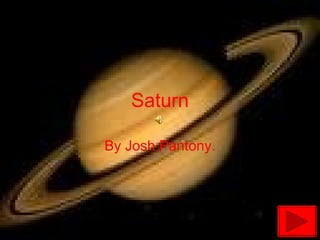
Saturn By Josh Pantony.
Welcome Main menu Where is Saturn What is Saturn  Made Of Saturn’s Weather Saturn’s Amazing  Rings Saturn’s Amazing Moons Titan Saturn in History What we can See Missions Video Library
Where is Saturn
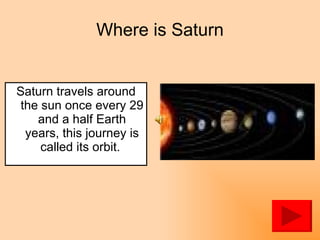
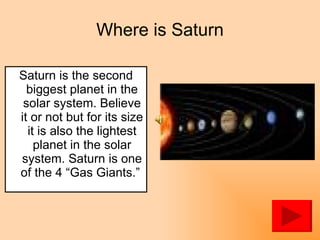
Where is Saturn There are 8 planets in our solar system; all 8 planets travel around the sun, Saturn is the 6th planet from the sun.
Where is Saturn Saturn travels around the sun once every 29 and a half Earth years, this journey is called its orbit.
Where is Saturn Planets are always spinning. The time it takes a planet to spin around once is called a day. A day on Saturn is 10 and a half hours long on Earth.
Where is Saturn Saturn is the second biggest planet in the solar system. Believe it or not but for its size it is also the lightest planet in the solar system. Saturn is one of the 4 “Gas Giants.”
What is Saturn made of?
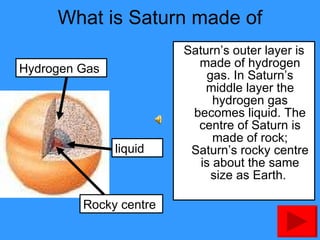
What is Saturn made of Saturn’s outer layer is made of hydrogen gas. In Saturn’s middle layer the hydrogen gas becomes liquid. The centre of Saturn is made of rock; Saturn’s rocky centre is about the same size as Earth.  Hydrogen Gas liquid Rocky centre
Saturn's Weather
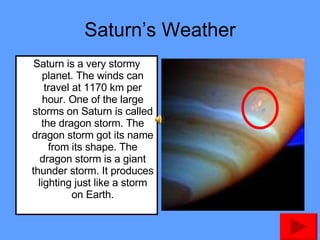
Saturn’s Weather Saturn is a very stormy planet. The winds can travel at 1170 km per hour. One of the large storms on Saturn is called the dragon storm. The dragon storm got its name from its shape. The dragon storm is a giant thunder storm. It produces lighting just like a storm on Earth.
Saturn's Amazing Rings
Saturn’s Amazing Rings Saturn has the largest and brightest system of rings in the whole solar system. The rings on Saturn are made of ice with some dust and rock.
Saturn’s Amazing Rings There are chunks of rocks in Saturn’s rings, some of these chunks of rock are as big as a house! There are 7 rings around Saturn. Some of these rings are very small and hard to see, only 9 metres thick which is as tall as a 2 storey house. The bigger rings are made up of many smaller ringlets.
Saturn's Amazing Moons
Saturn’s Amazing Moons Moons are big rocks that orbit planets. Only 1 moon orbits Earth, but at least 60 moons orbit Saturn. Saturn’s moons vary in size. The smallest moon is  “Pan”  and the biggest is  “Titan.” Pan Titan
List of Saturn’s main Moons Name of moon  year Titan  1655  Iapetus  1671  Rhea  1672  Tethys  1684  Dione  1684  Enceladus  1789  Mimas  1789  Hyperion  1848  Phoebe  1898  Janus  1966  Epimetheus  1977  Atlas  1980  Helene  1980  Calypso  1980  Telesto  1980  Prometheus  1980  Pandora  1990  Pan  1990
Titan
Saturn’s Amazing Moons Titan Titan is Saturn’s biggest moon and is the second biggest moon in the whole solar system. In comparison to Earth Titan is about half the size of Earth. Titan
Saturn in History
Saturn in History Saturn was well known in ancient times. Saturn is the furthest planet that can be seen from Earth without a telescope.
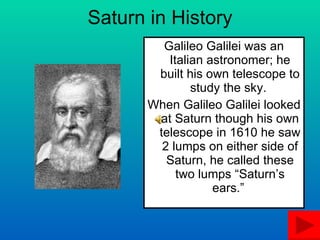
Saturn in History Galileo Galilei was an Italian astronomer; he built his own telescope to study the sky.  When Galileo Galilei looked at Saturn though his own telescope in 1610 he saw 2 lumps on either side of Saturn, he called these two lumps “Saturn’s ears.”
Saturn in History In 1656 Dutch astronomer Christian Huygens viewed Saturn though a much more powerful telescope and he discovered that “Saturn’s ears” were actually Saturn’s amazing rings.
What we can See
What we can See From Earth, Saturn looks like a bright yellow star. It is easy to see without a telescope. But with a telescope you are able to see Saturn’s rings.  Earth’s Moon Saturn
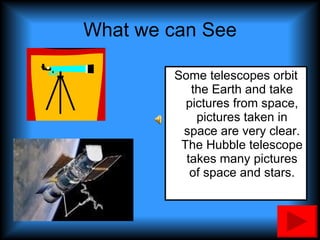
What we can See Some telescopes orbit the Earth and take pictures from space, pictures taken in space are very clear. The Hubble telescope takes many pictures of space and stars.
Missions
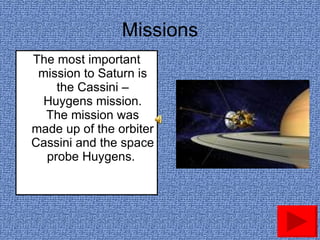
Missions The most important mission to Saturn is the Cassini – Huygens mission. The mission was made up of the orbiter Cassini and the space probe Huygens.
Missions At the beginning of the mission, Huygens was attached to Cassini; they were then taken to space by a rocket.  The rocket was launched in 1997 and reached Saturn in December 2004.  That’s a trip time of 7 years!
Missions The Cassini Huygens spacecraft then separated into two. Orbiter, Cassini began orbiting Saturn, to study the planet from space. While the space probe Huygens was released from Cassini and then sent to Titan. It took 20 days for huygens to reach Titan after being released from Cassini.
Missions Cassini and Huygens are still discovering new facts and uncovering the secrets of Saturn and Titan to this day.
Video Library Titan Saturn System Mission Cassini – Huygens Mission Cassini at Saturn
If you want to see what Cassini and  Huygens have discovered and uncovered  of Saturn and it’s amazing moons Click next then click on the Play button


Where I got my information All of my information is from the book  “ Blast off lets explore Saturn” All three videos featured in my power point are from the NASA website.
Thank You Thank you for your time listening, Are there any questions???

Saturn

  • 1.
  • 2.
    Welcome Main menuWhere is Saturn What is Saturn Made Of Saturn’s Weather Saturn’s Amazing Rings Saturn’s Amazing Moons Titan Saturn in History What we can See Missions Video Library
  • 3.
  • 4.
    Where is SaturnThere are 8 planets in our solar system; all 8 planets travel around the sun, Saturn is the 6th planet from the sun.
  • 5.
    Where is SaturnSaturn travels around the sun once every 29 and a half Earth years, this journey is called its orbit.
  • 6.
    Where is SaturnPlanets are always spinning. The time it takes a planet to spin around once is called a day. A day on Saturn is 10 and a half hours long on Earth.
  • 7.
    Where is SaturnSaturn is the second biggest planet in the solar system. Believe it or not but for its size it is also the lightest planet in the solar system. Saturn is one of the 4 “Gas Giants.”
  • 8.
  • 9.
    What is Saturnmade of Saturn’s outer layer is made of hydrogen gas. In Saturn’s middle layer the hydrogen gas becomes liquid. The centre of Saturn is made of rock; Saturn’s rocky centre is about the same size as Earth. Hydrogen Gas liquid Rocky centre
  • 10.
  • 11.
    Saturn’s Weather Saturnis a very stormy planet. The winds can travel at 1170 km per hour. One of the large storms on Saturn is called the dragon storm. The dragon storm got its name from its shape. The dragon storm is a giant thunder storm. It produces lighting just like a storm on Earth.
  • 12.
  • 13.
    Saturn’s Amazing RingsSaturn has the largest and brightest system of rings in the whole solar system. The rings on Saturn are made of ice with some dust and rock.
  • 14.
    Saturn’s Amazing RingsThere are chunks of rocks in Saturn’s rings, some of these chunks of rock are as big as a house! There are 7 rings around Saturn. Some of these rings are very small and hard to see, only 9 metres thick which is as tall as a 2 storey house. The bigger rings are made up of many smaller ringlets.
  • 15.
  • 16.
    Saturn’s Amazing MoonsMoons are big rocks that orbit planets. Only 1 moon orbits Earth, but at least 60 moons orbit Saturn. Saturn’s moons vary in size. The smallest moon is “Pan” and the biggest is “Titan.” Pan Titan
  • 17.
    List of Saturn’smain Moons Name of moon year Titan 1655 Iapetus 1671 Rhea 1672 Tethys 1684 Dione 1684 Enceladus 1789 Mimas 1789 Hyperion 1848 Phoebe 1898 Janus 1966 Epimetheus 1977 Atlas 1980 Helene 1980 Calypso 1980 Telesto 1980 Prometheus 1980 Pandora 1990 Pan 1990
  • 18.
  • 19.
    Saturn’s Amazing MoonsTitan Titan is Saturn’s biggest moon and is the second biggest moon in the whole solar system. In comparison to Earth Titan is about half the size of Earth. Titan
  • 20.
  • 21.
    Saturn in HistorySaturn was well known in ancient times. Saturn is the furthest planet that can be seen from Earth without a telescope.
  • 22.
    Saturn in HistoryGalileo Galilei was an Italian astronomer; he built his own telescope to study the sky. When Galileo Galilei looked at Saturn though his own telescope in 1610 he saw 2 lumps on either side of Saturn, he called these two lumps “Saturn’s ears.”
  • 23.
    Saturn in HistoryIn 1656 Dutch astronomer Christian Huygens viewed Saturn though a much more powerful telescope and he discovered that “Saturn’s ears” were actually Saturn’s amazing rings.
  • 24.
  • 25.
    What we canSee From Earth, Saturn looks like a bright yellow star. It is easy to see without a telescope. But with a telescope you are able to see Saturn’s rings. Earth’s Moon Saturn
  • 26.
    What we canSee Some telescopes orbit the Earth and take pictures from space, pictures taken in space are very clear. The Hubble telescope takes many pictures of space and stars.
  • 27.
  • 28.
    Missions The mostimportant mission to Saturn is the Cassini – Huygens mission. The mission was made up of the orbiter Cassini and the space probe Huygens.
  • 29.
    Missions At thebeginning of the mission, Huygens was attached to Cassini; they were then taken to space by a rocket. The rocket was launched in 1997 and reached Saturn in December 2004. That’s a trip time of 7 years!
  • 30.
    Missions The CassiniHuygens spacecraft then separated into two. Orbiter, Cassini began orbiting Saturn, to study the planet from space. While the space probe Huygens was released from Cassini and then sent to Titan. It took 20 days for huygens to reach Titan after being released from Cassini.
  • 31.
    Missions Cassini andHuygens are still discovering new facts and uncovering the secrets of Saturn and Titan to this day.
  • 32.
    Video Library TitanSaturn System Mission Cassini – Huygens Mission Cassini at Saturn
  • 33.
    If you wantto see what Cassini and Huygens have discovered and uncovered of Saturn and it’s amazing moons Click next then click on the Play button
  • 34.
  • 35.
  • 36.
  • 37.
    Where I gotmy information All of my information is from the book “ Blast off lets explore Saturn” All three videos featured in my power point are from the NASA website.
  • 38.
    Thank You Thankyou for your time listening, Are there any questions???