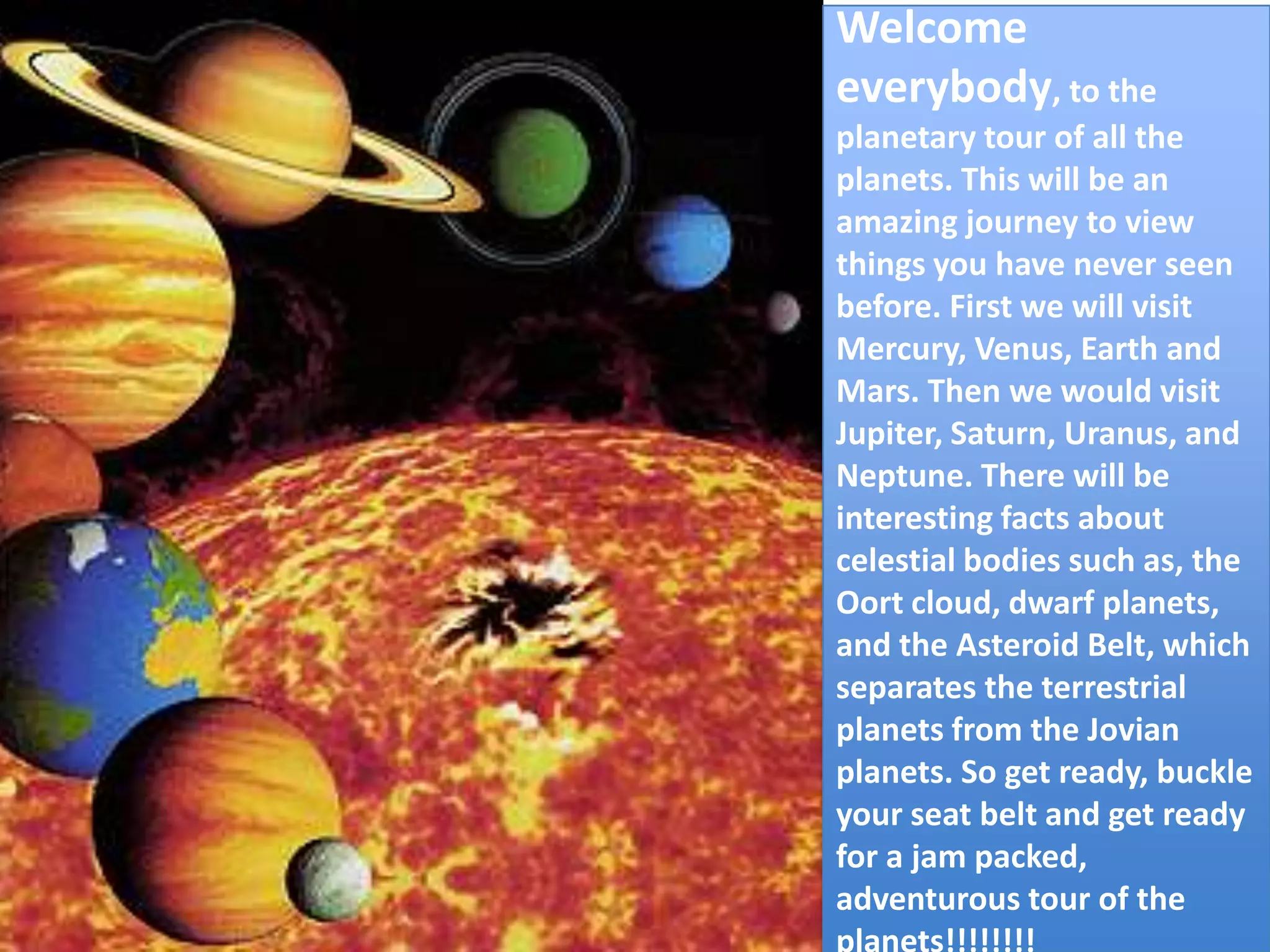
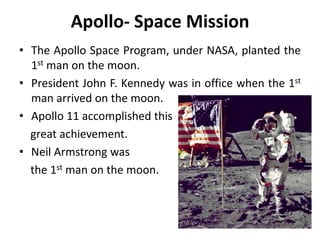
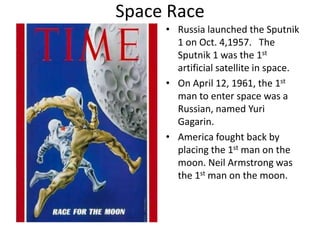
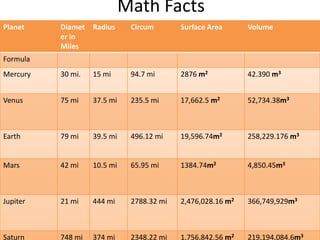
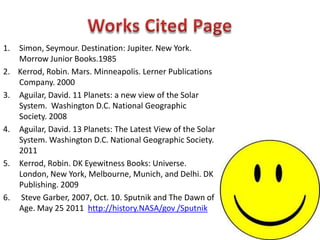
Welcome  everybody, to the planetary tour of all the planets. This will be an amazing journey to view things you have never seen before. First we will visit Mercury, Venus, Earth and Mars. Then we would visit Jupiter, Saturn, Uranus, and Neptune. There will be interesting facts about celestial bodies such as, the Oort cloud, dwarf planets,  and the Asteroid Belt, which separates the terrestrial planets from the Jovian planets. So get ready, buckle your seat belt and get ready for a jam packed, adventurous tour of the planets!!!!!!!!
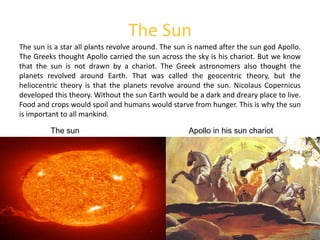
The SunThe sun is a star all plants revolve around. The sun is named after the sun god Apollo. The Greeks thought Apollo carried the sun across the sky is his chariot. But we know that the sun is not drawn by a chariot. The Greek astronomers also thought the  planets revolved around Earth. That was called the geocentric theory, but the heliocentric theory is that the planets revolve around the sun. Nicolaus Copernicus developed this theory. Without the sun Earth would be a dark and dreary place to live. Food and crops would spoil and humans would starve from hunger. This is why the sun is important to all mankind.Apollo in his sun chariotThe sun
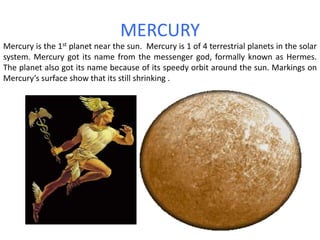
MERCURYMercury is the 1st planet near the sun.  Mercury is 1 of 4 terrestrial planets in the solar system. Mercury got its name from the messenger god, formally known as Hermes. The planet also got its name because of its speedy orbit around the sun. Markings on Mercury’s surface show that its still shrinking .
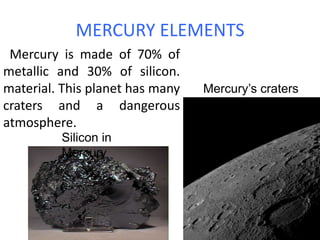
MERCURY ELEMENTS  Mercury is made of 70% of metallic and 30% of silicon. material. This planet has many craters and a dangerous             atmosphere. Mercury’s cratersSilicon in Mercury
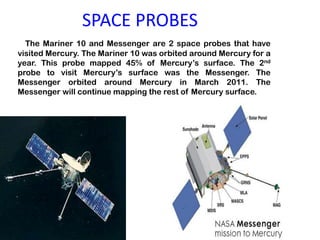
SPACE PROBES The Mariner 10 and Messenger are 2 space probes that have visited Mercury. The Mariner 10 was orbited around Mercury for a year. This probe mapped 45% of Mercury’s surface. The 2nd probe to visit Mercury’s surface was the Messenger. The Messenger orbited around Mercury in March 2011. The Messenger will continue mapping the rest of Mercury surface.
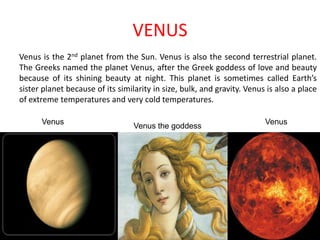
VENUSVenus is the 2nd planet from the Sun. Venus is also the second terrestrial planet. The Greeks named the planet Venus, after the Greek goddess of love and beauty because of its shining beauty at night. This planet is sometimes called Earth’s sister planet because of its similarity in size, bulk, and gravity. Venus is also a place  of extreme temperatures and very cold temperatures.VenusVenusVenus the goddess
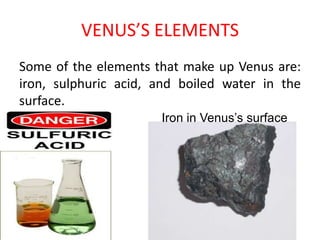
VENUS’S ELEMENTSSome of the elements that make up Venus are: iron, sulphuric acid, and boiled water in the surface.   Iron in Venus’s surface
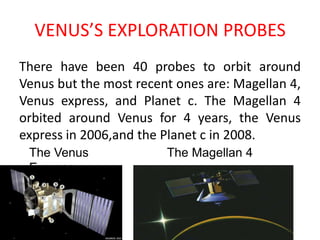
VENUS’S EXPLORATION PROBESThere have been 40 probes to orbit around Venus but the most recent ones are: Magellan 4, Venus express, and Planet c. The Magellan 4 orbited around Venus for 4 years, the Venus express in 2006,and the Planet c in 2008.The Venus ExpressThe Magellan 4
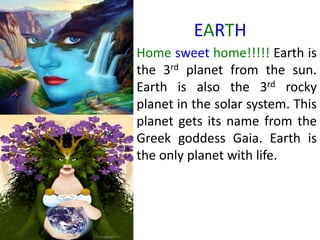
EARTHHome sweet home!!!!! Earth is the 3rd planet from the sun. Earth is also the 3rd rocky planet in the solar system. This planet gets its name from the Greek goddess Gaia. Earth is the only planet with life.
EARTH’S ELEMENTS
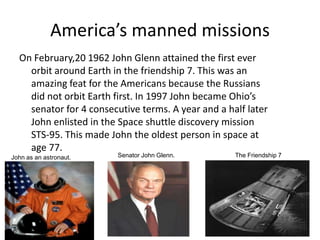
America’s manned missionsOn February,20 1962 John Glenn attained the first ever orbit around Earth in the friendship 7. This was an amazing feat for the Americans because the Russians did not orbit Earth first. In 1997 John became Ohio’s senator for 4 consecutive terms. A year and a half later John enlisted in the Space shuttle discovery mission STS-95. This made John the oldest person in space at age 77. Senator John Glenn.The Friendship 7John as an astronaut.
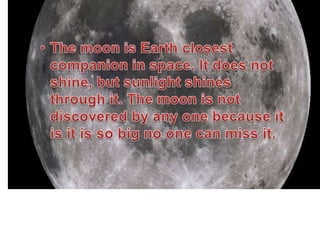
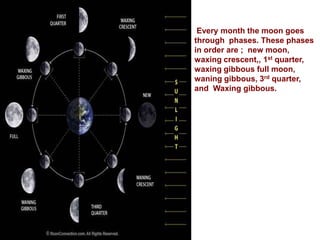
EARTH’S MOONThe moon is Earth closest companion in space. It does not shine, but sunlight shines through it. The moon is not discovered by any one because it is it is so big no one can miss it. Every month the moon goes through  phases. These phases in order are ;  new moon, waxing crescent,, 1st quarter,  waxing gibbous full moon, waning gibbous, 3rd quarter, and  Waxing gibbous.
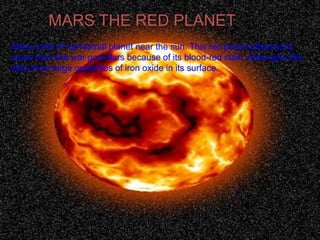
MARS THE RED PLANETMars is the 4th terrestrial planet near the sun. This red planet attained its name from the war god Mars because of its blood-red stain. Mars gets this stain from large quantities of iron oxide in its surface.
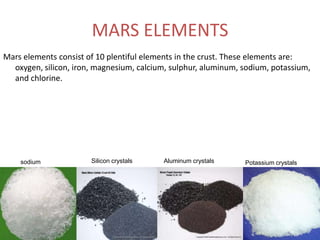
MARS ELEMENTSMars elements consist of 10 plentiful elements in the crust. These elements are: oxygen, silicon, iron, magnesium, calcium, sulphur, aluminum, sodium, potassium, and chlorine.Silicon crystalsAluminum crystals      sodiumPotassium crystals
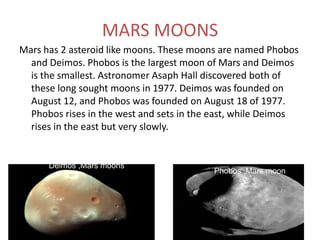
MARS MOONSMars has 2 asteroid like moons. These moons are named Phobos and Deimos. Phobos is the largest moon of Mars and Deimos is the smallest. Astronomer Asaph Hall discovered both of these long sought moons in 1977. Deimos was founded on August 12, and Phobos was founded on August 18 of 1977. Phobos rises in the west and sets in the east, while Deimos rises in the east but very slowly.Deimos ,Mars moonsPhobos ,Mars moon
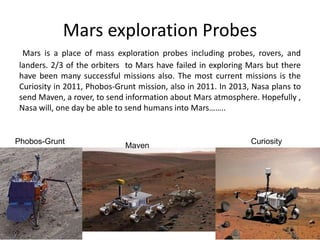
Mars exploration ProbesMars is a place of mass exploration probes including probes, rovers, and landers. 2/3 of the orbiters  to Mars have failed in exploring Mars but there have been many successful missions also. The most current missions is the Curiosity in 2011, Phobos-Grunt mission, also in 2011. In 2013, Nasa plans to send Maven, a rover, to send information about Mars atmosphere. Hopefully , Nasa will, one day be able to send humans into Mars…….. CuriosityPhobos-GruntMaven
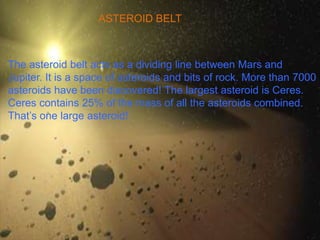
CERES/ASTEROID BELTASTEROID BELTThe asteroid belt acts as a dividing line between Mars and Jupiter. It is a space of asteroids and bits of rock. More than 7000 asteroids have been discovered! The largest asteroid is Ceres. Ceres contains 25% of the mass of all the asteroids combined. That’s one large asteroid!
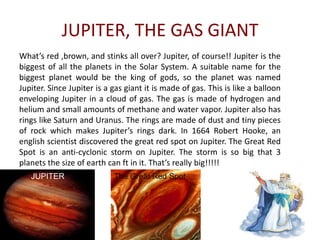
JUPITER, THE GAS GIANTWhat’s red ,brown, and stinks all over? Jupiter, of course!! Jupiter is the biggest of all the planets in the Solar System. A suitable name for the biggest planet would be the king of gods, so the planet was named Jupiter. Since Jupiter is a gas giant it is made of gas. This is like a balloon enveloping Jupiter in a cloud of gas. The gas is made of hydrogen and helium and small amounts of methane and water vapor. Jupiter also has rings like Saturn and Uranus. The rings are made of dust and tiny pieces of rock which makes Jupiter’s rings dark. In 1664 Robert Hooke, an english scientist discovered the great red spot on Jupiter. The Great Red Spot is an anti-cyclonic storm on Jupiter. The storm is so big that 3 planets the size of earth can ft in it. That’s really big!!!!!JUPITERThe Great Red Spot
Jupiter’s Elements Jupiter is mainly composed of hydrogen with a quarter of the mass being helium and methane mixed in therefore making it an un-solid surface to walk on. Jupiter may also contain a core of heavier  elements.
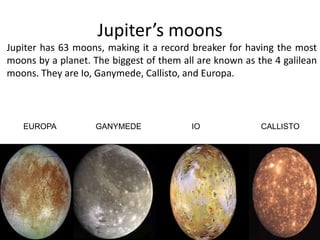
Jupiter’s moonsJupiter has 63 moons, making it a record breaker for having the most moons by a planet. The biggest of them all are known as the 4 galilean moons. They are Io, Ganymede, Callisto, and Europa.IOCALLISTOGANYMEDEEUROPA
Io is the 4th largest moon in the Solar System. This moon has over 400 active volcanoes making it the most geologically active moon. Unlike most moons that are composed of ice, Io is composed of silicate rock with a molten or iron sulfide core.
Ganymede is the biggest moon in the Solar System. Scientists believe there is a salt water ocean underneath the crust in between the ice layers.
Callisto is the 3rd largest moon in the Solar System. It is heavily craterous and very old.
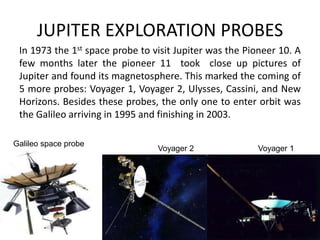
Europa is the smallest of the Galilean moons, slightly smaller than the moon. It is primarily made of silicate rock and has an iron core. It has many cracks and streaks across its surface.JUPITER EXPLORATION PROBESIn 1973 the 1st space probe to visit Jupiter was the Pioneer 10. A few months later the pioneer 11  took  close up pictures of Jupiter and found its magnetosphere. This marked the coming of 5 more probes: Voyager 1, Voyager 2, Ulysses, Cassini, and New Horizons. Besides these probes, the only one to enter orbit was the Galileo arriving in 1995 and finishing in 2003.Galileo space probeVoyager 1Voyager 2
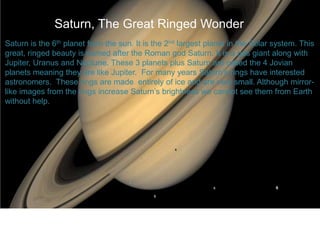
       Saturn, The Great Ringed WonderSaturn is the 6th planet from the sun. It is the 2nd largest planet in the Solar system. This great, ringed beauty is named after the Roman god Saturn. It is a gas giant along with Jupiter, Uranus and Neptune. These 3 planets plus Saturn are called the 4 Jovian planets meaning they are like Jupiter.  For many years Saturn’s rings have interested astronomers.  These rings are made  entirely of ice and are very small. Although mirror-like images from the rings increase Saturn’s brightness we cannot see them from Earth without help.
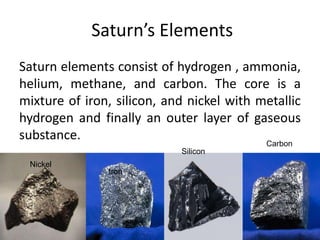
 Saturn’s Elements Saturn elements consist of hydrogen , ammonia, helium, methane, and carbon. The core is a mixture of iron, silicon, and nickel with metallic hydrogen and finally an outer layer of gaseous substance.CarbonSiliconNickelIron
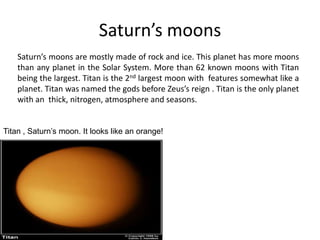
Saturn’s moons Saturn’s moons are mostly made of rock and ice. This planet has more moons than any planet in the Solar System. More than 62 known moons with Titan being the largest. Titan is the 2nd largest moon with  features somewhat like a planet. Titan was named the gods before Zeus’s reign . Titan is the only planet with an  thick, nitrogen, atmosphere and seasons.Titan , Saturn’s moon. It looks like an orange!
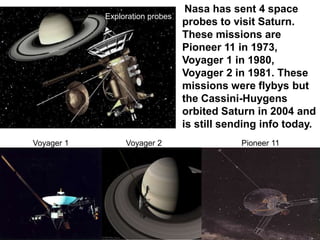
Nasa has sent 4 space probes to visit Saturn. These missions are Pioneer 11 in 1973, Voyager 1 in 1980, Voyager 2 in 1981. These missions were flybys but the Cassini-Huygens orbited Saturn in 2004 and is still sending info today. Exploration probesPioneer 11Voyager 2Voyager 1
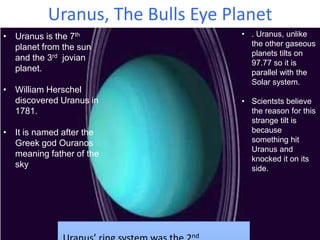
Uranus, The Bulls Eye Planet . Uranus, unlike the other gaseous planets tilts on 97.77 so it is parallel with the Solar system.
Scientstsbelieve the reason for this strange tilt is because something hit Uranus and knocked it on its side.
Uranus is the 7th planet from the sun and the 3rdjovian planet.
William Herschel discovered Uranus in 1781.
It is named after the Greek god Ouranos meaning father of the skyUranus’ ring system was the 2nd discovered after Saturns, The rings are made of dark particles.  Presently 13 rings  are known, the brightest being ring E.
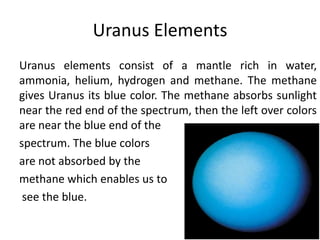
Uranus ElementsUranus elements consist of a mantle rich in water, ammonia, helium, hydrogen and methane. The methane gives Uranus its blue color. The methane absorbs sunlight near the red end of the spectrum, then the left over colors are near the blue end of the spectrum. The blue colors are not absorbed by the methane which enables us to see the blue.
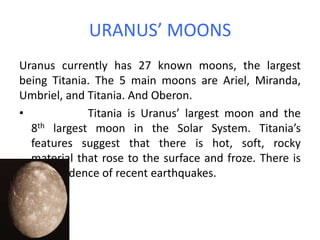
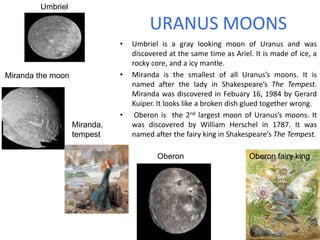
URANUS’ MOONSUranus currently has 27 known moons, the largest being Titania. The 5 main moons are Ariel, Miranda, Umbriel, and Titania. And Oberon.Titaniais Uranus’ largest moon and the 8th largest moon in the Solar System. Titania’s features suggest that there is hot, soft, rocky material that rose to the surface and froze. There is also evidence of recent earthquakes.Ariel is the brightest of Uranus’s moons and the 4th largest. Ariel was discovered on October 24, 1851 by William Lassel. Ariel is named after a spirit in Shakespeare’s The Tempest. Ariel appears to have a younger surface and fewer impact craters than Umbriel.UmbrielURANUS MOONSUmbriel is a gray looking moon of Uranus and was discovered at the same time as Ariel. It is made of ice, a rocky core, and a icy mantle.
Miranda is the smallest of all Uranus’s moons. It is named after the lady in Shakespeare’s The Tempest. Miranda was discovered in Febuary 16, 1984 by Gerard Kuiper. It looks like a broken dish glued together wrong.
Oberon is  the 2nd largest moon of Uranus’s moons. It was discovered by William Herschel in 1787. It was named after the fairy king in Shakespeare’s The Tempest.Miranda the moonUmbriel the moonMiranda, tempestOberonOberon fairy king
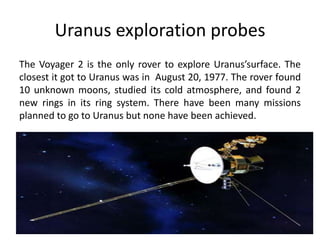
Uranus exploration probesThe Voyager 2 is the only rover to explore Uranus’surface. The closest it got to Uranus was in  August 20, 1977. The rover found 10 unknown moons, studied its cold atmosphere, and found 2 new rings in its ring system. There have been many missions planned to go to Uranus but none have been achieved.
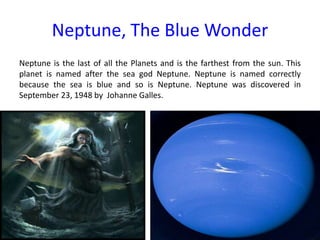
Neptune, The Blue WonderNeptune is the last of all the Planets and is the farthest from the sun. This planet is named after the sea god Neptune. Neptune is named correctly because the sea is blue and so is Neptune. Neptune was discovered in September 23, 1948 by  JohanneGalles.
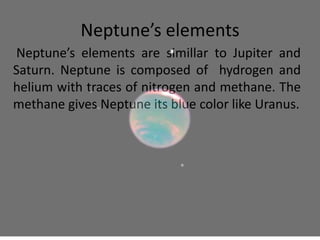
Neptune’s elements Neptune’s elements are simillar to Jupiter and Saturn. Neptune is composed of  hydrogen and helium with traces of nitrogen and methane. The methane gives Neptune its blue color like Uranus.
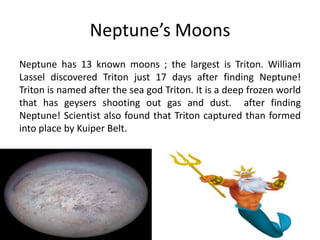
Neptune’s MoonsNeptune has 13 known moons ; the largest is Triton. William Lassel discovered Triton just 17 days after finding Neptune!  Triton is named after the sea god Triton. It is a deep frozen world that has geysers shooting out gas and dust.  after finding Neptune! Scientist also found that Triton captured than formed into place by Kuiper Belt.
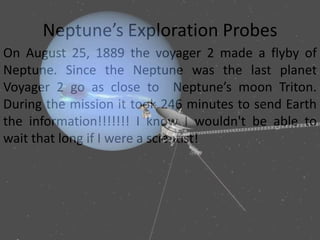
Neptune’sExplorationProbesOn August 25, 1889 the voyager 2 made a flyby of Neptune. Since the Neptune was the last planet Voyager 2 go as close to  Neptune’s moon Triton. During the mission it took 246 minutes to send Earth the information!!!!!!! I know I wouldn't be able to wait that long if I were a scientist!
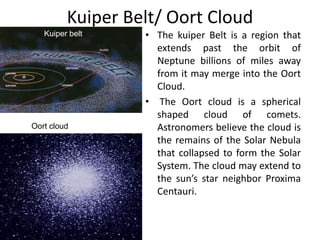
Kuiper Belt/ Oort CloudThe kuiper Belt is a region that extends past the orbit of Neptune billions of miles away from it may merge into the Oort Cloud.
 The Oort cloud is a spherical shaped cloud of comets. Astronomers believe the cloud is the remains of the Solar Nebula that collapsed to form the Solar System. The cloud may extend to the sun’s star neighbor Proxima Centauri.Kuiper beltOort cloud
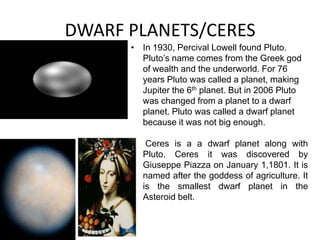
DWARF PLANETS/CERESIn 1930, Percival Lowell found Pluto. Pluto’s name comes from the Greek god of wealth and the underworld. For 76 years Pluto was called a planet, making Jupiter the 6th planet. But in 2006 Pluto was changed from a planet to a dwarf planet. Pluto was called a dwarf planet because it was not big enough.

Taylin final planet

  • 1.
    Welcome everybody,to the planetary tour of all the planets. This will be an amazing journey to view things you have never seen before. First we will visit Mercury, Venus, Earth and Mars. Then we would visit Jupiter, Saturn, Uranus, and Neptune. There will be interesting facts about celestial bodies such as, the Oort cloud, dwarf planets, and the Asteroid Belt, which separates the terrestrial planets from the Jovian planets. So get ready, buckle your seat belt and get ready for a jam packed, adventurous tour of the planets!!!!!!!!
  • 2.
    The SunThe sunis a star all plants revolve around. The sun is named after the sun god Apollo. The Greeks thought Apollo carried the sun across the sky is his chariot. But we know that the sun is not drawn by a chariot. The Greek astronomers also thought the planets revolved around Earth. That was called the geocentric theory, but the heliocentric theory is that the planets revolve around the sun. Nicolaus Copernicus developed this theory. Without the sun Earth would be a dark and dreary place to live. Food and crops would spoil and humans would starve from hunger. This is why the sun is important to all mankind.Apollo in his sun chariotThe sun
  • 3.
    MERCURYMercury is the1st planet near the sun. Mercury is 1 of 4 terrestrial planets in the solar system. Mercury got its name from the messenger god, formally known as Hermes. The planet also got its name because of its speedy orbit around the sun. Markings on Mercury’s surface show that its still shrinking .
  • 4.
    MERCURY ELEMENTS Mercury is made of 70% of metallic and 30% of silicon. material. This planet has many craters and a dangerous atmosphere. Mercury’s cratersSilicon in Mercury
  • 5.
    SPACE PROBES TheMariner 10 and Messenger are 2 space probes that have visited Mercury. The Mariner 10 was orbited around Mercury for a year. This probe mapped 45% of Mercury’s surface. The 2nd probe to visit Mercury’s surface was the Messenger. The Messenger orbited around Mercury in March 2011. The Messenger will continue mapping the rest of Mercury surface.
  • 6.
    VENUSVenus is the2nd planet from the Sun. Venus is also the second terrestrial planet. The Greeks named the planet Venus, after the Greek goddess of love and beauty because of its shining beauty at night. This planet is sometimes called Earth’s sister planet because of its similarity in size, bulk, and gravity. Venus is also a place of extreme temperatures and very cold temperatures.VenusVenusVenus the goddess
  • 7.
    VENUS’S ELEMENTSSome ofthe elements that make up Venus are: iron, sulphuric acid, and boiled water in the surface. Iron in Venus’s surface
  • 8.
    VENUS’S EXPLORATION PROBESTherehave been 40 probes to orbit around Venus but the most recent ones are: Magellan 4, Venus express, and Planet c. The Magellan 4 orbited around Venus for 4 years, the Venus express in 2006,and the Planet c in 2008.The Venus ExpressThe Magellan 4
  • 9.
    EARTHHome sweet home!!!!!Earth is the 3rd planet from the sun. Earth is also the 3rd rocky planet in the solar system. This planet gets its name from the Greek goddess Gaia. Earth is the only planet with life.
  • 10.
  • 11.
    America’s manned missionsOnFebruary,20 1962 John Glenn attained the first ever orbit around Earth in the friendship 7. This was an amazing feat for the Americans because the Russians did not orbit Earth first. In 1997 John became Ohio’s senator for 4 consecutive terms. A year and a half later John enlisted in the Space shuttle discovery mission STS-95. This made John the oldest person in space at age 77. Senator John Glenn.The Friendship 7John as an astronaut.
  • 12.
    EARTH’S MOONThe moonis Earth closest companion in space. It does not shine, but sunlight shines through it. The moon is not discovered by any one because it is it is so big no one can miss it. Every month the moon goes through phases. These phases in order are ; new moon, waxing crescent,, 1st quarter, waxing gibbous full moon, waning gibbous, 3rd quarter, and Waxing gibbous.
  • 13.
    MARS THE REDPLANETMars is the 4th terrestrial planet near the sun. This red planet attained its name from the war god Mars because of its blood-red stain. Mars gets this stain from large quantities of iron oxide in its surface.
  • 14.
    MARS ELEMENTSMars elementsconsist of 10 plentiful elements in the crust. These elements are: oxygen, silicon, iron, magnesium, calcium, sulphur, aluminum, sodium, potassium, and chlorine.Silicon crystalsAluminum crystals sodiumPotassium crystals
  • 15.
    MARS MOONSMars has2 asteroid like moons. These moons are named Phobos and Deimos. Phobos is the largest moon of Mars and Deimos is the smallest. Astronomer Asaph Hall discovered both of these long sought moons in 1977. Deimos was founded on August 12, and Phobos was founded on August 18 of 1977. Phobos rises in the west and sets in the east, while Deimos rises in the east but very slowly.Deimos ,Mars moonsPhobos ,Mars moon
  • 16.
    Mars exploration ProbesMarsis a place of mass exploration probes including probes, rovers, and landers. 2/3 of the orbiters to Mars have failed in exploring Mars but there have been many successful missions also. The most current missions is the Curiosity in 2011, Phobos-Grunt mission, also in 2011. In 2013, Nasa plans to send Maven, a rover, to send information about Mars atmosphere. Hopefully , Nasa will, one day be able to send humans into Mars…….. CuriosityPhobos-GruntMaven
  • 17.
    CERES/ASTEROID BELTASTEROID BELTTheasteroid belt acts as a dividing line between Mars and Jupiter. It is a space of asteroids and bits of rock. More than 7000 asteroids have been discovered! The largest asteroid is Ceres. Ceres contains 25% of the mass of all the asteroids combined. That’s one large asteroid!
  • 18.
    JUPITER, THE GASGIANTWhat’s red ,brown, and stinks all over? Jupiter, of course!! Jupiter is the biggest of all the planets in the Solar System. A suitable name for the biggest planet would be the king of gods, so the planet was named Jupiter. Since Jupiter is a gas giant it is made of gas. This is like a balloon enveloping Jupiter in a cloud of gas. The gas is made of hydrogen and helium and small amounts of methane and water vapor. Jupiter also has rings like Saturn and Uranus. The rings are made of dust and tiny pieces of rock which makes Jupiter’s rings dark. In 1664 Robert Hooke, an english scientist discovered the great red spot on Jupiter. The Great Red Spot is an anti-cyclonic storm on Jupiter. The storm is so big that 3 planets the size of earth can ft in it. That’s really big!!!!!JUPITERThe Great Red Spot
  • 19.
    Jupiter’s Elements Jupiteris mainly composed of hydrogen with a quarter of the mass being helium and methane mixed in therefore making it an un-solid surface to walk on. Jupiter may also contain a core of heavier elements.
  • 20.
    Jupiter’s moonsJupiter has63 moons, making it a record breaker for having the most moons by a planet. The biggest of them all are known as the 4 galilean moons. They are Io, Ganymede, Callisto, and Europa.IOCALLISTOGANYMEDEEUROPA
  • 21.
    Io is the4th largest moon in the Solar System. This moon has over 400 active volcanoes making it the most geologically active moon. Unlike most moons that are composed of ice, Io is composed of silicate rock with a molten or iron sulfide core.
  • 22.
    Ganymede is thebiggest moon in the Solar System. Scientists believe there is a salt water ocean underneath the crust in between the ice layers.
  • 23.
    Callisto is the3rd largest moon in the Solar System. It is heavily craterous and very old.
  • 24.
    Europa is thesmallest of the Galilean moons, slightly smaller than the moon. It is primarily made of silicate rock and has an iron core. It has many cracks and streaks across its surface.JUPITER EXPLORATION PROBESIn 1973 the 1st space probe to visit Jupiter was the Pioneer 10. A few months later the pioneer 11 took close up pictures of Jupiter and found its magnetosphere. This marked the coming of 5 more probes: Voyager 1, Voyager 2, Ulysses, Cassini, and New Horizons. Besides these probes, the only one to enter orbit was the Galileo arriving in 1995 and finishing in 2003.Galileo space probeVoyager 1Voyager 2
  • 25.
    Saturn, The Great Ringed WonderSaturn is the 6th planet from the sun. It is the 2nd largest planet in the Solar system. This great, ringed beauty is named after the Roman god Saturn. It is a gas giant along with Jupiter, Uranus and Neptune. These 3 planets plus Saturn are called the 4 Jovian planets meaning they are like Jupiter. For many years Saturn’s rings have interested astronomers. These rings are made entirely of ice and are very small. Although mirror-like images from the rings increase Saturn’s brightness we cannot see them from Earth without help.
  • 26.
    Saturn’s ElementsSaturn elements consist of hydrogen , ammonia, helium, methane, and carbon. The core is a mixture of iron, silicon, and nickel with metallic hydrogen and finally an outer layer of gaseous substance.CarbonSiliconNickelIron
  • 27.
    Saturn’s moons Saturn’smoons are mostly made of rock and ice. This planet has more moons than any planet in the Solar System. More than 62 known moons with Titan being the largest. Titan is the 2nd largest moon with features somewhat like a planet. Titan was named the gods before Zeus’s reign . Titan is the only planet with an thick, nitrogen, atmosphere and seasons.Titan , Saturn’s moon. It looks like an orange!
  • 28.
    Nasa has sent4 space probes to visit Saturn. These missions are Pioneer 11 in 1973, Voyager 1 in 1980, Voyager 2 in 1981. These missions were flybys but the Cassini-Huygens orbited Saturn in 2004 and is still sending info today. Exploration probesPioneer 11Voyager 2Voyager 1
  • 29.
    Uranus, The BullsEye Planet . Uranus, unlike the other gaseous planets tilts on 97.77 so it is parallel with the Solar system.
  • 30.
    Scientstsbelieve the reasonfor this strange tilt is because something hit Uranus and knocked it on its side.
  • 31.
    Uranus is the7th planet from the sun and the 3rdjovian planet.
  • 32.
  • 33.
    It is namedafter the Greek god Ouranos meaning father of the skyUranus’ ring system was the 2nd discovered after Saturns, The rings are made of dark particles. Presently 13 rings are known, the brightest being ring E.
  • 34.
    Uranus ElementsUranus elementsconsist of a mantle rich in water, ammonia, helium, hydrogen and methane. The methane gives Uranus its blue color. The methane absorbs sunlight near the red end of the spectrum, then the left over colors are near the blue end of the spectrum. The blue colors are not absorbed by the methane which enables us to see the blue.
  • 35.
    URANUS’ MOONSUranus currentlyhas 27 known moons, the largest being Titania. The 5 main moons are Ariel, Miranda, Umbriel, and Titania. And Oberon.Titaniais Uranus’ largest moon and the 8th largest moon in the Solar System. Titania’s features suggest that there is hot, soft, rocky material that rose to the surface and froze. There is also evidence of recent earthquakes.Ariel is the brightest of Uranus’s moons and the 4th largest. Ariel was discovered on October 24, 1851 by William Lassel. Ariel is named after a spirit in Shakespeare’s The Tempest. Ariel appears to have a younger surface and fewer impact craters than Umbriel.UmbrielURANUS MOONSUmbriel is a gray looking moon of Uranus and was discovered at the same time as Ariel. It is made of ice, a rocky core, and a icy mantle.
  • 36.
    Miranda is thesmallest of all Uranus’s moons. It is named after the lady in Shakespeare’s The Tempest. Miranda was discovered in Febuary 16, 1984 by Gerard Kuiper. It looks like a broken dish glued together wrong.
  • 37.
    Oberon is the 2nd largest moon of Uranus’s moons. It was discovered by William Herschel in 1787. It was named after the fairy king in Shakespeare’s The Tempest.Miranda the moonUmbriel the moonMiranda, tempestOberonOberon fairy king
  • 38.
    Uranus exploration probesTheVoyager 2 is the only rover to explore Uranus’surface. The closest it got to Uranus was in August 20, 1977. The rover found 10 unknown moons, studied its cold atmosphere, and found 2 new rings in its ring system. There have been many missions planned to go to Uranus but none have been achieved.
  • 39.
    Neptune, The BlueWonderNeptune is the last of all the Planets and is the farthest from the sun. This planet is named after the sea god Neptune. Neptune is named correctly because the sea is blue and so is Neptune. Neptune was discovered in September 23, 1948 by JohanneGalles.
  • 40.
    Neptune’s elements Neptune’selements are simillar to Jupiter and Saturn. Neptune is composed of hydrogen and helium with traces of nitrogen and methane. The methane gives Neptune its blue color like Uranus.
  • 41.
    Neptune’s MoonsNeptune has13 known moons ; the largest is Triton. William Lassel discovered Triton just 17 days after finding Neptune! Triton is named after the sea god Triton. It is a deep frozen world that has geysers shooting out gas and dust. after finding Neptune! Scientist also found that Triton captured than formed into place by Kuiper Belt.
  • 42.
    Neptune’sExplorationProbesOn August 25,1889 the voyager 2 made a flyby of Neptune. Since the Neptune was the last planet Voyager 2 go as close to Neptune’s moon Triton. During the mission it took 246 minutes to send Earth the information!!!!!!! I know I wouldn't be able to wait that long if I were a scientist!
  • 43.
    Kuiper Belt/ OortCloudThe kuiper Belt is a region that extends past the orbit of Neptune billions of miles away from it may merge into the Oort Cloud.
  • 44.
    The Oortcloud is a spherical shaped cloud of comets. Astronomers believe the cloud is the remains of the Solar Nebula that collapsed to form the Solar System. The cloud may extend to the sun’s star neighbor Proxima Centauri.Kuiper beltOort cloud
  • 45.
    DWARF PLANETS/CERESIn 1930,Percival Lowell found Pluto. Pluto’s name comes from the Greek god of wealth and the underworld. For 76 years Pluto was called a planet, making Jupiter the 6th planet. But in 2006 Pluto was changed from a planet to a dwarf planet. Pluto was called a dwarf planet because it was not big enough.