NEPTUNE


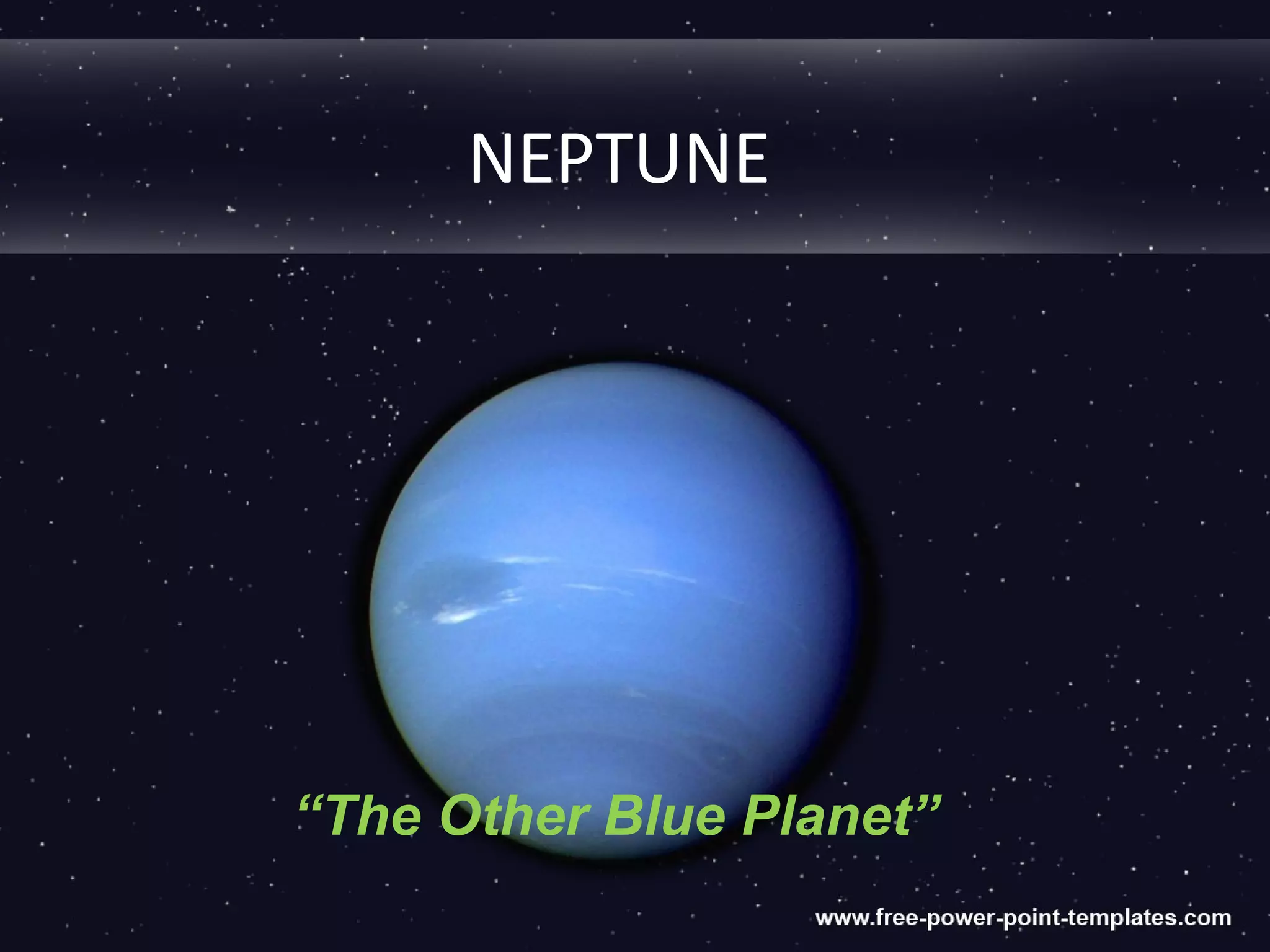
“The Other Blue Planet”
NEPTUNE
• Neptune is one of the four gas giants in our Solar
  System, as well as being one of the four Jovian
  planets.
• As a gas giant, Neptune has no solid surface, so
  even if a spaceship could reach it, it could not land
  because it would simply keep sinking into the planet.
• Neptune cannot be seen with the naked eye and was
  therefore not discovered until 1846.
• Although Neptune is a gas giant, it is actually in a
  subclass of gas giants known as ice giants. It has a
  higher percentage of “ices” in its atmosphere.
Facts about NEPTUNE
•   History of Neptune
•   Characteristics of Neptune
•   Position and Movement of Neptune
•   Neptune’s Moon and Rings
•   Exploration on Neptune
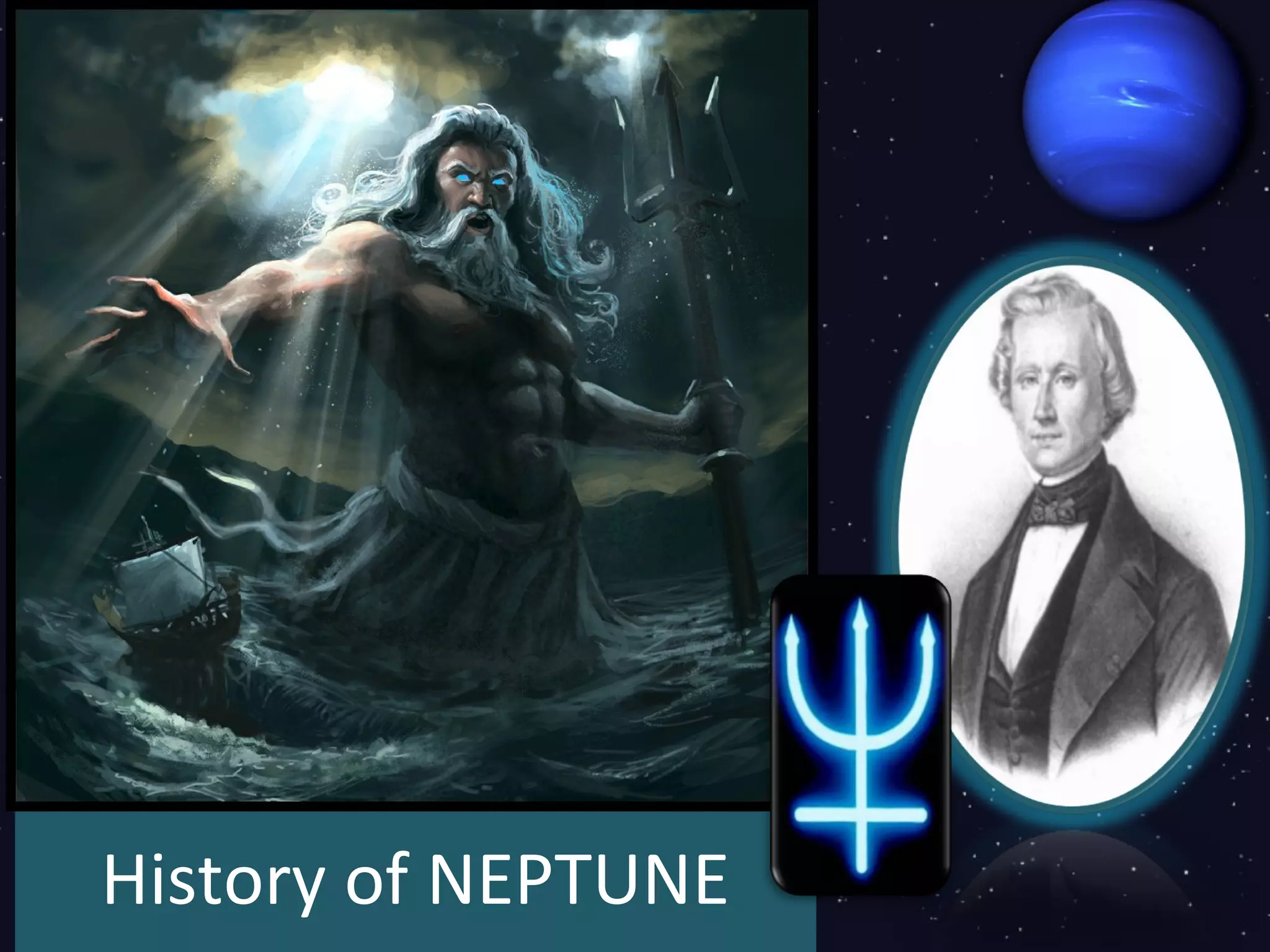
History of NEPTUNE
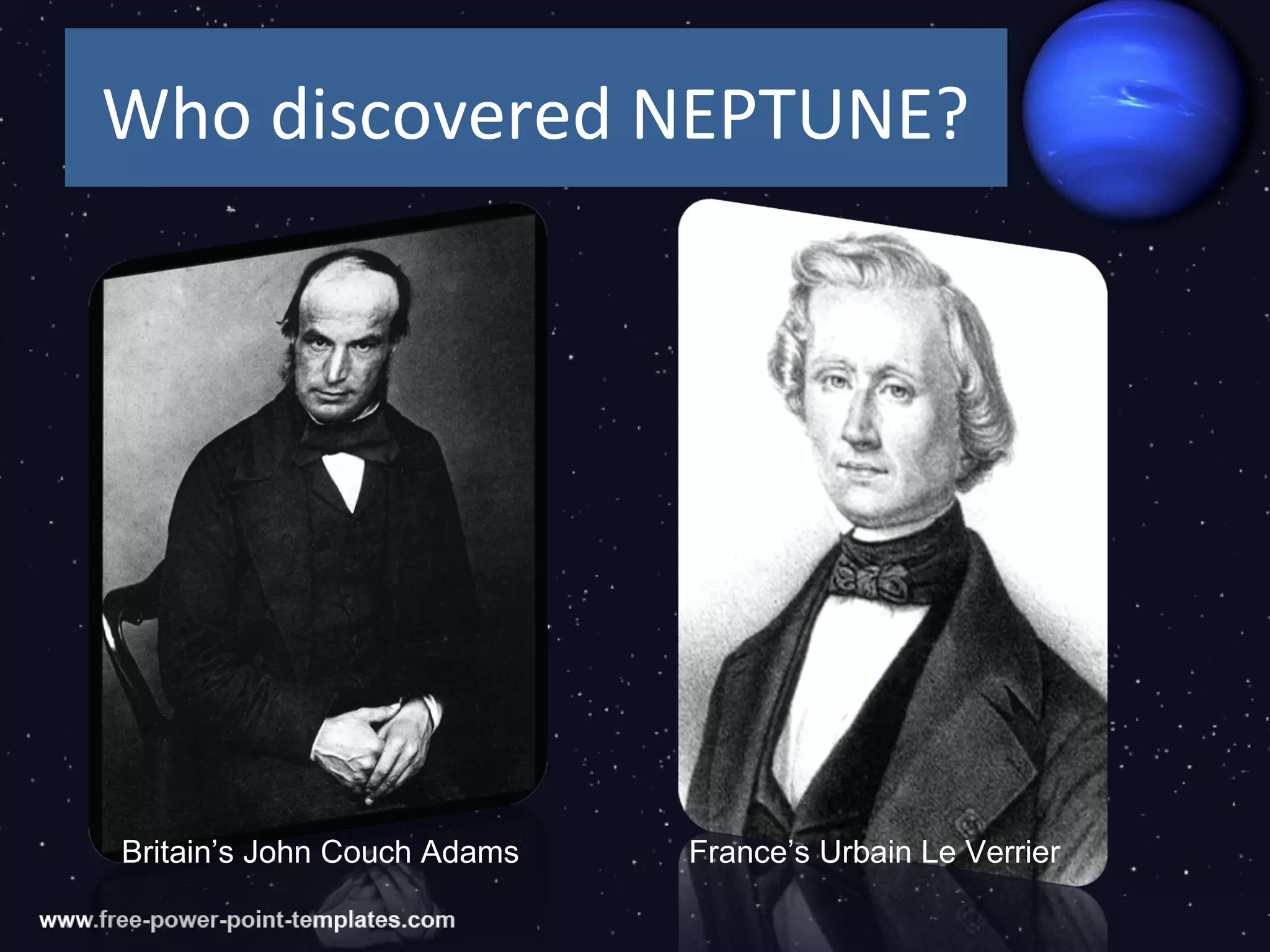
Who discovered NEPTUNE?


Britain’s John Couch Adams   France’s Urbain Le Verrier
Who discovered NEPTUNE?
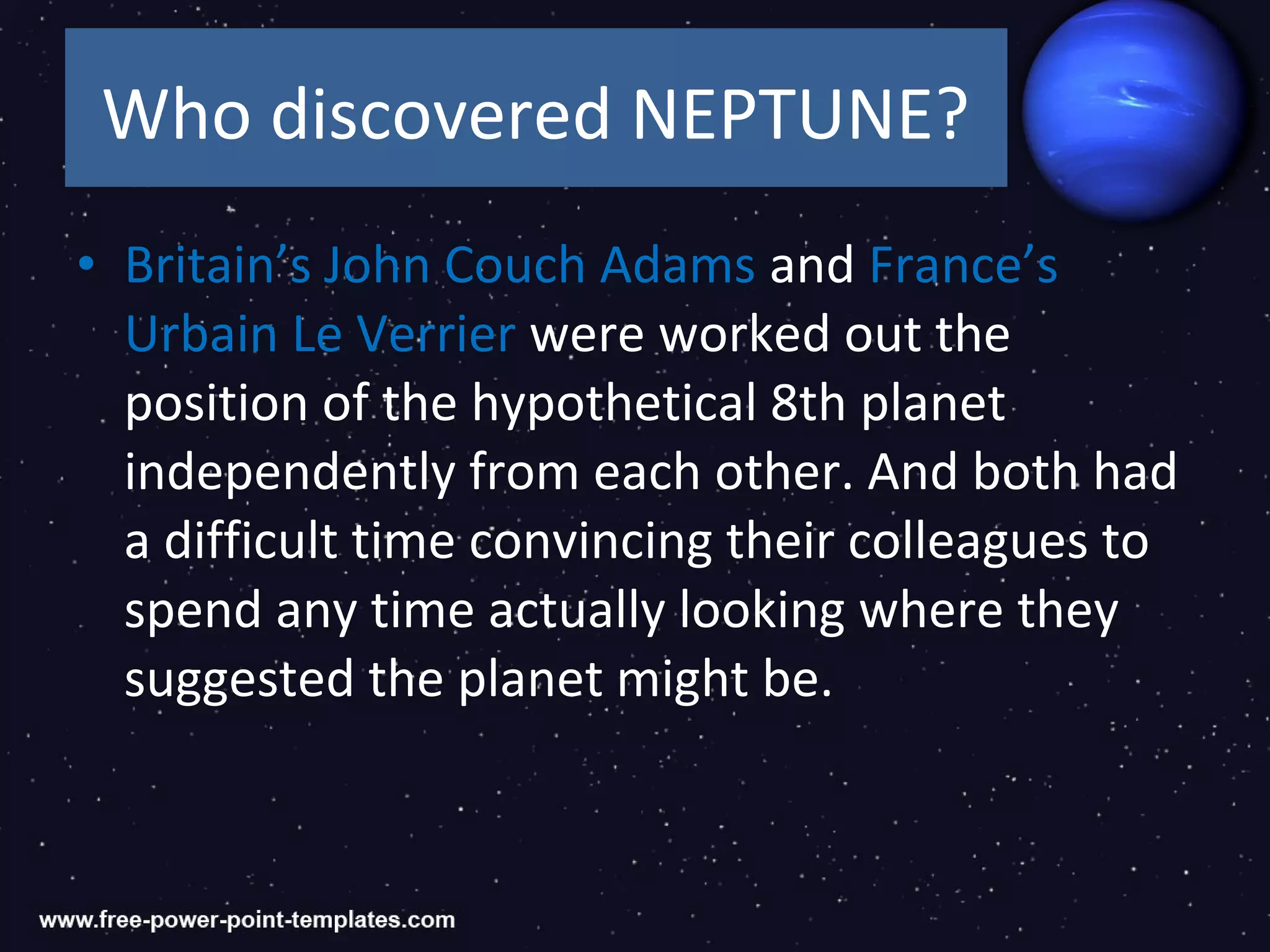
• Britain’s John Couch Adams and France’s
  Urbain Le Verrier were worked out the
  position of the hypothetical 8th planet
  independently from each other. And both had
  a difficult time convincing their colleagues to
  spend any time actually looking where they
  suggested the planet might be.
Who discovered NEPTUNE?
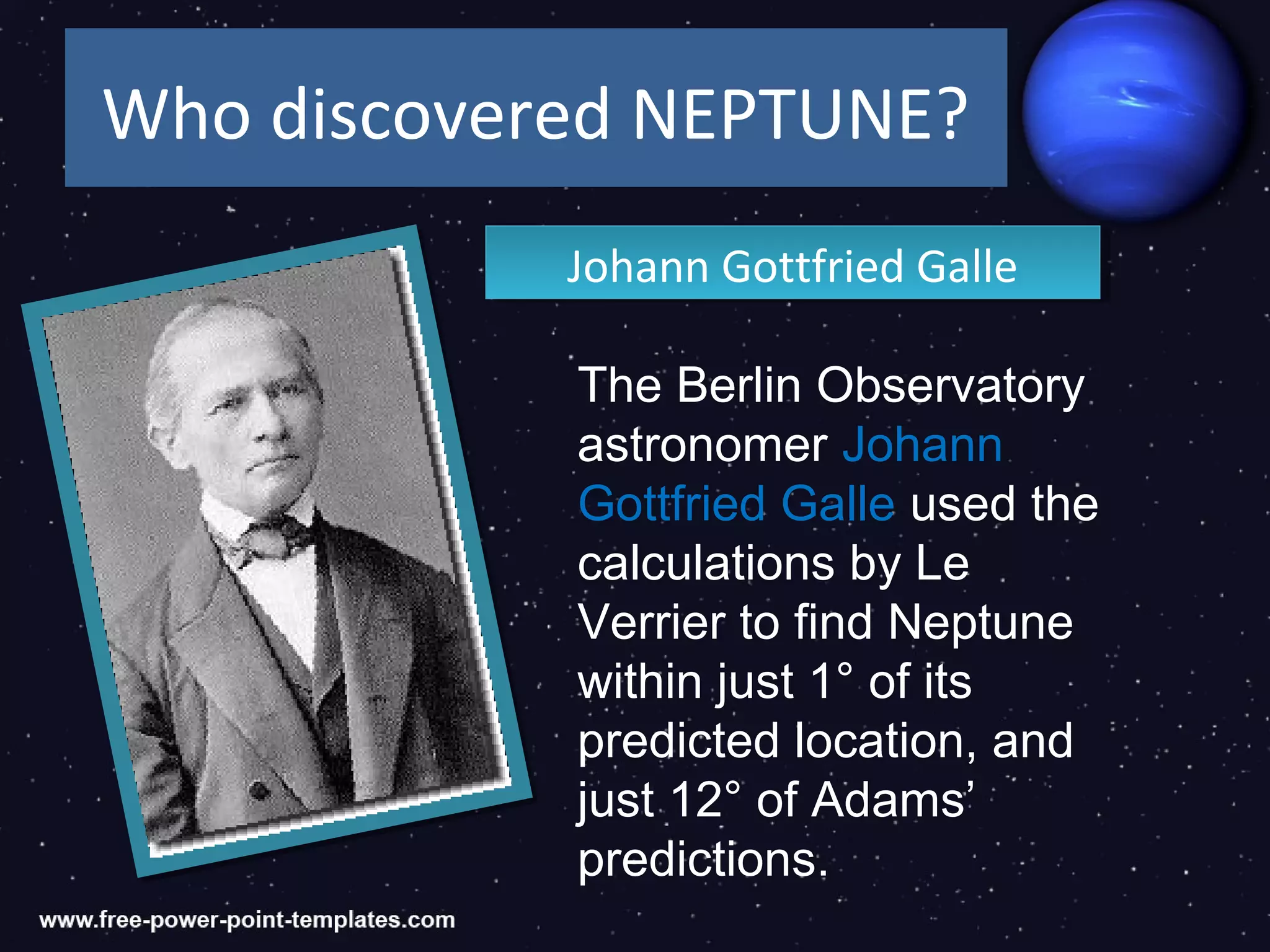
            Johann Gottfried Galle
             Johann Gottfried Galle

            The Berlin Observatory
            astronomer Johann
            Gottfried Galle used the
            calculations by Le
            Verrier to find Neptune
            within just 1° of its
            predicted location, and
            just 12° of Adams’
            predictions.
How did NEPTUNE get its name?

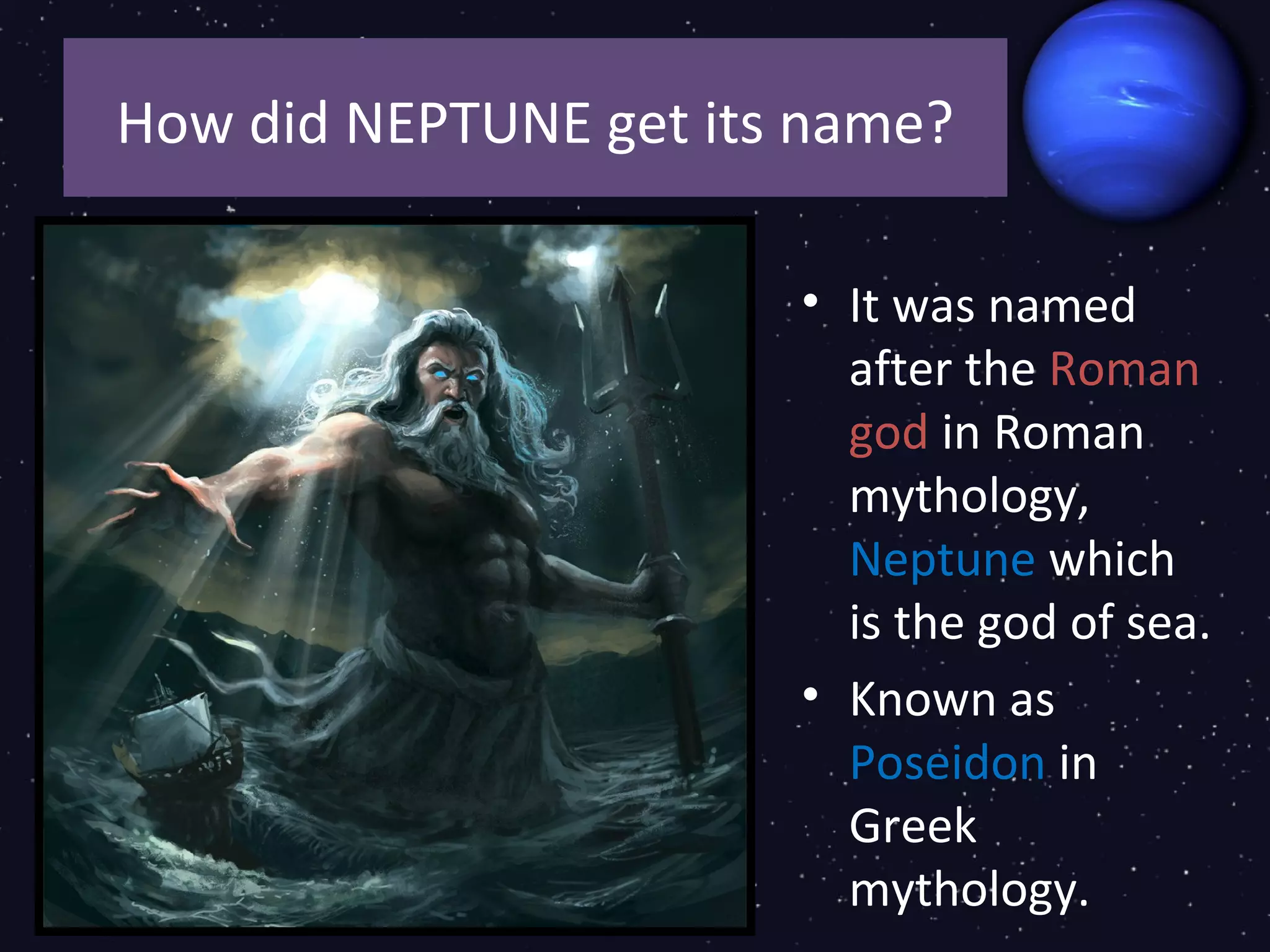
                       • It was named
                         after the Roman
                         god in Roman
                         mythology,
                         Neptune which
                         is the god of sea.
                       • Known as
                         Poseidon in
                         Greek
                         mythology.
How did NEPTUNE get its name?

• Shortly after its discovery, Neptune was only
  referred to as “the planet exterior to Uranus”
  or as “Le Verrier’s planet”.
• The first suggestion for a name came from
  Johann Galle, who proposed the name Janus.
• Another proposal was Oceanus.
• Urbain Le Verrier, who discovered the planet,
  claimed the right to name his discovery:
  Neptune.
Symbol of NEPTUNE


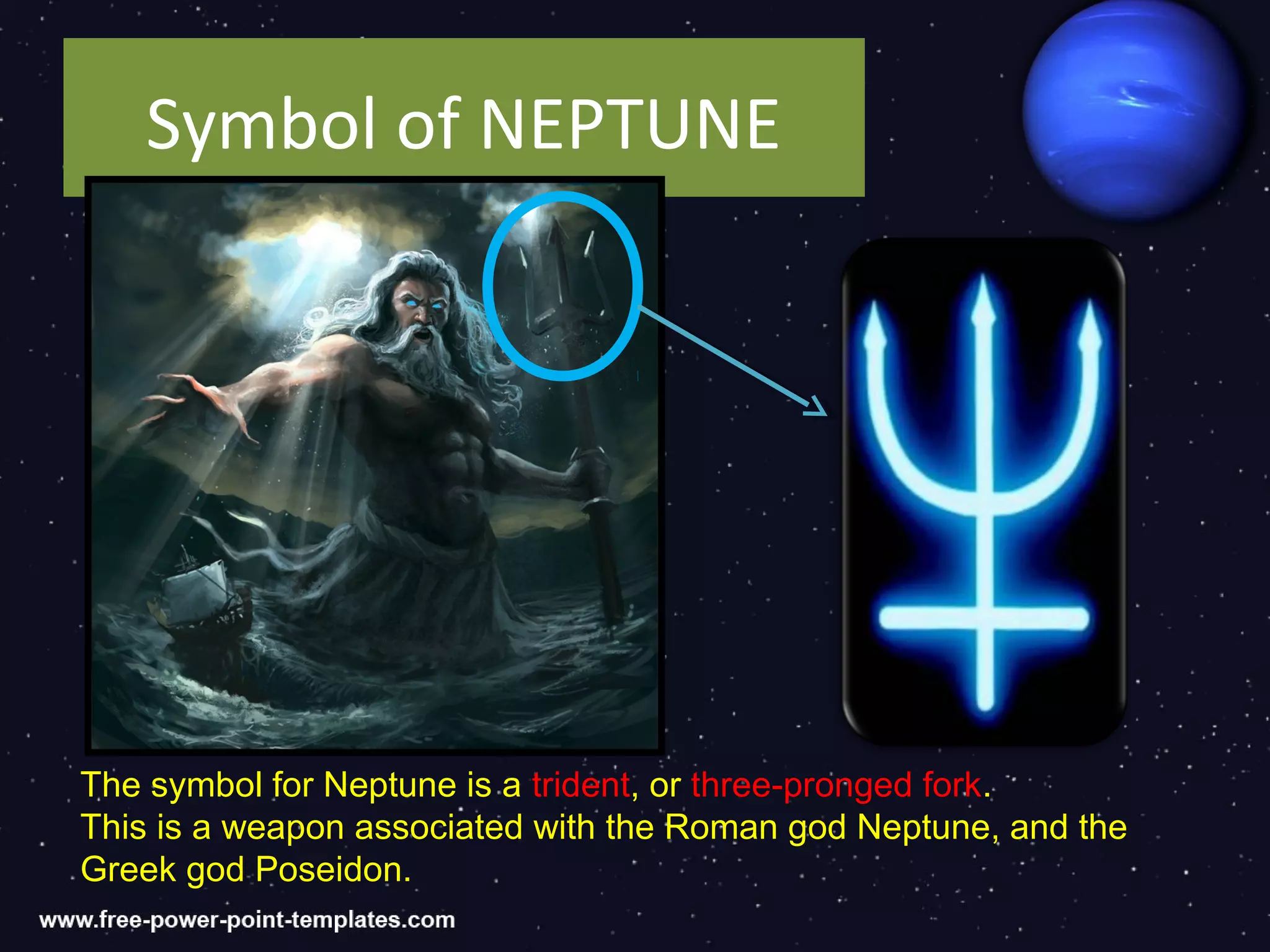
The symbol for Neptune is a trident, or three-pronged fork.
This is a weapon associated with the Roman god Neptune, and the
Greek god Poseidon.
Facts about NEPTUNE
•   History of Neptune
•   Characteristics of Neptune
•   Position and Movement of Neptune
•   Neptune’s Moon and Rings
•   Exploration on Neptune
Characteristics of NEPTUNE
How big NEPTUNE is?
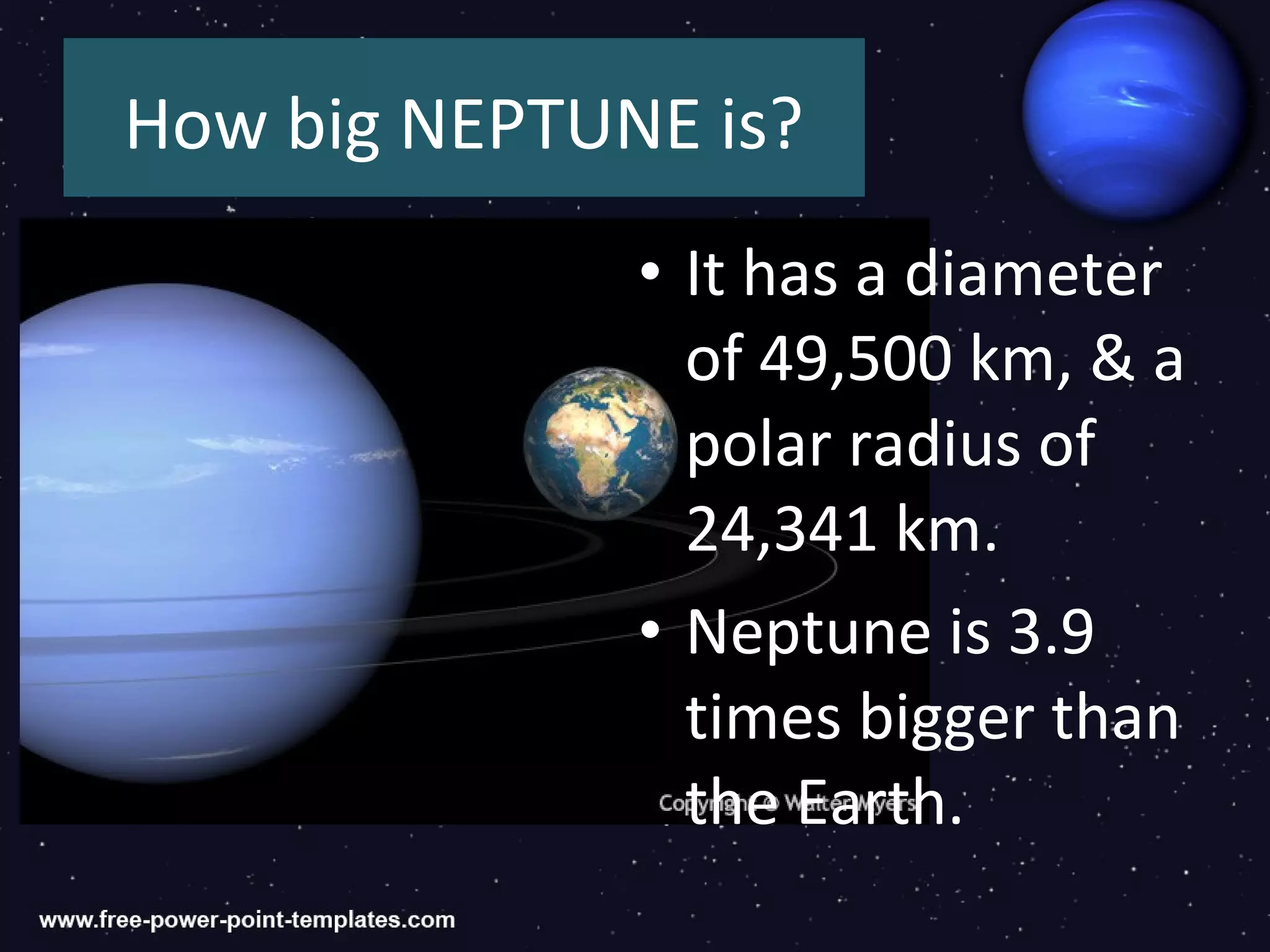
              • It has a diameter
                of 49,500 km, & a
                polar radius of
                24,341 km.
              • Neptune is 3.9
                times bigger than
                the Earth.
What is NEPTUNE made of?
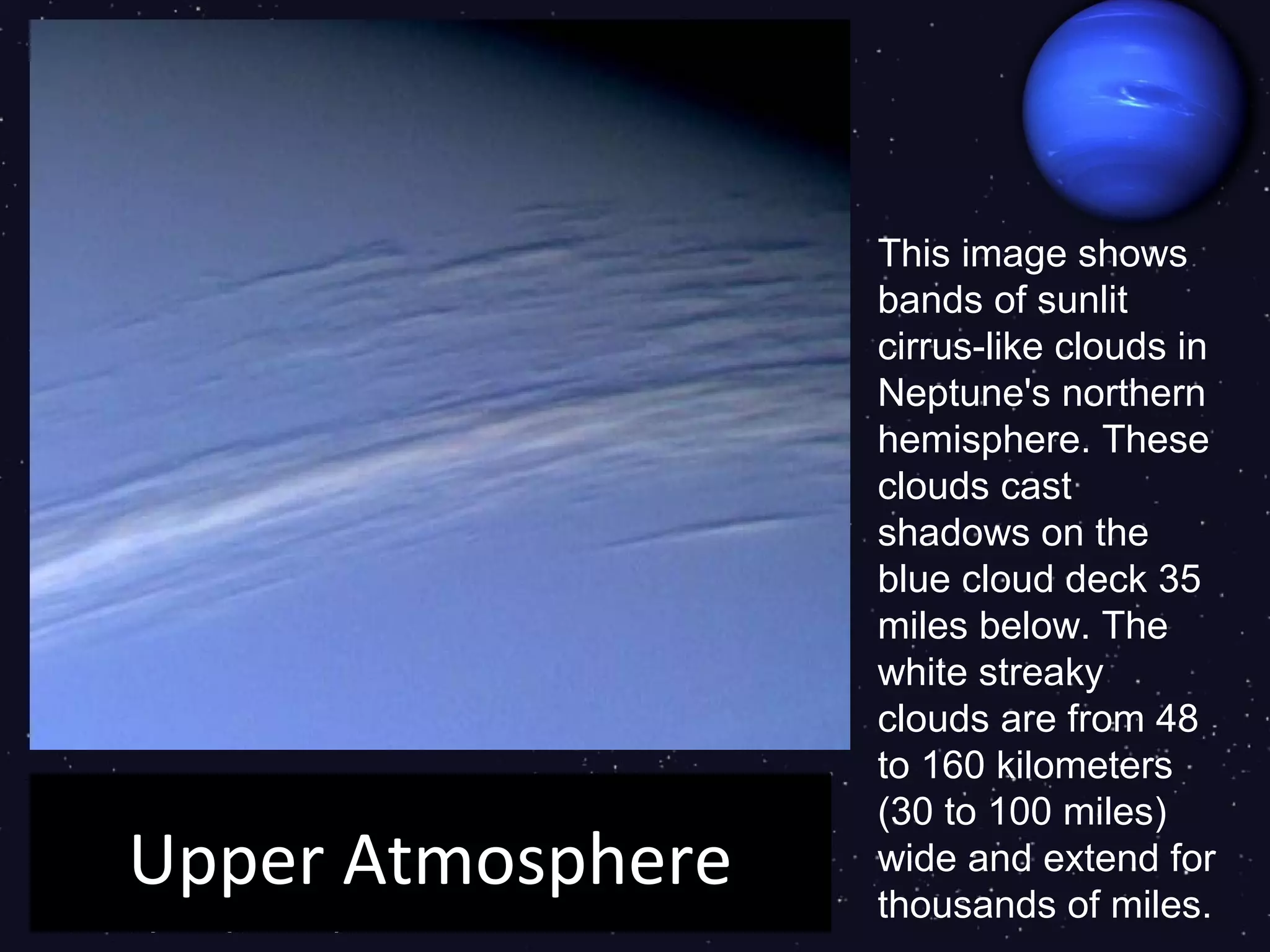
This image shows
                   bands of sunlit
                   cirrus-like clouds in
                   Neptune's northern
                   hemisphere. These
                   clouds cast
                   shadows on the
                   blue cloud deck 35
                   miles below. The
                   white streaky
                   clouds are from 48
                   to 160 kilometers
                   (30 to 100 miles)
Upper Atmosphere   wide and extend for
                   thousands of miles.
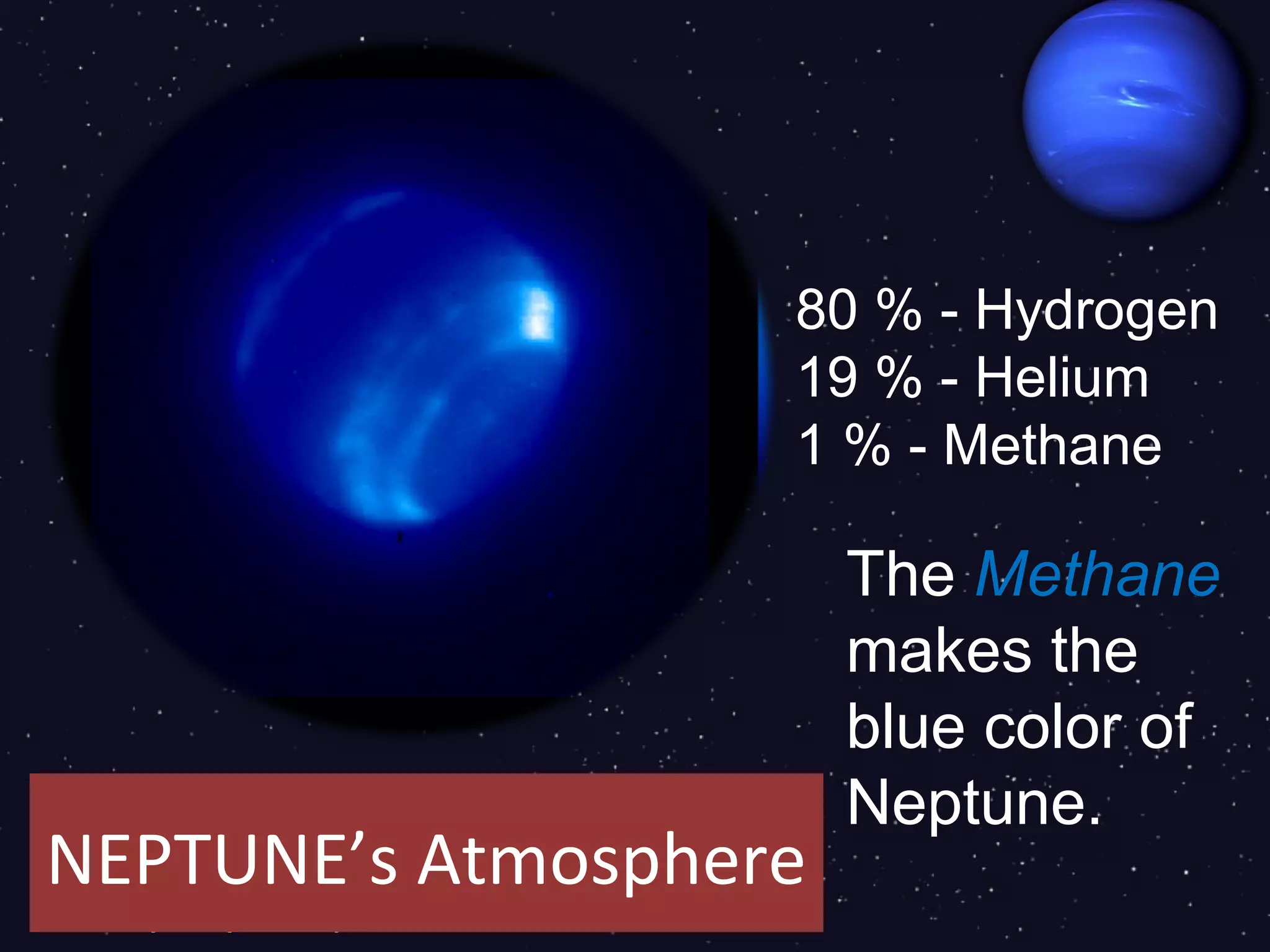
80 % - Hydrogen
                   19 % - Helium
                   1 % - Methane

                       The Methane
                       makes the
                       blue color of
                       Neptune.
NEPTUNE’s Atmosphere
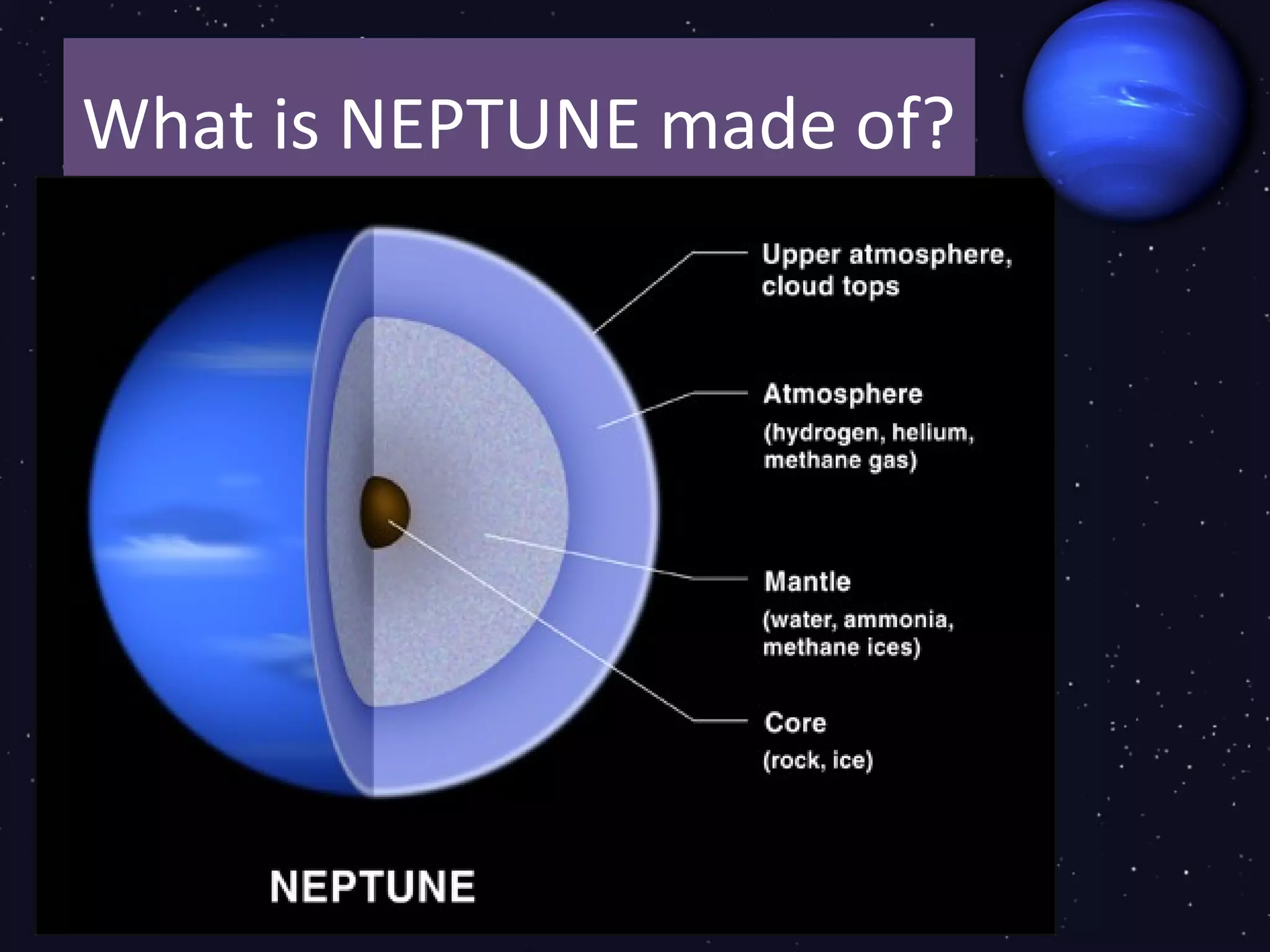
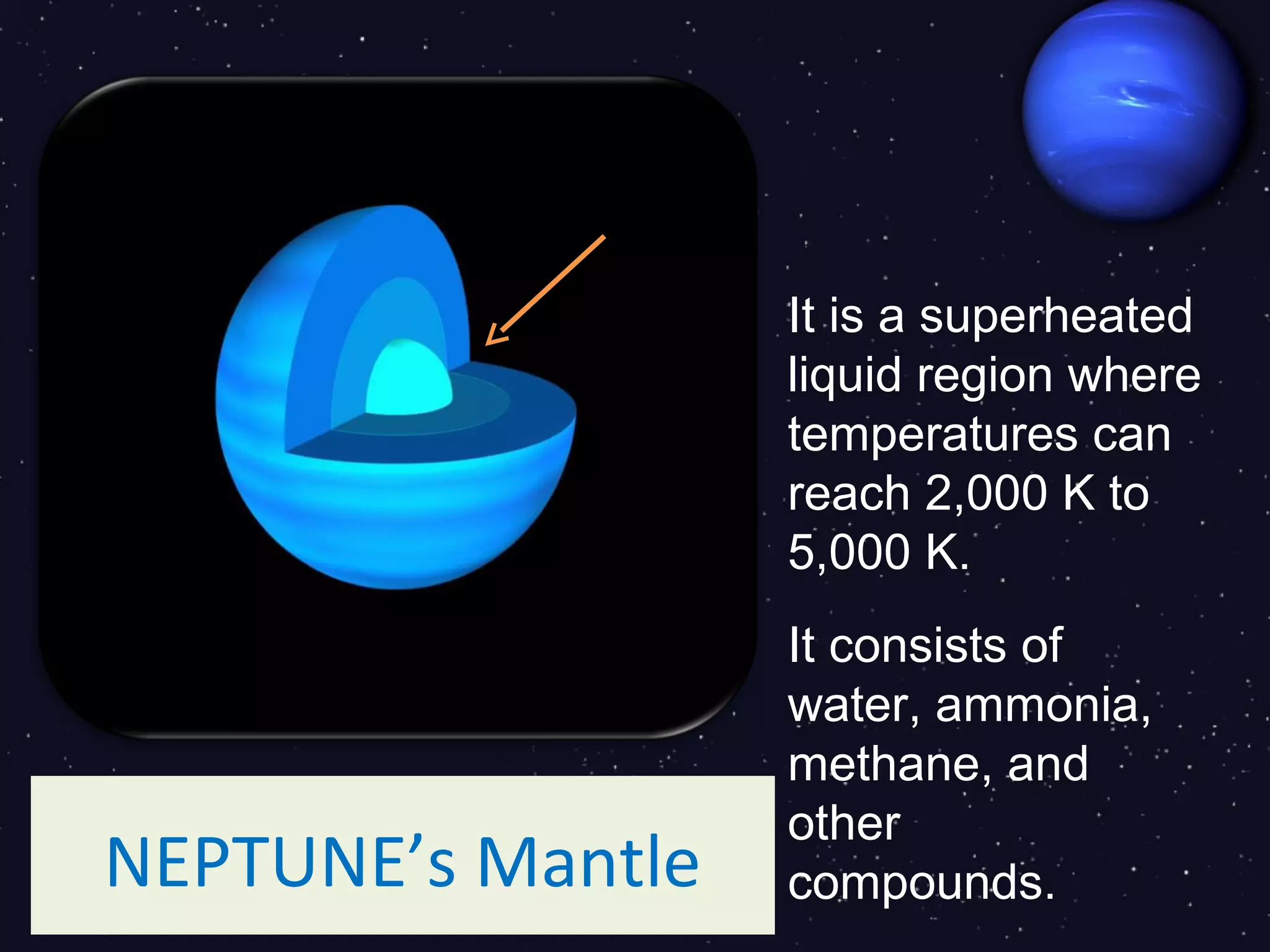
It is a superheated
                   liquid region where
                   temperatures can
                   reach 2,000 K to
                   5,000 K.
                   It consists of
                   water, ammonia,
                   methane, and
                   other
NEPTUNE’s Mantle   compounds.
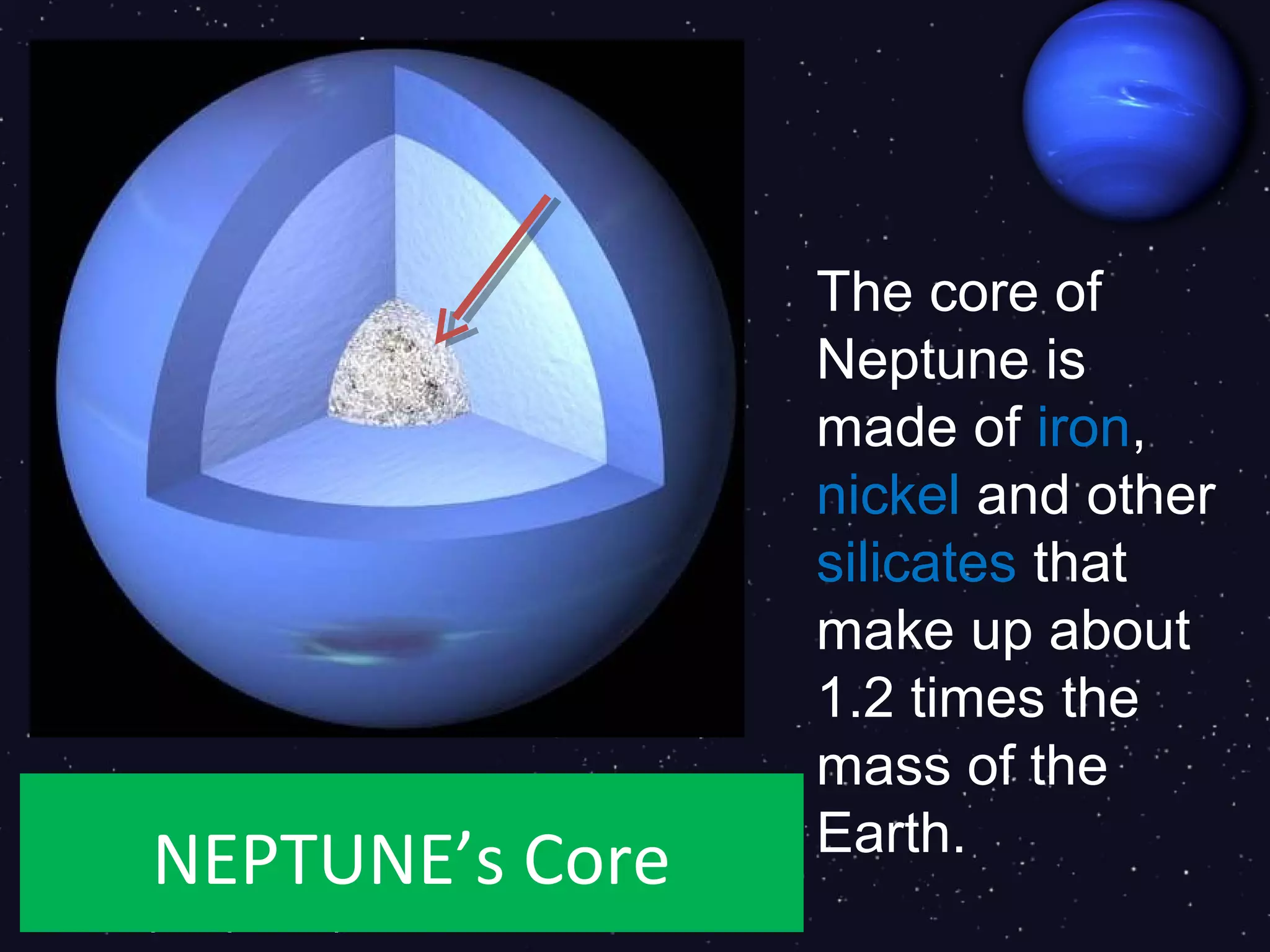
The core of
                 Neptune is
                 made of iron,
                 nickel and other
                 silicates that
                 make up about
                 1.2 times the
                 mass of the
                 Earth.
NEPTUNE’s Core
Gravity on NEPTUNE

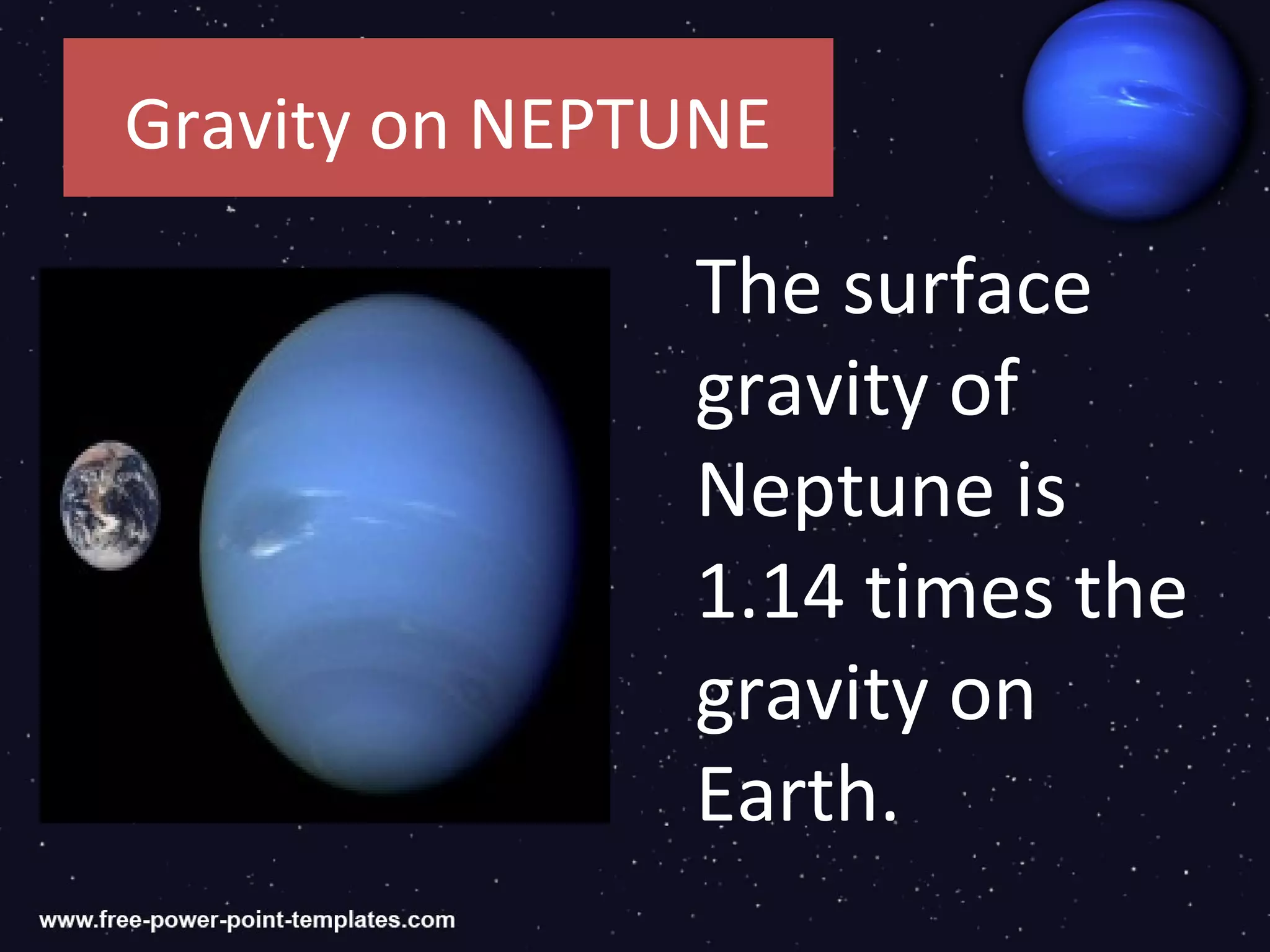
               The surface
               gravity of
               Neptune is
               1.14 times the
               gravity on
               Earth.
Axis Tilt of NEPTUNE
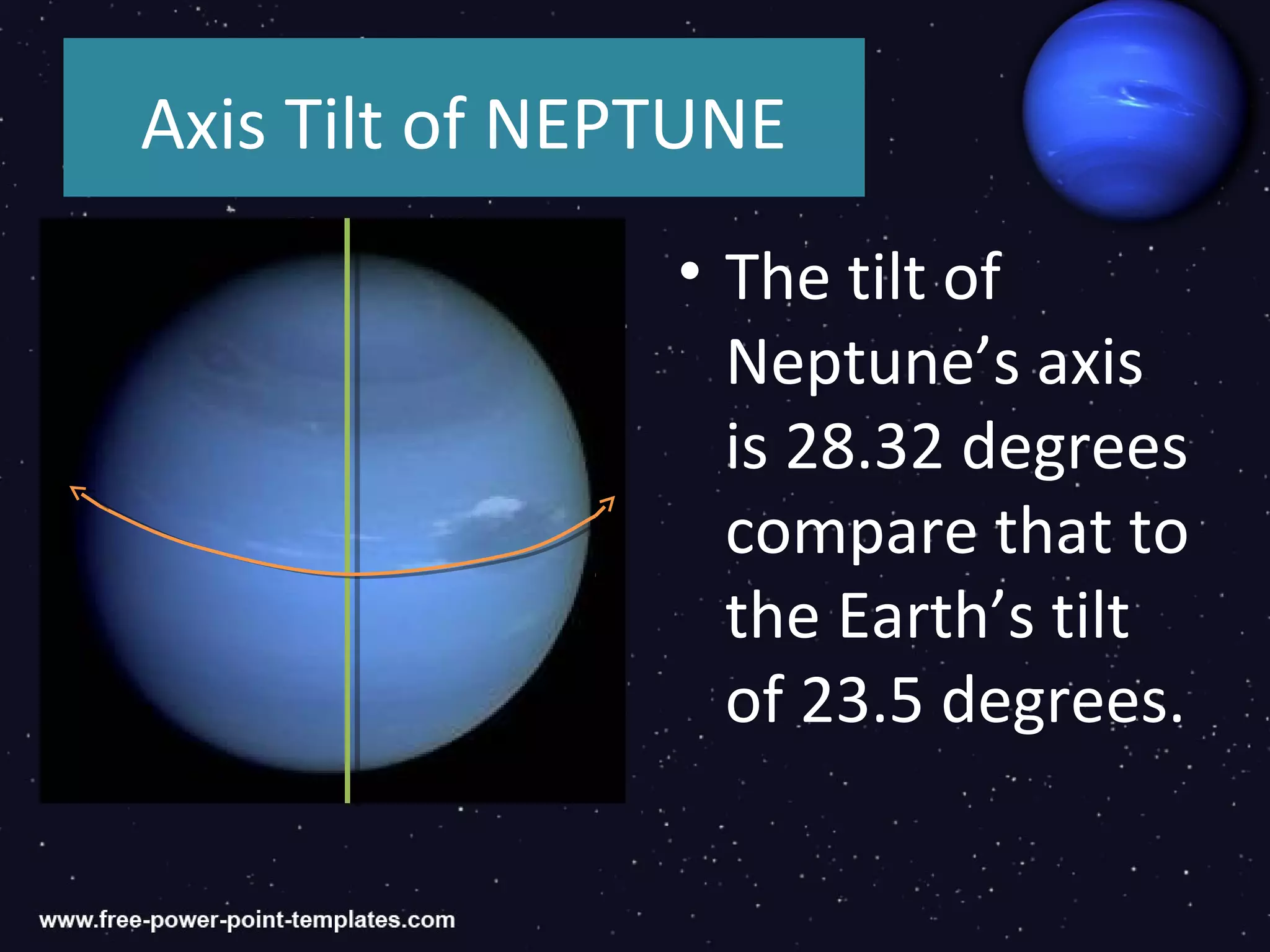
                • The tilt of
                  Neptune’s axis
                  is 28.32 degrees
                  compare that to
                  the Earth’s tilt
                  of 23.5 degrees.
Temperature of NEPTUNE
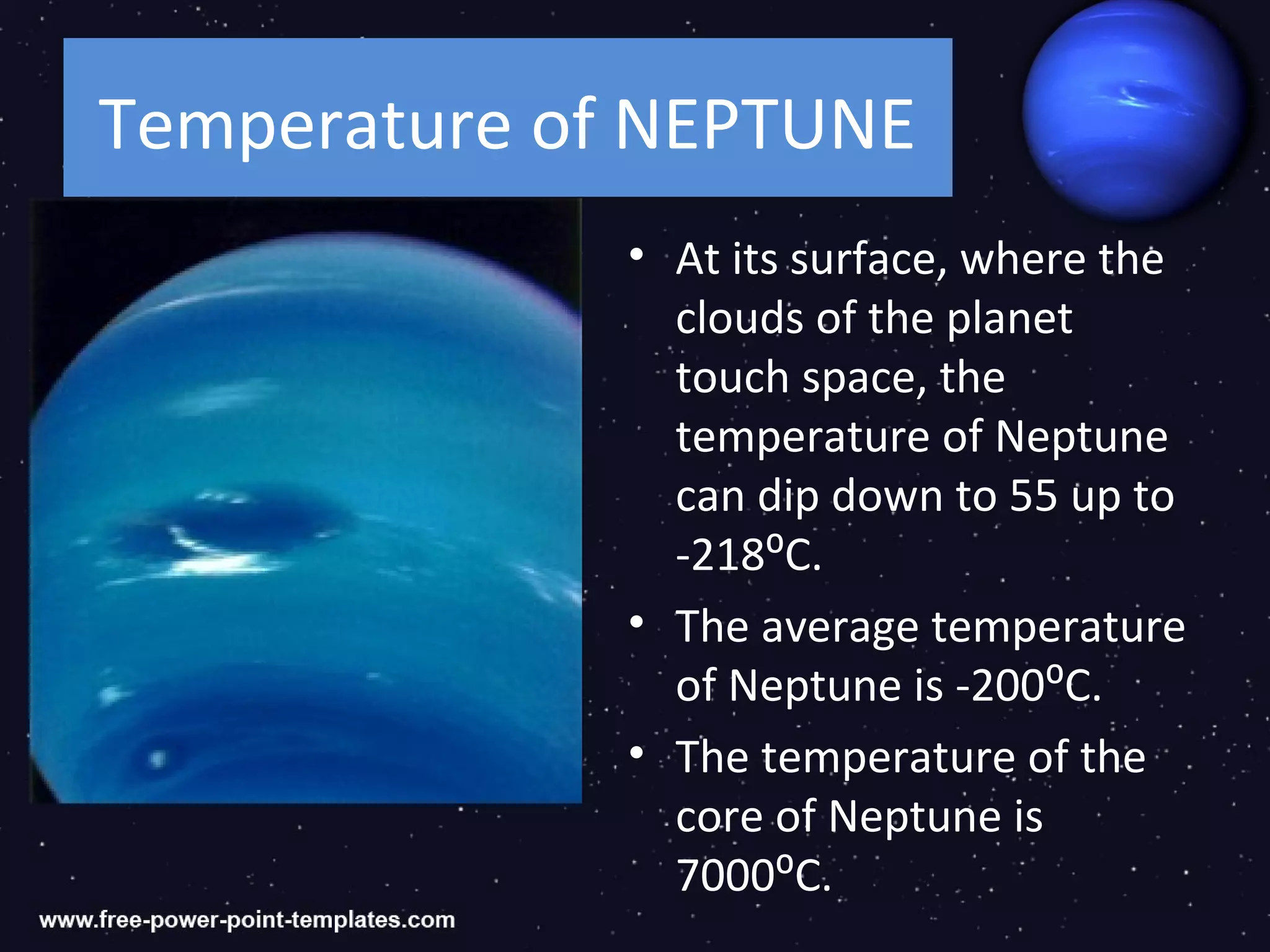
              • At its surface, where the
                clouds of the planet
                touch space, the
                temperature of Neptune
                can dip down to 55 up to
                -218⁰C.
              • The average temperature
                of Neptune is -200⁰C.
              • The temperature of the
                core of Neptune is
                7000⁰C.
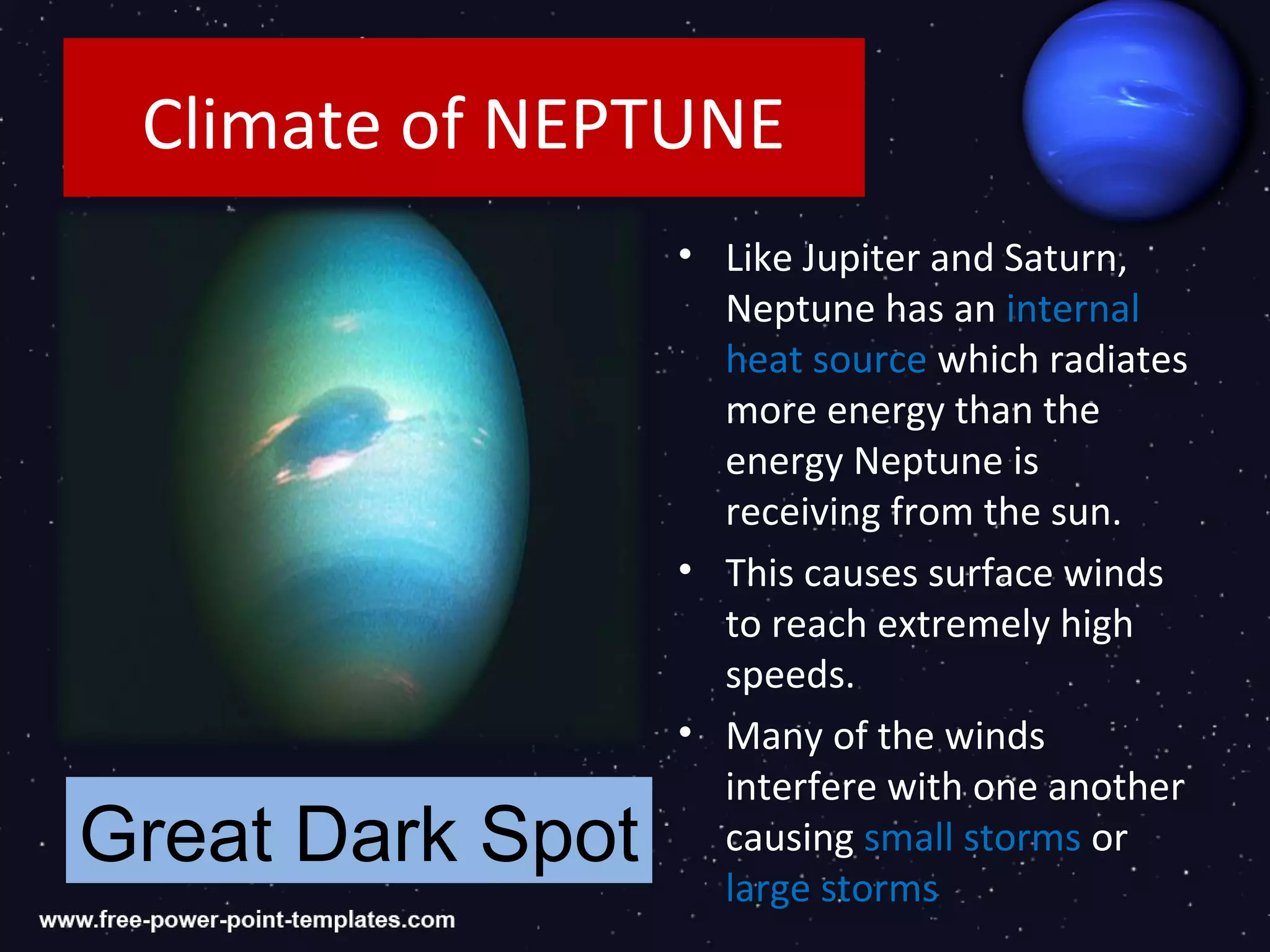
Climate of NEPTUNE
                  • Like Jupiter and Saturn,
                    Neptune has an internal
                    heat source which radiates
                    more energy than the
                    energy Neptune is
                    receiving from the sun.
                  • This causes surface winds
                    to reach extremely high
                    speeds.
                  • Many of the winds
                    interfere with one another
Great Dark Spot     causing small storms or
                    large storms
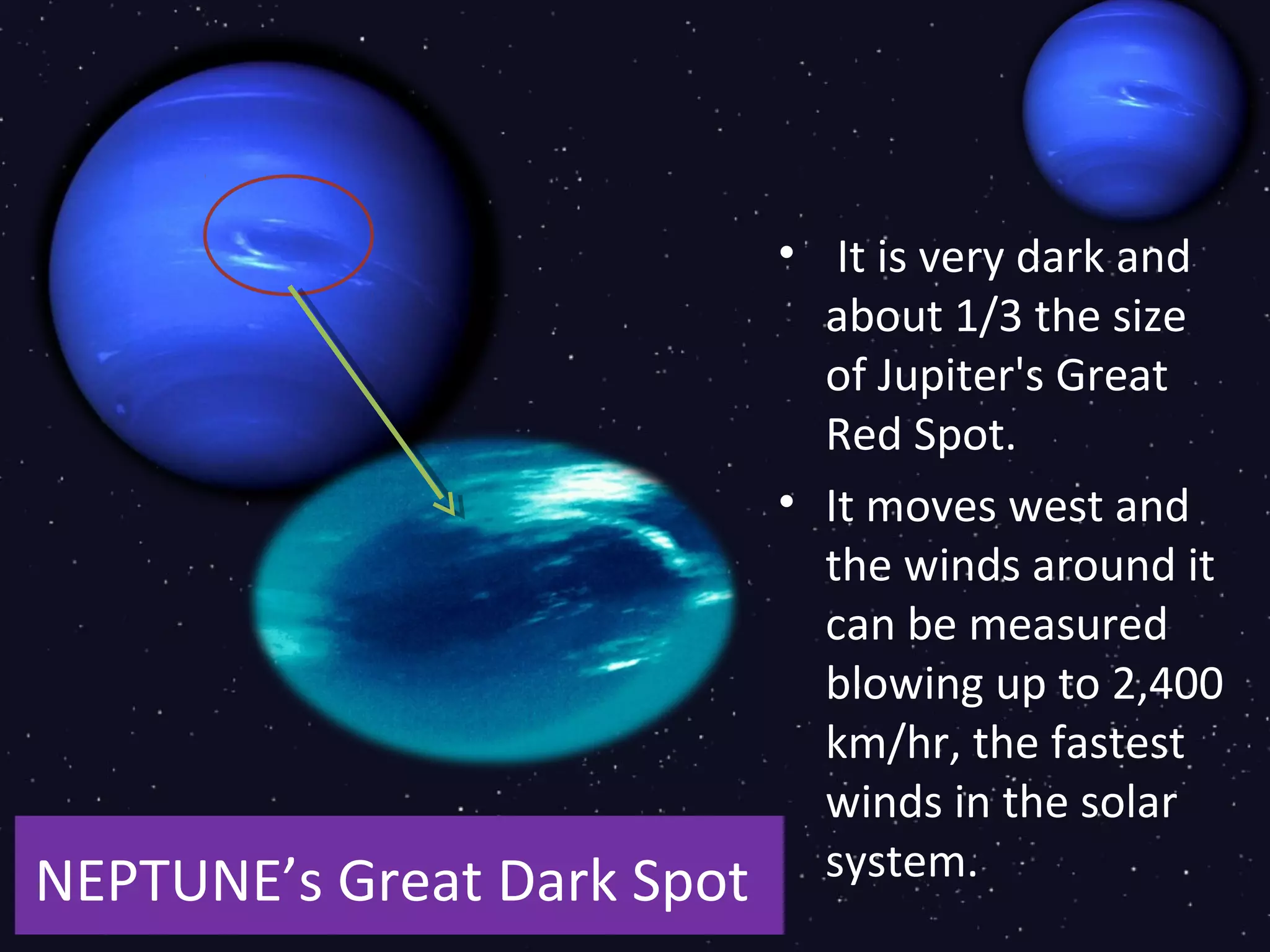
• It is very dark and
                              about 1/3 the size
                              of Jupiter's Great
                              Red Spot.
                            • It moves west and
                              the winds around it
                              can be measured
                              blowing up to 2,400
                              km/hr, the fastest
                              winds in the solar
NEPTUNE’s Great Dark Spot     system.
Facts about NEPTUNE
•   History of Neptune
•   Characteristics of Neptune
•   Position and Movement of Neptune
•   Neptune’s Moon and Rings
•   Exploration on Neptune
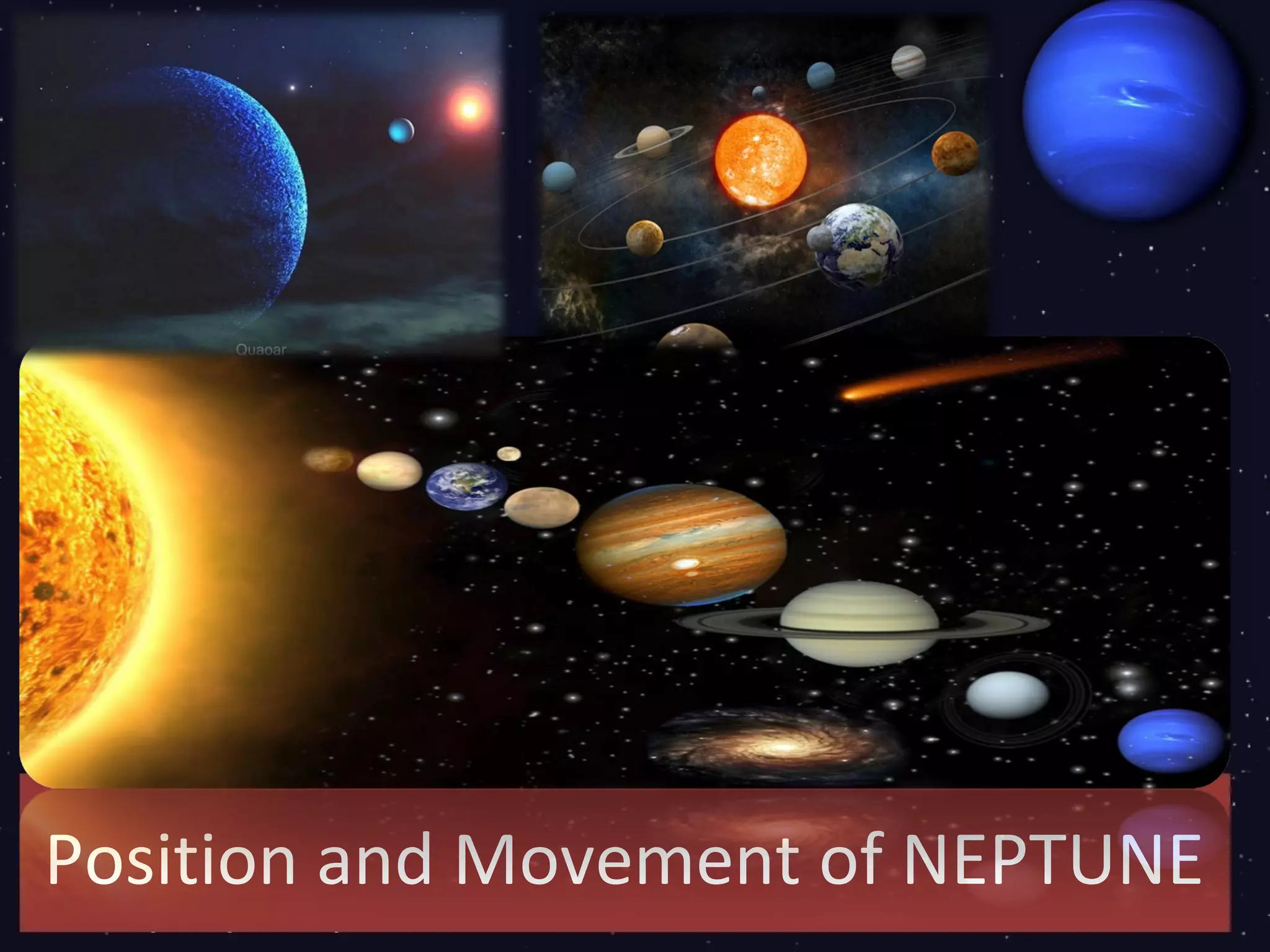
Position and Movement of NEPTUNE
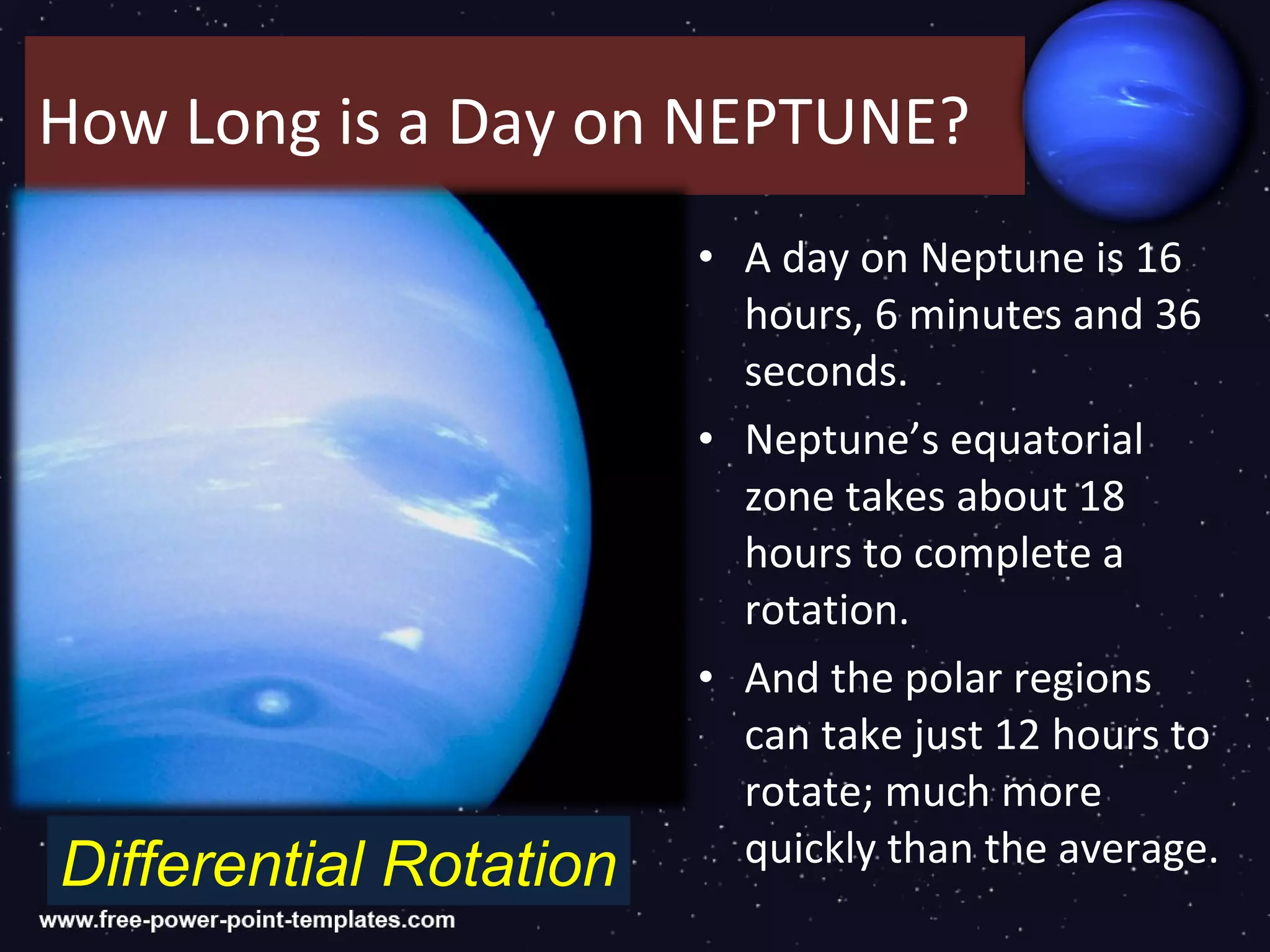
How Long is a Day on NEPTUNE?
                        • A day on Neptune is 16
                          hours, 6 minutes and 36
                          seconds.
                        • Neptune’s equatorial
                          zone takes about 18
                          hours to complete a
                          rotation.
                        • And the polar regions
                          can take just 12 hours to
                          rotate; much more
Differential Rotation     quickly than the average.
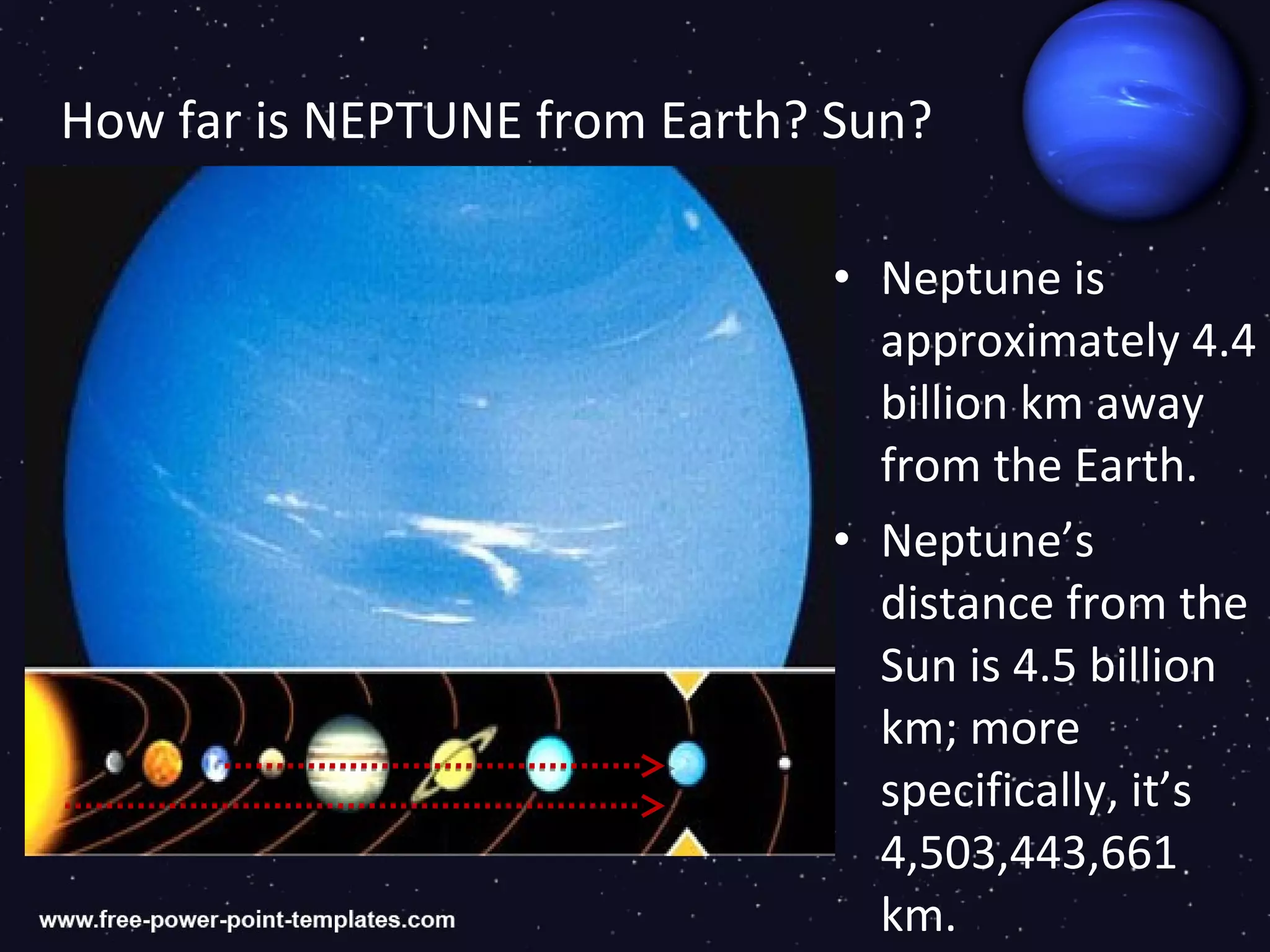
How far is NEPTUNE from Earth? Sun?

                              • Neptune is
                                approximately 4.4
                                billion km away
                                from the Earth.
                              • Neptune’s
                                distance from the
                                Sun is 4.5 billion
                                km; more
                                specifically, it’s
                                4,503,443,661
                                km.
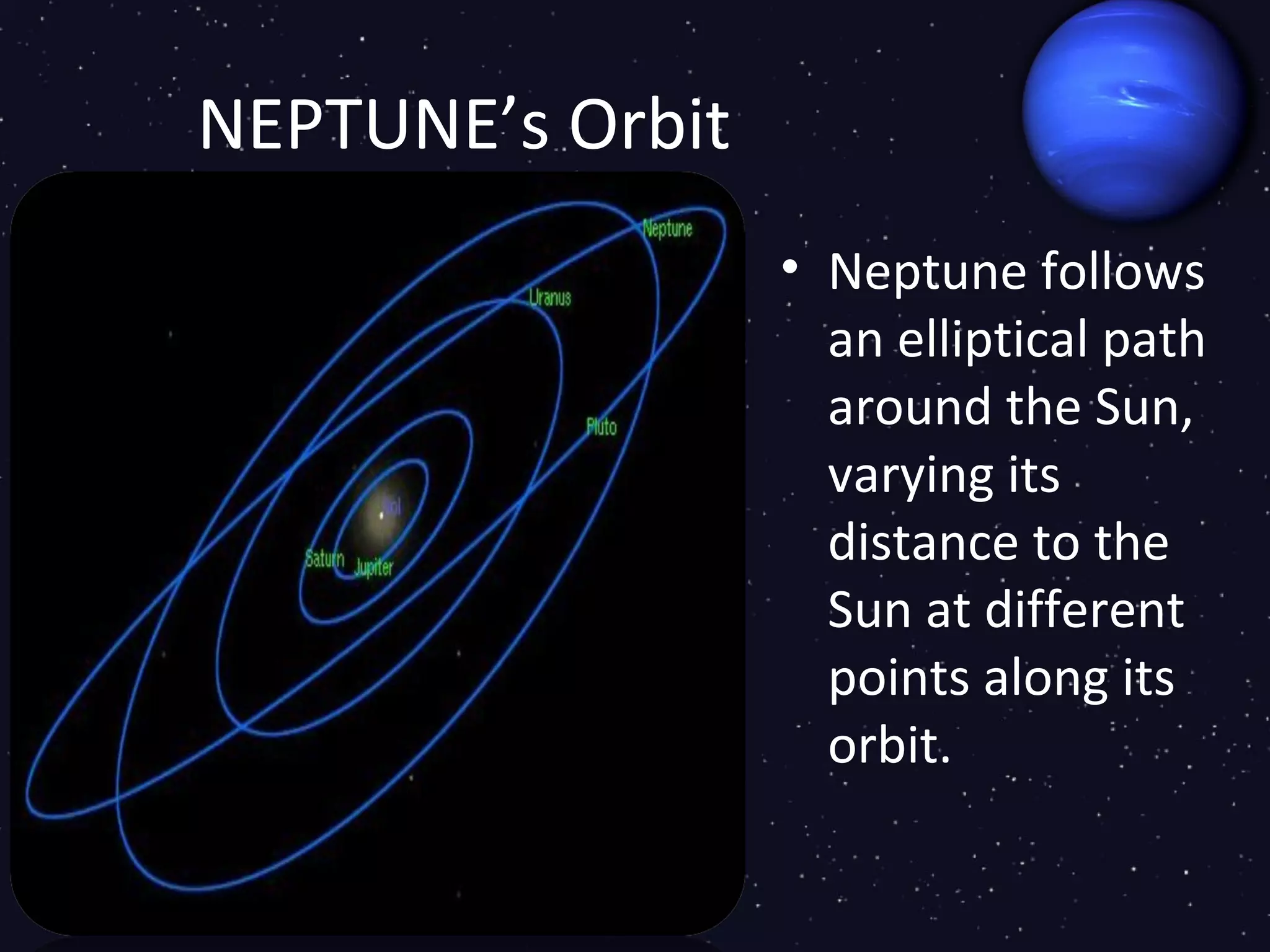
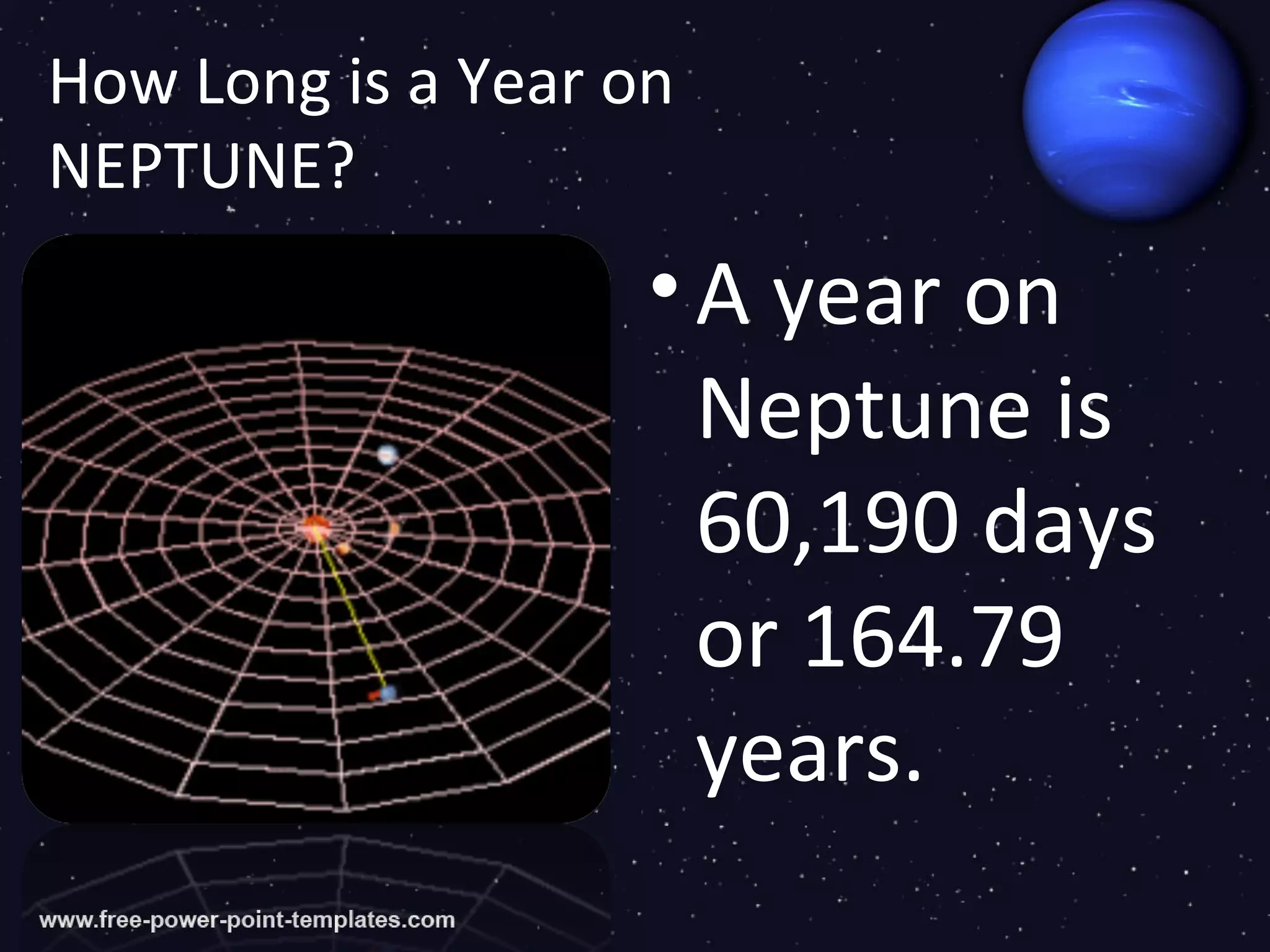
NEPTUNE’s Orbit
                  • Neptune follows
                    an elliptical path
                    around the Sun,
                    varying its
                    distance to the
                    Sun at different
                    points along its
                    orbit.
How Long is a Year on
NEPTUNE?
                    • A year on
                      Neptune is
                      60,190 days
                      or 164.79
                      years.
Facts about NEPTUNE
•   History of Neptune
•   Characteristics of Neptune
•   Position and Movement of Neptune
•   Neptune’s Moons and Rings
•   Exploration on Neptune
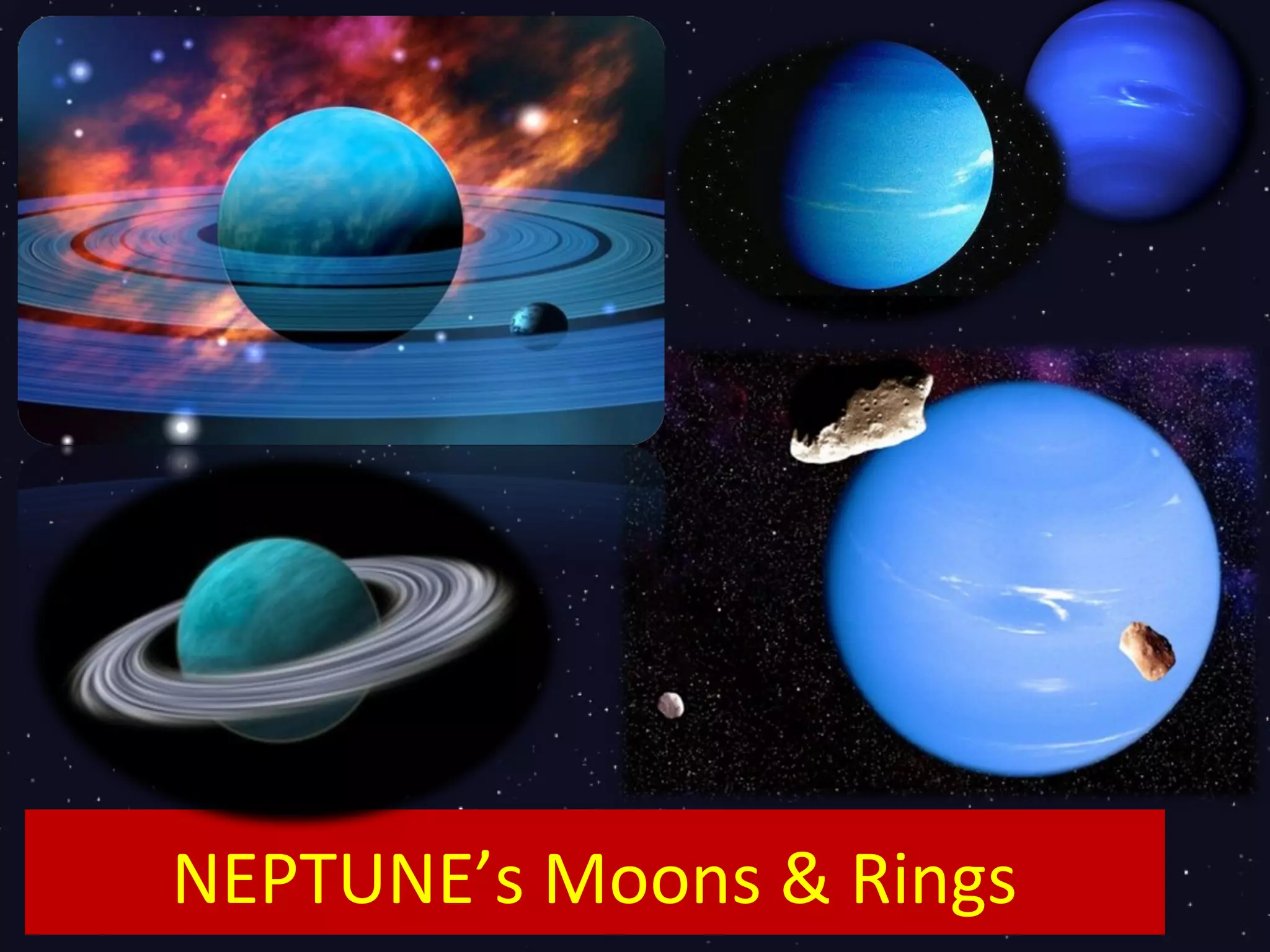
NEPTUNE’s Moons & Rings
NEPTUNE’s Moons


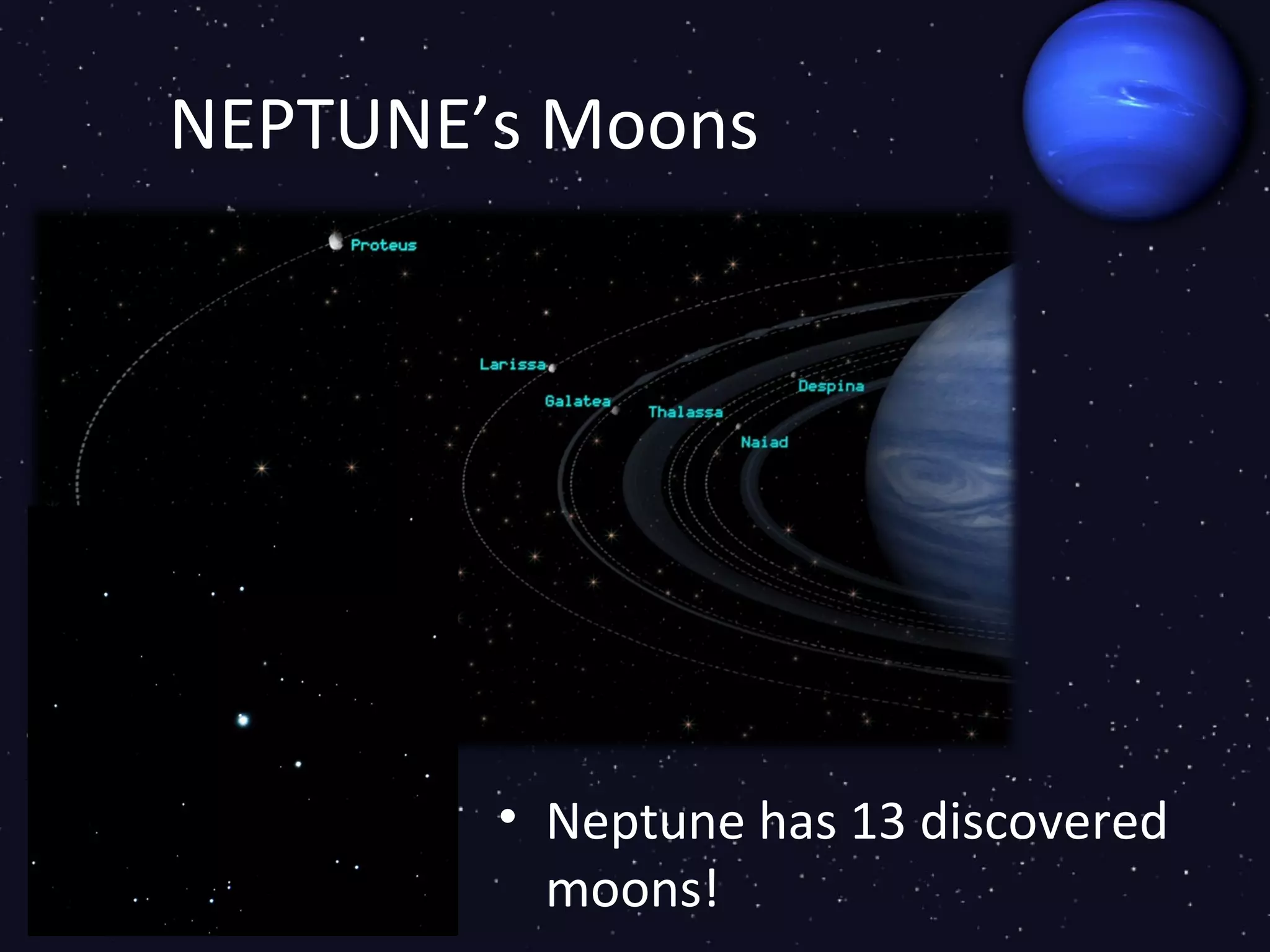
        • Neptune has 13 discovered
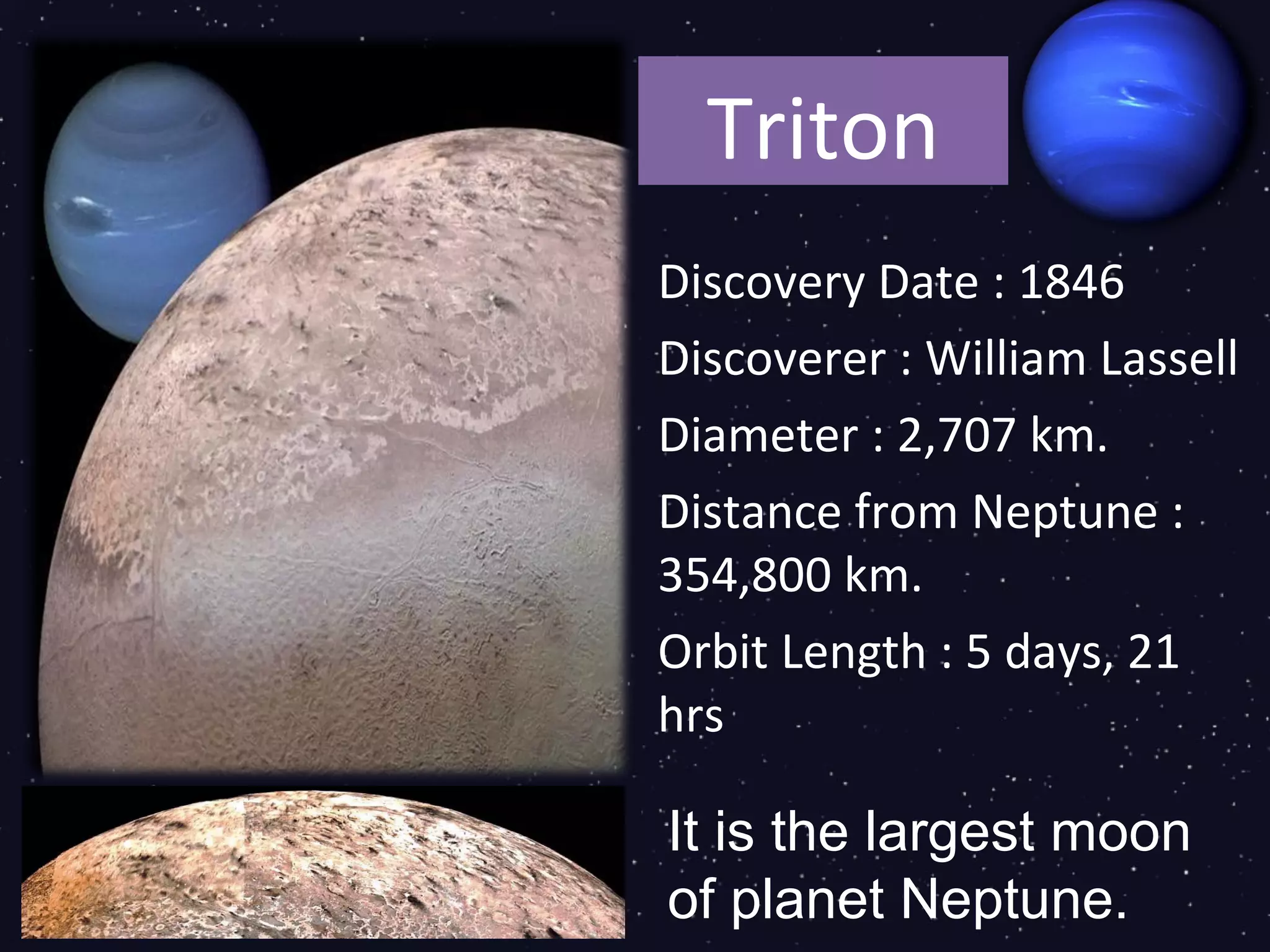
          moons!
Triton
Discovery Date : 1846
Discoverer : William Lassell
Diameter : 2,707 km.
Distance from Neptune :
354,800 km.
Orbit Length : 5 days, 21
hrs

It is the largest moon
of planet Neptune.
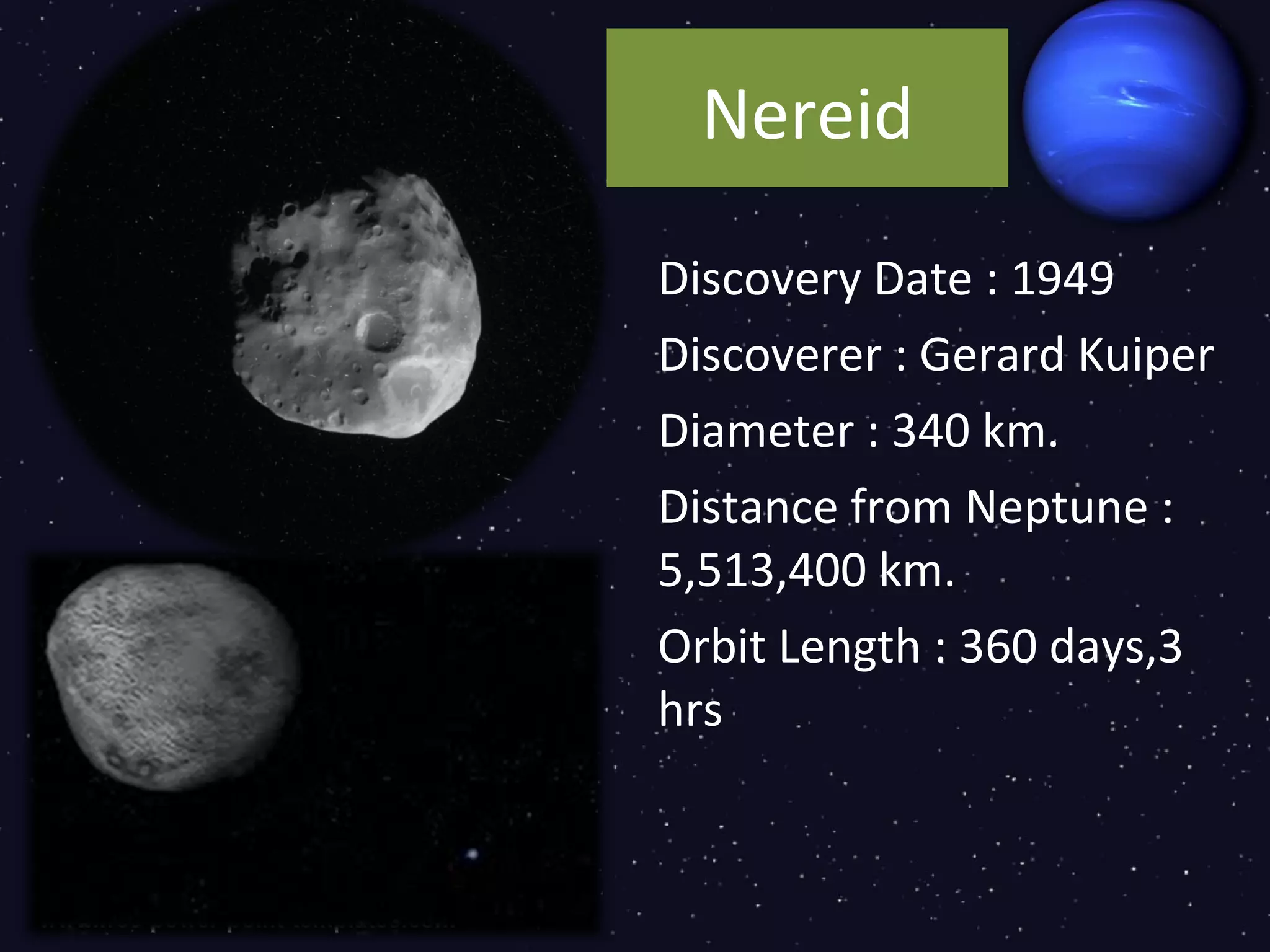
Nereid

Discovery Date : 1949
Discoverer : Gerard Kuiper
Diameter : 340 km.
Distance from Neptune :
5,513,400 km.
Orbit Length : 360 days,3
hrs
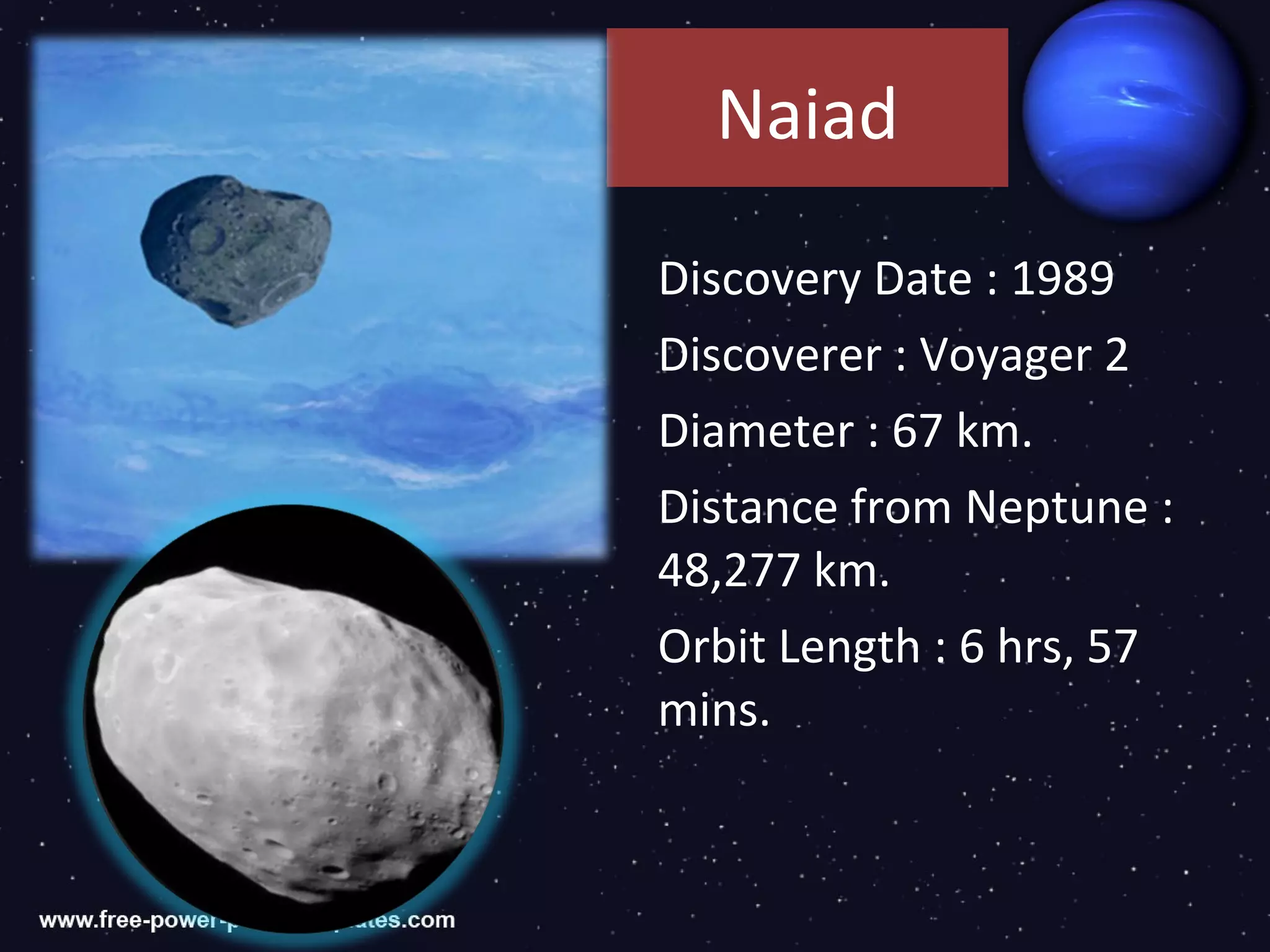
Naiad

Discovery Date : 1989
Discoverer : Voyager 2
Diameter : 67 km.
Distance from Neptune :
48,277 km.
Orbit Length : 6 hrs, 57
mins.
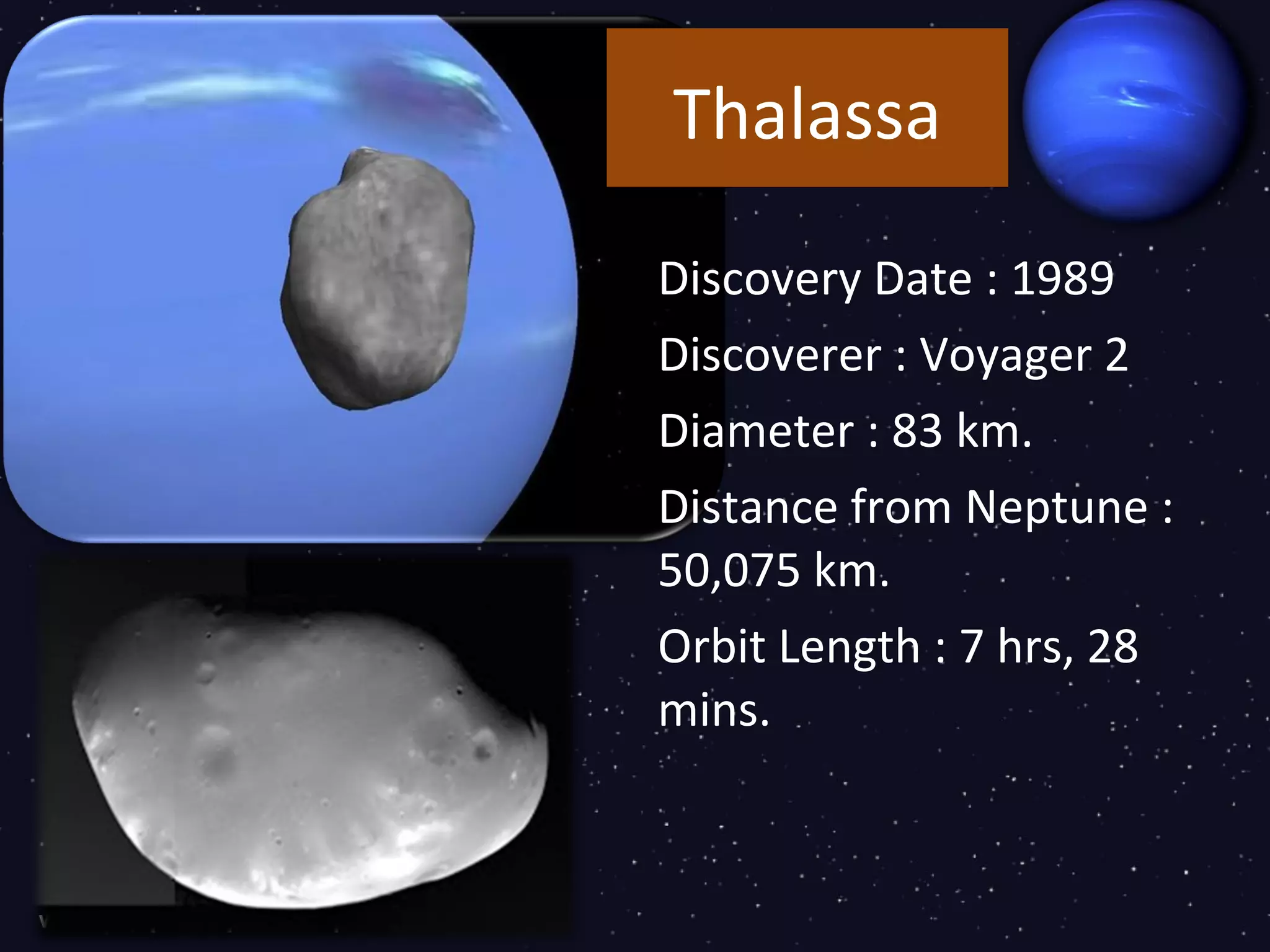
Thalassa

Discovery Date : 1989
Discoverer : Voyager 2
Diameter : 83 km.
Distance from Neptune :
50,075 km.
Orbit Length : 7 hrs, 28
mins.
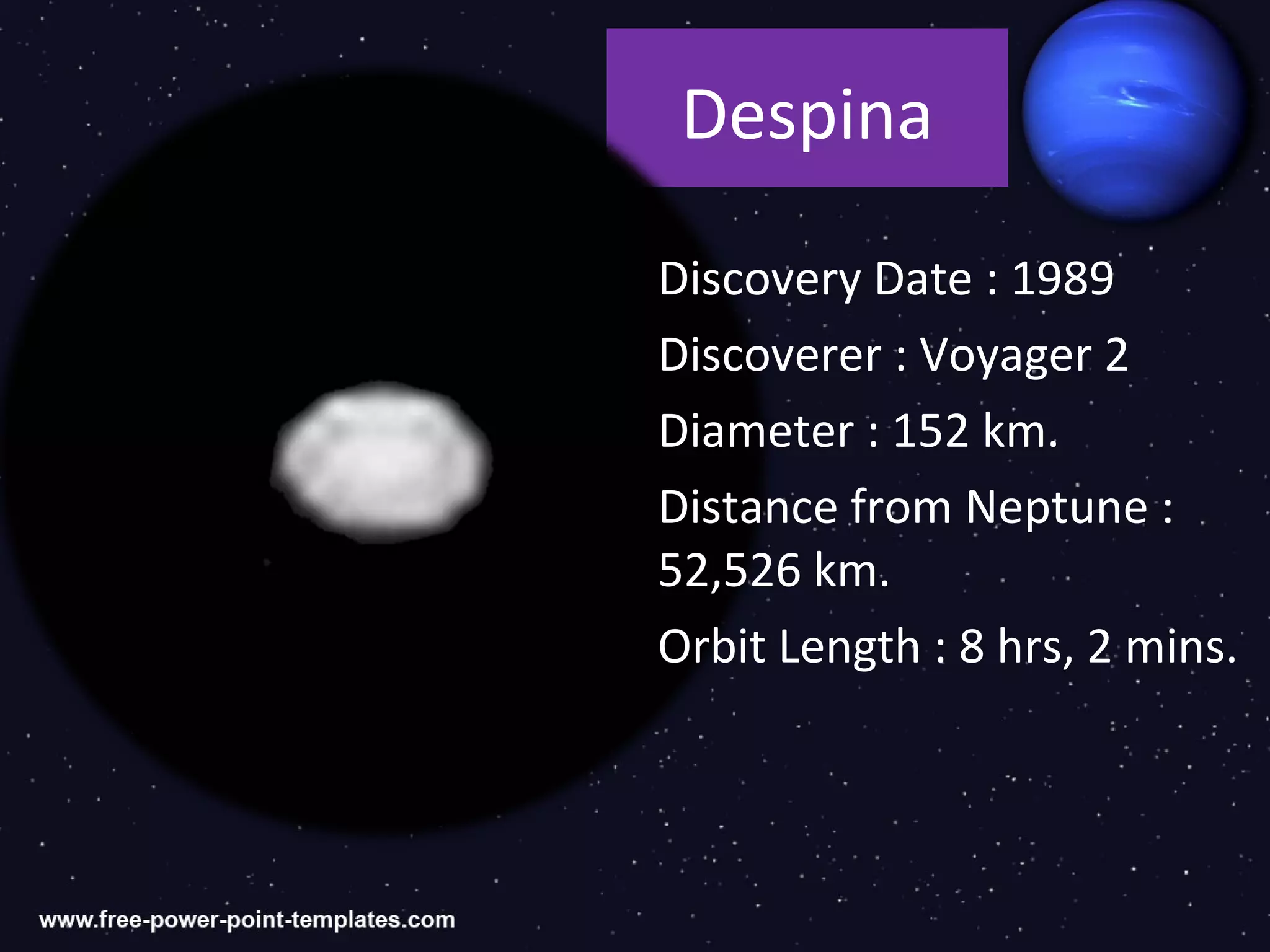
Despina

Discovery Date : 1989
Discoverer : Voyager 2
Diameter : 152 km.
Distance from Neptune :
52,526 km.
Orbit Length : 8 hrs, 2 mins.
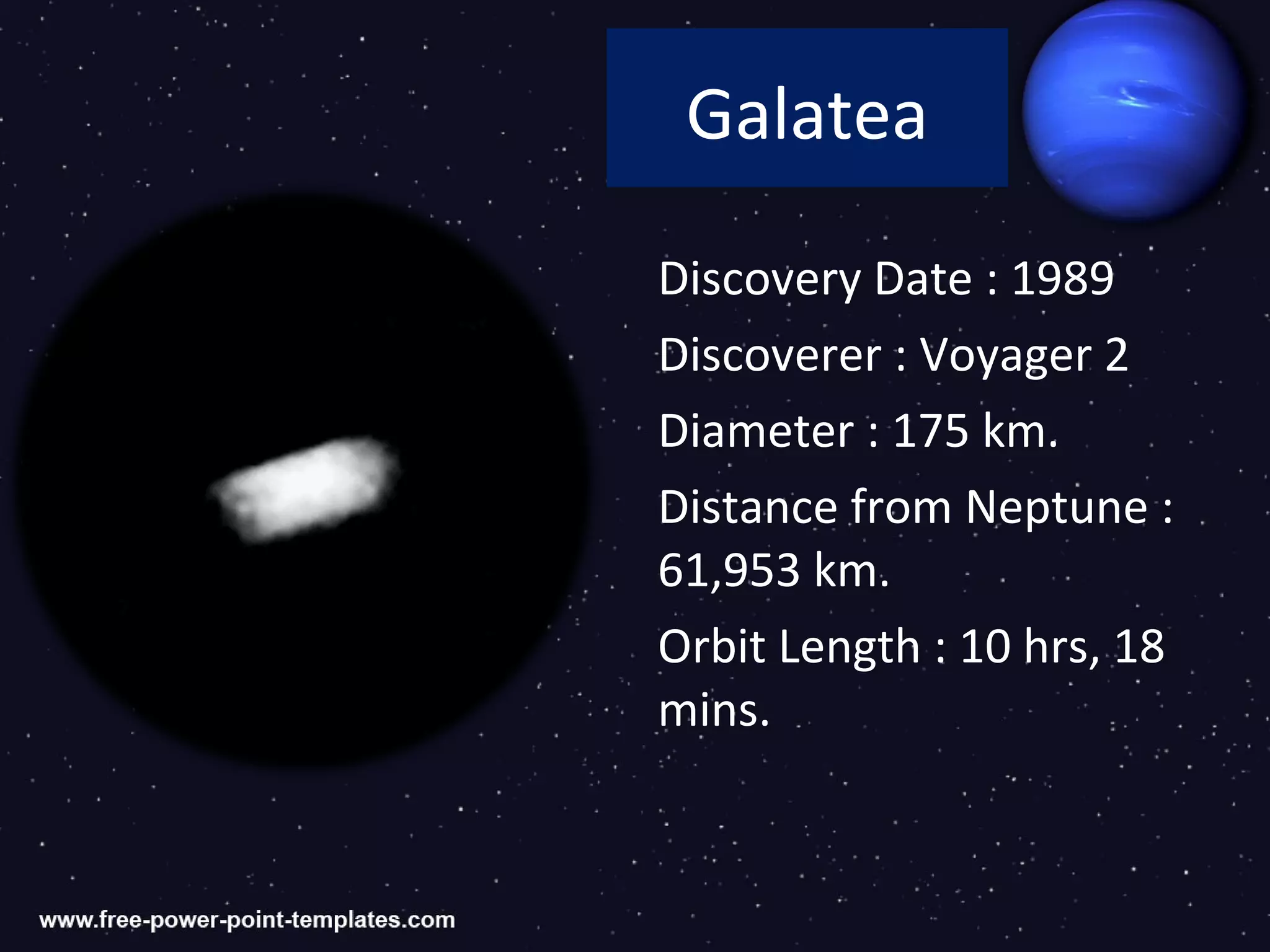
Galatea

Discovery Date : 1989
Discoverer : Voyager 2
Diameter : 175 km.
Distance from Neptune :
61,953 km.
Orbit Length : 10 hrs, 18
mins.
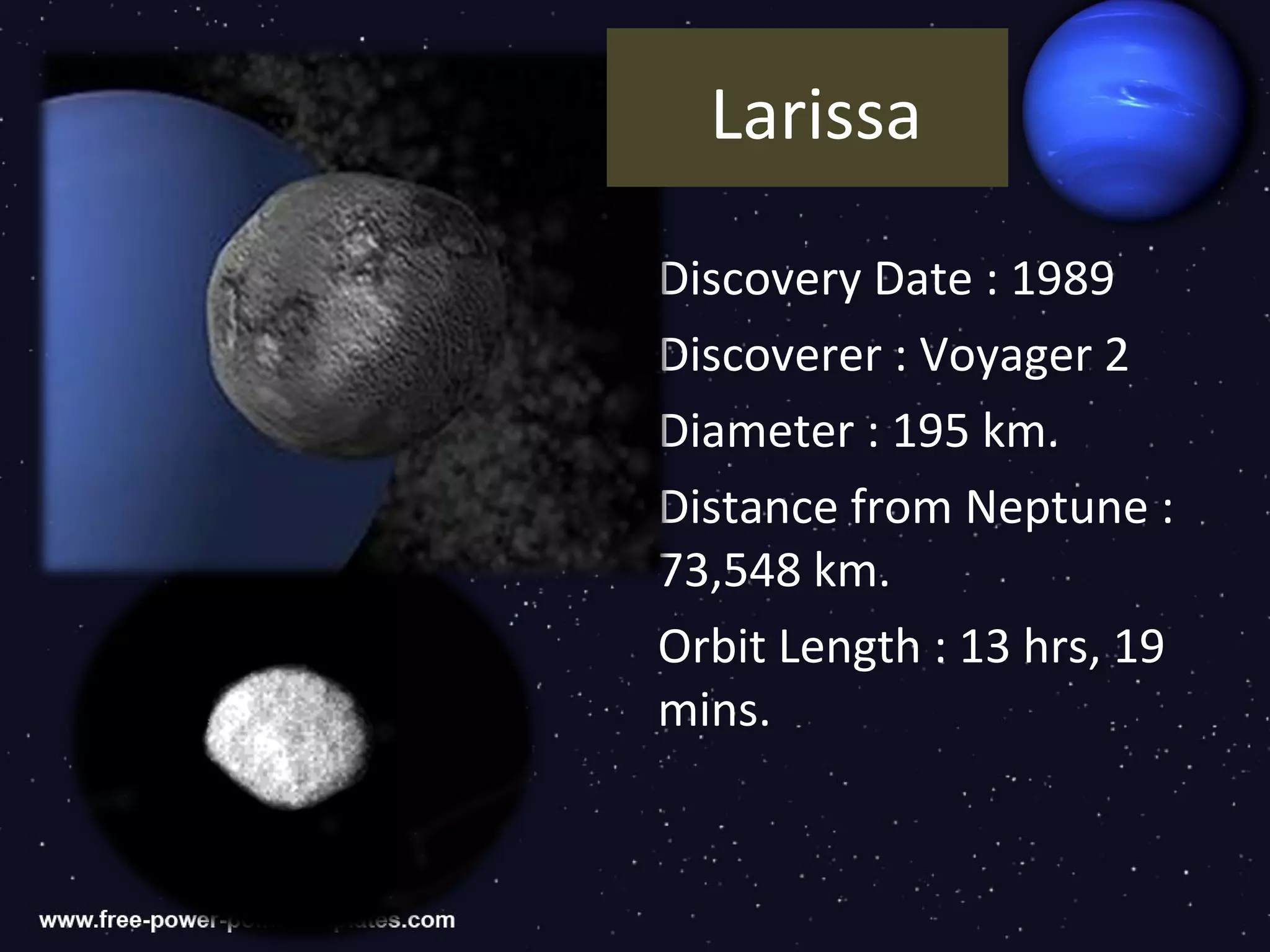
Larissa

Discovery Date : 1989
Discoverer : Voyager 2
Diameter : 195 km.
Distance from Neptune :
73,548 km.
Orbit Length : 13 hrs, 19
mins.
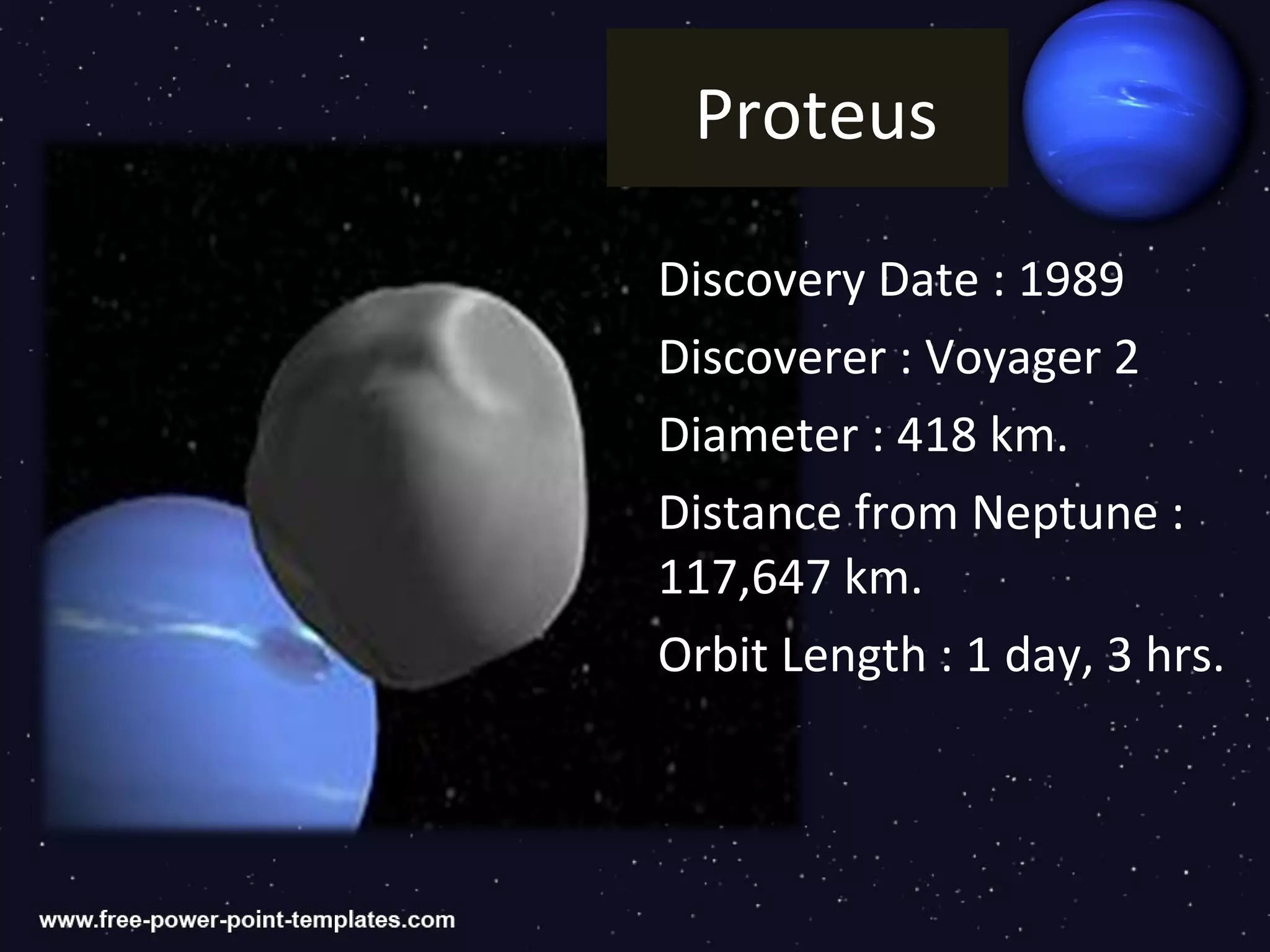
Proteus

Discovery Date : 1989
Discoverer : Voyager 2
Diameter : 418 km.
Distance from Neptune :
117,647 km.
Orbit Length : 1 day, 3 hrs.
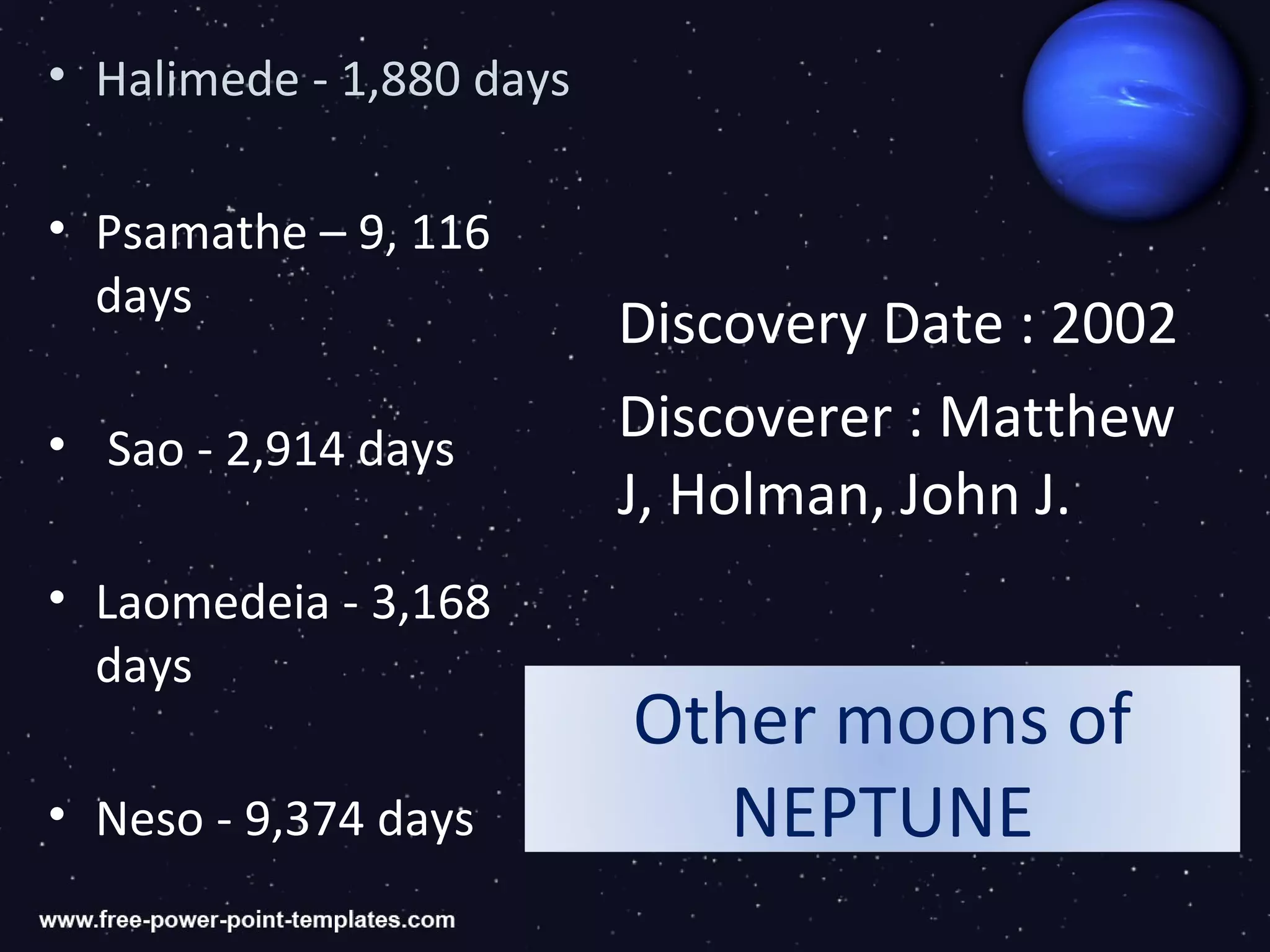
• Halimede - 1,880 days

• Psamathe – 9, 116
  days
                          Discovery Date : 2002
• Sao - 2,914 days        Discoverer : Matthew
                          J, Holman, John J.
• Laomedeia - 3,168
  days
                          Other moons of
• Neso - 9,374 days          NEPTUNE
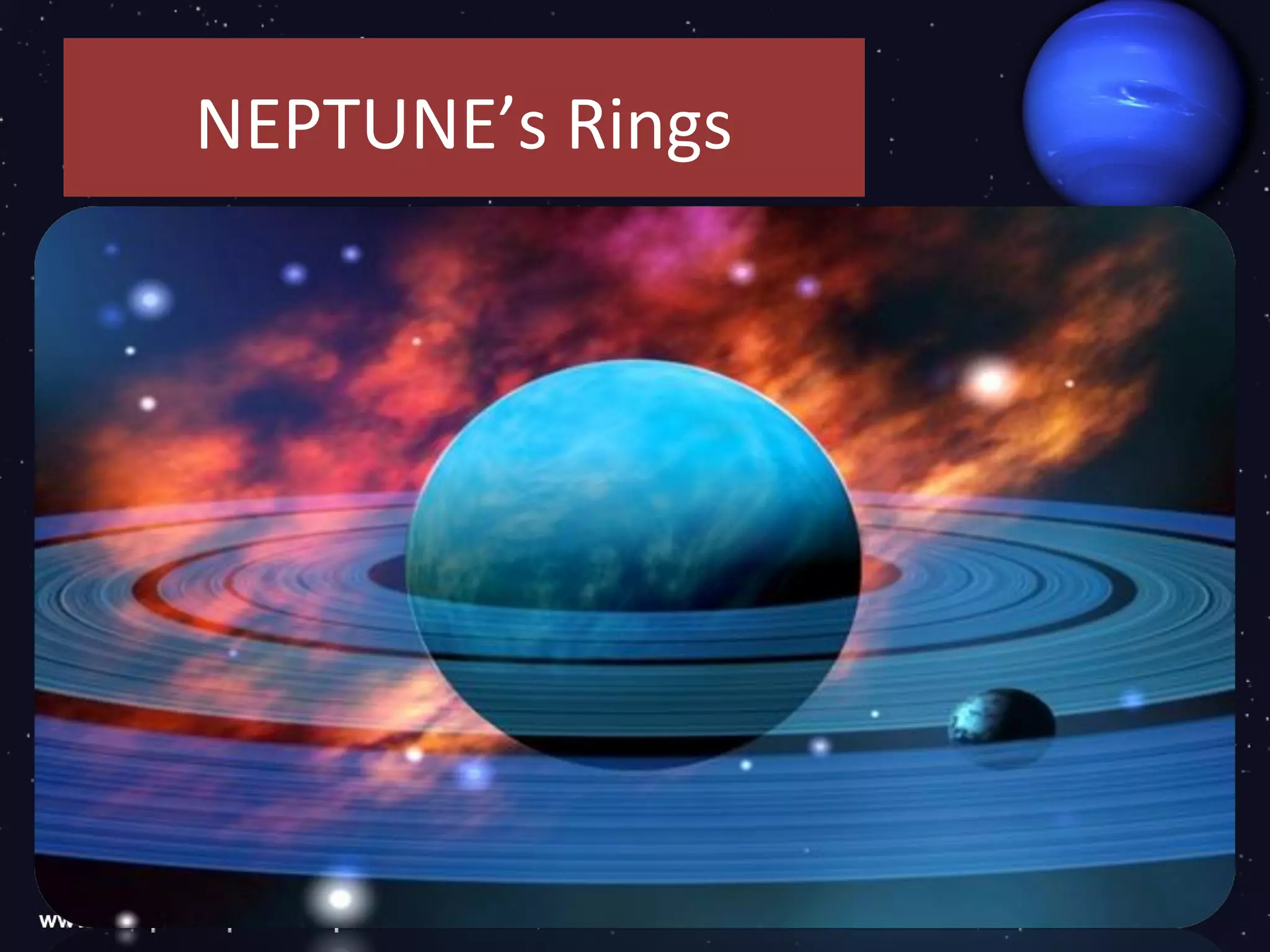
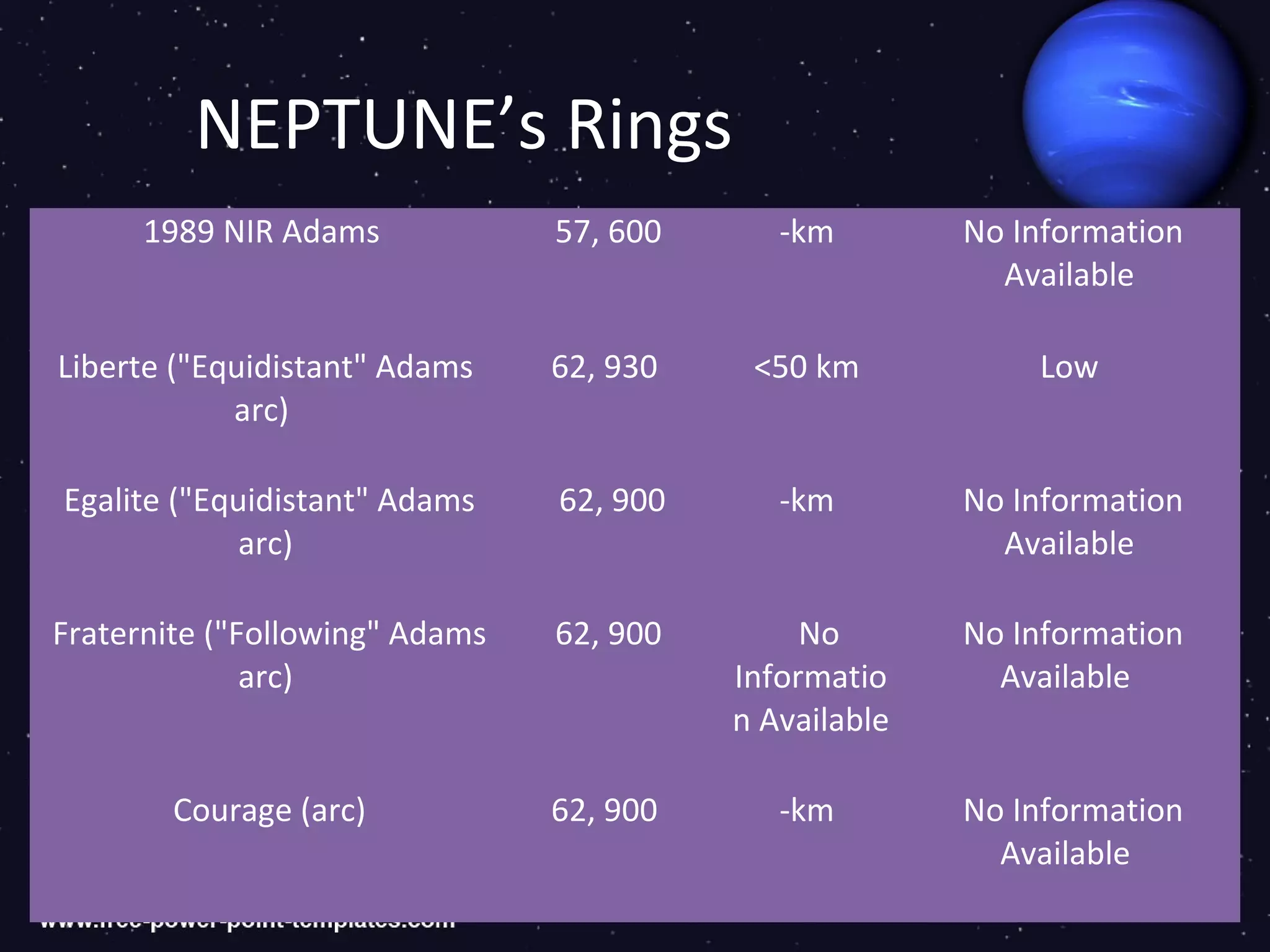
NEPTUNE’s Rings
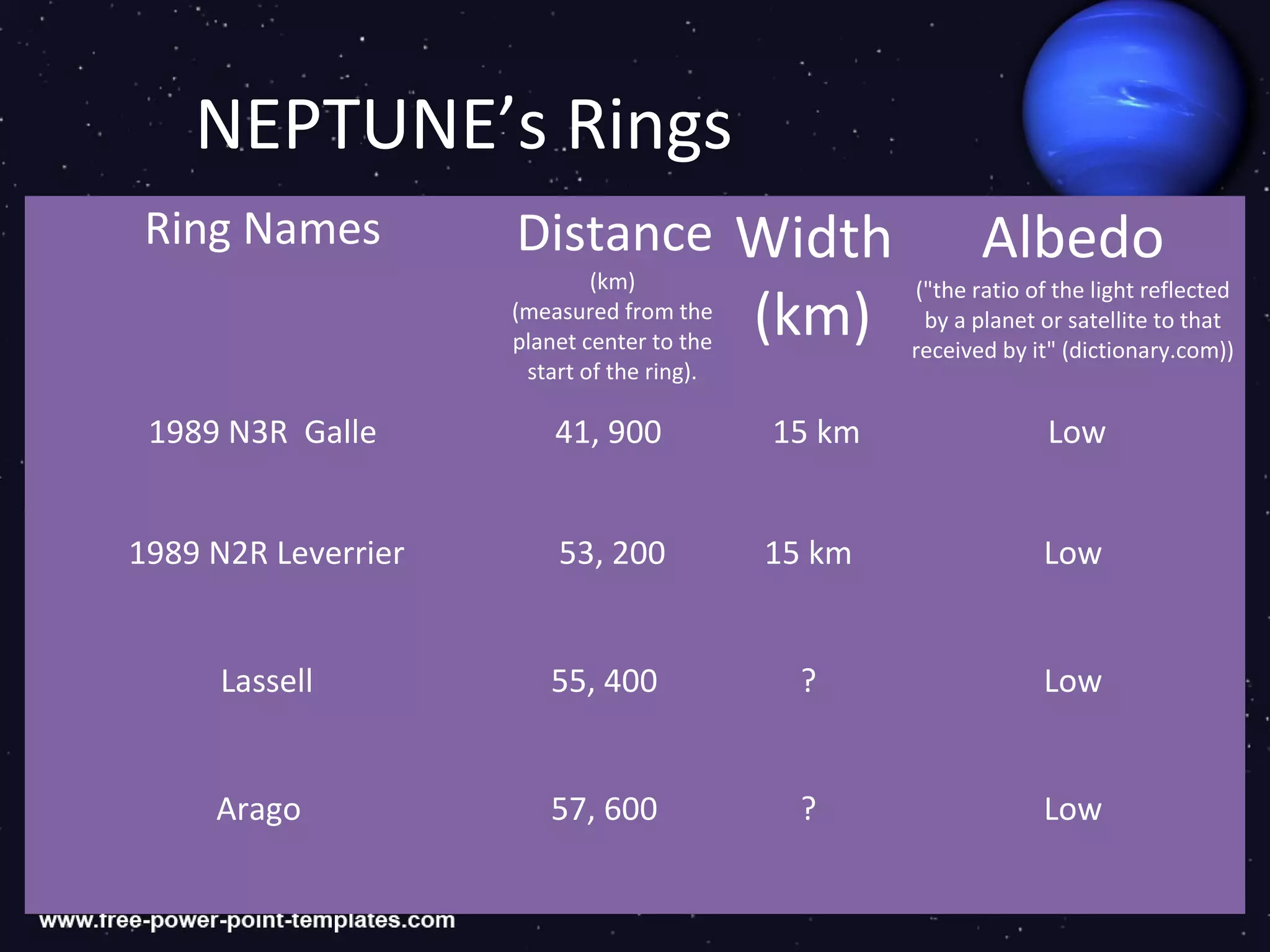
NEPTUNE’s Rings
 Ring Names          Distance Width                        Albedo
                             (km)                   ("the ratio of the light reflected
                     (measured from the
                     planet center to the
                                            (km)     by a planet or satellite to that
                                                    received by it" (dictionary.com))
                      start of the ring).

 1989 N3R Galle          41, 900            15 km                 Low


1989 N2R Leverrier       53, 200            15 km                Low


     Lassell            55, 400               ?                  Low


     Arago              57, 600               ?                  Low
NEPTUNE’s Rings
      1989 NIR Adams            57, 600      -km        No Information
                                                          Available

Liberte ("Equidistant" Adams    62, 930    <50 km           Low
            arc)

Egalite ("Equidistant" Adams    62, 900      -km        No Information
            arc)                                          Available

Fraternite ("Following" Adams   62, 900        No       No Information
              arc)                        Informatio      Available
                                          n Available

        Courage (arc)           62, 900      -km        No Information
                                                          Available
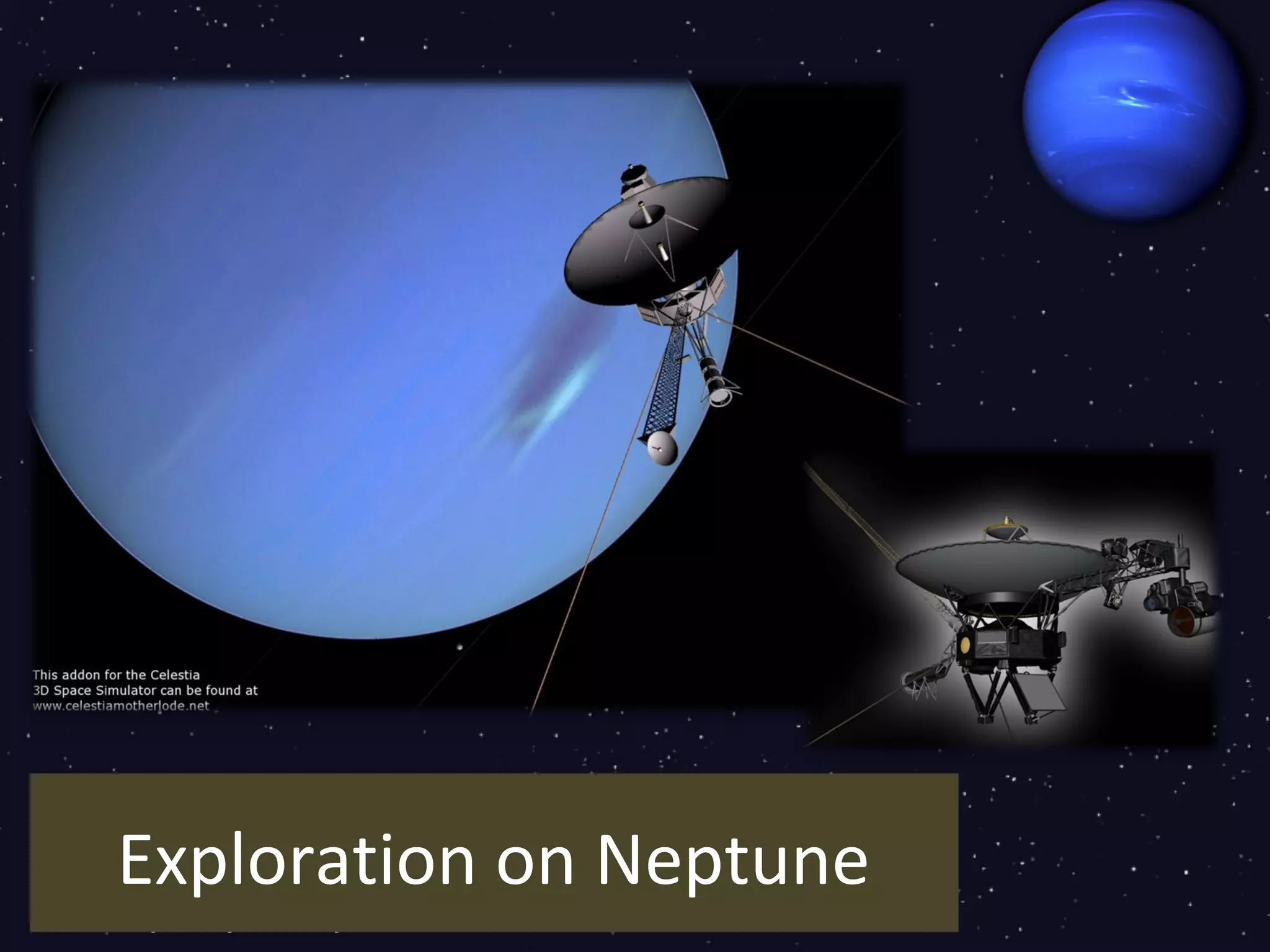
Exploration on Neptune
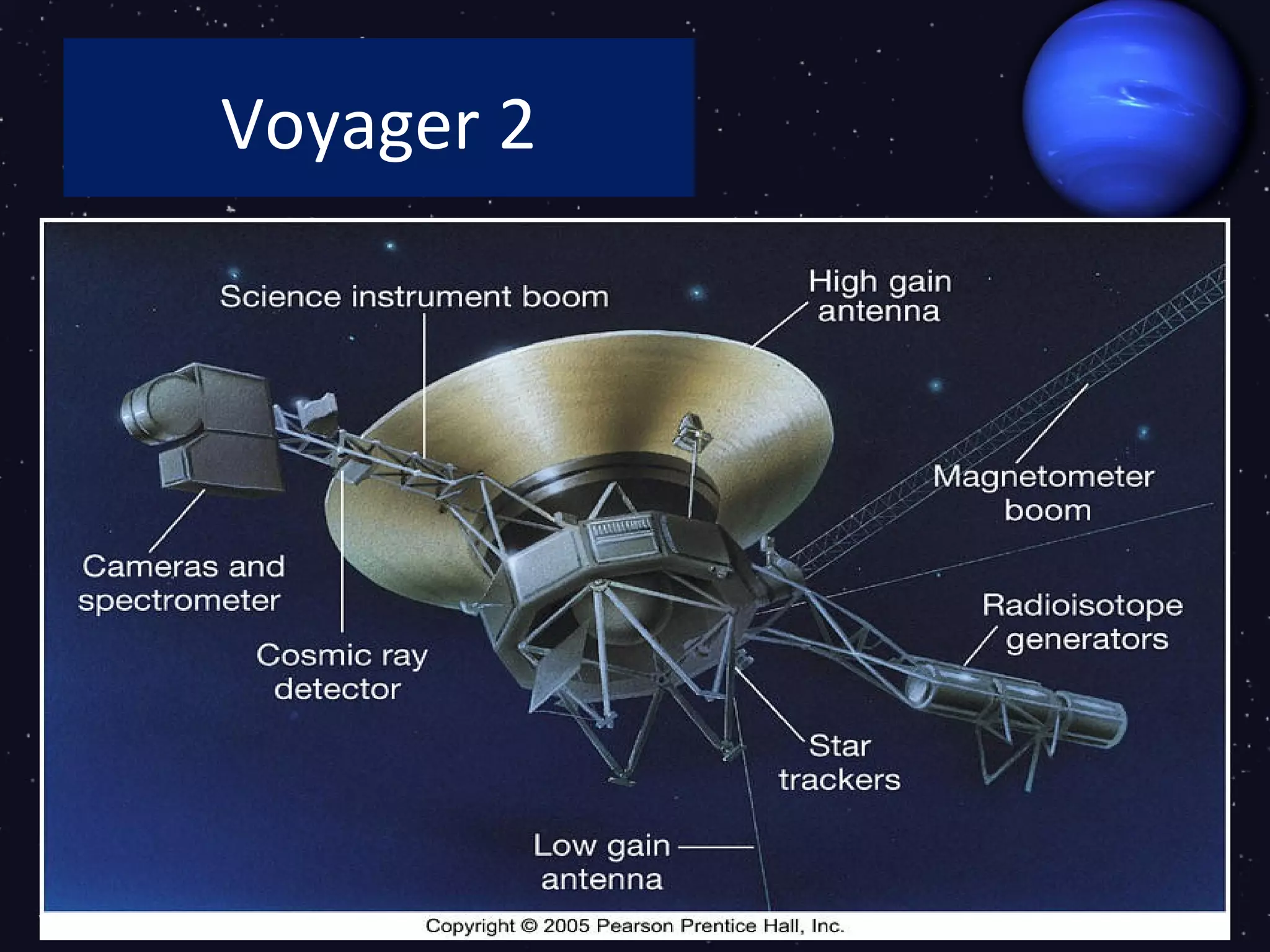
Voyager 2
Voyager 2
• The Voyager 2 spacecraft is a 722 kg (1,590 lb) space
  probe launched by NASA on August 20, 1977 to study
  the outer Solar System and eventually interstellar
  space. It was actually launched before Voyager 1, but
  Voyager 1 moved faster and eventually passed it. It has
  been operating for 35 years, 6 months and 16 days as
  of 5 March 2013, the spacecraft still receives and
  transmits data via the Deep Space Network.[2] At a
  distance of 100.675 AU (1.51×10¹⁰ km; 9.36×10⁹ mi)
  as of November 2012, it is one of the most distant
  manmade objects
Voyager 2
• Voyager 2 is part of the Voyager program with its
  identical sister craft Voyager 1, and is in extended
  mission, tasked with locating and studying the
  boundaries of the Solar System, including the
  Kuiper belt, the heliosphere and interstellar space.
  The primary mission ended December 31, 1989 after
  encountering the Jovian system in 1979,
  Saturnian system in 1980, Uranian system in 1986,
  and the Neptunian system in 1989. It is still the only
  spacecraft to have visited the two outer gas giant
  planets Uranus and Neptune.
Voyager 2
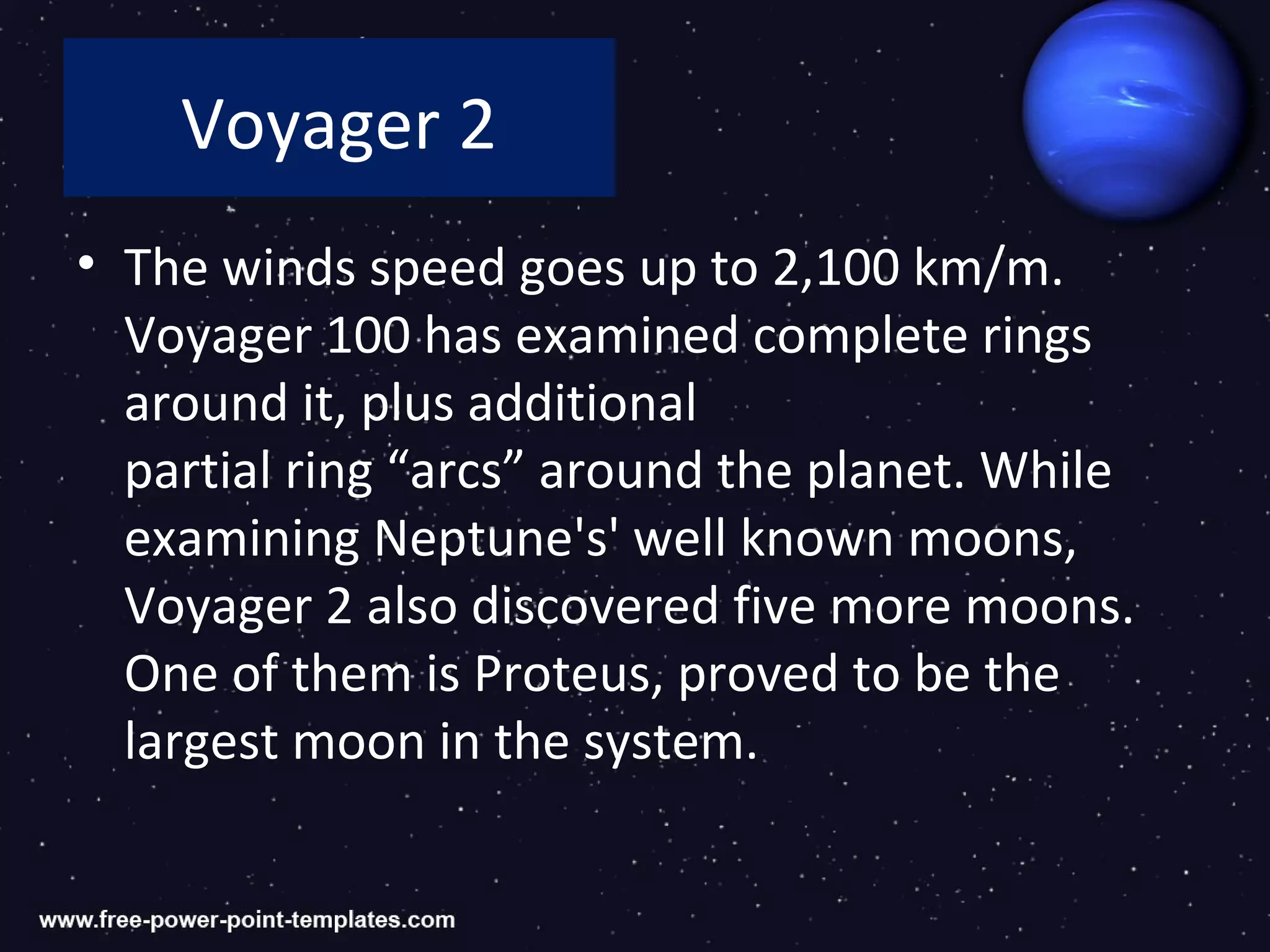
• Voyager 2 was launched on August 20, 1977.
  Voyager 2 sent images to earth from radio
  on Neptune. It radioed the planet data, its
  moons, the atmosphere, the interior, and the
  magnetic environment surrounding
  Uranus. Voyager 1 and voyager 2 will both
  continue to study sorces like ultraviolet
  among tge stars for aproxomitley the next 20
  years.
Voyager 2
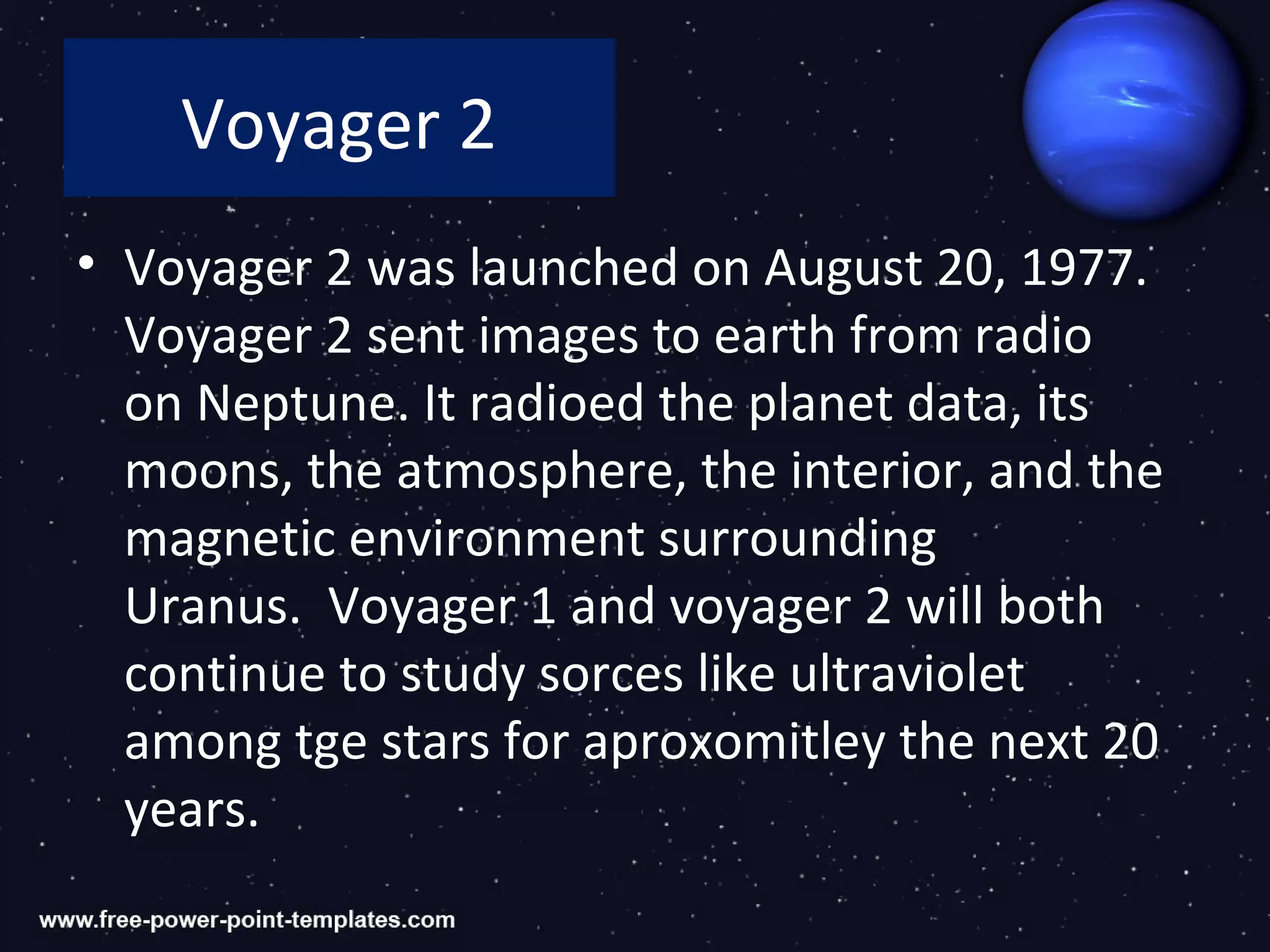
• The winds speed goes up to 2,100 km/m.
  Voyager 100 has examined complete rings
  around it, plus additional
  partial ring “arcs” around the planet. While
  examining Neptune's' well known moons,
  Voyager 2 also discovered five more moons.
  One of them is Proteus, proved to be the
  largest moon in the system.
Da nke,
Viel en
      eu nd!
   Fr
References
• http://www.universetoday.com/21581/neptune/
• http://nineplanets.org/neptune.html
• http://www.solarviews.com/eng/neptune.htm
• http://science.nationalgeographic.com/science/phot
  os/neptune/#/neptune_1114_600x450.jpg
• http://www.buzzle.com/articles/interesting-facts-
  about-neptune.html
• https://sites.google.com/site/mvmneptunemvm/ho
  me

Neptune

  • 2.
  • 3.
    NEPTUNE • Neptune isone of the four gas giants in our Solar System, as well as being one of the four Jovian planets. • As a gas giant, Neptune has no solid surface, so even if a spaceship could reach it, it could not land because it would simply keep sinking into the planet. • Neptune cannot be seen with the naked eye and was therefore not discovered until 1846. • Although Neptune is a gas giant, it is actually in a subclass of gas giants known as ice giants. It has a higher percentage of “ices” in its atmosphere.
  • 4.
    Facts about NEPTUNE • History of Neptune • Characteristics of Neptune • Position and Movement of Neptune • Neptune’s Moon and Rings • Exploration on Neptune
  • 5.
  • 6.
    Who discovered NEPTUNE? Britain’sJohn Couch Adams France’s Urbain Le Verrier
  • 7.
    Who discovered NEPTUNE? •Britain’s John Couch Adams and France’s Urbain Le Verrier were worked out the position of the hypothetical 8th planet independently from each other. And both had a difficult time convincing their colleagues to spend any time actually looking where they suggested the planet might be.
  • 8.
    Who discovered NEPTUNE? Johann Gottfried Galle Johann Gottfried Galle The Berlin Observatory astronomer Johann Gottfried Galle used the calculations by Le Verrier to find Neptune within just 1° of its predicted location, and just 12° of Adams’ predictions.
  • 9.
    How did NEPTUNEget its name? • It was named after the Roman god in Roman mythology, Neptune which is the god of sea. • Known as Poseidon in Greek mythology.
  • 10.
    How did NEPTUNEget its name? • Shortly after its discovery, Neptune was only referred to as “the planet exterior to Uranus” or as “Le Verrier’s planet”. • The first suggestion for a name came from Johann Galle, who proposed the name Janus. • Another proposal was Oceanus. • Urbain Le Verrier, who discovered the planet, claimed the right to name his discovery: Neptune.
  • 11.
    Symbol of NEPTUNE Thesymbol for Neptune is a trident, or three-pronged fork. This is a weapon associated with the Roman god Neptune, and the Greek god Poseidon.
  • 12.
    Facts about NEPTUNE • History of Neptune • Characteristics of Neptune • Position and Movement of Neptune • Neptune’s Moon and Rings • Exploration on Neptune
  • 13.
  • 14.
    How big NEPTUNEis? • It has a diameter of 49,500 km, & a polar radius of 24,341 km. • Neptune is 3.9 times bigger than the Earth.
  • 15.
  • 16.
    This image shows bands of sunlit cirrus-like clouds in Neptune's northern hemisphere. These clouds cast shadows on the blue cloud deck 35 miles below. The white streaky clouds are from 48 to 160 kilometers (30 to 100 miles) Upper Atmosphere wide and extend for thousands of miles.
  • 17.
    80 % -Hydrogen 19 % - Helium 1 % - Methane The Methane makes the blue color of Neptune. NEPTUNE’s Atmosphere
  • 18.
    It is asuperheated liquid region where temperatures can reach 2,000 K to 5,000 K. It consists of water, ammonia, methane, and other NEPTUNE’s Mantle compounds.
  • 19.
    The core of Neptune is made of iron, nickel and other silicates that make up about 1.2 times the mass of the Earth. NEPTUNE’s Core
  • 20.
    Gravity on NEPTUNE The surface gravity of Neptune is 1.14 times the gravity on Earth.
  • 21.
    Axis Tilt ofNEPTUNE • The tilt of Neptune’s axis is 28.32 degrees compare that to the Earth’s tilt of 23.5 degrees.
  • 22.
    Temperature of NEPTUNE • At its surface, where the clouds of the planet touch space, the temperature of Neptune can dip down to 55 up to -218⁰C. • The average temperature of Neptune is -200⁰C. • The temperature of the core of Neptune is 7000⁰C.
  • 23.
    Climate of NEPTUNE • Like Jupiter and Saturn, Neptune has an internal heat source which radiates more energy than the energy Neptune is receiving from the sun. • This causes surface winds to reach extremely high speeds. • Many of the winds interfere with one another Great Dark Spot causing small storms or large storms
  • 24.
    • It isvery dark and about 1/3 the size of Jupiter's Great Red Spot. • It moves west and the winds around it can be measured blowing up to 2,400 km/hr, the fastest winds in the solar NEPTUNE’s Great Dark Spot system.
  • 25.
    Facts about NEPTUNE • History of Neptune • Characteristics of Neptune • Position and Movement of Neptune • Neptune’s Moon and Rings • Exploration on Neptune
  • 26.
  • 27.
    How Long isa Day on NEPTUNE? • A day on Neptune is 16 hours, 6 minutes and 36 seconds. • Neptune’s equatorial zone takes about 18 hours to complete a rotation. • And the polar regions can take just 12 hours to rotate; much more Differential Rotation quickly than the average.
  • 28.
    How far isNEPTUNE from Earth? Sun? • Neptune is approximately 4.4 billion km away from the Earth. • Neptune’s distance from the Sun is 4.5 billion km; more specifically, it’s 4,503,443,661 km.
  • 29.
    NEPTUNE’s Orbit • Neptune follows an elliptical path around the Sun, varying its distance to the Sun at different points along its orbit.
  • 30.
    How Long isa Year on NEPTUNE? • A year on Neptune is 60,190 days or 164.79 years.
  • 31.
    Facts about NEPTUNE • History of Neptune • Characteristics of Neptune • Position and Movement of Neptune • Neptune’s Moons and Rings • Exploration on Neptune
  • 32.
  • 33.
    NEPTUNE’s Moons • Neptune has 13 discovered moons!
  • 34.
    Triton Discovery Date :1846 Discoverer : William Lassell Diameter : 2,707 km. Distance from Neptune : 354,800 km. Orbit Length : 5 days, 21 hrs It is the largest moon of planet Neptune.
  • 35.
    Nereid Discovery Date :1949 Discoverer : Gerard Kuiper Diameter : 340 km. Distance from Neptune : 5,513,400 km. Orbit Length : 360 days,3 hrs
  • 36.
    Naiad Discovery Date :1989 Discoverer : Voyager 2 Diameter : 67 km. Distance from Neptune : 48,277 km. Orbit Length : 6 hrs, 57 mins.
  • 37.
    Thalassa Discovery Date :1989 Discoverer : Voyager 2 Diameter : 83 km. Distance from Neptune : 50,075 km. Orbit Length : 7 hrs, 28 mins.
  • 38.
    Despina Discovery Date :1989 Discoverer : Voyager 2 Diameter : 152 km. Distance from Neptune : 52,526 km. Orbit Length : 8 hrs, 2 mins.
  • 39.
    Galatea Discovery Date :1989 Discoverer : Voyager 2 Diameter : 175 km. Distance from Neptune : 61,953 km. Orbit Length : 10 hrs, 18 mins.
  • 40.
    Larissa Discovery Date :1989 Discoverer : Voyager 2 Diameter : 195 km. Distance from Neptune : 73,548 km. Orbit Length : 13 hrs, 19 mins.
  • 41.
    Proteus Discovery Date :1989 Discoverer : Voyager 2 Diameter : 418 km. Distance from Neptune : 117,647 km. Orbit Length : 1 day, 3 hrs.
  • 42.
    • Halimede -1,880 days • Psamathe – 9, 116 days Discovery Date : 2002 • Sao - 2,914 days Discoverer : Matthew J, Holman, John J. • Laomedeia - 3,168 days Other moons of • Neso - 9,374 days NEPTUNE
  • 43.
  • 44.
    NEPTUNE’s Rings RingNames Distance Width Albedo (km) ("the ratio of the light reflected (measured from the planet center to the (km) by a planet or satellite to that received by it" (dictionary.com)) start of the ring). 1989 N3R Galle 41, 900 15 km Low 1989 N2R Leverrier 53, 200 15 km Low Lassell 55, 400 ? Low Arago 57, 600 ? Low
  • 45.
    NEPTUNE’s Rings 1989 NIR Adams 57, 600 -km No Information Available Liberte ("Equidistant" Adams 62, 930 <50 km Low arc) Egalite ("Equidistant" Adams 62, 900 -km No Information arc) Available Fraternite ("Following" Adams 62, 900 No No Information arc) Informatio Available n Available Courage (arc) 62, 900 -km No Information Available
  • 46.
  • 47.
  • 48.
    Voyager 2 • TheVoyager 2 spacecraft is a 722 kg (1,590 lb) space probe launched by NASA on August 20, 1977 to study the outer Solar System and eventually interstellar space. It was actually launched before Voyager 1, but Voyager 1 moved faster and eventually passed it. It has been operating for 35 years, 6 months and 16 days as of 5 March 2013, the spacecraft still receives and transmits data via the Deep Space Network.[2] At a distance of 100.675 AU (1.51×10¹⁰ km; 9.36×10⁹ mi) as of November 2012, it is one of the most distant manmade objects
  • 49.
    Voyager 2 • Voyager2 is part of the Voyager program with its identical sister craft Voyager 1, and is in extended mission, tasked with locating and studying the boundaries of the Solar System, including the Kuiper belt, the heliosphere and interstellar space. The primary mission ended December 31, 1989 after encountering the Jovian system in 1979, Saturnian system in 1980, Uranian system in 1986, and the Neptunian system in 1989. It is still the only spacecraft to have visited the two outer gas giant planets Uranus and Neptune.
  • 50.
    Voyager 2 • Voyager2 was launched on August 20, 1977. Voyager 2 sent images to earth from radio on Neptune. It radioed the planet data, its moons, the atmosphere, the interior, and the magnetic environment surrounding Uranus. Voyager 1 and voyager 2 will both continue to study sorces like ultraviolet among tge stars for aproxomitley the next 20 years.
  • 51.
    Voyager 2 • Thewinds speed goes up to 2,100 km/m. Voyager 100 has examined complete rings around it, plus additional partial ring “arcs” around the planet. While examining Neptune's' well known moons, Voyager 2 also discovered five more moons. One of them is Proteus, proved to be the largest moon in the system.
  • 52.
    Da nke, Viel en eu nd! Fr
  • 53.
    References • http://www.universetoday.com/21581/neptune/ • http://nineplanets.org/neptune.html •http://www.solarviews.com/eng/neptune.htm • http://science.nationalgeographic.com/science/phot os/neptune/#/neptune_1114_600x450.jpg • http://www.buzzle.com/articles/interesting-facts- about-neptune.html • https://sites.google.com/site/mvmneptunemvm/ho me