SAP ABAP Multiple Choice
Questions and Answers

Learning IT Courses Has Never Been This Easy
www.ITLearnMore.com
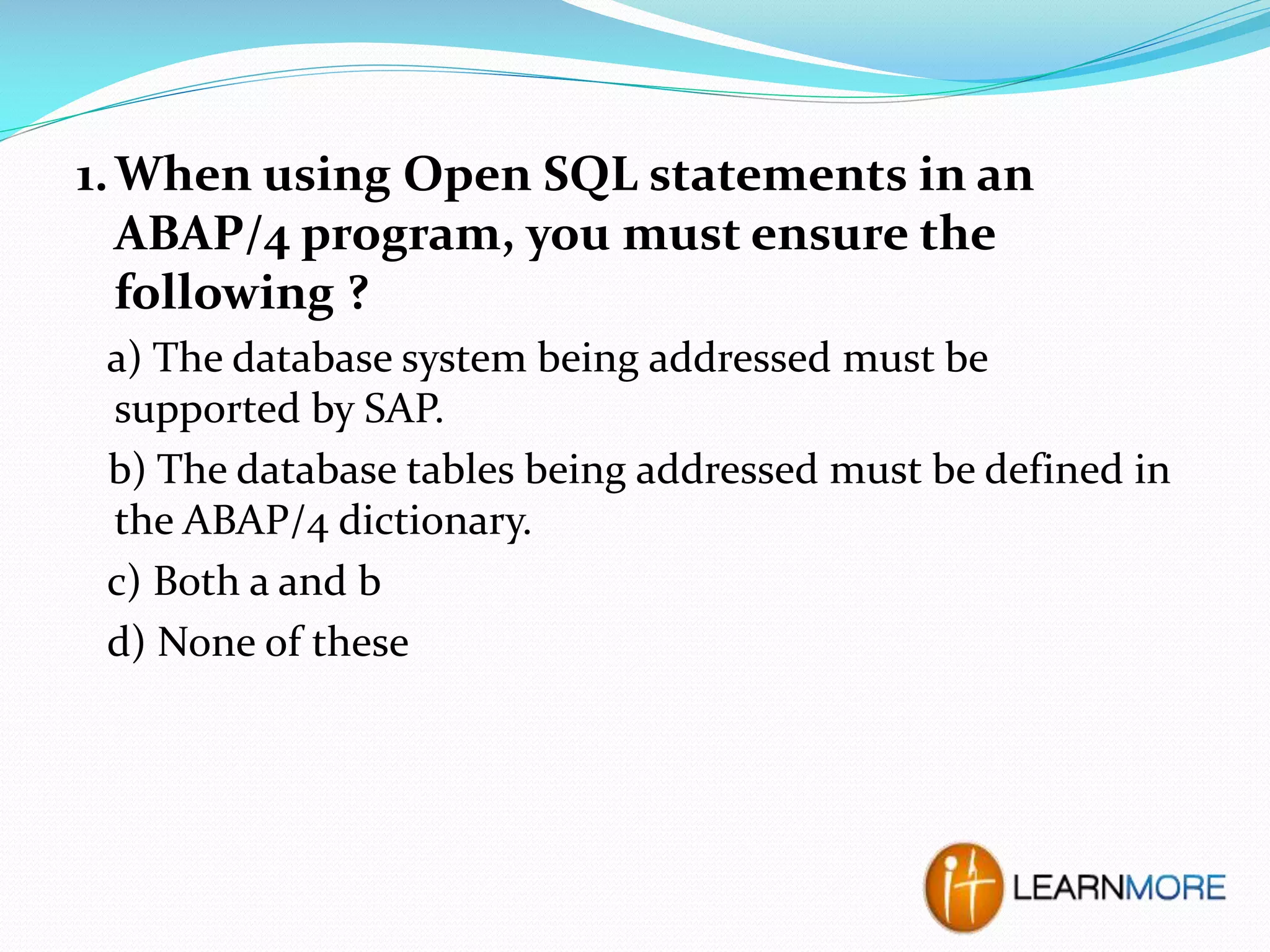
1. When using Open SQL statements in an
ABAP/4 program, you must ensure the
following ?
a) The database system being addressed must be
supported by SAP.
b) The database tables being addressed must be defined in
the ABAP/4 dictionary.
c) Both a and b
d) None of these
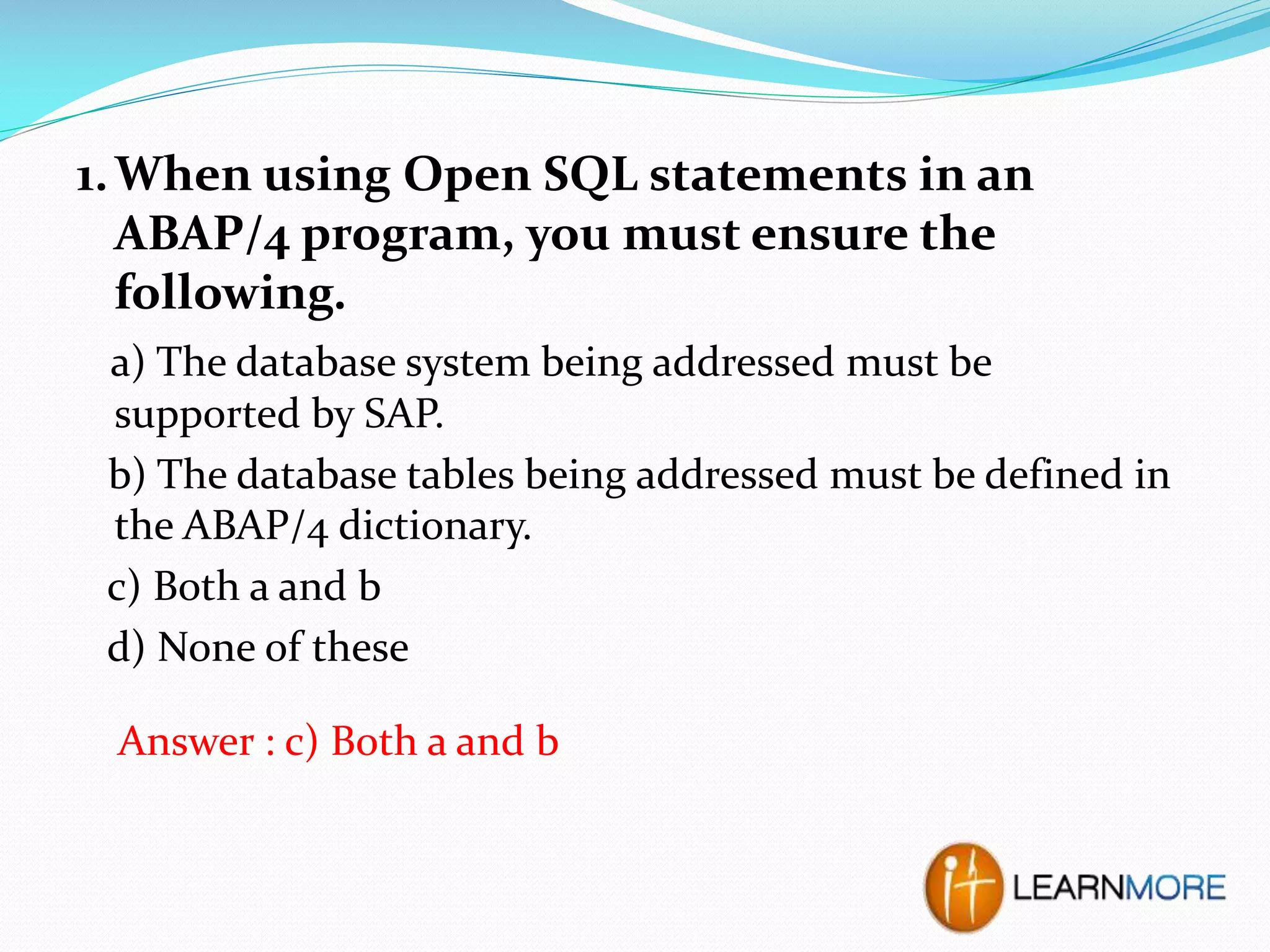
1. When using Open SQL statements in an
ABAP/4 program, you must ensure the
following.
a) The database system being addressed must be
supported by SAP.
b) The database tables being addressed must be defined in
the ABAP/4 dictionary.
c) Both a and b
d) None of these
Answer : c) Both a and b
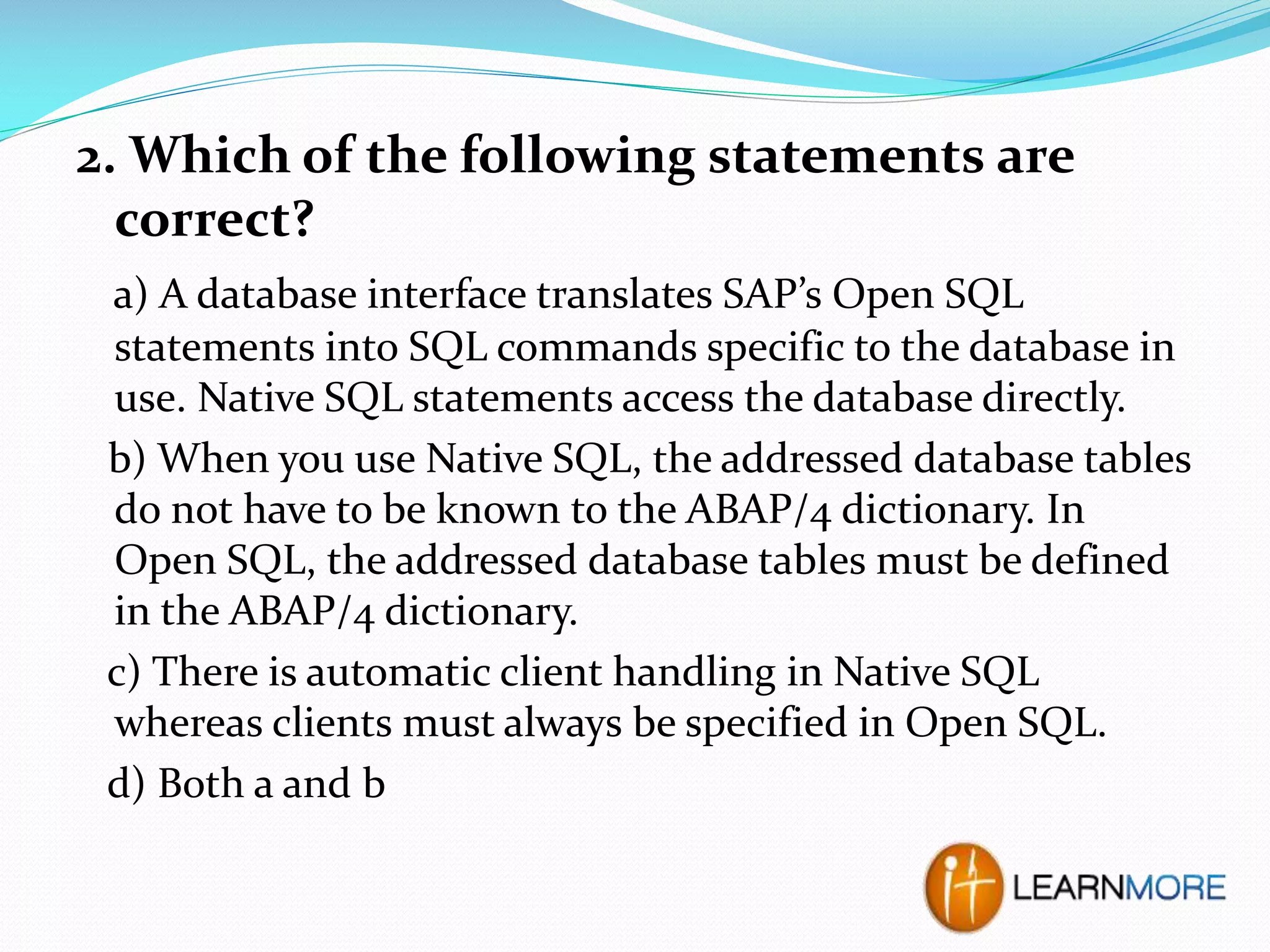
2. Which of the following statements are
correct?
a) A database interface translates SAP’s Open SQL
statements into SQL commands specific to the database in
use. Native SQL statements access the database directly.
b) When you use Native SQL, the addressed database tables
do not have to be known to the ABAP/4 dictionary. In
Open SQL, the addressed database tables must be defined
in the ABAP/4 dictionary.
c) There is automatic client handling in Native SQL
whereas clients must always be specified in Open SQL.
d) Both a and b
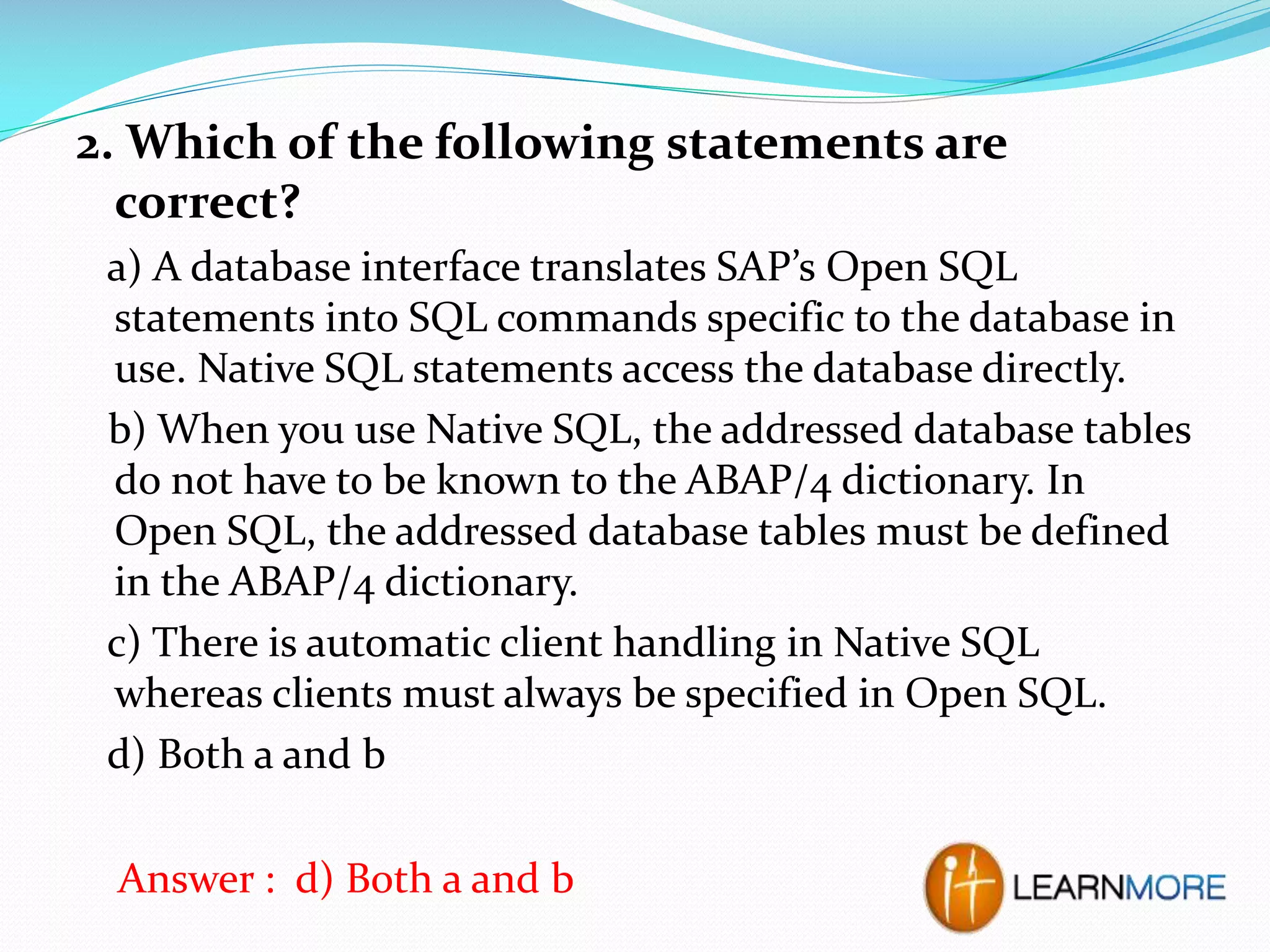
2. Which of the following statements are
correct?
a) A database interface translates SAP’s Open SQL
statements into SQL commands specific to the database in
use. Native SQL statements access the database directly.
b) When you use Native SQL, the addressed database tables
do not have to be known to the ABAP/4 dictionary. In
Open SQL, the addressed database tables must be defined
in the ABAP/4 dictionary.
c) There is automatic client handling in Native SQL
whereas clients must always be specified in Open SQL.
d) Both a and b
Answer : d) Both a and b
3. Which of the following are true?
a) TABLE is used as a synonym for STANDARD TABLE
b) Explicit or implicit index operations
c) All hashed tables are index tables.
d) both a and b
3. Which of the following are true?
a) TABLE is used as a synonym for STANDARD TABLE
b) Explicit or implicit index operations
c) All hashed tables are index tables.
d) both a and b
Answer : d) both a and b
4. Can a transparent table exist in data
dictionary but not in the database physically?
a) True
b) False
4. Can a transparent table exist in data
dictionary but not in the database physically?
a) True
b) False
Answer : a) True
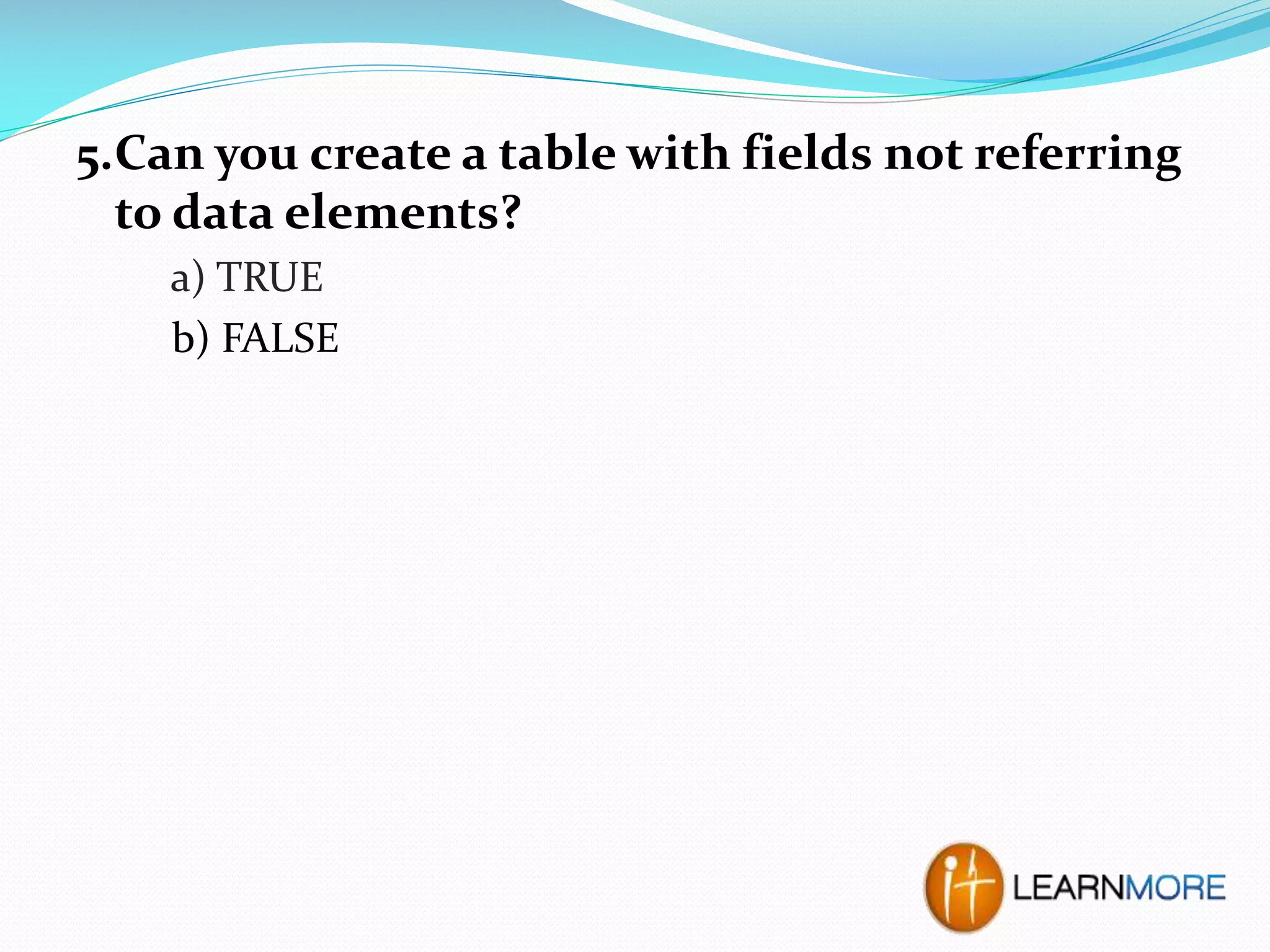
5.Can you create a table with fields not referring
to data elements?
a) TRUE
b) FALSE
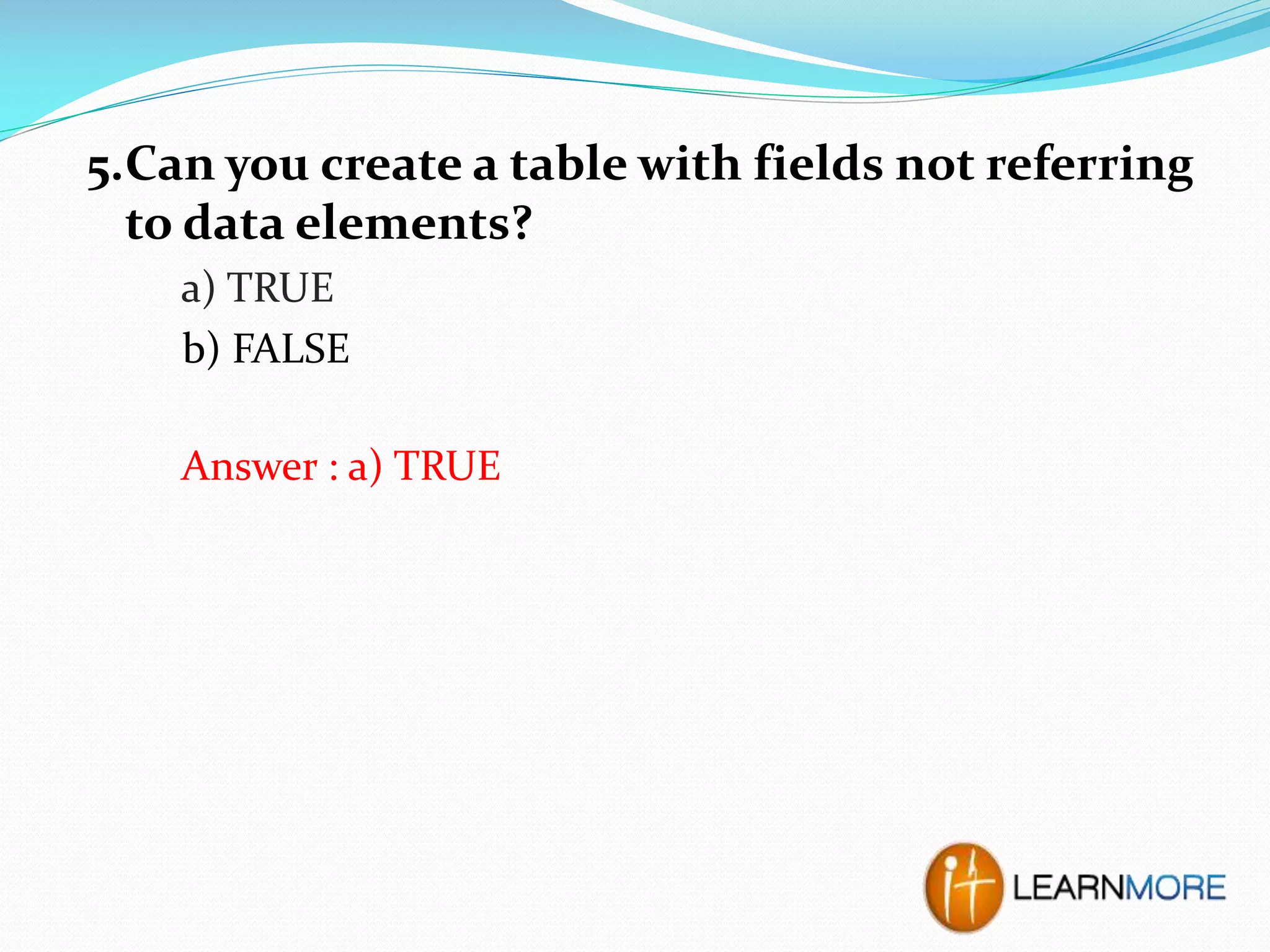
5.Can you create a table with fields not referring
to data elements?
a) TRUE
b) FALSE
Answer : a) TRUE
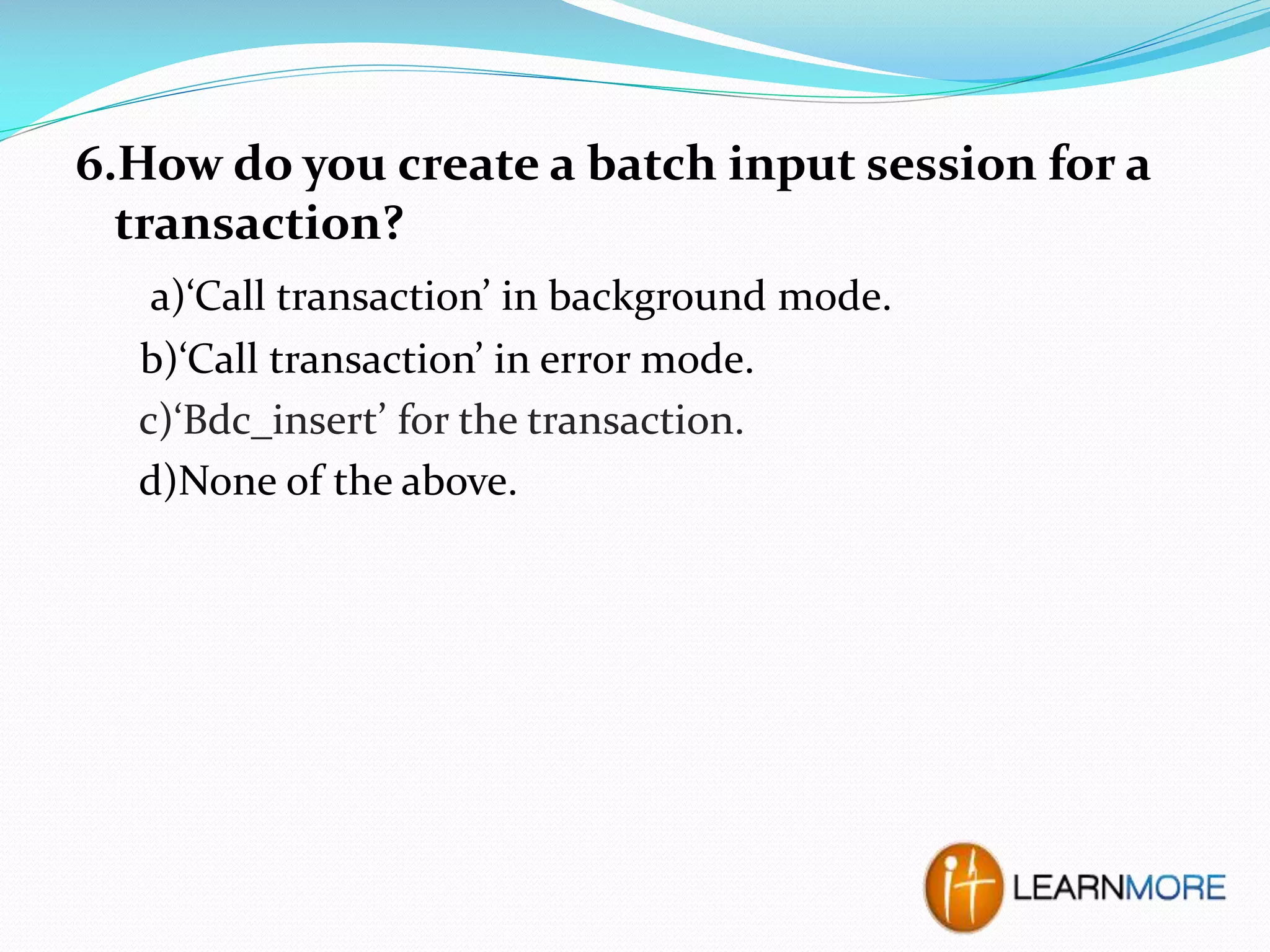
6.How do you create a batch input session for a
transaction?
a)‘Call transaction’ in background mode.
b)‘Call transaction’ in error mode.
c)‘Bdc_insert’ for the transaction.
d)None of the above.
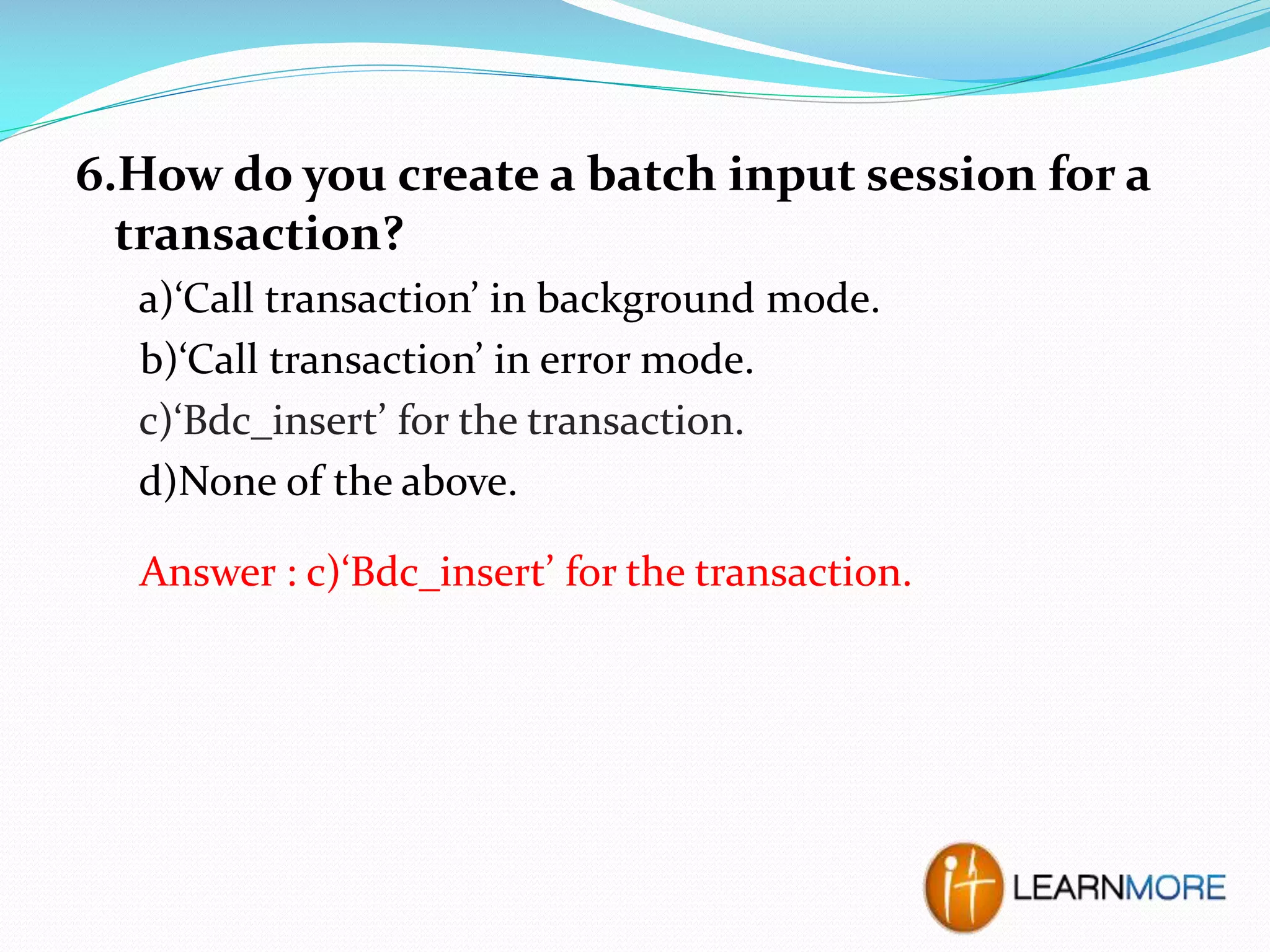
6.How do you create a batch input session for a
transaction?
a)‘Call transaction’ in background mode.
b)‘Call transaction’ in error mode.
c)‘Bdc_insert’ for the transaction.
d)None of the above.
Answer : c)‘Bdc_insert’ for the transaction.
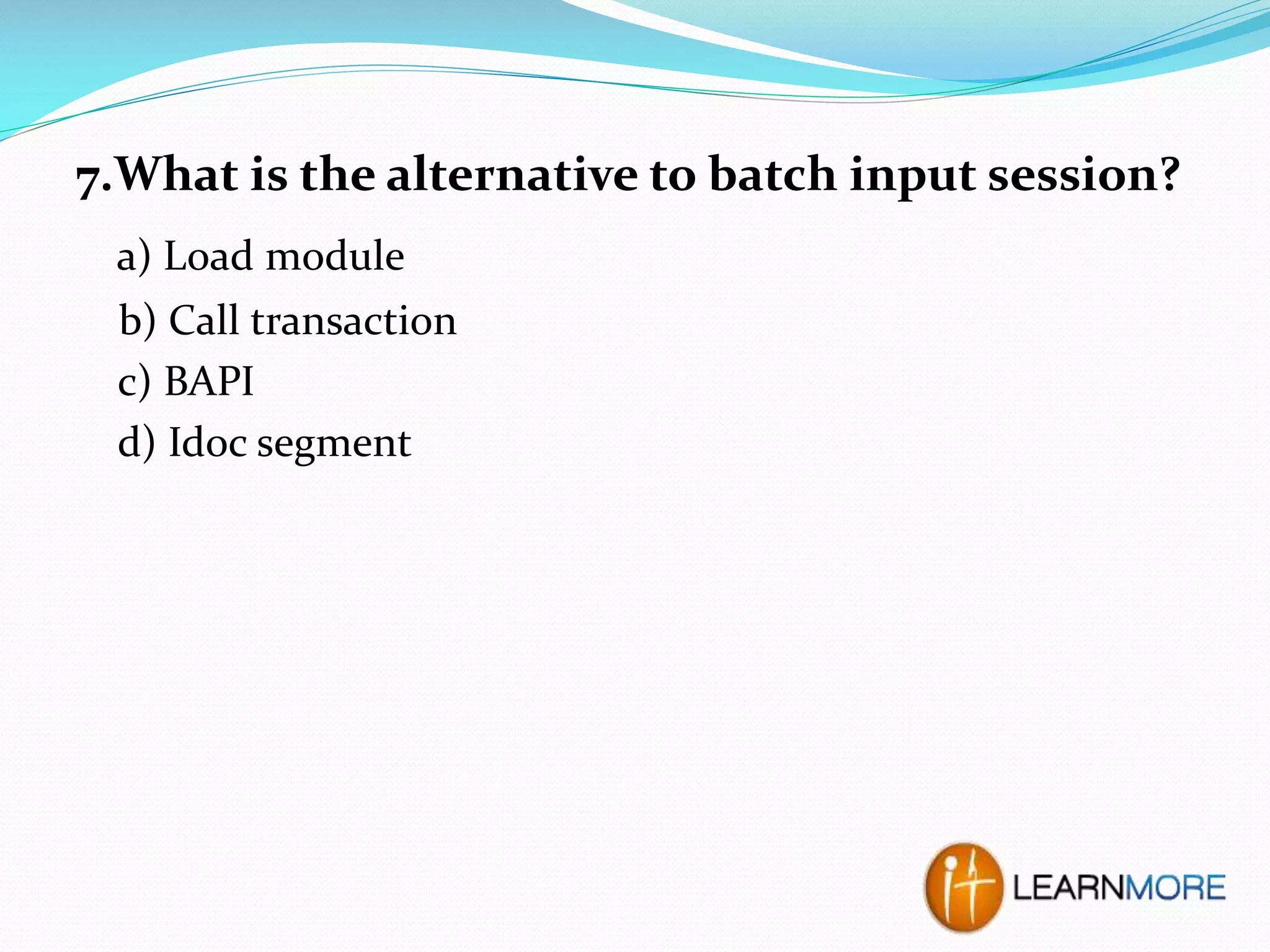
7.What is the alternative to batch input session?
a) Load module
b) Call transaction
c) BAPI
d) Idoc segment
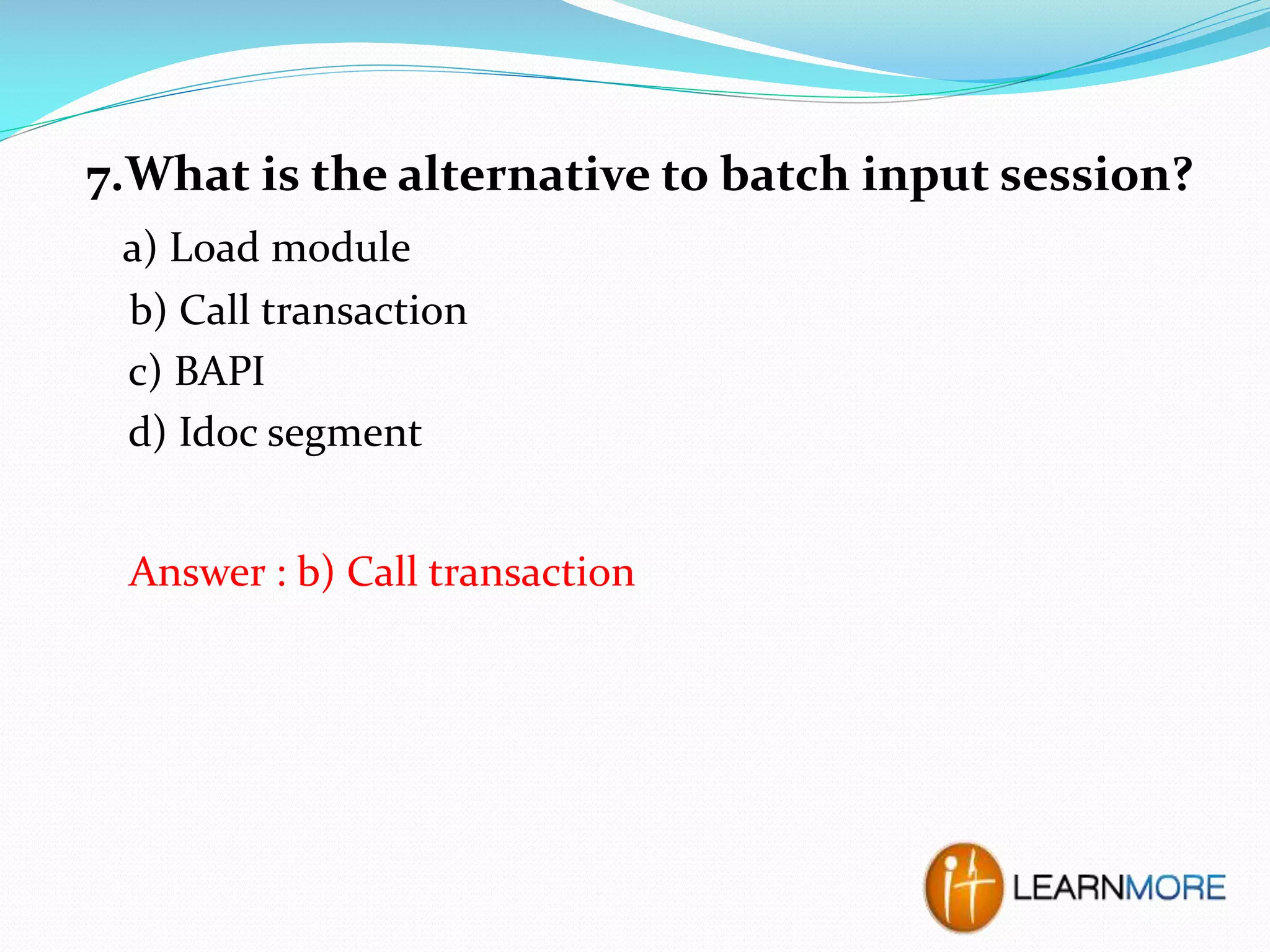
7.What is the alternative to batch input session?
a) Load module
b) Call transaction
c) BAPI
d) Idoc segment
Answer : b) Call transaction
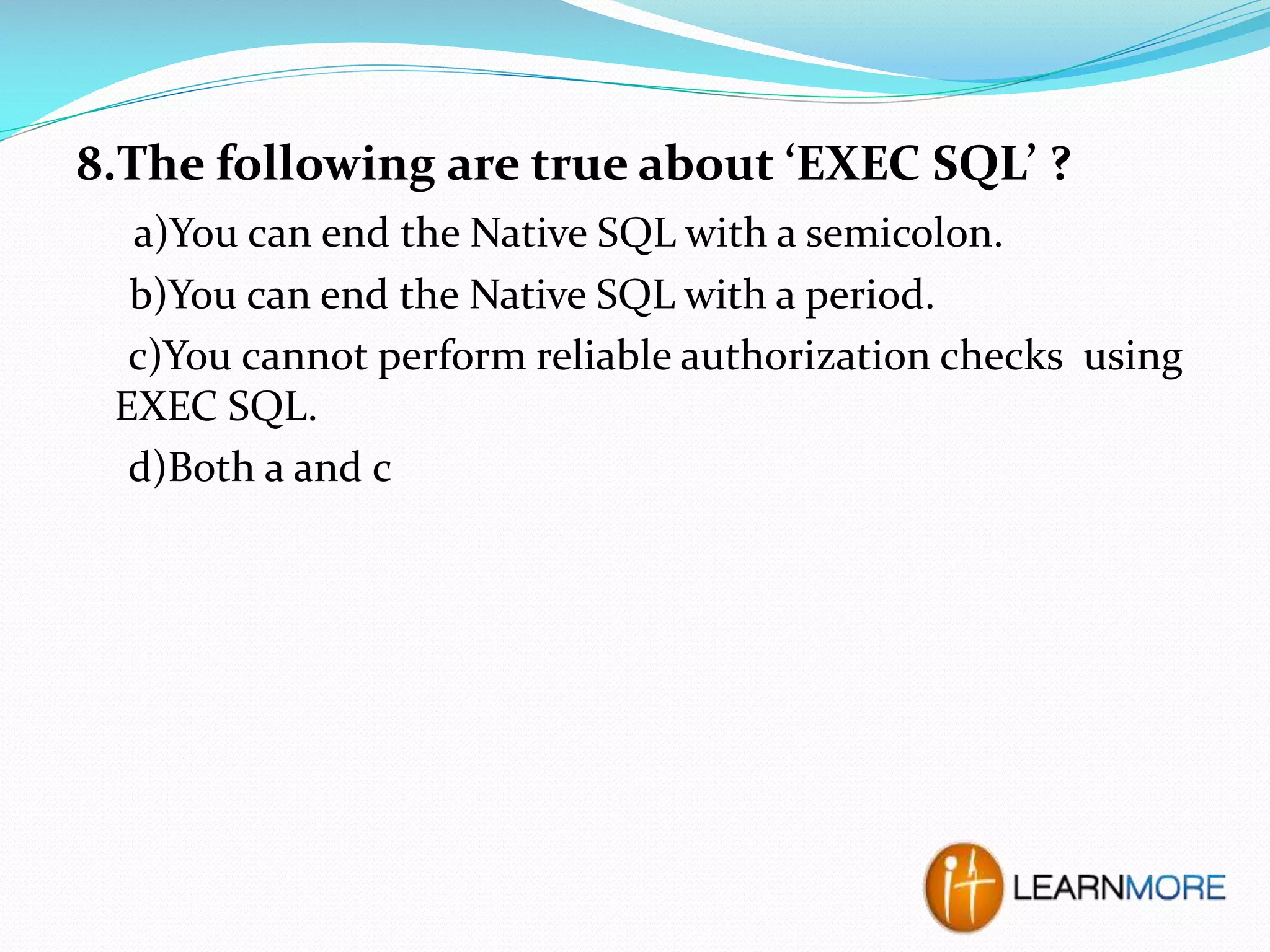
8.The following are true about ‘EXEC SQL’ ?
a)You can end the Native SQL with a semicolon.
b)You can end the Native SQL with a period.
c)You cannot perform reliable authorization checks using
EXEC SQL.
d)Both a and c
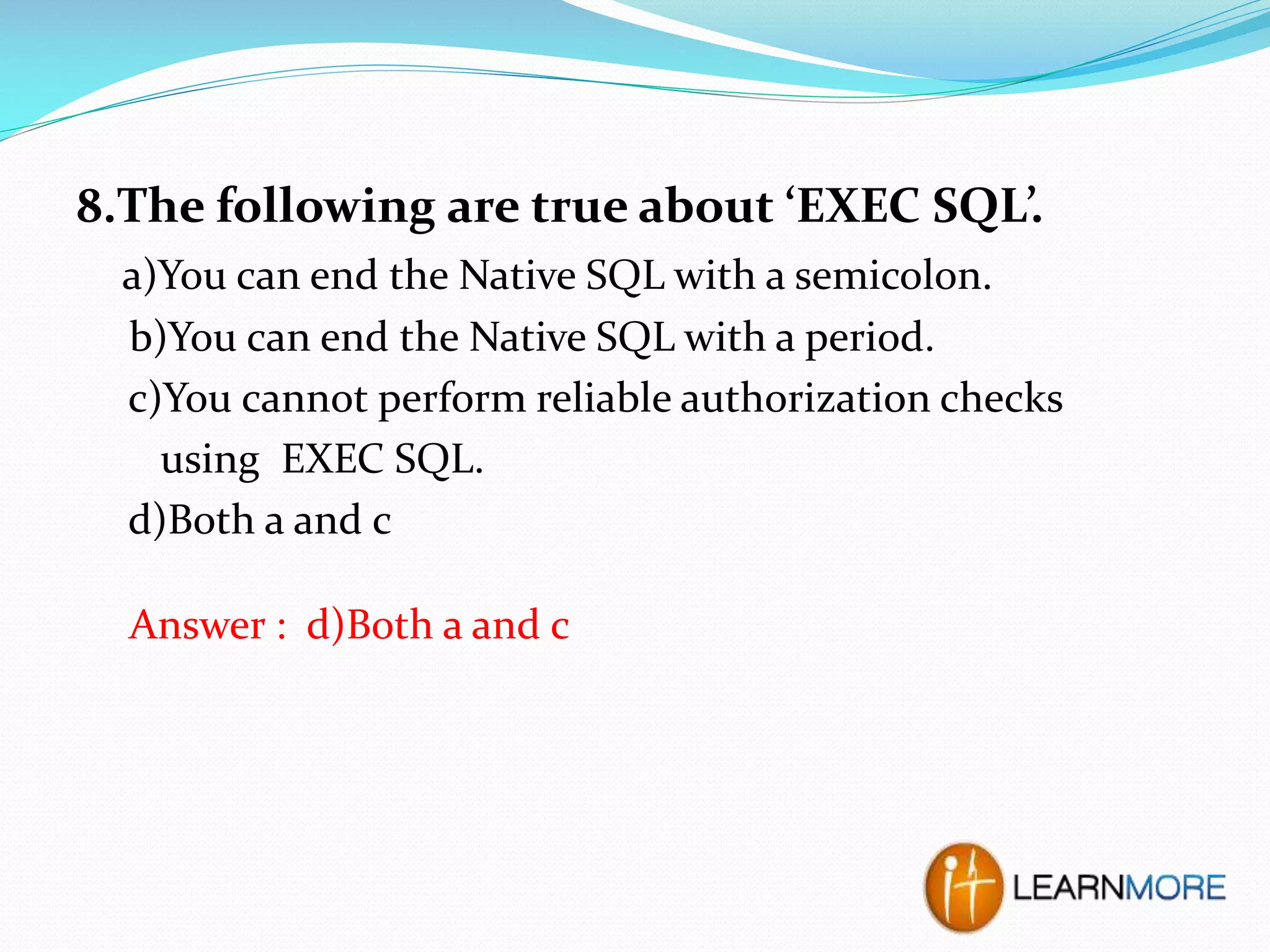
8.The following are true about ‘EXEC SQL’.
a)You can end the Native SQL with a semicolon.
b)You can end the Native SQL with a period.
c)You cannot perform reliable authorization checks
using EXEC SQL.
d)Both a and c
Answer : d)Both a and c
9.Which of the following is true about database
locking ?
a) Database systems set physical locks on all lines affected by
a database call.
b) Read locks prevent the setting of further read locks for the
objects in question.
c) Read locks prevent other transactions from setting write
locks for the objects in question.
d)Both a and c
9.Which of the following is true about database
locking.
a) Database systems set physical locks on all lines affected by
a database call.
b) Read locks prevent the setting of further read locks for the
objects in question.
c) Read locks prevent other transactions from setting write
locks for the objects in question.
d)Both a and c
Answer : d)Both a and c
10. What are field symbols?
a) Field symbols are like pointers in C that can point to any
data object in ABAP/4 and to structures defined in ABAP/4
dictionary.
b)Field symbols have to be created with type specifications
only.
c)All operations you have programmed with the field
symbol are carried out with the assigned field.
d) Both a and c
10. What are field symbols?
a) Field symbols are like pointers in C that can point to any
data object in ABAP/4 and to structures defined in ABAP/4
dictionary.
b)Field symbols have to be created with type specifications
only.
c)All operations you have programmed with the field
symbol are carried out with the assigned field.
d) Both a and c
Answer : d) Both a and c
11. What is EXTRACT statement?
a) The first EXTRACT statement extracts the first extract
record.
b) The first EXTRACT statement creates the extract dataset
and adds the first extract record.
c) Each extract record contains, if specified, the fields of the
field group.
b) Both a and c
11. What is EXTRACT statement?
a) The first EXTRACT statement extracts the first extract
record.
b) The first EXTRACT statement creates the extract dataset
and adds the first extract record.
c) Each extract record contains, if specified, the fields of the
field group.
b) Both a and c
Answer : b) Both a and c
12. You cannot assign a local data object defined
in a subroutine or function module to a field
group ?
a) True
b) False
12. You cannot assign a local data object defined
in a subroutine or function module to a field
group.
a) True
b) False
Answer : a) True
13. Which of the following are true?
a) COLLECT can only be used with STANDARD TABLE.
b) To use COLLECT, the internal table should be derived
from a database table with an explicit key.
c) If the system finds a numeric component, that is not part
of the key, the numeric fields that are not part of the table
key (see ABAP number types) are added to the sum total of
the existing entries. If it does not find an entry, control
passes on to the next record in the internal table.
d) If the system finds a numeric component, that is not part
of the key, the numeric fields that are not part of the table
key (see ABAP number types) are added to the sum total of
the existing entries. If it does not find an entry, the system
creates a new entry instead.
13. Which of the following are true?
a) COLLECT can only be used with STANDARD TABLE.
b) To use COLLECT, the internal table should be derived
from a database table with an explicit key.
c) If the system finds a numeric component, that is not part
of the key, the numeric fields that are not part of the table
key (see ABAP number types) are added to the sum total of
the existing entries. If it does not find an entry, control
passes on to the next record in the internal table.
d) If the system finds a numeric component, that is not part
of the key, the numeric fields that are not part of the table
key (see ABAP number types) are added to the sum total of
the existing entries. If it does not find an entry, the system
creates a new entry instead.
Answer : D
14. Which of the following are true?
a)ABAP queries are created by associating them to a logical
database or through a direct read/data retrieval program.
b) ABAP queries are created from functional areas that are
created from a logical database or through a direct
read/retrieval program.
c)ABAP queries are created from user groups attached to
the functional areas that are created from a logical
database or through a direct read/retrieval program.
d)ABAP queries are created through the regular report
program.
14. Which of the following are true?
a)ABAP queries are created by associating them to a logical
database or through a direct read/data retrieval program.
b) ABAP queries are created from functional areas that are
created from a logical database or through a direct
read/retrieval program.
c)ABAP queries are created from user groups attached to
the functional areas that are created from a logical
database or through a direct read/retrieval program.
d)ABAP queries are created through the regular report
program.
Answer : C
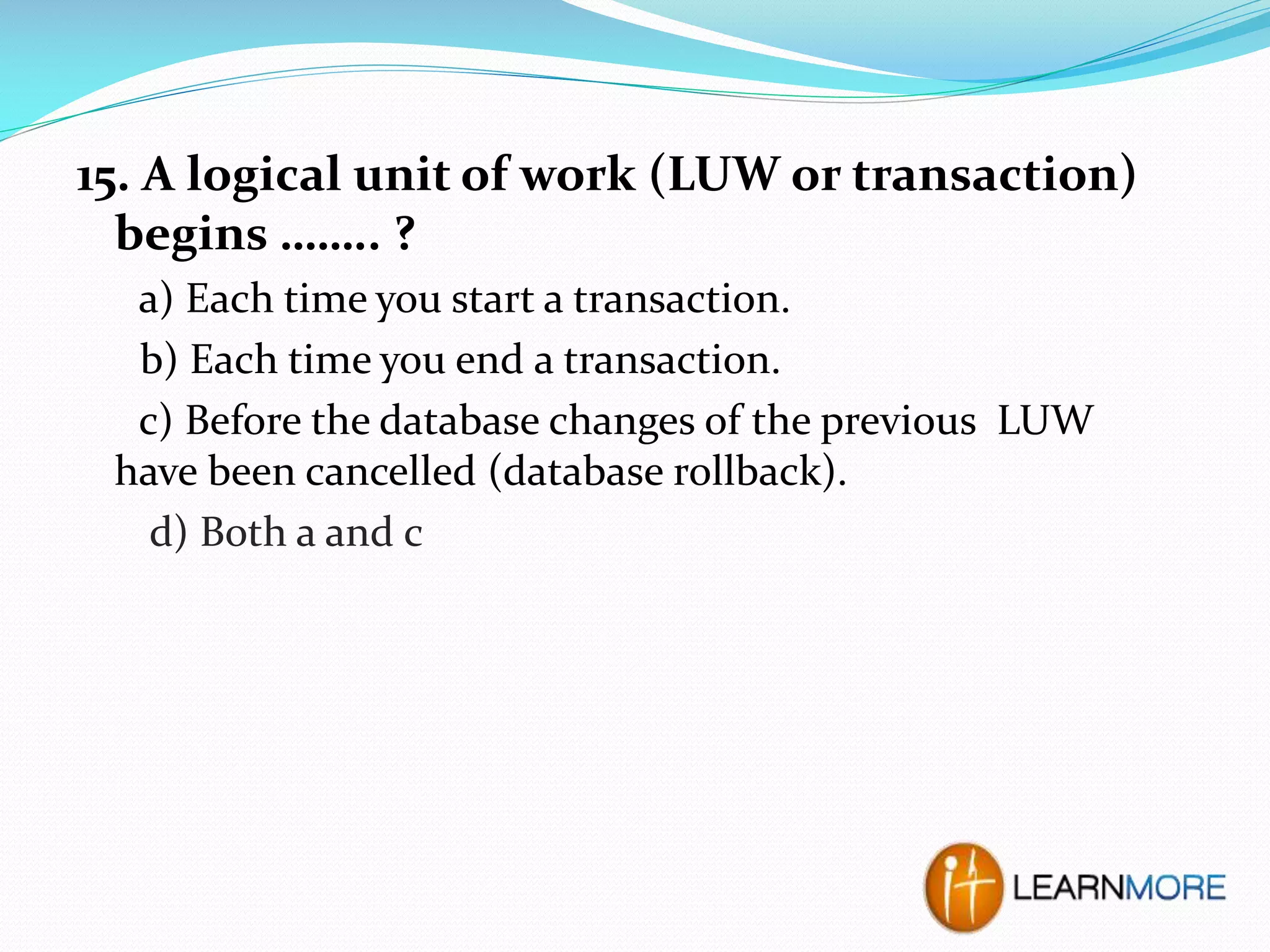
15. A logical unit of work (LUW or transaction)
begins …….. ?
a) Each time you start a transaction.
b) Each time you end a transaction.
c) Before the database changes of the previous LUW
have been cancelled (database rollback).
d) Both a and c
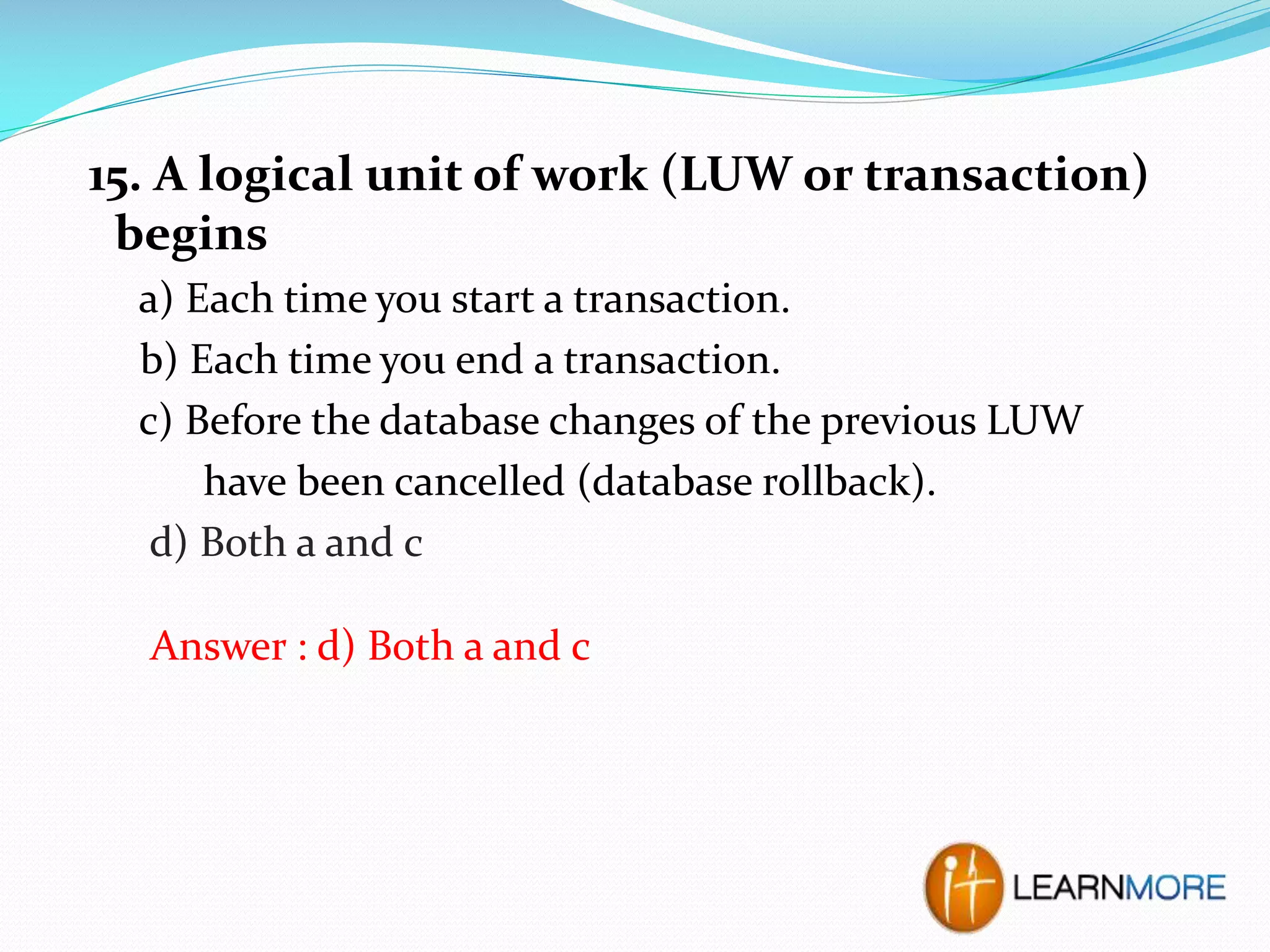
15. A logical unit of work (LUW or transaction)
begins
a) Each time you start a transaction.
b) Each time you end a transaction.
c) Before the database changes of the previous LUW
have been cancelled (database rollback).
d) Both a and c
Answer : d) Both a and c
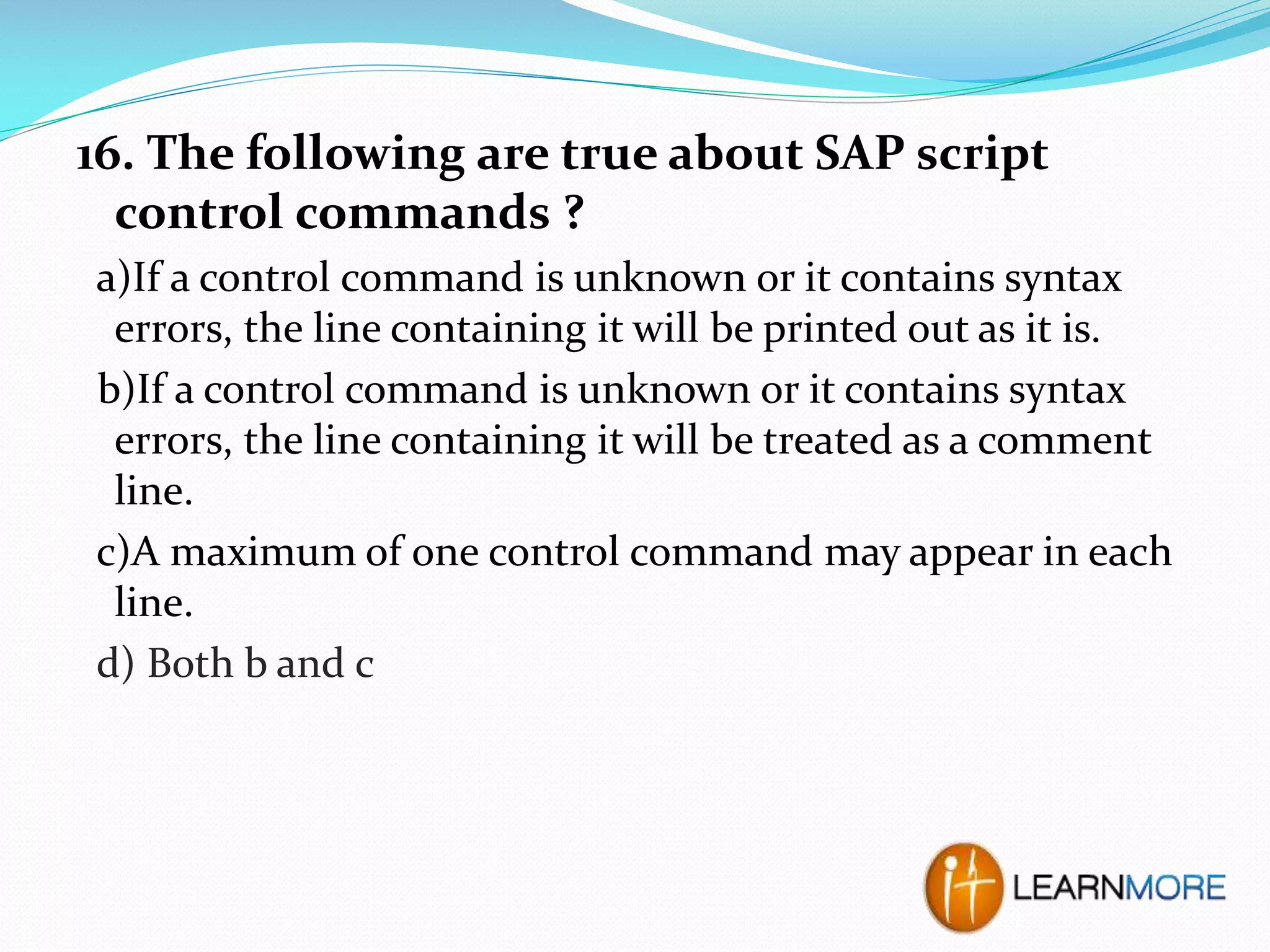
16. The following are true about SAP script
control commands ?
a)If a control command is unknown or it contains syntax
errors, the line containing it will be printed out as it is.
b)If a control command is unknown or it contains syntax
errors, the line containing it will be treated as a comment
line.
c)A maximum of one control command may appear in each
line.
d) Both b and c
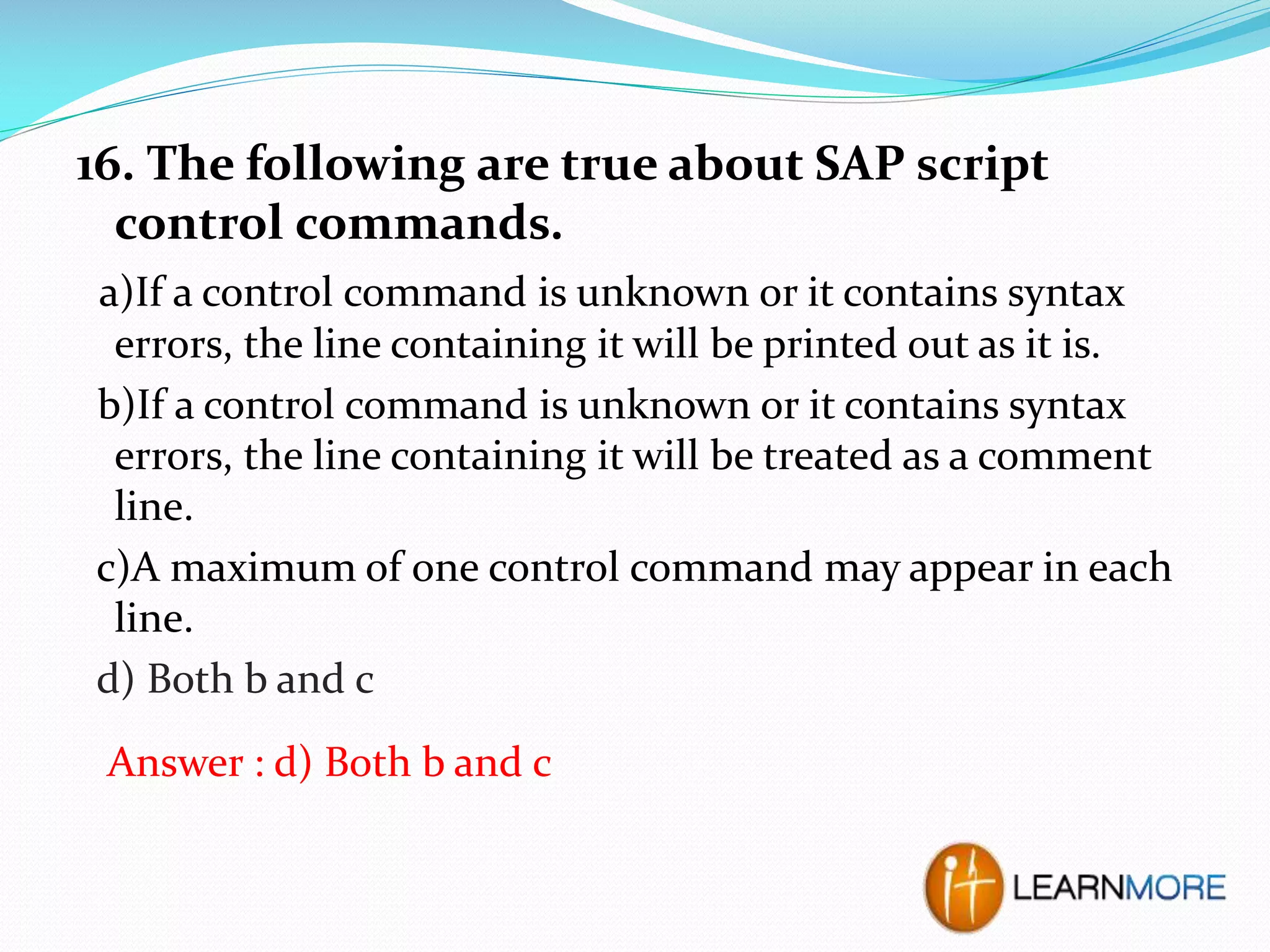
16. The following are true about SAP script
control commands.
a)If a control command is unknown or it contains syntax
errors, the line containing it will be printed out as it is.
b)If a control command is unknown or it contains syntax
errors, the line containing it will be treated as a comment
line.
c)A maximum of one control command may appear in each
line.
d) Both b and c
Answer : d) Both b and c
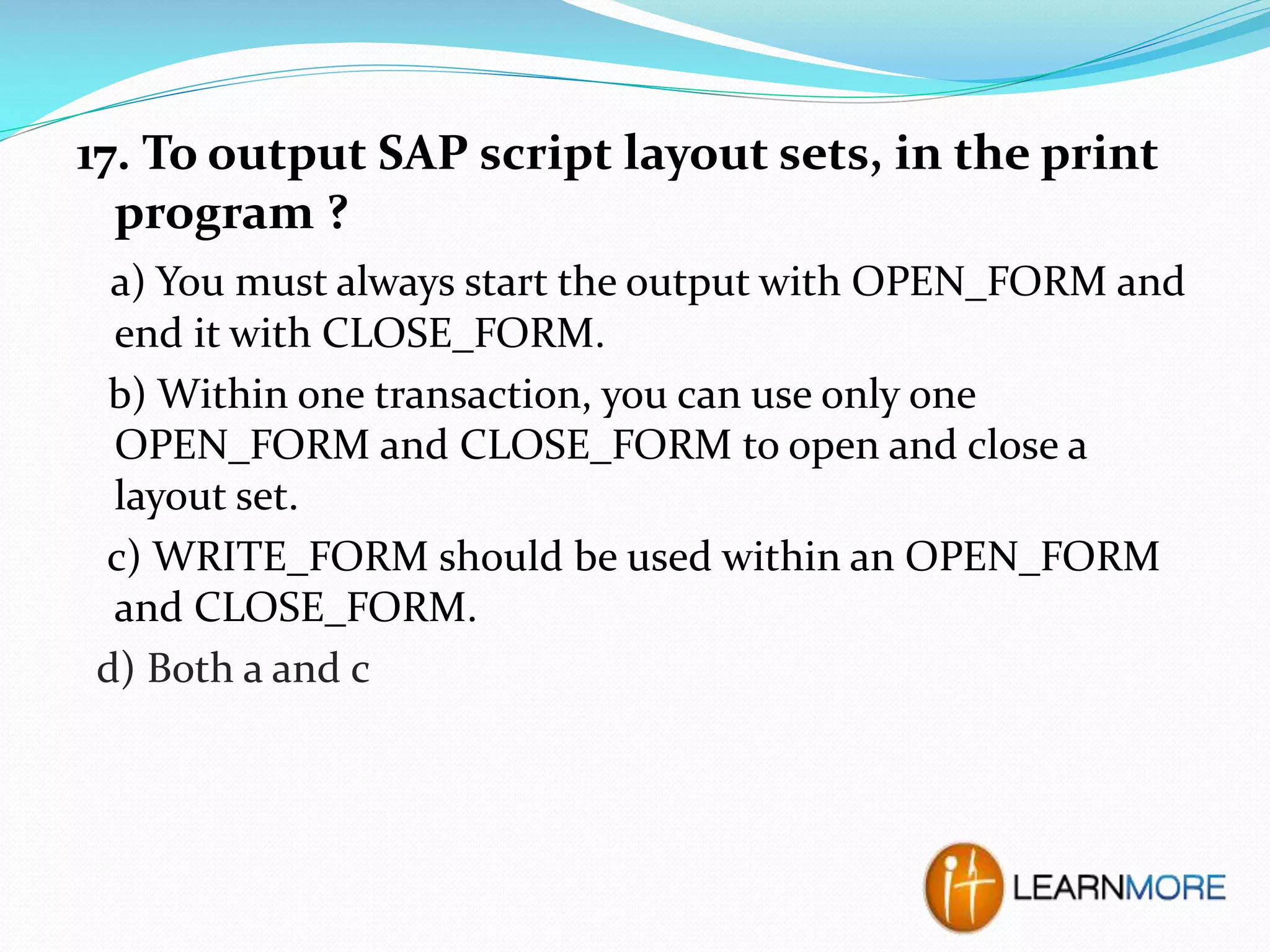
17. To output SAP script layout sets, in the print
program ?
a) You must always start the output with OPEN_FORM and
end it with CLOSE_FORM.
b) Within one transaction, you can use only one
OPEN_FORM and CLOSE_FORM to open and close a
layout set.
c) WRITE_FORM should be used within an OPEN_FORM
and CLOSE_FORM.
d) Both a and c
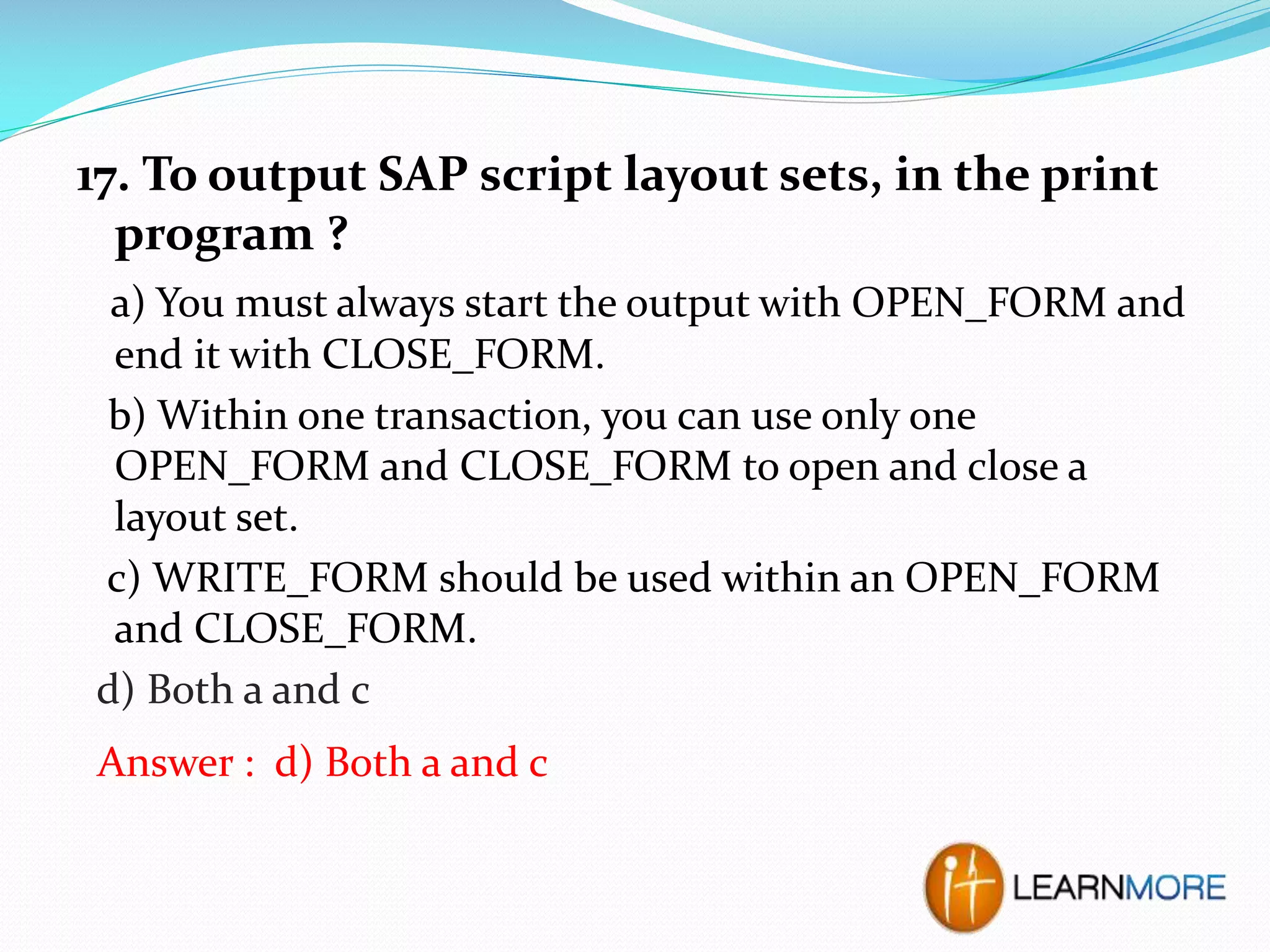
17. To output SAP script layout sets, in the print
program ?
a) You must always start the output with OPEN_FORM and
end it with CLOSE_FORM.
b) Within one transaction, you can use only one
OPEN_FORM and CLOSE_FORM to open and close a
layout set.
c) WRITE_FORM should be used within an OPEN_FORM
and CLOSE_FORM.
d) Both a and c
Answer : d) Both a and c
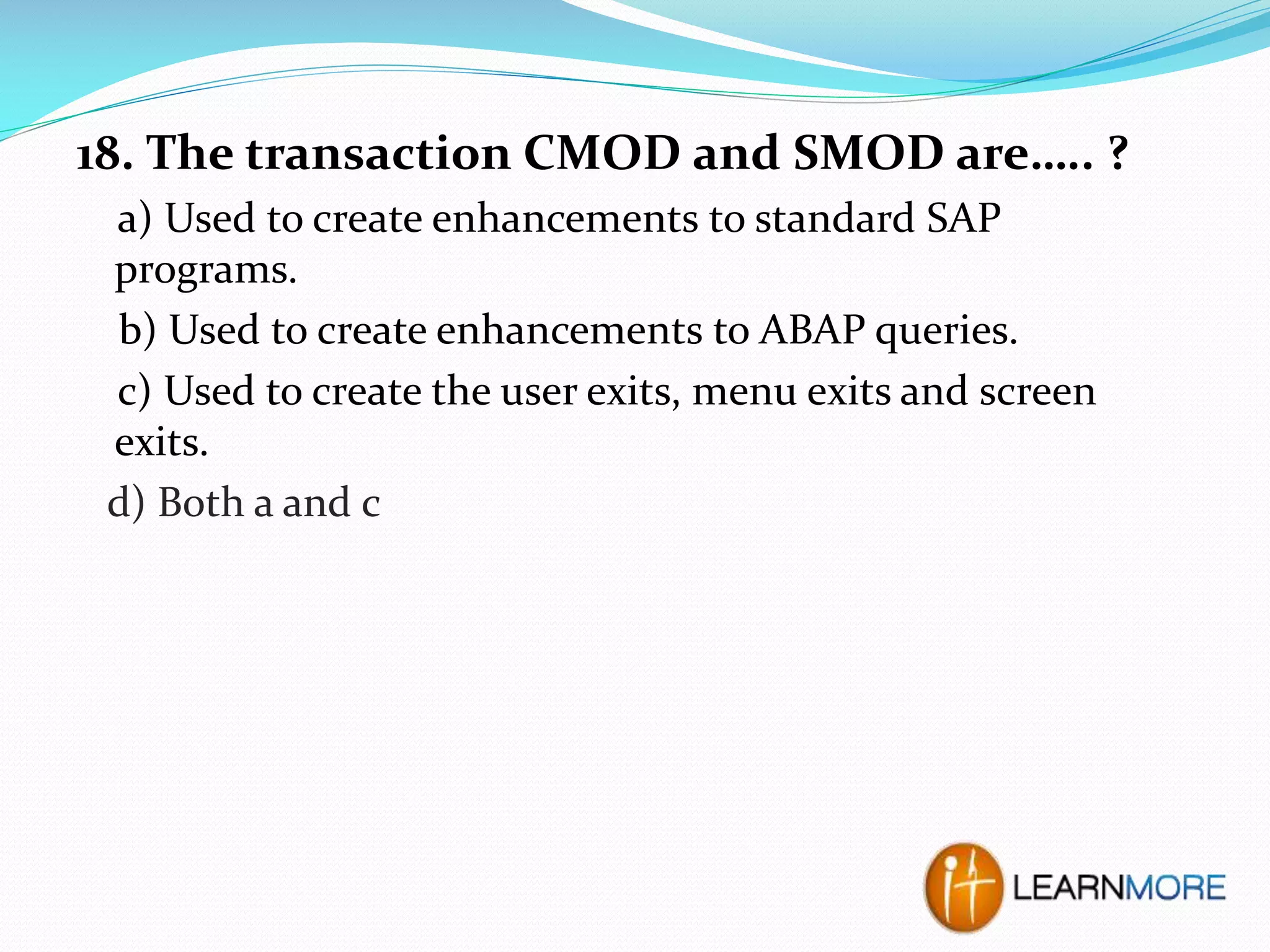
18. The transaction CMOD and SMOD are….. ?
a) Used to create enhancements to standard SAP
programs.
b) Used to create enhancements to ABAP queries.
c) Used to create the user exits, menu exits and screen
exits.
d) Both a and c
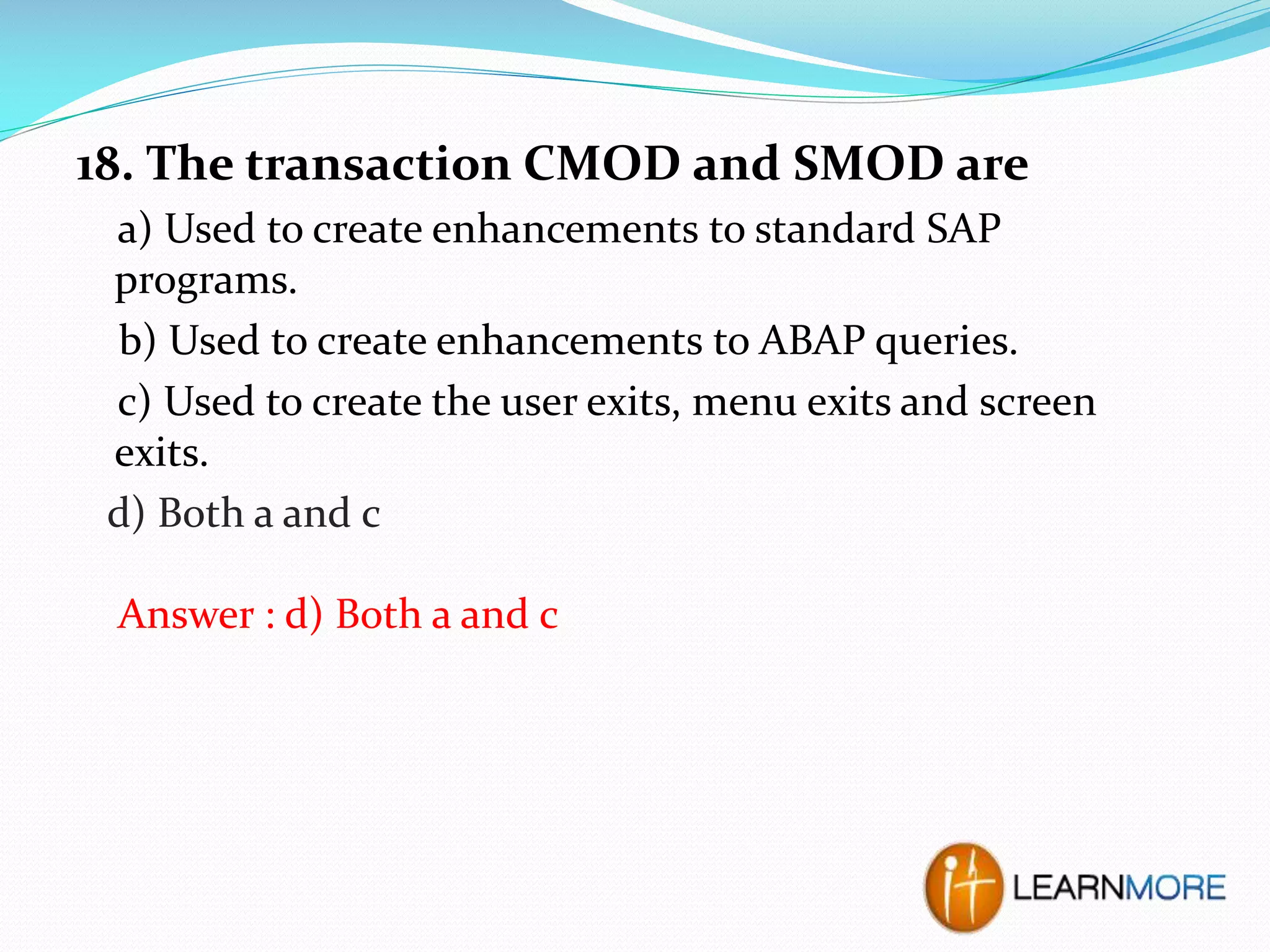
18. The transaction CMOD and SMOD are
a) Used to create enhancements to standard SAP
programs.
b) Used to create enhancements to ABAP queries.
c) Used to create the user exits, menu exits and screen
exits.
d) Both a and c
Answer : d) Both a and c
19. ABAP Query tool is used to………… ?
a) Enquire about a running-program status
b) Automatically generate code for reporting
c) Perform database operations for user-written programs
d) None of the above
19. ABAP Query tool is used to:
a) Enquire about a running-program status
b) Automatically generate code for reporting
c) Perform database operations for user-written programs
d) None of the above
Answer : b) Automatically generate code for reporting
20. Logical databases must be used to create an
ABAP Query……….. ?
a) True
b) False
20. Logical databases must be used to create an
ABAP Query
a) True
b) False

Answer : b) False
Contact Us:
For more details, please log on to www.ITLearnMore.com

You can also Find us on :
Thank you !

SAP ABAP Practice exam

  • 1.
    SAP ABAP MultipleChoice Questions and Answers Learning IT Courses Has Never Been This Easy www.ITLearnMore.com
  • 2.
    1. When usingOpen SQL statements in an ABAP/4 program, you must ensure the following ? a) The database system being addressed must be supported by SAP. b) The database tables being addressed must be defined in the ABAP/4 dictionary. c) Both a and b d) None of these
  • 3.
    1. When usingOpen SQL statements in an ABAP/4 program, you must ensure the following. a) The database system being addressed must be supported by SAP. b) The database tables being addressed must be defined in the ABAP/4 dictionary. c) Both a and b d) None of these Answer : c) Both a and b
  • 4.
    2. Which ofthe following statements are correct? a) A database interface translates SAP’s Open SQL statements into SQL commands specific to the database in use. Native SQL statements access the database directly. b) When you use Native SQL, the addressed database tables do not have to be known to the ABAP/4 dictionary. In Open SQL, the addressed database tables must be defined in the ABAP/4 dictionary. c) There is automatic client handling in Native SQL whereas clients must always be specified in Open SQL. d) Both a and b
  • 5.
    2. Which ofthe following statements are correct? a) A database interface translates SAP’s Open SQL statements into SQL commands specific to the database in use. Native SQL statements access the database directly. b) When you use Native SQL, the addressed database tables do not have to be known to the ABAP/4 dictionary. In Open SQL, the addressed database tables must be defined in the ABAP/4 dictionary. c) There is automatic client handling in Native SQL whereas clients must always be specified in Open SQL. d) Both a and b Answer : d) Both a and b
  • 6.
    3. Which ofthe following are true? a) TABLE is used as a synonym for STANDARD TABLE b) Explicit or implicit index operations c) All hashed tables are index tables. d) both a and b
  • 7.
    3. Which ofthe following are true? a) TABLE is used as a synonym for STANDARD TABLE b) Explicit or implicit index operations c) All hashed tables are index tables. d) both a and b Answer : d) both a and b
  • 8.
    4. Can atransparent table exist in data dictionary but not in the database physically? a) True b) False
  • 9.
    4. Can atransparent table exist in data dictionary but not in the database physically? a) True b) False Answer : a) True
  • 10.
    5.Can you createa table with fields not referring to data elements? a) TRUE b) FALSE
  • 11.
    5.Can you createa table with fields not referring to data elements? a) TRUE b) FALSE Answer : a) TRUE
  • 12.
    6.How do youcreate a batch input session for a transaction? a)‘Call transaction’ in background mode. b)‘Call transaction’ in error mode. c)‘Bdc_insert’ for the transaction. d)None of the above.
  • 13.
    6.How do youcreate a batch input session for a transaction? a)‘Call transaction’ in background mode. b)‘Call transaction’ in error mode. c)‘Bdc_insert’ for the transaction. d)None of the above. Answer : c)‘Bdc_insert’ for the transaction.
  • 14.
    7.What is thealternative to batch input session? a) Load module b) Call transaction c) BAPI d) Idoc segment
  • 15.
    7.What is thealternative to batch input session? a) Load module b) Call transaction c) BAPI d) Idoc segment Answer : b) Call transaction
  • 16.
    8.The following aretrue about ‘EXEC SQL’ ? a)You can end the Native SQL with a semicolon. b)You can end the Native SQL with a period. c)You cannot perform reliable authorization checks using EXEC SQL. d)Both a and c
  • 17.
    8.The following aretrue about ‘EXEC SQL’. a)You can end the Native SQL with a semicolon. b)You can end the Native SQL with a period. c)You cannot perform reliable authorization checks using EXEC SQL. d)Both a and c Answer : d)Both a and c
  • 18.
    9.Which of thefollowing is true about database locking ? a) Database systems set physical locks on all lines affected by a database call. b) Read locks prevent the setting of further read locks for the objects in question. c) Read locks prevent other transactions from setting write locks for the objects in question. d)Both a and c
  • 19.
    9.Which of thefollowing is true about database locking. a) Database systems set physical locks on all lines affected by a database call. b) Read locks prevent the setting of further read locks for the objects in question. c) Read locks prevent other transactions from setting write locks for the objects in question. d)Both a and c Answer : d)Both a and c
  • 20.
    10. What arefield symbols? a) Field symbols are like pointers in C that can point to any data object in ABAP/4 and to structures defined in ABAP/4 dictionary. b)Field symbols have to be created with type specifications only. c)All operations you have programmed with the field symbol are carried out with the assigned field. d) Both a and c
  • 21.
    10. What arefield symbols? a) Field symbols are like pointers in C that can point to any data object in ABAP/4 and to structures defined in ABAP/4 dictionary. b)Field symbols have to be created with type specifications only. c)All operations you have programmed with the field symbol are carried out with the assigned field. d) Both a and c Answer : d) Both a and c
  • 22.
    11. What isEXTRACT statement? a) The first EXTRACT statement extracts the first extract record. b) The first EXTRACT statement creates the extract dataset and adds the first extract record. c) Each extract record contains, if specified, the fields of the field group. b) Both a and c
  • 23.
    11. What isEXTRACT statement? a) The first EXTRACT statement extracts the first extract record. b) The first EXTRACT statement creates the extract dataset and adds the first extract record. c) Each extract record contains, if specified, the fields of the field group. b) Both a and c Answer : b) Both a and c
  • 24.
    12. You cannotassign a local data object defined in a subroutine or function module to a field group ? a) True b) False
  • 25.
    12. You cannotassign a local data object defined in a subroutine or function module to a field group. a) True b) False Answer : a) True
  • 26.
    13. Which ofthe following are true? a) COLLECT can only be used with STANDARD TABLE. b) To use COLLECT, the internal table should be derived from a database table with an explicit key. c) If the system finds a numeric component, that is not part of the key, the numeric fields that are not part of the table key (see ABAP number types) are added to the sum total of the existing entries. If it does not find an entry, control passes on to the next record in the internal table. d) If the system finds a numeric component, that is not part of the key, the numeric fields that are not part of the table key (see ABAP number types) are added to the sum total of the existing entries. If it does not find an entry, the system creates a new entry instead.
  • 27.
    13. Which ofthe following are true? a) COLLECT can only be used with STANDARD TABLE. b) To use COLLECT, the internal table should be derived from a database table with an explicit key. c) If the system finds a numeric component, that is not part of the key, the numeric fields that are not part of the table key (see ABAP number types) are added to the sum total of the existing entries. If it does not find an entry, control passes on to the next record in the internal table. d) If the system finds a numeric component, that is not part of the key, the numeric fields that are not part of the table key (see ABAP number types) are added to the sum total of the existing entries. If it does not find an entry, the system creates a new entry instead. Answer : D
  • 28.
    14. Which ofthe following are true? a)ABAP queries are created by associating them to a logical database or through a direct read/data retrieval program. b) ABAP queries are created from functional areas that are created from a logical database or through a direct read/retrieval program. c)ABAP queries are created from user groups attached to the functional areas that are created from a logical database or through a direct read/retrieval program. d)ABAP queries are created through the regular report program.
  • 29.
    14. Which ofthe following are true? a)ABAP queries are created by associating them to a logical database or through a direct read/data retrieval program. b) ABAP queries are created from functional areas that are created from a logical database or through a direct read/retrieval program. c)ABAP queries are created from user groups attached to the functional areas that are created from a logical database or through a direct read/retrieval program. d)ABAP queries are created through the regular report program. Answer : C
  • 30.
    15. A logicalunit of work (LUW or transaction) begins …….. ? a) Each time you start a transaction. b) Each time you end a transaction. c) Before the database changes of the previous LUW have been cancelled (database rollback). d) Both a and c
  • 31.
    15. A logicalunit of work (LUW or transaction) begins a) Each time you start a transaction. b) Each time you end a transaction. c) Before the database changes of the previous LUW have been cancelled (database rollback). d) Both a and c Answer : d) Both a and c
  • 32.
    16. The followingare true about SAP script control commands ? a)If a control command is unknown or it contains syntax errors, the line containing it will be printed out as it is. b)If a control command is unknown or it contains syntax errors, the line containing it will be treated as a comment line. c)A maximum of one control command may appear in each line. d) Both b and c
  • 33.
    16. The followingare true about SAP script control commands. a)If a control command is unknown or it contains syntax errors, the line containing it will be printed out as it is. b)If a control command is unknown or it contains syntax errors, the line containing it will be treated as a comment line. c)A maximum of one control command may appear in each line. d) Both b and c Answer : d) Both b and c
  • 34.
    17. To outputSAP script layout sets, in the print program ? a) You must always start the output with OPEN_FORM and end it with CLOSE_FORM. b) Within one transaction, you can use only one OPEN_FORM and CLOSE_FORM to open and close a layout set. c) WRITE_FORM should be used within an OPEN_FORM and CLOSE_FORM. d) Both a and c
  • 35.
    17. To outputSAP script layout sets, in the print program ? a) You must always start the output with OPEN_FORM and end it with CLOSE_FORM. b) Within one transaction, you can use only one OPEN_FORM and CLOSE_FORM to open and close a layout set. c) WRITE_FORM should be used within an OPEN_FORM and CLOSE_FORM. d) Both a and c Answer : d) Both a and c
  • 36.
    18. The transactionCMOD and SMOD are….. ? a) Used to create enhancements to standard SAP programs. b) Used to create enhancements to ABAP queries. c) Used to create the user exits, menu exits and screen exits. d) Both a and c
  • 37.
    18. The transactionCMOD and SMOD are a) Used to create enhancements to standard SAP programs. b) Used to create enhancements to ABAP queries. c) Used to create the user exits, menu exits and screen exits. d) Both a and c Answer : d) Both a and c
  • 38.
    19. ABAP Querytool is used to………… ? a) Enquire about a running-program status b) Automatically generate code for reporting c) Perform database operations for user-written programs d) None of the above
  • 39.
    19. ABAP Querytool is used to: a) Enquire about a running-program status b) Automatically generate code for reporting c) Perform database operations for user-written programs d) None of the above Answer : b) Automatically generate code for reporting
  • 40.
    20. Logical databasesmust be used to create an ABAP Query……….. ? a) True b) False
  • 41.
    20. Logical databasesmust be used to create an ABAP Query a) True b) False Answer : b) False
  • 42.
    Contact Us: For moredetails, please log on to www.ITLearnMore.com You can also Find us on :
  • 43.