Database Design Application Development and
Administration 3rd Edition Mannino Test Bank
download
https://testbankfan.com/product/database-design-application-
development-and-administration-3rd-edition-mannino-test-bank/
Visit testbankfan.com today to download the complete set of
test bank or solution manual
We believe these products will be a great fit for you. Click
the link to download now, or visit testbankfan.com
to discover even more!
Database Design Application Development and Administration
3rd Edition Mannino Solutions Manual
https://testbankfan.com/product/database-design-application-
development-and-administration-3rd-edition-mannino-solutions-manual/
Oracle 10g Database Administrator Implementation and
Administration 2nd Edition Powell Test Bank
https://testbankfan.com/product/oracle-10g-database-administrator-
implementation-and-administration-2nd-edition-powell-test-bank/
Leadership Theory Application and Skill Development 6th
Edition Lussier Test Bank
https://testbankfan.com/product/leadership-theory-application-and-
skill-development-6th-edition-lussier-test-bank/
Calculus Single and Multivariable 6th Edition Hughes-
Hallett Test Bank
https://testbankfan.com/product/calculus-single-and-multivariable-6th-
edition-hughes-hallett-test-bank/
Microeconomics An Intuitive Approach with Calculus 1st
Edition Nechyba Solutions Manual
https://testbankfan.com/product/microeconomics-an-intuitive-approach-
with-calculus-1st-edition-nechyba-solutions-manual/
PFIN 4 4th Edition Gitman Solutions Manual
https://testbankfan.com/product/pfin-4-4th-edition-gitman-solutions-
manual/
ASTRO2 2nd Edition Seeds Test Bank
https://testbankfan.com/product/astro2-2nd-edition-seeds-test-bank/
Managerial Accounting 13th Edition Warren Solutions Manual
https://testbankfan.com/product/managerial-accounting-13th-edition-
warren-solutions-manual/
Chemistry 12th Edition Chang Solutions Manual
https://testbankfan.com/product/chemistry-12th-edition-chang-
solutions-manual/
Legal Ethical and Regulatory Environment of Business in a
Diverse Society 1st Edition Bennett Test Bank
https://testbankfan.com/product/legal-ethical-and-regulatory-
environment-of-business-in-a-diverse-society-1st-edition-bennett-test-
bank/
Chapter 11 Stored Procedures and Triggers
1. A database programming language allows a program to combine procedural statements with non-procedural
database access.
True False
2. Due to the growth of online database processing and commercial Web commerce, batch processing is no
longer an important method to process database work.
True False
3. Transitive closure, an important operation for queries involving self-referencing relationships, is supported by
most SQL implementations.
True False
4. Portability across host languages is one advantage of using the statement level interface language style.
True False
5. Because the optimization process can consume considerable computing resources, it is usually desirable to
determine the access plan at run-time using dynamic statement binding.
True False
6. In the SQL:2003 specification, a statement level interface can support both static and dynamic binding, while
a call level interface supports only dynamic binding.
True False
7. For procedures and triggers stored in a database, the database connection is explicit.
True False
8. Triggers provide reuse of common code, while stored procedures provide rule processing for common tasks.
True False
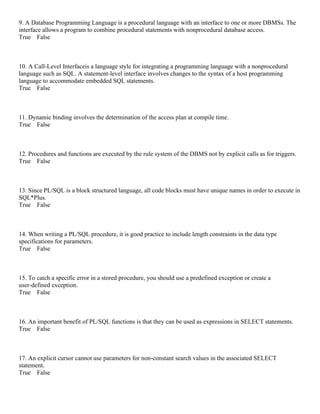
9. A Database Programming Language is a procedural language with an interface to one or more DBMSs. The
interface allows a program to combine procedural statements with nonprocedural database access.
True False
10. A Call-Level Interfaceis a language style for integrating a programming language with a nonprocedural
language such as SQL. A statement-level interface involves changes to the syntax of a host programming
language to accommodate embedded SQL statements.
True False
11. Dynamic binding involves the determination of the access plan at compile time.
True False
12. Procedures and functions are executed by the rule system of the DBMS not by explicit calls as for triggers.
True False
13. Since PL/SQL is a block structured language, all code blocks must have unique names in order to execute in
SQL*Plus.
True False
14. When writing a PL/SQL procedure, it is good practice to include length constraints in the data type
specifications for parameters.
True False
15. To catch a specific error in a stored procedure, you should use a predefined exception or create a
user-defined exception.
True False
16. An important benefit of PL/SQL functions is that they can be used as expressions in SELECT statements.
True False
17. An explicit cursor cannot use parameters for non-constant search values in the associated SELECT
statement.
True False
18. All objects in a package interface are public.
True False
19. To use the objects in a package, you must use the package name before the object name.
True False
20. Because the SQL:1999 trigger specification was defined in response to vendor implementation, most trigger
implementations adhere to the SQL:1999 specification.
True False
21. The body of a trigger is similar to other PL/SQL blocks, except that triggers have more restrictions on the
statements in a block.
True False
22. Like procedures, triggers can be tested directly by executing them in SQL*Plus.
True False
23. Since the number of triggers is a complicating factor in understanding the interaction among triggers, it is
always better to create a few large triggers instead of many smaller triggers.
True False
24. You can encounter mutating table errors in trigger execution, regardless of the DBMS they are executed on.
True False
25. For most triggers, you can avoid mutating table errors by using statement triggers with new and old values.
True False
26. What is the primary motivation for using a database programming language?
A. Customization.
B. Batch processing.
C. Complex operations.
D. All of the above.
27. The two language styles provided by SQL:2003 for integrating a procedural language with SQL are:
A. Statement level interface and function level interface.
B. Procedural level interface and trigger level interface.
C. Statement level interface and call level interface.
D. None of the above.
28. Which of the following is true of a statement level interface?
A. It is more difficult to learn and use than a CLI.
B. It is available only for proprietary languages.
C. It includes a set of procedures and a set of type definitions for manipulating the results of SQL statements in
computer programs.
D. It involves changes to the syntax of a host programming language to accommodate embedded SQL.
29. For statement level interfaces, SQL:2003 provides statements to:
A. Declare cursors.
B. Position cursors.
C. Retrieve values from cursors.
D. All of the above.
30. As with other programming languages, in PL/SQL the IF-THEN-ELSE statement construct is:
A. A comparison operator.
B. A conditional statement.
C. A logical operator.
D. None of the above.
31. With regards to conditional decision making in PL/SQL, which statement is true?
A. A condition must evaluate to TRUE or FALSE.
B. Complex conditions are evaluated left to right, and this order cannot be altered.
C. Conditions are evaluated using three-value logic.
D. There is a limit to the number of statements that can be used between the THEN and END-IF keywords.
32. Which of the following is true of PL/SQL iteration statements?
A. The FOR LOOP iterates until a stopping condition is false.
B. The WHILE LOOP iterates over a range of integer values.
C. The LOOP statement iterates until an EXIT statement ceases termination.
D. All of the above.
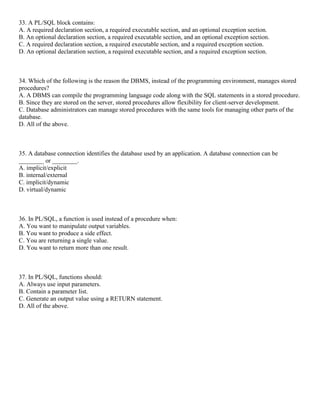
33. A PL/SQL block contains:
A. A required declaration section, a required executable section, and an optional exception section.
B. An optional declaration section, a required executable section, and an optional exception section.
C. A required declaration section, a required executable section, and a required exception section.
D. An optional declaration section, a required executable section, and a required exception section.
34. Which of the following is the reason the DBMS, instead of the programming environment, manages stored
procedures?
A. A DBMS can compile the programming language code along with the SQL statements in a stored procedure.
B. Since they are stored on the server, stored procedures allow flexibility for client-server development.
C. Database administrators can manage stored procedures with the same tools for managing other parts of the
database.
D. All of the above.
35. A database connection identifies the database used by an application. A database connection can be
________ or ________.
A. implicit/explicit
B. internal/external
C. implicit/dynamic
D. virtual/dynamic
36. In PL/SQL, a function is used instead of a procedure when:
A. You want to manipulate output variables.
B. You want to produce a side effect.
C. You are returning a single value.
D. You want to return more than one result.
37. In PL/SQL, functions should:
A. Always use input parameters.
B. Contain a parameter list.
C. Generate an output value using a RETURN statement.
D. All of the above.
CREATE OR REPLACE FUNCTION fn_RetrieveStudentName
(aStdSSN IN Student.StdSSN%Type) RETURN VARCHAR2 IS
aFirstName Student.StdFirstName%Type;
aLastName Student.StdLastName%Type;
BEGIN
SELECT StdFirstName, StdLastName
INTO aFirstName, aLastName
FROM Student
WHERE StdSSN = aStdSSN;
RETURN(aLastName || ', ' || aFirstName);
EXCEPTION
WHEN No_Data_Found THEN
RETURN(NULL);
WHEN OTHERS THEN
raise_application_error(-20001, 'Database error.');
END;
/
38. The PL/SQL code block above is an example of:
A. An anonymous block.
B. A PL/SQL package.
C. A PL/SQL function.
D. None of the above.
39. In the PL/SQL code block above, aStdSSN is:
A. A return variable.
B. An input parameter.
C. A column in the Student table.
D. None of the above.
40. Based on the PL/SQL code block above, if there is not a SSN in the Student table which matches the value
provided:
A. The code will return the name of the Student record that is the closest numeric match.
B. The code will raise an application error.
C. The code will stop executing without any explanation.
D. The code will return NULL.
41. The PL/SQL code block above:
A. Declares and opens an explicit cursor.
B. Declares and opens an implicit cursor.
C. Does not use a cursor.
D. None of the above.
42. The PL/SQL statement "FOR StudentRec IN SELECT StudentID FROM StudentTable" is an example of:
A. An implicit cursor.
B. An explicit cursor.
C. A dynamic cursor.
D. This statement does not define a cursor.
43. In the use of an explicit cursor, which 3 statements replace the FOR statement of an implicit cursor?
A. OPEN, FIND, and CLOSE.
B. OPEN, FETCH, and CLOSE.
C. OPEN, GET, and CLOSE.
D. CONNECT, FIND, and CLOSE.
44. Which of the following is not a common cursor attribute?
A. %IsOpen.
B. %IsNotOpen.
C. %Found.
D. %NotFound.
45. One of the advantages of using a package over procedures and functions is:
A. A package supports a larger unit of modularity.
B. Packages provide easier reuse of code.
C. Packages reduce software maintenance costs.
D. All of the above.
46. For each object defined in a package interface, the package body must define:
A. A private object.
B. An implementation.
C. A cursor.
D. An exception handler.
47. Which of the following is not a typical use for triggers:
A. Complex integrity constraints.
B. Update propagation.
C. Exception reporting.
D. All of the above are typical uses for triggers.
48. To control complexity among a collection of triggers, which guideline(s) should be followed?
A. Use data manipulation statements primarily in BEFORE triggers.
B. For triggers that fire on UPDATE statements, do not list the columns to which the trigger applies.
C. Be cautious about creating triggers on tables affected by actions on referenced rows.
D. All of the above.
49. A trigger execution procedure can be affected by which of the following?
A. The DBMS the triggers are executed on.
B. The type of data manipulation statements specified in a trigger.
C. Foreign key constraints on referenced rows.
D. All of the above.
50. In the case of overlapping triggers, which of the following is true?
A. The firing order is predictable and can be depended on to be the same every time.
B. The firing order has not been specified for SQL:2003.
C. The firing order is the same for all DBMSs.
D. None of the above.
51. Mutating table errors:
A. Can occur when one table is cloned from another.
B. Can occur in trigger actions with SQL statements on the target table or related tables affected by DELETE
CASCADE actions.
C. Never occur in Oracle databases.
D. None of the above.
52. A _____________________ is a procedural language with an interface to one or more DBMSs.
________________________________________
53. To support customized code, most database application development tools use a coding style known as
_________________.
________________________________________
54. A(n) _____________ level interface is a language style that involves changes to the syntax of a host
programming language to accommodate embedded SQL statements.
________________________________________
55. Open Database Connectivity (ODBC) and Java Database Connectivity (JDBC) are the most widely used
_____________ level interfaces.
________________________________________
56. The concept of ______________ for a database programming language involves the association of an SQL
statement with its access plan.
________________________________________
57. A(n) ______________ is a construct in a database programming language that allows for storage and
iteration of a set of records returned by a SELECT statement.
________________________________________
58. A ______________ can be implicit or explicit.
________________________________________
59. In PL/SQL, a(n) _____________ statement is comprised of a variable, the assignment symbol, and an
expression.
________________________________________
60. In a PL/SQL IF statement, the keywords AND, OR and NOT are ____________ operators.
________________________________________
61. An unnamed PL/SQL block of code, which is useful for testing procedures and triggers, is known as a(n)
_________ block.
________________________________________
62. The common SQL*Plus command used to list the columns of a table is ___________.
________________________________________
63. The common SQL*Plus command used to display compilation errors is ___________________.
________________________________________
64. In a stored procedure, a(n) _____________ parameter should have a value provided outside the procedure
but it can be changed inside the procedure.
________________________________________
65. Functions should be usable in expressions, i.e. a function call can be replaced by the __________ it returns.
________________________________________
66. In the body of a function, a(n) ______________ statement is used to generate the function's output value.
________________________________________
67. A package ________________ contains the definitions of procedures and functions along with other objects
that can be specified in the DECLARE section of a PL/SQL block.
________________________________________
68. A package ________________ contains the private details of a package.
________________________________________
69. Inside a package implementation, each procedure or function must be terminated by a(n) _____________
statement containing the procedure or function name.
________________________________________
70. An event-condition-action rule managed by a DBMS is another name for a ____________.
________________________________________
71. Integrity constraints that compare the values before and after an update to a table occurs are called
___________.
________________________________________
72. The _________________ of a trigger involves the keywords BEFORE, AFTER, or INSTEAD OF, along
with a triggering event using the keywords INSERT, UPDATE, or DELETE.
________________________________________
73. If you omit the keywords FOR EACH ROW from a trigger specification, the trigger by default becomes
a(n) _____________ trigger.
________________________________________
74. The ______________________________ specifies the order of execution among the various kinds of
triggers, integrity constraints, and database manipulation statements.
________________________________________
75. Two triggers with the same timing, granularity, and applicable table ______________ if an SQL statement
may cause both triggers to fire.
________________________________________
76. When a procedure calls itself, this is known as ______________________.
________________________________________
Chapter 11 Stored Procedures and Triggers Key
1. A database programming language allows a program to combine procedural statements with non-procedural
database access.
TRUE
Level: Medium
Mannino - Chapter 11 #1
2. Due to the growth of online database processing and commercial Web commerce, batch processing is no
longer an important method to process database work.
FALSE
Batch processing continues to be an important way to process database work.
Level: Easy
Mannino - Chapter 11 #2
3. Transitive closure, an important operation for queries involving self-referencing relationships, is supported by
most SQL implementations.
FALSE
Transitive closure is not supported by most SQL implementations.
Level: Medium
Mannino - Chapter 11 #3
4. Portability across host languages is one advantage of using the statement level interface language style.
FALSE
The statement level interface is not portable.
Level: Medium
Mannino - Chapter 11 #4
Other documents randomly have
different content
of nature. A divorce takes place, as much constitutional, depending
on the nature of things, as when, if iron sulphate and caustic potash
are brought together, the SO4 ions leave the iron to unite with the
potassium. When in nature an adjustment of such differences of
potential is about to take place, he who would approve or
disapprove of the process from the moral point of view would appear
to most to play a ridiculous part.
This is the fundamental idea in Goethe’s “Wahlverwandtschaften”
(Elective Affinities), and in the fourth chapter of the first part of that
work he makes it the subject of a playful introduction which was full
of undreamed of future significance, and the full force of which he
was fated himself to experience in later life. I must confess to being
proud that this book is the first work to take up his ideas. None the
less, it is as little my intention as it was the intention of Goethe to
advocate divorce; I hope only to explain it. There are human
motives which indispose man to divorce and enable him to withstand
it. This I shall discuss later on. The physical side of sex in man is less
completely ruled by natural law than is the case with lower animals.
We get an indication of this in the fact that man is sexual throughout
the year, and that in him there is less trace than even in domestic
animals of the existence of a special spring breeding-season.
The law of sexual affinity is analogous in another respect to a
well-known law of theoretical chemistry, although, indeed, there are
marked differences. The violence of a chemical reaction is
proportionate to the mass of the substances involved, as, for
instance, a stronger acid solution unites with a stronger basic
solution with greater avidity, just as in the case of the union of a pair
of living beings with strong maleness and femaleness. But there is
an essential difference between the living process and the reaction
of the lifeless chemical substances. The living organism is not
homogeneous and isotropic in its composition; it is not divisible into
a number of small parts of identical properties. The difference
depends on the principle of individuality, on the fact that every living
thing is an individual, and that its individuality is essentially
structural. And so in the vital process it is not as in inorganic
chemistry; there is no possibility of a larger proportion forming one
compound, a smaller proportion forming another. The organic
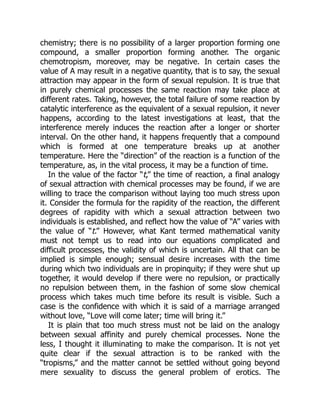
chemotropism, moreover, may be negative. In certain cases the
value of A may result in a negative quantity, that is to say, the sexual
attraction may appear in the form of sexual repulsion. It is true that
in purely chemical processes the same reaction may take place at
different rates. Taking, however, the total failure of some reaction by
catalytic interference as the equivalent of a sexual repulsion, it never
happens, according to the latest investigations at least, that the
interference merely induces the reaction after a longer or shorter
interval. On the other hand, it happens frequently that a compound
which is formed at one temperature breaks up at another
temperature. Here the “direction” of the reaction is a function of the
temperature, as, in the vital process, it may be a function of time.
In the value of the factor “t,” the time of reaction, a final analogy
of sexual attraction with chemical processes may be found, if we are
willing to trace the comparison without laying too much stress upon
it. Consider the formula for the rapidity of the reaction, the different
degrees of rapidity with which a sexual attraction between two
individuals is established, and reflect how the value of “A” varies with
the value of “t.” However, what Kant termed mathematical vanity
must not tempt us to read into our equations complicated and
difficult processes, the validity of which is uncertain. All that can be
implied is simple enough; sensual desire increases with the time
during which two individuals are in propinquity; if they were shut up
together, it would develop if there were no repulsion, or practically
no repulsion between them, in the fashion of some slow chemical
process which takes much time before its result is visible. Such a
case is the confidence with which it is said of a marriage arranged
without love, “Love will come later; time will bring it.”
It is plain that too much stress must not be laid on the analogy
between sexual affinity and purely chemical processes. None the
less, I thought it illuminating to make the comparison. It is not yet
quite clear if the sexual attraction is to be ranked with the
“tropisms,” and the matter cannot be settled without going beyond
mere sexuality to discuss the general problem of erotics. The
phenomena of love require a different treatment, and I shall return
to them in the second part of this book. None the less, there are
analogies that cannot be denied when human attractions and
chemotropism are compared. I may refer as an instance to the
relation between Edward and Ottilie in Goethe’s
“Wahlverwandtschaften.”
Mention of Goethe’s romance leads naturally to a discussion of the
marriage problem, and I may here give a few of the practical
inferences which would seem to follow from the theoretical
considerations of this chapter. It is clear that a natural law, not
dissimilar to other natural laws, exists with regard to sexual
attraction; this law shows that, whilst innumerable gradations of
sexuality exist, there always may be found pairs of beings the
members of which are almost perfectly adapted to one another. So
far, marriage has its justification, and, from the standpoint of
biology, free love is condemned. Monogamy, however, is a more
difficult problem, the solution of which involves other considerations,
such as periodicity, to which I shall refer later, and the change of the
sexual taste with advancing years.
A second conclusion may be derived from heterostylism, especially
with reference to the fact that “illegitimate fertilisation” almost
invariably produces less fertile offspring. This leads to the
consideration that amongst other forms of life the strongest and
healthiest offspring will result from unions in which there is the
maximum of sexual suitability. As the old saying has it, “love-
children” turn out to be the finest, strongest, and most vigorous of
human beings. Those who are interested in the improvement of
mankind must therefore, on purely hygienic grounds, oppose the
ordinary mercenary marriages of convenience.
It is more than probable that the law of sexual attraction may
yield useful results when applied to the breeding of animals. More
attention will have to be given to the secondary sexual characters of
the animals which it is proposed to mate. The artificial methods
made use of to secure the serving of mares by stallions unattractive
to them do not always fail, but are followed by indifferent results.
Probably an obvious result of the use of a substituted stallion in
impregnating a mare is the extreme nervousness of the progeny,
which must be treated with bromide and other drugs. So, also, the
degeneration of modern Jews may be traced in part to the fact that
amongst them marriages for other reasons than love are specially
common.
Amongst the many fundamental principles established by the
careful observations and experiments of Darwin, and since confirmed
by other investigators, is the fact that both very closely related
individuals, and those whose specific characters are too unlike, have
little sexual attraction for each other, and that if in spite of this
sexual union occurs, the offspring usually die at an early stage or are
very feeble, or are practically infertile. So also, in heterostylous
plants “legitimate fertilisation” brings about more numerous and
vigorous seeds than come from other unions.
It may be said in general that the offspring of those parents which
showed the greatest sexual attraction succeed best.
This rule, which is certainly universal, implies the correctness of a
conclusion which might be drawn from the earlier part of this book.
When a marriage has taken place and children have been produced,
these have gained nothing from the conquest of sexual repulsion by
the parents, for such a conquest could not take place without
damage to the mental and bodily characters of the children that
would come of it. It is certain, however, that many childless
marriages have been loveless marriages. The old idea that the
chance of conception is increased where there is a mutual
participation in the sexual act is closely connected with what we
have been considering as to the greater intensity of the sexual
attraction between two complementary individuals.
CHAPTER IV
HOMO-SEXUALITY AND PEDERASTY
The law of Sexual Attraction gives the long-sought-for explanation
of sexual inversion, of sexual inclination towards members of the
same sex, whether or no that be accompanied by aversion from
members of the opposite sex. Without reference to a distinction
which I shall deal with later on, I may say at once that it is
exceedingly probable that, in all cases of sexual inversion, there will
be found indications of the anatomical characters of the other sex.
There is no such thing as a genuine “psycho-sexual
hermaphroditism”; the men who are sexually attracted by men have
outward marks of effeminacy, just as women of a similar disposition
to those of their own sex exhibit male characters. That this should
be so is quite intelligible if we admit the close parallelism between
body and mind, and further light is thrown upon it by the facts
explained in the second chapter of this book; the facts as to the
male or female principle not being uniformly present all over the
same body, but distributed in different amounts in different organs.
In all cases of sexual inversion, there is invariably an anatomical
approximation to the opposite sex.
Such a view is directly opposed to that of those who would
maintain that sexual inversion is an acquired character, and one that
has superseded normal sexual impulses. Schrenk-Notzing, Kraepelin,
and Féré are amongst those writers who have urged the view that
sexual inversion is an acquired habit, the result of abstinence from
normal intercourse and particularly induced by example. But what
about the first offender? Did the god Hermaphroditos teach him? It
might equally be sought to prove that the sexual inclination of a
normal man for a normal woman was an unnatural, acquired habit—
a habit, as some ancient writers have suggested, that arose from
some accidental discovery of its agreeable nature. Just as a normal
man discovers for himself what a woman is, so also, in the case of a
sexual “invert” the attraction exercised on him by a person of his
own sex is a normal product of his development from his birth.
Naturally the opportunity must come in which the individual may put
in practice his desire for inverted sexuality, but the opportunity will
be taken only when his natural constitution has made the individual
ready for it. That sexual abstinence (to take the second supposed
cause of inversion) should result in anything more than masturbation
may be explained by the supposition that inversion is acquired, but
that it should be coveted and eagerly sought can only happen when
the demand for it is rooted in the constitution. In the same fashion
normal sexual attraction might be said to be an acquired character, if
it could be proved definitely that, to fall in love, a normal man must
first see a woman or a picture of a woman. Those who assert that
sexual inversion is an acquired character, are making a merely
incidental or accessory factor responsible for the whole constitution
of an organism.
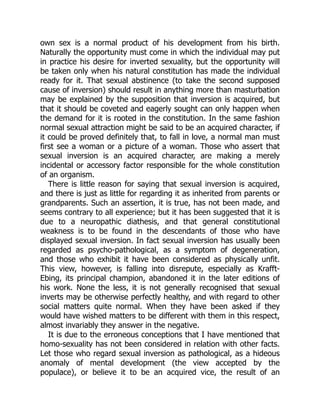
There is little reason for saying that sexual inversion is acquired,
and there is just as little for regarding it as inherited from parents or
grandparents. Such an assertion, it is true, has not been made, and
seems contrary to all experience; but it has been suggested that it is
due to a neuropathic diathesis, and that general constitutional
weakness is to be found in the descendants of those who have
displayed sexual inversion. In fact sexual inversion has usually been
regarded as psycho-pathological, as a symptom of degeneration,
and those who exhibit it have been considered as physically unfit.
This view, however, is falling into disrepute, especially as Krafft-
Ebing, its principal champion, abandoned it in the later editions of
his work. None the less, it is not generally recognised that sexual
inverts may be otherwise perfectly healthy, and with regard to other
social matters quite normal. When they have been asked if they
would have wished matters to be different with them in this respect,
almost invariably they answer in the negative.
It is due to the erroneous conceptions that I have mentioned that
homo-sexuality has not been considered in relation with other facts.
Let those who regard sexual inversion as pathological, as a hideous
anomaly of mental development (the view accepted by the
populace), or believe it to be an acquired vice, the result of an
execrable seduction, remember that there exist all transitional stages
reaching from the most masculine male to the most effeminate male
and so on to the sexual invert, the false and true hermaphrodite;
and then, on the other side, successively through the sapphist to the
virago and so on until the most feminine virgin is reached. In the
interpretation of this volume, sexual inverts of both sexes are to be
defined as individuals in whom the factor α (see page 8, chap. i.) is
very nearly 0.5 and so is practically equal to α´; in other words,
individuals in whom there is as much maleness as femaleness, or
indeed who, although reckoned as men, may contain an excess of
femaleness, or as women and yet be more male than female.
Because of the want of uniformity in the sexual characters of the
body, it is fairly certain that many individuals have their sex assigned
them on account of the existence of the primary male sexual
characteristic, even although there may be delayed descensus
testiculorum, or epi- or hypo-spadism, or, later on, absence of active
spermatozoa, or even, in the case of assignment of the female sex,
absence of the vagina, and thus male avocations (such as
compulsory military service) may come to be assigned to those in
whom α is less than 0.5 and α´ greater than 0.5. The sexual
complement of such individuals really is to be found on their own
side of the sexual line, that is to say, on the side on which they are
reckoned, although in reality they may belong to the other.
Moreover, and this not only supports my view but can be
explained only by it, there are no inverts who are completely
sexually inverted. In all of them there is from the beginning an
inclination to both sexes; they are, in fact, bisexual. It may be that
later on they may actively encourage a slight leaning towards one
sex or the other, and so become practically unisexual either in the
normal or in the inverted sense, or surrounding influence may bring
about this result for them. But in such processes the fundamental
bisexuality is never obliterated and may at any time give evidence of
its suppressed presence.
Reference has often been made, and in recent years has
increasingly been made, to the relation between homo-sexuality and
the presence of bisexual rudiments in the embryonic stages of
animals and plants. What is new in my view is that according to it,
homo-sexuality cannot be regarded as an atavism or as due to
arrested embryonic development, or incomplete differentiation of
sex; it cannot be regarded as an anomaly of rare occurrence
interpolating itself in customary complete separation of the sexes.
Homo-sexuality is merely the sexual condition of these intermediate
sexual forms that stretch from one ideally sexual condition to the
other sexual condition. In my view all actual organisms have both
homo-sexuality and hetero-sexuality.
That the rudiment of homo-sexuality, in however weak a form,
exists in every human being, corresponding to the greater or smaller
development of the characters of the opposite sex, is proved
conclusively from the fact that in the adolescent stage, while there is
still a considerable amount of undifferentiated sexuality, and before
the internal secretions have exerted their stimulating force,
passionate attachments with a sensual side are the rule amongst
boys as well as amongst girls.
A person who retains from that age onwards a marked tendency
to “friendship” with a person of his own sex must have a strong taint
of the other sex in him. Those, however, are still more obviously
intermediate sexual forms, who, after association with both sexes,
fail to have aroused in them the normal passion for the opposite sex,
but still endeavour to maintain confidential, devoted affection with
those of their own sex.
There is no friendship between men that has not an element of
sexuality in it, however little accentuated it may be in the nature of
the friendship, and however painful the idea of the sexual element
would be. But it is enough to remember that there can be no
friendship unless there has been some attraction to draw the men
together. Much of the affection, protection, and nepotism between
men is due to the presence of unsuspected sexual compatibility.
An analogy with the sexual friendship of youth may be traced in
the case of old men, when, for instance, with the involution
following old age, the latent amphisexuality of man appears. This
may be the reason why so many men of fifty years and upwards are
guilty of indecency.
Homo-sexuality has been observed amongst animals to a
considerable extent. F. Karsch has made a wide, if not complete,
compilation from other authors. Unfortunately, practically no
observations were made as to the grades of maleness or femaleness
to be observed in such cases. But we may be reasonably certain that
the law holds good in the animal world. If bulls are kept apart from
cows for a considerable time, homo-sexual acts occur amongst
them; the most female are the first to become corrupted, the others
later, some perhaps never. (It is amongst cattle that the greatest
number of sexually intermediate forms have been recorded.) This
shows that the tendency was latent in them, but that at other times
the sexual demand was satisfied in normal fashion. Cattle in captivity
behave precisely as prisoners and convicts in these matters. Animals
exhibit not merely onanism (which is known to them as to human
beings), but also homo-sexuality; and this fact, together with the
fact that sexually intermediate forms are known to occur amongst
them, I regard as strong evidence for my law of sexual attraction.
Inverted sexual attraction, then, is no exception to my law of
sexual attraction, but is merely a special case of it. An individual who
is half-man, half-woman, requires as sexual complement a being
similarly equipped with a share of both sexes in order to fulfil the
requirements of the law. This explains the fact that sexual inverts
usually associate only with persons of similar character, and rarely
admit to intimacy those who are normal. The sexual attraction is
mutual, and this explains why sexual inverts so readily recognise
each other. This being so, the normal element in human society has
very little idea of the extent to which homo-sexuality is practised,
and when a case becomes public property, every normal young
profligate thinks that he has a right to condemn such “atrocities.” So
recently as the year 1900 a professor of psychiatry in a German
university urged that those who practised homo-sexuality should be
castrated.
The therapeutical remedies which have been used to combat
homo-sexuality, in cases where such treatment has been attempted,
are certainly less radical than the advice of the professor; but they
serve to show only how little the nature of homo-sexuality was
understood. The method used at present is hypnotism, and this can
rest only on the theory that homo-sexuality is an acquired character.
By suggesting the idea of the female form and of normal congress, it
is sought to accustom those under treatment to normal relations.
But the acknowledged results are very few.
The failure is to be expected from our standpoint. The hypnotiser
suggests to the subject the image of a “typical” woman, ignorant of
the innate differences in the subject and unaware that such a type is
naturally repulsive to him. And as the normal typical woman is not
his complement, it is fruitless of the doctor to advise the services of
any casual Venus, however attractive, to complete the cure of a man
who has long shunned normal intercourse. If our formula were used
to discover the complement of the male invert, it would point to the
most man-like woman, the Lesbian or Sapphist type. Probably such
is the only type of woman who would attract the sexual invert or
please him. If a cure for sexual inversion must be sought because it
cannot be left to its own extinction, then this theory offers the
following solution. Sexual inverts must be brought to sexual inverts,
from homo-sexualists to Sapphists, each in their grades. Knowledge
of such a solution should lead to repeal of the ridiculous laws of
England, Germany and Austria directed against homo-sexuality, so
far at least as to make the punishments the lightest possible. In the
second part of this book it will be made clear why both the active
and the passive parts in male homo-sexuality appear disgraceful,
although the desire is greater than in the case of the normal relation
of a man and woman. In the abstract there is no ethical difference
between the two.
In spite of all the present-day clamour about the existence of
different rights for different individualities, there is only one law that
governs mankind, just as there is only one logic and not several
logics. It is in opposition to that law, as well as to the theory of
punishment according to which the legal offence, not the moral
offence, is punished, that we forbid the homo-sexualist to carry on
his practices whilst we allow the hetero-sexualist full play, so long as
both avoid open scandal. Speaking from the standpoint of a purer
state of humanity and of a criminal law untainted by the pedagogic
idea of punishment as a deterrent, the only logical and rational
method of treatment for sexual inverts would be to allow them to
seek and obtain what they require where they can, that is to say,
amongst other inverts.
My theory appears to me quite incontrovertible and conclusive,
and to afford a complete explanation of the entire set of
phenomena. The exposition, however, must now face a set of facts
which appear quite opposed to it, and which seem absolutely to
contradict my reference of sexual inversion to the existence of
sexually intermediate types, and my explanation of the law
governing the attraction of these types for each other. It is probably
the case that my explanation is sufficient for all female sexual
inverts, but it is certainly true that there are men with very little taint
of femaleness about them who yet exert a very strong influence on
members of their own sex, a stronger influence than that of other
men who may have more femaleness—an influence which can be
exerted even on very male men, and an influence which, finally,
often appears to be much greater than the influence any woman can
exert on these men. Albert Moll is justified in saying as follows:
“There exist psycho-sexual hermaphrodites who are attracted by
members of both sexes, but who in the case of each sex appear to
care only for the characters peculiar to that sex; and, on the other
hand, there are also psycho-sexual (?) hermaphrodites who, in the
case of each sex, are attracted, not by the characteristics peculiar to
that sex, but by those which are either sexually indifferent or even
antagonistic to the sex in question.” Upon this distinction depends
the difference between the two sets of phenomena indicated in the
title of this chapter—Homo-sexuality and Pederasty. The distinction
may be expressed as follows: The homo-sexualist is that type of
sexual invert who prefers very female men or very male women, in
accordance with the general law of sexual attraction. The pederast,
on the other hand, may be attracted either by very male men or by
very female women, but in the latter case only in so far as he is not
pederastic. Moreover, his inclination for the male sex is stronger than
for the female sex, and is more deeply seated in his nature. The
origin of pederasty is a problem in itself and remains unsolved by
this investigation.
CHAPTER V
THE SCIENCE OF CHARACTER AND THE SCIENCE OF
FORM
In view of the admitted close correspondence between matter and
mind, we may expect to find that the conception of sexually
intermediate forms, if applied to mental facts, will yield a rich crop of
results. The existence of a female mental type and a male mental
type can readily be imagined (and the quest of these types has been
made by many investigators), but such perfect types never occur as
actual individuals, simply because in the mind, as in the body, all
sorts of sexually intermediate conditions exist. My conception will
also be of great service in helping us to discriminate between the
different mental qualities, and to throw some light into what has
always been a dark corner for psychologists—the differences
between different individuals. A great step will be made if we are
able to supply graded categories for the mental diathesis of
individuals; if it shall cease to be scientific to say that the character
of an individual is merely male or female; but if we can make a
measured judgment and say that such and such an one is so many
parts male and so many parts female. Which element in any
particular individual has done, said, or thought this or the other? By
making the answer to such a question possible, we shall have done
much towards the definite description of the individual, and the new
method will determine the direction of future investigation. The
knowledge of the past, which set out from conceptions which were
really confused averages, has been equally far from reaching the
broadest truths as from searching out the most intimate detailed
knowledge. This failure of past methods gives us hope that the
principle of sexually intermediate forms may serve as the foundation
of a scientific study of character and justifies the attempt to make of
it an illuminating principle for the psychology of individual
differences. Its application to the science of character, which, so far,
has been in the hands of merely literary authors, and is from the
scientific point of view an untouched field, is to be greeted more
warmly as it is capable of being used quantitatively, so that we
venture to estimate the percentage of maleness and femaleness
which an individual possesses even in the mental qualities. The
answer to this question is not given even if we know the exact
anatomical position of an organism on the scale stretching from
male to female, although as a matter of fact congruity between
bodily and mental sexuality is more common than incongruity. But
we must remember what was stated in chap. ii. as to the uneven
distribution of sexuality over the body.
The proportion of the male to the female principle in the same
human being must not be assumed to be a constant quantity. An
important new conclusion must be taken into account, a conclusion
which is necessary to the right application of the principle which
clears up in a striking fashion earlier psychological work. The fact is
that every human being varies or oscillates between the maleness
and the femaleness of his constitution. In some cases these
oscillations are abnormally large, in other cases so small as to
escape observation, but they are always present, and when they are
great they may even reveal themselves in the outward aspect of the
body. Like the variations in the magnetism of the earth, these sexual
oscillations are either regular or irregular. The regular forms are
sometimes minute; for instance, many men feel more male at night.
The large and regular oscillations correspond to the great divisions
of organic life to which attention is only now being directed, and
they may throw light upon many puzzling phenomena. The irregular
oscillations probably depend chiefly upon the environment, as for
instance on the sexuality of surrounding human beings. They may
help to explain some curious points in the psychology of a crowd
which have not yet received sufficient attention.
In short, bi-sexuality cannot be properly observed in a single
moment, but must be studied through successive periods of time.
This time-element in psychological differences of sexuality may be
regularly periodic or not. The swing towards one pole of sexuality
may be greater than the following swing to the other side. Although
theoretically possible, it seems to be extremely rare for the swing to
the male side to be exactly equal to the swing towards the female
side.
It may be admitted in principle, before proceeding to detailed
investigation, that the conception of sexually intermediate forms
makes possible a more accurate description of individual characters
in so far as it aids in determining the proportion of male and female
in each individual, and of measuring the oscillations to each side of
which any individual is capable. A point of method must be decided
at once, as upon it depends the course the investigation will pursue.
Are we to begin by an empirical investigation of the almost
innumerable intermediate conditions in mental sexuality, or are we
to set out with the abstract sexual types, the ideal psychological man
and woman, and then investigate deductively how far such ideal
pictures correspond with concrete cases? The former method is that
which the development of psychological knowledge has pursued;
ideals have been derived from facts, sexual types constructed from
observation of the manifold complexity of nature; it would be
inductive and analytic. The latter mode, deductive and synthetic, is
more in accordance with formal logic.
I have been unwilling to pursue the second method as fully as is
possible, because every one can apply for himself to concrete facts
the two well-defined extreme types; once it is understood that actual
individuals are mixtures of the types, it is simple to apply theory to
practice, and the actual pursuit of detailed cases would involve much
repetition and bring little theoretical advantage. The second method,
however, is impracticable. The collection of the long series of details
from which the inductions would be made would simply weary the
reader.
In the first or biological part of my work, I give little attention to
the extreme types, but devote myself to the fullest investigation of
the intermediate stages. In the second part, I shall endeavour to
make as full a psychological analysis as possible of the characters of
the male and female types, and will touch only lightly on concrete
instances.
I shall first mention, without laying too much stress on them,
some of the more obvious mental characteristics of the intermediate
conditions.
Womanish men are usually extremely anxious to marry, at least (I
mention this to prevent misconception) if a sufficiently brilliant
opportunity offers itself. When it is possible, they nearly always
marry whilst they are still quite young. It is especially gratifying to
them to get as wives famous women, artists or poets, or singers and
actresses.
Womanish men are physically lazier than other men in proportion
to the degree of their womanishness. There are “men” who go out
walking with the sole object of displaying their faces like the faces of
women, hoping that they will be admired, after which they return
contentedly home. The ancient “Narcissus” was a prototype of such
persons. These people are naturally fastidious about the dressing of
their hair, their apparel, shoes, and linen; they are concerned as to
their personal appearance at all times, and about the minutest
details of their toilet. They are conscious of every glance thrown on
them by other men, and because of the female element in them,
they are coquettish in gait and demeanour. Viragoes, on the other
hand, frequently are careless about their toilet, and even about the
personal care of their bodies; they take less time in dressing than
many womanish men. The dandyism of men on the one hand, and
much of what is called the emancipation of women, are due to the
increase in the numbers of these epicene creatures, and not merely
to a passing fashion.
Indeed, if one inquires why anything becomes the fashion it will
be found that there is a true cause for it.
The more femaleness a woman possesses the less will she
understand a man, and the sexual characters of a man will have the
greater influence on her. This is more than a mere application of the
law of sexual attraction, as I have already stated it. So also the more
manly a man is the less will he understand women, but the more
readily be influenced by them as women. Those men who claim to
understand women are themselves very nearly women. Womanish
men often know how to treat women much better than manly men.
Manly men, except in most rare cases, learn how to deal with
women only after long experience, and even then most imperfectly.
Although I have been touching here in a most superficial way on
what are no more than tertiary sexual characters, I wish to point out
an application of my conclusions to pedagogy. I am convinced that
the more these views are understood the more certainly will they
lead to an individual treatment in education. At the present time
shoemakers, who make shoes to measure, deal more rationally with
individuals than our teachers and schoolmasters in their application
of moral principles. At present the sexually intermediate forms of
individuals (especially on the female side) are treated exactly as if
they were good examples of the ideal male or female types. There is
wanted an “orthopædic” treatment of the soul instead of the torture
caused by the application of ready-made conventional shapes. The
present system stamps out much that is original, uproots much that
is truly natural, and distorts much into artificial and unnatural forms.
From time immemorial there have been only two systems of
education; one for those who come into the world designated by one
set of characters as males, and another for those who are similarly
assumed to be females. Almost at once the “boys” and the “girls”
are dressed differently, learn to play different games, go through
different courses of instruction, the girls being put to stitching and
so forth. The intermediate individuals are placed at a great
disadvantage. And yet the instincts natural to their condition reveal
themselves quickly enough, often even before puberty. There are
boys who like to play with dolls, who learn to knit and sew with their
sisters, and who are pleased to be given girls’ names. There are girls
who delight in the noisier sports of their brothers, and who make
chums and playmates of them. After puberty, there is a still stronger
display of the innate differences. Manlike women wear their hair
short, affect manly dress, study, drink, smoke, are fond of
mountaineering, or devote themselves passionately to sport.
Womanish men grow their hair long, wear corsets, are experts in the
toilet devices of women, and show the greatest readiness to become
friendly and intimate with them, preferring their society to that of
men.
Later on, the different laws and customs to which the so-called
sexes are subjected press them as by a vice into distinctive moulds.
The proposals which should follow from my conclusions will
encounter more passive resistance, I fear, in the case of girls than in
that of boys. I must here contradict, in the most positive fashion, a
dogma that is authoritatively and widely maintained at the present
time, the idea that all women are alike, that no individuals exist
amongst women. It is true that amongst those individuals whose
constitutions lie nearer the female side than the male side, the
differences and possibilities are not so great as amongst those on
the male side; the greater variability of males is true not only for the
human race but for the living world, and is related to the principles
established by Darwin. None the less, there are plenty of differences
amongst women. The psychological origin of this common error
depends chiefly on a fact that I explained in chap. iii., the fact that
every man in his life becomes intimate only with a group of women
defined by his own constitution, and so naturally he finds them
much alike. For the same reason, and in the same way, one may
often hear a woman say that all men are alike. And the narrow
uniform view about men, displayed by most of the leaders of the
women’s rights movement depends on precisely the same cause.
It is clear that the principle of the existence of innumerable
individual proportions of the male and female principles is a basis of
the study of character which must be applied in any rational scheme
of pedagogy.
The science of character must be associated with some form of
psychology that takes into account some theory of the real existence
of mental phenomena in the same fashion that anatomy is related to
physiology. And so it is necessary, quite apart from theoretical
reasons, to attempt to pursue a psychology of individual differences.
This attempt will be readily enough followed by those who believe in
the parallelism between mind and matter, for they will see in
psychology no more than the physiology of the central nervous
system, and will readily admit that the science of character must be
a sister of morphology. As a matter of fact there is great hope that in
future characterology and morphology will each greatly help the
other. The principle of sexually intermediate forms, and still more the
parallelism between characterology and morphology in the widest
application, make us look forward to the time when physiognomy
will take its honourable place amongst the sciences, a place which so
many have attempted to gain for it but as yet unsuccessfully.
The problem of physiognomy is the problem of the relation
between the static mental forces and the static bodily forces, just as
the problem of physiological psychology deals with the dynamic
aspect of the same relations. It is a great error in method, and in
fact, to treat the study of physiognomy, because of its difficulty, as
impracticable. And yet this is the attitude of contemporary scientific
circles, unconsciously perhaps rather than consciously, but
occasionally becoming obvious as for instance in the case of the
attempt of von Möbius to pursue the work of Gall with regard to the
physiognomy of those with a natural aptitude for mathematics. If it
be possible, and many have shown that it is possible, to judge
correctly much of the character of an individual merely from the
examination of his external appearance, without the aid of cross-
examination or guessing, it cannot be impossible to reduce such
modes of observation to an exact method. There is little more
required than an exact study of the expression of the characteristic
emotions and the tracking (to use a rough analogy) of the routes of
the cables passing to the speech centres.
None the less it will be long before official science ceases to
regard the study of physiognomy as illegitimate. Although people will
still believe in the parallelism of mind and body, they will continue to
treat the physiognomist as as much of a charlatan as until quite
recently the hypnotist was thought to be. None the less, all mankind
at least unconsciously, and intelligent persons consciously, will
continue to be physiognomists, people will continue to judge
character from the nose, although they will not admit the existence
of a science of physiognomy, and the portraits of celebrated men
and of murderers will continue to interest every one.
I am inclined to believe that the assumption of a universally
acquired correspondence between mind and body may be a hitherto
neglected fundamental function of our mind. It is certainly the case
that every one believes in physiognomy and actually practises it. The
principle of the existence of a definite relation between mind and
body must be accepted as an illuminating axiom for psychological
research, and it will be for religion and metaphysics to work out the
details of a relationship which must be accepted as existing.
Whether or no the science of character can be linked with
morphology, it will be valuable not only to these sciences but to
physiognomy if we can penetrate a little deeper into the confusion
that now reigns in order to find if wrong methods have not been
responsible for it. I hope that the attempt I am about to make will
lead some little way into the labyrinth, and will prove to be of
general application.
Some men are fond of dogs and detest cats; others are devoted to
cats and dislike dogs. Inquiring minds have delighted to ask in such
cases, Why are cats attractive to one person, dogs to another? Why?
I do not think that this is the most fruitful way of stating the
problem. I believe it to be more important to ask in what other
respects lovers of dogs and of cats differ from one another. The
habit, where one difference has been detected, of seeking for the
associated differences, will prove extremely useful not only to pure
morphology and to the science of character, but ultimately to
physiognomy, the meeting-point of the two sciences. Aristotle
pointed out long ago that many characteristics of animals do not
vary independently of each other. Later on Cuvier, in particular, but
also Geoffrey St. Hilaire and Darwin made a special study of these
“correlations.” Occasionally the association of the characters is easy
to understand on obvious utilitarian principles; where for instance
the alimentary canal is adapted to the digestion of flesh, the jaws
and body must be adapted for the capture of the prey. But
association such as that between ruminant stomachs and the
presence of cloven hoofs and of horns in the male, or of immunity to
certain poisons with particular colouring of the hair, or among
domestic pigeons of short bills with small feet, of long bills with large
feet, or in cats of deafness with white fur and blue eyes—such are
extremely difficult to refer to a single purpose.
I do not in the least mean to assert that science must be content
with no more than the mere discovery of correlations. Such a
position would be little better than that of a person who was
satisfied by finding out that the placing of a penny in the slot of a
particular automatic machine always was followed by the release of
a box of matches. It would be making resignation the leading
principle of metaphysics. We shall get a good deal further by such
correlations, as, for instance, that of long hair and normal ovaries;
but these are within the sphere of physiology, not of morphology.
Probably the goal of an ideal morphology could be reached best not
by deductions from an attempted synthesis of observations on all
the animals that creep on the land or swim in the sea (in the fashion
of collectors of postage stamps), but by a complete study of a few
organisms. Cuvier by a kind of guess-work used to reconstruct an
entire animal from a single bone: full knowledge would enable us to
do this in a complete, definite, qualitative and quantitative fashion.
When such a knowledge has been attained, each single character
will at once define and limit for us the possibilities of the other
characters. Such a true and logical extension of the principle of
correlation in morphology is really an application of the theory of
functions to the living world. It would not exclude the study of
causation, but limit it to its proper sphere. No doubt the “causes” of
the correlations of organisms must be sought for in the idioplasm.
The possibility of applying the principle of correlated variation to
psychology depends on differential psychology, the study of
psychological variation. I believe, moreover, that a combination of
study of the anatomical “habit,” and the mental characteristics will
lead to a statical psycho-physics, a true science of physiognomy. The
rule of investigation in all the three sciences will have to be that the
question is posed as follows; given that two organisms are known to
differ in one respect, in what other respects are they different? This
will be the golden rule of discovery, and, following it, we shall no
longer lose ourselves hopelessly in the dark maze that surrounds the
answer to the question “Why?” As soon as we are informed as to
one difference, we must diligently seek out the others, and the mere
putting of the question in this form will directly bring about many
discoveries.
The conscious pursuit of this rule of investigation will be
particularly valuable in dealing with problems of the mind. Mental
actions are not co-existent in the sense of physical characters, and it
has been only by accidental and fortunate chances, when the
phenomena have presented themselves in rapid succession in an
individual, that discoveries of correlation in mental phenomena have
been noticed. The correlated mental phenomena may be very
different in kind, and it is only when we know what we are after and
deliberately seek for them that we shall be able to transcend the
special difficulties of the kind of material we are investigating, and
so secure for psychology what is comparatively simple in anatomy.
CHAPTER VI
EMANCIPATED WOMEN
As an immediate application of the attempt to establish the
principle of intermediate sexual forms by means of a differential
psychology, we must now come to the question which it is the
special object of this book to answer, theoretically and practically, I
mean the woman question, theoretically so far as it is not a matter
of ethnology and national economics, and practically in so far as it is
not merely a matter of law and domestic economy, that is to say, of
social science in the widest sense. The answer which this chapter is
about to give must not be considered as final or as exhaustive. It is
rather a necessary preliminary investigation, and does not go
beyond deductions from the principles that I have established. It will
deal with the exploration of individual cases and will not attempt to
Welcome to our website – the perfect destination for book lovers and
knowledge seekers. We believe that every book holds a new world,
offering opportunities for learning, discovery, and personal growth.
That’s why we are dedicated to bringing you a diverse collection of
books, ranging from classic literature and specialized publications to
self-development guides and children's books.
More than just a book-buying platform, we strive to be a bridge
connecting you with timeless cultural and intellectual values. With an
elegant, user-friendly interface and a smart search system, you can
quickly find the books that best suit your interests. Additionally,
our special promotions and home delivery services help you save time
and fully enjoy the joy of reading.
Join us on a journey of knowledge exploration, passion nurturing, and
personal growth every day!
testbankfan.com

Database Design Application Development and Administration 3rd Edition Mannino Test Bank

  • 1.
    Database Design ApplicationDevelopment and Administration 3rd Edition Mannino Test Bank download https://testbankfan.com/product/database-design-application- development-and-administration-3rd-edition-mannino-test-bank/ Visit testbankfan.com today to download the complete set of test bank or solution manual

  • 2.
    We believe theseproducts will be a great fit for you. Click the link to download now, or visit testbankfan.com to discover even more! Database Design Application Development and Administration 3rd Edition Mannino Solutions Manual https://testbankfan.com/product/database-design-application- development-and-administration-3rd-edition-mannino-solutions-manual/ Oracle 10g Database Administrator Implementation and Administration 2nd Edition Powell Test Bank https://testbankfan.com/product/oracle-10g-database-administrator- implementation-and-administration-2nd-edition-powell-test-bank/ Leadership Theory Application and Skill Development 6th Edition Lussier Test Bank https://testbankfan.com/product/leadership-theory-application-and- skill-development-6th-edition-lussier-test-bank/ Calculus Single and Multivariable 6th Edition Hughes- Hallett Test Bank https://testbankfan.com/product/calculus-single-and-multivariable-6th- edition-hughes-hallett-test-bank/
  • 3.
    Microeconomics An IntuitiveApproach with Calculus 1st Edition Nechyba Solutions Manual https://testbankfan.com/product/microeconomics-an-intuitive-approach- with-calculus-1st-edition-nechyba-solutions-manual/ PFIN 4 4th Edition Gitman Solutions Manual https://testbankfan.com/product/pfin-4-4th-edition-gitman-solutions- manual/ ASTRO2 2nd Edition Seeds Test Bank https://testbankfan.com/product/astro2-2nd-edition-seeds-test-bank/ Managerial Accounting 13th Edition Warren Solutions Manual https://testbankfan.com/product/managerial-accounting-13th-edition- warren-solutions-manual/ Chemistry 12th Edition Chang Solutions Manual https://testbankfan.com/product/chemistry-12th-edition-chang- solutions-manual/
  • 4.
    Legal Ethical andRegulatory Environment of Business in a Diverse Society 1st Edition Bennett Test Bank https://testbankfan.com/product/legal-ethical-and-regulatory- environment-of-business-in-a-diverse-society-1st-edition-bennett-test- bank/
  • 5.
    Chapter 11 StoredProcedures and Triggers 1. A database programming language allows a program to combine procedural statements with non-procedural database access. True False 2. Due to the growth of online database processing and commercial Web commerce, batch processing is no longer an important method to process database work. True False 3. Transitive closure, an important operation for queries involving self-referencing relationships, is supported by most SQL implementations. True False 4. Portability across host languages is one advantage of using the statement level interface language style. True False 5. Because the optimization process can consume considerable computing resources, it is usually desirable to determine the access plan at run-time using dynamic statement binding. True False 6. In the SQL:2003 specification, a statement level interface can support both static and dynamic binding, while a call level interface supports only dynamic binding. True False 7. For procedures and triggers stored in a database, the database connection is explicit. True False 8. Triggers provide reuse of common code, while stored procedures provide rule processing for common tasks. True False
  • 6.
    9. A DatabaseProgramming Language is a procedural language with an interface to one or more DBMSs. The interface allows a program to combine procedural statements with nonprocedural database access. True False 10. A Call-Level Interfaceis a language style for integrating a programming language with a nonprocedural language such as SQL. A statement-level interface involves changes to the syntax of a host programming language to accommodate embedded SQL statements. True False 11. Dynamic binding involves the determination of the access plan at compile time. True False 12. Procedures and functions are executed by the rule system of the DBMS not by explicit calls as for triggers. True False 13. Since PL/SQL is a block structured language, all code blocks must have unique names in order to execute in SQL*Plus. True False 14. When writing a PL/SQL procedure, it is good practice to include length constraints in the data type specifications for parameters. True False 15. To catch a specific error in a stored procedure, you should use a predefined exception or create a user-defined exception. True False 16. An important benefit of PL/SQL functions is that they can be used as expressions in SELECT statements. True False 17. An explicit cursor cannot use parameters for non-constant search values in the associated SELECT statement. True False
  • 7.
    18. All objectsin a package interface are public. True False 19. To use the objects in a package, you must use the package name before the object name. True False 20. Because the SQL:1999 trigger specification was defined in response to vendor implementation, most trigger implementations adhere to the SQL:1999 specification. True False 21. The body of a trigger is similar to other PL/SQL blocks, except that triggers have more restrictions on the statements in a block. True False 22. Like procedures, triggers can be tested directly by executing them in SQL*Plus. True False 23. Since the number of triggers is a complicating factor in understanding the interaction among triggers, it is always better to create a few large triggers instead of many smaller triggers. True False 24. You can encounter mutating table errors in trigger execution, regardless of the DBMS they are executed on. True False 25. For most triggers, you can avoid mutating table errors by using statement triggers with new and old values. True False 26. What is the primary motivation for using a database programming language? A. Customization. B. Batch processing. C. Complex operations. D. All of the above.
  • 8.
    27. The twolanguage styles provided by SQL:2003 for integrating a procedural language with SQL are: A. Statement level interface and function level interface. B. Procedural level interface and trigger level interface. C. Statement level interface and call level interface. D. None of the above. 28. Which of the following is true of a statement level interface? A. It is more difficult to learn and use than a CLI. B. It is available only for proprietary languages. C. It includes a set of procedures and a set of type definitions for manipulating the results of SQL statements in computer programs. D. It involves changes to the syntax of a host programming language to accommodate embedded SQL. 29. For statement level interfaces, SQL:2003 provides statements to: A. Declare cursors. B. Position cursors. C. Retrieve values from cursors. D. All of the above. 30. As with other programming languages, in PL/SQL the IF-THEN-ELSE statement construct is: A. A comparison operator. B. A conditional statement. C. A logical operator. D. None of the above. 31. With regards to conditional decision making in PL/SQL, which statement is true? A. A condition must evaluate to TRUE or FALSE. B. Complex conditions are evaluated left to right, and this order cannot be altered. C. Conditions are evaluated using three-value logic. D. There is a limit to the number of statements that can be used between the THEN and END-IF keywords. 32. Which of the following is true of PL/SQL iteration statements? A. The FOR LOOP iterates until a stopping condition is false. B. The WHILE LOOP iterates over a range of integer values. C. The LOOP statement iterates until an EXIT statement ceases termination. D. All of the above.
  • 9.
    33. A PL/SQLblock contains: A. A required declaration section, a required executable section, and an optional exception section. B. An optional declaration section, a required executable section, and an optional exception section. C. A required declaration section, a required executable section, and a required exception section. D. An optional declaration section, a required executable section, and a required exception section. 34. Which of the following is the reason the DBMS, instead of the programming environment, manages stored procedures? A. A DBMS can compile the programming language code along with the SQL statements in a stored procedure. B. Since they are stored on the server, stored procedures allow flexibility for client-server development. C. Database administrators can manage stored procedures with the same tools for managing other parts of the database. D. All of the above. 35. A database connection identifies the database used by an application. A database connection can be ________ or ________. A. implicit/explicit B. internal/external C. implicit/dynamic D. virtual/dynamic 36. In PL/SQL, a function is used instead of a procedure when: A. You want to manipulate output variables. B. You want to produce a side effect. C. You are returning a single value. D. You want to return more than one result. 37. In PL/SQL, functions should: A. Always use input parameters. B. Contain a parameter list. C. Generate an output value using a RETURN statement. D. All of the above.
  • 10.
    CREATE OR REPLACEFUNCTION fn_RetrieveStudentName (aStdSSN IN Student.StdSSN%Type) RETURN VARCHAR2 IS aFirstName Student.StdFirstName%Type; aLastName Student.StdLastName%Type; BEGIN SELECT StdFirstName, StdLastName INTO aFirstName, aLastName FROM Student WHERE StdSSN = aStdSSN; RETURN(aLastName || ', ' || aFirstName); EXCEPTION WHEN No_Data_Found THEN RETURN(NULL); WHEN OTHERS THEN raise_application_error(-20001, 'Database error.'); END; / 38. The PL/SQL code block above is an example of: A. An anonymous block. B. A PL/SQL package. C. A PL/SQL function. D. None of the above. 39. In the PL/SQL code block above, aStdSSN is: A. A return variable. B. An input parameter. C. A column in the Student table. D. None of the above. 40. Based on the PL/SQL code block above, if there is not a SSN in the Student table which matches the value provided: A. The code will return the name of the Student record that is the closest numeric match. B. The code will raise an application error. C. The code will stop executing without any explanation. D. The code will return NULL. 41. The PL/SQL code block above: A. Declares and opens an explicit cursor. B. Declares and opens an implicit cursor. C. Does not use a cursor. D. None of the above.
  • 11.
    42. The PL/SQLstatement "FOR StudentRec IN SELECT StudentID FROM StudentTable" is an example of: A. An implicit cursor. B. An explicit cursor. C. A dynamic cursor. D. This statement does not define a cursor. 43. In the use of an explicit cursor, which 3 statements replace the FOR statement of an implicit cursor? A. OPEN, FIND, and CLOSE. B. OPEN, FETCH, and CLOSE. C. OPEN, GET, and CLOSE. D. CONNECT, FIND, and CLOSE. 44. Which of the following is not a common cursor attribute? A. %IsOpen. B. %IsNotOpen. C. %Found. D. %NotFound. 45. One of the advantages of using a package over procedures and functions is: A. A package supports a larger unit of modularity. B. Packages provide easier reuse of code. C. Packages reduce software maintenance costs. D. All of the above. 46. For each object defined in a package interface, the package body must define: A. A private object. B. An implementation. C. A cursor. D. An exception handler. 47. Which of the following is not a typical use for triggers: A. Complex integrity constraints. B. Update propagation. C. Exception reporting. D. All of the above are typical uses for triggers.
  • 12.
    48. To controlcomplexity among a collection of triggers, which guideline(s) should be followed? A. Use data manipulation statements primarily in BEFORE triggers. B. For triggers that fire on UPDATE statements, do not list the columns to which the trigger applies. C. Be cautious about creating triggers on tables affected by actions on referenced rows. D. All of the above. 49. A trigger execution procedure can be affected by which of the following? A. The DBMS the triggers are executed on. B. The type of data manipulation statements specified in a trigger. C. Foreign key constraints on referenced rows. D. All of the above. 50. In the case of overlapping triggers, which of the following is true? A. The firing order is predictable and can be depended on to be the same every time. B. The firing order has not been specified for SQL:2003. C. The firing order is the same for all DBMSs. D. None of the above. 51. Mutating table errors: A. Can occur when one table is cloned from another. B. Can occur in trigger actions with SQL statements on the target table or related tables affected by DELETE CASCADE actions. C. Never occur in Oracle databases. D. None of the above. 52. A _____________________ is a procedural language with an interface to one or more DBMSs. ________________________________________ 53. To support customized code, most database application development tools use a coding style known as _________________. ________________________________________ 54. A(n) _____________ level interface is a language style that involves changes to the syntax of a host programming language to accommodate embedded SQL statements. ________________________________________
  • 13.
    55. Open DatabaseConnectivity (ODBC) and Java Database Connectivity (JDBC) are the most widely used _____________ level interfaces. ________________________________________ 56. The concept of ______________ for a database programming language involves the association of an SQL statement with its access plan. ________________________________________ 57. A(n) ______________ is a construct in a database programming language that allows for storage and iteration of a set of records returned by a SELECT statement. ________________________________________ 58. A ______________ can be implicit or explicit. ________________________________________ 59. In PL/SQL, a(n) _____________ statement is comprised of a variable, the assignment symbol, and an expression. ________________________________________ 60. In a PL/SQL IF statement, the keywords AND, OR and NOT are ____________ operators. ________________________________________ 61. An unnamed PL/SQL block of code, which is useful for testing procedures and triggers, is known as a(n) _________ block. ________________________________________ 62. The common SQL*Plus command used to list the columns of a table is ___________. ________________________________________ 63. The common SQL*Plus command used to display compilation errors is ___________________. ________________________________________
  • 14.
    64. In astored procedure, a(n) _____________ parameter should have a value provided outside the procedure but it can be changed inside the procedure. ________________________________________ 65. Functions should be usable in expressions, i.e. a function call can be replaced by the __________ it returns. ________________________________________ 66. In the body of a function, a(n) ______________ statement is used to generate the function's output value. ________________________________________ 67. A package ________________ contains the definitions of procedures and functions along with other objects that can be specified in the DECLARE section of a PL/SQL block. ________________________________________ 68. A package ________________ contains the private details of a package. ________________________________________ 69. Inside a package implementation, each procedure or function must be terminated by a(n) _____________ statement containing the procedure or function name. ________________________________________ 70. An event-condition-action rule managed by a DBMS is another name for a ____________. ________________________________________ 71. Integrity constraints that compare the values before and after an update to a table occurs are called ___________. ________________________________________ 72. The _________________ of a trigger involves the keywords BEFORE, AFTER, or INSTEAD OF, along with a triggering event using the keywords INSERT, UPDATE, or DELETE. ________________________________________
  • 15.
    73. If youomit the keywords FOR EACH ROW from a trigger specification, the trigger by default becomes a(n) _____________ trigger. ________________________________________ 74. The ______________________________ specifies the order of execution among the various kinds of triggers, integrity constraints, and database manipulation statements. ________________________________________ 75. Two triggers with the same timing, granularity, and applicable table ______________ if an SQL statement may cause both triggers to fire. ________________________________________ 76. When a procedure calls itself, this is known as ______________________. ________________________________________
  • 16.
    Chapter 11 StoredProcedures and Triggers Key 1. A database programming language allows a program to combine procedural statements with non-procedural database access. TRUE Level: Medium Mannino - Chapter 11 #1 2. Due to the growth of online database processing and commercial Web commerce, batch processing is no longer an important method to process database work. FALSE Batch processing continues to be an important way to process database work. Level: Easy Mannino - Chapter 11 #2 3. Transitive closure, an important operation for queries involving self-referencing relationships, is supported by most SQL implementations. FALSE Transitive closure is not supported by most SQL implementations. Level: Medium Mannino - Chapter 11 #3 4. Portability across host languages is one advantage of using the statement level interface language style. FALSE The statement level interface is not portable. Level: Medium Mannino - Chapter 11 #4
  • 17.
    Other documents randomlyhave different content
  • 18.
    of nature. Adivorce takes place, as much constitutional, depending on the nature of things, as when, if iron sulphate and caustic potash are brought together, the SO4 ions leave the iron to unite with the potassium. When in nature an adjustment of such differences of potential is about to take place, he who would approve or disapprove of the process from the moral point of view would appear to most to play a ridiculous part. This is the fundamental idea in Goethe’s “Wahlverwandtschaften” (Elective Affinities), and in the fourth chapter of the first part of that work he makes it the subject of a playful introduction which was full of undreamed of future significance, and the full force of which he was fated himself to experience in later life. I must confess to being proud that this book is the first work to take up his ideas. None the less, it is as little my intention as it was the intention of Goethe to advocate divorce; I hope only to explain it. There are human motives which indispose man to divorce and enable him to withstand it. This I shall discuss later on. The physical side of sex in man is less completely ruled by natural law than is the case with lower animals. We get an indication of this in the fact that man is sexual throughout the year, and that in him there is less trace than even in domestic animals of the existence of a special spring breeding-season. The law of sexual affinity is analogous in another respect to a well-known law of theoretical chemistry, although, indeed, there are marked differences. The violence of a chemical reaction is proportionate to the mass of the substances involved, as, for instance, a stronger acid solution unites with a stronger basic solution with greater avidity, just as in the case of the union of a pair of living beings with strong maleness and femaleness. But there is an essential difference between the living process and the reaction of the lifeless chemical substances. The living organism is not homogeneous and isotropic in its composition; it is not divisible into a number of small parts of identical properties. The difference depends on the principle of individuality, on the fact that every living thing is an individual, and that its individuality is essentially structural. And so in the vital process it is not as in inorganic
  • 19.
    chemistry; there isno possibility of a larger proportion forming one compound, a smaller proportion forming another. The organic chemotropism, moreover, may be negative. In certain cases the value of A may result in a negative quantity, that is to say, the sexual attraction may appear in the form of sexual repulsion. It is true that in purely chemical processes the same reaction may take place at different rates. Taking, however, the total failure of some reaction by catalytic interference as the equivalent of a sexual repulsion, it never happens, according to the latest investigations at least, that the interference merely induces the reaction after a longer or shorter interval. On the other hand, it happens frequently that a compound which is formed at one temperature breaks up at another temperature. Here the “direction” of the reaction is a function of the temperature, as, in the vital process, it may be a function of time. In the value of the factor “t,” the time of reaction, a final analogy of sexual attraction with chemical processes may be found, if we are willing to trace the comparison without laying too much stress upon it. Consider the formula for the rapidity of the reaction, the different degrees of rapidity with which a sexual attraction between two individuals is established, and reflect how the value of “A” varies with the value of “t.” However, what Kant termed mathematical vanity must not tempt us to read into our equations complicated and difficult processes, the validity of which is uncertain. All that can be implied is simple enough; sensual desire increases with the time during which two individuals are in propinquity; if they were shut up together, it would develop if there were no repulsion, or practically no repulsion between them, in the fashion of some slow chemical process which takes much time before its result is visible. Such a case is the confidence with which it is said of a marriage arranged without love, “Love will come later; time will bring it.” It is plain that too much stress must not be laid on the analogy between sexual affinity and purely chemical processes. None the less, I thought it illuminating to make the comparison. It is not yet quite clear if the sexual attraction is to be ranked with the “tropisms,” and the matter cannot be settled without going beyond mere sexuality to discuss the general problem of erotics. The
  • 20.
    phenomena of loverequire a different treatment, and I shall return to them in the second part of this book. None the less, there are analogies that cannot be denied when human attractions and chemotropism are compared. I may refer as an instance to the relation between Edward and Ottilie in Goethe’s “Wahlverwandtschaften.” Mention of Goethe’s romance leads naturally to a discussion of the marriage problem, and I may here give a few of the practical inferences which would seem to follow from the theoretical considerations of this chapter. It is clear that a natural law, not dissimilar to other natural laws, exists with regard to sexual attraction; this law shows that, whilst innumerable gradations of sexuality exist, there always may be found pairs of beings the members of which are almost perfectly adapted to one another. So far, marriage has its justification, and, from the standpoint of biology, free love is condemned. Monogamy, however, is a more difficult problem, the solution of which involves other considerations, such as periodicity, to which I shall refer later, and the change of the sexual taste with advancing years. A second conclusion may be derived from heterostylism, especially with reference to the fact that “illegitimate fertilisation” almost invariably produces less fertile offspring. This leads to the consideration that amongst other forms of life the strongest and healthiest offspring will result from unions in which there is the maximum of sexual suitability. As the old saying has it, “love- children” turn out to be the finest, strongest, and most vigorous of human beings. Those who are interested in the improvement of mankind must therefore, on purely hygienic grounds, oppose the ordinary mercenary marriages of convenience. It is more than probable that the law of sexual attraction may yield useful results when applied to the breeding of animals. More attention will have to be given to the secondary sexual characters of the animals which it is proposed to mate. The artificial methods made use of to secure the serving of mares by stallions unattractive to them do not always fail, but are followed by indifferent results. Probably an obvious result of the use of a substituted stallion in
  • 21.
    impregnating a mareis the extreme nervousness of the progeny, which must be treated with bromide and other drugs. So, also, the degeneration of modern Jews may be traced in part to the fact that amongst them marriages for other reasons than love are specially common. Amongst the many fundamental principles established by the careful observations and experiments of Darwin, and since confirmed by other investigators, is the fact that both very closely related individuals, and those whose specific characters are too unlike, have little sexual attraction for each other, and that if in spite of this sexual union occurs, the offspring usually die at an early stage or are very feeble, or are practically infertile. So also, in heterostylous plants “legitimate fertilisation” brings about more numerous and vigorous seeds than come from other unions. It may be said in general that the offspring of those parents which showed the greatest sexual attraction succeed best. This rule, which is certainly universal, implies the correctness of a conclusion which might be drawn from the earlier part of this book. When a marriage has taken place and children have been produced, these have gained nothing from the conquest of sexual repulsion by the parents, for such a conquest could not take place without damage to the mental and bodily characters of the children that would come of it. It is certain, however, that many childless marriages have been loveless marriages. The old idea that the chance of conception is increased where there is a mutual participation in the sexual act is closely connected with what we have been considering as to the greater intensity of the sexual attraction between two complementary individuals.
  • 22.
    CHAPTER IV HOMO-SEXUALITY ANDPEDERASTY The law of Sexual Attraction gives the long-sought-for explanation of sexual inversion, of sexual inclination towards members of the same sex, whether or no that be accompanied by aversion from members of the opposite sex. Without reference to a distinction which I shall deal with later on, I may say at once that it is exceedingly probable that, in all cases of sexual inversion, there will be found indications of the anatomical characters of the other sex. There is no such thing as a genuine “psycho-sexual hermaphroditism”; the men who are sexually attracted by men have outward marks of effeminacy, just as women of a similar disposition to those of their own sex exhibit male characters. That this should be so is quite intelligible if we admit the close parallelism between body and mind, and further light is thrown upon it by the facts explained in the second chapter of this book; the facts as to the male or female principle not being uniformly present all over the same body, but distributed in different amounts in different organs. In all cases of sexual inversion, there is invariably an anatomical approximation to the opposite sex. Such a view is directly opposed to that of those who would maintain that sexual inversion is an acquired character, and one that has superseded normal sexual impulses. Schrenk-Notzing, Kraepelin, and Féré are amongst those writers who have urged the view that sexual inversion is an acquired habit, the result of abstinence from normal intercourse and particularly induced by example. But what about the first offender? Did the god Hermaphroditos teach him? It might equally be sought to prove that the sexual inclination of a normal man for a normal woman was an unnatural, acquired habit— a habit, as some ancient writers have suggested, that arose from some accidental discovery of its agreeable nature. Just as a normal man discovers for himself what a woman is, so also, in the case of a sexual “invert” the attraction exercised on him by a person of his
  • 23.
    own sex isa normal product of his development from his birth. Naturally the opportunity must come in which the individual may put in practice his desire for inverted sexuality, but the opportunity will be taken only when his natural constitution has made the individual ready for it. That sexual abstinence (to take the second supposed cause of inversion) should result in anything more than masturbation may be explained by the supposition that inversion is acquired, but that it should be coveted and eagerly sought can only happen when the demand for it is rooted in the constitution. In the same fashion normal sexual attraction might be said to be an acquired character, if it could be proved definitely that, to fall in love, a normal man must first see a woman or a picture of a woman. Those who assert that sexual inversion is an acquired character, are making a merely incidental or accessory factor responsible for the whole constitution of an organism. There is little reason for saying that sexual inversion is acquired, and there is just as little for regarding it as inherited from parents or grandparents. Such an assertion, it is true, has not been made, and seems contrary to all experience; but it has been suggested that it is due to a neuropathic diathesis, and that general constitutional weakness is to be found in the descendants of those who have displayed sexual inversion. In fact sexual inversion has usually been regarded as psycho-pathological, as a symptom of degeneration, and those who exhibit it have been considered as physically unfit. This view, however, is falling into disrepute, especially as Krafft- Ebing, its principal champion, abandoned it in the later editions of his work. None the less, it is not generally recognised that sexual inverts may be otherwise perfectly healthy, and with regard to other social matters quite normal. When they have been asked if they would have wished matters to be different with them in this respect, almost invariably they answer in the negative. It is due to the erroneous conceptions that I have mentioned that homo-sexuality has not been considered in relation with other facts. Let those who regard sexual inversion as pathological, as a hideous anomaly of mental development (the view accepted by the populace), or believe it to be an acquired vice, the result of an
  • 24.
    execrable seduction, rememberthat there exist all transitional stages reaching from the most masculine male to the most effeminate male and so on to the sexual invert, the false and true hermaphrodite; and then, on the other side, successively through the sapphist to the virago and so on until the most feminine virgin is reached. In the interpretation of this volume, sexual inverts of both sexes are to be defined as individuals in whom the factor α (see page 8, chap. i.) is very nearly 0.5 and so is practically equal to α´; in other words, individuals in whom there is as much maleness as femaleness, or indeed who, although reckoned as men, may contain an excess of femaleness, or as women and yet be more male than female. Because of the want of uniformity in the sexual characters of the body, it is fairly certain that many individuals have their sex assigned them on account of the existence of the primary male sexual characteristic, even although there may be delayed descensus testiculorum, or epi- or hypo-spadism, or, later on, absence of active spermatozoa, or even, in the case of assignment of the female sex, absence of the vagina, and thus male avocations (such as compulsory military service) may come to be assigned to those in whom α is less than 0.5 and α´ greater than 0.5. The sexual complement of such individuals really is to be found on their own side of the sexual line, that is to say, on the side on which they are reckoned, although in reality they may belong to the other. Moreover, and this not only supports my view but can be explained only by it, there are no inverts who are completely sexually inverted. In all of them there is from the beginning an inclination to both sexes; they are, in fact, bisexual. It may be that later on they may actively encourage a slight leaning towards one sex or the other, and so become practically unisexual either in the normal or in the inverted sense, or surrounding influence may bring about this result for them. But in such processes the fundamental bisexuality is never obliterated and may at any time give evidence of its suppressed presence. Reference has often been made, and in recent years has increasingly been made, to the relation between homo-sexuality and the presence of bisexual rudiments in the embryonic stages of
  • 25.
    animals and plants.What is new in my view is that according to it, homo-sexuality cannot be regarded as an atavism or as due to arrested embryonic development, or incomplete differentiation of sex; it cannot be regarded as an anomaly of rare occurrence interpolating itself in customary complete separation of the sexes. Homo-sexuality is merely the sexual condition of these intermediate sexual forms that stretch from one ideally sexual condition to the other sexual condition. In my view all actual organisms have both homo-sexuality and hetero-sexuality. That the rudiment of homo-sexuality, in however weak a form, exists in every human being, corresponding to the greater or smaller development of the characters of the opposite sex, is proved conclusively from the fact that in the adolescent stage, while there is still a considerable amount of undifferentiated sexuality, and before the internal secretions have exerted their stimulating force, passionate attachments with a sensual side are the rule amongst boys as well as amongst girls. A person who retains from that age onwards a marked tendency to “friendship” with a person of his own sex must have a strong taint of the other sex in him. Those, however, are still more obviously intermediate sexual forms, who, after association with both sexes, fail to have aroused in them the normal passion for the opposite sex, but still endeavour to maintain confidential, devoted affection with those of their own sex. There is no friendship between men that has not an element of sexuality in it, however little accentuated it may be in the nature of the friendship, and however painful the idea of the sexual element would be. But it is enough to remember that there can be no friendship unless there has been some attraction to draw the men together. Much of the affection, protection, and nepotism between men is due to the presence of unsuspected sexual compatibility. An analogy with the sexual friendship of youth may be traced in the case of old men, when, for instance, with the involution following old age, the latent amphisexuality of man appears. This may be the reason why so many men of fifty years and upwards are guilty of indecency.
  • 26.
    Homo-sexuality has beenobserved amongst animals to a considerable extent. F. Karsch has made a wide, if not complete, compilation from other authors. Unfortunately, practically no observations were made as to the grades of maleness or femaleness to be observed in such cases. But we may be reasonably certain that the law holds good in the animal world. If bulls are kept apart from cows for a considerable time, homo-sexual acts occur amongst them; the most female are the first to become corrupted, the others later, some perhaps never. (It is amongst cattle that the greatest number of sexually intermediate forms have been recorded.) This shows that the tendency was latent in them, but that at other times the sexual demand was satisfied in normal fashion. Cattle in captivity behave precisely as prisoners and convicts in these matters. Animals exhibit not merely onanism (which is known to them as to human beings), but also homo-sexuality; and this fact, together with the fact that sexually intermediate forms are known to occur amongst them, I regard as strong evidence for my law of sexual attraction. Inverted sexual attraction, then, is no exception to my law of sexual attraction, but is merely a special case of it. An individual who is half-man, half-woman, requires as sexual complement a being similarly equipped with a share of both sexes in order to fulfil the requirements of the law. This explains the fact that sexual inverts usually associate only with persons of similar character, and rarely admit to intimacy those who are normal. The sexual attraction is mutual, and this explains why sexual inverts so readily recognise each other. This being so, the normal element in human society has very little idea of the extent to which homo-sexuality is practised, and when a case becomes public property, every normal young profligate thinks that he has a right to condemn such “atrocities.” So recently as the year 1900 a professor of psychiatry in a German university urged that those who practised homo-sexuality should be castrated. The therapeutical remedies which have been used to combat homo-sexuality, in cases where such treatment has been attempted, are certainly less radical than the advice of the professor; but they serve to show only how little the nature of homo-sexuality was
  • 27.
    understood. The methodused at present is hypnotism, and this can rest only on the theory that homo-sexuality is an acquired character. By suggesting the idea of the female form and of normal congress, it is sought to accustom those under treatment to normal relations. But the acknowledged results are very few. The failure is to be expected from our standpoint. The hypnotiser suggests to the subject the image of a “typical” woman, ignorant of the innate differences in the subject and unaware that such a type is naturally repulsive to him. And as the normal typical woman is not his complement, it is fruitless of the doctor to advise the services of any casual Venus, however attractive, to complete the cure of a man who has long shunned normal intercourse. If our formula were used to discover the complement of the male invert, it would point to the most man-like woman, the Lesbian or Sapphist type. Probably such is the only type of woman who would attract the sexual invert or please him. If a cure for sexual inversion must be sought because it cannot be left to its own extinction, then this theory offers the following solution. Sexual inverts must be brought to sexual inverts, from homo-sexualists to Sapphists, each in their grades. Knowledge of such a solution should lead to repeal of the ridiculous laws of England, Germany and Austria directed against homo-sexuality, so far at least as to make the punishments the lightest possible. In the second part of this book it will be made clear why both the active and the passive parts in male homo-sexuality appear disgraceful, although the desire is greater than in the case of the normal relation of a man and woman. In the abstract there is no ethical difference between the two. In spite of all the present-day clamour about the existence of different rights for different individualities, there is only one law that governs mankind, just as there is only one logic and not several logics. It is in opposition to that law, as well as to the theory of punishment according to which the legal offence, not the moral offence, is punished, that we forbid the homo-sexualist to carry on his practices whilst we allow the hetero-sexualist full play, so long as both avoid open scandal. Speaking from the standpoint of a purer state of humanity and of a criminal law untainted by the pedagogic
  • 28.
    idea of punishmentas a deterrent, the only logical and rational method of treatment for sexual inverts would be to allow them to seek and obtain what they require where they can, that is to say, amongst other inverts. My theory appears to me quite incontrovertible and conclusive, and to afford a complete explanation of the entire set of phenomena. The exposition, however, must now face a set of facts which appear quite opposed to it, and which seem absolutely to contradict my reference of sexual inversion to the existence of sexually intermediate types, and my explanation of the law governing the attraction of these types for each other. It is probably the case that my explanation is sufficient for all female sexual inverts, but it is certainly true that there are men with very little taint of femaleness about them who yet exert a very strong influence on members of their own sex, a stronger influence than that of other men who may have more femaleness—an influence which can be exerted even on very male men, and an influence which, finally, often appears to be much greater than the influence any woman can exert on these men. Albert Moll is justified in saying as follows: “There exist psycho-sexual hermaphrodites who are attracted by members of both sexes, but who in the case of each sex appear to care only for the characters peculiar to that sex; and, on the other hand, there are also psycho-sexual (?) hermaphrodites who, in the case of each sex, are attracted, not by the characteristics peculiar to that sex, but by those which are either sexually indifferent or even antagonistic to the sex in question.” Upon this distinction depends the difference between the two sets of phenomena indicated in the title of this chapter—Homo-sexuality and Pederasty. The distinction may be expressed as follows: The homo-sexualist is that type of sexual invert who prefers very female men or very male women, in accordance with the general law of sexual attraction. The pederast, on the other hand, may be attracted either by very male men or by very female women, but in the latter case only in so far as he is not pederastic. Moreover, his inclination for the male sex is stronger than for the female sex, and is more deeply seated in his nature. The
  • 29.
    origin of pederastyis a problem in itself and remains unsolved by this investigation. CHAPTER V THE SCIENCE OF CHARACTER AND THE SCIENCE OF FORM In view of the admitted close correspondence between matter and mind, we may expect to find that the conception of sexually intermediate forms, if applied to mental facts, will yield a rich crop of results. The existence of a female mental type and a male mental type can readily be imagined (and the quest of these types has been made by many investigators), but such perfect types never occur as actual individuals, simply because in the mind, as in the body, all sorts of sexually intermediate conditions exist. My conception will also be of great service in helping us to discriminate between the different mental qualities, and to throw some light into what has always been a dark corner for psychologists—the differences between different individuals. A great step will be made if we are able to supply graded categories for the mental diathesis of individuals; if it shall cease to be scientific to say that the character of an individual is merely male or female; but if we can make a measured judgment and say that such and such an one is so many parts male and so many parts female. Which element in any particular individual has done, said, or thought this or the other? By making the answer to such a question possible, we shall have done much towards the definite description of the individual, and the new method will determine the direction of future investigation. The knowledge of the past, which set out from conceptions which were really confused averages, has been equally far from reaching the broadest truths as from searching out the most intimate detailed knowledge. This failure of past methods gives us hope that the
  • 30.
    principle of sexuallyintermediate forms may serve as the foundation of a scientific study of character and justifies the attempt to make of it an illuminating principle for the psychology of individual differences. Its application to the science of character, which, so far, has been in the hands of merely literary authors, and is from the scientific point of view an untouched field, is to be greeted more warmly as it is capable of being used quantitatively, so that we venture to estimate the percentage of maleness and femaleness which an individual possesses even in the mental qualities. The answer to this question is not given even if we know the exact anatomical position of an organism on the scale stretching from male to female, although as a matter of fact congruity between bodily and mental sexuality is more common than incongruity. But we must remember what was stated in chap. ii. as to the uneven distribution of sexuality over the body. The proportion of the male to the female principle in the same human being must not be assumed to be a constant quantity. An important new conclusion must be taken into account, a conclusion which is necessary to the right application of the principle which clears up in a striking fashion earlier psychological work. The fact is that every human being varies or oscillates between the maleness and the femaleness of his constitution. In some cases these oscillations are abnormally large, in other cases so small as to escape observation, but they are always present, and when they are great they may even reveal themselves in the outward aspect of the body. Like the variations in the magnetism of the earth, these sexual oscillations are either regular or irregular. The regular forms are sometimes minute; for instance, many men feel more male at night. The large and regular oscillations correspond to the great divisions of organic life to which attention is only now being directed, and they may throw light upon many puzzling phenomena. The irregular oscillations probably depend chiefly upon the environment, as for instance on the sexuality of surrounding human beings. They may help to explain some curious points in the psychology of a crowd which have not yet received sufficient attention.
  • 31.
    In short, bi-sexualitycannot be properly observed in a single moment, but must be studied through successive periods of time. This time-element in psychological differences of sexuality may be regularly periodic or not. The swing towards one pole of sexuality may be greater than the following swing to the other side. Although theoretically possible, it seems to be extremely rare for the swing to the male side to be exactly equal to the swing towards the female side. It may be admitted in principle, before proceeding to detailed investigation, that the conception of sexually intermediate forms makes possible a more accurate description of individual characters in so far as it aids in determining the proportion of male and female in each individual, and of measuring the oscillations to each side of which any individual is capable. A point of method must be decided at once, as upon it depends the course the investigation will pursue. Are we to begin by an empirical investigation of the almost innumerable intermediate conditions in mental sexuality, or are we to set out with the abstract sexual types, the ideal psychological man and woman, and then investigate deductively how far such ideal pictures correspond with concrete cases? The former method is that which the development of psychological knowledge has pursued; ideals have been derived from facts, sexual types constructed from observation of the manifold complexity of nature; it would be inductive and analytic. The latter mode, deductive and synthetic, is more in accordance with formal logic. I have been unwilling to pursue the second method as fully as is possible, because every one can apply for himself to concrete facts the two well-defined extreme types; once it is understood that actual individuals are mixtures of the types, it is simple to apply theory to practice, and the actual pursuit of detailed cases would involve much repetition and bring little theoretical advantage. The second method, however, is impracticable. The collection of the long series of details from which the inductions would be made would simply weary the reader. In the first or biological part of my work, I give little attention to the extreme types, but devote myself to the fullest investigation of
  • 32.
    the intermediate stages.In the second part, I shall endeavour to make as full a psychological analysis as possible of the characters of the male and female types, and will touch only lightly on concrete instances. I shall first mention, without laying too much stress on them, some of the more obvious mental characteristics of the intermediate conditions. Womanish men are usually extremely anxious to marry, at least (I mention this to prevent misconception) if a sufficiently brilliant opportunity offers itself. When it is possible, they nearly always marry whilst they are still quite young. It is especially gratifying to them to get as wives famous women, artists or poets, or singers and actresses. Womanish men are physically lazier than other men in proportion to the degree of their womanishness. There are “men” who go out walking with the sole object of displaying their faces like the faces of women, hoping that they will be admired, after which they return contentedly home. The ancient “Narcissus” was a prototype of such persons. These people are naturally fastidious about the dressing of their hair, their apparel, shoes, and linen; they are concerned as to their personal appearance at all times, and about the minutest details of their toilet. They are conscious of every glance thrown on them by other men, and because of the female element in them, they are coquettish in gait and demeanour. Viragoes, on the other hand, frequently are careless about their toilet, and even about the personal care of their bodies; they take less time in dressing than many womanish men. The dandyism of men on the one hand, and much of what is called the emancipation of women, are due to the increase in the numbers of these epicene creatures, and not merely to a passing fashion. Indeed, if one inquires why anything becomes the fashion it will be found that there is a true cause for it. The more femaleness a woman possesses the less will she understand a man, and the sexual characters of a man will have the greater influence on her. This is more than a mere application of the law of sexual attraction, as I have already stated it. So also the more
  • 33.
    manly a manis the less will he understand women, but the more readily be influenced by them as women. Those men who claim to understand women are themselves very nearly women. Womanish men often know how to treat women much better than manly men. Manly men, except in most rare cases, learn how to deal with women only after long experience, and even then most imperfectly. Although I have been touching here in a most superficial way on what are no more than tertiary sexual characters, I wish to point out an application of my conclusions to pedagogy. I am convinced that the more these views are understood the more certainly will they lead to an individual treatment in education. At the present time shoemakers, who make shoes to measure, deal more rationally with individuals than our teachers and schoolmasters in their application of moral principles. At present the sexually intermediate forms of individuals (especially on the female side) are treated exactly as if they were good examples of the ideal male or female types. There is wanted an “orthopædic” treatment of the soul instead of the torture caused by the application of ready-made conventional shapes. The present system stamps out much that is original, uproots much that is truly natural, and distorts much into artificial and unnatural forms. From time immemorial there have been only two systems of education; one for those who come into the world designated by one set of characters as males, and another for those who are similarly assumed to be females. Almost at once the “boys” and the “girls” are dressed differently, learn to play different games, go through different courses of instruction, the girls being put to stitching and so forth. The intermediate individuals are placed at a great disadvantage. And yet the instincts natural to their condition reveal themselves quickly enough, often even before puberty. There are boys who like to play with dolls, who learn to knit and sew with their sisters, and who are pleased to be given girls’ names. There are girls who delight in the noisier sports of their brothers, and who make chums and playmates of them. After puberty, there is a still stronger display of the innate differences. Manlike women wear their hair short, affect manly dress, study, drink, smoke, are fond of mountaineering, or devote themselves passionately to sport.
  • 34.
    Womanish men growtheir hair long, wear corsets, are experts in the toilet devices of women, and show the greatest readiness to become friendly and intimate with them, preferring their society to that of men. Later on, the different laws and customs to which the so-called sexes are subjected press them as by a vice into distinctive moulds. The proposals which should follow from my conclusions will encounter more passive resistance, I fear, in the case of girls than in that of boys. I must here contradict, in the most positive fashion, a dogma that is authoritatively and widely maintained at the present time, the idea that all women are alike, that no individuals exist amongst women. It is true that amongst those individuals whose constitutions lie nearer the female side than the male side, the differences and possibilities are not so great as amongst those on the male side; the greater variability of males is true not only for the human race but for the living world, and is related to the principles established by Darwin. None the less, there are plenty of differences amongst women. The psychological origin of this common error depends chiefly on a fact that I explained in chap. iii., the fact that every man in his life becomes intimate only with a group of women defined by his own constitution, and so naturally he finds them much alike. For the same reason, and in the same way, one may often hear a woman say that all men are alike. And the narrow uniform view about men, displayed by most of the leaders of the women’s rights movement depends on precisely the same cause. It is clear that the principle of the existence of innumerable individual proportions of the male and female principles is a basis of the study of character which must be applied in any rational scheme of pedagogy. The science of character must be associated with some form of psychology that takes into account some theory of the real existence of mental phenomena in the same fashion that anatomy is related to physiology. And so it is necessary, quite apart from theoretical reasons, to attempt to pursue a psychology of individual differences. This attempt will be readily enough followed by those who believe in the parallelism between mind and matter, for they will see in
  • 35.
    psychology no morethan the physiology of the central nervous system, and will readily admit that the science of character must be a sister of morphology. As a matter of fact there is great hope that in future characterology and morphology will each greatly help the other. The principle of sexually intermediate forms, and still more the parallelism between characterology and morphology in the widest application, make us look forward to the time when physiognomy will take its honourable place amongst the sciences, a place which so many have attempted to gain for it but as yet unsuccessfully. The problem of physiognomy is the problem of the relation between the static mental forces and the static bodily forces, just as the problem of physiological psychology deals with the dynamic aspect of the same relations. It is a great error in method, and in fact, to treat the study of physiognomy, because of its difficulty, as impracticable. And yet this is the attitude of contemporary scientific circles, unconsciously perhaps rather than consciously, but occasionally becoming obvious as for instance in the case of the attempt of von Möbius to pursue the work of Gall with regard to the physiognomy of those with a natural aptitude for mathematics. If it be possible, and many have shown that it is possible, to judge correctly much of the character of an individual merely from the examination of his external appearance, without the aid of cross- examination or guessing, it cannot be impossible to reduce such modes of observation to an exact method. There is little more required than an exact study of the expression of the characteristic emotions and the tracking (to use a rough analogy) of the routes of the cables passing to the speech centres. None the less it will be long before official science ceases to regard the study of physiognomy as illegitimate. Although people will still believe in the parallelism of mind and body, they will continue to treat the physiognomist as as much of a charlatan as until quite recently the hypnotist was thought to be. None the less, all mankind at least unconsciously, and intelligent persons consciously, will continue to be physiognomists, people will continue to judge character from the nose, although they will not admit the existence
  • 36.
    of a scienceof physiognomy, and the portraits of celebrated men and of murderers will continue to interest every one. I am inclined to believe that the assumption of a universally acquired correspondence between mind and body may be a hitherto neglected fundamental function of our mind. It is certainly the case that every one believes in physiognomy and actually practises it. The principle of the existence of a definite relation between mind and body must be accepted as an illuminating axiom for psychological research, and it will be for religion and metaphysics to work out the details of a relationship which must be accepted as existing. Whether or no the science of character can be linked with morphology, it will be valuable not only to these sciences but to physiognomy if we can penetrate a little deeper into the confusion that now reigns in order to find if wrong methods have not been responsible for it. I hope that the attempt I am about to make will lead some little way into the labyrinth, and will prove to be of general application. Some men are fond of dogs and detest cats; others are devoted to cats and dislike dogs. Inquiring minds have delighted to ask in such cases, Why are cats attractive to one person, dogs to another? Why? I do not think that this is the most fruitful way of stating the problem. I believe it to be more important to ask in what other respects lovers of dogs and of cats differ from one another. The habit, where one difference has been detected, of seeking for the associated differences, will prove extremely useful not only to pure morphology and to the science of character, but ultimately to physiognomy, the meeting-point of the two sciences. Aristotle pointed out long ago that many characteristics of animals do not vary independently of each other. Later on Cuvier, in particular, but also Geoffrey St. Hilaire and Darwin made a special study of these “correlations.” Occasionally the association of the characters is easy to understand on obvious utilitarian principles; where for instance the alimentary canal is adapted to the digestion of flesh, the jaws and body must be adapted for the capture of the prey. But association such as that between ruminant stomachs and the presence of cloven hoofs and of horns in the male, or of immunity to

  • 37.
    certain poisons withparticular colouring of the hair, or among domestic pigeons of short bills with small feet, of long bills with large feet, or in cats of deafness with white fur and blue eyes—such are extremely difficult to refer to a single purpose. I do not in the least mean to assert that science must be content with no more than the mere discovery of correlations. Such a position would be little better than that of a person who was satisfied by finding out that the placing of a penny in the slot of a particular automatic machine always was followed by the release of a box of matches. It would be making resignation the leading principle of metaphysics. We shall get a good deal further by such correlations, as, for instance, that of long hair and normal ovaries; but these are within the sphere of physiology, not of morphology. Probably the goal of an ideal morphology could be reached best not by deductions from an attempted synthesis of observations on all the animals that creep on the land or swim in the sea (in the fashion of collectors of postage stamps), but by a complete study of a few organisms. Cuvier by a kind of guess-work used to reconstruct an entire animal from a single bone: full knowledge would enable us to do this in a complete, definite, qualitative and quantitative fashion. When such a knowledge has been attained, each single character will at once define and limit for us the possibilities of the other characters. Such a true and logical extension of the principle of correlation in morphology is really an application of the theory of functions to the living world. It would not exclude the study of causation, but limit it to its proper sphere. No doubt the “causes” of the correlations of organisms must be sought for in the idioplasm. The possibility of applying the principle of correlated variation to psychology depends on differential psychology, the study of psychological variation. I believe, moreover, that a combination of study of the anatomical “habit,” and the mental characteristics will lead to a statical psycho-physics, a true science of physiognomy. The rule of investigation in all the three sciences will have to be that the question is posed as follows; given that two organisms are known to differ in one respect, in what other respects are they different? This will be the golden rule of discovery, and, following it, we shall no
  • 38.
    longer lose ourselveshopelessly in the dark maze that surrounds the answer to the question “Why?” As soon as we are informed as to one difference, we must diligently seek out the others, and the mere putting of the question in this form will directly bring about many discoveries. The conscious pursuit of this rule of investigation will be particularly valuable in dealing with problems of the mind. Mental actions are not co-existent in the sense of physical characters, and it has been only by accidental and fortunate chances, when the phenomena have presented themselves in rapid succession in an individual, that discoveries of correlation in mental phenomena have been noticed. The correlated mental phenomena may be very different in kind, and it is only when we know what we are after and deliberately seek for them that we shall be able to transcend the special difficulties of the kind of material we are investigating, and so secure for psychology what is comparatively simple in anatomy. CHAPTER VI EMANCIPATED WOMEN As an immediate application of the attempt to establish the principle of intermediate sexual forms by means of a differential psychology, we must now come to the question which it is the special object of this book to answer, theoretically and practically, I mean the woman question, theoretically so far as it is not a matter of ethnology and national economics, and practically in so far as it is not merely a matter of law and domestic economy, that is to say, of social science in the widest sense. The answer which this chapter is about to give must not be considered as final or as exhaustive. It is rather a necessary preliminary investigation, and does not go beyond deductions from the principles that I have established. It will deal with the exploration of individual cases and will not attempt to
  • 39.
    Welcome to ourwebsite – the perfect destination for book lovers and knowledge seekers. We believe that every book holds a new world, offering opportunities for learning, discovery, and personal growth. That’s why we are dedicated to bringing you a diverse collection of books, ranging from classic literature and specialized publications to self-development guides and children's books. More than just a book-buying platform, we strive to be a bridge connecting you with timeless cultural and intellectual values. With an elegant, user-friendly interface and a smart search system, you can quickly find the books that best suit your interests. Additionally, our special promotions and home delivery services help you save time and fully enjoy the joy of reading. Join us on a journey of knowledge exploration, passion nurturing, and personal growth every day! testbankfan.com