Competitive Dynamics
INTRODUCTION
• Samsung was founded by Lee Byung-Chull in
1938 as a trading company.
• It is a South Korean Multi- National Company.
• Global Market Leader in more than 60
products including DRAM, SDRAM, LCD
Displays, etc
• Tagline- “ Inspire the World. Create the Future
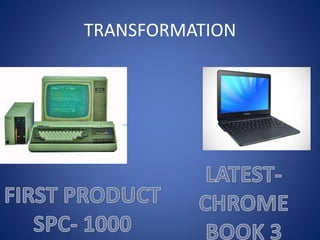
TRANSFORMATION
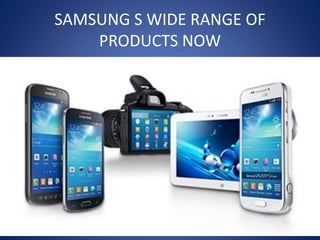
SAMSUNG S WIDE RANGE OF
PRODUCTS NOW
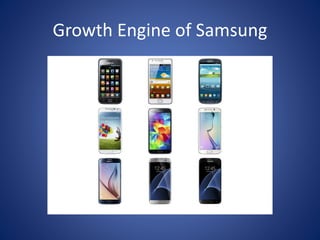
Growth Engine of Samsung
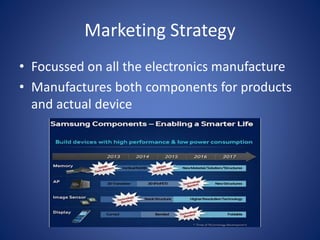
Marketing Strategy
• Focussed on all the electronics manufacture
• Manufactures both components for products
and actual device
Contd..
• Enhanced product portfolio.
• Wide Distribution Channels.
• Adjust preferences for specific market.
• Increased Commitment to emerging markets.
Contd..
• Provide more than extra.
• Pours a lot of money into R&D
STRENGTH
• World’s most successful Electronics
Manufacturer.
• Number 1 marketer of mobile phones with
21.4% of world’s largest market share in
second quarter of 2015.
• Amazing Research and Design capabilities.
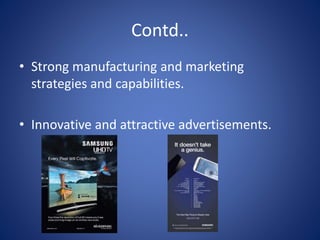
Contd..
• Strong manufacturing and marketing
strategies and capabilities.
• Innovative and attractive advertisements.
Weaknesses
• Chinese competitors are catching up to
Samsung in smart phone market.
• Apple Products are more advanced and more
reliable than Samsung
• Heavily Dependant on Consumer electronics
sales in market
Opportunity
• Growing market for smartphones, tablets and
other devices especially in developing
countries.
• Growing online market from sales channles
such as Amazon, Flipkart, etc.
• Research and Development might lead to new
technologies.
Threats
• Hasn’t been able to overcome Apple s reputation
for reliability
• Declining or stagnating middle class income in
North America and USA could reduce customer
buying power in those key markets.
• Apple could enter more consumer product areas
such as home appliance and camera and compete
with Samsung ie. threats from competitors.
Contd..
• Budgeted $40 billion during 2005-10 for
Research and Development. This type of huge
investment on R&D might back fire when
results aren’t obtained.
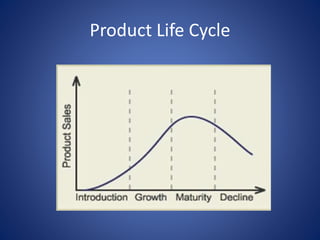
Product Life Cycle
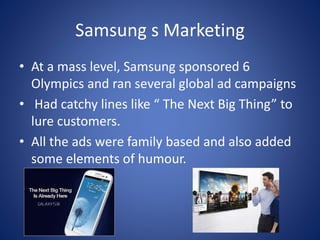
Samsung s Marketing
• At a mass level, Samsung sponsored 6
Olympics and ran several global ad campaigns
• Had catchy lines like “ The Next Big Thing” to
lure customers.
• All the ads were family based and also added
some elements of humour.
Questions
1. What are some of Samsung s greatest
competitive strengths ?
Ans:
Throughout Samsung s existence, the brand
evolved with time resulting in competitive
strengths. In the beginning, it focussed on
volume and market domination. Then, cut
company fat, emphasised product quality
and manufacturing flexibility.
Questions
2. Samsung s goal of $400 billion in sales by 2020
would bring it to the same level as Walmart. Is
this feasible ?
Ans:
Yes. This is definitely feasible. Samsung is currently
the 9th largest global brand and the number one
in Smartphones, TV’s and memory conductors.
This leadership position suggests that they will
thrive when expanded into new areas. Moreover,
it sells $200Billion now without all these
expansions.
Summary
• Incredible transformation.
• Samsung phones are the growth engine of Samsung.
• Brilliant Marketing Strategy.
• Strength- No.1 marketer of Mobile Phones and
brilliant R&D.
• Weakness- Competitors catching up.
• Opportunity- Emerging countries, a big market.
• Threats- Apple perceived to be more reliable.
• Product Life Cycle.
• Good Advertisements
DISCLAIMER
• Created by Jishnu Mohan, SRM University
during a marketing internship by Prof. Sameer
Mathur, IIM Lucknow

Samsung Analysis

  • 1.
  • 2.
    INTRODUCTION • Samsung wasfounded by Lee Byung-Chull in 1938 as a trading company. • It is a South Korean Multi- National Company. • Global Market Leader in more than 60 products including DRAM, SDRAM, LCD Displays, etc • Tagline- “ Inspire the World. Create the Future
  • 3.
  • 4.
    SAMSUNG S WIDERANGE OF PRODUCTS NOW
  • 5.
  • 6.
    Marketing Strategy • Focussedon all the electronics manufacture • Manufactures both components for products and actual device
  • 7.
    Contd.. • Enhanced productportfolio. • Wide Distribution Channels. • Adjust preferences for specific market. • Increased Commitment to emerging markets.
  • 8.
    Contd.. • Provide morethan extra. • Pours a lot of money into R&D
  • 10.
    STRENGTH • World’s mostsuccessful Electronics Manufacturer. • Number 1 marketer of mobile phones with 21.4% of world’s largest market share in second quarter of 2015. • Amazing Research and Design capabilities.
  • 11.
    Contd.. • Strong manufacturingand marketing strategies and capabilities. • Innovative and attractive advertisements.
  • 12.
    Weaknesses • Chinese competitorsare catching up to Samsung in smart phone market. • Apple Products are more advanced and more reliable than Samsung • Heavily Dependant on Consumer electronics sales in market
  • 13.
    Opportunity • Growing marketfor smartphones, tablets and other devices especially in developing countries. • Growing online market from sales channles such as Amazon, Flipkart, etc. • Research and Development might lead to new technologies.
  • 14.
    Threats • Hasn’t beenable to overcome Apple s reputation for reliability • Declining or stagnating middle class income in North America and USA could reduce customer buying power in those key markets. • Apple could enter more consumer product areas such as home appliance and camera and compete with Samsung ie. threats from competitors.
  • 15.
    Contd.. • Budgeted $40billion during 2005-10 for Research and Development. This type of huge investment on R&D might back fire when results aren’t obtained.
  • 16.
  • 17.
    Samsung s Marketing •At a mass level, Samsung sponsored 6 Olympics and ran several global ad campaigns • Had catchy lines like “ The Next Big Thing” to lure customers. • All the ads were family based and also added some elements of humour.
  • 18.
    Questions 1. What aresome of Samsung s greatest competitive strengths ? Ans: Throughout Samsung s existence, the brand evolved with time resulting in competitive strengths. In the beginning, it focussed on volume and market domination. Then, cut company fat, emphasised product quality and manufacturing flexibility.
  • 19.
    Questions 2. Samsung sgoal of $400 billion in sales by 2020 would bring it to the same level as Walmart. Is this feasible ? Ans: Yes. This is definitely feasible. Samsung is currently the 9th largest global brand and the number one in Smartphones, TV’s and memory conductors. This leadership position suggests that they will thrive when expanded into new areas. Moreover, it sells $200Billion now without all these expansions.
  • 20.
    Summary • Incredible transformation. •Samsung phones are the growth engine of Samsung. • Brilliant Marketing Strategy. • Strength- No.1 marketer of Mobile Phones and brilliant R&D. • Weakness- Competitors catching up. • Opportunity- Emerging countries, a big market. • Threats- Apple perceived to be more reliable. • Product Life Cycle. • Good Advertisements
  • 21.
    DISCLAIMER • Created byJishnu Mohan, SRM University during a marketing internship by Prof. Sameer Mathur, IIM Lucknow