By: Brooke Graham
SAMSUNG
Marketing Plan
• Category: Consumer Electronics- Mobile Devices
• Between the years 2014-2015 Consumer Electronics increased 2.8%
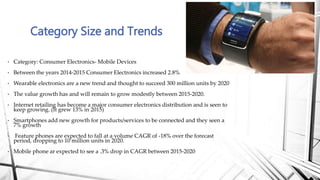
• Wearable electronics are a new trend and thought to succeed 300 million units by 2020
• The value growth has and will remain to grow modestly between 2015-2020.
• Internet retailing has become a major consumer electronics distribution and is seen to
keep growing. (It grew 13% in 2015)
• Smartphones add new growth for products/services to be connected and they seen a
7% growth
• Feature phones are expected to fall at a volume CAGR of -18% over the forecast
period, dropping to 10 million units in 2020.
• Mobile phone ar expected to see a .3% drop in CAGR between 2015-2020
Category Size and Trends
• Samsung is the #2 placeholder as their volume decreased by .2% in the last
year.
• Samsung's brand shares are above Apples by 3.1%.
• Samsung has Google Android systems on their devices which is the biggest
operating system in the U.S with 57% of smartphones using the OS.
• Apples volume is seen to be decreasing because of the delays in advanced
technology they do not use.
• LG’s volume in Brand an Company shares is seen to be increasing due to the
technology advances they use. (Their share grew 46%)
• Additionally, because iOS is not available on new devices at lower price
points, Android is able to occupy larger portions of the smartphones market
at a far higher rate.
Competition
• Anyone who is tech savvy, has a desire for a smartphone, uses mobile
devices for communication/work.
• Based on modern salaries the consumers tend to be middle-class to low
because Samsung has affordable price ranges between its many different
phones.
• Consumers tend to purchase Samsung because of its industry improved
features consumers want in devices
Consumers
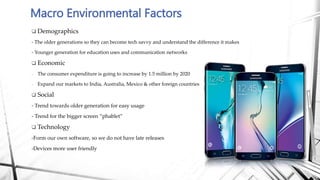
 Demographics
- The older generations so they can become tech savvy and understand the difference it makes
- Younger generation for education uses and communication networks
 Economic
- The consumer expenditure is going to increase by 1.5 million by 2020
- Expand our markets to India, Australia, Mexico & other foreign countries
 Social
- Trend towards older generation for easy usage
- Trend for the bigger screen “phablet”
 Technology
-Form our own software, so we do not have late releases
-Devices more user friendly
Macro Environmental Factors
Strengths: · First in Smartphone sales
· Low production costs
· Design and features (technology
advances before Apple)
· Product line (TVs, Tablets, Cell
phones, Camera, etc.)
· High market share
· Financial support
· Global brand image (affiliated
business' and subsidiaries)
Weaknesses: · Depends on third
parties for software
· Not the only product that hosts
Android OS (the public has options)
· Slower releases for software
updates on mobile devices
· Mobile devices aren't as user
friendly as Apple's
· Dependent on markets in the US
and Europe for most of its sales, where
growth is limited
Opportunities: · Growing market of
smart phones and tablets
· Taking advantage of growing
personal electronic industry in India and
other foreign countries
· Increase in mobile advertising
· Increase the usability of products in
everyday life
· Could partner with athletic company
similar to Nike and Apple
· Make products more unique to
Threats: · Competition with Apple
· Extreme diversity; a lot of major
competition
· New smartphone companies, like
Huawei, growing faster
· Other companies operating systems
are more popular
· Other companies release new
products first
SWOT
• 1. Samsung could improve its
marketing strategy to compete
with companies making the same
products in the US and European
markets, as well as around the
world. This would increase brand
awareness and market share.
• 2. Samsung could integrate its own
software division so it can become
a leader in development rather
than depend on others. This would
speed up release of products and
keep Samsung more current in the
marketplace.
• 3. Samsung could form
partnerships with like-minded
companies to be more innovative
and increase its customer base.
Strategies
• 1. Samsung has a strong Market
Strategy advertising wise in the
US and Europe but they need to
increase awareness.
• 2. Samsung depends too much on
third parties for software and
Apps, making releases slower.
• 3. Samsung is already the most
innovative company in the
mobile device business, I think
they just need to expand their
brand into different countries to
increase customer base and
loyalty
Key Learnings
Key Strategies
• Consumers who like sleek and
simple design, likes innovative
technology advances in mobile
devices, affordability (low cost),
options for OS & devices, global
brand presence.
Psychographic
• Teens between the ages of 13-19
with extra curricular activities,
communication and
• Adults between 20-65, who
understand technology and have
work/communication needs.
• Low-Middle class families who
can afford to have a cellular
device
Demographics
Target Market
• For tech savy teens and adults, Samsung is the most
innovative company in consumer electronics.
Unlike traditional electronics company’s we provide
affordability, design, and selection.
Positioning Statement
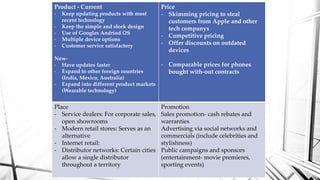
Product - Current
- Keep updating products with most
recent technology
- Keep the simple and sleek design
- Use of Googles Andriod OS
- Multiple device options
- Customer service satisfactory
New-
- Have updates faster
- Expand to other foreign countries
(India, Mexico, Australia)
- Expand into different product markets
(Wearable technology)
Price
- Skimming pricing to steal
customers from Apple and other
tech companys
- Competitive pricing
- Offer discounts on outdated
devices
- Comparable prices for phones
bought with-out contracts
Place
- Service dealers: For corporate sales,
open showrooms
- Modern retail stores: Serves as an
alternative
- Internet retail:
- Distributor networks: Certain cities
allow a single distributor
throughout a territory
Promotion
Sales promotion- cash rebates and
warranties
Advertising via social networks and
commercials (include celebrities and
stylishness)
Public campaigns and sponsors
(entertainment- movie premieres,
sporting events)

SAMSUNG

  • 1.
  • 2.
    • Category: ConsumerElectronics- Mobile Devices • Between the years 2014-2015 Consumer Electronics increased 2.8% • Wearable electronics are a new trend and thought to succeed 300 million units by 2020 • The value growth has and will remain to grow modestly between 2015-2020. • Internet retailing has become a major consumer electronics distribution and is seen to keep growing. (It grew 13% in 2015) • Smartphones add new growth for products/services to be connected and they seen a 7% growth • Feature phones are expected to fall at a volume CAGR of -18% over the forecast period, dropping to 10 million units in 2020. • Mobile phone ar expected to see a .3% drop in CAGR between 2015-2020 Category Size and Trends
  • 3.
    • Samsung isthe #2 placeholder as their volume decreased by .2% in the last year. • Samsung's brand shares are above Apples by 3.1%. • Samsung has Google Android systems on their devices which is the biggest operating system in the U.S with 57% of smartphones using the OS. • Apples volume is seen to be decreasing because of the delays in advanced technology they do not use. • LG’s volume in Brand an Company shares is seen to be increasing due to the technology advances they use. (Their share grew 46%) • Additionally, because iOS is not available on new devices at lower price points, Android is able to occupy larger portions of the smartphones market at a far higher rate. Competition
  • 4.
    • Anyone whois tech savvy, has a desire for a smartphone, uses mobile devices for communication/work. • Based on modern salaries the consumers tend to be middle-class to low because Samsung has affordable price ranges between its many different phones. • Consumers tend to purchase Samsung because of its industry improved features consumers want in devices Consumers
  • 5.
     Demographics - Theolder generations so they can become tech savvy and understand the difference it makes - Younger generation for education uses and communication networks  Economic - The consumer expenditure is going to increase by 1.5 million by 2020 - Expand our markets to India, Australia, Mexico & other foreign countries  Social - Trend towards older generation for easy usage - Trend for the bigger screen “phablet”  Technology -Form our own software, so we do not have late releases -Devices more user friendly Macro Environmental Factors
  • 6.
    Strengths: · Firstin Smartphone sales · Low production costs · Design and features (technology advances before Apple) · Product line (TVs, Tablets, Cell phones, Camera, etc.) · High market share · Financial support · Global brand image (affiliated business' and subsidiaries) Weaknesses: · Depends on third parties for software · Not the only product that hosts Android OS (the public has options) · Slower releases for software updates on mobile devices · Mobile devices aren't as user friendly as Apple's · Dependent on markets in the US and Europe for most of its sales, where growth is limited Opportunities: · Growing market of smart phones and tablets · Taking advantage of growing personal electronic industry in India and other foreign countries · Increase in mobile advertising · Increase the usability of products in everyday life · Could partner with athletic company similar to Nike and Apple · Make products more unique to Threats: · Competition with Apple · Extreme diversity; a lot of major competition · New smartphone companies, like Huawei, growing faster · Other companies operating systems are more popular · Other companies release new products first SWOT
  • 7.
    • 1. Samsungcould improve its marketing strategy to compete with companies making the same products in the US and European markets, as well as around the world. This would increase brand awareness and market share. • 2. Samsung could integrate its own software division so it can become a leader in development rather than depend on others. This would speed up release of products and keep Samsung more current in the marketplace. • 3. Samsung could form partnerships with like-minded companies to be more innovative and increase its customer base. Strategies • 1. Samsung has a strong Market Strategy advertising wise in the US and Europe but they need to increase awareness. • 2. Samsung depends too much on third parties for software and Apps, making releases slower. • 3. Samsung is already the most innovative company in the mobile device business, I think they just need to expand their brand into different countries to increase customer base and loyalty Key Learnings Key Strategies
  • 8.
    • Consumers wholike sleek and simple design, likes innovative technology advances in mobile devices, affordability (low cost), options for OS & devices, global brand presence. Psychographic • Teens between the ages of 13-19 with extra curricular activities, communication and • Adults between 20-65, who understand technology and have work/communication needs. • Low-Middle class families who can afford to have a cellular device Demographics Target Market
  • 9.
    • For techsavy teens and adults, Samsung is the most innovative company in consumer electronics. Unlike traditional electronics company’s we provide affordability, design, and selection. Positioning Statement
  • 10.
    Product - Current -Keep updating products with most recent technology - Keep the simple and sleek design - Use of Googles Andriod OS - Multiple device options - Customer service satisfactory New- - Have updates faster - Expand to other foreign countries (India, Mexico, Australia) - Expand into different product markets (Wearable technology) Price - Skimming pricing to steal customers from Apple and other tech companys - Competitive pricing - Offer discounts on outdated devices - Comparable prices for phones bought with-out contracts Place - Service dealers: For corporate sales, open showrooms - Modern retail stores: Serves as an alternative - Internet retail: - Distributor networks: Certain cities allow a single distributor throughout a territory Promotion Sales promotion- cash rebates and warranties Advertising via social networks and commercials (include celebrities and stylishness) Public campaigns and sponsors (entertainment- movie premieres, sporting events)