SAMSUNG APPLIED
By: Jayla Dunlap
SAMSUNG Background
SAMSUNG...
Is headquartered in Samsung Town, Seoul
Is a multinational conglomerate that unites numerous affiliated businesses
Was founded almost eighty years ago, on March 1st, 1938 by Lee Byung-chul
Has a revenue of over $300 billion (2016)
Has employees in over 80 countries
Has a construction company that built the Burj Khalifa, the tallest building in the
world
SAMSUNG: How it
all began
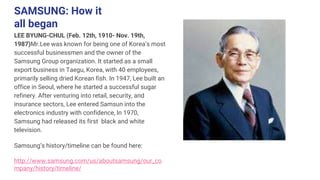
LEE BYUNG-CHUL (Feb. 12th, 1910- Nov. 19th,
1987)Mr.Lee was known for being one of Korea’s most
successful businessmen and the owner of the
Samsung Group organization. It started as a small
export business in Taegu, Korea, with 40 employees,
primarily selling dried Korean fish. In 1947, Lee built an
office in Seoul, where he started a successful sugar
refinery. After venturing into retail, security, and
insurance sectors, Lee entered Samsun into the
electronics industry with confidence, In 1970,
Samsung had released its first black and white
television.
Samsung’s history/timeline can be found here:
http://www.samsung.com/us/aboutsamsung/our_co
mpany/history/timeline/
ARTICLE ONE: “Managing Cross-Cultural Environment in Samsing Company:
Strategy in Global Business”
This study was conducted in order to learn how Samsung…
overcomes issues in communication with internal and external structure in order
to overcome potential threats,
how culture in global business works, managing cross-cultural issues,
employers and employees’ specific roles in the company,
how Samsung has dealt with the “Globalization era”, making its business blow up
and ultimately expand over international borders
ARTICLE 2: Globalization and Divergent Paths of Industrial Development: Mobile
Phone Manufacturing in China, Japan, South Korea and Taiwan
This study found…
“...globalisation does not lead to the convergence of development paths, but promotes cross-
national divergence depending on countries’ positions in the value chain and market
niches”,
the concurrent development of multiple trajectories in China’s mobile phone industry with
some overlap in value chain niches with its neighbouring countries,
China, Japan, North Korea and Taiwan hold the same level of importance in global markets, but
are different parts in the GVC (global value chain: “the full range of activities that firms and
workers perform to bring a specific product from its conception to its end use and
beyond”.),
a diverging pattern of development paths in the East Asian region, as well as the internal
complexity of the Chinese trajectory
CONCEPT: Globalization
In Katherine Miller’s Organizational
Communication: Approaches and Processes, the
first chapter describes that we live in a global
economy with a global market, and as
telecommunications and transportation
improves, so does our connections amongst
other in the world (on personal and
organizational terms). Globalization arose not
too long after key political changes, and has led
to practices such as outsourcing (moving the
company somewhere where labor is cheaper)
and businesses are spread across nations
throughout the developing world to create
international presence.
GLOBALIZATION: defined by
globalization101.org:
“Globalization is a process of interaction and
integration among the people, companies,
and governments of different nations, a
process driven by international trade and
investment and aided by information
technology. This process has effects on the
environment, on culture, on political
systems, on economic development and
prosperity, and on human physical well-being
in societies around the world.
How Globalization has applied to Samsung
Samsung is a Korean MNC (multinational company) which has
used globalization to its advantage in the best ways possible. The
mobile phone industry has changed significantly due to
globalization over the past 20+ years, and although it has
challenged how industrial development takes place, the company
has embraced new ways to market and distribute its products to
consumers in various ways. It has used the opportunities given to
them to expand internationally into industrialized and developing
worlds.
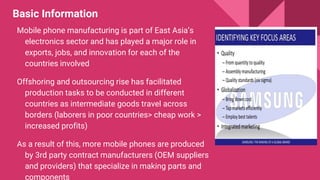
Basic Information
Mobile phone manufacturing is part of East Asia’s
electronics sector and has played a major role in
exports, jobs, and innovation for each of the
countries involved
Offshoring and outsourcing rise has facilitated
production tasks to be conducted in different
countries as intermediate goods travel across
borders (laborers in poor countries> cheap work >
increased profits)
As a result of this, more mobile phones are produced
by 3rd party contract manufacturers (OEM suppliers
and providers) that specialize in making parts and
components
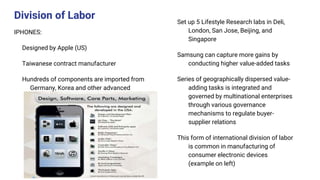
Division of Labor
IPHONES:
Designed by Apple (US)
Taiwanese contract manufacturer
Hundreds of components are imported from
Germany, Korea and other advanced
economies
Set up 5 Lifestyle Research labs in Deli,
London, San Jose, Beijing, and
Singapore
Samsung can capture more gains by
conducting higher value-added tasks
Series of geographically dispersed value-
adding tasks is integrated and
governed by multinational enterprises
through various governance
mechanisms to regulate buyer-
supplier relations
This form of international division of labor
is common in manufacturing of
consumer electronic devices
(example on left)
Why globalization works for Samsung
Performance of mobile phone producers increasingly relies on their
competitiveness in global markets
Companies must conduct extensive marketing efforts and a source product (cost to entering global
market)
Rapid growth of Samsung is mainly attributed to their active engagement in global markets through
exports
Without a globalized market, Samsung wouldn’t be able to use low cost strategy to mass produce
various phones and products
Location advantages
Samsung selects locations for manufacturing plants called “clusters” (US, England, China, Brazil, etc)
Why globalization works for Samsung cont...
Having different international locations allows Samsung to gain knowledge, and create an innovative
spirit
Samsung searches these clusters for the best educated employees as candidates to import to HQ in
Seoul
This allows innovative ideas to come into play
Innovative thinking
Samsung analyzes the global market through demand factors
Enters a market where the company is already established in
Uses transfer of knowledge between its activities and adapts its products - for example, Samsung
created the Galaxy S3 with more attributes at a cheaper cost. When research showed that people
thought the handset was too big, Samsung created the Galaxy S3 Mini 4-6 months later)
Vertical Integration - has all parts to manufacture their phones (chips, screen, etc.)
Staying
Globalized
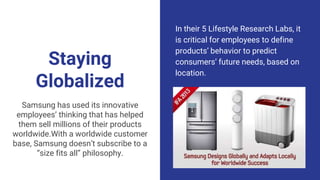
In their 5 Lifestyle Research Labs, it
is critical for employees to define
products’ behavior to predict
consumers’ future needs, based on
location.
Samsung has used its innovative
employees’ thinking that has helped
them sell millions of their products
worldwide.With a worldwide customer
base, Samsung doesn’t subscribe to a
“size fits all” philosophy.
Staying Globalized Examples
Employees find inspiration from observing
people’s lives and giving them options that meet
their cultural and regional needs. Samsung has
even created an app to fit the needs of
customers through technology, and promises
that they will make products based on local
needs.
The following slides will show some of
Samsung’s most successful products that have
been made to accommodate specific regions:
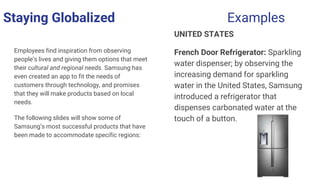
UNITED STATES
French Door Refrigerator: Sparkling
water dispenser; by observing the
increasing demand for sparkling
water in the United States, Samsung
introduced a refrigerator that
dispenses carbonated water at the
touch of a button.
Examples
BULGARIA
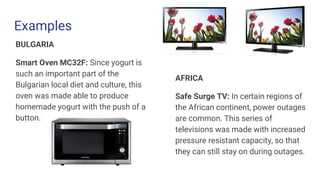
Smart Oven MC32F: Since yogurt is
such an important part of the
Bulgarian local diet and culture, this
oven was made able to produce
homemade yogurt with the push of a
button.
AFRICA
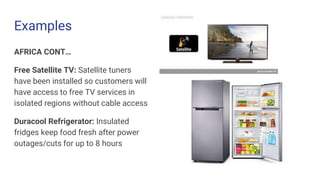
Safe Surge TV: In certain regions of
the African continent, power outages
are common. This series of
televisions was made with increased
pressure resistant capacity, so that
they can still stay on during outages.
Examples
AFRICA CONT…
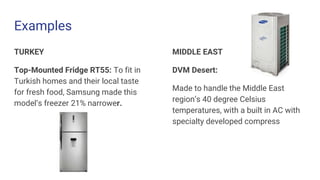
Free Satellite TV: Satellite tuners
have been installed so customers will
have access to free TV services in
isolated regions without cable access
Duracool Refrigerator: Insulated
fridges keep food fresh after power
outages/cuts for up to 8 hours
a
Examples
TURKEY
Top-Mounted Fridge RT55: To fit in
Turkish homes and their local taste
for fresh food, Samsung made this
model’s freezer 21% narrower.
MIDDLE EAST
DVM Desert:
Made to handle the Middle East
region’s 40 degree Celsius
temperatures, with a built in AC with
specialty developed compress
Examples
INDIA
Twin Top Washing Machine: Wheels were built in
so the machines can be transferred and
connected to a different power source during
power outages, and filled with a special basin to
meet the custom for hand washing certain clothes
before the cycle
CHINA
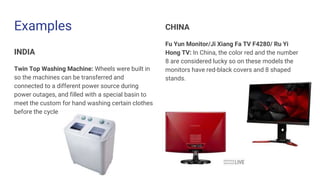
Fu Yun Monitor/Ji Xiang Fa TV F4280/ Ru Yi
Hong TV: In China, the color red and the number
8 are considered lucky so on these models the
monitors have red-black covers and 8 shaped
stands.
Examples
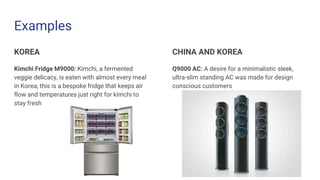
KOREA
Kimchi Fridge M9000: Kimchi, a fermented
veggie delicacy, is eaten with almost every meal
in Korea; this is a bespoke fridge that keeps air
flow and temperatures just right for kimchi to
stay fresh
CHINA AND KOREA
Q9000 AC: A desire for a minimalistic sleek,
ultra-slim standing AC was made for design
conscious customers
Questions/Observations
1. In what new, innovative ways can Samsung prove that it can adapt to
any country/region’s needs through their products?
2. In ten years, how will Samsung figure out ways to create products that
will satisfy regions/areas that not many live in?
3. IF, for some reason, globalization stopped being an important factor for
Samsung’s sales and manufacturing, what steps would the company
take in order to establish a base for their work?
Works cited
Lee, Joonkoo, Jong-Cheo Kim, and Jinho Lim. "Journal of Contemporary Asia."
Globalization and Divergent Paths of Industrial Development: Mobile Phone
Manufacturing in China, Japan, South Korea and Taiwan: Journal of
Contemporary Asia: Vol 46, No 2. Routledge Taylor and Francis Group, 12 Nov.
2015. Web. 13 Feb. 2017.
Rani, Hazrin Shahar, Faiezi Zubuer, Muhammad Saifulbarki Yusoof, Muhammad
Nadhir Zamziba, and Saazmi Ahmad Toriryhrma. "Managing Cross-Cultural
Environment in Samsung Company: Strategy in Global Business." Hrmars.com.
Shah University, 2016. Web. 5 Feb. 2017.

Slideshare 1: Globalization and Samsung

  • 1.
  • 2.
    SAMSUNG Background SAMSUNG... Is headquarteredin Samsung Town, Seoul Is a multinational conglomerate that unites numerous affiliated businesses Was founded almost eighty years ago, on March 1st, 1938 by Lee Byung-chul Has a revenue of over $300 billion (2016) Has employees in over 80 countries Has a construction company that built the Burj Khalifa, the tallest building in the world
  • 3.
    SAMSUNG: How it allbegan LEE BYUNG-CHUL (Feb. 12th, 1910- Nov. 19th, 1987)Mr.Lee was known for being one of Korea’s most successful businessmen and the owner of the Samsung Group organization. It started as a small export business in Taegu, Korea, with 40 employees, primarily selling dried Korean fish. In 1947, Lee built an office in Seoul, where he started a successful sugar refinery. After venturing into retail, security, and insurance sectors, Lee entered Samsun into the electronics industry with confidence, In 1970, Samsung had released its first black and white television. Samsung’s history/timeline can be found here: http://www.samsung.com/us/aboutsamsung/our_co mpany/history/timeline/
  • 4.
    ARTICLE ONE: “ManagingCross-Cultural Environment in Samsing Company: Strategy in Global Business” This study was conducted in order to learn how Samsung… overcomes issues in communication with internal and external structure in order to overcome potential threats, how culture in global business works, managing cross-cultural issues, employers and employees’ specific roles in the company, how Samsung has dealt with the “Globalization era”, making its business blow up and ultimately expand over international borders
  • 5.
    ARTICLE 2: Globalizationand Divergent Paths of Industrial Development: Mobile Phone Manufacturing in China, Japan, South Korea and Taiwan This study found… “...globalisation does not lead to the convergence of development paths, but promotes cross- national divergence depending on countries’ positions in the value chain and market niches”, the concurrent development of multiple trajectories in China’s mobile phone industry with some overlap in value chain niches with its neighbouring countries, China, Japan, North Korea and Taiwan hold the same level of importance in global markets, but are different parts in the GVC (global value chain: “the full range of activities that firms and workers perform to bring a specific product from its conception to its end use and beyond”.), a diverging pattern of development paths in the East Asian region, as well as the internal complexity of the Chinese trajectory
  • 6.
    CONCEPT: Globalization In KatherineMiller’s Organizational Communication: Approaches and Processes, the first chapter describes that we live in a global economy with a global market, and as telecommunications and transportation improves, so does our connections amongst other in the world (on personal and organizational terms). Globalization arose not too long after key political changes, and has led to practices such as outsourcing (moving the company somewhere where labor is cheaper) and businesses are spread across nations throughout the developing world to create international presence. GLOBALIZATION: defined by globalization101.org: “Globalization is a process of interaction and integration among the people, companies, and governments of different nations, a process driven by international trade and investment and aided by information technology. This process has effects on the environment, on culture, on political systems, on economic development and prosperity, and on human physical well-being in societies around the world.
  • 7.
    How Globalization hasapplied to Samsung Samsung is a Korean MNC (multinational company) which has used globalization to its advantage in the best ways possible. The mobile phone industry has changed significantly due to globalization over the past 20+ years, and although it has challenged how industrial development takes place, the company has embraced new ways to market and distribute its products to consumers in various ways. It has used the opportunities given to them to expand internationally into industrialized and developing worlds.
  • 8.
    Basic Information Mobile phonemanufacturing is part of East Asia’s electronics sector and has played a major role in exports, jobs, and innovation for each of the countries involved Offshoring and outsourcing rise has facilitated production tasks to be conducted in different countries as intermediate goods travel across borders (laborers in poor countries> cheap work > increased profits) As a result of this, more mobile phones are produced by 3rd party contract manufacturers (OEM suppliers and providers) that specialize in making parts and components
  • 9.
    Division of Labor IPHONES: Designedby Apple (US) Taiwanese contract manufacturer Hundreds of components are imported from Germany, Korea and other advanced economies Set up 5 Lifestyle Research labs in Deli, London, San Jose, Beijing, and Singapore Samsung can capture more gains by conducting higher value-added tasks Series of geographically dispersed value- adding tasks is integrated and governed by multinational enterprises through various governance mechanisms to regulate buyer- supplier relations This form of international division of labor is common in manufacturing of consumer electronic devices (example on left)
  • 10.
    Why globalization worksfor Samsung Performance of mobile phone producers increasingly relies on their competitiveness in global markets Companies must conduct extensive marketing efforts and a source product (cost to entering global market) Rapid growth of Samsung is mainly attributed to their active engagement in global markets through exports Without a globalized market, Samsung wouldn’t be able to use low cost strategy to mass produce various phones and products Location advantages Samsung selects locations for manufacturing plants called “clusters” (US, England, China, Brazil, etc)
  • 11.
    Why globalization worksfor Samsung cont... Having different international locations allows Samsung to gain knowledge, and create an innovative spirit Samsung searches these clusters for the best educated employees as candidates to import to HQ in Seoul This allows innovative ideas to come into play Innovative thinking Samsung analyzes the global market through demand factors Enters a market where the company is already established in Uses transfer of knowledge between its activities and adapts its products - for example, Samsung created the Galaxy S3 with more attributes at a cheaper cost. When research showed that people thought the handset was too big, Samsung created the Galaxy S3 Mini 4-6 months later) Vertical Integration - has all parts to manufacture their phones (chips, screen, etc.)
  • 12.
    Staying Globalized In their 5Lifestyle Research Labs, it is critical for employees to define products’ behavior to predict consumers’ future needs, based on location. Samsung has used its innovative employees’ thinking that has helped them sell millions of their products worldwide.With a worldwide customer base, Samsung doesn’t subscribe to a “size fits all” philosophy.
  • 13.
    Staying Globalized Examples Employeesfind inspiration from observing people’s lives and giving them options that meet their cultural and regional needs. Samsung has even created an app to fit the needs of customers through technology, and promises that they will make products based on local needs. The following slides will show some of Samsung’s most successful products that have been made to accommodate specific regions: UNITED STATES French Door Refrigerator: Sparkling water dispenser; by observing the increasing demand for sparkling water in the United States, Samsung introduced a refrigerator that dispenses carbonated water at the touch of a button.
  • 14.
    Examples BULGARIA Smart Oven MC32F:Since yogurt is such an important part of the Bulgarian local diet and culture, this oven was made able to produce homemade yogurt with the push of a button. AFRICA Safe Surge TV: In certain regions of the African continent, power outages are common. This series of televisions was made with increased pressure resistant capacity, so that they can still stay on during outages.
  • 15.
    Examples AFRICA CONT… Free SatelliteTV: Satellite tuners have been installed so customers will have access to free TV services in isolated regions without cable access Duracool Refrigerator: Insulated fridges keep food fresh after power outages/cuts for up to 8 hours a
  • 16.
    Examples TURKEY Top-Mounted Fridge RT55:To fit in Turkish homes and their local taste for fresh food, Samsung made this model’s freezer 21% narrower. MIDDLE EAST DVM Desert: Made to handle the Middle East region’s 40 degree Celsius temperatures, with a built in AC with specialty developed compress
  • 17.
    Examples INDIA Twin Top WashingMachine: Wheels were built in so the machines can be transferred and connected to a different power source during power outages, and filled with a special basin to meet the custom for hand washing certain clothes before the cycle CHINA Fu Yun Monitor/Ji Xiang Fa TV F4280/ Ru Yi Hong TV: In China, the color red and the number 8 are considered lucky so on these models the monitors have red-black covers and 8 shaped stands.
  • 18.
    Examples KOREA Kimchi Fridge M9000:Kimchi, a fermented veggie delicacy, is eaten with almost every meal in Korea; this is a bespoke fridge that keeps air flow and temperatures just right for kimchi to stay fresh CHINA AND KOREA Q9000 AC: A desire for a minimalistic sleek, ultra-slim standing AC was made for design conscious customers
  • 19.
    Questions/Observations 1. In whatnew, innovative ways can Samsung prove that it can adapt to any country/region’s needs through their products? 2. In ten years, how will Samsung figure out ways to create products that will satisfy regions/areas that not many live in? 3. IF, for some reason, globalization stopped being an important factor for Samsung’s sales and manufacturing, what steps would the company take in order to establish a base for their work?
  • 20.
    Works cited Lee, Joonkoo,Jong-Cheo Kim, and Jinho Lim. "Journal of Contemporary Asia." Globalization and Divergent Paths of Industrial Development: Mobile Phone Manufacturing in China, Japan, South Korea and Taiwan: Journal of Contemporary Asia: Vol 46, No 2. Routledge Taylor and Francis Group, 12 Nov. 2015. Web. 13 Feb. 2017. Rani, Hazrin Shahar, Faiezi Zubuer, Muhammad Saifulbarki Yusoof, Muhammad Nadhir Zamziba, and Saazmi Ahmad Toriryhrma. "Managing Cross-Cultural Environment in Samsung Company: Strategy in Global Business." Hrmars.com. Shah University, 2016. Web. 5 Feb. 2017.