Presented by: Aditya Gupta Raut
Amity University, Kolkata
SAMSUNG’S HISTORY
o Founded in 1938 as an export company.
o Turned towards providing value-priced
commodity products in the 1970s and 1980s.
o Founder’s son, Kun-Hee Lee succeeded his late
father in 1987 and restructured the company to
make it what it is today.
VISION
“For over 70 years, Samsung has been dedicated to making a better
world through diverse businesses that today span advanced technology,
semiconductors, skyscraper and plant construction, petrochemicals,
fashion, medicine, finance, hotels, and more.”
List of Products:
Samsung manufacturers and sell a variety of
products, such as:
o Electronic Devices( Phones, Tablets,
Televisions)
o Appliances( Washing Machines, Refrigerators)
o Gadgets ( Smartwatch, Virtual Reality Headsets)
Samsung Marketing Strategy
Samsung uses a marketing strategy commonly
referred to as the ‘spray and pray’. It refers to
flooding a market with products and
advertisements catering to all needs.
Samsung’s Marketing Strategy
o Has a huge variety of products.
o Sells directly to the retailers and service dealers.
And due to this strategy, only service dealers are
responsible for the corporate sales.
o Uses competitive and skimming pricing
techniques.
o Believes advertising is key in engaging potential
customers.
Samsung vs Apple
o Samsung markets more aggressively on
social media compared to Apple.
o Keeps prices below Apple iPhones.
o Enlists high profile celebrities to create
buzz.
Samsung released a set of advertisements where it
clearly mentioned Apple’s name.
Samsung challenging Apple’s build quality.
One of the most influential photos of the 21st
century features a Samsung phone.
Advertisements and Promotions
o Samsung believes that advertisement is key
when it comes to engaging potential customers.
o Samsung believes in promotions through
sponsorships.
o Samsung employs hugely influential brand
ambassadors.
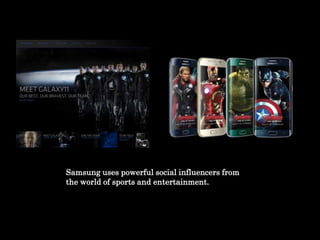
Samsung uses powerful social influencers from
the world of sports and entertainment.
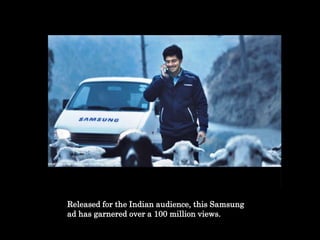
Released for the Indian audience, this Samsung
ad has garnered over a 100 million views.
What are some of Samsung’s greatest
competitive strengths?
o Wide range of products.
o Competitive and skimming pricing techniques.
o Good and trust worthy brand image.
o Focus on advertisements and social media
marketing.
o Leader in innovation and design.
Samsung’s goal of earning $400 billion in sales
by 2020 would bring it to the same level as
Walmart. Is this a feasible goal? Why or why
not?
• Samsung sells about $200 billion a year, with record
sales in 2013 of $327 billion.
• Apple sells about $220B Samsung's Galaxy outsells
iPhone in most countries
• It will 'only' take a 15% annual growth rate (across all
divisions) to achieve $400B in sales
• If everything goes according to Samsung’s plans, it is
possible to see a rise to $400 billion by 2020.
To Summarise:
o Samsung has a wide range of products, satisfying
a wide range of needs.
o Samsung is not afraid to venture and innovate
into unexplored territories.
o Samsung is beating Apple like paper beats rock.
DISCLAIMER
• This presentation was made by Aditya Gupta
Raut of Amity University, Kolkata under the
guidance of Prof. Sameer Mathur.

Samsung

  • 1.
    Presented by: AdityaGupta Raut Amity University, Kolkata
  • 2.
    SAMSUNG’S HISTORY o Foundedin 1938 as an export company. o Turned towards providing value-priced commodity products in the 1970s and 1980s. o Founder’s son, Kun-Hee Lee succeeded his late father in 1987 and restructured the company to make it what it is today.
  • 3.
    VISION “For over 70years, Samsung has been dedicated to making a better world through diverse businesses that today span advanced technology, semiconductors, skyscraper and plant construction, petrochemicals, fashion, medicine, finance, hotels, and more.”
  • 4.
    List of Products: Samsungmanufacturers and sell a variety of products, such as: o Electronic Devices( Phones, Tablets, Televisions) o Appliances( Washing Machines, Refrigerators) o Gadgets ( Smartwatch, Virtual Reality Headsets)
  • 8.
    Samsung Marketing Strategy Samsunguses a marketing strategy commonly referred to as the ‘spray and pray’. It refers to flooding a market with products and advertisements catering to all needs.
  • 9.
    Samsung’s Marketing Strategy oHas a huge variety of products. o Sells directly to the retailers and service dealers. And due to this strategy, only service dealers are responsible for the corporate sales. o Uses competitive and skimming pricing techniques. o Believes advertising is key in engaging potential customers.
  • 10.
    Samsung vs Apple oSamsung markets more aggressively on social media compared to Apple. o Keeps prices below Apple iPhones. o Enlists high profile celebrities to create buzz.
  • 11.
    Samsung released aset of advertisements where it clearly mentioned Apple’s name.
  • 12.
  • 13.
    One of themost influential photos of the 21st century features a Samsung phone.
  • 14.
    Advertisements and Promotions oSamsung believes that advertisement is key when it comes to engaging potential customers. o Samsung believes in promotions through sponsorships. o Samsung employs hugely influential brand ambassadors.
  • 15.
    Samsung uses powerfulsocial influencers from the world of sports and entertainment.
  • 16.
    Released for theIndian audience, this Samsung ad has garnered over a 100 million views.
  • 17.
    What are someof Samsung’s greatest competitive strengths? o Wide range of products. o Competitive and skimming pricing techniques. o Good and trust worthy brand image. o Focus on advertisements and social media marketing. o Leader in innovation and design.
  • 18.
    Samsung’s goal ofearning $400 billion in sales by 2020 would bring it to the same level as Walmart. Is this a feasible goal? Why or why not? • Samsung sells about $200 billion a year, with record sales in 2013 of $327 billion. • Apple sells about $220B Samsung's Galaxy outsells iPhone in most countries • It will 'only' take a 15% annual growth rate (across all divisions) to achieve $400B in sales • If everything goes according to Samsung’s plans, it is possible to see a rise to $400 billion by 2020.
  • 19.
    To Summarise: o Samsunghas a wide range of products, satisfying a wide range of needs. o Samsung is not afraid to venture and innovate into unexplored territories. o Samsung is beating Apple like paper beats rock.
  • 20.
    DISCLAIMER • This presentationwas made by Aditya Gupta Raut of Amity University, Kolkata under the guidance of Prof. Sameer Mathur.