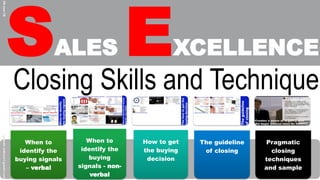

SALES EXCELLENCE
29-Jan-16
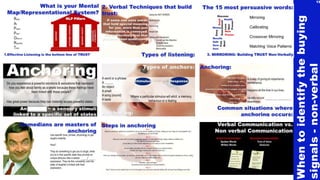
When to
identify the
buying signals
– verbal
When to
identify the
buying
signals - non-
verbal
How to get
the buying
decision
The guideline
of closing
Pragmatic
closing
techniques
and sample
ghazali.mdnoor@gmail.com
Closing Skills and Technique
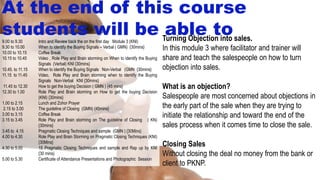
Turning Objection into sales.
In this module 3 where facilitator and trainer will
share and teach the salespeople on how to turn
objection into sales.
What is an objection?
Salespeople are most concerned about objections in
the early part of the sale when they are trying to
initiate the relationship and toward the end of the
sales process when it comes time to close the sale.
Closing Sales
Without closing the deal no money from the bank or
client to PKNP.
9.00 to 9.30 Intro and Review back the on the first day Module 3 (KNI)
9.30 to 10.00 When to identify the Buying Signals – Verbal ( GMN) {30mins}
10.00 to 10.15 Coffee Break
10.15 to 10.45 Video , Role Play and Brain storming on When to identify the Buying
Signals (Verbal) KNI {30mins}
10.45. to 11.15 When to identify the Buying Signals Non-Verbal (GMN {30mins}
11.15 to 11.45 Video, Role Play and Brain storming when to identify the Buying
Signals Non-Verbal KNI {30mins}
11.45 to 12.30 How to get the buying Decision ( GMN ) {45 mins}
12.30 to 1.00 Role Play and Brain storming on How to get the buying Decision
(KNI) {30mins}
1.00 to 2.15 Lunch and Zohor Prayer
2.15 to 3.00 The guideline of Closing (GMN) {45mins}
3.00 to 3.15 Coffee Break
3.15 to 3.45 Role Play and Brain storming on The guideline of Closing ( KN)
{30mins}
3.45 to 4.15 Pragmatic Closing Techniques and sample (GMN ) {30Mins}
4.00 to 4.30 Role Play and Brain Storming on Pragmatic Closing Techniques (KNI)
{30Mins}
4.30 to 5.00 15 Pragmatic Closing Techniques and sample and Rap up by KNI
{30 mins}
5.00 to 5.30 Certificate of Attendance Presentations and Photographic Session
At the end of this course
students will be able to
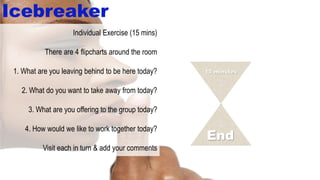
Icebreaker
15 minutes
End
Individual Exercise (15 mins)
There are 4 flipcharts around the room
1. What are you leaving behind to be here today?
2. What do you want to take away from today?
3. What are you offering to the group today?
4. How would we like to work together today?
Visit each in turn & add your comments
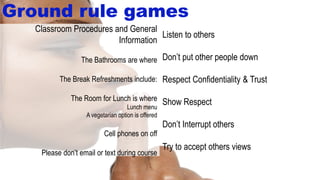
Ground rule games
Listen to others
Don’t put other people down
Respect Confidentiality & Trust
Show Respect
Don’t Interrupt others
Try to accept others views
Classroom Procedures and General
Information
The Bathrooms are where
The Break Refreshments include:
The Room for Lunch is where
Lunch menu
A vegetarian option is offered
Cell phones on off
Please don’t email or text during course
8-6
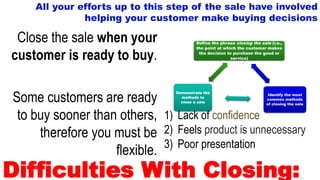
All your efforts up to this step of the sale have involved
helping your customer make buying decisions
Define the phrase closing the sale (i.e.,
the point at which the customer makes
the decision to purchase the good or
service)
Demonstrate the
methods to
close a sale
Identify the most
common methods
of closing the sale
1) Lack of confidence
2) Feels product is unnecessary
3) Poor presentation
Difficulties With Closing:
Close the sale when your
customer is ready to buy.
Some customers are ready
to buy sooner than others,
therefore you must be
flexible.
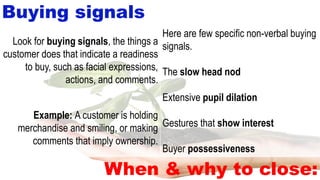
Buying signals
When & why to close:
Here are few specific non-verbal buying
signals.
The slow head nod
Extensive pupil dilation
Gestures that show interest
Buyer possessiveness
Look for buying signals, the things a
customer does that indicate a readiness
to buy, such as facial expressions,
actions, and comments.
Example: A customer is holding
merchandise and smiling, or making
comments that imply ownership.
8
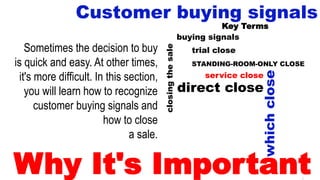
Customer buying signals
Key Terms
Sometimes the decision to buy
is quick and easy. At other times,
it's more difficult. In this section,
you will learn how to recognize
customer buying signals and
how to close
a sale.
closingthesale
buying signals
trial close
whichclose
direct close
STANDING-ROOM-ONLY CLOSE
service close
Why It's Important
14-9
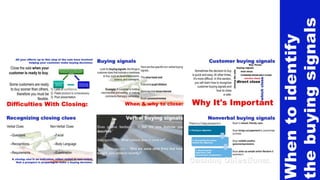
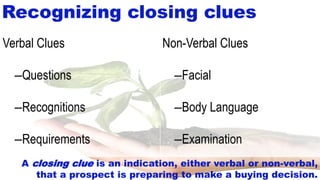
Recognizing closing clues
Non-Verbal Clues
–Facial
–Body Language
–Examination
Verbal Clues
–Questions
–Recognitions
–Requirements
A closing clue is an indication, either verbal or non-verbal,
that a prospect is preparing to make a buying decision.
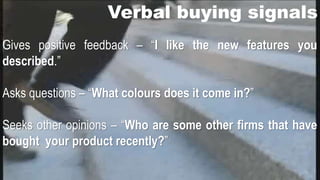
Verbal buying signals
Gives positive feedback – “I like the new features you
described.”
Asks questions – “What colours does it come in?”
Seeks other opinions – “Who are some other firms that have
bought your product recently?”
8-11
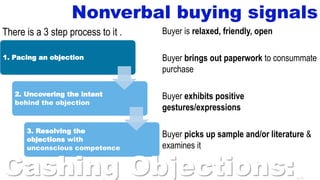
Nonverbal buying signals
Buyer is relaxed, friendly, open
Buyer brings out paperwork to consummate
purchase
Buyer exhibits positive
gestures/expressions
Buyer picks up sample and/or literature &
examines it
There is a 3 step process to it .
1. Pacing an objection
2. Uncovering the intent
behind the objection
3. Resolving the
objections with
unconscious competence
Cashing Objections:
13
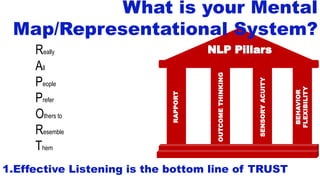
RAPPORT
OUTCOMETHINKING
SENSORYACUITY
BEHAVIOR
FLEXIBILITY
Really
All
People
Prefer
Others to
Resemble
Them
1.Effective Listening is the bottom line of TRUST
What is your Mental
Map/Representational System?
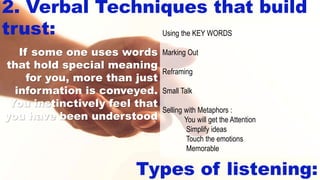
2. Verbal Techniques that build
trust:
Types of listening:
Using the KEY WORDS
Marking Out
Reframing
Small Talk
Selling with Metaphors :
You will get the Attention
Simplify ideas
Touch the emotions
Memorable
If some one uses words
that hold special meaning
for you, more than just
information is conveyed.
You instinctively feel that
you have been understood
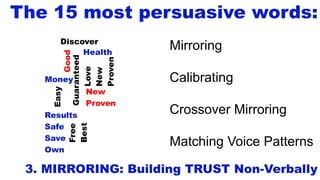
The 15 most persuasive words:
Mirroring
Calibrating
Crossover Mirroring
Matching Voice Patterns
Discover
3. MIRRORING: Building TRUST Non-Verbally
Good
Money
Easy
Health
Guaranteed
Love
New
Proven
New
Proven
Free
Best
Results
Safe
Save
Own
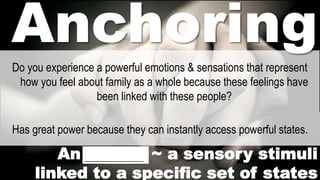
Do you experience a powerful emotions & sensations that represent
how you feel about family as a whole because these feelings have
been linked with these people?
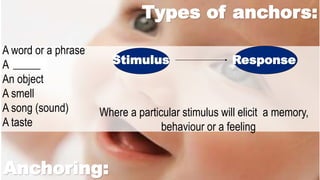
Anchoring
An anchor ~ a sensory stimuli
linked to a specific set of states
Has great power because they can instantly access powerful states.
________________
A word or a phrase
A touch
An object
A smell
A song (sound)
A taste
Types of anchors:
Stimulus Response
Where a particular stimulus will elicit a memory,
behaviour or a feeling
Anchoring:
_____
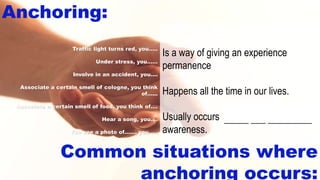
Anchoring:
Is a way of giving an experience
permanence
Happens all the time in our lives.
Usually occurs outside our conscious
awareness.
Traffic light turns red, you…..
Under stress, you……
Involve in an accident, you….
Associate a certain smell of cologne, you think
of…...
Associate a certain smell of food, you think of….
Hear a song, you….
You see a photo of……, you…..
Common situations where
anchoring occurs:
_____ ___ _________
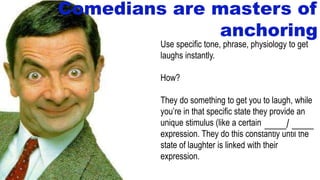
Comedians are masters of
anchoring
Use specific tone, phrase, physiology to get
laughs instantly.
How?
They do something to get you to laugh, while
you’re in that specific state they provide an
unique stimulus (like a certain smile/ facial
expression. They do this constantly until the
state of laughter is linked with their
expression.
____/ ____
Step 1:
Select an uncommon gesture you would like to use as your anchor (twiddle your thumb, pulling your ear, clasp your hand together, etc.).
Something you do not do often.
Step 2:
Close your eyes and try to picture a particular moment you have gone through (happy, relaxed, confident, etc.).
Recreate the scenario in your head
(it may take you a few minutes depending on how used you are to visualisation)
Step 3:
Are you totally associated with the moment? Enhance your anchors further.
Brighten that image, feel the wind, hear the sound, etc.….
Steps in anchoring
Step 4:
When your feelings are at its peak / you are at an intense state, anchor that emotion with an uncommon gesture (twiddle your thumb, pulling
your ear, clasp your hand together, etc.)
Step 5:
Repetition, again and again.
Successful anchoring depends on precise repetition.
Step 6:
Test it. Once you have calmed down, try to do the gesture you anchored a particular feeling with, and see if any feelings come forth.
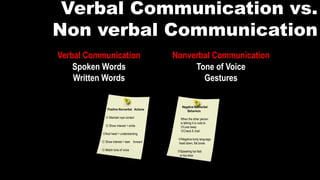
Verbal Communication vs.
Non verbal Communication
Positive Nonverbal Actions
 Maintain eye contact
 Show interest = smile
Nod head = understanding
 Show interest = lean forward
 Match tone of voice
Negative Nonverbal
Behaviors
When the other person
is talking it is rude to:
Look away
Check E-mail
Negative body language;
head down, flat tones
Speaking too fast
or too slow
Verbal Communication Nonverbal Communication
Spoken Words
Written Words
Tone of Voice
Gestures
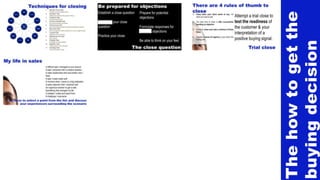
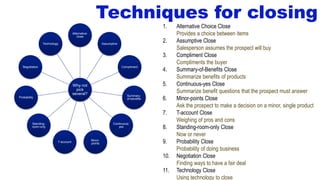
Techniques for closing
Why not
pick
several?
Alternative-
close
Assumptive
Compliment
Summary-
of-benefits
Continuous-
yes
Minor-
points
T-account
Standing-
room-only
Probability
Negotiation
Technology
1. Alternative Choice Close
Provides a choice between items
2. Assumptive Close
Salesperson assumes the prospect will buy
3. Compliment Close
Compliments the buyer
4. Summary-of-Benefits Close
Summarize benefits of products
5. Continuous-yes Close
Summarize benefit questions that the prospect must answer
6. Minor-points Close
Ask the prospect to make a decision on a minor, single product
7. T-account Close
Weighing of pros and cons
8. Standing-room-only Close
Now or never
9. Probability Close
Probability of doing business
10. Negotiation Close
Finding ways to have a fair deal
11. Technology Close
Using technology to close
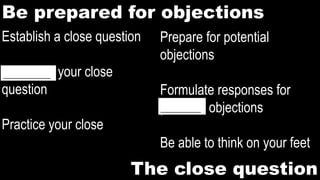
Be prepared for objections
Prepare for potential
objections
Formulate responses for
potential objections
Be able to think on your feet
The close question
Establish a close question
Memorize your close
question
Practice your close
___________
_____________
26
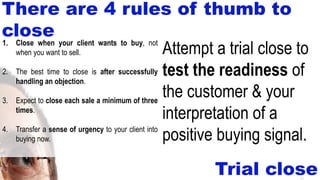
Trial close
Attempt a trial close to
test the readiness of
the customer & your
interpretation of a
positive buying signal.
1. Close when your client wants to buy, not
when you want to sell.
2. The best time to close is after successfully
handling an objection.
3. Expect to close each sale a minimum of three
times.
4. Transfer a sense of urgency to your client into
buying now.
There are 4 rules of thumb to
close
27
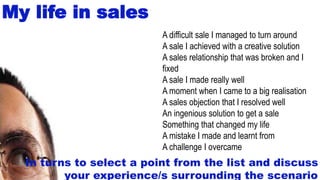
My life in sales
A difficult sale I managed to turn around
A sale I achieved with a creative solution
A sales relationship that was broken and I
fixed
A sale I made really well
A moment when I came to a big realisation
A sales objection that I resolved well
An ingenious solution to get a sale
Something that changed my life
A mistake I made and learnt from
A challenge I overcame
In turns to select a point from the list and discuss
your experience/s surrounding the scenario
29
14-30
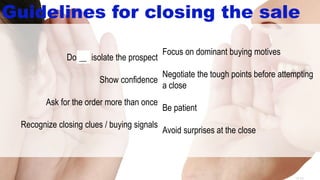
Guidelines for closing the sale
Focus on dominant buying motives
Negotiate the tough points before attempting
a close
Be patient
Avoid surprises at the close
Do not isolate the prospect
Show confidence
Ask for the order more than once
Recognize closing clues / buying signals
__
14-31
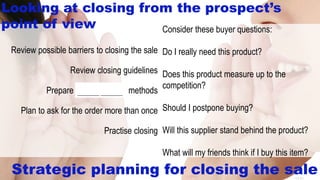
Consider these buyer questions:
Do I really need this product?
Does this product measure up to the
competition?
Should I postpone buying?
Will this supplier stand behind the product?
What will my friends think if I buy this item?
Review possible barriers to closing the sale
Review closing guidelines
Prepare several closing methods
Plan to ask for the order more than once
Practise closing
Strategic planning for closing the sale
Looking at closing from the prospect’s
point of view
________ ________
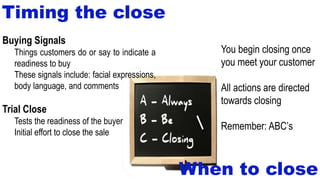
Timing the close
Buying Signals
Things customers do or say to indicate a
readiness to buy
These signals include: facial expressions,
body language, and comments
Trial Close
Tests the readiness of the buyer
Initial effort to close the sale
When to close
You begin closing once
you meet your customer
All actions are directed
towards closing
Remember: ABC’s
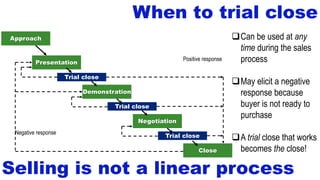
When to trial close
Close
Negotiation
Demonstration
Presentation
Approach
Trial close
Trial close
Trial close
Negative response
Positive response
Selling is not a linear process
Can be used at any
time during the sales
process
May elicit a negative
response because
buyer is not ready to
purchase
A trial close that works
becomes the close!
14-34
Methods to close the sale
Trial Close
– Series of trial close questions
– Trial close questions give you an
indication of interest
Which Close
– Encourages buyer to make a
decision between two items
A Trial Close is a closing attempt made at an opportune time during the sales
presentation to encourage the customer to reveal readiness or unwillingness to buy
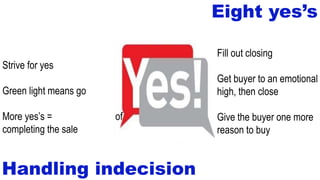
Eight yes’s
Handling indecision
Fill out closing documents
Get buyer to an emotional
high, then close
Give the buyer one more
reason to buy
Strive for yes
Green light means go
More yes’s = greater chance of
completing the sale
37
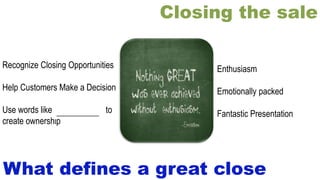
Closing the sale
Enthusiasm
Emotionally packed
Fantastic Presentation
What defines a great close
Recognize Closing Opportunities
Help Customers Make a Decision
Use words like “you and your” to
create ownership
__________
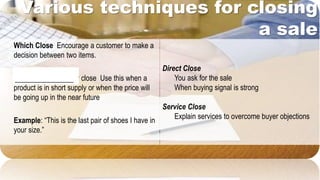
Various techniques for closing
a sale
Direct Close
You ask for the sale
When buying signal is strong
Service Close
Explain services to overcome buyer objections
Which Close Encourage a customer to make a
decision between two items.
Standing-Room-Only close Use this when a
product is in short supply or when the price will
be going up in the near future
Example: “This is the last pair of shoes I have in
your size.”
________________
8-40
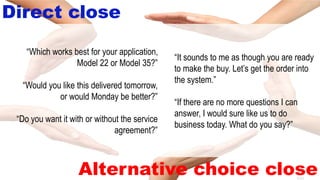
Direct close
Alternative choice close
“It sounds to me as though you are ready
to make the buy. Let’s get the order into
the system.”
“If there are no more questions I can
answer, I would sure like us to do
business today. What do you say?”
“Which works best for your application,
Model 22 or Model 35?”
“Would you like this delivered tomorrow,
or would Monday be better?”
“Do you want it with or without the service
agreement?”
8-41
Summary-of-benefits close
Reviews the benefits accepted, reminds buyer why
they are important, then asks for the order:
“Ms. Buyer, we’ve agreed that our
product will substantially upgrade
your technical capabilities, allow you
to attract new business, and all the
while save you money, isn’t that
right? Let’s go ahead and place the
order today. I will have my service
technician out to train your staff next
week.”
8-42
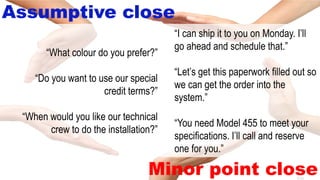
Assumptive close
Minor point close
“I can ship it to you on Monday. I’ll
go ahead and schedule that.”
“Let’s get this paperwork filled out so
we can get the order into the
system.”
“You need Model 455 to meet your
specifications. I’ll call and reserve
one for you.”
“What colour do you prefer?”
“Do you want to use our special
credit terms?”
“When would you like our technical
crew to do the installation?”
8-43
Balance sheet close
“Mr. Buyer, let’s take a few minutes
to list out and summarize the
reasons this purchase makes sense
for you, and also list any remaining
questions you may have. This will
help us make the right decision.”
2 column list: “Reasons for Buying”
and “Remaining Questions”
8-44
Buy-now close
“We have a price increase on this
product effective in two weeks. Orders
placed today can be guaranteed to ship
at the current price.”
“My company is running a special this
week. This product is currently 20
percent off the regular price.”
“I’m almost out of stock on this product
in our warehouse.”
Creates a sense of urgency with
the buyer (reason must be honest):
45
Greeting the customer
Analyzing customer's needs
Describing your product
Customer yawns at the middle of your presentation
Customer interrupts with a question
Customer claims that the price is too high
Concluding your sales call (without an order)
The world's worst
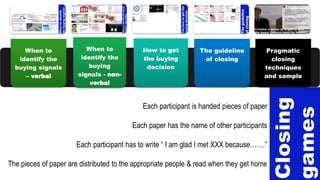
Each participant is handed pieces of paper
Each paper has the name of other participants
Each participant has to write “ I am glad I met XXX because…….”
The pieces of paper are distributed to the appropriate people & read when they get home
When to
identify the
buying signals
– verbal
When to
identify the
buying
signals - non-
verbal
How to get
the buying
decision
The guideline
of closing
Pragmatic
closing
techniques
and sample
14-47
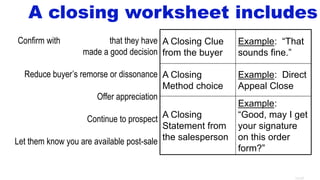
A closing worksheet includes
A Closing Clue
from the buyer
Example: “That
sounds fine.”
A Closing
Method choice
Example: Direct
Appeal Close
A Closing
Statement from
the salesperson
Example:
“Good, may I get
your signature
on this order
form?”
Confirm with reassurance that they have
made a good decision
Reduce buyer’s remorse or dissonance
Offer appreciation
Continue to prospect
Let them know you are available post-sale
14-48
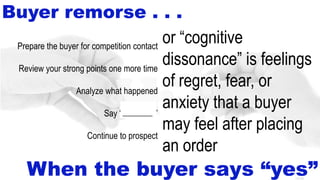
Buyer remorse . . .
or “cognitive
dissonance” is feelings
of regret, fear, or
anxiety that a buyer
may feel after placing
an order
Prepare the buyer for competition contact
Review your strong points one more time
Analyze what happened
Say “thank you”
Continue to prospect
When the buyer says “yes”
_______
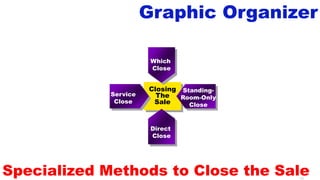
Closing
The
Sale
49
Graphic Organizer
Specialized Methods to Close the Sale
Service
Close
Standing-
Room-Only
Close
Which
Close
Direct
Close
8-50
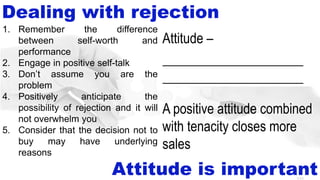
Dealing with rejection
Attitude is important
1. Remember the difference
between self-worth and
performance
2. Engage in positive self-talk
3. Don’t assume you are the
problem
4. Positively anticipate the
possibility of rejection and it will
not overwhelm you
5. Consider that the decision not to
buy may have underlying
reasons
Attitude –
state of mind or feeling with
regard to a person or thing
A positive attitude combined
with tenacity closes more
sales
_____________________
_____________________
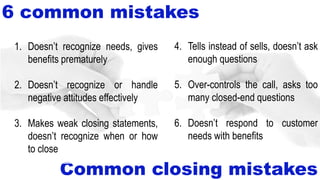
6 common mistakes
Common closing mistakes
4. Tells instead of sells, doesn’t ask
enough questions
5. Over-controls the call, asks too
many closed-end questions
6. Doesn’t respond to customer
needs with benefits
1. Doesn’t recognize needs, gives
benefits prematurely
2. Doesn’t recognize or handle
negative attitudes effectively
3. Makes weak closing statements,
doesn’t recognize when or how
to close
52
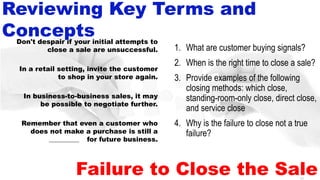
Failure to Close the Sale
1. What are customer buying signals?
2. When is the right time to close a sale?
3. Provide examples of the following
closing methods: which close,
standing-room-only close, direct close,
and service close
4. Why is the failure to close not a true
failure?
Don't despair if your initial attempts to
close a sale are unsuccessful.
In a retail setting, invite the customer
to shop in your store again.
In business-to-business sales, it may
be possible to negotiate further.
Remember that even a customer who
does not make a purchase is still a
prospect for future business.
Reviewing Key Terms and
Concepts
__________
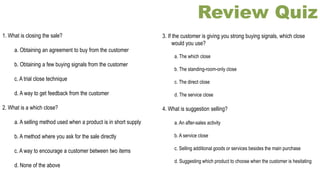
Review Quiz
1. What is closing the sale?
a. Obtaining an agreement to buy from the customer
b. Obtaining a few buying signals from the customer
c. A trial close technique
d. A way to get feedback from the customer
2. What is a which close?
a. A selling method used when a product is in short supply
b. A method where you ask for the sale directly
c. A way to encourage a customer between two items
d. None of the above
3. If the customer is giving you strong buying signals, which close
would you use?
a. The which close
b. The standing-room-only close
c. The direct close
d. The service close
4. What is suggestion selling?
a. An after-sales activity
b. A service close
c. Selling additional goods or services besides the main purchase
d. Suggesting which product to choose when the customer is hesitating
Review Quiz
5. CRM is
a. Maintaining relationships with customers
b. Offering related merchandise
c. Giving customers reviews of the product
d. Demonstrating the product
3 things you have learnt today
2 things you are not sure about
1 way you can link what you have done today to your work place
55
Wrap up
Write Down
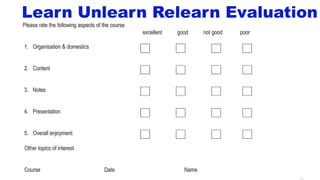
Learn Unlearn Relearn Evaluation
56
Please rate the following aspects of the course
excellent good not good poor
1. Organisation & domestics
2. Content
3. Notes
4. Presentation
5. Overall enjoyment
Other topics of interest
Course Date Name

S&m module 3 2nd day 3 jan-15

  • 1.
    SALES EXCELLENCE 29-Jan-16 When to identifythe buying signals – verbal When to identify the buying signals - non- verbal How to get the buying decision The guideline of closing Pragmatic closing techniques and sample ghazali.mdnoor@gmail.com Closing Skills and Technique
  • 2.
    Turning Objection intosales. In this module 3 where facilitator and trainer will share and teach the salespeople on how to turn objection into sales. What is an objection? Salespeople are most concerned about objections in the early part of the sale when they are trying to initiate the relationship and toward the end of the sales process when it comes time to close the sale. Closing Sales Without closing the deal no money from the bank or client to PKNP. 9.00 to 9.30 Intro and Review back the on the first day Module 3 (KNI) 9.30 to 10.00 When to identify the Buying Signals – Verbal ( GMN) {30mins} 10.00 to 10.15 Coffee Break 10.15 to 10.45 Video , Role Play and Brain storming on When to identify the Buying Signals (Verbal) KNI {30mins} 10.45. to 11.15 When to identify the Buying Signals Non-Verbal (GMN {30mins} 11.15 to 11.45 Video, Role Play and Brain storming when to identify the Buying Signals Non-Verbal KNI {30mins} 11.45 to 12.30 How to get the buying Decision ( GMN ) {45 mins} 12.30 to 1.00 Role Play and Brain storming on How to get the buying Decision (KNI) {30mins} 1.00 to 2.15 Lunch and Zohor Prayer 2.15 to 3.00 The guideline of Closing (GMN) {45mins} 3.00 to 3.15 Coffee Break 3.15 to 3.45 Role Play and Brain storming on The guideline of Closing ( KN) {30mins} 3.45 to 4.15 Pragmatic Closing Techniques and sample (GMN ) {30Mins} 4.00 to 4.30 Role Play and Brain Storming on Pragmatic Closing Techniques (KNI) {30Mins} 4.30 to 5.00 15 Pragmatic Closing Techniques and sample and Rap up by KNI {30 mins} 5.00 to 5.30 Certificate of Attendance Presentations and Photographic Session At the end of this course students will be able to
  • 3.
    Icebreaker 15 minutes End Individual Exercise(15 mins) There are 4 flipcharts around the room 1. What are you leaving behind to be here today? 2. What do you want to take away from today? 3. What are you offering to the group today? 4. How would we like to work together today? Visit each in turn & add your comments
  • 4.
    Ground rule games Listento others Don’t put other people down Respect Confidentiality & Trust Show Respect Don’t Interrupt others Try to accept others views Classroom Procedures and General Information The Bathrooms are where The Break Refreshments include: The Room for Lunch is where Lunch menu A vegetarian option is offered Cell phones on off Please don’t email or text during course
  • 6.
    8-6 All your effortsup to this step of the sale have involved helping your customer make buying decisions Define the phrase closing the sale (i.e., the point at which the customer makes the decision to purchase the good or service) Demonstrate the methods to close a sale Identify the most common methods of closing the sale 1) Lack of confidence 2) Feels product is unnecessary 3) Poor presentation Difficulties With Closing: Close the sale when your customer is ready to buy. Some customers are ready to buy sooner than others, therefore you must be flexible.
  • 7.
    Buying signals When &why to close: Here are few specific non-verbal buying signals. The slow head nod Extensive pupil dilation Gestures that show interest Buyer possessiveness Look for buying signals, the things a customer does that indicate a readiness to buy, such as facial expressions, actions, and comments. Example: A customer is holding merchandise and smiling, or making comments that imply ownership.
  • 8.
    8 Customer buying signals KeyTerms Sometimes the decision to buy is quick and easy. At other times, it's more difficult. In this section, you will learn how to recognize customer buying signals and how to close a sale. closingthesale buying signals trial close whichclose direct close STANDING-ROOM-ONLY CLOSE service close Why It's Important
  • 9.
    14-9 Recognizing closing clues Non-VerbalClues –Facial –Body Language –Examination Verbal Clues –Questions –Recognitions –Requirements A closing clue is an indication, either verbal or non-verbal, that a prospect is preparing to make a buying decision.
  • 10.
    Verbal buying signals Givespositive feedback – “I like the new features you described.” Asks questions – “What colours does it come in?” Seeks other opinions – “Who are some other firms that have bought your product recently?”
  • 11.
    8-11 Nonverbal buying signals Buyeris relaxed, friendly, open Buyer brings out paperwork to consummate purchase Buyer exhibits positive gestures/expressions Buyer picks up sample and/or literature & examines it There is a 3 step process to it . 1. Pacing an objection 2. Uncovering the intent behind the objection 3. Resolving the objections with unconscious competence Cashing Objections:
  • 12.
  • 13.
  • 14.
    2. Verbal Techniquesthat build trust: Types of listening: Using the KEY WORDS Marking Out Reframing Small Talk Selling with Metaphors : You will get the Attention Simplify ideas Touch the emotions Memorable If some one uses words that hold special meaning for you, more than just information is conveyed. You instinctively feel that you have been understood
  • 15.
    The 15 mostpersuasive words: Mirroring Calibrating Crossover Mirroring Matching Voice Patterns Discover 3. MIRRORING: Building TRUST Non-Verbally Good Money Easy Health Guaranteed Love New Proven New Proven Free Best Results Safe Save Own
  • 16.
    Do you experiencea powerful emotions & sensations that represent how you feel about family as a whole because these feelings have been linked with these people? Anchoring An anchor ~ a sensory stimuli linked to a specific set of states Has great power because they can instantly access powerful states. ________________
  • 17.
    A word ora phrase A touch An object A smell A song (sound) A taste Types of anchors: Stimulus Response Where a particular stimulus will elicit a memory, behaviour or a feeling Anchoring: _____
  • 18.
    Anchoring: Is a wayof giving an experience permanence Happens all the time in our lives. Usually occurs outside our conscious awareness. Traffic light turns red, you….. Under stress, you…… Involve in an accident, you…. Associate a certain smell of cologne, you think of…... Associate a certain smell of food, you think of…. Hear a song, you…. You see a photo of……, you….. Common situations where anchoring occurs: _____ ___ _________
  • 19.
    Comedians are mastersof anchoring Use specific tone, phrase, physiology to get laughs instantly. How? They do something to get you to laugh, while you’re in that specific state they provide an unique stimulus (like a certain smile/ facial expression. They do this constantly until the state of laughter is linked with their expression. ____/ ____
  • 20.
    Step 1: Select anuncommon gesture you would like to use as your anchor (twiddle your thumb, pulling your ear, clasp your hand together, etc.). Something you do not do often. Step 2: Close your eyes and try to picture a particular moment you have gone through (happy, relaxed, confident, etc.). Recreate the scenario in your head (it may take you a few minutes depending on how used you are to visualisation) Step 3: Are you totally associated with the moment? Enhance your anchors further. Brighten that image, feel the wind, hear the sound, etc.…. Steps in anchoring Step 4: When your feelings are at its peak / you are at an intense state, anchor that emotion with an uncommon gesture (twiddle your thumb, pulling your ear, clasp your hand together, etc.) Step 5: Repetition, again and again. Successful anchoring depends on precise repetition. Step 6: Test it. Once you have calmed down, try to do the gesture you anchored a particular feeling with, and see if any feelings come forth.
  • 21.
    Verbal Communication vs. Nonverbal Communication Positive Nonverbal Actions  Maintain eye contact  Show interest = smile Nod head = understanding  Show interest = lean forward  Match tone of voice Negative Nonverbal Behaviors When the other person is talking it is rude to: Look away Check E-mail Negative body language; head down, flat tones Speaking too fast or too slow Verbal Communication Nonverbal Communication Spoken Words Written Words Tone of Voice Gestures
  • 23.
    Techniques for closing Whynot pick several? Alternative- close Assumptive Compliment Summary- of-benefits Continuous- yes Minor- points T-account Standing- room-only Probability Negotiation Technology 1. Alternative Choice Close Provides a choice between items 2. Assumptive Close Salesperson assumes the prospect will buy 3. Compliment Close Compliments the buyer 4. Summary-of-Benefits Close Summarize benefits of products 5. Continuous-yes Close Summarize benefit questions that the prospect must answer 6. Minor-points Close Ask the prospect to make a decision on a minor, single product 7. T-account Close Weighing of pros and cons 8. Standing-room-only Close Now or never 9. Probability Close Probability of doing business 10. Negotiation Close Finding ways to have a fair deal 11. Technology Close Using technology to close
  • 24.
    Be prepared forobjections Prepare for potential objections Formulate responses for potential objections Be able to think on your feet The close question Establish a close question Memorize your close question Practice your close ___________ _____________
  • 25.
    26 Trial close Attempt atrial close to test the readiness of the customer & your interpretation of a positive buying signal. 1. Close when your client wants to buy, not when you want to sell. 2. The best time to close is after successfully handling an objection. 3. Expect to close each sale a minimum of three times. 4. Transfer a sense of urgency to your client into buying now. There are 4 rules of thumb to close
  • 26.
    27 My life insales A difficult sale I managed to turn around A sale I achieved with a creative solution A sales relationship that was broken and I fixed A sale I made really well A moment when I came to a big realisation A sales objection that I resolved well An ingenious solution to get a sale Something that changed my life A mistake I made and learnt from A challenge I overcame In turns to select a point from the list and discuss your experience/s surrounding the scenario
  • 27.
  • 28.
    14-30 Guidelines for closingthe sale Focus on dominant buying motives Negotiate the tough points before attempting a close Be patient Avoid surprises at the close Do not isolate the prospect Show confidence Ask for the order more than once Recognize closing clues / buying signals __
  • 29.
    14-31 Consider these buyerquestions: Do I really need this product? Does this product measure up to the competition? Should I postpone buying? Will this supplier stand behind the product? What will my friends think if I buy this item? Review possible barriers to closing the sale Review closing guidelines Prepare several closing methods Plan to ask for the order more than once Practise closing Strategic planning for closing the sale Looking at closing from the prospect’s point of view ________ ________
  • 30.
    Timing the close BuyingSignals Things customers do or say to indicate a readiness to buy These signals include: facial expressions, body language, and comments Trial Close Tests the readiness of the buyer Initial effort to close the sale When to close You begin closing once you meet your customer All actions are directed towards closing Remember: ABC’s
  • 31.
    When to trialclose Close Negotiation Demonstration Presentation Approach Trial close Trial close Trial close Negative response Positive response Selling is not a linear process Can be used at any time during the sales process May elicit a negative response because buyer is not ready to purchase A trial close that works becomes the close!
  • 32.
    14-34 Methods to closethe sale Trial Close – Series of trial close questions – Trial close questions give you an indication of interest Which Close – Encourages buyer to make a decision between two items A Trial Close is a closing attempt made at an opportune time during the sales presentation to encourage the customer to reveal readiness or unwillingness to buy
  • 33.
    Eight yes’s Handling indecision Fillout closing documents Get buyer to an emotional high, then close Give the buyer one more reason to buy Strive for yes Green light means go More yes’s = greater chance of completing the sale
  • 34.
  • 35.
    Closing the sale Enthusiasm Emotionallypacked Fantastic Presentation What defines a great close Recognize Closing Opportunities Help Customers Make a Decision Use words like “you and your” to create ownership __________
  • 36.
    Various techniques forclosing a sale Direct Close You ask for the sale When buying signal is strong Service Close Explain services to overcome buyer objections Which Close Encourage a customer to make a decision between two items. Standing-Room-Only close Use this when a product is in short supply or when the price will be going up in the near future Example: “This is the last pair of shoes I have in your size.” ________________
  • 37.
    8-40 Direct close Alternative choiceclose “It sounds to me as though you are ready to make the buy. Let’s get the order into the system.” “If there are no more questions I can answer, I would sure like us to do business today. What do you say?” “Which works best for your application, Model 22 or Model 35?” “Would you like this delivered tomorrow, or would Monday be better?” “Do you want it with or without the service agreement?”
  • 38.
    8-41 Summary-of-benefits close Reviews thebenefits accepted, reminds buyer why they are important, then asks for the order: “Ms. Buyer, we’ve agreed that our product will substantially upgrade your technical capabilities, allow you to attract new business, and all the while save you money, isn’t that right? Let’s go ahead and place the order today. I will have my service technician out to train your staff next week.”
  • 39.
    8-42 Assumptive close Minor pointclose “I can ship it to you on Monday. I’ll go ahead and schedule that.” “Let’s get this paperwork filled out so we can get the order into the system.” “You need Model 455 to meet your specifications. I’ll call and reserve one for you.” “What colour do you prefer?” “Do you want to use our special credit terms?” “When would you like our technical crew to do the installation?”
  • 40.
    8-43 Balance sheet close “Mr.Buyer, let’s take a few minutes to list out and summarize the reasons this purchase makes sense for you, and also list any remaining questions you may have. This will help us make the right decision.” 2 column list: “Reasons for Buying” and “Remaining Questions”
  • 41.
    8-44 Buy-now close “We havea price increase on this product effective in two weeks. Orders placed today can be guaranteed to ship at the current price.” “My company is running a special this week. This product is currently 20 percent off the regular price.” “I’m almost out of stock on this product in our warehouse.” Creates a sense of urgency with the buyer (reason must be honest):
  • 42.
    45 Greeting the customer Analyzingcustomer's needs Describing your product Customer yawns at the middle of your presentation Customer interrupts with a question Customer claims that the price is too high Concluding your sales call (without an order) The world's worst
  • 43.
    Each participant ishanded pieces of paper Each paper has the name of other participants Each participant has to write “ I am glad I met XXX because…….” The pieces of paper are distributed to the appropriate people & read when they get home When to identify the buying signals – verbal When to identify the buying signals - non- verbal How to get the buying decision The guideline of closing Pragmatic closing techniques and sample
  • 44.
    14-47 A closing worksheetincludes A Closing Clue from the buyer Example: “That sounds fine.” A Closing Method choice Example: Direct Appeal Close A Closing Statement from the salesperson Example: “Good, may I get your signature on this order form?” Confirm with reassurance that they have made a good decision Reduce buyer’s remorse or dissonance Offer appreciation Continue to prospect Let them know you are available post-sale
  • 45.
    14-48 Buyer remorse .. . or “cognitive dissonance” is feelings of regret, fear, or anxiety that a buyer may feel after placing an order Prepare the buyer for competition contact Review your strong points one more time Analyze what happened Say “thank you” Continue to prospect When the buyer says “yes” _______
  • 46.
    Closing The Sale 49 Graphic Organizer Specialized Methodsto Close the Sale Service Close Standing- Room-Only Close Which Close Direct Close
  • 47.
    8-50 Dealing with rejection Attitudeis important 1. Remember the difference between self-worth and performance 2. Engage in positive self-talk 3. Don’t assume you are the problem 4. Positively anticipate the possibility of rejection and it will not overwhelm you 5. Consider that the decision not to buy may have underlying reasons Attitude – state of mind or feeling with regard to a person or thing A positive attitude combined with tenacity closes more sales _____________________ _____________________
  • 48.
    6 common mistakes Commonclosing mistakes 4. Tells instead of sells, doesn’t ask enough questions 5. Over-controls the call, asks too many closed-end questions 6. Doesn’t respond to customer needs with benefits 1. Doesn’t recognize needs, gives benefits prematurely 2. Doesn’t recognize or handle negative attitudes effectively 3. Makes weak closing statements, doesn’t recognize when or how to close
  • 49.
    52 Failure to Closethe Sale 1. What are customer buying signals? 2. When is the right time to close a sale? 3. Provide examples of the following closing methods: which close, standing-room-only close, direct close, and service close 4. Why is the failure to close not a true failure? Don't despair if your initial attempts to close a sale are unsuccessful. In a retail setting, invite the customer to shop in your store again. In business-to-business sales, it may be possible to negotiate further. Remember that even a customer who does not make a purchase is still a prospect for future business. Reviewing Key Terms and Concepts __________
  • 50.
    Review Quiz 1. Whatis closing the sale? a. Obtaining an agreement to buy from the customer b. Obtaining a few buying signals from the customer c. A trial close technique d. A way to get feedback from the customer 2. What is a which close? a. A selling method used when a product is in short supply b. A method where you ask for the sale directly c. A way to encourage a customer between two items d. None of the above 3. If the customer is giving you strong buying signals, which close would you use? a. The which close b. The standing-room-only close c. The direct close d. The service close 4. What is suggestion selling? a. An after-sales activity b. A service close c. Selling additional goods or services besides the main purchase d. Suggesting which product to choose when the customer is hesitating
  • 51.
    Review Quiz 5. CRMis a. Maintaining relationships with customers b. Offering related merchandise c. Giving customers reviews of the product d. Demonstrating the product
  • 52.
    3 things youhave learnt today 2 things you are not sure about 1 way you can link what you have done today to your work place 55 Wrap up Write Down
  • 53.
    Learn Unlearn RelearnEvaluation 56 Please rate the following aspects of the course excellent good not good poor 1. Organisation & domestics 2. Content 3. Notes 4. Presentation 5. Overall enjoyment Other topics of interest Course Date Name