Agenda for communications Today – revise non-verbal communication Go over assignment Presentation Skills Verbal Communication Skills: part 1 Next session: 20 th  August
You can make you $1000’s of dollars  Anyone can become a great presenter.
Great presentations Why Prepare What is the end result you want to achieve Effective Openings Main Body Conclusions – and thank you’s Questions and Answers Where to stand How to use visual aids Body Language Verbal skills Be prepared
Preparing your presentation What do I want to achieve Who will I be talking to What do they need to know How long will I be speaking for Where will presentation take place What support material/equipment do I need? What is my presentation plan Content Sequence Timing Balance Focus
Creating the Presentation List all the points you could put across in the presentation – scattergram What are the benefits to my listeners? Reduce list to 4 or 5 “must know” statements and prioritise these into a natural flow Reduce each statement to a few key words Build a mini speech on each “must know” statement explain it - re-inforce it - sell it What points need visuals, what need handouts The presenters maxim : tell them what you are going to tell them, tell them, tell them what you just told them
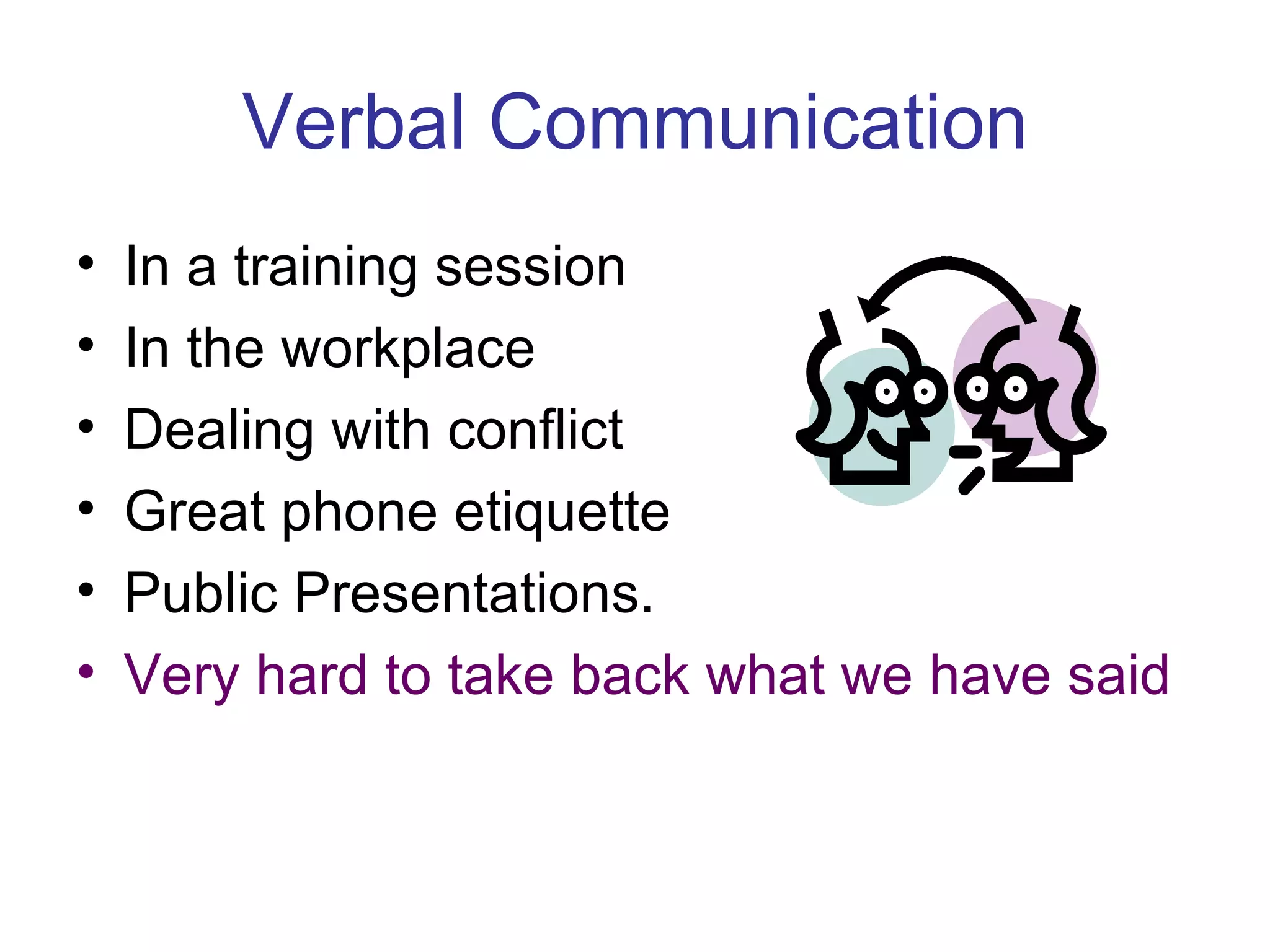
Verbal Communication In a training session In the workplace Dealing with conflict Great phone etiquette Public Presentations. Very hard to take back what we have said
Ingredients to making a presentation build your business. What are your barriers to delivering a great presentation?
YOU CAN DO IT You can learn presentation skills You can develop your own unique style What you have to say is important The information you have is of benefit to your audience You have the competence and you can communicate it
Verbal Skills in Consultations & Training Sessions Aim – to make people feel comfortable and have confidence in you.  Meet and greet Explanations Instructions Questions Clarifications Suggestions Reflections
In the workplace Using people’s names Appropriateness of location Appropriateness of topic Humour Being positive
Dealing with Conflict Listen  Ask open ended questions Be Fair Be politely assertive -  acknowledge what is being said state your own point of view clearly state what you want to happen next (move it forward)  Avoid anger Avoid sarcasm Avoid insinuations Conclusions – solution orientated
Insinuations " I don't want to name names but it's pretty obvious that someone around here isn't interested in anything but his own job. “ Ambiguous, vague, generally negative.  It avoids addressing issues straight up and directly, and therein lies its destructiveness. The use of insinuation pushes solutions much farther away because it disguises the issue, and creates additional mistrust. Understand why other people use it Avoid using it yourself
Conversation “Cons” linguistic tactics, that tend to obscure, or hide the issue under discussion, or create in the other person one ore more of the following: confusion  embarrassment  intimidation  anxiety  other strong negative emotions.
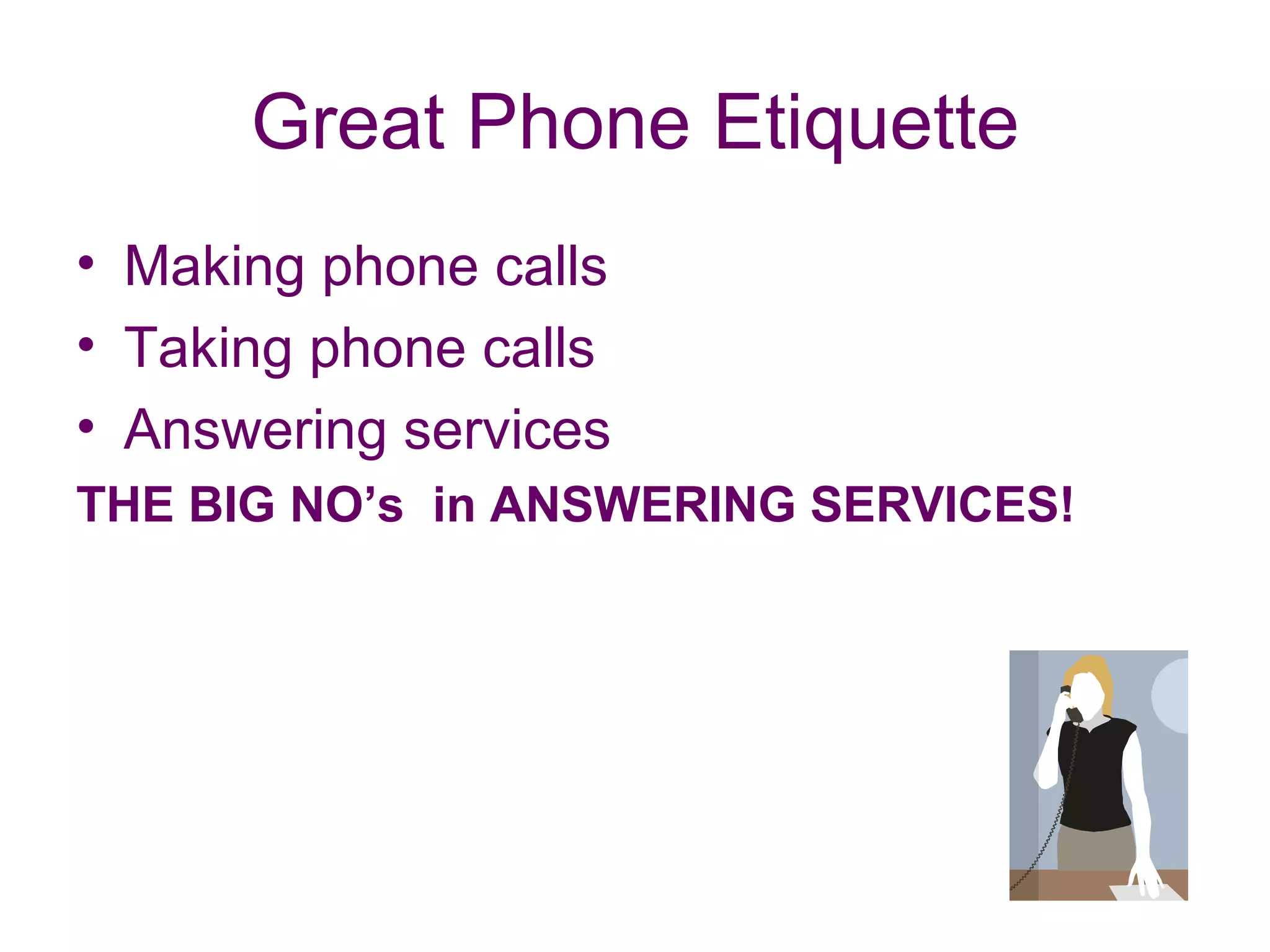
Great Phone Etiquette Making phone calls Taking phone calls Answering services  THE BIG NO’s  in ANSWERING SERVICES!
Getting it right Sound upbeat but not over the top. Try standing up and smiling as you record it. Go somewhere quiet to make your recording.  Aim to keep your recording to under 10 seconds. Do not include superfluous information.  Do include your full name - clearly, i.e. “Jo Bloggs your business, i.e. “personal trainer”. Acceptable add on’s to your message include  today’s date, your email address, the information you would like the caller to leave, when you intend to get back to the caller
Other hot tips Steer clear of pre-recorded messages, music, jokes affirmations, religious beliefs, and stories.  They may not suit the mood of your caller. Listen to your recording and get others to listen to it and give you feedback on how to improve it. Record a different message if you go away on holiday/business and remember to say when you are due back. If necessary set up a diversion number and/or slowly state, maybe twice, another number, of someone who can be contacted in your absence. try answering your phone on all possible occasions.  If you just need a few seconds delay before talking, to pull over, or excuse yourself from a meeting, then see if you have a ‘meeting mode’ option under the ‘settings’ option in the menu. With this activated the caller will be placed on hold simply by you pressing  ‘talk’ or ‘answer’ on your mobile.  The caller will then hear a message similar to  “please wait and your call will be answered in a moment”. By pressing talk again the call will be connected to you.  It’s great when you need a delay of up to 30 seconds, but much longer and your caller is likely to hang up. Listen to other answering services.  Note what annoys you and what you like.
Examples of a good answering messages a) Hi, this is Jo Bloggs, Personal trainer.  Please leave a message and I will get back to you as soon as possible. b) Hi it’s Monday 19th Feb and you’ve reached Jo Bloggs, Personal Trainer.  Please leave your contact details and a short message and I will get back to you in the next 24hrs.  Alternatively please email me at  jobloggs@ reps.org.
Tips on leaving  messages your name, slowly your phone number.  Say it at very the start of the message ( this makes going back to listen to it again a lot easier )  a short explanation of why you’re calling, thereby giving the caller a chance to prepare for their conversation with you.
10 strategies 4 effective cross cultural communication Ask Questions Distinguish Perspectives Build self awareness Recognise the complexity Avoid stereotyping Respect Differences Listen Actively Be honest Be flexible Think Twice

Verbal Communication Lecture

  • 1.
    Agenda for communicationsToday – revise non-verbal communication Go over assignment Presentation Skills Verbal Communication Skills: part 1 Next session: 20 th August
  • 2.
    You can makeyou $1000’s of dollars Anyone can become a great presenter.
  • 3.
    Great presentations WhyPrepare What is the end result you want to achieve Effective Openings Main Body Conclusions – and thank you’s Questions and Answers Where to stand How to use visual aids Body Language Verbal skills Be prepared
  • 4.
    Preparing your presentationWhat do I want to achieve Who will I be talking to What do they need to know How long will I be speaking for Where will presentation take place What support material/equipment do I need? What is my presentation plan Content Sequence Timing Balance Focus
  • 5.
    Creating the PresentationList all the points you could put across in the presentation – scattergram What are the benefits to my listeners? Reduce list to 4 or 5 “must know” statements and prioritise these into a natural flow Reduce each statement to a few key words Build a mini speech on each “must know” statement explain it - re-inforce it - sell it What points need visuals, what need handouts The presenters maxim : tell them what you are going to tell them, tell them, tell them what you just told them
  • 6.
    Verbal Communication Ina training session In the workplace Dealing with conflict Great phone etiquette Public Presentations. Very hard to take back what we have said
  • 7.
    Ingredients to makinga presentation build your business. What are your barriers to delivering a great presentation?
  • 8.
    YOU CAN DOIT You can learn presentation skills You can develop your own unique style What you have to say is important The information you have is of benefit to your audience You have the competence and you can communicate it
  • 9.
    Verbal Skills inConsultations & Training Sessions Aim – to make people feel comfortable and have confidence in you. Meet and greet Explanations Instructions Questions Clarifications Suggestions Reflections
  • 10.
    In the workplaceUsing people’s names Appropriateness of location Appropriateness of topic Humour Being positive
  • 11.
    Dealing with ConflictListen Ask open ended questions Be Fair Be politely assertive - acknowledge what is being said state your own point of view clearly state what you want to happen next (move it forward) Avoid anger Avoid sarcasm Avoid insinuations Conclusions – solution orientated
  • 12.
    Insinuations " Idon't want to name names but it's pretty obvious that someone around here isn't interested in anything but his own job. “ Ambiguous, vague, generally negative. It avoids addressing issues straight up and directly, and therein lies its destructiveness. The use of insinuation pushes solutions much farther away because it disguises the issue, and creates additional mistrust. Understand why other people use it Avoid using it yourself
  • 13.
    Conversation “Cons” linguistictactics, that tend to obscure, or hide the issue under discussion, or create in the other person one ore more of the following: confusion embarrassment intimidation anxiety other strong negative emotions.
  • 14.
    Great Phone EtiquetteMaking phone calls Taking phone calls Answering services THE BIG NO’s in ANSWERING SERVICES!
  • 15.
    Getting it rightSound upbeat but not over the top. Try standing up and smiling as you record it. Go somewhere quiet to make your recording. Aim to keep your recording to under 10 seconds. Do not include superfluous information. Do include your full name - clearly, i.e. “Jo Bloggs your business, i.e. “personal trainer”. Acceptable add on’s to your message include today’s date, your email address, the information you would like the caller to leave, when you intend to get back to the caller
  • 16.
    Other hot tipsSteer clear of pre-recorded messages, music, jokes affirmations, religious beliefs, and stories. They may not suit the mood of your caller. Listen to your recording and get others to listen to it and give you feedback on how to improve it. Record a different message if you go away on holiday/business and remember to say when you are due back. If necessary set up a diversion number and/or slowly state, maybe twice, another number, of someone who can be contacted in your absence. try answering your phone on all possible occasions. If you just need a few seconds delay before talking, to pull over, or excuse yourself from a meeting, then see if you have a ‘meeting mode’ option under the ‘settings’ option in the menu. With this activated the caller will be placed on hold simply by you pressing ‘talk’ or ‘answer’ on your mobile. The caller will then hear a message similar to “please wait and your call will be answered in a moment”. By pressing talk again the call will be connected to you. It’s great when you need a delay of up to 30 seconds, but much longer and your caller is likely to hang up. Listen to other answering services. Note what annoys you and what you like.
  • 17.
    Examples of agood answering messages a) Hi, this is Jo Bloggs, Personal trainer. Please leave a message and I will get back to you as soon as possible. b) Hi it’s Monday 19th Feb and you’ve reached Jo Bloggs, Personal Trainer. Please leave your contact details and a short message and I will get back to you in the next 24hrs. Alternatively please email me at jobloggs@ reps.org.
  • 18.
    Tips on leaving messages your name, slowly your phone number. Say it at very the start of the message ( this makes going back to listen to it again a lot easier ) a short explanation of why you’re calling, thereby giving the caller a chance to prepare for their conversation with you.
  • 19.
    10 strategies 4effective cross cultural communication Ask Questions Distinguish Perspectives Build self awareness Recognise the complexity Avoid stereotyping Respect Differences Listen Actively Be honest Be flexible Think Twice