
RESEARCH METHODS FOR MANAGERS

                  Presentation by
                      Afsal Mohammed
                         Sabari Nath J
ORAL PRESENTATION
         &
HANDLING QUESTIONS
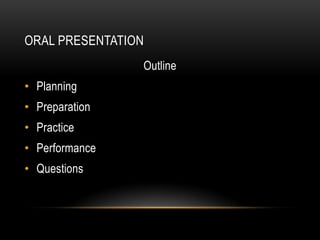
ORAL PRESENTATION
                Outline
• Planning
• Preparation
• Practice
• Performance
• Questions
PLANNING
• Who are you talking to?
• Why are you talking to them?
• How long have you got?
• What topic are you going to tell?
PREPARATION
• Outline and sketch slides
• Prepare slides
• Proof read
• Prepare notes
PRACTICE
• Practice, practice, practice
• Get feedback, and use it.
• Be ruthless - delete unnecessary information
PERFORMANCE
• Speak loudly & clearly
• Use short simple sentences
• Avoid jargon & abbrev.
• Vary pitch, tone, volume, speed and pauses
• Avoid distracting mannerisms
• Relax, be enthusiastic
CONTD..
• Make eye contact
• Keep an eye on the time remaining
• Explain figures, and
• point to important aspects
• Give a clear and concise summary, then stop.
• Don’t go overtime..Ever.
STRUCTURE OF A TEN-MINUTE TALK
• Background (1-2 slides)
• Aim of the study (1 slide – essential!)
• Brief methods (1 slide)
• Results (4-8 slides)
• Summary (1 slide)
• Conclusions (1 slide)
   • Make it sexy!
NEED FOR ORAL PRESENTATION
• It is a useful supplement to written research reports.
• They give listeners the opportunity to raise questions.
• Clarify ambiguous issues or points.
• The researcher must be well prepared to defend the
  results of hisher written report.
CONTD..
• The researcher should try to maintain good
  communication with the listeners.
• Avoid technical jargons.
• Maintain Eye contact with all listeners.
• Multimedia aids is another option.
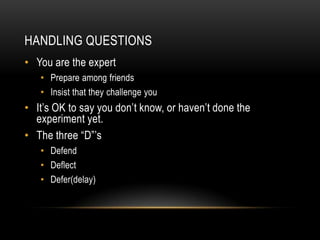
HANDLING QUESTIONS
• You are the expert
   • Prepare among friends
   • Insist that they challenge you
• It’s OK to say you don’t know, or haven’t done the
  experiment yet.
• The three “D”’s
   • Defend
   • Deflect
   • Defer(delay)
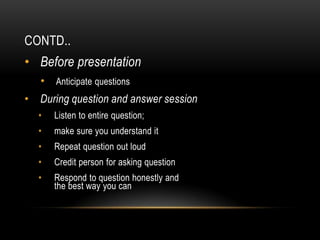
CONTD..
• Before presentation
    • Anticipate questions
•   During question and answer session
    •   Listen to entire question;
    •   make sure you understand it
    •   Repeat question out loud
    •   Credit person for asking question
    •   Respond to question honestly and
        the best way you can
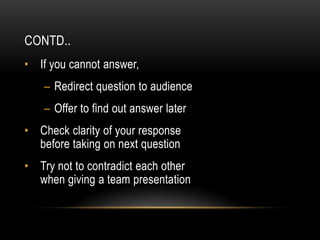
CONTD..
• If you cannot answer,
    – Redirect question to audience
    – Offer to find out answer later
• Check clarity of your response
  before taking on next question
• Try not to contradict each other
  when giving a team presentation
Oral Presentation and Handling Questions

Oral Presentation and Handling Questions

  • 1.
    RESEARCH METHODS FORMANAGERS Presentation by Afsal Mohammed Sabari Nath J
  • 2.
    ORAL PRESENTATION & HANDLING QUESTIONS
  • 3.
    ORAL PRESENTATION Outline • Planning • Preparation • Practice • Performance • Questions
  • 4.
    PLANNING • Who areyou talking to? • Why are you talking to them? • How long have you got? • What topic are you going to tell?
  • 5.
    PREPARATION • Outline andsketch slides • Prepare slides • Proof read • Prepare notes
  • 6.
    PRACTICE • Practice, practice,practice • Get feedback, and use it. • Be ruthless - delete unnecessary information
  • 7.
    PERFORMANCE • Speak loudly& clearly • Use short simple sentences • Avoid jargon & abbrev. • Vary pitch, tone, volume, speed and pauses • Avoid distracting mannerisms • Relax, be enthusiastic
  • 8.
    CONTD.. • Make eyecontact • Keep an eye on the time remaining • Explain figures, and • point to important aspects • Give a clear and concise summary, then stop. • Don’t go overtime..Ever.
  • 9.
    STRUCTURE OF ATEN-MINUTE TALK • Background (1-2 slides) • Aim of the study (1 slide – essential!) • Brief methods (1 slide) • Results (4-8 slides) • Summary (1 slide) • Conclusions (1 slide) • Make it sexy!
  • 10.
    NEED FOR ORALPRESENTATION • It is a useful supplement to written research reports. • They give listeners the opportunity to raise questions. • Clarify ambiguous issues or points. • The researcher must be well prepared to defend the results of hisher written report.
  • 11.
    CONTD.. • The researchershould try to maintain good communication with the listeners. • Avoid technical jargons. • Maintain Eye contact with all listeners. • Multimedia aids is another option.
  • 12.
    HANDLING QUESTIONS • Youare the expert • Prepare among friends • Insist that they challenge you • It’s OK to say you don’t know, or haven’t done the experiment yet. • The three “D”’s • Defend • Deflect • Defer(delay)
  • 13.
    CONTD.. • Before presentation • Anticipate questions • During question and answer session • Listen to entire question; • make sure you understand it • Repeat question out loud • Credit person for asking question • Respond to question honestly and the best way you can
  • 14.
    CONTD.. • If youcannot answer, – Redirect question to audience – Offer to find out answer later • Check clarity of your response before taking on next question • Try not to contradict each other when giving a team presentation