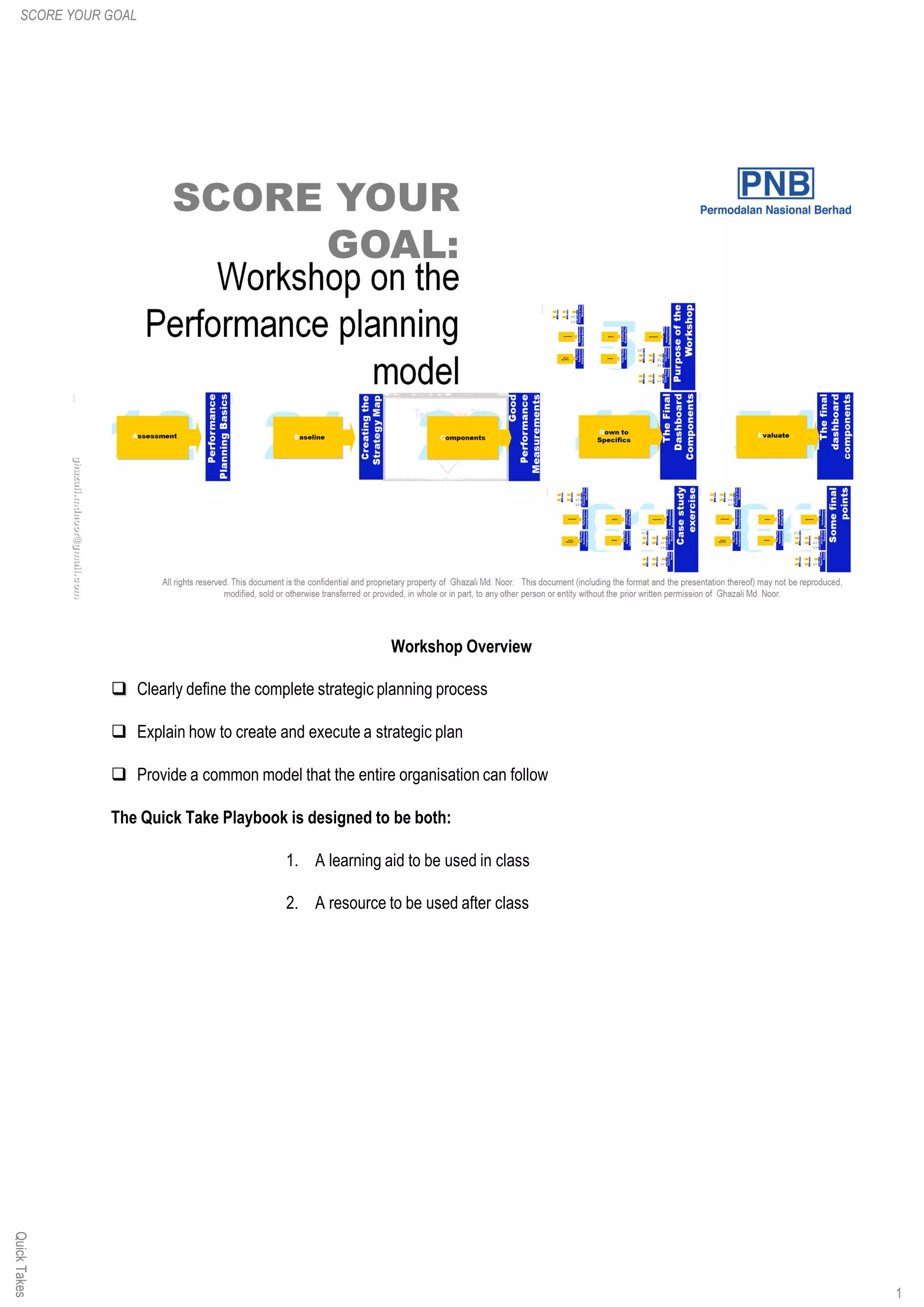
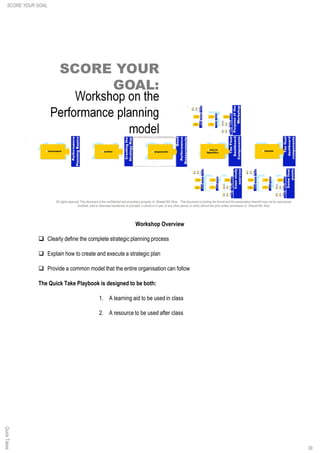
Workshop Overview
q Clearly define the complete strategic planning process
q Explain how to create and execute a strategic plan
q Provide a common model that the entire organisation can follow
The Quick Take Playbook is designed to be both:
1. A learning aid to be used in class
2. A resource to be used after class
1
QuickTakesSCORE YOUR GOAL
2
QuickTakes
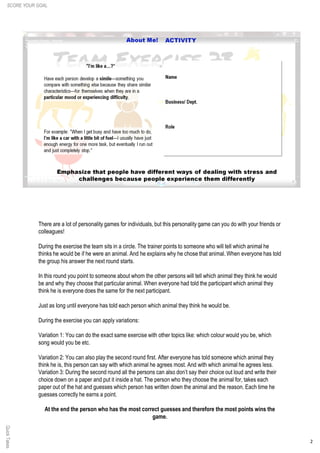
There are a lot of personality games for individuals, but this personality game can you do with your friends or
colleagues!
During the exercise the team sits in a circle. The trainer points to someone who will tell which animal he
thinks he would be if he were an animal. And he explains why he chose that animal. When everyone has told
the group his answer the next round starts.
In this round you point to someone about whom the other persons will tell which animal they think he would
be and why they choose that particular animal. When everyone had told the participant which animal they
think he is everyone does the same for the next participant.
Just as long until everyone has told each person which animal they think he would be.
During the exercise you can apply variations:
Variation 1: You can do the exact same exercise with other topics like: which colour would you be, which
song would you be etc.
Variation 2: You can also play the second round first. After everyone has told someone which animal they
think he is, this person can say with which animal he agrees most. And with which animal he agrees less.
Variation 3: During the second round all the persons can also don’t say their choice out loud and write their
choice down on a paper and put it inside a hat. The person who they choose the animal for, takes each
paper out of the hat and guesses which person has written down the animal and the reason. Each time he
guesses correctly he earns a point.
At the end the person who has the most correct guesses and therefore the most points wins the
game.
SCORE YOUR GOAL
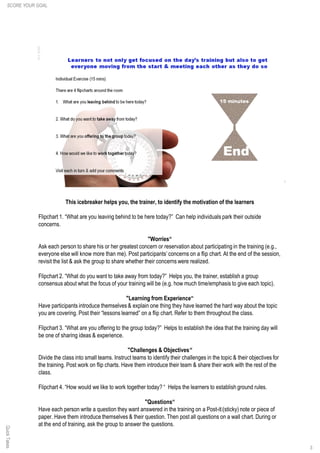
This icebreaker helps you, the trainer, to identify the motivation of the learners
Flipchart 1. “What are you leaving behind to be here today?” Can help individuals park their outside
concerns.
"Worries“
Ask each person to share his or her greatest concern or reservation about participating in the training (e.g.,
everyone else will know more than me). Post participants’ concerns on a flip chart. At the end of the session,
revisit the list & ask the group to share whether their concerns were realized.
Flipchart 2. “What do you want to take away from today?” Helps you, the trainer, establish a group
consensus about what the focus of your training will be (e.g. how much time/emphasis to give each topic).
"Learning from Experience“
Have participants introduce themselves & explain one thing they have learned the hard way about the topic
you are covering. Post their “lessons learned” on a flip chart. Refer to them throughout the class.
Flipchart 3. “What are you offering to the group today?” Helps to establish the idea that the training day will
be one of sharing ideas & experience.
"Challenges & Objectives“
Divide the class into small teams. Instruct teams to identify their challenges in the topic & their objectives for
the training. Post work on flip charts. Have them introduce their team & share their work with the rest of the
class.
Flipchart 4. “How would we like to work together today? “ Helps the learners to establish ground rules.
"Questions“
Have each person write a question they want answered in the training on a Post-it(sticky) note or piece of
paper. Have them introduce themselves & their question. Then post all questions on a wall chart. During or
at the end of training, ask the group to answer the questions.
QuickTakes
3
SCORE YOUR GOAL
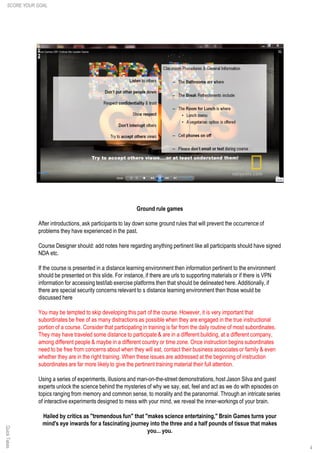
Ground rule games
After introductions, ask participants to lay down some ground rules that will prevent the occurrence of
problems they have experienced in the past.
Course Designer should: add notes here regarding anything pertinent like all participants should have signed
NDA etc.
If the course is presented in a distance learning environment then information pertinent to the environment
should be presented on this slide. For instance, if there are urls to supporting materials or if there is VPN
information for accessing test/lab exercise platforms then that should be delineated here. Additionally, if
there are special security concerns relevant to s distance learning environment then those would be
discussed here
You may be tempted to skip developing this part of the course. However, it is very important that
subordinates be free of as many distractions as possible when they are engaged in the true instructional
portion of a course. Consider that participating in training is far from the daily routine of most subordinates.
They may have traveled some distance to participate & are in a different building, at a different company,
among different people & maybe in a different country or time zone. Once instruction begins subordinates
need to be free from concerns about when they will eat, contact their business associates or family & even
whether they are in the right training. When these issues are addressed at the beginning of instruction
subordinates are far more likely to give the pertinent training material their full attention.
Using a series of experiments, illusions and man-on-the-street demonstrations, host Jason Silva and guest
experts unlock the science behind the mysteries of why we say, eat, feel and act as we do with episodes on
topics ranging from memory and common sense, to morality and the paranormal. Through an intricate series
of interactive experiments designed to mess with your mind, we reveal the inner-workings of your brain.
Hailed by critics as "tremendous fun" that "makes science entertaining," Brain Games turns your
mind's eye inwards for a fascinating journey into the three and a half pounds of tissue that makes
you... you.
QuickTakes
4
SCORE YOUR GOAL
5
Table of Content
1. Purpose of the Workshop
2. Performance Planning Basics
3. Creating the Strategy Map
4. Good performance measurements
5. The Final Dashboard Components
6. Case Study Exercise
7. Some Final Points
Designed to:
Introduce the Performance Planning to the Organisation
Make sure everyone understands how the dashboard works
Communicate how the Performance Planning fits with the Malcolm Baldrige Model of performance
excellence
SCORE YOUR GOALQuickTakes
6
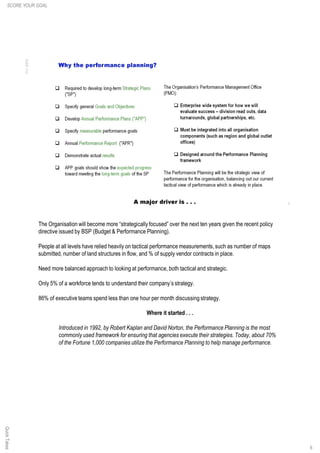
The Organisation will become more “strategically focused” over the next ten years given the recent policy
directive issued by BSP (Budget & Performance Planning).
People at all levels have relied heavily on tactical performance measurements,such as number of maps
submitted, number of land structures in flow, and % of supply vendor contracts in place.
Need more balanced approach to looking at performance, both tactical and strategic.
Only 5% of a workforce tends to understand their company’s strategy.
86% of executive teams spend less than one hour per month discussing strategy.
Where it started . . .
Introduced in 1992, by Robert Kaplan and David Norton, the Performance Planning is the most
commonly used framework for ensuring that agencies execute their strategies. Today, about 70%
of the Fortune 1,000 companies utilize the Performance Planning to help manage performance.
SCORE YOUR GOALQuickTakes
7
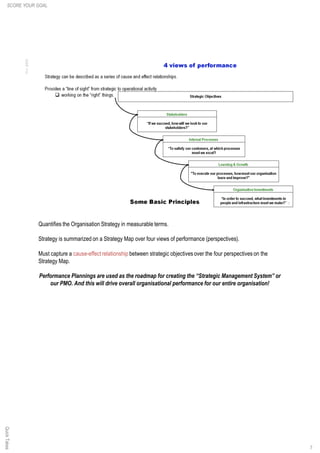
Quantifies the Organisation Strategy in measurable terms.
Strategy is summarized on a Strategy Map over four views of performance (perspectives).
Must capture a cause-effectrelationship between strategic objectives over the four perspectives on the
Strategy Map.
Performance Plannings are used as the roadmap for creating the “Strategic Management System” or
our PMO. And this will drive overall organisational performance for our entire organisation!
SCORE YOUR GOALQuickTakes
8
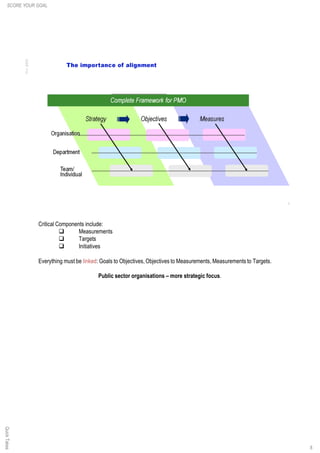
Critical Components include:
q Measurements
q Targets
q Initiatives
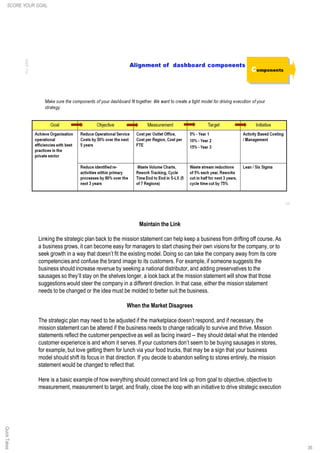
Everything must be linked: Goals to Objectives,Objectives to Measurements, Measurements to Targets.
Public sector organisations – more strategic focus.
SCORE YOUR GOALQuickTakes
9
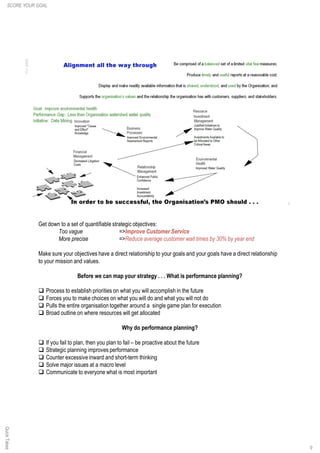
Get down to a set of quantifiable strategic objectives:
Too vague =>Improve Customer Service
More precise =>Reduce average customer wait times by 30% by year end
Make sure your objectives have a direct relationship to your goals and your goals have a direct relationship
to your mission and values.
Before we can map your strategy . . . What is performance planning?
q Process to establish priorities on what you will accomplish in the future
q Forces you to make choices on what you will do and what you will not do
q Pulls the entire organisation together around a single game plan for execution
q Broad outline on where resources will get allocated
Why do performance planning?
q If you fail to plan, then you plan to fail – be proactive about the future
q Strategic planning improves performance
q Counter excessive inward and short-term thinking
q Solve major issues at a macro level
q Communicate to everyone what is most important
SCORE YOUR GOALQuickTakes
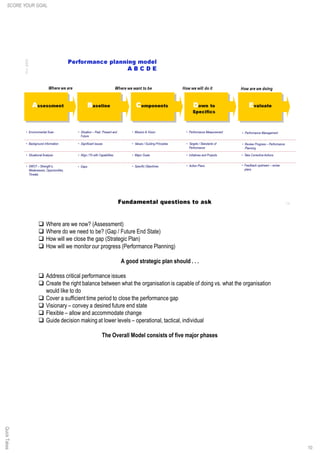
q Where are we now? (Assessment)
q Where do we need to be? (Gap / Future End State)
q How will we close the gap (Strategic Plan)
q How will we monitor our progress (Performance Planning)
A good strategic plan should . . .
q Address critical performance issues
q Create the right balance between what the organisation is capable of doing vs. what the organisation
would like to do
q Cover a sufficient time period to close the performance gap
q Visionary – convey a desired future end state
q Flexible – allow and accommodate change
q Guide decision making at lower levels – operational, tactical, individual
The Overall Model consists of five major phases
SCORE YOUR GOAL
10
QuickTakes
11
QuickTakes
During this exercise the team will learn about the personality types using the four elements:
earth, wind, water and fire
You divide the room into 4 equal areas and name the areas after the element:. earth, wind, water and fire.
Each person will stand into the area of which the element represents him the most when he is in a certain
situation.
Let each person tell why he made this choice. This way the team learns that a different part of them is
activated according to the social environment they are in. And the team now knows which element people
represent in the team and which elements they want to have more in the team.
During the exercise you can apply variations:
1. Next to social situations you can ask them in which element they are when they are in different
states of being. For example, which element represents you when you are drunk? Or when you are
alone?
2. Next to social situations you can ask them in which element they are when they are in different
emotions. For example, which element represents you when you are happy? And when you are sad?
Note that each element can represent each emotion.
3. Let the team act out situations of social settings in duos. Each time in a different element. For
example: approaching someone at a network event. First each duo acts out the scene in their own
element of how they would usually do it. Then in the element they need a bit more. This way they will
SCORE YOUR GOAL
practise behaviour in different elements.
11
SCORE YOUR GOALQuickTakes
Pre-Requisites to Planning
Before you begin, make sure the groundwork has been done to make the planning process work.
q Senior leadership commitment
q Who will do what?
q What will each group do?
q How will we do it?
q When is the best time?
12
QuickTakesSCORE YOUR GOAL
Case Study
A social worker in a support group for abused women is gradually delegating her responsibilities to the group
members. Her intention is to move the group from a professionally- supported group to a member-led group.
This is due to the changing atmosphere in her organisation, lack of funding and a positive move towards
self-sufficiency. She is aware that some women in the group are more committed and attuned to group
work. However, she feels that for the group to sustain itself, all the members need to take ownership. She
starts to move the group to a shared leadership model by asking the group the above questions. In a simple
exercise of going through the above points, group members gradually create an identity and a vision for
their group.
Ultimately all causal paths start from learning perspective… and to improve learning
This is the step to begin looking at the work that needs to be done in any given group.
Follower interaction with a leader
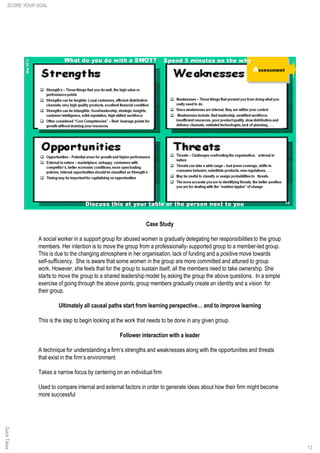
A technique for understanding a firm’s strengths and weaknesses along with the opportunities and threats
that exist in the firm’s environment
Takes a narrow focus by centering on an individual firm
Used to compare internal and external factors in order to generate ideas about how their firm might become
more successful
13
QuickTakesSCORE YOUR GOAL
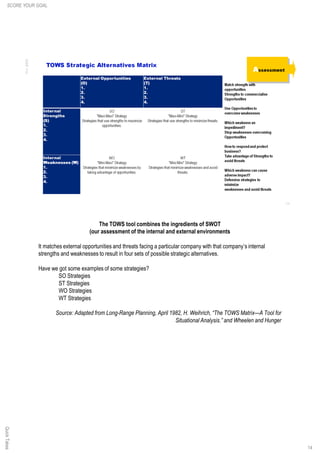
The TOWS tool combines the ingredients of SWOT
(our assessment of the internal and external environments
It matches external opportunities and threats facing a particular company with that company’s internal
strengths and weaknesses to result in four sets of possible strategic alternatives.
Have we got some examples of some strategies?
SO Strategies
ST Strategies
WO Strategies
WT Strategies
Source: Adapted from Long-Range Planning, April 1982, H. Weihrich, “The TOWS Matrix—A Tool for
Situational Analysis.” and Wheelen and Hunger
14
SCORE YOUR GOALQuickTakes
Compassion is one of the few things we can practice that will bring immediate and long-term
happiness to our lives
The key to developing compassion in your life is to make it a daily practice. The first step in cultivating
compassion is to develop empathy for your fellow human beings. When we encounter someone who
mistreats us, instead of acting in anger, withdraw.
But determine that if people do you good, you will do good to them; and if they oppress you, you will
not oppress them.
Sacrifice of the lamb
Just as the Prophet (S.A.W.), and his companions landed from their rides, and laid the loads down, it was
decided that they would sacrifice a lamb for dinner.
One of the companions volunteered: "I will sacrifice the lamb."
Another: "I will skin it."
Third: "I will cook it."
Fourth: " I will...."
The Prophet (S.A.W.): "I will gather the wood from the desert."
The group: "O Messenger of Allah, it is not becoming of you to discomfort yourself as such. You rest. We will
be honoured to do all this on our own."
The Prophet (S.A.W.): "I know that you are eager to do it all, but Allah isn't pleased with the slave who
distinguishes between himself and his companions, and considers himself better than others.“ Then he went
to the desert, and gathered some wood, and brought it to the group.
SCORE YOUR GOAL
15
QuickTakes
16
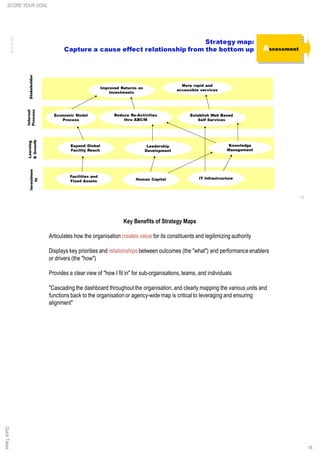
Key Benefits of Strategy Maps
Articulates how the organisation creates value for its constituents and legitimizing authority
Displays key priorities and relationships between outcomes (the "what") and performance enablers
or drivers (the "how")
Provides a clear view of "how I fit in" for sub-organisations, teams, and individuals
"Cascading the dashboard throughout the organisation, and clearly mapping the various units and
functions back to the organisation or agency-wide map is critical to leveraging and ensuring
alignment"
SCORE YOUR GOALQuickTakes
17
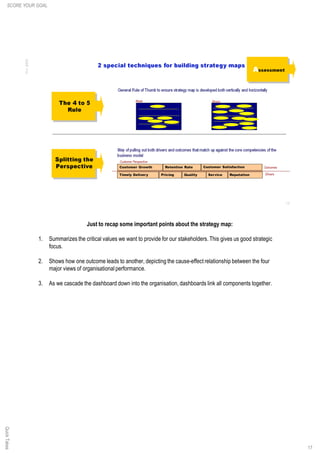
Just to recap some important points about the strategy map:
1. Summarizes the critical values we want to provide for our stakeholders.This gives us good strategic
focus.
2. Shows how one outcome leads to another, depicting the cause-effect relationship between the four
major views of organisational performance.
3. As we cascade the dashboard down into the organisation, dashboards link all components together.
SCORE YOUR GOALQuickTakes
18
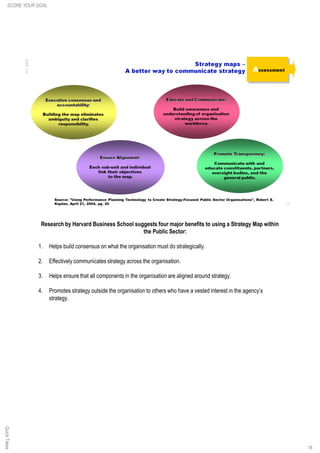
Research by Harvard Business School suggests four major benefits to using a Strategy Map within
the Public Sector:
1. Helps build consensus on what the organisation must do strategically.
2. Effectively communicates strategy across the organisation.
3. Helps ensure that all components in the organisation are aligned around strategy.
4. Promotes strategy outside the organisation to others who have a vested interest in the agency’s
strategy.
SCORE YOUR GOALQuickTakes
19
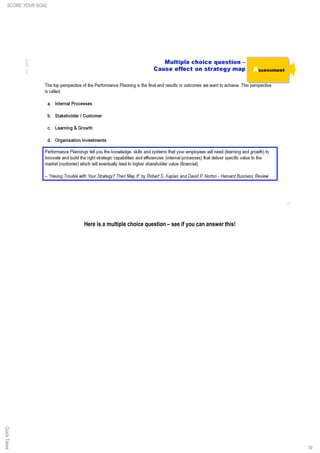
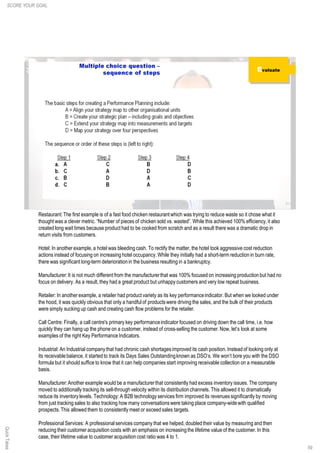
Here is a multiple choice question – see if you can answer this!
SCORE YOUR GOALQuickTakes
QuickTakes
20
WHAT’S IN MY POCKET?
Objective:
To emphasise the value of open vs. closed questions.
Instructions
1. The team are allowed 10 closed questions to guess what is in the trainer’s pocket (choose an unusual
object here if you can). It is very unusual that they will work it out.
2. Next, they play the game again & have to guess a different item using ten open questions. The only rule
is that they cannot ask, ‘What is the item?’ They will usually guess this in less than four tries.
3. This is a short exercise. However, it really emphasises the value of open questions in drawing out
information.
SCORE YOUR GOAL
A critical steps creating a Strategic Plan is establishing a solid, substantiated baseline. It will be used as a
starting point to define the future goals and metrics; it also allows for a fact-based analysis of the current
situation. Both are part of creating an achievable plan.
21
QuickTakesSCORE YOUR GOAL
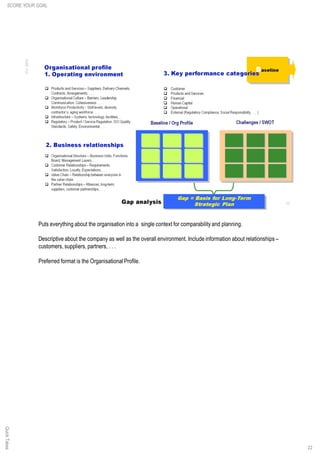
Puts everything about the organisation into a single context for comparability and planning.
Descriptive about the company as well as the overall environment. Include information about relationships –
customers, suppliers, partners, . . .
Preferred format is the Organisational Profile.
22
QuickTakesSCORE YOUR GOAL
23
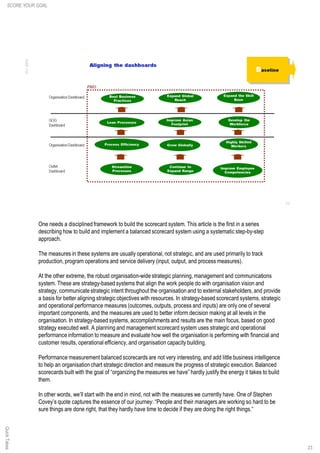
One needs a disciplined framework to build the scorecard system. This article is the first in a series
describing how to build and implement a balanced scorecard system using a systematic step-by-step
approach.
The measures in these systems are usually operational, not strategic, and are used primarily to track
production, program operations and service delivery (input, output, and process measures).
At the other extreme, the robust organisation-wide strategic planning, management and communications
system. These are strategy-based systems that align the work people do with organisation vision and
strategy, communicate strategic intent throughout the organisation and to external stakeholders,and provide
a basis for better aligning strategic objectives with resources. In strategy-based scorecard systems, strategic
and operational performance measures (outcomes, outputs, process and inputs) are only one of several
important components, and the measures are used to better inform decision making at all levels in the
organisation. In strategy-based systems, accomplishments and results are the main focus, based on good
strategy executed well. A planning and management scorecard system uses strategic and operational
performance information to measure and evaluate how well the organisation is performing with financial and
customer results, operational efficiency, and organisation capacity building.
Performance measurement balanced scorecards are not very interesting, and add little business intelligence
to help an organisation chart strategic direction and measure the progress of strategic execution. Balanced
scorecards built with the goal of “organizing the measures we have” hardly justify the energy it takes to build
them.
In other words, we’ll start with the end in mind, not with the measures we currently have. One of Stephen
Covey’s quote captures the essence of our journey: “People and their managers are working so hard to be
sure things are done right, that they hardly have time to decide if they are doing the right things.”
SCORE YOUR GOALQuickTakes
24
This overall alignment of KPIs throughout the entire organisation forms the Strategic Management
System within PMO.
PMOs may take other functions beyond standards and methodology, and participate in Strategic
project management either as facilitator or actively as owner of the Portfolio Management process.
Tasks[4] may include monitoring and reporting on active projects and portfolios (following up project
until completion),and reporting progress to top management for strategic decisions on what
projects to continue or cancel.
The degree of control and influence that PMOs have on projects depend on the type of PMO
structure within the enterprise; it can be:
Supportive, with a consultative role
Controlling, by requiring compliance for example
Directive, by taking control and managing the projects
There are many opinions and practices some say PMO's must fulfil, The Polk 5th edition dedicates
a page and a half to such discussion identifying 6 PMO functions. (Hobbs & Aubrey 2010) identified
27 distinct functions of PMO's highlighting a number of these were found to not correlate to
enhanced project performance. Darling & Whitty (2016) state there is a need for evidence-based
management practice, that consultants and practitioners are providing unproven solutions which
organisations both public and private are investing enormous quantities of finance to without
assured outcome, further the publication of opinions without scientific basis in the field of science,
medicine or law would not be tolerated, and it is equally important for justification to be presented in
the management field.[1]
SCORE YOUR GOALQuickTakes
There are a range of PMO types, including:[5]
Enterprise PMO: ensures that projects align with the organisation strategy and objective; these have the
broadest remit of all PMO types, typically reporting direct to the CEO (or similar role), and have authority to
make strategic and tactical decisions across all projects.[6]
Divisional PMO: provides support to projects for a specific business unit within an organisation; includes
portfolio management, training, resource planning, and project coordination.
Project PMO: established for the duration of a single large project or program; includes administrative
support, controlling, reporting and monitoring.
Project Management Centre of Excellence (PMCoE): defines standardized project management
standards, procedures, methods and tools to support project teams across an entire organisation; includes
administrativeservices and training in process, methodology,and tools.
The Project Management Institute (PMI) Program Management Office Community of Practice (CoP),
describes the PMO as a strategic driver for organisational excellence, which seeks to enhance the practices
of execution management, organisational governance, and strategic change leadership.[7]
Darling & Whitty (2016) highlight many PMO typologies exist from the early 1800s as a collective for running
government strategy in the agricultural sector, to the civil infrastructure projects of the early 20th century to
the early 2000s when the PMO became a commodity to be traded and traded upon. It would be impossible
to group PMO's into specific types (Darling & Whitty, 2016).
25
SCORE YOUR GOALQuickTakes
26
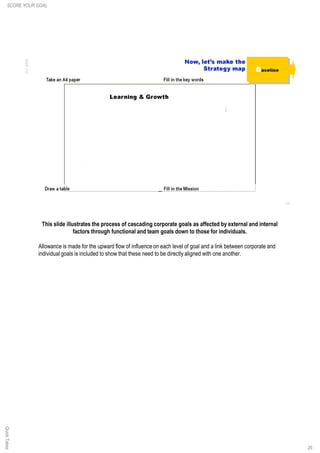
This slide illustrates the process of cascading corporate goals as affected by external and internal
factors through functional and team goals down to those for individuals.
Allowance is made for the upward flow of influence on each level of goal and a link between corporate and
individual goals is included to show that these need to be directly aligned with one another.
SCORE YOUR GOALQuickTakes
27
MODULE KNOWLEDGE CHECK
During this assertiveness training exercise the team will stand in two lines facing each other.
Because they walk towards each other and stop if the other person says so, they learn how to feel what is
their personal space and how to communicate that towards the other person. They learn how to do this by
saying it oud loud, but also in silence by body language. In the second part of the exercise everyone walks
side by side with his partners towards the room while remaining the distance.
Everyone will switch partners every few minutes. Everyone will notice that there can be a difference in the
distance you want to maintain with certain persons.
During the exercise the trainer can apply variations to the exercise.
Variation 1: When, in the first part of the exercise, the participants have walked toward each other and
determined a distance you can tell them to do it again, but now with their eyes closed. Now they feel in with
their eyes closed what the right distance is. Of course they keep their hands a bit in front if them so they
won't bump into each other.
Variation 2: Now you can let the participants walk towards each other, but now they look each other right into
each others eyes. Next they walk toward each other when they don't look into each others eyes. Is there a
difference between the two time? And which time the distance between the participants is bigger?
Variation 3: You can do this exercise at the beginning and at the end of the day. If during the day people
bonded with each other, it can be that some people literally will walk towards each other and experience a
smaller distance.
SCORE YOUR GOALQuickTakes
This is one of our group exercises in which the team sits in a circle.
You ask the team which value, when it comes to group work, they think is the most important to them.
Everyone gives his answer and you writes down each answer on a note card. After everyone has named his
value you write the name of the participants on the remaining cards. You make two stables of cards. One
with the values and one with the names.
In the next round each participant picks a card from the value card and a name card and tells the rest of the
group how those two relate to each other.
The trainer can apply variations to the exercise:
1. Next to values you can do the exercise with other topics. For example: challenges. Each team member
now names what he thinks is the most important challenge the team is facing. In the next round
everyone picks a challenge card and a name card and tells the rest of the team how he thinks those two
relate to each other.
2. You can also let each person only pick a value card. And choose a person himself to tell how he thinks
that person relates to that value.
3. Instead of saying out loud to a certain person how you thinks a value relates to him, you can also write
this down in silence on the back of the card an give it to the person. In this case no one else hears what
it is, so it stays private.
28
QuickTakesSCORE YOUR GOAL
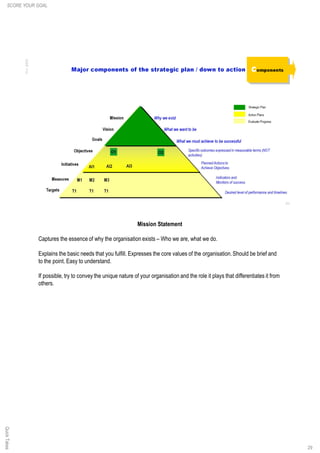
Mission Statement
Captures the essence of why the organisation exists – Who we are, what we do.
Explains the basic needs that you fulfill. Expresses the core values of the organisation. Should be brief and
to the point. Easy to understand.
If possible, try to convey the unique nature of your organisation and the role it plays that differentiates it from
others.
29
QuickTakesSCORE YOUR GOAL
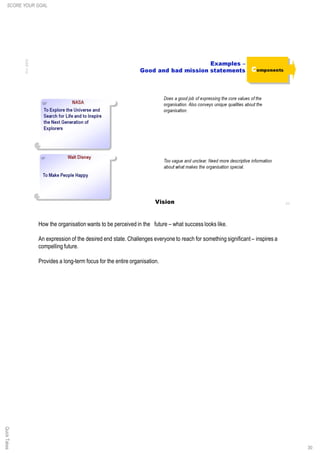
How the organisation wants to be perceived in the future – what success looks like.
An expression of the desired end state. Challenges everyone to reach for something significant – inspires a
compelling future.
Provides a long-term focus for the entire organisation.
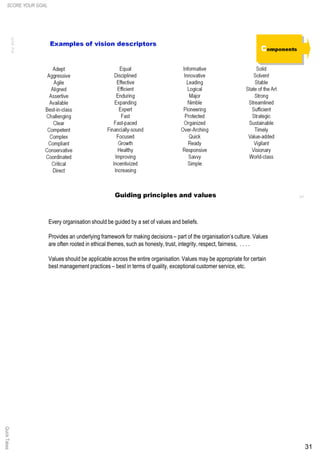
30
QuickTakesSCORE YOUR GOAL
31
Every organisation should be guided by a set of values and beliefs.
Provides an underlying framework for making decisions – part of the organisation’s culture. Values
are often rooted in ethical themes, such as honesty, trust, integrity, respect, fairness, . . . .
Values should be applicable across the entire organisation. Values may be appropriate for certain
best management practices – best in terms of quality, exceptional customer service, etc.
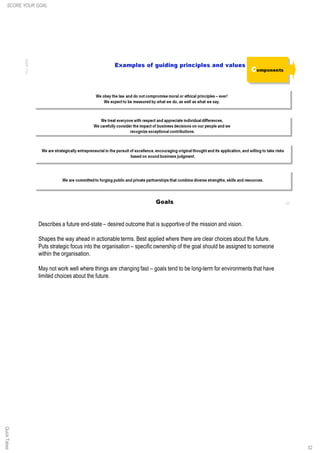
SCORE YOUR GOALQuickTakes
Describes a future end-state – desired outcome that is supportive of the mission and vision.
Shapes the way ahead in actionable terms. Best applied where there are clear choices about the future.
Puts strategic focus into the organisation – specific ownership of the goal should be assigned to someone
within the organisation.
May not work well where things are changing fast – goals tend to be long-term for environments that have
limited choices about the future.
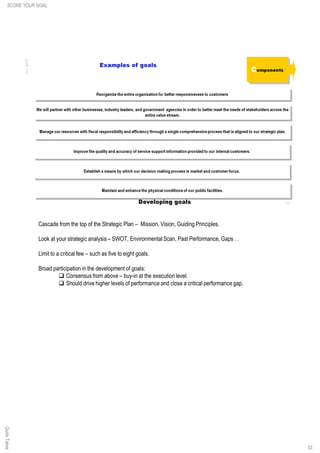
32
QuickTakesSCORE YOUR GOAL
Cascade from the top of the Strategic Plan – Mission, Vision, Guiding Principles.
Look at your strategic analysis – SWOT, Environmental Scan, Past Performance, Gaps . .
Limit to a critical few – such as five to eight goals.
Broad participation in the development of goals:
q Consensus from above – buy-in at the execution level.
q Should drive higher levels of performance and close a critical performance gap.
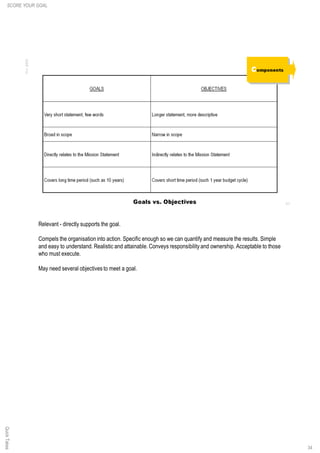
33
QuickTakesSCORE YOUR GOAL
Relevant - directly supports the goal.
Compels the organisation into action. Specific enough so we can quantify and measure the results. Simple
and easy to understand. Realistic and attainable. Conveys responsibility and ownership. Acceptable to those
who must execute.
May need several objectives to meet a goal.
34
QuickTakesSCORE YOUR GOAL
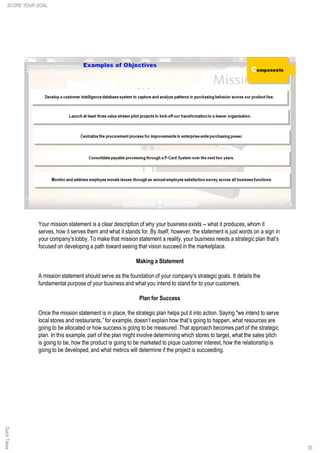
Your mission statement is a clear description of why your business exists -- what it produces, whom it
serves, how it serves them and what it stands for. By itself, however, the statement is just words on a sign in
your company's lobby. To make that mission statement a reality, your business needs a strategic plan that’s
focused on developing a path toward seeing that vision succeed in the marketplace.
Making a Statement
A mission statement should serve as the foundation of your company's strategic goals. It details the
fundamental purpose of your business and what you intend to stand for to your customers.
Plan for Success
Once the mission statement is in place, the strategic plan helps put it into action. Saying "we intend to serve
local stores and restaurants,” for example, doesn’t explain how that’s going to happen, what resources are
going to be allocated or how success is going to be measured. That approach becomes part of the strategic
plan. In this example, part of the plan might involve determining which stores to target, what the sales pitch
is going to be, how the product is going to be marketed to pique customer interest, how the relationship is
going to be developed, and what metrics will determine if the project is succeeding.
35
QuickTakesSCORE YOUR GOAL
36
Maintain the Link
Linking the strategic plan back to the mission statement can help keep a business from drifting off course. As
a business grows, it can become easy for managers to start chasing their own visions for the company, or to
seek growth in a way that doesn’t fit the existing model. Doing so can take the company away from its core
competencies and confuse the brand image to its customers. For example, if someone suggests the
business should increase revenue by seeking a national distributor, and adding preservatives to the
sausages so they’ll stay on the shelves longer, a look back at the mission statement will show that those
suggestions would steer the company in a different direction. In that case, either the mission statement
needs to be changed or the idea must be molded to better suit the business.
When the Market Disagrees
The strategic plan may need to be adjusted if the marketplace doesn’t respond, and if necessary, the
mission statement can be altered if the business needs to change radically to survive and thrive. Mission
statements reflect the customer perspective as well as facing inward -- they should detail what the intended
customer experience is and whom it serves. If your customers don’t seem to be buying sausages in stores,
for example, but love getting them for lunch via your food trucks, that may be a sign that your business
model should shift its focus in that direction. If you decide to abandon selling to stores entirely, the mission
statement would be changed to reflect that.
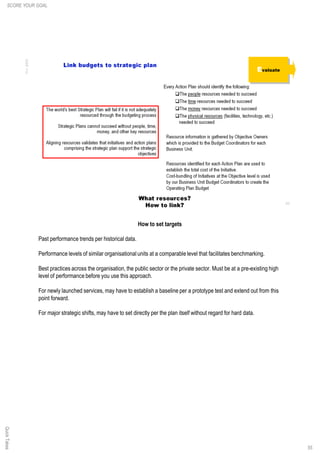
Here is a basic example of how everything should connect and link up from goal to objective, objective to
measurement, measurement to target, and finally, close the loop with an initiative to drive strategic execution
SCORE YOUR GOALQuickTakes
upstream. We want a good solid, tight model where everything is aligned together.
36
SCORE YOUR GOALQuickTakes
37
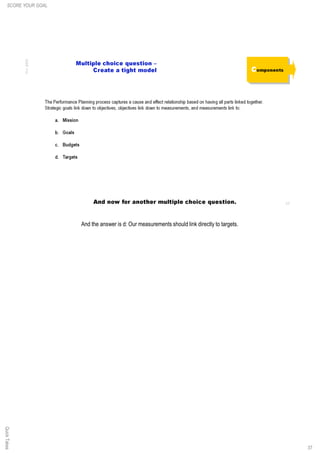
And the answer is d: Our measurements should link directly to targets.
SCORE YOUR GOALQuickTakes
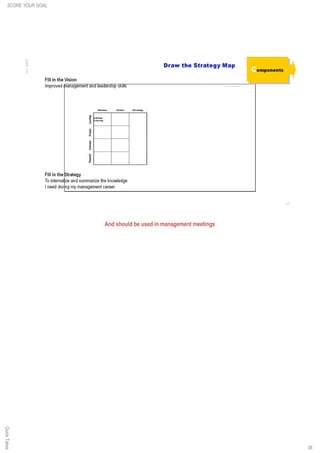
And should be used in management meetings
38
SCORE YOUR GOALQuickTakes
Workshop Overview
q Clearly define the complete strategic planning process
q Explain how to create and execute a strategic plan
q Provide a common model that the entire organisation can follow
The Quick Take Playbook is designed to be both:
1. A learning aid to be used in class
2. A resource to be used after class
39
QuickTakesSCORE YOUR GOAL
A performance scorecard is a graphical representation of the progress over time of some entity, such as an
enterprise, an employee or a business unit, toward some specified goal or goals. Performance scorecards
are widely used in many industries throughout both the public and private sectors. The performance
scorecard is an essential component of the balanced scorecard methodology.
Performance scorecards are also used independently of the balanced scorecard methodology to monitor the
progress of any organisational goal. The integral concepts of scorecards are targets and key performance
indicators (KPIs). KPIs are metrics used to evaluate factors that are crucial to the success of an
organisation; targets are specific goals for those indicators.
KPIs differ from one organisation to another. Net revenue is a typical enterprise KPI; unemployment rate is a
typical government KPI. In the scorecard, KPIs are represented by icons. For example, the vice president of
manufacturing might be interested in such items as:
The number of units produced
The number items that fail quality control
The amount of by-product generated
Inventory levels
Raw materials inventory levels
The current price of raw materials
Each KPI is typically displayed as a symbol indicating the health of that particular number. For example, the
number of items failing quality control might be 50. If the company is making two million items a day, this is a
low percentage and might be acceptable. If, on the other hand, the company is producing only 75 expensive
products a day, 50 failed products probably indicate a serious issue that must be addressed. A KPI icon may
use coloured indicators (green/yellow/red), smiley faces, gauges, dials, and so forth. This way, at a glance,
an individual can determine whether things are good for each particular KPI without having to see the exact
number or translate a number into an indicator of overall health.
Performance scorecards are often said to be a visual answer to the question, "How are we doing?"
40
QuickTakesSCORE YOUR GOAL
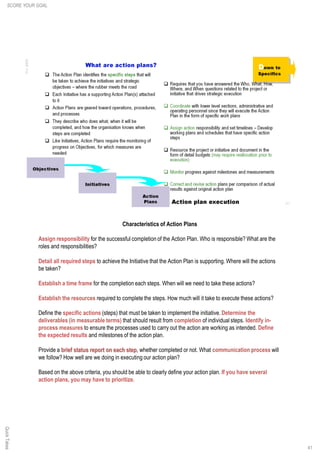
Characteristics of Action Plans
Assign responsibility for the successful completion of the Action Plan. Who is responsible? What are the
roles and responsibilities?
Detail all required steps to achieve the Initiative that the Action Plan is supporting. Where will the actions
be taken?
Establish a time frame for the completion each steps. When will we need to take these actions?
Establish the resources required to complete the steps. How much will it take to execute these actions?
Define the specific actions (steps) that must be taken to implement the initiative. Determine the
deliverables (in measurable terms) that should result from completion of individual steps. Identify in-
process measures to ensure the processes used to carry out the action are working as intended. Define
the expected results and milestones of the action plan.
Provide a brief status report on each step, whether completed or not. What communication process will
we follow? How well are we doing in executing our action plan?
Based on the above criteria, you should be able to clearly define your action plan. If you have several
action plans, you may have to prioritize.
41
QuickTakesSCORE YOUR GOAL
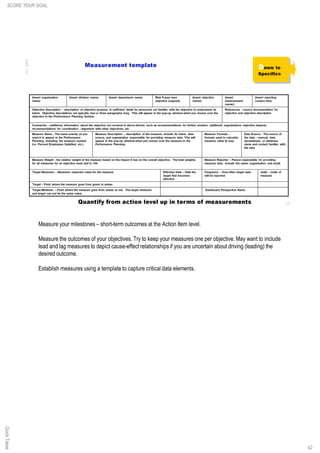
Measure your milestones – short-term outcomes at the Action Item level.
Measure the outcomes of your objectives. Try to keep your measures one per objective. May want to include
lead and lag measures to depict cause-effect relationships if you are uncertain about driving (leading) the
desired outcome.
Establish measures using a template to capture critical data elements.
42
QuickTakesSCORE YOUR GOAL
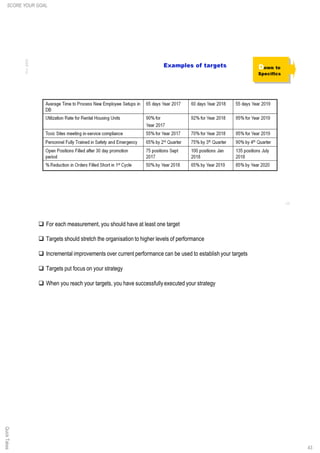
q For each measurement, you should have at least one target
q Targets should stretch the organisation to higher levels of performance
q Incremental improvements over current performance can be used to establish your targets
q Targets put focus on your strategy
q When you reach your targets, you have successfully executed your strategy
43
QuickTakesSCORE YOUR GOAL
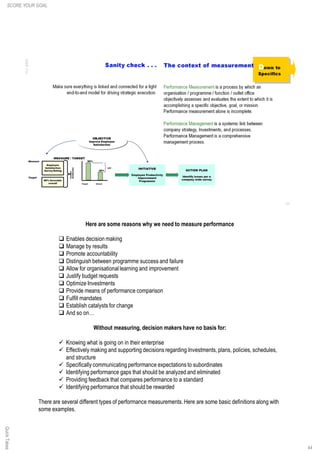
Here are some reasons why we need to measure performance
q Enables decision making
q Manage by results
q Promote accountability
q Distinguish between programme success and failure
q Allow for organisational learning and improvement
q Justify budget requests
q Optimize Investments
q Provide means of performance comparison
q Fulfill mandates
q Establish catalysts for change
q And so on…
Without measuring, decision makers have no basis for:
ü Knowing what is going on in their enterprise
ü Effectively making and supporting decisions regarding Investments, plans, policies, schedules,
and structure
ü Specifically communicating performance expectations to subordinates
ü Identifying performance gaps that should be analyzed and eliminated
ü Providing feedback that compares performance to a standard
ü Identifying performance that should be rewarded
There are several different types of performance measurements. Here are some basic definitions along with
some examples.
44
QuickTakesSCORE YOUR GOAL
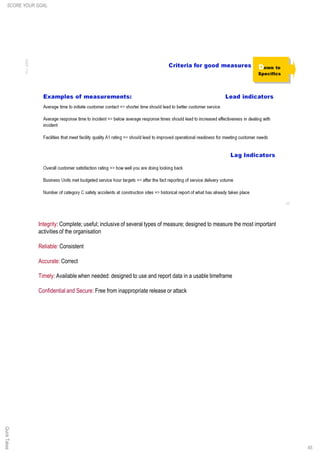
Integrity: Complete; useful; inclusive of several types of measure; designed to measure the most important
activities of the organisation
Reliable: Consistent
Accurate: Correct
Timely: Available when needed: designed to use and report data in a usable timeframe
Confidential and Secure: Free from inappropriate release or attack
SCORE YOUR GOALQuickTakes
45
46
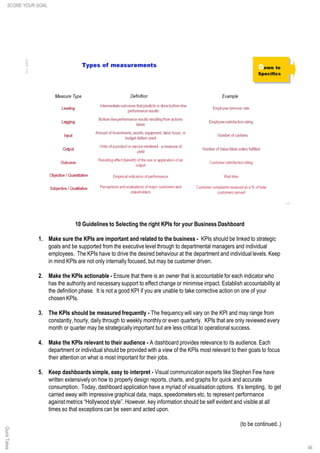
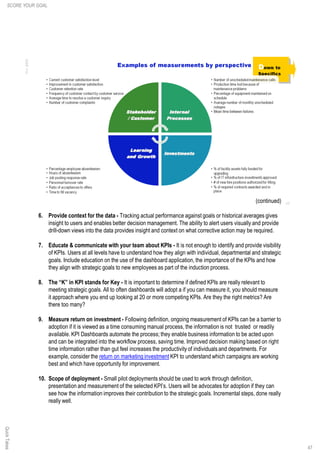
10 Guidelines to Selecting the right KPIs for your Business Dashboard
1. Make sure the KPIs are important and related to the business - KPIs should be linked to strategic
goals and be supported from the executive level through to departmental managers and individual
employees. The KPIs have to drive the desired behaviour at the department and individual levels. Keep
in mind KPIs are not only internally focused, but may be customer driven.
2. Make the KPIs actionable - Ensure that there is an owner that is accountable for each indicator who
has the authority and necessary support to effect change or minimise impact. Establish accountability at
the definition phase. It is not a good KPI if you are unable to take corrective action on one of your
chosen KPIs.
3. The KPIs should be measured frequently - The frequency will vary on the KPI and may range from
constantly, hourly, daily through to weekly monthly or even quarterly. KPIs that are only reviewed every
month or quarter may be strategically important but are less critical to operational success.
4. Make the KPIs relevant to their audience - A dashboard provides relevance to its audience. Each
department or individual should be provided with a view of the KPIs most relevant to their goals to focus
their attention on what is most important for their jobs.
5. Keep dashboards simple, easy to interpret - Visual communication experts like Stephen Few have
written extensively on how to properly design reports, charts, and graphs for quick and accurate
consumption. Today, dashboard application have a myriad of visualisation options. It’s tempting, to get
carried away with impressive graphical data, maps, speedometers etc. to represent performance
against metrics “Hollywood style”. However, key information should be self evident and visible at all
times so that exceptions can be seen and acted upon.
(to be continued..)
SCORE YOUR GOALQuickTakes
47
(continued)
6. Provide context for the data - Tracking actual performance against goals or historical averages gives
insight to users and enables better decision management. The ability to alert users visually and provide
drill-down views into the data provides insight and context on what corrective action may be required.
7. Educate & communicate with your team about KPIs - It is not enough to identify and provide visibility
of KPIs. Users at all levels have to understand how they align with individual, departmental and strategic
goals. Include education on the use of the dashboard application, the importance of the KPIs and how
they align with strategic goals to new employees as part of the induction process.
8. The “K” in KPI stands for Key - It is important to determine if defined KPIs are really relevant to
meeting strategic goals. All to often dashboards will adopt a if you can measure it, you should measure
it approach where you end up looking at 20 or more competing KPIs. Are they the right metrics? Are
there too many?
9. Measure return on investment - Following definition, ongoing measurement of KPIs can be a barrier to
adoption if it is viewed as a time consuming manual process, the information is not trusted or readily
available. KPI Dashboards automate the process; they enable business information to be acted upon
and can be integrated into the workflow process, saving time. Improved decision making based on right
time information rather than gut feel increases the productivity of individuals and departments. For
example, consider the return on marketing investment KPI to understand which campaigns are working
best and which have opportunity for improvement.
10. Scope of deployment - Small pilot deployments should be used to work through definition,
presentation and measurement of the selected KPI’s. Users will be advocates for adoption if they can
see how the information improves their contribution to the strategic goals. Incremental steps, done really
really well.
SCORE YOUR GOALQuickTakes
48
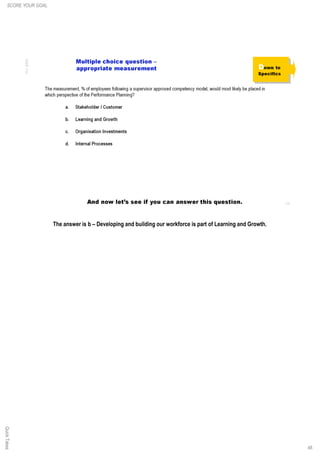
The answer is b – Developing and building our workforce is part of Learning and Growth.
SCORE YOUR GOALQuickTakes
49
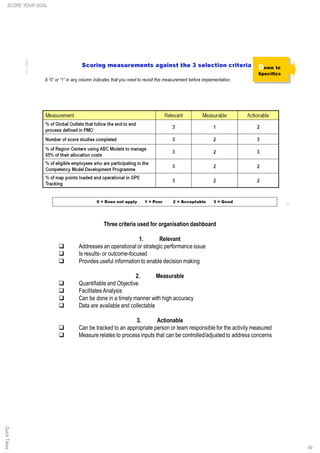
Three criteria used for organisation dashboard
1. Relevant
q Addresses an operational or strategic performance issue
q Is results- or outcome-focused
q Provides useful information to enable decision making
2. Measurable
q Quantifiable and Objective
q Facilitates Analysis
q Can be done in a timely manner with high accuracy
q Data are available and collectable
3. Actionable
q Can be tracked to an appropriate person or team responsible for the activity measured
q Measure relates to process inputs that can be controlled/adjusted to address concerns
SCORE YOUR GOALQuickTakes
50
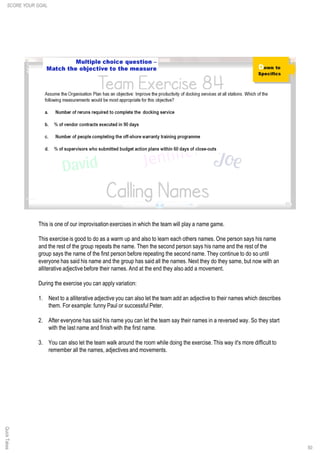
This is one of our improvisation exercises in which the team will play a name game.
This exercise is good to do as a warm up and also to learn each others names. One person says his name
and the rest of the group repeats the name. Then the second person says his name and the rest of the
group says the name of the first person before repeating the second name. They continue to do so until
everyone has said his name and the group has said all the names. Next they do they same, but now with an
alliterative adjective before their names. And at the end they also add a movement.
During the exercise you can apply variation:
1. Next to a alliterative adjective you can also let the team add an adjective to their names which describes
them. For example: funny Paul or successful Peter.
2. After everyone has said his name you can let the team say their names in a reversed way. So they start
with the last name and finish with the first name.
3. You can also let the team walk around the room while doing the exercise. This way it's more difficult to
remember all the names, adjectives and movements.
SCORE YOUR GOALQuickTakes
51
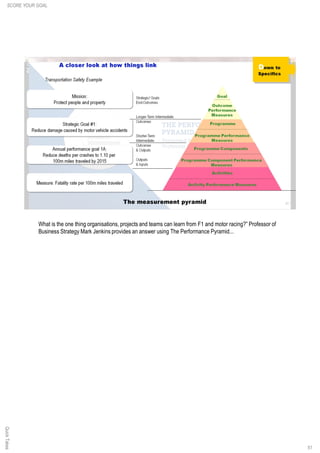
What is the one thing organisations, projects and teams can learn from F1 and motor racing?” Professor of
Business Strategy Mark Jenkins provides an answer using The Performance Pyramid...
SCORE YOUR GOALQuickTakes
52
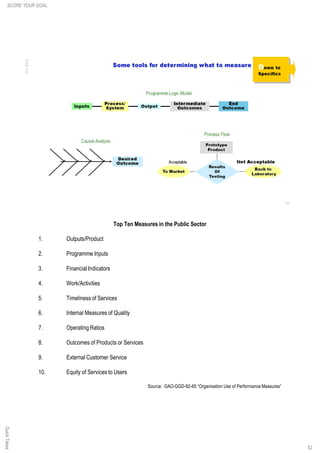
Top Ten Measures in the Public Sector
1. Outputs/Product
2. Programme Inputs
3. Financial Indicators
4. Work/Activities
5. Timeliness of Services
6. Internal Measures of Quality
7. Operating Ratios
8. Outcomes of Products or Services
9. External Customer Service
10. Equity of Services to Users
Source: GAO-GGD-92-65 “Organisation Use of Performance Measures”
SCORE YOUR GOALQuickTakes
53
QuickTakes
Dilemma
To assist participants in appreciating how to react in particular circumstances. Can be used in customer
care, leadership, sales, negotiation & many other areas of training.
Materials:
Blank paper, pens.
Instructions
1. Each participant writes down 3 ‘What would you do?’ type dilemmas based on the topic of the training or
an element of it i.e. ‘A customer complains that they find your manner rude & offensive, what would you
do?’ or ‘You think you can close this sale, but to do so you need to lie about an element of the product,
what do you do?’
2. These are placed in a bowl & participants take turns to pick them out & then write down in a few brief
words what they would do.
3. The other participants then take it in turns to say what they think you would do.
4. Any participant that identifies closely with the real reaction gets a point. The winner is the participant that
gains the most points.
SCORE YOUR GOAL
This game is fantastic for exploring the morality of situations & provoking discussion. It also helps to
link training to the ‘real’ world.
53
SCORE YOUR GOALQuickTakes
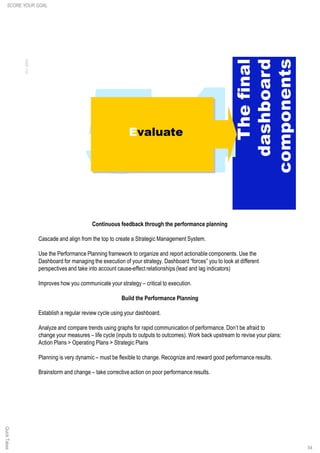
Continuous feedback through the performance planning
Cascade and align from the top to create a Strategic Management System.
Use the Performance Planning framework to organize and report actionable components. Use the
Dashboard for managing the execution of your strategy. Dashboard “forces” you to look at different
perspectives and take into account cause-effect relationships (lead and lag indicators)
Improves how you communicate your strategy – critical to execution.
Build the Performance Planning
Establish a regular review cycle using your dashboard.
Analyze and compare trends using graphs for rapid communication of performance. Don’t be afraid to
change your measures – life cycle (inputs to outputs to outcomes). Work back upstream to revise your plans:
Action Plans > Operating Plans > Strategic Plans
Planning is very dynamic – must be flexible to change. Recognize and reward good performance results.
Brainstorm and change – take corrective action on poor performance results.
54
QuickTakesSCORE YOUR GOAL
How to set targets
Past performance trends per historical data.
Performance levels of similar organisational units at a comparable level that facilitates benchmarking.
Best practices across the organisation, the public sector or the private sector. Must be at a pre-existing high
level of performance before you use this approach.
For newly launched services, may have to establish a baseline per a prototype test and extend out from this
point forward.
For major strategic shifts, may have to set directly per the plan itself without regard for hard data.
55
QuickTakesSCORE YOUR GOAL
56
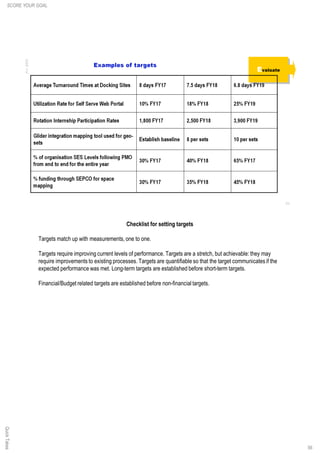
Checklist for setting targets
Targets match up with measurements, one to one.
Targets require improving current levels of performance. Targets are a stretch, but achievable: they may
require improvements to existing processes. Targets are quantifiable so that the target communicates if the
expected performance was met. Long-term targets are established before short-term targets.
Financial/Budget related targets are established before non-financial targets.
SCORE YOUR GOALQuickTakes
57
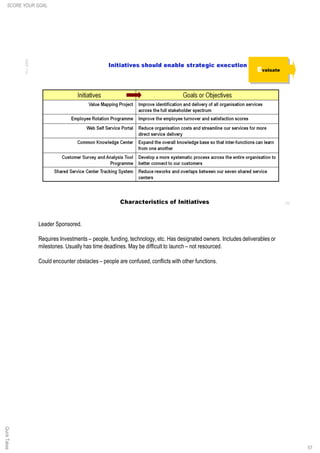
Leader Sponsored.
Requires Investments – people, funding, technology, etc. Has designated owners. Includes deliverables or
milestones. Usually has time deadlines. May be difficult to launch – not resourced.
Could encounter obstacles – people are confused, conflicts with other functions.
SCORE YOUR GOALQuickTakes
58
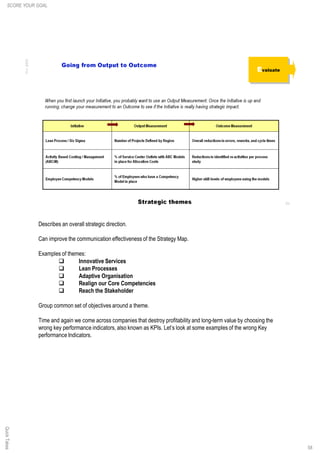
Describes an overall strategic direction.
Can improve the communication effectiveness of the Strategy Map.
Examples of themes:
q Innovative Services
q Lean Processes
q Adaptive Organisation
q Realign our Core Competencies
q Reach the Stakeholder
Group common set of objectives around a theme.
Time and again we come across companies that destroy profitability and long-term value by choosing the
wrong key performance indicators, also known as KPIs. Let’s look at some examples of the wrong Key
performance Indicators.
SCORE YOUR GOALQuickTakes
59
Restaurant:The first example is of a fast food chicken restaurantwhich was trying to reduce waste so it chose what it
thought was a clever metric. “Number of pieces of chicken sold vs. wasted”. While this achieved 100% efficiency,it also
created long wait times because product had to be cooked from scratch and as a result there was a dramatic drop in
return visits from customers.
Hotel: In another example, a hotel was bleedingcash. To rectify the matter, the hotel took aggressive cost reduction
actions instead of focusing on increasing hotel occupancy.While they initially had a short-term reductionin burn rate,
there was significant long-term deteriorationin the business resulting in a bankruptcy.
Manufacturer:It is not much different from the manufacturerthat was 100% focused on increasing productionbut had no
focus on delivery. As a result, they had a great product but unhappycustomers and very low repeat business.
Retailer: In another example, a retailer had product variety as its key performanceindicator. But when we looked under
the hood, it was quickly obvious that only a handful of productswere driving the sales, and the bulk of their products
were simply sucking up cash and creating cash flow problems for the retailer.
Call Centre: Finally, a call centre's primary key performanceindicator focused on driving down the call time, i.e. how
quickly they can hang up the phone on a customer, instead of cross-selling the customer.Now, let’s look at some
examples of the right Key PerformanceIndicators.
Industrial: An Industrial company that had chronic cash shortagesimproved its cash position. Instead of looking only at
its receivablebalance, it started to track its Days Sales Outstandingknown as DSO’s. We won’t bore you with the DSO
formula but it should suffice to know that it can help companies start improving receivable collection on a measurable
basis.
Manufacturer:Another example would be a manufacturerthat consistently had excess inventory issues. The company
moved to additionally tracking its sell-through velocity within its distributionchannels. This allowed it to dramatically
reduce its inventorylevels. Technology:A B2B technologyservices firm improved its revenuessignificantly by moving
from just tracking sales to also tracking how many conversationswere taking place company-widewith qualified
prospects.This allowedthem to consistently meet or exceedsales targets.
ProfessionalServices: A professionalservices company that we helped, doubled their value by measuring and then
reducing their customer acquisition costs with an emphasis on increasingthe lifetime value of the customer. In this
case, their lifetime value to customer acquisitioncost ratio was 4 to 1.
SCORE YOUR GOALQuickTakes
QuickTakes
60
ARE YOU LISTENING?
Objective: To emphasis how important listening skills are & how hard it can be to take in too much
information at one time. A useful game to help leaders understand that they have to provide clear
instructions.
Instructions
1. Ask one person to leave the room while the rest of the participants come up with a well known
phrase, slogan or rhyme. Each participant must take one word from the phrase.
2. They call the person back into the room, shout “1, 2, 3” & then all at the same time shout out their word
from the phrase. The listener must make sense of the words & identify the phrase.
3. Of course the listener will find this very hard to do. They may ask for it to be repeated twice & after that
they must guess. If they don’t identify the phrase, they lose.
SCORE YOUR GOAL
61
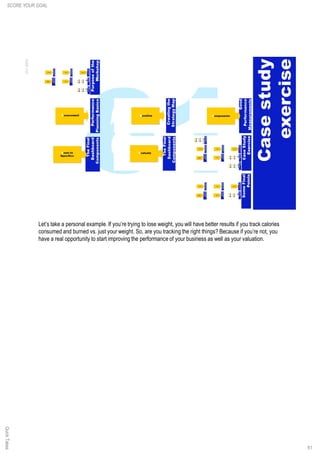
Let’s take a personal example. If you’re trying to lose weight, you will have better results if you track calories
consumed and burned vs. just your weight. So, are you tracking the right things? Because if you’re not, you
have a real opportunity to start improving the performance of your business as well as your valuation.
SCORE YOUR GOALQuickTakes
62
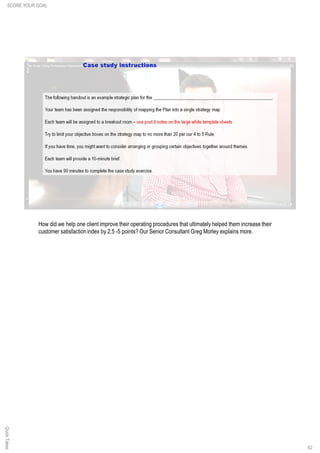
How did we help one client improve their operating procedures that ultimately helped them increase their
customer satisfaction index by 2.5 -5 points? Our Senior Consultant Greg Morley explains more.
SCORE YOUR GOALQuickTakes
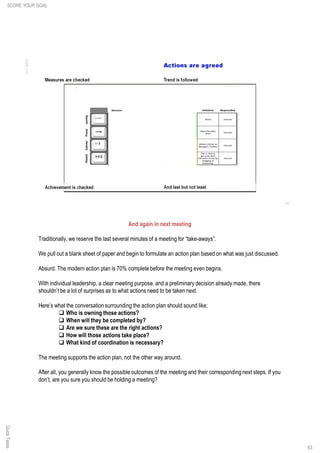
And again in next meeting
Traditionally, we reserve the last several minutes of a meeting for “take-aways”.
We pull out a blank sheet of paper and begin to formulate an action plan based on what was just discussed.
Absurd. The modern action plan is 70% complete before the meeting even begins.
With individual leadership, a clear meeting purpose, and a preliminary decision already made, there
shouldn’t be a lot of surprises as to what actions need to be taken next.
Here’s what the conversation surrounding the action plan should sound like:
q Who is owning those actions?
q When will they be completed by?
q Are we sure these are the right actions?
q How will those actions take place?
q What kind of coordination is necessary?
The meeting supports the action plan, not the other way around.
After all, you generally know the possible outcomes of the meeting and their corresponding next steps. If you
don’t, are you sure you should be holding a meeting?
63
QuickTakesSCORE YOUR GOAL
64
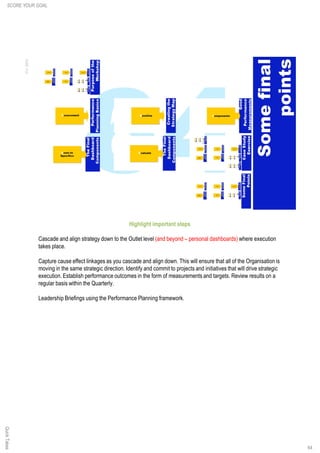
Highlight important steps
Cascade and align strategy down to the Outlet level (and beyond – personal dashboards) where execution
takes place.
Capture cause effect linkages as you cascade and align down. This will ensure that all of the Organisation is
moving in the same strategic direction. Identify and commit to projects and initiatives that will drive strategic
execution. Establish performance outcomes in the form of measurements and targets. Review results on a
regular basis within the Quarterly.
Leadership Briefings using the Performance Planning framework.
SCORE YOUR GOALQuickTakes
65
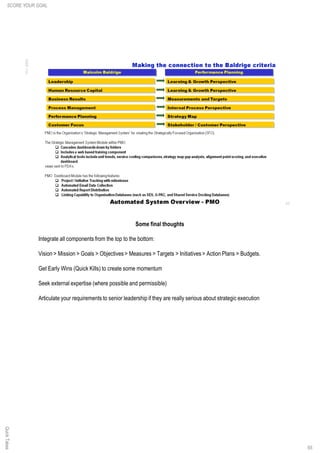
Some final thoughts
Integrate all components from the top to the bottom:
Vision > Mission > Goals > Objectives > Measures > Targets > Initiatives > Action Plans > Budgets.
Get Early Wins (Quick Kills) to create some momentum
Seek external expertise (where possible and permissible)
Articulate your requirements to senior leadership if they are really serious about strategic execution
SCORE YOUR GOALQuickTakes
QuickTakes
66
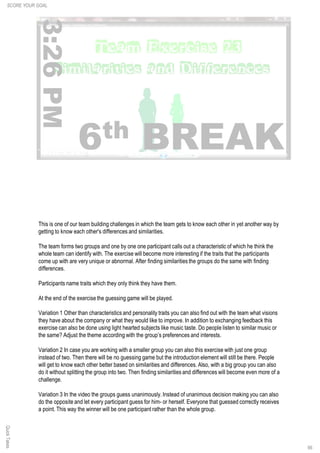
This is one of our team building challenges in which the team gets to know each other in yet another way by
getting to know each other's differences and similarities.
The team forms two groups and one by one one participant calls out a characteristic of which he think the
whole team can identify with. The exercise will become more interesting if the traits that the participants
come up with are very unique or abnormal. After finding similarities the groups do the same with finding
differences.
Participants name traits which they only think they have them.
At the end of the exercise the guessing game will be played.
Variation 1 Other than characteristics and personality traits you can also find out with the team what visions
they have about the company or what they would like to improve. In addition to exchanging feedback this
exercise can also be done using light hearted subjects like music taste. Do people listen to similar music or
the same? Adjust the theme according with the group’s preferences and interests.
Variation 2 In case you are working with a smaller group you can also this exercise with just one group
instead of two. Then there will be no guessing game but the introduction element will still be there. People
will get to know each other better based on similarities and differences. Also, with a big group you can also
do it without splitting the group into two. Then finding similarities and differences will become even more of a
challenge.
Variation 3 In the video the groups guess unanimously. Instead of unanimous decision making you can also
do the opposite and let every participant guess for him- or herself. Everyone that guessed correctly receives
a point. This way the winner will be one participant rather than the whole group.
SCORE YOUR GOAL
QuickTakes
67
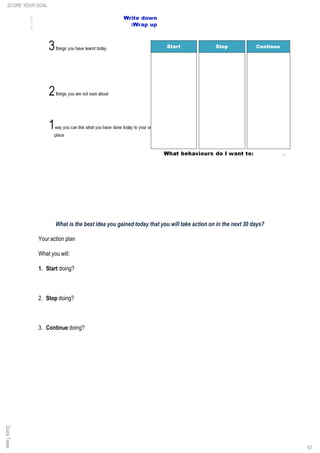
What is the best idea you gained today that you will take action on in the next 30 days?
Your action plan
What you will:
1. Start doing?
2. Stop doing?
3. Continue doing?
SCORE YOUR GOAL
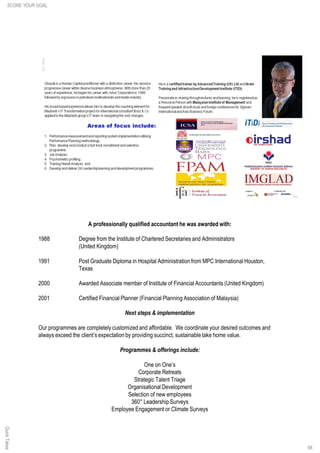
A professionally qualified accountant he was awarded with:
1988 Degree from the Institute of Chartered Secretaries and Administrators
(United Kingdom)
1991 Post Graduate Diploma in Hospital Administration from MPC International Houston,
Texas
2000 Awarded Associate member of Institute of Financial Accountants (United Kingdom)
2001 Certified Financial Planner (Financial Planning Association of Malaysia)
Next steps & implementation
Our programmes are completely customized and affordable. We coordinate your desired outcomes and
always exceed the client’s expectation by providing succinct, sustainabletake home value.
Programmes & offerings include:
One on One’s
Corporate Retreats
Strategic Talent Triage
Organisational Development
Selection of new employees
360° Leadership Surveys
Employee Engagement or Climate Surveys
QuickTakes
68
SCORE YOUR GOAL
68
SCORE YOUR GOALQuickTakes
69
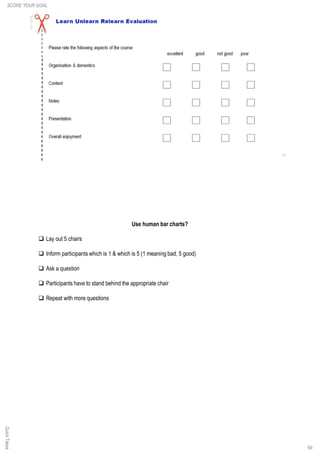
Use human bar charts?
q Lay out 5 chairs
q Inform participants which is 1 & which is 5 (1 meaning bad, 5 good)
q Ask a question
q Participants have to stand behind the appropriate chair
q Repeat with more questions
SCORE YOUR GOALQuickTakes
70
Can be problems re: confidentiality, but they do give you a good gist about things.
Always give the option of not participating.
Participants must be fed back the results too!
SCORE YOUR GOALQuickTakes

Score your goal quick takes

  • 1.
    Workshop Overview q Clearlydefine the complete strategic planning process q Explain how to create and execute a strategic plan q Provide a common model that the entire organisation can follow The Quick Take Playbook is designed to be both: 1. A learning aid to be used in class 2. A resource to be used after class 1 QuickTakesSCORE YOUR GOAL
  • 2.
    2 QuickTakes There are alot of personality games for individuals, but this personality game can you do with your friends or colleagues! During the exercise the team sits in a circle. The trainer points to someone who will tell which animal he thinks he would be if he were an animal. And he explains why he chose that animal. When everyone has told the group his answer the next round starts. In this round you point to someone about whom the other persons will tell which animal they think he would be and why they choose that particular animal. When everyone had told the participant which animal they think he is everyone does the same for the next participant. Just as long until everyone has told each person which animal they think he would be. During the exercise you can apply variations: Variation 1: You can do the exact same exercise with other topics like: which colour would you be, which song would you be etc. Variation 2: You can also play the second round first. After everyone has told someone which animal they think he is, this person can say with which animal he agrees most. And with which animal he agrees less. Variation 3: During the second round all the persons can also don’t say their choice out loud and write their choice down on a paper and put it inside a hat. The person who they choose the animal for, takes each paper out of the hat and guesses which person has written down the animal and the reason. Each time he guesses correctly he earns a point. At the end the person who has the most correct guesses and therefore the most points wins the game. SCORE YOUR GOAL
  • 3.
    This icebreaker helpsyou, the trainer, to identify the motivation of the learners Flipchart 1. “What are you leaving behind to be here today?” Can help individuals park their outside concerns. "Worries“ Ask each person to share his or her greatest concern or reservation about participating in the training (e.g., everyone else will know more than me). Post participants’ concerns on a flip chart. At the end of the session, revisit the list & ask the group to share whether their concerns were realized. Flipchart 2. “What do you want to take away from today?” Helps you, the trainer, establish a group consensus about what the focus of your training will be (e.g. how much time/emphasis to give each topic). "Learning from Experience“ Have participants introduce themselves & explain one thing they have learned the hard way about the topic you are covering. Post their “lessons learned” on a flip chart. Refer to them throughout the class. Flipchart 3. “What are you offering to the group today?” Helps to establish the idea that the training day will be one of sharing ideas & experience. "Challenges & Objectives“ Divide the class into small teams. Instruct teams to identify their challenges in the topic & their objectives for the training. Post work on flip charts. Have them introduce their team & share their work with the rest of the class. Flipchart 4. “How would we like to work together today? “ Helps the learners to establish ground rules. "Questions“ Have each person write a question they want answered in the training on a Post-it(sticky) note or piece of paper. Have them introduce themselves & their question. Then post all questions on a wall chart. During or at the end of training, ask the group to answer the questions. QuickTakes 3 SCORE YOUR GOAL
  • 4.
    Ground rule games Afterintroductions, ask participants to lay down some ground rules that will prevent the occurrence of problems they have experienced in the past. Course Designer should: add notes here regarding anything pertinent like all participants should have signed NDA etc. If the course is presented in a distance learning environment then information pertinent to the environment should be presented on this slide. For instance, if there are urls to supporting materials or if there is VPN information for accessing test/lab exercise platforms then that should be delineated here. Additionally, if there are special security concerns relevant to s distance learning environment then those would be discussed here You may be tempted to skip developing this part of the course. However, it is very important that subordinates be free of as many distractions as possible when they are engaged in the true instructional portion of a course. Consider that participating in training is far from the daily routine of most subordinates. They may have traveled some distance to participate & are in a different building, at a different company, among different people & maybe in a different country or time zone. Once instruction begins subordinates need to be free from concerns about when they will eat, contact their business associates or family & even whether they are in the right training. When these issues are addressed at the beginning of instruction subordinates are far more likely to give the pertinent training material their full attention. Using a series of experiments, illusions and man-on-the-street demonstrations, host Jason Silva and guest experts unlock the science behind the mysteries of why we say, eat, feel and act as we do with episodes on topics ranging from memory and common sense, to morality and the paranormal. Through an intricate series of interactive experiments designed to mess with your mind, we reveal the inner-workings of your brain. Hailed by critics as "tremendous fun" that "makes science entertaining," Brain Games turns your mind's eye inwards for a fascinating journey into the three and a half pounds of tissue that makes you... you. QuickTakes 4 SCORE YOUR GOAL
  • 5.
    5 Table of Content 1.Purpose of the Workshop 2. Performance Planning Basics 3. Creating the Strategy Map 4. Good performance measurements 5. The Final Dashboard Components 6. Case Study Exercise 7. Some Final Points Designed to: Introduce the Performance Planning to the Organisation Make sure everyone understands how the dashboard works Communicate how the Performance Planning fits with the Malcolm Baldrige Model of performance excellence SCORE YOUR GOALQuickTakes
  • 6.
    6 The Organisation willbecome more “strategically focused” over the next ten years given the recent policy directive issued by BSP (Budget & Performance Planning). People at all levels have relied heavily on tactical performance measurements,such as number of maps submitted, number of land structures in flow, and % of supply vendor contracts in place. Need more balanced approach to looking at performance, both tactical and strategic. Only 5% of a workforce tends to understand their company’s strategy. 86% of executive teams spend less than one hour per month discussing strategy. Where it started . . . Introduced in 1992, by Robert Kaplan and David Norton, the Performance Planning is the most commonly used framework for ensuring that agencies execute their strategies. Today, about 70% of the Fortune 1,000 companies utilize the Performance Planning to help manage performance. SCORE YOUR GOALQuickTakes
  • 7.
    7 Quantifies the OrganisationStrategy in measurable terms. Strategy is summarized on a Strategy Map over four views of performance (perspectives). Must capture a cause-effectrelationship between strategic objectives over the four perspectives on the Strategy Map. Performance Plannings are used as the roadmap for creating the “Strategic Management System” or our PMO. And this will drive overall organisational performance for our entire organisation! SCORE YOUR GOALQuickTakes
  • 8.
    8 Critical Components include: qMeasurements q Targets q Initiatives Everything must be linked: Goals to Objectives,Objectives to Measurements, Measurements to Targets. Public sector organisations – more strategic focus. SCORE YOUR GOALQuickTakes
  • 9.
    9 Get down toa set of quantifiable strategic objectives: Too vague =>Improve Customer Service More precise =>Reduce average customer wait times by 30% by year end Make sure your objectives have a direct relationship to your goals and your goals have a direct relationship to your mission and values. Before we can map your strategy . . . What is performance planning? q Process to establish priorities on what you will accomplish in the future q Forces you to make choices on what you will do and what you will not do q Pulls the entire organisation together around a single game plan for execution q Broad outline on where resources will get allocated Why do performance planning? q If you fail to plan, then you plan to fail – be proactive about the future q Strategic planning improves performance q Counter excessive inward and short-term thinking q Solve major issues at a macro level q Communicate to everyone what is most important SCORE YOUR GOALQuickTakes
  • 10.
    q Where arewe now? (Assessment) q Where do we need to be? (Gap / Future End State) q How will we close the gap (Strategic Plan) q How will we monitor our progress (Performance Planning) A good strategic plan should . . . q Address critical performance issues q Create the right balance between what the organisation is capable of doing vs. what the organisation would like to do q Cover a sufficient time period to close the performance gap q Visionary – convey a desired future end state q Flexible – allow and accommodate change q Guide decision making at lower levels – operational, tactical, individual The Overall Model consists of five major phases SCORE YOUR GOAL 10 QuickTakes
  • 11.
    11 QuickTakes During this exercisethe team will learn about the personality types using the four elements: earth, wind, water and fire You divide the room into 4 equal areas and name the areas after the element:. earth, wind, water and fire. Each person will stand into the area of which the element represents him the most when he is in a certain situation. Let each person tell why he made this choice. This way the team learns that a different part of them is activated according to the social environment they are in. And the team now knows which element people represent in the team and which elements they want to have more in the team. During the exercise you can apply variations: 1. Next to social situations you can ask them in which element they are when they are in different states of being. For example, which element represents you when you are drunk? Or when you are alone? 2. Next to social situations you can ask them in which element they are when they are in different emotions. For example, which element represents you when you are happy? And when you are sad? Note that each element can represent each emotion. 3. Let the team act out situations of social settings in duos. Each time in a different element. For example: approaching someone at a network event. First each duo acts out the scene in their own element of how they would usually do it. Then in the element they need a bit more. This way they will SCORE YOUR GOAL
  • 12.
    practise behaviour indifferent elements. 11 SCORE YOUR GOALQuickTakes
  • 13.
    Pre-Requisites to Planning Beforeyou begin, make sure the groundwork has been done to make the planning process work. q Senior leadership commitment q Who will do what? q What will each group do? q How will we do it? q When is the best time? 12 QuickTakesSCORE YOUR GOAL
  • 14.
    Case Study A socialworker in a support group for abused women is gradually delegating her responsibilities to the group members. Her intention is to move the group from a professionally- supported group to a member-led group. This is due to the changing atmosphere in her organisation, lack of funding and a positive move towards self-sufficiency. She is aware that some women in the group are more committed and attuned to group work. However, she feels that for the group to sustain itself, all the members need to take ownership. She starts to move the group to a shared leadership model by asking the group the above questions. In a simple exercise of going through the above points, group members gradually create an identity and a vision for their group. Ultimately all causal paths start from learning perspective… and to improve learning This is the step to begin looking at the work that needs to be done in any given group. Follower interaction with a leader A technique for understanding a firm’s strengths and weaknesses along with the opportunities and threats that exist in the firm’s environment Takes a narrow focus by centering on an individual firm Used to compare internal and external factors in order to generate ideas about how their firm might become more successful 13 QuickTakesSCORE YOUR GOAL
  • 15.
    The TOWS toolcombines the ingredients of SWOT (our assessment of the internal and external environments It matches external opportunities and threats facing a particular company with that company’s internal strengths and weaknesses to result in four sets of possible strategic alternatives. Have we got some examples of some strategies? SO Strategies ST Strategies WO Strategies WT Strategies Source: Adapted from Long-Range Planning, April 1982, H. Weihrich, “The TOWS Matrix—A Tool for Situational Analysis.” and Wheelen and Hunger 14 SCORE YOUR GOALQuickTakes
  • 16.
    Compassion is oneof the few things we can practice that will bring immediate and long-term happiness to our lives The key to developing compassion in your life is to make it a daily practice. The first step in cultivating compassion is to develop empathy for your fellow human beings. When we encounter someone who mistreats us, instead of acting in anger, withdraw. But determine that if people do you good, you will do good to them; and if they oppress you, you will not oppress them. Sacrifice of the lamb Just as the Prophet (S.A.W.), and his companions landed from their rides, and laid the loads down, it was decided that they would sacrifice a lamb for dinner. One of the companions volunteered: "I will sacrifice the lamb." Another: "I will skin it." Third: "I will cook it." Fourth: " I will...." The Prophet (S.A.W.): "I will gather the wood from the desert." The group: "O Messenger of Allah, it is not becoming of you to discomfort yourself as such. You rest. We will be honoured to do all this on our own." The Prophet (S.A.W.): "I know that you are eager to do it all, but Allah isn't pleased with the slave who distinguishes between himself and his companions, and considers himself better than others.“ Then he went to the desert, and gathered some wood, and brought it to the group. SCORE YOUR GOAL 15 QuickTakes
  • 17.
    16 Key Benefits ofStrategy Maps Articulates how the organisation creates value for its constituents and legitimizing authority Displays key priorities and relationships between outcomes (the "what") and performance enablers or drivers (the "how") Provides a clear view of "how I fit in" for sub-organisations, teams, and individuals "Cascading the dashboard throughout the organisation, and clearly mapping the various units and functions back to the organisation or agency-wide map is critical to leveraging and ensuring alignment" SCORE YOUR GOALQuickTakes
  • 18.
    17 Just to recapsome important points about the strategy map: 1. Summarizes the critical values we want to provide for our stakeholders.This gives us good strategic focus. 2. Shows how one outcome leads to another, depicting the cause-effect relationship between the four major views of organisational performance. 3. As we cascade the dashboard down into the organisation, dashboards link all components together. SCORE YOUR GOALQuickTakes
  • 19.
    18 Research by HarvardBusiness School suggests four major benefits to using a Strategy Map within the Public Sector: 1. Helps build consensus on what the organisation must do strategically. 2. Effectively communicates strategy across the organisation. 3. Helps ensure that all components in the organisation are aligned around strategy. 4. Promotes strategy outside the organisation to others who have a vested interest in the agency’s strategy. SCORE YOUR GOALQuickTakes
  • 20.
    19 Here is amultiple choice question – see if you can answer this! SCORE YOUR GOALQuickTakes
  • 21.
    QuickTakes 20 WHAT’S IN MYPOCKET? Objective: To emphasise the value of open vs. closed questions. Instructions 1. The team are allowed 10 closed questions to guess what is in the trainer’s pocket (choose an unusual object here if you can). It is very unusual that they will work it out. 2. Next, they play the game again & have to guess a different item using ten open questions. The only rule is that they cannot ask, ‘What is the item?’ They will usually guess this in less than four tries. 3. This is a short exercise. However, it really emphasises the value of open questions in drawing out information. SCORE YOUR GOAL
  • 22.
    A critical stepscreating a Strategic Plan is establishing a solid, substantiated baseline. It will be used as a starting point to define the future goals and metrics; it also allows for a fact-based analysis of the current situation. Both are part of creating an achievable plan. 21 QuickTakesSCORE YOUR GOAL
  • 23.
    Puts everything aboutthe organisation into a single context for comparability and planning. Descriptive about the company as well as the overall environment. Include information about relationships – customers, suppliers, partners, . . . Preferred format is the Organisational Profile. 22 QuickTakesSCORE YOUR GOAL
  • 24.
    23 One needs adisciplined framework to build the scorecard system. This article is the first in a series describing how to build and implement a balanced scorecard system using a systematic step-by-step approach. The measures in these systems are usually operational, not strategic, and are used primarily to track production, program operations and service delivery (input, output, and process measures). At the other extreme, the robust organisation-wide strategic planning, management and communications system. These are strategy-based systems that align the work people do with organisation vision and strategy, communicate strategic intent throughout the organisation and to external stakeholders,and provide a basis for better aligning strategic objectives with resources. In strategy-based scorecard systems, strategic and operational performance measures (outcomes, outputs, process and inputs) are only one of several important components, and the measures are used to better inform decision making at all levels in the organisation. In strategy-based systems, accomplishments and results are the main focus, based on good strategy executed well. A planning and management scorecard system uses strategic and operational performance information to measure and evaluate how well the organisation is performing with financial and customer results, operational efficiency, and organisation capacity building. Performance measurement balanced scorecards are not very interesting, and add little business intelligence to help an organisation chart strategic direction and measure the progress of strategic execution. Balanced scorecards built with the goal of “organizing the measures we have” hardly justify the energy it takes to build them. In other words, we’ll start with the end in mind, not with the measures we currently have. One of Stephen Covey’s quote captures the essence of our journey: “People and their managers are working so hard to be sure things are done right, that they hardly have time to decide if they are doing the right things.” SCORE YOUR GOALQuickTakes
  • 25.
    24 This overall alignmentof KPIs throughout the entire organisation forms the Strategic Management System within PMO. PMOs may take other functions beyond standards and methodology, and participate in Strategic project management either as facilitator or actively as owner of the Portfolio Management process. Tasks[4] may include monitoring and reporting on active projects and portfolios (following up project until completion),and reporting progress to top management for strategic decisions on what projects to continue or cancel. The degree of control and influence that PMOs have on projects depend on the type of PMO structure within the enterprise; it can be: Supportive, with a consultative role Controlling, by requiring compliance for example Directive, by taking control and managing the projects There are many opinions and practices some say PMO's must fulfil, The Polk 5th edition dedicates a page and a half to such discussion identifying 6 PMO functions. (Hobbs & Aubrey 2010) identified 27 distinct functions of PMO's highlighting a number of these were found to not correlate to enhanced project performance. Darling & Whitty (2016) state there is a need for evidence-based management practice, that consultants and practitioners are providing unproven solutions which organisations both public and private are investing enormous quantities of finance to without assured outcome, further the publication of opinions without scientific basis in the field of science, medicine or law would not be tolerated, and it is equally important for justification to be presented in the management field.[1] SCORE YOUR GOALQuickTakes
  • 26.
    There are arange of PMO types, including:[5] Enterprise PMO: ensures that projects align with the organisation strategy and objective; these have the broadest remit of all PMO types, typically reporting direct to the CEO (or similar role), and have authority to make strategic and tactical decisions across all projects.[6] Divisional PMO: provides support to projects for a specific business unit within an organisation; includes portfolio management, training, resource planning, and project coordination. Project PMO: established for the duration of a single large project or program; includes administrative support, controlling, reporting and monitoring. Project Management Centre of Excellence (PMCoE): defines standardized project management standards, procedures, methods and tools to support project teams across an entire organisation; includes administrativeservices and training in process, methodology,and tools. The Project Management Institute (PMI) Program Management Office Community of Practice (CoP), describes the PMO as a strategic driver for organisational excellence, which seeks to enhance the practices of execution management, organisational governance, and strategic change leadership.[7] Darling & Whitty (2016) highlight many PMO typologies exist from the early 1800s as a collective for running government strategy in the agricultural sector, to the civil infrastructure projects of the early 20th century to the early 2000s when the PMO became a commodity to be traded and traded upon. It would be impossible to group PMO's into specific types (Darling & Whitty, 2016). 25 SCORE YOUR GOALQuickTakes
  • 27.
    26 This slide illustratesthe process of cascading corporate goals as affected by external and internal factors through functional and team goals down to those for individuals. Allowance is made for the upward flow of influence on each level of goal and a link between corporate and individual goals is included to show that these need to be directly aligned with one another. SCORE YOUR GOALQuickTakes
  • 28.
    27 MODULE KNOWLEDGE CHECK Duringthis assertiveness training exercise the team will stand in two lines facing each other. Because they walk towards each other and stop if the other person says so, they learn how to feel what is their personal space and how to communicate that towards the other person. They learn how to do this by saying it oud loud, but also in silence by body language. In the second part of the exercise everyone walks side by side with his partners towards the room while remaining the distance. Everyone will switch partners every few minutes. Everyone will notice that there can be a difference in the distance you want to maintain with certain persons. During the exercise the trainer can apply variations to the exercise. Variation 1: When, in the first part of the exercise, the participants have walked toward each other and determined a distance you can tell them to do it again, but now with their eyes closed. Now they feel in with their eyes closed what the right distance is. Of course they keep their hands a bit in front if them so they won't bump into each other. Variation 2: Now you can let the participants walk towards each other, but now they look each other right into each others eyes. Next they walk toward each other when they don't look into each others eyes. Is there a difference between the two time? And which time the distance between the participants is bigger? Variation 3: You can do this exercise at the beginning and at the end of the day. If during the day people bonded with each other, it can be that some people literally will walk towards each other and experience a smaller distance. SCORE YOUR GOALQuickTakes
  • 29.
    This is oneof our group exercises in which the team sits in a circle. You ask the team which value, when it comes to group work, they think is the most important to them. Everyone gives his answer and you writes down each answer on a note card. After everyone has named his value you write the name of the participants on the remaining cards. You make two stables of cards. One with the values and one with the names. In the next round each participant picks a card from the value card and a name card and tells the rest of the group how those two relate to each other. The trainer can apply variations to the exercise: 1. Next to values you can do the exercise with other topics. For example: challenges. Each team member now names what he thinks is the most important challenge the team is facing. In the next round everyone picks a challenge card and a name card and tells the rest of the team how he thinks those two relate to each other. 2. You can also let each person only pick a value card. And choose a person himself to tell how he thinks that person relates to that value. 3. Instead of saying out loud to a certain person how you thinks a value relates to him, you can also write this down in silence on the back of the card an give it to the person. In this case no one else hears what it is, so it stays private. 28 QuickTakesSCORE YOUR GOAL
  • 30.
    Mission Statement Captures theessence of why the organisation exists – Who we are, what we do. Explains the basic needs that you fulfill. Expresses the core values of the organisation. Should be brief and to the point. Easy to understand. If possible, try to convey the unique nature of your organisation and the role it plays that differentiates it from others. 29 QuickTakesSCORE YOUR GOAL
  • 31.
    How the organisationwants to be perceived in the future – what success looks like. An expression of the desired end state. Challenges everyone to reach for something significant – inspires a compelling future. Provides a long-term focus for the entire organisation. 30 QuickTakesSCORE YOUR GOAL
  • 32.
    31 Every organisation shouldbe guided by a set of values and beliefs. Provides an underlying framework for making decisions – part of the organisation’s culture. Values are often rooted in ethical themes, such as honesty, trust, integrity, respect, fairness, . . . . Values should be applicable across the entire organisation. Values may be appropriate for certain best management practices – best in terms of quality, exceptional customer service, etc. SCORE YOUR GOALQuickTakes
  • 33.
    Describes a futureend-state – desired outcome that is supportive of the mission and vision. Shapes the way ahead in actionable terms. Best applied where there are clear choices about the future. Puts strategic focus into the organisation – specific ownership of the goal should be assigned to someone within the organisation. May not work well where things are changing fast – goals tend to be long-term for environments that have limited choices about the future. 32 QuickTakesSCORE YOUR GOAL
  • 34.
    Cascade from thetop of the Strategic Plan – Mission, Vision, Guiding Principles. Look at your strategic analysis – SWOT, Environmental Scan, Past Performance, Gaps . . Limit to a critical few – such as five to eight goals. Broad participation in the development of goals: q Consensus from above – buy-in at the execution level. q Should drive higher levels of performance and close a critical performance gap. 33 QuickTakesSCORE YOUR GOAL
  • 35.
    Relevant - directlysupports the goal. Compels the organisation into action. Specific enough so we can quantify and measure the results. Simple and easy to understand. Realistic and attainable. Conveys responsibility and ownership. Acceptable to those who must execute. May need several objectives to meet a goal. 34 QuickTakesSCORE YOUR GOAL
  • 36.
    Your mission statementis a clear description of why your business exists -- what it produces, whom it serves, how it serves them and what it stands for. By itself, however, the statement is just words on a sign in your company's lobby. To make that mission statement a reality, your business needs a strategic plan that’s focused on developing a path toward seeing that vision succeed in the marketplace. Making a Statement A mission statement should serve as the foundation of your company's strategic goals. It details the fundamental purpose of your business and what you intend to stand for to your customers. Plan for Success Once the mission statement is in place, the strategic plan helps put it into action. Saying "we intend to serve local stores and restaurants,” for example, doesn’t explain how that’s going to happen, what resources are going to be allocated or how success is going to be measured. That approach becomes part of the strategic plan. In this example, part of the plan might involve determining which stores to target, what the sales pitch is going to be, how the product is going to be marketed to pique customer interest, how the relationship is going to be developed, and what metrics will determine if the project is succeeding. 35 QuickTakesSCORE YOUR GOAL
  • 37.
    36 Maintain the Link Linkingthe strategic plan back to the mission statement can help keep a business from drifting off course. As a business grows, it can become easy for managers to start chasing their own visions for the company, or to seek growth in a way that doesn’t fit the existing model. Doing so can take the company away from its core competencies and confuse the brand image to its customers. For example, if someone suggests the business should increase revenue by seeking a national distributor, and adding preservatives to the sausages so they’ll stay on the shelves longer, a look back at the mission statement will show that those suggestions would steer the company in a different direction. In that case, either the mission statement needs to be changed or the idea must be molded to better suit the business. When the Market Disagrees The strategic plan may need to be adjusted if the marketplace doesn’t respond, and if necessary, the mission statement can be altered if the business needs to change radically to survive and thrive. Mission statements reflect the customer perspective as well as facing inward -- they should detail what the intended customer experience is and whom it serves. If your customers don’t seem to be buying sausages in stores, for example, but love getting them for lunch via your food trucks, that may be a sign that your business model should shift its focus in that direction. If you decide to abandon selling to stores entirely, the mission statement would be changed to reflect that. Here is a basic example of how everything should connect and link up from goal to objective, objective to measurement, measurement to target, and finally, close the loop with an initiative to drive strategic execution SCORE YOUR GOALQuickTakes
  • 38.
    upstream. We wanta good solid, tight model where everything is aligned together. 36 SCORE YOUR GOALQuickTakes
  • 39.
    37 And the answeris d: Our measurements should link directly to targets. SCORE YOUR GOALQuickTakes
  • 40.
    And should beused in management meetings 38 SCORE YOUR GOALQuickTakes
  • 41.
    Workshop Overview q Clearlydefine the complete strategic planning process q Explain how to create and execute a strategic plan q Provide a common model that the entire organisation can follow The Quick Take Playbook is designed to be both: 1. A learning aid to be used in class 2. A resource to be used after class 39 QuickTakesSCORE YOUR GOAL
  • 42.
    A performance scorecardis a graphical representation of the progress over time of some entity, such as an enterprise, an employee or a business unit, toward some specified goal or goals. Performance scorecards are widely used in many industries throughout both the public and private sectors. The performance scorecard is an essential component of the balanced scorecard methodology. Performance scorecards are also used independently of the balanced scorecard methodology to monitor the progress of any organisational goal. The integral concepts of scorecards are targets and key performance indicators (KPIs). KPIs are metrics used to evaluate factors that are crucial to the success of an organisation; targets are specific goals for those indicators. KPIs differ from one organisation to another. Net revenue is a typical enterprise KPI; unemployment rate is a typical government KPI. In the scorecard, KPIs are represented by icons. For example, the vice president of manufacturing might be interested in such items as: The number of units produced The number items that fail quality control The amount of by-product generated Inventory levels Raw materials inventory levels The current price of raw materials Each KPI is typically displayed as a symbol indicating the health of that particular number. For example, the number of items failing quality control might be 50. If the company is making two million items a day, this is a low percentage and might be acceptable. If, on the other hand, the company is producing only 75 expensive products a day, 50 failed products probably indicate a serious issue that must be addressed. A KPI icon may use coloured indicators (green/yellow/red), smiley faces, gauges, dials, and so forth. This way, at a glance, an individual can determine whether things are good for each particular KPI without having to see the exact number or translate a number into an indicator of overall health. Performance scorecards are often said to be a visual answer to the question, "How are we doing?" 40 QuickTakesSCORE YOUR GOAL
  • 43.
    Characteristics of ActionPlans Assign responsibility for the successful completion of the Action Plan. Who is responsible? What are the roles and responsibilities? Detail all required steps to achieve the Initiative that the Action Plan is supporting. Where will the actions be taken? Establish a time frame for the completion each steps. When will we need to take these actions? Establish the resources required to complete the steps. How much will it take to execute these actions? Define the specific actions (steps) that must be taken to implement the initiative. Determine the deliverables (in measurable terms) that should result from completion of individual steps. Identify in- process measures to ensure the processes used to carry out the action are working as intended. Define the expected results and milestones of the action plan. Provide a brief status report on each step, whether completed or not. What communication process will we follow? How well are we doing in executing our action plan? Based on the above criteria, you should be able to clearly define your action plan. If you have several action plans, you may have to prioritize. 41 QuickTakesSCORE YOUR GOAL
  • 44.
    Measure your milestones– short-term outcomes at the Action Item level. Measure the outcomes of your objectives. Try to keep your measures one per objective. May want to include lead and lag measures to depict cause-effect relationships if you are uncertain about driving (leading) the desired outcome. Establish measures using a template to capture critical data elements. 42 QuickTakesSCORE YOUR GOAL
  • 45.
    q For eachmeasurement, you should have at least one target q Targets should stretch the organisation to higher levels of performance q Incremental improvements over current performance can be used to establish your targets q Targets put focus on your strategy q When you reach your targets, you have successfully executed your strategy 43 QuickTakesSCORE YOUR GOAL
  • 46.
    Here are somereasons why we need to measure performance q Enables decision making q Manage by results q Promote accountability q Distinguish between programme success and failure q Allow for organisational learning and improvement q Justify budget requests q Optimize Investments q Provide means of performance comparison q Fulfill mandates q Establish catalysts for change q And so on… Without measuring, decision makers have no basis for: ü Knowing what is going on in their enterprise ü Effectively making and supporting decisions regarding Investments, plans, policies, schedules, and structure ü Specifically communicating performance expectations to subordinates ü Identifying performance gaps that should be analyzed and eliminated ü Providing feedback that compares performance to a standard ü Identifying performance that should be rewarded There are several different types of performance measurements. Here are some basic definitions along with some examples. 44 QuickTakesSCORE YOUR GOAL
  • 47.
    Integrity: Complete; useful;inclusive of several types of measure; designed to measure the most important activities of the organisation Reliable: Consistent Accurate: Correct Timely: Available when needed: designed to use and report data in a usable timeframe Confidential and Secure: Free from inappropriate release or attack SCORE YOUR GOALQuickTakes 45
  • 48.
    46 10 Guidelines toSelecting the right KPIs for your Business Dashboard 1. Make sure the KPIs are important and related to the business - KPIs should be linked to strategic goals and be supported from the executive level through to departmental managers and individual employees. The KPIs have to drive the desired behaviour at the department and individual levels. Keep in mind KPIs are not only internally focused, but may be customer driven. 2. Make the KPIs actionable - Ensure that there is an owner that is accountable for each indicator who has the authority and necessary support to effect change or minimise impact. Establish accountability at the definition phase. It is not a good KPI if you are unable to take corrective action on one of your chosen KPIs. 3. The KPIs should be measured frequently - The frequency will vary on the KPI and may range from constantly, hourly, daily through to weekly monthly or even quarterly. KPIs that are only reviewed every month or quarter may be strategically important but are less critical to operational success. 4. Make the KPIs relevant to their audience - A dashboard provides relevance to its audience. Each department or individual should be provided with a view of the KPIs most relevant to their goals to focus their attention on what is most important for their jobs. 5. Keep dashboards simple, easy to interpret - Visual communication experts like Stephen Few have written extensively on how to properly design reports, charts, and graphs for quick and accurate consumption. Today, dashboard application have a myriad of visualisation options. It’s tempting, to get carried away with impressive graphical data, maps, speedometers etc. to represent performance against metrics “Hollywood style”. However, key information should be self evident and visible at all times so that exceptions can be seen and acted upon. (to be continued..) SCORE YOUR GOALQuickTakes
  • 49.
    47 (continued) 6. Provide contextfor the data - Tracking actual performance against goals or historical averages gives insight to users and enables better decision management. The ability to alert users visually and provide drill-down views into the data provides insight and context on what corrective action may be required. 7. Educate & communicate with your team about KPIs - It is not enough to identify and provide visibility of KPIs. Users at all levels have to understand how they align with individual, departmental and strategic goals. Include education on the use of the dashboard application, the importance of the KPIs and how they align with strategic goals to new employees as part of the induction process. 8. The “K” in KPI stands for Key - It is important to determine if defined KPIs are really relevant to meeting strategic goals. All to often dashboards will adopt a if you can measure it, you should measure it approach where you end up looking at 20 or more competing KPIs. Are they the right metrics? Are there too many? 9. Measure return on investment - Following definition, ongoing measurement of KPIs can be a barrier to adoption if it is viewed as a time consuming manual process, the information is not trusted or readily available. KPI Dashboards automate the process; they enable business information to be acted upon and can be integrated into the workflow process, saving time. Improved decision making based on right time information rather than gut feel increases the productivity of individuals and departments. For example, consider the return on marketing investment KPI to understand which campaigns are working best and which have opportunity for improvement. 10. Scope of deployment - Small pilot deployments should be used to work through definition, presentation and measurement of the selected KPI’s. Users will be advocates for adoption if they can see how the information improves their contribution to the strategic goals. Incremental steps, done really really well. SCORE YOUR GOALQuickTakes
  • 50.
    48 The answer isb – Developing and building our workforce is part of Learning and Growth. SCORE YOUR GOALQuickTakes
  • 51.
    49 Three criteria usedfor organisation dashboard 1. Relevant q Addresses an operational or strategic performance issue q Is results- or outcome-focused q Provides useful information to enable decision making 2. Measurable q Quantifiable and Objective q Facilitates Analysis q Can be done in a timely manner with high accuracy q Data are available and collectable 3. Actionable q Can be tracked to an appropriate person or team responsible for the activity measured q Measure relates to process inputs that can be controlled/adjusted to address concerns SCORE YOUR GOALQuickTakes
  • 52.
    50 This is oneof our improvisation exercises in which the team will play a name game. This exercise is good to do as a warm up and also to learn each others names. One person says his name and the rest of the group repeats the name. Then the second person says his name and the rest of the group says the name of the first person before repeating the second name. They continue to do so until everyone has said his name and the group has said all the names. Next they do they same, but now with an alliterative adjective before their names. And at the end they also add a movement. During the exercise you can apply variation: 1. Next to a alliterative adjective you can also let the team add an adjective to their names which describes them. For example: funny Paul or successful Peter. 2. After everyone has said his name you can let the team say their names in a reversed way. So they start with the last name and finish with the first name. 3. You can also let the team walk around the room while doing the exercise. This way it's more difficult to remember all the names, adjectives and movements. SCORE YOUR GOALQuickTakes
  • 53.
    51 What is theone thing organisations, projects and teams can learn from F1 and motor racing?” Professor of Business Strategy Mark Jenkins provides an answer using The Performance Pyramid... SCORE YOUR GOALQuickTakes
  • 54.
    52 Top Ten Measuresin the Public Sector 1. Outputs/Product 2. Programme Inputs 3. Financial Indicators 4. Work/Activities 5. Timeliness of Services 6. Internal Measures of Quality 7. Operating Ratios 8. Outcomes of Products or Services 9. External Customer Service 10. Equity of Services to Users Source: GAO-GGD-92-65 “Organisation Use of Performance Measures” SCORE YOUR GOALQuickTakes
  • 55.
    53 QuickTakes Dilemma To assist participantsin appreciating how to react in particular circumstances. Can be used in customer care, leadership, sales, negotiation & many other areas of training. Materials: Blank paper, pens. Instructions 1. Each participant writes down 3 ‘What would you do?’ type dilemmas based on the topic of the training or an element of it i.e. ‘A customer complains that they find your manner rude & offensive, what would you do?’ or ‘You think you can close this sale, but to do so you need to lie about an element of the product, what do you do?’ 2. These are placed in a bowl & participants take turns to pick them out & then write down in a few brief words what they would do. 3. The other participants then take it in turns to say what they think you would do. 4. Any participant that identifies closely with the real reaction gets a point. The winner is the participant that gains the most points. SCORE YOUR GOAL
  • 56.
    This game isfantastic for exploring the morality of situations & provoking discussion. It also helps to link training to the ‘real’ world. 53 SCORE YOUR GOALQuickTakes
  • 57.
    Continuous feedback throughthe performance planning Cascade and align from the top to create a Strategic Management System. Use the Performance Planning framework to organize and report actionable components. Use the Dashboard for managing the execution of your strategy. Dashboard “forces” you to look at different perspectives and take into account cause-effect relationships (lead and lag indicators) Improves how you communicate your strategy – critical to execution. Build the Performance Planning Establish a regular review cycle using your dashboard. Analyze and compare trends using graphs for rapid communication of performance. Don’t be afraid to change your measures – life cycle (inputs to outputs to outcomes). Work back upstream to revise your plans: Action Plans > Operating Plans > Strategic Plans Planning is very dynamic – must be flexible to change. Recognize and reward good performance results. Brainstorm and change – take corrective action on poor performance results. 54 QuickTakesSCORE YOUR GOAL
  • 58.
    How to settargets Past performance trends per historical data. Performance levels of similar organisational units at a comparable level that facilitates benchmarking. Best practices across the organisation, the public sector or the private sector. Must be at a pre-existing high level of performance before you use this approach. For newly launched services, may have to establish a baseline per a prototype test and extend out from this point forward. For major strategic shifts, may have to set directly per the plan itself without regard for hard data. 55 QuickTakesSCORE YOUR GOAL
  • 59.
    56 Checklist for settingtargets Targets match up with measurements, one to one. Targets require improving current levels of performance. Targets are a stretch, but achievable: they may require improvements to existing processes. Targets are quantifiable so that the target communicates if the expected performance was met. Long-term targets are established before short-term targets. Financial/Budget related targets are established before non-financial targets. SCORE YOUR GOALQuickTakes
  • 60.
    57 Leader Sponsored. Requires Investments– people, funding, technology, etc. Has designated owners. Includes deliverables or milestones. Usually has time deadlines. May be difficult to launch – not resourced. Could encounter obstacles – people are confused, conflicts with other functions. SCORE YOUR GOALQuickTakes
  • 61.
    58 Describes an overallstrategic direction. Can improve the communication effectiveness of the Strategy Map. Examples of themes: q Innovative Services q Lean Processes q Adaptive Organisation q Realign our Core Competencies q Reach the Stakeholder Group common set of objectives around a theme. Time and again we come across companies that destroy profitability and long-term value by choosing the wrong key performance indicators, also known as KPIs. Let’s look at some examples of the wrong Key performance Indicators. SCORE YOUR GOALQuickTakes
  • 62.
    59 Restaurant:The first exampleis of a fast food chicken restaurantwhich was trying to reduce waste so it chose what it thought was a clever metric. “Number of pieces of chicken sold vs. wasted”. While this achieved 100% efficiency,it also created long wait times because product had to be cooked from scratch and as a result there was a dramatic drop in return visits from customers. Hotel: In another example, a hotel was bleedingcash. To rectify the matter, the hotel took aggressive cost reduction actions instead of focusing on increasing hotel occupancy.While they initially had a short-term reductionin burn rate, there was significant long-term deteriorationin the business resulting in a bankruptcy. Manufacturer:It is not much different from the manufacturerthat was 100% focused on increasing productionbut had no focus on delivery. As a result, they had a great product but unhappycustomers and very low repeat business. Retailer: In another example, a retailer had product variety as its key performanceindicator. But when we looked under the hood, it was quickly obvious that only a handful of productswere driving the sales, and the bulk of their products were simply sucking up cash and creating cash flow problems for the retailer. Call Centre: Finally, a call centre's primary key performanceindicator focused on driving down the call time, i.e. how quickly they can hang up the phone on a customer, instead of cross-selling the customer.Now, let’s look at some examples of the right Key PerformanceIndicators. Industrial: An Industrial company that had chronic cash shortagesimproved its cash position. Instead of looking only at its receivablebalance, it started to track its Days Sales Outstandingknown as DSO’s. We won’t bore you with the DSO formula but it should suffice to know that it can help companies start improving receivable collection on a measurable basis. Manufacturer:Another example would be a manufacturerthat consistently had excess inventory issues. The company moved to additionally tracking its sell-through velocity within its distributionchannels. This allowed it to dramatically reduce its inventorylevels. Technology:A B2B technologyservices firm improved its revenuessignificantly by moving from just tracking sales to also tracking how many conversationswere taking place company-widewith qualified prospects.This allowedthem to consistently meet or exceedsales targets. ProfessionalServices: A professionalservices company that we helped, doubled their value by measuring and then reducing their customer acquisition costs with an emphasis on increasingthe lifetime value of the customer. In this case, their lifetime value to customer acquisitioncost ratio was 4 to 1. SCORE YOUR GOALQuickTakes
  • 63.
    QuickTakes 60 ARE YOU LISTENING? Objective:To emphasis how important listening skills are & how hard it can be to take in too much information at one time. A useful game to help leaders understand that they have to provide clear instructions. Instructions 1. Ask one person to leave the room while the rest of the participants come up with a well known phrase, slogan or rhyme. Each participant must take one word from the phrase. 2. They call the person back into the room, shout “1, 2, 3” & then all at the same time shout out their word from the phrase. The listener must make sense of the words & identify the phrase. 3. Of course the listener will find this very hard to do. They may ask for it to be repeated twice & after that they must guess. If they don’t identify the phrase, they lose. SCORE YOUR GOAL
  • 64.
    61 Let’s take apersonal example. If you’re trying to lose weight, you will have better results if you track calories consumed and burned vs. just your weight. So, are you tracking the right things? Because if you’re not, you have a real opportunity to start improving the performance of your business as well as your valuation. SCORE YOUR GOALQuickTakes
  • 65.
    62 How did wehelp one client improve their operating procedures that ultimately helped them increase their customer satisfaction index by 2.5 -5 points? Our Senior Consultant Greg Morley explains more. SCORE YOUR GOALQuickTakes
  • 66.
    And again innext meeting Traditionally, we reserve the last several minutes of a meeting for “take-aways”. We pull out a blank sheet of paper and begin to formulate an action plan based on what was just discussed. Absurd. The modern action plan is 70% complete before the meeting even begins. With individual leadership, a clear meeting purpose, and a preliminary decision already made, there shouldn’t be a lot of surprises as to what actions need to be taken next. Here’s what the conversation surrounding the action plan should sound like: q Who is owning those actions? q When will they be completed by? q Are we sure these are the right actions? q How will those actions take place? q What kind of coordination is necessary? The meeting supports the action plan, not the other way around. After all, you generally know the possible outcomes of the meeting and their corresponding next steps. If you don’t, are you sure you should be holding a meeting? 63 QuickTakesSCORE YOUR GOAL
  • 67.
    64 Highlight important steps Cascadeand align strategy down to the Outlet level (and beyond – personal dashboards) where execution takes place. Capture cause effect linkages as you cascade and align down. This will ensure that all of the Organisation is moving in the same strategic direction. Identify and commit to projects and initiatives that will drive strategic execution. Establish performance outcomes in the form of measurements and targets. Review results on a regular basis within the Quarterly. Leadership Briefings using the Performance Planning framework. SCORE YOUR GOALQuickTakes
  • 68.
    65 Some final thoughts Integrateall components from the top to the bottom: Vision > Mission > Goals > Objectives > Measures > Targets > Initiatives > Action Plans > Budgets. Get Early Wins (Quick Kills) to create some momentum Seek external expertise (where possible and permissible) Articulate your requirements to senior leadership if they are really serious about strategic execution SCORE YOUR GOALQuickTakes
  • 69.
    QuickTakes 66 This is oneof our team building challenges in which the team gets to know each other in yet another way by getting to know each other's differences and similarities. The team forms two groups and one by one one participant calls out a characteristic of which he think the whole team can identify with. The exercise will become more interesting if the traits that the participants come up with are very unique or abnormal. After finding similarities the groups do the same with finding differences. Participants name traits which they only think they have them. At the end of the exercise the guessing game will be played. Variation 1 Other than characteristics and personality traits you can also find out with the team what visions they have about the company or what they would like to improve. In addition to exchanging feedback this exercise can also be done using light hearted subjects like music taste. Do people listen to similar music or the same? Adjust the theme according with the group’s preferences and interests. Variation 2 In case you are working with a smaller group you can also this exercise with just one group instead of two. Then there will be no guessing game but the introduction element will still be there. People will get to know each other better based on similarities and differences. Also, with a big group you can also do it without splitting the group into two. Then finding similarities and differences will become even more of a challenge. Variation 3 In the video the groups guess unanimously. Instead of unanimous decision making you can also do the opposite and let every participant guess for him- or herself. Everyone that guessed correctly receives a point. This way the winner will be one participant rather than the whole group. SCORE YOUR GOAL
  • 70.
    QuickTakes 67 What is thebest idea you gained today that you will take action on in the next 30 days? Your action plan What you will: 1. Start doing? 2. Stop doing? 3. Continue doing? SCORE YOUR GOAL
  • 71.
    A professionally qualifiedaccountant he was awarded with: 1988 Degree from the Institute of Chartered Secretaries and Administrators (United Kingdom) 1991 Post Graduate Diploma in Hospital Administration from MPC International Houston, Texas 2000 Awarded Associate member of Institute of Financial Accountants (United Kingdom) 2001 Certified Financial Planner (Financial Planning Association of Malaysia) Next steps & implementation Our programmes are completely customized and affordable. We coordinate your desired outcomes and always exceed the client’s expectation by providing succinct, sustainabletake home value. Programmes & offerings include: One on One’s Corporate Retreats Strategic Talent Triage Organisational Development Selection of new employees 360° Leadership Surveys Employee Engagement or Climate Surveys QuickTakes 68 SCORE YOUR GOAL
  • 72.
  • 73.
    69 Use human barcharts? q Lay out 5 chairs q Inform participants which is 1 & which is 5 (1 meaning bad, 5 good) q Ask a question q Participants have to stand behind the appropriate chair q Repeat with more questions SCORE YOUR GOALQuickTakes
  • 74.
    70 Can be problemsre: confidentiality, but they do give you a good gist about things. Always give the option of not participating. Participants must be fed back the results too! SCORE YOUR GOALQuickTakes