PRESENTATION SKILLS
      Unit 7: Closing
PEOPLE WILL FORGET
        WHAT YOU SAID,
      PEOPLE WILL FORGET
         WHAT YOU DID,
     BUT PEOPLE WILL NEVER
FORGET HOW YOU MADE THEM FEEL.

                    — Maya Angelou
Look, there are the Notes
   and the More Notes
  handouts on her table.
The participants will sure
 have something to read
    on their way back
       home today.
       Or tomorrow.
THE conclusion has a special importance because
it’s the part that your audience will remember best.
Thus, it must be especially inspirational, it must make
the best effort to motivate your audience.
TRY to prepare your conclusion before you prepare
the rest of the talk. This will help you define your aim
clearly. Because it’s not clear for you right from the start,
then how can you define what you need to say
throughout the whole presentation? Here’s an analogy:
how can you plan a trip somewhere if you don’t know
where you want to be finally?
NOW, let’s look at the most common
        structure of the conclusion part
and the phrases we can use during each of them.
Structure for conclusion
Conclusion structure


       1. Signaling the end.
          2. Summarizing.
           3. Conclusion.
             4. Closing.
5. Inviting questions/discussion.
Conclusion structure

1. Signaling the end
At the end of the main body of your presentation
you say a couple phrases which let the audience know you’re about to stop.
This will attract everybody’s attention.

✣ That’s all I want to say for now on...
✣ Okay, that ends (the third part of) my talk.
✣ That brings me to the end of my presentation...
✣ That covers all I wanted to say today.
Conclusion structure

2. Summarizing
A brief summary restates main point(s) of your talk and restates what
the audience must understand and remember.

Important: summary cannot contain any new information and must be short.
Don’t launch into another mini-presentation. And the number of your main points
cannot be more than three. Otherwise the word ‘main’ just loses its sense.

✣ I’d like to end with a summary of my main point(s).
✣ Let me just run over the key points again.
✣ I’ll briefly summarize the main issues.
✣ To sum up, ...
Conclusion structure

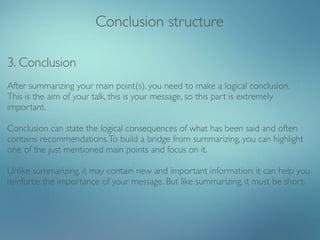
3. Conclusion
After summarizing your main point(s), you need to make a logical conclusion.
This is the aim of your talk, this is your message, so this part is extremely
important.

Conclusion can state the logical consequences of what has been said and often
contains recommendations. To build a bridge from summarizing, you can highlight
one of the just mentioned main points and focus on it.

Unlike summarizing, it may contain new and important information: it can help you
reinforce the importance of your message. But like summarizing, it must be short.
Conclusion structure

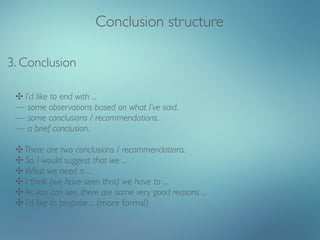
3. Conclusion

 ✣ I’d like to end with ...
 — some observations based on what I’ve said.
 — some conclusions / recommendations.
 — a brief conclusion.

 ✣ There are two conclusions / recommendations.
 ✣ So, I would suggest that we ...
 ✣ What we need is ...
 ✣ I think (we have seen that) we have to ...
 ✣ As you can see, there are some very good reasons ...
 ✣ I’d like to propose ... (more formal)
Conclusion structure

4. Closing
This is an easy part: at the end of everything you wanted to say
you just say thank you to your audience.

✣ Thank you for listening / your attention.
Conclusion structure

5. Inviting questions / discussion
We will examine how to deal with questions and discussion in the next unit,
but here is advice how to invite them.

✣ Now we have (half an hour) for questions and discussion.
✣ Alright. Now, any questions or comments?
✣ So, now I’d be very interested to hear your comments.
✣ I’d be glad to try and answer any questions.
✣ So, let’s throw it open to questions.
Conclusion structure

5. Inviting questions / discussion
 Beware of the ‘nightmare scenario‘ — total silence after your ‘Any questions?’
 Have one or two prepared questions to ask the audience. This will start
 your interacting, and audience will feel easier to ask back.

 In case you’re getting a lot of questions, watch the time, limit long questions.

 As for choosing between questions or a discussion, you can decide which way
 of interacting and getting feedback is better, depending on your specific subject
 and audience.
Formality versus creativity

REMEMBER always to adjust your speech
to your audience. As we said in Getting Started Unit,
if your audience consists of creative young people,
you’d rather be unconventional and use our following
advice as you feel is appropriate. If, on the other hand,
you’re about to be talking in front of an older
and conservative audience, sticking to the common
structure that we just described is more preferable.
LET’S go back to the aim of conclusion to make
the ultimate impression on audience and motivate it.
As we said, summarizing the main points and drawing
 consequences/recommendations is a very common
  and effective way. Especially — for logical people.
LOOK at some more effective means we can use.
Effective conclusions

Calling the audience to action

Stating your objective clearly is effective for action people, who often
just need inspiration to start doing new things.

✣ So that’s the plan. Now let’s go and put it into practice!
✣ So now it’s your turn.
✣ Now let’s make a real effort to achieve this goal!
Effective conclusions


Using rhetorical questions

We already talked about rhetorical questions in the Key Language Unit.

✣ After all, isn’t that why we’re here?
✣ Let me just finish with a question: if we don’t do it, won’t somebody else?
Effective conclusions

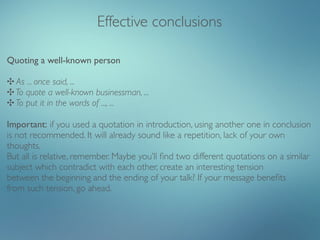
Quoting a well-known person

✣ As ... once said, ...
✣ To quote a well-known businessman, ...
✣ To put it in the words of ..., ...

Important: if you used a quotation in introduction, using another one in conclusion
is not recommended. It will already sound like a repetition, lack of your own
thoughts.
But all is relative, remember. Maybe you’ll find two different quotations on a similar
subject which contradict with each other, create an interesting tension
between the beginning and the ending of your talk? If your message benefits
from such tension, go ahead.
Effective conclusions

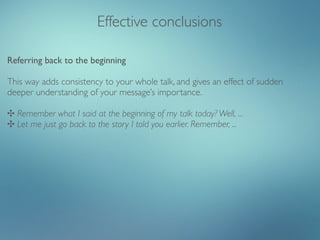
Referring back to the beginning

This way adds consistency to your whole talk, and gives an effect of sudden
deeper understanding of your message’s importance.

✣ Remember what I said at the beginning of my talk today? Well, ...
✣ Let me just go back to the story I told you earlier. Remember, ...
KEY POINTS
KEY POINTS

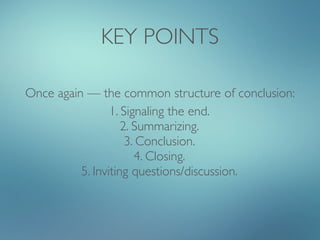
Once again — the common structure of conclusion:
KEY POINTS

Once again — the common structure of conclusion:
                 1. Signaling the end.
                    2. Summarizing.
                     3. Conclusion.
                       4. Closing.
          5. Inviting questions/discussion.
KEY POINTS

         ... and above all:

Inspire and motivate, but be short.

Presentation Skills. Unit 7: Closing

  • 1.
    PRESENTATION SKILLS Unit 7: Closing
  • 2.
    PEOPLE WILL FORGET WHAT YOU SAID, PEOPLE WILL FORGET WHAT YOU DID, BUT PEOPLE WILL NEVER FORGET HOW YOU MADE THEM FEEL. — Maya Angelou
  • 4.
    Look, there arethe Notes and the More Notes handouts on her table. The participants will sure have something to read on their way back home today. Or tomorrow.
  • 5.
    THE conclusion hasa special importance because it’s the part that your audience will remember best. Thus, it must be especially inspirational, it must make the best effort to motivate your audience.
  • 6.
    TRY to prepareyour conclusion before you prepare the rest of the talk. This will help you define your aim clearly. Because it’s not clear for you right from the start, then how can you define what you need to say throughout the whole presentation? Here’s an analogy: how can you plan a trip somewhere if you don’t know where you want to be finally?
  • 7.
    NOW, let’s lookat the most common structure of the conclusion part and the phrases we can use during each of them.
  • 8.
  • 9.
    Conclusion structure 1. Signaling the end. 2. Summarizing. 3. Conclusion. 4. Closing. 5. Inviting questions/discussion.
  • 10.
    Conclusion structure 1. Signalingthe end At the end of the main body of your presentation you say a couple phrases which let the audience know you’re about to stop. This will attract everybody’s attention. ✣ That’s all I want to say for now on... ✣ Okay, that ends (the third part of) my talk. ✣ That brings me to the end of my presentation... ✣ That covers all I wanted to say today.
  • 11.
    Conclusion structure 2. Summarizing Abrief summary restates main point(s) of your talk and restates what the audience must understand and remember. Important: summary cannot contain any new information and must be short. Don’t launch into another mini-presentation. And the number of your main points cannot be more than three. Otherwise the word ‘main’ just loses its sense. ✣ I’d like to end with a summary of my main point(s). ✣ Let me just run over the key points again. ✣ I’ll briefly summarize the main issues. ✣ To sum up, ...
  • 12.
    Conclusion structure 3. Conclusion Aftersummarizing your main point(s), you need to make a logical conclusion. This is the aim of your talk, this is your message, so this part is extremely important. Conclusion can state the logical consequences of what has been said and often contains recommendations. To build a bridge from summarizing, you can highlight one of the just mentioned main points and focus on it. Unlike summarizing, it may contain new and important information: it can help you reinforce the importance of your message. But like summarizing, it must be short.
  • 13.
    Conclusion structure 3. Conclusion ✣ I’d like to end with ... — some observations based on what I’ve said. — some conclusions / recommendations. — a brief conclusion. ✣ There are two conclusions / recommendations. ✣ So, I would suggest that we ... ✣ What we need is ... ✣ I think (we have seen that) we have to ... ✣ As you can see, there are some very good reasons ... ✣ I’d like to propose ... (more formal)
  • 14.
    Conclusion structure 4. Closing Thisis an easy part: at the end of everything you wanted to say you just say thank you to your audience. ✣ Thank you for listening / your attention.
  • 15.
    Conclusion structure 5. Invitingquestions / discussion We will examine how to deal with questions and discussion in the next unit, but here is advice how to invite them. ✣ Now we have (half an hour) for questions and discussion. ✣ Alright. Now, any questions or comments? ✣ So, now I’d be very interested to hear your comments. ✣ I’d be glad to try and answer any questions. ✣ So, let’s throw it open to questions.
  • 16.
    Conclusion structure 5. Invitingquestions / discussion Beware of the ‘nightmare scenario‘ — total silence after your ‘Any questions?’ Have one or two prepared questions to ask the audience. This will start your interacting, and audience will feel easier to ask back. In case you’re getting a lot of questions, watch the time, limit long questions. As for choosing between questions or a discussion, you can decide which way of interacting and getting feedback is better, depending on your specific subject and audience.
  • 17.
  • 18.
    Formality versus creativity REMEMBERalways to adjust your speech to your audience. As we said in Getting Started Unit, if your audience consists of creative young people, you’d rather be unconventional and use our following advice as you feel is appropriate. If, on the other hand, you’re about to be talking in front of an older and conservative audience, sticking to the common structure that we just described is more preferable.
  • 19.
    LET’S go backto the aim of conclusion to make the ultimate impression on audience and motivate it. As we said, summarizing the main points and drawing consequences/recommendations is a very common and effective way. Especially — for logical people.
  • 20.
    LOOK at somemore effective means we can use.
  • 21.
    Effective conclusions Calling theaudience to action Stating your objective clearly is effective for action people, who often just need inspiration to start doing new things. ✣ So that’s the plan. Now let’s go and put it into practice! ✣ So now it’s your turn. ✣ Now let’s make a real effort to achieve this goal!
  • 22.
    Effective conclusions Using rhetoricalquestions We already talked about rhetorical questions in the Key Language Unit. ✣ After all, isn’t that why we’re here? ✣ Let me just finish with a question: if we don’t do it, won’t somebody else?
  • 23.
    Effective conclusions Quoting awell-known person ✣ As ... once said, ... ✣ To quote a well-known businessman, ... ✣ To put it in the words of ..., ... Important: if you used a quotation in introduction, using another one in conclusion is not recommended. It will already sound like a repetition, lack of your own thoughts. But all is relative, remember. Maybe you’ll find two different quotations on a similar subject which contradict with each other, create an interesting tension between the beginning and the ending of your talk? If your message benefits from such tension, go ahead.
  • 24.
    Effective conclusions Referring backto the beginning This way adds consistency to your whole talk, and gives an effect of sudden deeper understanding of your message’s importance. ✣ Remember what I said at the beginning of my talk today? Well, ... ✣ Let me just go back to the story I told you earlier. Remember, ...
  • 25.
  • 26.
    KEY POINTS Once again— the common structure of conclusion:
  • 27.
    KEY POINTS Once again— the common structure of conclusion: 1. Signaling the end. 2. Summarizing. 3. Conclusion. 4. Closing. 5. Inviting questions/discussion.
  • 28.
    KEY POINTS ... and above all: Inspire and motivate, but be short.