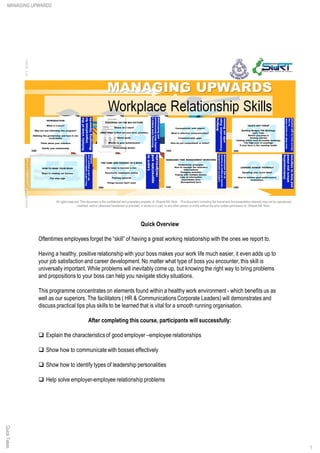
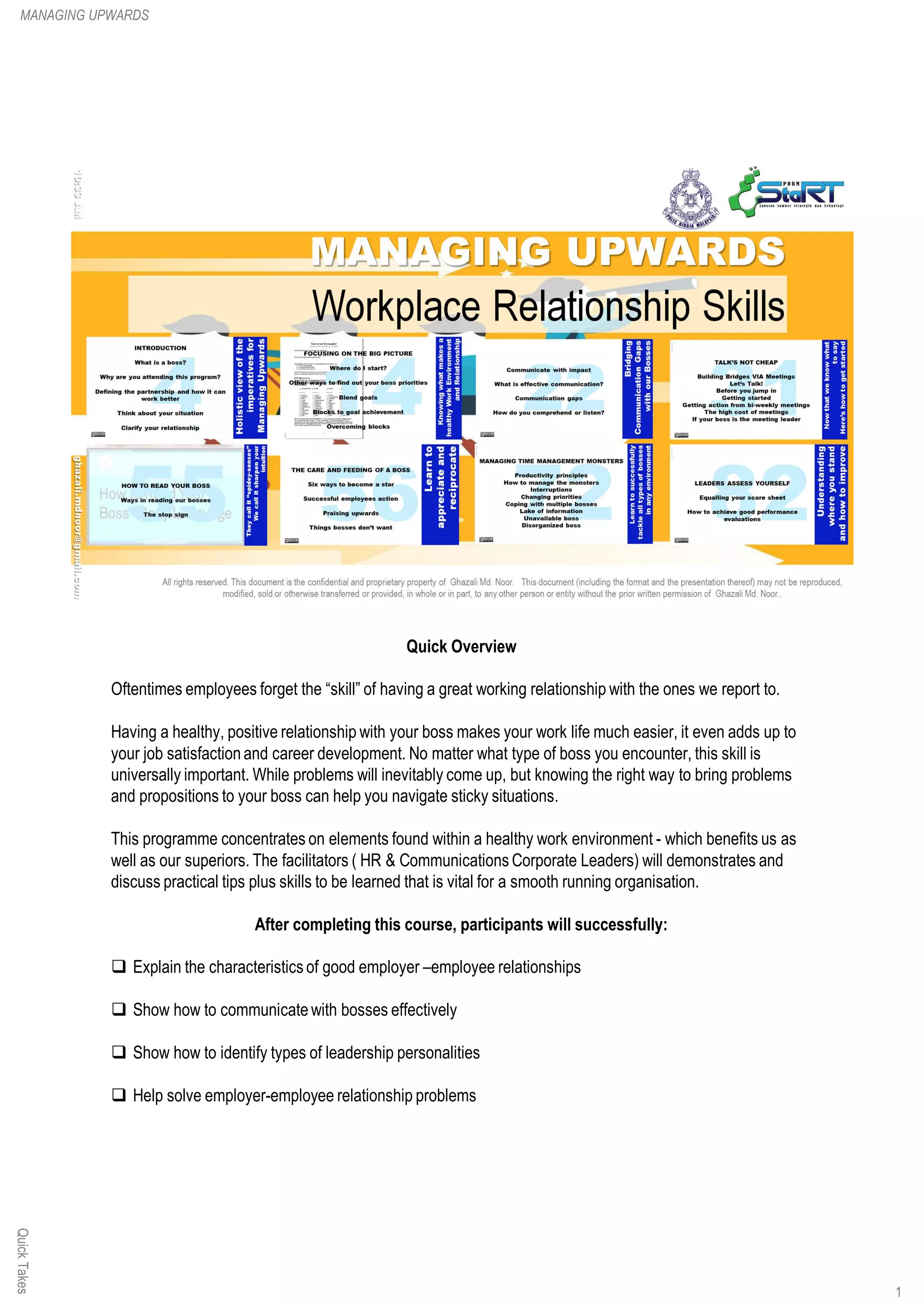
Quick Overview
Oftentimes employees forget the “skill” of having a great working relationship with the ones we report to.
Having a healthy, positive relationship with your boss makes your work life much easier, it even adds up to
your job satisfaction and career development. No matter what type of boss you encounter, this skill is
universally important. While problems will inevitably come up, but knowing the right way to bring problems
and propositions to your boss can help you navigate sticky situations.
This programme concentrates on elements found within a healthy work environment - which benefits us as
well as our superiors. The facilitators ( HR & Communications Corporate Leaders) will demonstrates and
discuss practical tips plus skills to be learned that is vital for a smooth running organisation.
After completing this course, participants will successfully:
q Explain the characteristics of good employer –employee relationships
q Show how to communicate with bosses effectively
q Show how to identify types of leadership personalities
q Help solve employer-employee relationship problems
MANAGING UPWARDS
1
QuickTakes
Influencing 1
INFLUENCER Brief
q You are a Team Leader. The other role player is your Manager, to whom you report.
q You have worked for this company for the last 4 years. The work is very enjoyable however you get very
little development time from him/her, and you are very keen to get on. They do the annual performance
appraisal with you – lots of promises are made, however nothing seems to get done. There’s always an
excuse. As your Manager is so busy, you rarely get one-to-one time with them.
q Your colleague, another Team Leader but in a different section, always seems to get plenty of time from
their Manager – reviewing performance, action planning, different projects, extra responsibility.She’s
even spent some time in another part of the organisation for a couple of days on secondment.
q You are pretty fed up with this and have pre-arranged a meeting with your Manager. You said that you
want to discuss training and development.
INFLUENCE your Manager to give you more time to develop you. Make sure you get a firm commitment
such as:
q The first ‘coaching’ session put in the diary.
q Another meeting secured to discuss a potential secondment you would like.
QuickTakesMANAGING UPWARDS
4
Influencing 1
INFLUENCEE Brief
q You are a Manager. The other role player is a Team Leader who reports to you.
q The Team Leader has worked for you for 4 years. They are really good at their job.
q You are a great believer in making your own opportunities in life – you had to when you were looking to
be developed and promoted. Nobody put it ‘on a plate’ for you.
q As a really pressurised Manager, you sometimes don’t have as much time for your staff as you would
like.
q Your Team Leader has invited you to a meeting – said something about training and development, which
you take to mean for your Leader’s team.
QuickTakesMANAGING UPWARDS
5
QuickTakes
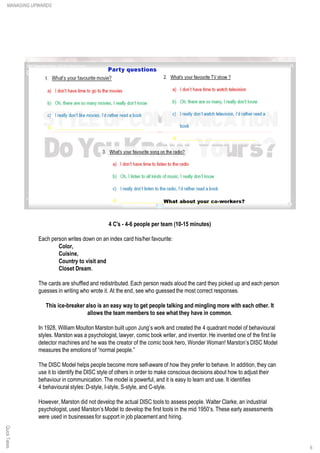
4 C's - 4-6 people per team (10-15 minutes)
Each person writes down on an index card his/her favourite:
Color,
Cuisine,
Country to visit and
Closet Dream.
The cards are shuffled and redistributed. Each person reads aloud the card they picked up and each person
guesses in writing who wrote it. At the end, see who guessed the most correct responses.
This ice-breaker also is an easy way to get people talking and mingling more with each other. It
allows the team members to see what they have in common.
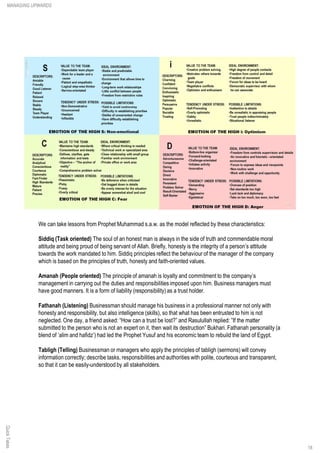
In 1928, William Moulton Marston built upon Jung’s work and created the 4 quadrant model of behavioural
styles. Marston was a psychologist, lawyer, comic book writer, and inventor. He invented one of the first lie
detector machines and he was the creator of the comic book hero, Wonder Woman! Marston’s DISC Model
measures the emotions of “normal people.”
The DISC Model helps people become more self-aware of how they prefer to behave. In addition, they can
use it to identify the DISC style of others in order to make conscious decisions about how to adjust their
behaviour in communication. The model is powerful, and it is easy to learn and use. It identifies
4 behavioural styles: D-style, I-style, S-style, and C-style.
However, Marston did not develop the actual DISC tools to assess people. Walter Clarke, an industrial
psychologist, used Marston’s Model to develop the first tools in the mid 1950’s. These early assessments
were used in businesses for support in job placement and hiring.
MANAGING UPWARDS
6
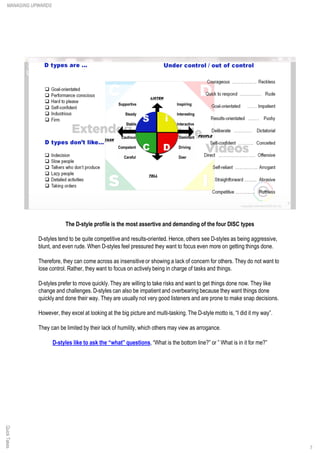
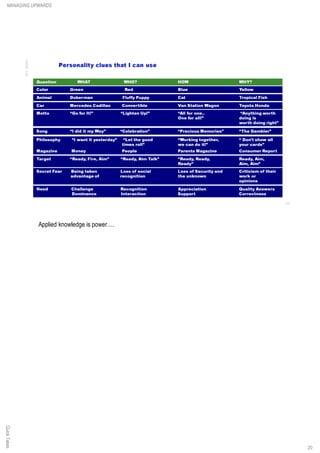
The D-style profile is the most assertive and demanding of the four DISC types
D-styles tend to be quite competitiveand results-oriented. Hence, others see D-styles as being aggressive,
blunt, and even rude. When D-styles feel pressured they want to focus even more on getting things done.
Therefore, they can come across as insensitiveor showing a lack of concern for others. They do not want to
lose control. Rather, they want to focus on actively being in charge of tasks and things.
D-styles prefer to move quickly. They are willing to take risks and want to get things done now. They like
change and challenges. D-styles can also be impatient and overbearing because they want things done
quickly and done their way. They are usually not very good listeners and are prone to make snap decisions.
However, they excel at looking at the big picture and multi-tasking. The D-style motto is, “I did it my way”.
They can be limited by their lack of humility, which others may view as arrogance.
D-styles like to ask the “what” questions, “What is the bottom line?” or ” What is in it for me?”
QuickTakesMANAGING UPWARDS
7
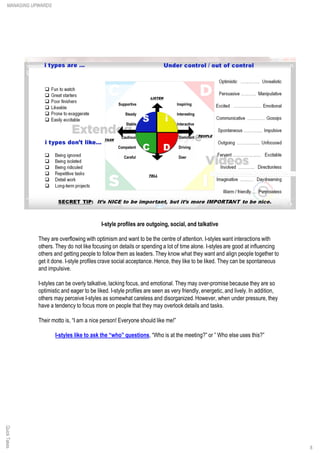
I-style profiles are outgoing, social, and talkative
They are overflowing with optimism and want to be the centre of attention. I-styles want interactions with
others. They do not like focusing on details or spending a lot of time alone. I-styles are good at influencing
others and getting people to follow them as leaders. They know what they want and align people together to
get it done. I-style profiles crave social acceptance. Hence, they like to be liked. They can be spontaneous
and impulsive.
I-styles can be overly talkative, lacking focus, and emotional. They may over-promise because they are so
optimistic and eager to be liked. I-style profiles are seen as very friendly, energetic, and lively. In addition,
others may perceive I-styles as somewhat careless and disorganized. However, when under pressure, they
have a tendency to focus more on people that they may overlook details and tasks.
Their motto is, “I am a nice person! Everyone should like me!”
I-styles like to ask the “who” questions, “Who is at the meeting?” or ” Who else uses this?”
QuickTakesMANAGING UPWARDS
8
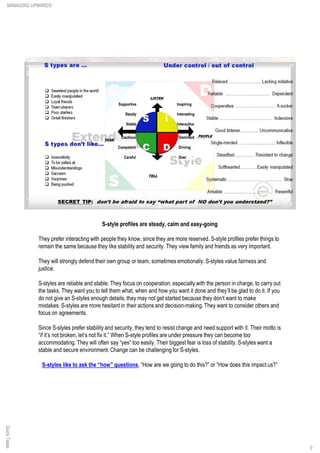
S-style profiles are steady, calm and easy-going
They prefer interacting with people they know, since they are more reserved. S-style profiles prefer things to
remain the same because they like stability and security. They view family and friends as very important.
They will strongly defend their own group or team, sometimes emotionally.S-styles value fairness and
justice.
S-styles are reliable and stable. They focus on cooperation, especially with the person in charge, to carry out
the tasks. They want you to tell them what, when and how you want it done and they’ll be glad to do it. If you
do not give an S-styles enough details, they may not get started because they don’t want to make
mistakes. S-styles are more hesitant in their actions and decision-making. They want to consider others and
focus on agreements.
Since S-styles prefer stability and security, they tend to resist change and need support with it. Their motto is
“if it’s not broken, let’s not fix it.” When S-style profiles are under pressure they can become too
accommodating. They will often say “yes” too easily. Their biggest fear is loss of stability. S-styles want a
stable and secure environment. Change can be challenging for S-styles.
S-styles like to ask the “how” questions, “How are we going to do this?” or “How does this impact us?”
QuickTakesMANAGING UPWARDS
9
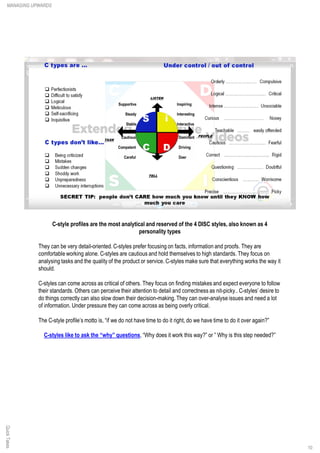
C-style profiles are the most analytical and reserved of the 4 DISC styles, also known as 4
personality types
They can be very detail-oriented. C-styles prefer focusing on facts, information and proofs. They are
comfortable working alone. C-styles are cautious and hold themselves to high standards. They focus on
analysing tasks and the quality of the product or service. C-styles make sure that everything works the way it
should.
C-styles can come across as critical of others. They focus on finding mistakes and expect everyone to follow
their standards. Others can perceive their attention to detail and correctness as nit-picky.. C-styles’ desire to
do things correctly can also slow down their decision-making. They can over-analyse issues and need a lot
of information. Under pressure they can come across as being overly critical.
The C-style profile’s motto is, “if we do not have time to do it right, do we have time to do it over again?”
C-styles like to ask the “why” questions, “Why does it work this way?” or ” Why is this step needed?”
QuickTakesMANAGING UPWARDS
10
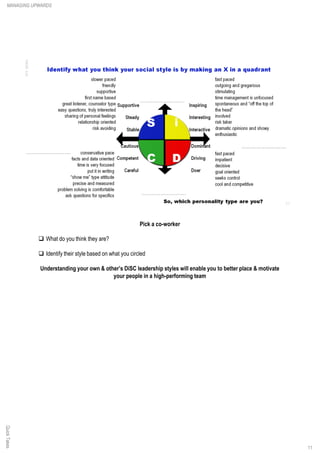
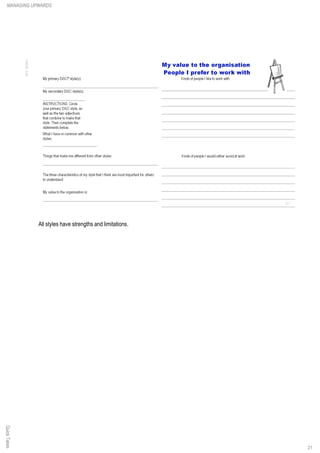
Pick a co-worker
q What do you think they are?
q Identify their style based on what you circled
Understanding your own & other’s DiSC leadership styles will enable you to better place & motivate
your people in a high-performing team
QuickTakesMANAGING UPWARDS
11
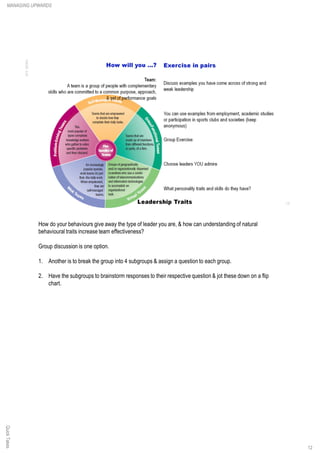
How do your behaviours give away the type of leader you are, & how can understanding of natural
behavioural traits increase team effectiveness?
Group discussion is one option.
1. Another is to break the group into 4 subgroups & assign a question to each group.
2. Have the subgroups to brainstorm responses to their respective question & jot these down on a flip
chart.
QuickTakesMANAGING UPWARDS
12
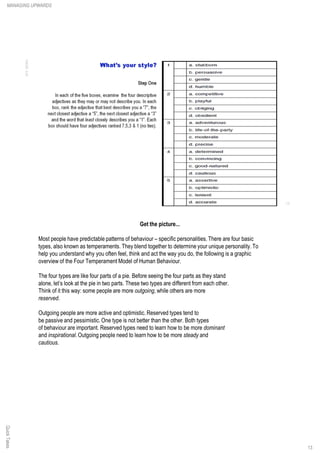
Get the picture...
Most people have predictable patterns of behaviour – specific personalities. There are four basic
types, also known as temperaments. They blend together to determine your unique personality.To
help you understand why you often feel, think and act the way you do, the following is a graphic
overview of the Four Temperament Model of Human Behaviour.
The four types are like four parts of a pie. Before seeing the four parts as they stand
alone, let’s look at the pie in two parts. These two types are different from each other.
Think of it this way: some people are more outgoing, while others are more
reserved.
Outgoing people are more active and optimistic. Reserved types tend to
be passive and pessimistic. One type is not better than the other. Both types
of behaviour are important. Reserved types need to learn how to be more dominant
and inspirational.Outgoing people need to learn how to be more steady and
cautious.
QuickTakesMANAGING UPWARDS
13
Also, there are two other parts of the pie – two other types of personalities. These are also
different from each other. Some people are more task-oriented, while others are more
people-oriented. Task-oriented types enjoy doing “things” [directing and correcting]
while people-oriented individuals like to relate with others [interacting and sharing].
When you look at the four parts of the pie together, you can visualize the four
temperament types.
Everyone is a unique blend of these four parts.
QuickTakesMANAGING UPWARDS
14
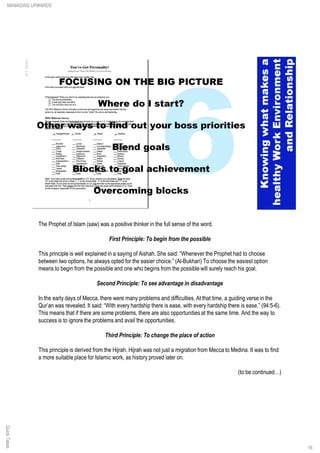
The Prophet of Islam (saw) was a positive thinker in the full sense of the word.
First Principle: To begin from the possible
This principle is well explained in a saying of Aishah. She said: “Whenever the Prophet had to choose
between two options, he always opted for the easier choice.” (Al-Bukhari) To choose the easiest option
means to begin from the possible and one who begins from the possible will surely reach his goal.
Second Principle: To see advantage in disadvantage
In the early days of Mecca, there were many problems and difficulties. At that time, a guiding verse in the
Qur’an was revealed. It said: “With every hardship there is ease, with every hardship there is ease.” (94:5-6).
This means that if there are some problems, there are also opportunities at the same time. And the way to
success is to ignore the problems and avail the opportunities.
Third Principle: To change the place of action
This principle is derived from the Hijrah. Hijrah was not just a migration from Mecca to Medina. It was to find
a more suitable place for Islamic work, as history proved later on.
(to be continued…)
QuickTakesMANAGING UPWARDS
16
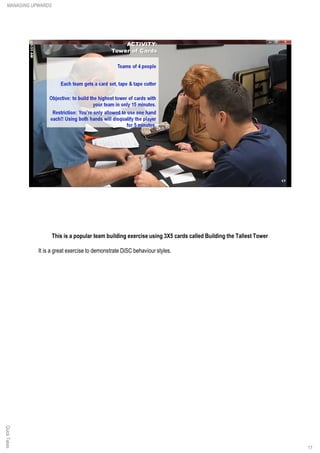
This is a popular team building exercise using 3X5 cards called Building the Tallest Tower
It is a great exercise to demonstrate DiSC behaviour styles.
QuickTakesMANAGING UPWARDS
17
We can take lessons from Prophet Muhammad s.a.w. as the model reflected by these characteristics:
Siddiq (Task oriented) The soul of an honest man is always in the side of truth and commendablemoral
attitude and being proud of being servant of Allah. Briefly, honesty is the integrity of a person’s attitude
towards the work mandated to him. Siddiq principles reflect the behaviour of the manager of the company
which is based on the principles of truth, honesty and faith-oriented values.
Amanah (People oriented) The principle of amanah is loyalty and commitment to the company’s
management in carrying out the duties and responsibilities imposed upon him. Business managers must
have good manners. It is a form of liability (responsibility) as a trust holder.
Fathanah (Listening) Businessman should manage his business in a professional manner not only with
honesty and responsibility, but also intelligence (skills), so that what has been entrusted to him is not
neglected. One day, a friend asked: “How can a trust be lost?” and Rasulullah replied: ”If the matter
submitted to the person who is not an expert on it, then wait its destruction” Bukhari. Fathanah personality (a
blend of ’alim and hafidz’) had led the Prophet Yusuf and his economic team to rebuild the land of Egypt.

Tabligh (Telling) Businessman or managers who apply the principles of tabligh (sermons) will convey
information correctly; describe tasks, responsibilities and authorities with polite, courteous and transparent,
so that it can be easily-understood by all stakeholders.
QuickTakesMANAGING UPWARDS
18
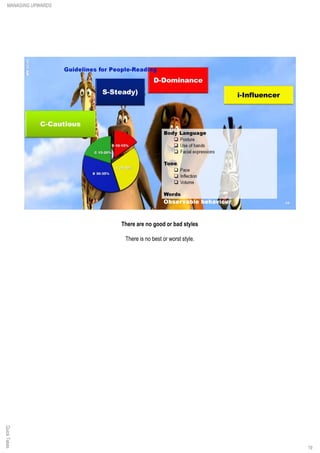
There are no good or bad styles
There is no best or worst style.
QuickTakesMANAGING UPWARDS
19
Applied knowledge is power….
QuickTakesMANAGING UPWARDS
20
All styles have strengths and limitations.
QuickTakesMANAGING UPWARDS
21
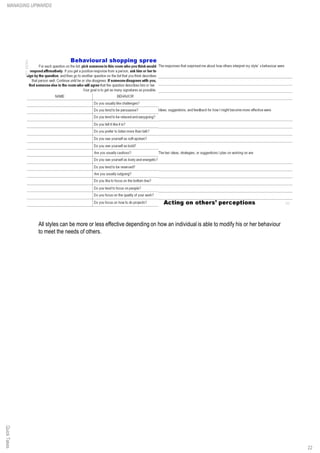
All styles can be more or less effective depending on how an individual is able to modify his or her behaviour
to meet the needs of others.
QuickTakesMANAGING UPWARDS
22
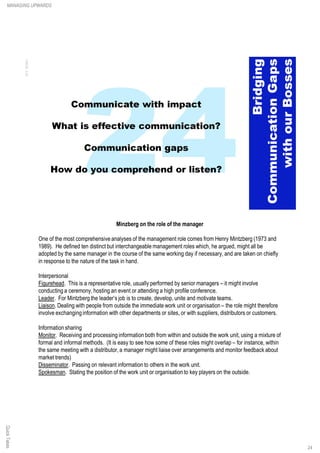
Minzberg on the role of the manager
One of the most comprehensiveanalyses of the management role comes from Henry Mintzberg (1973 and
1989). He defined ten distinct but interchangeable management roles which, he argued, might all be
adopted by the same manager in the course of the same working day if necessary, and are taken on chiefly
in response to the nature of the task in hand.
Interpersonal
Figurehead. This is a representative role, usually performed by senior managers – it might involve
conducting a ceremony, hosting an event or attending a high profile conference.
Leader. For Mintzberg the leader’s job is to create, develop, unite and motivate teams.
Liaison. Dealing with people from outside the immediate work unit or organisation – the role might therefore
involve exchanging information with other departments or sites, or with suppliers, distributors or customers.
Information sharing
Monitor. Receiving and processing information both from within and outside the work unit, using a mixture of
formal and informal methods. (It is easy to see how some of these roles might overlap – for instance, within
the same meeting with a distributor, a manager might liaise over arrangements and monitor feedback about
market trends)
Disseminator. Passing on relevant information to others in the work unit.
Spokesman. Stating the position of the work unit or organisation to key players on the outside.
QuickTakesMANAGING UPWARDS
24
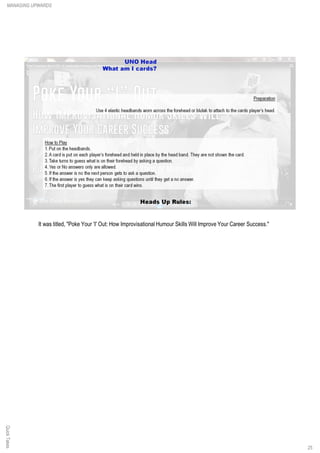
It was titled, "Poke Your 'I' Out: How Improvisational Humour Skills Will Improve Your Career Success."
QuickTakesMANAGING UPWARDS
25
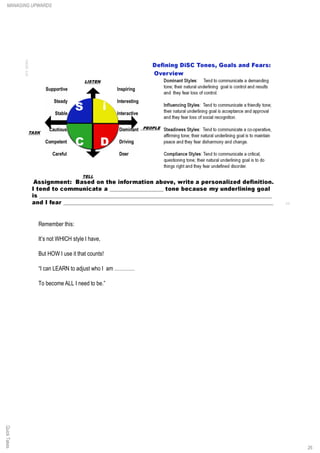
Remember this:
It’s not WHICH style I have,
But HOW I use it that counts!
“I can LEARN to adjust who I am …………
To become ALL I need to be.”
QuickTakesMANAGING UPWARDS
26
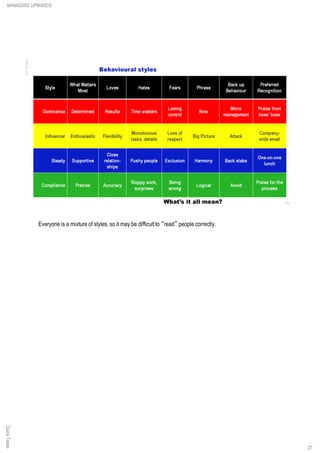
Everyone is a mixture of styles, so it may be difficult to “read” people correctly.
QuickTakesMANAGING UPWARDS
27
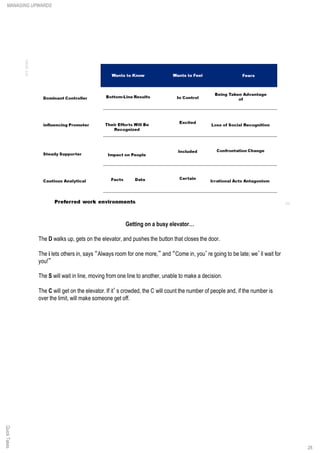
Getting on a busy elevator…
The D walks up, gets on the elevator, and pushes the button that closes the door.
The i lets others in, says “Always room for one more,” and “Come in, you’re going to be late; we’ll wait for
you!”
The S will wait in line, moving from one line to another, unable to make a decision.
The C will get on the elevator. If it’s crowded, the C will count the number of people and, if the number is
over the limit, will make someone get off.
QuickTakesMANAGING UPWARDS
28
QuickTakes
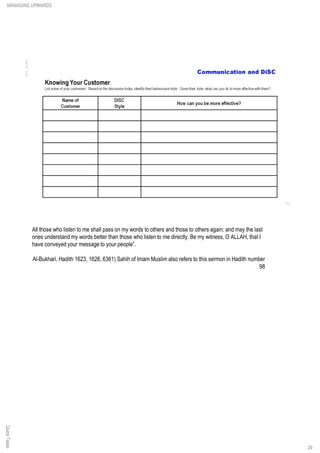
All those who listen to me shall pass on my words to others and those to others again; and may the last
ones understand my words better than those who listen to me directly. Be my witness, O ALLAH, that I
have conveyed your message to your people”.
Al-Bukhari, Hadith 1623, 1626, 6361) Sahih of Imam Muslim also refers to this sermon in Hadith number
98
MANAGING UPWARDS
29
All the Prophet’s activities were result-oriented.
Fourth Principle: To make a friend out of an enemy
The Prophet (saw) of Islam was repeatedly subjected to practices of antagonism by the unbelievers. At that
time the Qur’an enjoined upon him the return of good for evil. And then, as the Qur’an added, “You will see
your direst enemy has become your closest friend” (41:34). It means that a good deed in return of a bad
deed has a conquering effect over your enemies. And the life of the Prophet(saw) is a historical proof of this
principle.
Fifth Principle: To turn minus into plus
After the Battle of Badr, about 70 of the unbelievers were taken as the prisoners of war. They were educated
people. The Prophet(saw) announced that if any one of them would teach ten Muslim children how to read
and write he would be freed. This was the first school in the history of Islam in which all of the students were
Muslims, and all of the teachers were from the enemy rank. Here I shall quote a British orientalist who
remarked about the Prophet of Islam (saw): He faced adversity with the determination to writing success out
of failure.
Sixth Principle: The power of peace is stronger than the power of violence
When Mecca was conquered, all of the Prophet’s (saw) direst opponents were brought before him. They
were war criminals, in every sense of the word. But the Prophet (saw) did not order to kill them. He simply
said: “Go, you are free.” The result of this kind behavior was miraculous. They immediately accepted Islam.
(to be continued…)
QuickTakesMANAGING UPWARDS
31
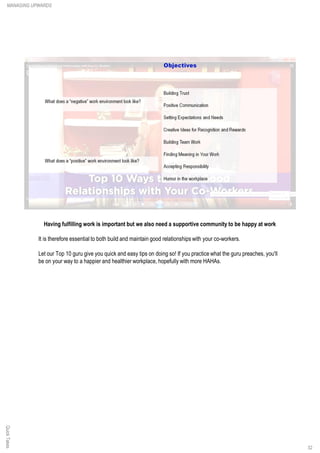
Having fulfilling work is important but we also need a supportive community to be happy at work
It is therefore essential to both build and maintain good relationships with your co-workers.
Let our Top 10 guru give you quick and easy tips on doing so! If you practice what the guru preaches, you'll
be on your way to a happier and healthier workplace, hopefully with more HAHAs.
QuickTakesMANAGING UPWARDS
32
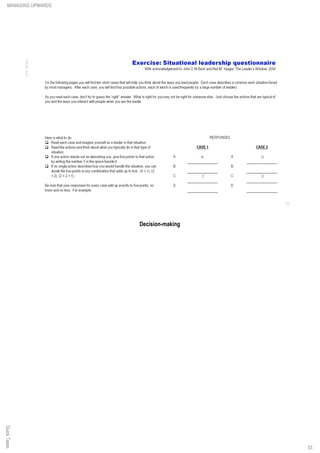
Decision-making
QuickTakesMANAGING UPWARDS
33
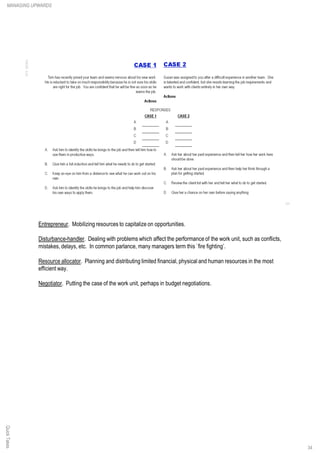
Entrepreneur. Mobilizing resources to capitalize on opportunities.
Disturbance-handler. Dealing with problems which affect the performance of the work unit, such as conflicts,
mistakes, delays, etc. In common parlance, many managers term this `fire fighting’.
Resource allocator. Planning and distributing limited financial, physical and human resources in the most
efficient way.
Negotiator. Putting the case of the work unit, perhaps in budget negotiations.
QuickTakesMANAGING UPWARDS
34
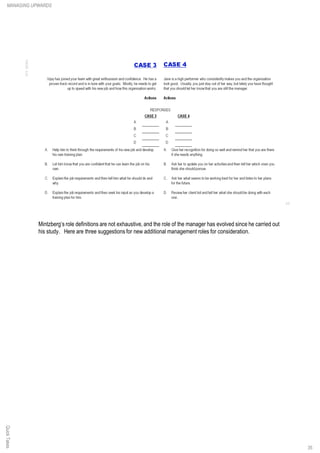
Mintzberg’s role definitions are not exhaustive, and the role of the manager has evolved since he carried out
his study. Here are three suggestions for new additional management roles for consideration.
QuickTakesMANAGING UPWARDS
35
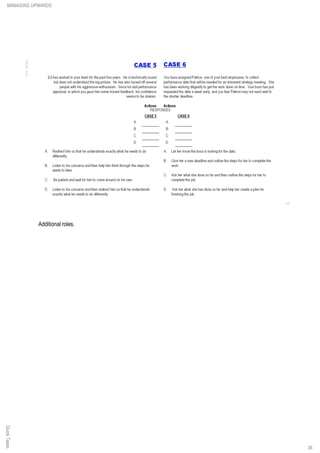
Additional roles.
QuickTakesMANAGING UPWARDS
36
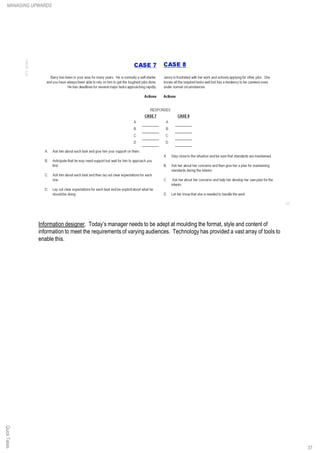
Information designer. Today’s manager needs to be adept at moulding the format, style and content of
information to meet the requirements of varying audiences. Technology has provided a vast array of tools to
enable this.
QuickTakesMANAGING UPWARDS
37
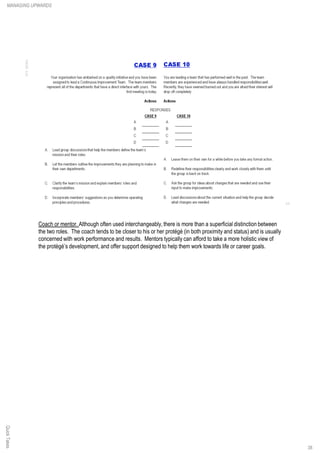
Coach or mentor. Although often used interchangeably,there is more than a superficial distinction between
the two roles. The coach tends to be closer to his or her protégé (in both proximity and status) and is usually
concerned with work performance and results. Mentors typically can afford to take a more holistic view of
the protégé’s development, and offer support designed to help them work towards life or career goals.
QuickTakesMANAGING UPWARDS
38
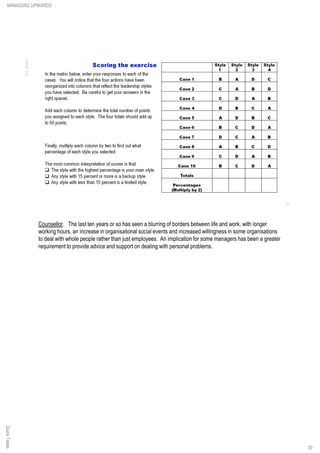
Counsellor. The last ten years or so has seen a blurring of borders between life and work, with longer
working hours, an increase in organisational social events and increased willingness in some organisations
to deal with whole people rather than just employees. An implication for some managers has been a greater
requirement to provide advice and support on dealing with personal problems.
QuickTakesMANAGING UPWARDS
39
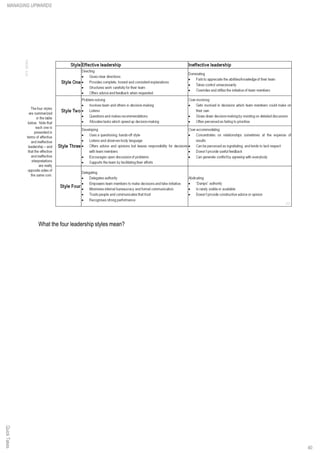
What the four leadership styles mean?
QuickTakesMANAGING UPWARDS
40
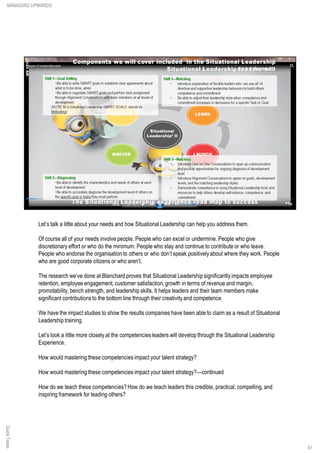
Let’s talk a little about your needs and how Situational Leadership can help you address them.
Of course all of your needs involve people. People who can excel or undermine. People who give
discretionary effort or who do the minimum. People who stay and continue to contribute or who leave.
People who endorse the organisation to others or who don’t speak positively about where they work. People
who are good corporate citizens or who aren’t.
The research we’ve done at Blanchard proves that Situational Leadership significantly impacts employee
retention, employee engagement, customer satisfaction, growth in terms of revenue and margin,
promotability,bench strength, and leadership skills. It helps leaders and their team members make
significant contributions to the bottom line through their creativity and competence.
We have the impact studies to show the results companies have been able to claim as a result of Situational
Leadership training.
Let’s look a little more closely at the competencies leaders will develop through the Situational Leadership
Experience.
How would mastering these competencies impact your talent strategy?
How would mastering these competencies impact your talent strategy?—continued
How do we teach these competencies?How do we teach leaders this credible, practical, compelling, and
inspiring framework for leading others?
QuickTakes
41
MANAGING UPWARDS
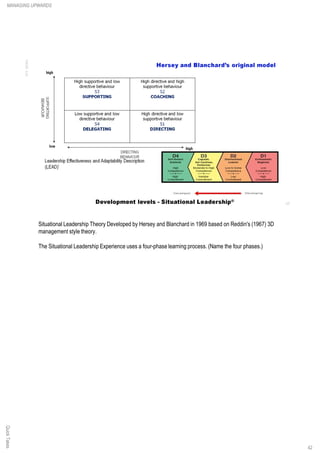
Situational Leadership Theory Developed by Hersey and Blanchard in 1969 based on Reddin's (1967) 3D
management style theory.
The Situational Leadership Experience uses a four-phase learning process. (Name the four phases.)
MANAGING UPWARDSQuickTakes
42
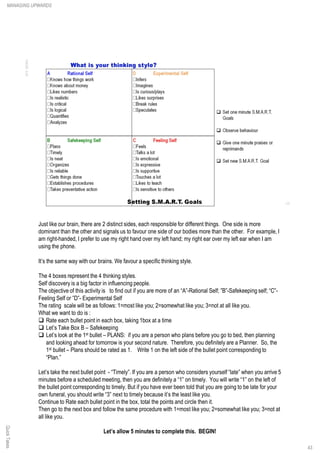
Just like our brain, there are 2 distinct sides, each responsible for different things. One side is more
dominant than the other and signals us to favour one side of our bodies more than the other. For example, I
am right-handed, I prefer to use my right hand over my left hand; my right ear over my left ear when I am
using the phone.
It’s the same way with our brains. We favour a specific thinking style.
The 4 boxes represent the 4 thinking styles.
Self discovery is a big factor in influencing people.
The objective of this activity is to find out if you are more of an “A”-Rational Self; ”B”-Safekeeping self; “C”-
Feeling Self or ”D”- Experimental Self
The rating scale will be as follows: 1=most like you; 2=somewhat like you; 3=not at all like you.
What we want to do is :
q Rate each bullet point in each box, taking 1box at a time
q Let’s Take Box B – Safekeeping
q Let’s look at the 1st bullet – PLANS: if you are a person who plans before you go to bed, then planning
and looking ahead for tomorrow is your second nature. Therefore, you definitely are a Planner. So, the
1st bullet – Plans should be rated as 1. Write 1 on the left side of the bullet point corresponding to
“Plan.”
Let’s take the next bullet point - “Timely”. If you are a person who considers yourself “late” when you arrive 5
minutes before a scheduled meeting, then you are definitely a “1” on timely. You will write “1” on the left of
the bullet point corresponding to timely. But if you have ever been told that you are going to be late for your
own funeral, you should write “3” next to timely because it’s the least like you.
Continue to Rate each bullet point in the box, total the points and circle then it.
Then go to the next box and follow the same procedure with 1=most like you; 2=somewhat like you; 3=not at
all like you.
Let’s allow 5 minutes to complete this. BEGIN!
MANAGING UPWARDSQuickTakes
43
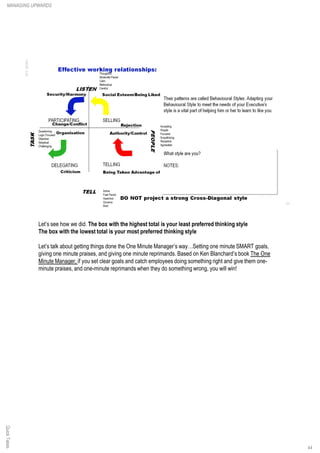
Let’s see how we did. The box with the highest total is your least preferred thinking style
The box with the lowest total is your most preferred thinking style
Let’s talk about getting things done the One Minute Manager’s way…Setting one minute SMART goals,
giving one minute praises, and giving one minute reprimands. Based on Ken Blanchard’s book The One
Minute Manager, if you set clear goals and catch employees doing something right and give them one-
minute praises, and one-minute reprimands when they do something wrong, you will win!
QuickTakesMANAGING UPWARDS
44
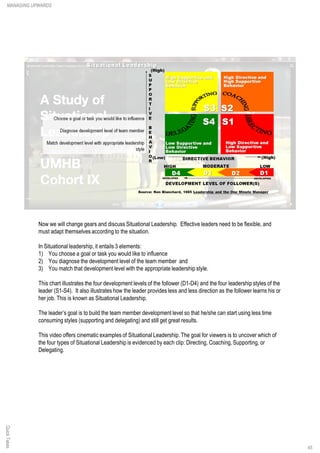
Now we will change gears and discuss Situational Leadership. Effective leaders need to be flexible, and
must adapt themselves according to the situation.
In Situational leadership, it entails 3 elements:
1) You choose a goal or task you would like to influence
2) You diagnose the development level of the team member and
3) You match that development level with the appropriate leadership style.
This chart illustrates the four development levels of the follower (D1-D4) and the four leadership styles of the
leader (S1-S4). It also illustrates how the leader provides less and less direction as the follower learns his or
her job. This is known as Situational Leadership.
The leader’s goal is to build the team member development level so that he/she can start using less time
consuming styles (supporting and delegating) and still get great results.
This video offers cinematic examples of Situational Leadership. The goal for viewers is to uncover which of
the four types of Situational Leadership is evidenced by each clip: Directing, Coaching, Supporting, or
Delegating.
MANAGING UPWARDSQuickTakes
45
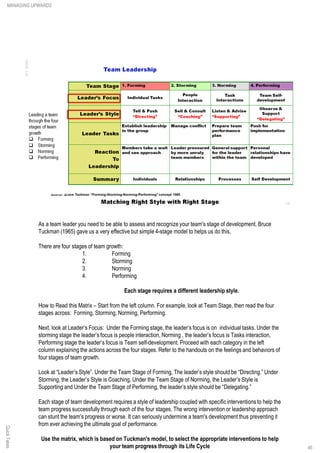
As a team leader you need to be able to assess and recognize your team's stage of development. Bruce
Tuckman (1965) gave us a very effective but simple 4-stage model to helps us do this.
There are four stages of team growth:
1. Forming
2. Storming
3. Norming
4. Performing
Each stage requires a different leadership style.
How to Read this Matrix – Start from the left column. For example, look at Team Stage, then read the four
stages across: Forming, Storming, Norming, Performing.
Next, look at Leader’s Focus: Under the Forming stage, the leader’s focus is on individual tasks. Under the
storming stage the leader’s focus is people interaction, Norming , the leader’s focus is Tasks interaction,
Performing stage the leader’s focus is Team self-development. Proceed with each category in the left
column explaining the actions across the four stages. Refer to the handouts on the feelings and behaviors of
four stages of team growth.
Look at “Leader’s Style”. Under the Team Stage of Forming, The leader’s style should be “Directing.” Under
Storming, the Leader’s Style is Coaching, Under the Team Stage of Norming, the Leader’s Style is
Supporting and Under the Team Stage of Performing, the leader’s style should be “Delegating.”
Each stage of team development requires a style of leadership coupled with specific interventions to help the
team progress successfully through each of the four stages. The wrong intervention or leadership approach
can stunt the team's progress or worse. It can seriously undermine a team's development thus preventing it
from ever achieving the ultimate goal of performance.
Use the matrix, which is based on Tuckman's model, to select the appropriate interventions to help
your team progress through its Life Cycle
QuickTakesMANAGING UPWARDS
46
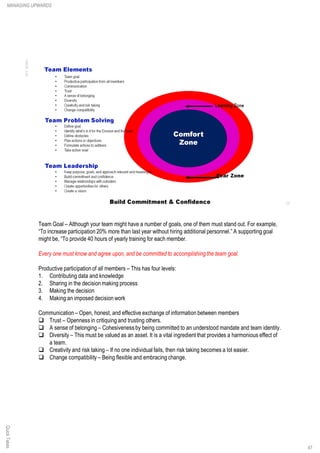
Team Goal – Although your team might have a number of goals, one of them must stand out. For example,
“To increase participation 20% more than last year without hiring additional personnel.” A supporting goal
might be, “To provide 40 hours of yearly training for each member.
Every one must know and agree upon, and be committed to accomplishing the team goal.
Productive participation of all members – This has four levels:
1. Contributing data and knowledge
2. Sharing in the decision making process
3. Making the decision
4. Making an imposed decision work
Communication – Open, honest, and effective exchange of information between members
q Trust – Openness in critiquing and trusting others.
q A sense of belonging – Cohesiveness by being committed to an understood mandate and team identity.
q Diversity – This must be valued as an asset. It is a vital ingredient that provides a harmonious effect of
a team.
q Creativity and risk taking – If no one individual fails, then risk taking becomes a lot easier.
q Change compatibility – Being flexible and embracing change.
QuickTakesMANAGING UPWARDS
47
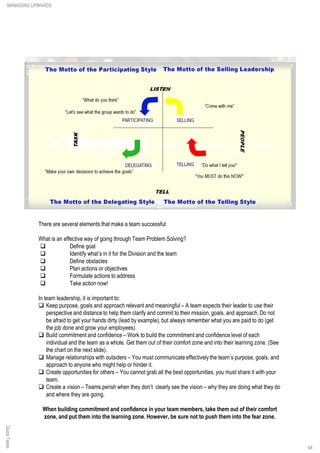
There are several elements that make a team successful:
What is an effective way of going through Team Problem Solving?
q Define goal
q Identify what’s in it for the Division and the team
q Define obstacles
q Plan actions or objectives
q Formulate actions to address
q Take action now!
In team leadership, it is important to:
q Keep purpose, goals and approach relevant and meaningful – A team expects their leader to use their
perspective and distance to help them clarify and commit to their mission, goals, and approach. Do not
be afraid to get your hands dirty (lead by example), but always remember what you are paid to do (get
the job done and grow your employees).
q Build commitment and confidence – Work to build the commitment and confidence level of each
individual and the team as a whole. Get them out of their comfort zone and into their learning zone. (See
the chart on the next slide).
q Manage relationships with outsiders – You must communicate effectively the team’s purpose, goals, and
approach to anyone who might help or hinder it.
q Create opportunities for others – You cannot grab all the best opportunities, you must share it with your
team.
q Create a vision – Teams perish when they don’t clearly see the vision – why they are doing what they do
and where they are going.
When building commitment and confidence in your team members, take them out of their comfort
zone, and put them into the learning zone. However, be sure not to push them into the fear zone.
QuickTakesMANAGING UPWARDS
48
Case Study:
Abigail is a newly joined member of a smoke cessation group. The group has 14 members, 6 men and 8
women. Some of the members have been with the group since its initiation 4 years ago. Some have been
with the group for more than a year, and some have recently joined. The group members’ age varies
between 40-60. They represent a diverse socio-economic group, but are not culturally diverse.
The group’s main objective is to provide support to those who intend to stop smoking cold turkey due to a
severe smoke-related health issue. In addition, the group provides information and make presentations to
interested groups and stakeholders. They play a strong advocacy role for the tobacco control laws. The
group tries to use a shared leadership model. Hence, it strives to get people involved from the onset.
Identify tasks, relationships,and the needs and wants in this group. Be imaginative and creative.
QuickTakesMANAGING UPWARDS
49
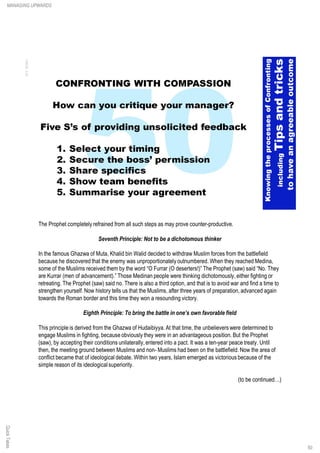
The Prophet completely refrained from all such steps as may prove counter-productive.
Seventh Principle: Not to be a dichotomous thinker
In the famous Ghazwa of Muta, Khalid bin Walid decided to withdraw Muslim forces from the battlefield
because he discovered that the enemy was unproportionately outnumbered. When they reached Medina,
some of the Muslims received them by the word “O Furrar (O deserters!)” The Prophet (saw) said “No. They
are Kurrar (men of advancement).” Those Medinan people were thinking dichotomously, either fighting or
retreating. The Prophet (saw) said no. There is also a third option, and that is to avoid war and find a time to
strengthen yourself. Now history tells us that the Muslims, after three years of preparation, advanced again
towards the Roman border and this time they won a resounding victory.
Eighth Principle: To bring the battle in one’s own favorable field
This principle is derived from the Ghazwa of Hudaibiyya. At that time, the unbelievers were determined to
engage Muslims in fighting, because obviously they were in an advantageous position. But the Prophet
(saw), by accepting their conditions unilaterally,entered into a pact. It was a ten-year peace treaty. Until
then, the meeting ground between Muslims and non- Muslims had been on the battlefield. Now the area of
conflict became that of ideological debate. Within two years, Islam emerged as victorious because of the
simple reason of its ideological superiority.
(to be continued…)
QuickTakesMANAGING UPWARDS
50
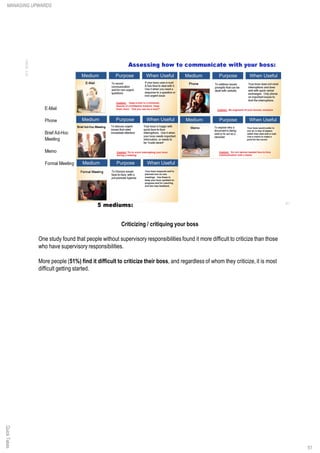
Criticizing / critiquing your boss
One study found that people without supervisory responsibilities found it more difficult to criticize than those
who have supervisory responsibilities.
More people (51%) find it difficult to criticize their boss, and regardless of whom they criticize, it is most
difficult getting started.
QuickTakesMANAGING UPWARDS
51
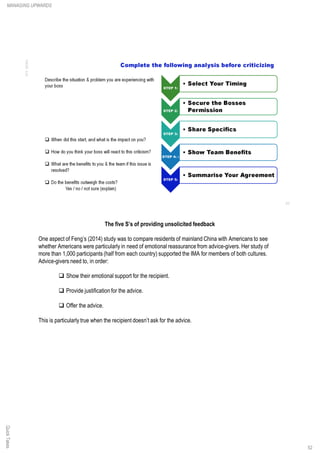
The five S’s of providing unsolicited feedback
One aspect of Feng’s (2014) study was to compare residents of mainland China with Americans to see
whether Americans were particularly in need of emotional reassurance from advice-givers. Her study of
more than 1,000 participants (half from each country) supported the IMA for members of both cultures.
Advice-givers need to, in order:
q Show their emotional support for the recipient.
q Provide justification for the advice.
q Offer the advice.
This is particularly true when the recipient doesn’t ask for the advice.
QuickTakesMANAGING UPWARDS
52
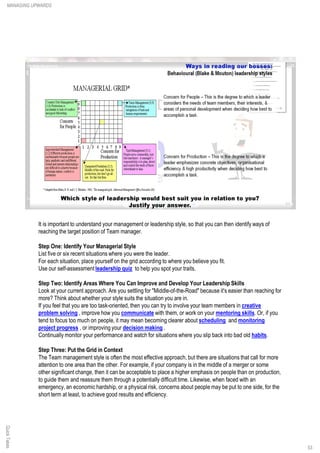
It is important to understand your management or leadership style, so that you can then identify ways of
reaching the target position of Team manager.
Step One: Identify Your Managerial Style
List five or six recent situations where you were the leader.
For each situation, place yourself on the grid according to where you believe you fit.
Use our self-assessment leadership quiz to help you spot your traits.
Step Two: Identify Areas Where You Can Improve and Develop Your Leadership Skills
Look at your current approach. Are you settling for "Middle-of-the-Road" because it's easier than reaching for
more? Think about whether your style suits the situation you are in.
If you feel that you are too task-oriented, then you can try to involve your team members in creative
problem solving , improve how you communicate with them, or work on your mentoring skills. Or, if you
tend to focus too much on people, it may mean becoming clearer about scheduling and monitoring
project progress , or improving your decision making .
Continually monitor your performance and watch for situations where you slip back into bad old habits.
Step Three: Put the Grid in Context
The Team management style is often the most effective approach, but there are situations that call for more
attention to one area than the other. For example, if your company is in the middle of a merger or some
other significant change, then it can be acceptable to place a higher emphasis on people than on production,
to guide them and reassure them through a potentially difficult time. Likewise, when faced with an
emergency, an economic hardship, or a physical risk, concerns about people may be put to one side, for the
short term at least, to achieve good results and efficiency.
QuickTakesMANAGING UPWARDS
53
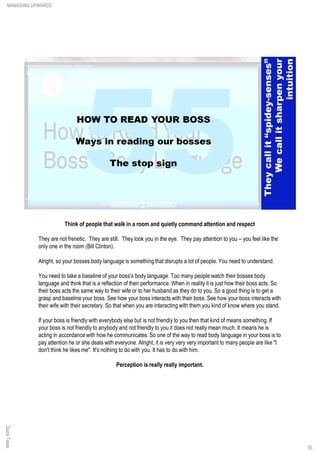
Think of people that walk in a room and quietly command attention and respect
They are not frenetic. They are still. They look you in the eye. They pay attention to you – you feel like the
only one in the room (Bill Clinton).
Alright, so your bosses body language is something that disrupts a lot of people. You need to understand.
You need to take a baseline of your boss's body language. Too many people watch their bosses body
language and think that is a reflection of their performance. When in reality it is just how their boss acts. So
their boss acts the same way to their wife or to her husband as they do to you. So a good thing is to get a
grasp and baseline your boss. See how your boss interacts with their boss. See how your boss interacts with
their wife with their secretary. So that when you are interacting with them you kind of know where you stand.
If your boss is friendly with everybody else but is not friendly to you then that kind of means something. If
your boss is not friendly to anybody and not friendly to you it does not really mean much. It means he is
acting in accordance with how he communicates. So one of the way to read body language in your boss is to
pay attention he or she deals with everyone. Alright, it is very very very important to many people are like "I
don't think he likes me". It's nothing to do with you. It has to do with him.
Perception is really really important.
QuickTakesMANAGING UPWARDS
55
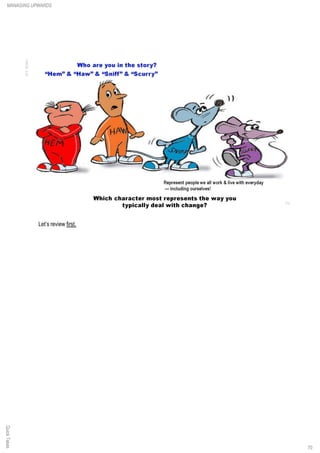
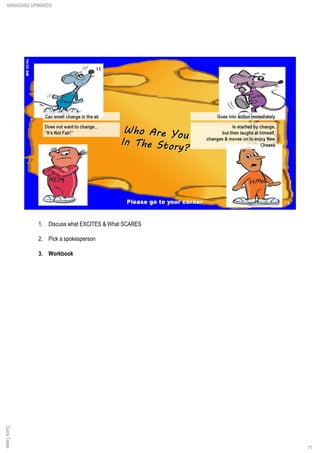
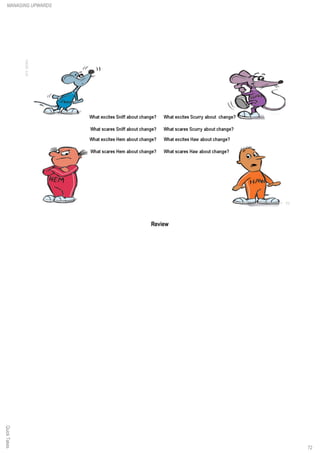
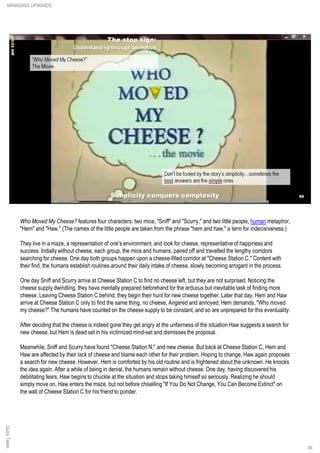
Who Moved My Cheese? features four characters: two mice, "Sniff" and "Scurry," and two little people, human metaphor,
"Hem" and "Haw." (The names of the little people are taken from the phrase "hem and haw," a term for indecisiveness.)
They live in a maze, a representation of one's environment, and look for cheese, representativeof happiness and
success. Initially without cheese, each group, the mice and humans, paired off and travelled the lengthy corridors
searching for cheese. One day both groups happen upon a cheese-filled corridor at "Cheese Station C." Content with
their find, the humans establish routines around their daily intake of cheese, slowly becoming arrogant in the process.
One day Sniff and Scurry arrive at Cheese Station C to find no cheese left, but they are not surprised. Noticing the
cheese supply dwindling, they have mentally prepared beforehand for the arduous but inevitable task of finding more
cheese. Leaving Cheese Station C behind, they begin their hunt for new cheese together. Later that day, Hem and Haw
arrive at Cheese Station C only to find the same thing, no cheese. Angered and annoyed, Hem demands, "Who moved
my cheese?" The humans have counted on the cheese supply to be constant, and so are unprepared for this eventuality.
After deciding that the cheese is indeed gone they get angry at the unfairness of the situation Haw suggests a search for
new cheese, but Hem is dead set in his victimized mind-set and dismisses the proposal.
Meanwhile, Sniff and Scurry have found "Cheese Station N," and new cheese. But back at Cheese Station C, Hem and
Haw are affected by their lack of cheese and blame each other for their problem. Hoping to change, Haw again proposes
a search for new cheese. However, Hem is comforted by his old routine and is frightened about the unknown. He knocks
the idea again. After a while of being in denial, the humans remain without cheese. One day, having discovered his
debilitating fears, Haw begins to chuckle at the situation and stops taking himself so seriously. Realizing he should
simply move on, Haw enters the maze, but not before chiselling "If You Do Not Change, You Can Become Extinct" on
the wall of Cheese Station C for his friend to ponder.
QuickTakesMANAGING UPWARDS
56
Still fearful of his trek, Haw jots "What Would You Do If You Weren't Afraid?" on the wall and, after thinking
about that, he begins his venture. Still plagued with worry (perhaps he has waited too long to begin his
search...), Haw finds some bits of cheese that nourish him and he is able to continue his search. Haw
realizes that the cheese has not suddenly vanished, but has dwindled from continual eating. After a stop at
an empty cheese station, Haw begins worrying about the unknown again. Brushing aside his fears, Haw's
new mind-set allows him to again enjoy life. He has even begun to smile again! He is realizing that "When
you move beyond your fear, you feel free." After another empty cheese station, Haw decides to go back for
Hem with the few bits of new cheese he has managed to find.
Uncompromising, Hem refuses the new cheese, to his friend's disappointment. With knowledge learned
along the way, Haw heads back into the maze. Getting deeper into the maze, inspired by bits of new cheese
here and there, Haw leaves a trail of writings on the wall ("The Handwriting On the Wall"). These clarify his
own thinking and give him hope that his friend will find aid in them during his search for new cheese. Still
traveling, Haw one day comes across Cheese Station N, abundant with cheese, including some varieties
that are strange to him, and he realizes he has found what he was looking for. After eating, Haw reflects on
his experience.
Notes
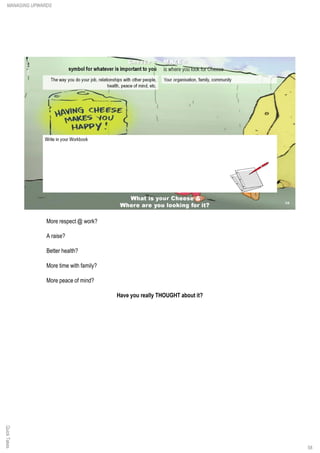
WHO ARE YOU?
Can you recognize SOMEONE YOU KNOW?
What is YOUR cheese??
QuickTakesMANAGING UPWARDS
57
More respect @ work?
A raise?
Better health?
More time with family?
More peace of mind?
Have you really THOUGHT about it?
QuickTakesMANAGING UPWARDS
58
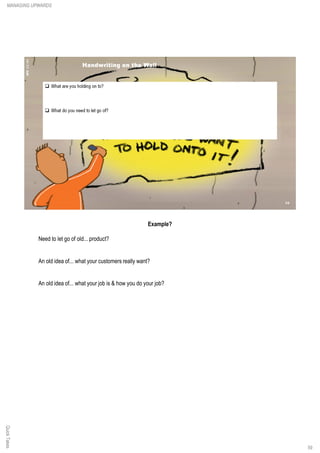
Example?
Need to let go of old... product?
An old idea of... what your customers really want?
An old idea of... what your job is & how you do your job?
QuickTakesMANAGING UPWARDS
59
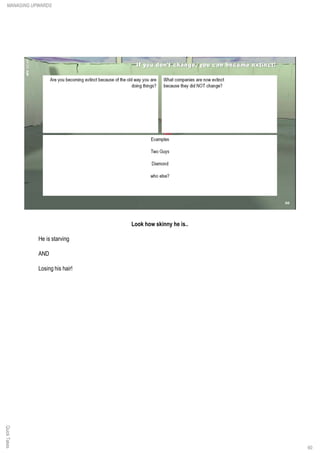
Look how skinny he is..
He is starving
AND
Losing his hair!
QuickTakesMANAGING UPWARDS
60
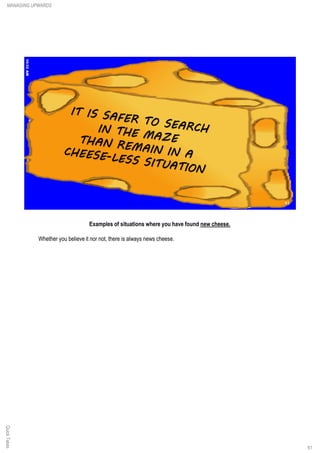
Examples of situations where you have found new cheese.
Whether you believe it nor not, there is always news cheese.
QuickTakesMANAGING UPWARDS
61
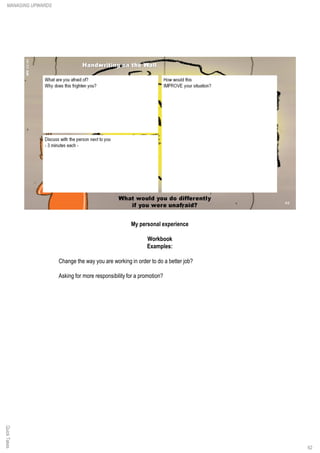
My personal experience
Workbook
Examples:
Change the way you are working in order to do a better job?
Asking for more responsibility for a promotion?
QuickTakesMANAGING UPWARDS
62
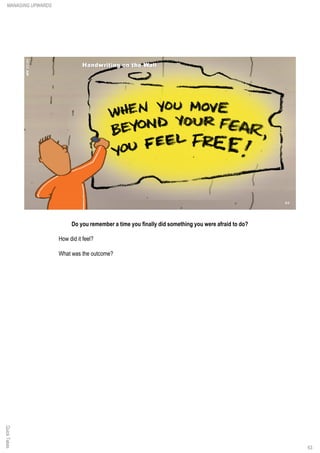
Do you remember a time you finally did something you were afraid to do?
How did it feel?
What was the outcome?
QuickTakesMANAGING UPWARDS
63
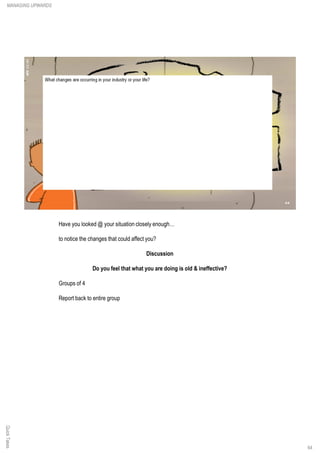
Have you looked @ your situation closely enough…
to notice the changes that could affect you?
Discussion
Do you feel that what you are doing is old & ineffective?
Groups of 4
Report back to entire group
QuickTakesMANAGING UPWARDS
64
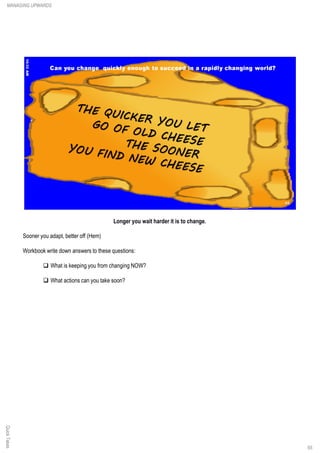
Longer you wait harder it is to change.
Sooner you adapt, better off (Hem)
Workbook write down answers to these questions:
q What is keeping you from changing NOW?
q What actions can you take soon?
QuickTakesMANAGING UPWARDS
65
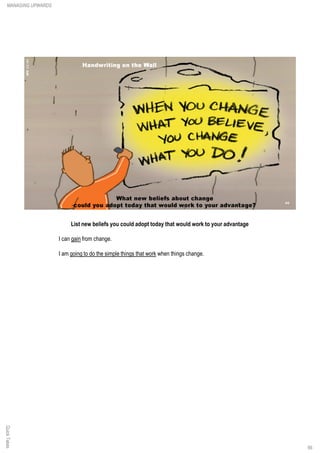
List new beliefs you could adopt today that would work to your advantage
I can gain from change.
I am going to do the simple things that work when things change.
QuickTakesMANAGING UPWARDS
66
QuickTakesMANAGING UPWARDS
67
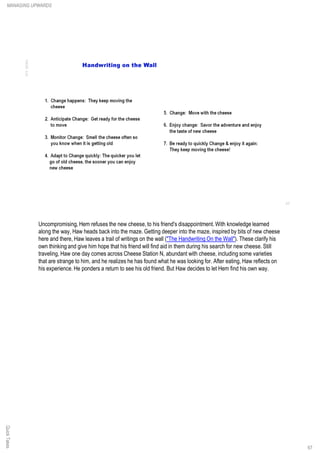
Uncompromising, Hem refuses the new cheese, to his friend's disappointment. With knowledge learned
along the way, Haw heads back into the maze. Getting deeper into the maze, inspired by bits of new cheese
here and there, Haw leaves a trail of writings on the wall ("The Handwriting On the Wall"). These clarify his
own thinking and give him hope that his friend will find aid in them during his search for new cheese. Still
traveling, Haw one day comes across Cheese Station N, abundant with cheese, including some varieties
that are strange to him, and he realizes he has found what he was looking for. After eating, Haw reflects on
his experience. He ponders a return to see his old friend. But Haw decides to let Hem find his own way.
More principles from the Prophet’s model:
Ninth Principle: Gradualism instead of radicalism
This principle is well-established by a hadith of Al-Bukhari. Aishah says that the first verses of the Qur’an
were related mostly to heaven and hell. And then after a long time when the people’s hearts had softened,
the specific commands to desist from adultery and drinking were revealed in the Qur’an. This is a clear proof
that for social changes, Islam advocates the evolutionary method, rather than the revolutionary method.
Tenth Principle: To be pragmatic in controversial matters
During the writing of Hudaibiyyah treaty, the Prophet (saw) dictated these words: “This is from Muhammad,
the Messenger of God.” The Qurayshi delegate raised objections over these words. The Prophet (saw)
promptly changed the word and ordered to write simply Muhammad, son of Abdullah.
QuickTakesMANAGING UPWARDS
69
QuickTakesMANAGING UPWARDS
Let’s review first.
70
QuickTakesMANAGING UPWARDS
1. Discuss what EXCITES & What SCARES
2. Pick a spokesperson
3. Workbook
71
QuickTakesMANAGING UPWARDS
72
Review
QuickTakesMANAGING UPWARDS
How does it feel when changing this time?
Are you choosing a new way to adapt to change that you can use to your advantage?
73
QuickTakesMANAGING UPWARDS
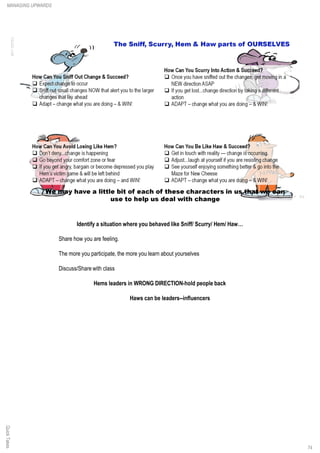
Identify a situation where you behaved like Sniff/ Scurry/ Hem/ Haw…
Share how you are feeling.
The more you participate, the more you learn about yourselves
Discuss/Share with class
Hems leaders in WRONG DIRECTION-hold people back
Haws can be leaders--influencers
74
QuickTakesMANAGING UPWARDS
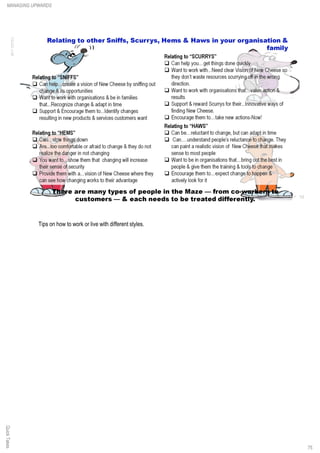
Tips on how to work or live with different styles.
75
QuickTakesMANAGING UPWARDS
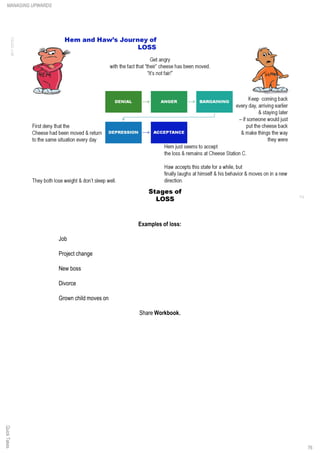
Examples of loss:
Job
Project change
New boss
Divorce
Grown child moves on
Share Workbook.
76
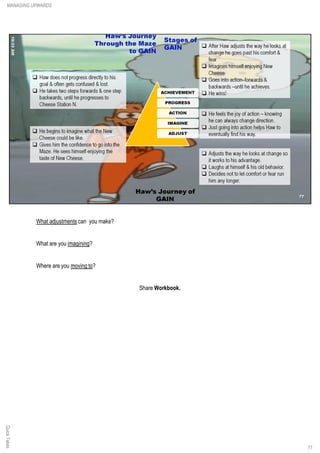
What adjustments can you make?
What are you imagining?
Where are you moving to?
Share Workbook.
QuickTakesMANAGING UPWARDS
77
QuickTakesMANAGING UPWARDS
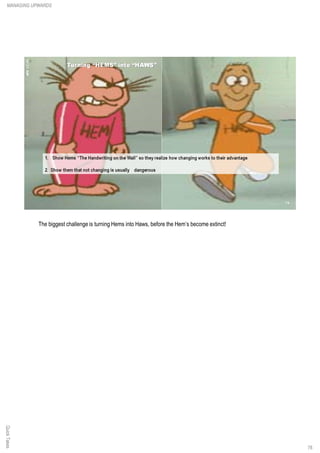
The biggest challenge is turning Hems into Haws, before the Hem’s become extinct!
78
QuickTakesMANAGING UPWARDS
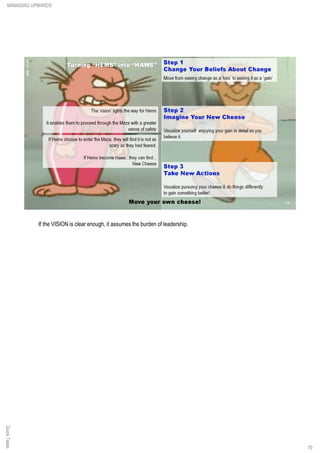
If the VISION is clear enough, it assumes the burden of leadership.
79
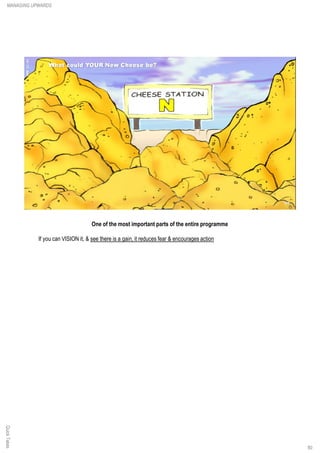
One of the most important parts of the entire programme
If you can VISION it, & see there is a gain, it reduces fear & encourages action
QuickTakesMANAGING UPWARDS
80
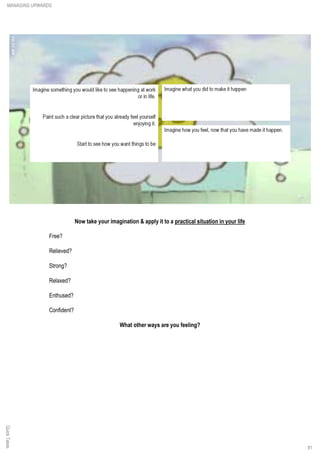
Now take your imagination & apply it to a practical situation in your life
Free?
Relieved?
Strong?
Relaxed?
Enthused?
Confident?
What other ways are you feeling?
QuickTakesMANAGING UPWARDS
81
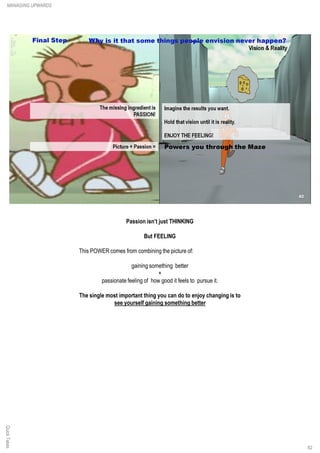
Passion isn’t just THINKING
But FEELING
This POWER comes from combining the picture of:
gaining something better
+
passionate feeling of how good it feels to pursue it.
The single most important thing you can do to enjoy changing is to
see yourself gaining something better
QuickTakesMANAGING UPWARDS
82
QuickTakesMANAGING UPWARDS
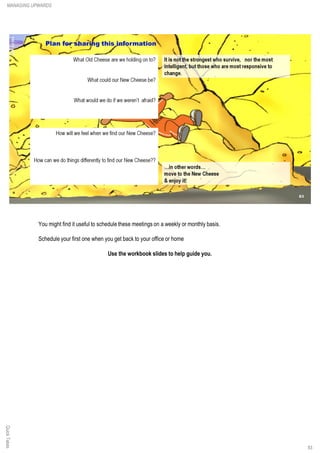
You might find it useful to schedule these meetings on a weekly or monthly basis.
Schedule your first one when you get back to your office or home
Use the workbook slides to help guide you.
83
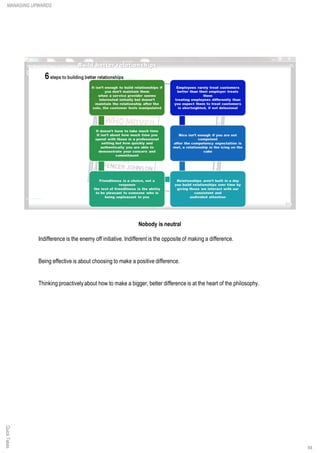
Nobody is neutral
Indifference is the enemy off initiative. Indifferent is the opposite of making a difference.
Being effective is about choosing to make a positive difference.
Thinking proactively about how to make a bigger, better difference is at the heart of the philosophy.
QuickTakesMANAGING UPWARDS
84
Perhaps the most important thing to remember is to stay calm. Feeling overwhelmed by too many tasks can
be very stressful. Remember that the world will probably not end if you fail to achieve your last task of the
day, or leave it until tomorrow, especially if you have prioritised sensibly.
Going home or getting an early night, so that you are fit for tomorrow, may be a much better option than
meeting a self-imposed or external deadline that may not even matter that much.
Take a moment to pause and get your life and priorities into perspective, and you may find that the view
changes quite substantially!
QuickTakesMANAGING UPWARDS
86
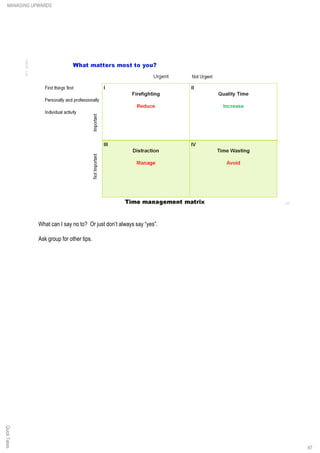
What can I say no to? Or just don’t always say “yes”.
Ask group for other tips.
QuickTakesMANAGING UPWARDS
87
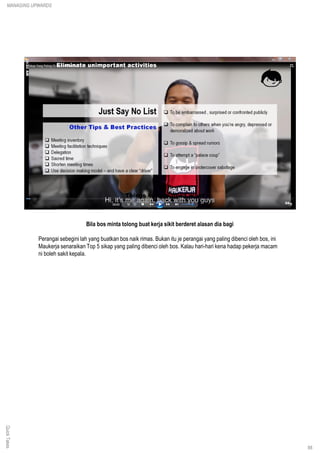
Bila bos minta tolong buat kerja sikit berderet alasan dia bagi
Perangai sebegini lah yang buatkan bos naik rimas. Bukan itu je perangai yang paling dibenci oleh bos, ini
Maukerja senaraikan Top 5 sikap yang paling dibenci oleh bos. Kalau hari-hari kena hadap pekerja macam
ni boleh sakit kepala.
QuickTakesMANAGING UPWARDS
88
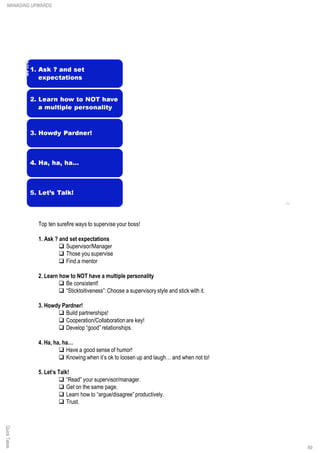
Top ten surefire ways to supervise your boss!
1. Ask ? and set expectations
q Supervisor/Manager
q Those you supervise
q Find a mentor
2. Learn how to NOT have a multiple personality
q Be consistent!
q “Sticktoitiveness”:Choose a supervisory style and stick with it.
3. Howdy Pardner!
q Build partnerships!
q Cooperation/Collaboration are key!
q Develop “good” relationships.
4. Ha, ha, ha…
q Have a good sense of humor!
q Knowing when it’s ok to loosen up and laugh… and when not to!
5. Let’s Talk!
q “Read” your supervisor/manager.
q Get on the same page.
q Learn how to “argue/disagree” productively.
q Trust.
QuickTakesMANAGING UPWARDS
89
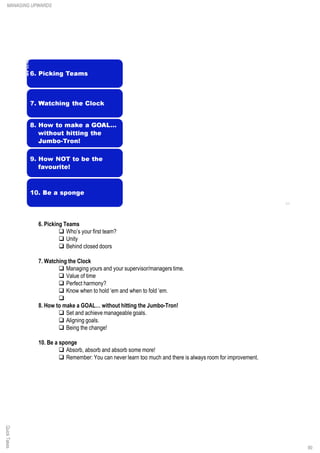
6. Picking Teams
q Who’s your first team?
q Unity
q Behind closed doors
7. Watching the Clock
q Managing yours and your supervisor/managers time.
q Value of time
q Perfect harmony?
q Know when to hold ‘em and when to fold ‘em.
q
8. How to make a GOAL… without hitting the Jumbo-Tron!
q Set and achieve manageable goals.
q Aligning goals.
q Being the change!
10. Be a sponge
q Absorb, absorb and absorb some more!
q Remember: You can never learn too much and there is always room for improvement.
QuickTakesMANAGING UPWARDS
90
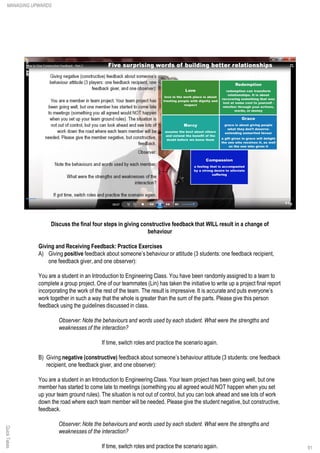
Discuss the final four steps in giving constructive feedback that WILL result in a change of
behaviour
Giving and Receiving Feedback: Practice Exercises
A) Giving positive feedback about someone’s behaviour or attitude (3 students: one feedback recipient,
one feedback giver, and one observer):
You are a student in an Introduction to Engineering Class. You have been randomly assigned to a team to
complete a group project. One of our teammates (Lin) has taken the initiative to write up a project final report
incorporating the work of the rest of the team. The result is impressive.It is accurate and puts everyone’s
work together in such a way that the whole is greater than the sum of the parts. Please give this person
feedback using the guidelines discussed in class.
Observer: Note the behaviours and words used by each student. What were the strengths and
weaknesses of the interaction?
If time, switch roles and practice the scenario again.
B) Giving negative (constructive) feedback about someone’s behaviour attitude (3 students: one feedback
recipient, one feedback giver, and one observer):
You are a student in an Introduction to Engineering Class. Your team project has been going well, but one
member has started to come late to meetings (something you all agreed would NOT happen when you set
up your team ground rules). The situation is not out of control, but you can look ahead and see lots of work
down the road where each team member will be needed. Please give the student negative, but constructive,
feedback.
Observer: Note the behaviours and words used by each student. What were the strengths and
weaknesses of the interaction?
If time, switch roles and practice the scenario again.
QuickTakesMANAGING UPWARDS
91
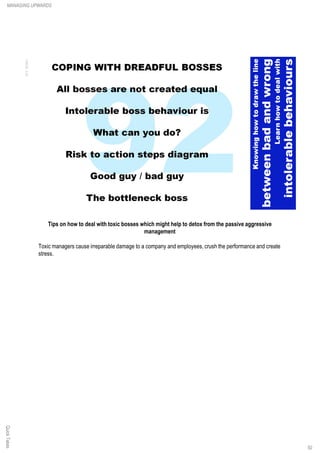
Tips on how to deal with toxic bosses which might help to detox from the passive aggressive
management
Toxic managers cause irreparable damage to a company and employees, crush the performance and create
stress.
QuickTakesMANAGING UPWARDS
92
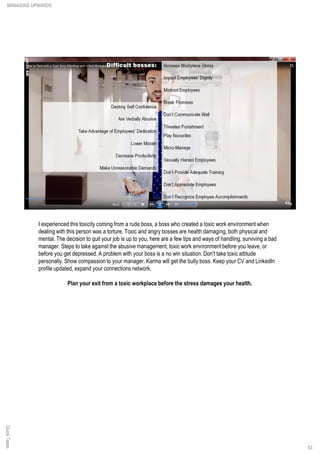
I experienced this toxicity coming from a rude boss, a boss who created a toxic work environment when
dealing with this person was a torture. Toxic and angry bosses are health damaging, both physical and
mental. The decision to quit your job is up to you, here are a few tips and ways of handling, surviving a bad
manager. Steps to take against the abusive management, toxic work environment before you leave, or
before you get depressed. A problem with your boss is a no win situation. Don't take toxic attitude
personally. Show compassion to your manager. Karma will get the bully boss. Keep your CV and LinkedIn
profile updated, expand your connections network.
Plan your exit from a toxic workplace before the stress damages your health.
QuickTakesMANAGING UPWARDS
93
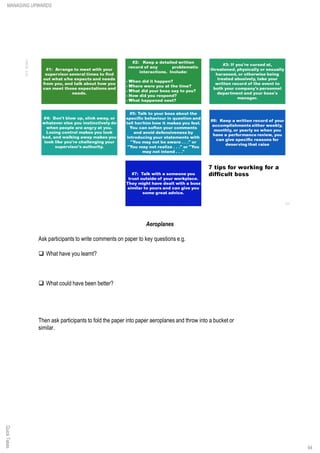
Aeroplanes
Ask participants to write comments on paper to key questions e.g.
q What have you learnt?
q What could have been better?
Then ask participants to fold the paper into paper aeroplanes and throw into a bucket or
similar.
QuickTakesMANAGING UPWARDS
94
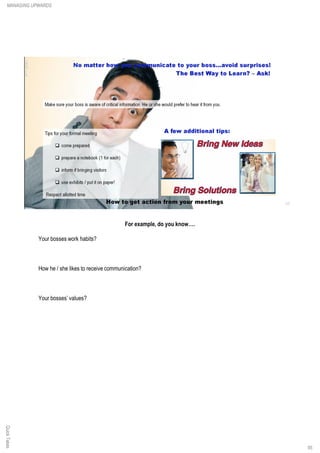
For example, do you know….
Your bosses work habits?
How he / she likes to receive communication?
Your bosses’ values?
QuickTakesMANAGING UPWARDS
95
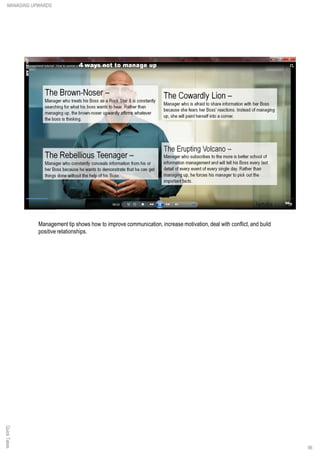
Management tip shows how to improve communication, increase motivation, deal with conflict, and build
positive relationships.
QuickTakesMANAGING UPWARDS
96
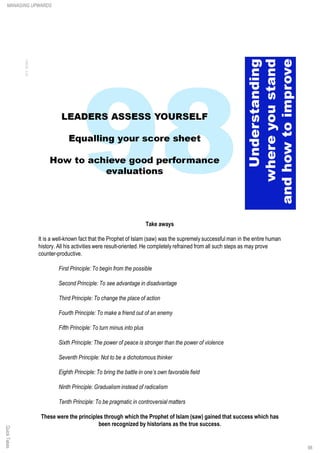
Take aways
It is a well-known fact that the Prophet of Islam (saw) was the supremely successful man in the entire human
history. All his activities were result-oriented. He completely refrained from all such steps as may prove
counter-productive.
First Principle: To begin from the possible
Second Principle: To see advantage in disadvantage
Third Principle: To change the place of action
Fourth Principle: To make a friend out of an enemy
Fifth Principle: To turn minus into plus
Sixth Principle: The power of peace is stronger than the power of violence
Seventh Principle: Not to be a dichotomous thinker
Eighth Principle: To bring the battle in one’s own favorable field
Ninth Principle: Gradualism instead of radicalism
Tenth Principle: To be pragmatic in controversial matters
These were the principles through which the Prophet of Islam (saw) gained that success which has
been recognized by historians as the true success.
QuickTakesMANAGING UPWARDS
98
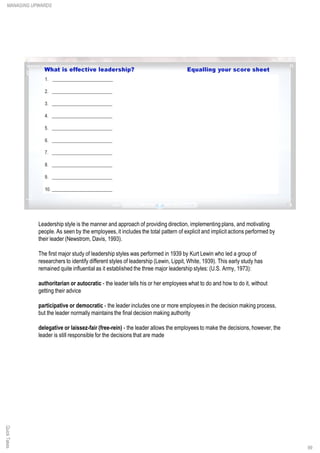
Leadership style is the manner and approach of providing direction, implementing plans, and motivating
people. As seen by the employees,it includes the total pattern of explicit and implicit actions performed by
their leader (Newstrom, Davis, 1993).
The first major study of leadership styles was performed in 1939 by Kurt Lewin who led a group of
researchers to identify different styles of leadership (Lewin, Lippit, White, 1939). This early study has
remained quite influential as it established the three major leadership styles: (U.S. Army, 1973):
authoritarian or autocratic - the leader tells his or her employees what to do and how to do it, without
getting their advice
participative or democratic - the leader includes one or more employees in the decision making process,
but the leader normally maintains the final decision making authority
delegative or laissez-fair (free-rein) - the leader allows the employees to make the decisions, however, the
leader is still responsible for the decisions that are made
QuickTakesMANAGING UPWARDS
99
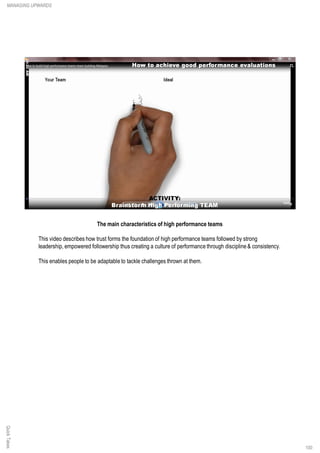
The main characteristics of high performance teams
This video describes how trust forms the foundation of high performance teams followed by strong
leadership, empowered followership thus creating a culture of performance through discipline & consistency.
This enables people to be adaptable to tackle challenges thrown at them.
QuickTakesMANAGING UPWARDS
100
QuickTakes
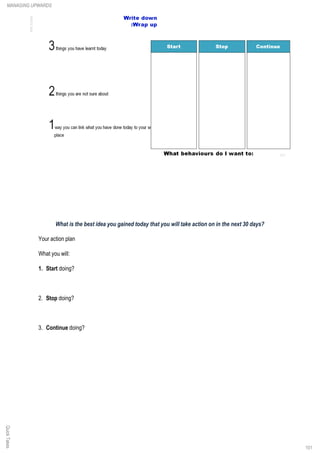
What is the best idea you gained today that you will take action on in the next 30 days?
Your action plan
What you will:
1. Start doing?
2. Stop doing?
3. Continue doing?
MANAGING UPWARDS
101
A professionally qualified accountant he was awarded with:
1988 Degree from the Institute of Chartered Secretaries and Administrators
(United Kingdom)
1991 Post Graduate Diploma in Hospital Administration from MPC International Houston,
Texas
2000 Awarded Associate member of Institute of Financial Accountants (United Kingdom)
2001 Certified Financial Planner (Financial Planning Association of Malaysia)
Next steps & implementation
Our programmes are completely customized and affordable. We coordinate your desired outcomes and
always exceed the client’s expectation by providing succinct, sustainabletake home value.
Programmes & offerings include:
One on One’s
Corporate Retreats
Strategic Talent Triage
Organisational Development
Selection of new employees
360° Leadership Surveys
Employee Engagement or Climate Surveys
QuickTakesMANAGING UPWARDS
102

Managing up quick takes

  • 1.
    Quick Overview Oftentimes employeesforget the “skill” of having a great working relationship with the ones we report to. Having a healthy, positive relationship with your boss makes your work life much easier, it even adds up to your job satisfaction and career development. No matter what type of boss you encounter, this skill is universally important. While problems will inevitably come up, but knowing the right way to bring problems and propositions to your boss can help you navigate sticky situations. This programme concentrates on elements found within a healthy work environment - which benefits us as well as our superiors. The facilitators ( HR & Communications Corporate Leaders) will demonstrates and discuss practical tips plus skills to be learned that is vital for a smooth running organisation. After completing this course, participants will successfully: q Explain the characteristics of good employer –employee relationships q Show how to communicate with bosses effectively q Show how to identify types of leadership personalities q Help solve employer-employee relationship problems MANAGING UPWARDS 1 QuickTakes
  • 2.
    Influencing 1 INFLUENCER Brief qYou are a Team Leader. The other role player is your Manager, to whom you report. q You have worked for this company for the last 4 years. The work is very enjoyable however you get very little development time from him/her, and you are very keen to get on. They do the annual performance appraisal with you – lots of promises are made, however nothing seems to get done. There’s always an excuse. As your Manager is so busy, you rarely get one-to-one time with them. q Your colleague, another Team Leader but in a different section, always seems to get plenty of time from their Manager – reviewing performance, action planning, different projects, extra responsibility.She’s even spent some time in another part of the organisation for a couple of days on secondment. q You are pretty fed up with this and have pre-arranged a meeting with your Manager. You said that you want to discuss training and development. INFLUENCE your Manager to give you more time to develop you. Make sure you get a firm commitment such as: q The first ‘coaching’ session put in the diary. q Another meeting secured to discuss a potential secondment you would like. QuickTakesMANAGING UPWARDS 4
  • 3.
    Influencing 1 INFLUENCEE Brief qYou are a Manager. The other role player is a Team Leader who reports to you. q The Team Leader has worked for you for 4 years. They are really good at their job. q You are a great believer in making your own opportunities in life – you had to when you were looking to be developed and promoted. Nobody put it ‘on a plate’ for you. q As a really pressurised Manager, you sometimes don’t have as much time for your staff as you would like. q Your Team Leader has invited you to a meeting – said something about training and development, which you take to mean for your Leader’s team. QuickTakesMANAGING UPWARDS 5
  • 4.
    QuickTakes 4 C's -4-6 people per team (10-15 minutes) Each person writes down on an index card his/her favourite: Color, Cuisine, Country to visit and Closet Dream. The cards are shuffled and redistributed. Each person reads aloud the card they picked up and each person guesses in writing who wrote it. At the end, see who guessed the most correct responses. This ice-breaker also is an easy way to get people talking and mingling more with each other. It allows the team members to see what they have in common. In 1928, William Moulton Marston built upon Jung’s work and created the 4 quadrant model of behavioural styles. Marston was a psychologist, lawyer, comic book writer, and inventor. He invented one of the first lie detector machines and he was the creator of the comic book hero, Wonder Woman! Marston’s DISC Model measures the emotions of “normal people.” The DISC Model helps people become more self-aware of how they prefer to behave. In addition, they can use it to identify the DISC style of others in order to make conscious decisions about how to adjust their behaviour in communication. The model is powerful, and it is easy to learn and use. It identifies 4 behavioural styles: D-style, I-style, S-style, and C-style. However, Marston did not develop the actual DISC tools to assess people. Walter Clarke, an industrial psychologist, used Marston’s Model to develop the first tools in the mid 1950’s. These early assessments were used in businesses for support in job placement and hiring. MANAGING UPWARDS 6
  • 5.
    The D-style profileis the most assertive and demanding of the four DISC types D-styles tend to be quite competitiveand results-oriented. Hence, others see D-styles as being aggressive, blunt, and even rude. When D-styles feel pressured they want to focus even more on getting things done. Therefore, they can come across as insensitiveor showing a lack of concern for others. They do not want to lose control. Rather, they want to focus on actively being in charge of tasks and things. D-styles prefer to move quickly. They are willing to take risks and want to get things done now. They like change and challenges. D-styles can also be impatient and overbearing because they want things done quickly and done their way. They are usually not very good listeners and are prone to make snap decisions. However, they excel at looking at the big picture and multi-tasking. The D-style motto is, “I did it my way”. They can be limited by their lack of humility, which others may view as arrogance. D-styles like to ask the “what” questions, “What is the bottom line?” or ” What is in it for me?” QuickTakesMANAGING UPWARDS 7
  • 6.
    I-style profiles areoutgoing, social, and talkative They are overflowing with optimism and want to be the centre of attention. I-styles want interactions with others. They do not like focusing on details or spending a lot of time alone. I-styles are good at influencing others and getting people to follow them as leaders. They know what they want and align people together to get it done. I-style profiles crave social acceptance. Hence, they like to be liked. They can be spontaneous and impulsive. I-styles can be overly talkative, lacking focus, and emotional. They may over-promise because they are so optimistic and eager to be liked. I-style profiles are seen as very friendly, energetic, and lively. In addition, others may perceive I-styles as somewhat careless and disorganized. However, when under pressure, they have a tendency to focus more on people that they may overlook details and tasks. Their motto is, “I am a nice person! Everyone should like me!” I-styles like to ask the “who” questions, “Who is at the meeting?” or ” Who else uses this?” QuickTakesMANAGING UPWARDS 8
  • 7.
    S-style profiles aresteady, calm and easy-going They prefer interacting with people they know, since they are more reserved. S-style profiles prefer things to remain the same because they like stability and security. They view family and friends as very important. They will strongly defend their own group or team, sometimes emotionally.S-styles value fairness and justice. S-styles are reliable and stable. They focus on cooperation, especially with the person in charge, to carry out the tasks. They want you to tell them what, when and how you want it done and they’ll be glad to do it. If you do not give an S-styles enough details, they may not get started because they don’t want to make mistakes. S-styles are more hesitant in their actions and decision-making. They want to consider others and focus on agreements. Since S-styles prefer stability and security, they tend to resist change and need support with it. Their motto is “if it’s not broken, let’s not fix it.” When S-style profiles are under pressure they can become too accommodating. They will often say “yes” too easily. Their biggest fear is loss of stability. S-styles want a stable and secure environment. Change can be challenging for S-styles. S-styles like to ask the “how” questions, “How are we going to do this?” or “How does this impact us?” QuickTakesMANAGING UPWARDS 9
  • 8.
    C-style profiles arethe most analytical and reserved of the 4 DISC styles, also known as 4 personality types They can be very detail-oriented. C-styles prefer focusing on facts, information and proofs. They are comfortable working alone. C-styles are cautious and hold themselves to high standards. They focus on analysing tasks and the quality of the product or service. C-styles make sure that everything works the way it should. C-styles can come across as critical of others. They focus on finding mistakes and expect everyone to follow their standards. Others can perceive their attention to detail and correctness as nit-picky.. C-styles’ desire to do things correctly can also slow down their decision-making. They can over-analyse issues and need a lot of information. Under pressure they can come across as being overly critical. The C-style profile’s motto is, “if we do not have time to do it right, do we have time to do it over again?” C-styles like to ask the “why” questions, “Why does it work this way?” or ” Why is this step needed?” QuickTakesMANAGING UPWARDS 10
  • 9.
    Pick a co-worker qWhat do you think they are? q Identify their style based on what you circled Understanding your own & other’s DiSC leadership styles will enable you to better place & motivate your people in a high-performing team QuickTakesMANAGING UPWARDS 11
  • 10.
    How do yourbehaviours give away the type of leader you are, & how can understanding of natural behavioural traits increase team effectiveness? Group discussion is one option. 1. Another is to break the group into 4 subgroups & assign a question to each group. 2. Have the subgroups to brainstorm responses to their respective question & jot these down on a flip chart. QuickTakesMANAGING UPWARDS 12
  • 11.
    Get the picture... Mostpeople have predictable patterns of behaviour – specific personalities. There are four basic types, also known as temperaments. They blend together to determine your unique personality.To help you understand why you often feel, think and act the way you do, the following is a graphic overview of the Four Temperament Model of Human Behaviour. The four types are like four parts of a pie. Before seeing the four parts as they stand alone, let’s look at the pie in two parts. These two types are different from each other. Think of it this way: some people are more outgoing, while others are more reserved. Outgoing people are more active and optimistic. Reserved types tend to be passive and pessimistic. One type is not better than the other. Both types of behaviour are important. Reserved types need to learn how to be more dominant and inspirational.Outgoing people need to learn how to be more steady and cautious. QuickTakesMANAGING UPWARDS 13
  • 12.
    Also, there aretwo other parts of the pie – two other types of personalities. These are also different from each other. Some people are more task-oriented, while others are more people-oriented. Task-oriented types enjoy doing “things” [directing and correcting] while people-oriented individuals like to relate with others [interacting and sharing]. When you look at the four parts of the pie together, you can visualize the four temperament types. Everyone is a unique blend of these four parts. QuickTakesMANAGING UPWARDS 14
  • 13.
    The Prophet ofIslam (saw) was a positive thinker in the full sense of the word. First Principle: To begin from the possible This principle is well explained in a saying of Aishah. She said: “Whenever the Prophet had to choose between two options, he always opted for the easier choice.” (Al-Bukhari) To choose the easiest option means to begin from the possible and one who begins from the possible will surely reach his goal. Second Principle: To see advantage in disadvantage In the early days of Mecca, there were many problems and difficulties. At that time, a guiding verse in the Qur’an was revealed. It said: “With every hardship there is ease, with every hardship there is ease.” (94:5-6). This means that if there are some problems, there are also opportunities at the same time. And the way to success is to ignore the problems and avail the opportunities. Third Principle: To change the place of action This principle is derived from the Hijrah. Hijrah was not just a migration from Mecca to Medina. It was to find a more suitable place for Islamic work, as history proved later on. (to be continued…) QuickTakesMANAGING UPWARDS 16
  • 14.
    This is apopular team building exercise using 3X5 cards called Building the Tallest Tower It is a great exercise to demonstrate DiSC behaviour styles. QuickTakesMANAGING UPWARDS 17
  • 15.
    We can takelessons from Prophet Muhammad s.a.w. as the model reflected by these characteristics: Siddiq (Task oriented) The soul of an honest man is always in the side of truth and commendablemoral attitude and being proud of being servant of Allah. Briefly, honesty is the integrity of a person’s attitude towards the work mandated to him. Siddiq principles reflect the behaviour of the manager of the company which is based on the principles of truth, honesty and faith-oriented values. Amanah (People oriented) The principle of amanah is loyalty and commitment to the company’s management in carrying out the duties and responsibilities imposed upon him. Business managers must have good manners. It is a form of liability (responsibility) as a trust holder. Fathanah (Listening) Businessman should manage his business in a professional manner not only with honesty and responsibility, but also intelligence (skills), so that what has been entrusted to him is not neglected. One day, a friend asked: “How can a trust be lost?” and Rasulullah replied: ”If the matter submitted to the person who is not an expert on it, then wait its destruction” Bukhari. Fathanah personality (a blend of ’alim and hafidz’) had led the Prophet Yusuf and his economic team to rebuild the land of Egypt. Tabligh (Telling) Businessman or managers who apply the principles of tabligh (sermons) will convey information correctly; describe tasks, responsibilities and authorities with polite, courteous and transparent, so that it can be easily-understood by all stakeholders. QuickTakesMANAGING UPWARDS 18
  • 16.
    There are nogood or bad styles There is no best or worst style. QuickTakesMANAGING UPWARDS 19
  • 17.
    Applied knowledge ispower…. QuickTakesMANAGING UPWARDS 20
  • 18.
    All styles havestrengths and limitations. QuickTakesMANAGING UPWARDS 21
  • 19.
    All styles canbe more or less effective depending on how an individual is able to modify his or her behaviour to meet the needs of others. QuickTakesMANAGING UPWARDS 22
  • 20.
    Minzberg on therole of the manager One of the most comprehensiveanalyses of the management role comes from Henry Mintzberg (1973 and 1989). He defined ten distinct but interchangeable management roles which, he argued, might all be adopted by the same manager in the course of the same working day if necessary, and are taken on chiefly in response to the nature of the task in hand. Interpersonal Figurehead. This is a representative role, usually performed by senior managers – it might involve conducting a ceremony, hosting an event or attending a high profile conference. Leader. For Mintzberg the leader’s job is to create, develop, unite and motivate teams. Liaison. Dealing with people from outside the immediate work unit or organisation – the role might therefore involve exchanging information with other departments or sites, or with suppliers, distributors or customers. Information sharing Monitor. Receiving and processing information both from within and outside the work unit, using a mixture of formal and informal methods. (It is easy to see how some of these roles might overlap – for instance, within the same meeting with a distributor, a manager might liaise over arrangements and monitor feedback about market trends) Disseminator. Passing on relevant information to others in the work unit. Spokesman. Stating the position of the work unit or organisation to key players on the outside. QuickTakesMANAGING UPWARDS 24
  • 21.
    It was titled,"Poke Your 'I' Out: How Improvisational Humour Skills Will Improve Your Career Success." QuickTakesMANAGING UPWARDS 25
  • 22.
    Remember this: It’s notWHICH style I have, But HOW I use it that counts! “I can LEARN to adjust who I am ………… To become ALL I need to be.” QuickTakesMANAGING UPWARDS 26
  • 23.
    Everyone is amixture of styles, so it may be difficult to “read” people correctly. QuickTakesMANAGING UPWARDS 27
  • 24.
    Getting on abusy elevator… The D walks up, gets on the elevator, and pushes the button that closes the door. The i lets others in, says “Always room for one more,” and “Come in, you’re going to be late; we’ll wait for you!” The S will wait in line, moving from one line to another, unable to make a decision. The C will get on the elevator. If it’s crowded, the C will count the number of people and, if the number is over the limit, will make someone get off. QuickTakesMANAGING UPWARDS 28
  • 25.
    QuickTakes All those wholisten to me shall pass on my words to others and those to others again; and may the last ones understand my words better than those who listen to me directly. Be my witness, O ALLAH, that I have conveyed your message to your people”. Al-Bukhari, Hadith 1623, 1626, 6361) Sahih of Imam Muslim also refers to this sermon in Hadith number 98 MANAGING UPWARDS 29
  • 26.
    All the Prophet’sactivities were result-oriented. Fourth Principle: To make a friend out of an enemy The Prophet (saw) of Islam was repeatedly subjected to practices of antagonism by the unbelievers. At that time the Qur’an enjoined upon him the return of good for evil. And then, as the Qur’an added, “You will see your direst enemy has become your closest friend” (41:34). It means that a good deed in return of a bad deed has a conquering effect over your enemies. And the life of the Prophet(saw) is a historical proof of this principle. Fifth Principle: To turn minus into plus After the Battle of Badr, about 70 of the unbelievers were taken as the prisoners of war. They were educated people. The Prophet(saw) announced that if any one of them would teach ten Muslim children how to read and write he would be freed. This was the first school in the history of Islam in which all of the students were Muslims, and all of the teachers were from the enemy rank. Here I shall quote a British orientalist who remarked about the Prophet of Islam (saw): He faced adversity with the determination to writing success out of failure. Sixth Principle: The power of peace is stronger than the power of violence When Mecca was conquered, all of the Prophet’s (saw) direst opponents were brought before him. They were war criminals, in every sense of the word. But the Prophet (saw) did not order to kill them. He simply said: “Go, you are free.” The result of this kind behavior was miraculous. They immediately accepted Islam. (to be continued…) QuickTakesMANAGING UPWARDS 31
  • 27.
    Having fulfilling workis important but we also need a supportive community to be happy at work It is therefore essential to both build and maintain good relationships with your co-workers. Let our Top 10 guru give you quick and easy tips on doing so! If you practice what the guru preaches, you'll be on your way to a happier and healthier workplace, hopefully with more HAHAs. QuickTakesMANAGING UPWARDS 32
  • 28.
  • 29.
    Entrepreneur. Mobilizing resourcesto capitalize on opportunities. Disturbance-handler. Dealing with problems which affect the performance of the work unit, such as conflicts, mistakes, delays, etc. In common parlance, many managers term this `fire fighting’. Resource allocator. Planning and distributing limited financial, physical and human resources in the most efficient way. Negotiator. Putting the case of the work unit, perhaps in budget negotiations. QuickTakesMANAGING UPWARDS 34
  • 30.
    Mintzberg’s role definitionsare not exhaustive, and the role of the manager has evolved since he carried out his study. Here are three suggestions for new additional management roles for consideration. QuickTakesMANAGING UPWARDS 35
  • 31.
  • 32.
    Information designer. Today’smanager needs to be adept at moulding the format, style and content of information to meet the requirements of varying audiences. Technology has provided a vast array of tools to enable this. QuickTakesMANAGING UPWARDS 37
  • 33.
    Coach or mentor.Although often used interchangeably,there is more than a superficial distinction between the two roles. The coach tends to be closer to his or her protégé (in both proximity and status) and is usually concerned with work performance and results. Mentors typically can afford to take a more holistic view of the protégé’s development, and offer support designed to help them work towards life or career goals. QuickTakesMANAGING UPWARDS 38
  • 34.
    Counsellor. The lastten years or so has seen a blurring of borders between life and work, with longer working hours, an increase in organisational social events and increased willingness in some organisations to deal with whole people rather than just employees. An implication for some managers has been a greater requirement to provide advice and support on dealing with personal problems. QuickTakesMANAGING UPWARDS 39
  • 35.
    What the fourleadership styles mean? QuickTakesMANAGING UPWARDS 40
  • 36.
    Let’s talk alittle about your needs and how Situational Leadership can help you address them. Of course all of your needs involve people. People who can excel or undermine. People who give discretionary effort or who do the minimum. People who stay and continue to contribute or who leave. People who endorse the organisation to others or who don’t speak positively about where they work. People who are good corporate citizens or who aren’t. The research we’ve done at Blanchard proves that Situational Leadership significantly impacts employee retention, employee engagement, customer satisfaction, growth in terms of revenue and margin, promotability,bench strength, and leadership skills. It helps leaders and their team members make significant contributions to the bottom line through their creativity and competence. We have the impact studies to show the results companies have been able to claim as a result of Situational Leadership training. Let’s look a little more closely at the competencies leaders will develop through the Situational Leadership Experience. How would mastering these competencies impact your talent strategy? How would mastering these competencies impact your talent strategy?—continued How do we teach these competencies?How do we teach leaders this credible, practical, compelling, and inspiring framework for leading others? QuickTakes 41 MANAGING UPWARDS
  • 37.
    Situational Leadership TheoryDeveloped by Hersey and Blanchard in 1969 based on Reddin's (1967) 3D management style theory. The Situational Leadership Experience uses a four-phase learning process. (Name the four phases.) MANAGING UPWARDSQuickTakes 42
  • 38.
    Just like ourbrain, there are 2 distinct sides, each responsible for different things. One side is more dominant than the other and signals us to favour one side of our bodies more than the other. For example, I am right-handed, I prefer to use my right hand over my left hand; my right ear over my left ear when I am using the phone. It’s the same way with our brains. We favour a specific thinking style. The 4 boxes represent the 4 thinking styles. Self discovery is a big factor in influencing people. The objective of this activity is to find out if you are more of an “A”-Rational Self; ”B”-Safekeeping self; “C”- Feeling Self or ”D”- Experimental Self The rating scale will be as follows: 1=most like you; 2=somewhat like you; 3=not at all like you. What we want to do is : q Rate each bullet point in each box, taking 1box at a time q Let’s Take Box B – Safekeeping q Let’s look at the 1st bullet – PLANS: if you are a person who plans before you go to bed, then planning and looking ahead for tomorrow is your second nature. Therefore, you definitely are a Planner. So, the 1st bullet – Plans should be rated as 1. Write 1 on the left side of the bullet point corresponding to “Plan.” Let’s take the next bullet point - “Timely”. If you are a person who considers yourself “late” when you arrive 5 minutes before a scheduled meeting, then you are definitely a “1” on timely. You will write “1” on the left of the bullet point corresponding to timely. But if you have ever been told that you are going to be late for your own funeral, you should write “3” next to timely because it’s the least like you. Continue to Rate each bullet point in the box, total the points and circle then it. Then go to the next box and follow the same procedure with 1=most like you; 2=somewhat like you; 3=not at all like you. Let’s allow 5 minutes to complete this. BEGIN! MANAGING UPWARDSQuickTakes 43
  • 39.
    Let’s see howwe did. The box with the highest total is your least preferred thinking style The box with the lowest total is your most preferred thinking style Let’s talk about getting things done the One Minute Manager’s way…Setting one minute SMART goals, giving one minute praises, and giving one minute reprimands. Based on Ken Blanchard’s book The One Minute Manager, if you set clear goals and catch employees doing something right and give them one- minute praises, and one-minute reprimands when they do something wrong, you will win! QuickTakesMANAGING UPWARDS 44
  • 40.
    Now we willchange gears and discuss Situational Leadership. Effective leaders need to be flexible, and must adapt themselves according to the situation. In Situational leadership, it entails 3 elements: 1) You choose a goal or task you would like to influence 2) You diagnose the development level of the team member and 3) You match that development level with the appropriate leadership style. This chart illustrates the four development levels of the follower (D1-D4) and the four leadership styles of the leader (S1-S4). It also illustrates how the leader provides less and less direction as the follower learns his or her job. This is known as Situational Leadership. The leader’s goal is to build the team member development level so that he/she can start using less time consuming styles (supporting and delegating) and still get great results. This video offers cinematic examples of Situational Leadership. The goal for viewers is to uncover which of the four types of Situational Leadership is evidenced by each clip: Directing, Coaching, Supporting, or Delegating. MANAGING UPWARDSQuickTakes 45
  • 41.
    As a teamleader you need to be able to assess and recognize your team's stage of development. Bruce Tuckman (1965) gave us a very effective but simple 4-stage model to helps us do this. There are four stages of team growth: 1. Forming 2. Storming 3. Norming 4. Performing Each stage requires a different leadership style. How to Read this Matrix – Start from the left column. For example, look at Team Stage, then read the four stages across: Forming, Storming, Norming, Performing. Next, look at Leader’s Focus: Under the Forming stage, the leader’s focus is on individual tasks. Under the storming stage the leader’s focus is people interaction, Norming , the leader’s focus is Tasks interaction, Performing stage the leader’s focus is Team self-development. Proceed with each category in the left column explaining the actions across the four stages. Refer to the handouts on the feelings and behaviors of four stages of team growth. Look at “Leader’s Style”. Under the Team Stage of Forming, The leader’s style should be “Directing.” Under Storming, the Leader’s Style is Coaching, Under the Team Stage of Norming, the Leader’s Style is Supporting and Under the Team Stage of Performing, the leader’s style should be “Delegating.” Each stage of team development requires a style of leadership coupled with specific interventions to help the team progress successfully through each of the four stages. The wrong intervention or leadership approach can stunt the team's progress or worse. It can seriously undermine a team's development thus preventing it from ever achieving the ultimate goal of performance. Use the matrix, which is based on Tuckman's model, to select the appropriate interventions to help your team progress through its Life Cycle QuickTakesMANAGING UPWARDS 46
  • 42.
    Team Goal –Although your team might have a number of goals, one of them must stand out. For example, “To increase participation 20% more than last year without hiring additional personnel.” A supporting goal might be, “To provide 40 hours of yearly training for each member. Every one must know and agree upon, and be committed to accomplishing the team goal. Productive participation of all members – This has four levels: 1. Contributing data and knowledge 2. Sharing in the decision making process 3. Making the decision 4. Making an imposed decision work Communication – Open, honest, and effective exchange of information between members q Trust – Openness in critiquing and trusting others. q A sense of belonging – Cohesiveness by being committed to an understood mandate and team identity. q Diversity – This must be valued as an asset. It is a vital ingredient that provides a harmonious effect of a team. q Creativity and risk taking – If no one individual fails, then risk taking becomes a lot easier. q Change compatibility – Being flexible and embracing change. QuickTakesMANAGING UPWARDS 47
  • 43.
    There are severalelements that make a team successful: What is an effective way of going through Team Problem Solving? q Define goal q Identify what’s in it for the Division and the team q Define obstacles q Plan actions or objectives q Formulate actions to address q Take action now! In team leadership, it is important to: q Keep purpose, goals and approach relevant and meaningful – A team expects their leader to use their perspective and distance to help them clarify and commit to their mission, goals, and approach. Do not be afraid to get your hands dirty (lead by example), but always remember what you are paid to do (get the job done and grow your employees). q Build commitment and confidence – Work to build the commitment and confidence level of each individual and the team as a whole. Get them out of their comfort zone and into their learning zone. (See the chart on the next slide). q Manage relationships with outsiders – You must communicate effectively the team’s purpose, goals, and approach to anyone who might help or hinder it. q Create opportunities for others – You cannot grab all the best opportunities, you must share it with your team. q Create a vision – Teams perish when they don’t clearly see the vision – why they are doing what they do and where they are going. When building commitment and confidence in your team members, take them out of their comfort zone, and put them into the learning zone. However, be sure not to push them into the fear zone. QuickTakesMANAGING UPWARDS 48
  • 44.
    Case Study: Abigail isa newly joined member of a smoke cessation group. The group has 14 members, 6 men and 8 women. Some of the members have been with the group since its initiation 4 years ago. Some have been with the group for more than a year, and some have recently joined. The group members’ age varies between 40-60. They represent a diverse socio-economic group, but are not culturally diverse. The group’s main objective is to provide support to those who intend to stop smoking cold turkey due to a severe smoke-related health issue. In addition, the group provides information and make presentations to interested groups and stakeholders. They play a strong advocacy role for the tobacco control laws. The group tries to use a shared leadership model. Hence, it strives to get people involved from the onset. Identify tasks, relationships,and the needs and wants in this group. Be imaginative and creative. QuickTakesMANAGING UPWARDS 49
  • 45.
    The Prophet completelyrefrained from all such steps as may prove counter-productive. Seventh Principle: Not to be a dichotomous thinker In the famous Ghazwa of Muta, Khalid bin Walid decided to withdraw Muslim forces from the battlefield because he discovered that the enemy was unproportionately outnumbered. When they reached Medina, some of the Muslims received them by the word “O Furrar (O deserters!)” The Prophet (saw) said “No. They are Kurrar (men of advancement).” Those Medinan people were thinking dichotomously, either fighting or retreating. The Prophet (saw) said no. There is also a third option, and that is to avoid war and find a time to strengthen yourself. Now history tells us that the Muslims, after three years of preparation, advanced again towards the Roman border and this time they won a resounding victory. Eighth Principle: To bring the battle in one’s own favorable field This principle is derived from the Ghazwa of Hudaibiyya. At that time, the unbelievers were determined to engage Muslims in fighting, because obviously they were in an advantageous position. But the Prophet (saw), by accepting their conditions unilaterally,entered into a pact. It was a ten-year peace treaty. Until then, the meeting ground between Muslims and non- Muslims had been on the battlefield. Now the area of conflict became that of ideological debate. Within two years, Islam emerged as victorious because of the simple reason of its ideological superiority. (to be continued…) QuickTakesMANAGING UPWARDS 50
  • 46.
    Criticizing / critiquingyour boss One study found that people without supervisory responsibilities found it more difficult to criticize than those who have supervisory responsibilities. More people (51%) find it difficult to criticize their boss, and regardless of whom they criticize, it is most difficult getting started. QuickTakesMANAGING UPWARDS 51
  • 47.
    The five S’sof providing unsolicited feedback One aspect of Feng’s (2014) study was to compare residents of mainland China with Americans to see whether Americans were particularly in need of emotional reassurance from advice-givers. Her study of more than 1,000 participants (half from each country) supported the IMA for members of both cultures. Advice-givers need to, in order: q Show their emotional support for the recipient. q Provide justification for the advice. q Offer the advice. This is particularly true when the recipient doesn’t ask for the advice. QuickTakesMANAGING UPWARDS 52
  • 48.
    It is importantto understand your management or leadership style, so that you can then identify ways of reaching the target position of Team manager. Step One: Identify Your Managerial Style List five or six recent situations where you were the leader. For each situation, place yourself on the grid according to where you believe you fit. Use our self-assessment leadership quiz to help you spot your traits. Step Two: Identify Areas Where You Can Improve and Develop Your Leadership Skills Look at your current approach. Are you settling for "Middle-of-the-Road" because it's easier than reaching for more? Think about whether your style suits the situation you are in. If you feel that you are too task-oriented, then you can try to involve your team members in creative problem solving , improve how you communicate with them, or work on your mentoring skills. Or, if you tend to focus too much on people, it may mean becoming clearer about scheduling and monitoring project progress , or improving your decision making . Continually monitor your performance and watch for situations where you slip back into bad old habits. Step Three: Put the Grid in Context The Team management style is often the most effective approach, but there are situations that call for more attention to one area than the other. For example, if your company is in the middle of a merger or some other significant change, then it can be acceptable to place a higher emphasis on people than on production, to guide them and reassure them through a potentially difficult time. Likewise, when faced with an emergency, an economic hardship, or a physical risk, concerns about people may be put to one side, for the short term at least, to achieve good results and efficiency. QuickTakesMANAGING UPWARDS 53
  • 49.
    Think of peoplethat walk in a room and quietly command attention and respect They are not frenetic. They are still. They look you in the eye. They pay attention to you – you feel like the only one in the room (Bill Clinton). Alright, so your bosses body language is something that disrupts a lot of people. You need to understand. You need to take a baseline of your boss's body language. Too many people watch their bosses body language and think that is a reflection of their performance. When in reality it is just how their boss acts. So their boss acts the same way to their wife or to her husband as they do to you. So a good thing is to get a grasp and baseline your boss. See how your boss interacts with their boss. See how your boss interacts with their wife with their secretary. So that when you are interacting with them you kind of know where you stand. If your boss is friendly with everybody else but is not friendly to you then that kind of means something. If your boss is not friendly to anybody and not friendly to you it does not really mean much. It means he is acting in accordance with how he communicates. So one of the way to read body language in your boss is to pay attention he or she deals with everyone. Alright, it is very very very important to many people are like "I don't think he likes me". It's nothing to do with you. It has to do with him. Perception is really really important. QuickTakesMANAGING UPWARDS 55
  • 50.
    Who Moved MyCheese? features four characters: two mice, "Sniff" and "Scurry," and two little people, human metaphor, "Hem" and "Haw." (The names of the little people are taken from the phrase "hem and haw," a term for indecisiveness.) They live in a maze, a representation of one's environment, and look for cheese, representativeof happiness and success. Initially without cheese, each group, the mice and humans, paired off and travelled the lengthy corridors searching for cheese. One day both groups happen upon a cheese-filled corridor at "Cheese Station C." Content with their find, the humans establish routines around their daily intake of cheese, slowly becoming arrogant in the process. One day Sniff and Scurry arrive at Cheese Station C to find no cheese left, but they are not surprised. Noticing the cheese supply dwindling, they have mentally prepared beforehand for the arduous but inevitable task of finding more cheese. Leaving Cheese Station C behind, they begin their hunt for new cheese together. Later that day, Hem and Haw arrive at Cheese Station C only to find the same thing, no cheese. Angered and annoyed, Hem demands, "Who moved my cheese?" The humans have counted on the cheese supply to be constant, and so are unprepared for this eventuality. After deciding that the cheese is indeed gone they get angry at the unfairness of the situation Haw suggests a search for new cheese, but Hem is dead set in his victimized mind-set and dismisses the proposal. Meanwhile, Sniff and Scurry have found "Cheese Station N," and new cheese. But back at Cheese Station C, Hem and Haw are affected by their lack of cheese and blame each other for their problem. Hoping to change, Haw again proposes a search for new cheese. However, Hem is comforted by his old routine and is frightened about the unknown. He knocks the idea again. After a while of being in denial, the humans remain without cheese. One day, having discovered his debilitating fears, Haw begins to chuckle at the situation and stops taking himself so seriously. Realizing he should simply move on, Haw enters the maze, but not before chiselling "If You Do Not Change, You Can Become Extinct" on the wall of Cheese Station C for his friend to ponder. QuickTakesMANAGING UPWARDS 56
  • 51.
    Still fearful ofhis trek, Haw jots "What Would You Do If You Weren't Afraid?" on the wall and, after thinking about that, he begins his venture. Still plagued with worry (perhaps he has waited too long to begin his search...), Haw finds some bits of cheese that nourish him and he is able to continue his search. Haw realizes that the cheese has not suddenly vanished, but has dwindled from continual eating. After a stop at an empty cheese station, Haw begins worrying about the unknown again. Brushing aside his fears, Haw's new mind-set allows him to again enjoy life. He has even begun to smile again! He is realizing that "When you move beyond your fear, you feel free." After another empty cheese station, Haw decides to go back for Hem with the few bits of new cheese he has managed to find. Uncompromising, Hem refuses the new cheese, to his friend's disappointment. With knowledge learned along the way, Haw heads back into the maze. Getting deeper into the maze, inspired by bits of new cheese here and there, Haw leaves a trail of writings on the wall ("The Handwriting On the Wall"). These clarify his own thinking and give him hope that his friend will find aid in them during his search for new cheese. Still traveling, Haw one day comes across Cheese Station N, abundant with cheese, including some varieties that are strange to him, and he realizes he has found what he was looking for. After eating, Haw reflects on his experience. Notes WHO ARE YOU? Can you recognize SOMEONE YOU KNOW? What is YOUR cheese?? QuickTakesMANAGING UPWARDS 57
  • 52.
    More respect @work? A raise? Better health? More time with family? More peace of mind? Have you really THOUGHT about it? QuickTakesMANAGING UPWARDS 58
  • 53.
    Example? Need to letgo of old... product? An old idea of... what your customers really want? An old idea of... what your job is & how you do your job? QuickTakesMANAGING UPWARDS 59
  • 54.
    Look how skinnyhe is.. He is starving AND Losing his hair! QuickTakesMANAGING UPWARDS 60
  • 55.
    Examples of situationswhere you have found new cheese. Whether you believe it nor not, there is always news cheese. QuickTakesMANAGING UPWARDS 61
  • 56.
    My personal experience Workbook Examples: Changethe way you are working in order to do a better job? Asking for more responsibility for a promotion? QuickTakesMANAGING UPWARDS 62
  • 57.
    Do you remembera time you finally did something you were afraid to do? How did it feel? What was the outcome? QuickTakesMANAGING UPWARDS 63
  • 58.
    Have you looked@ your situation closely enough… to notice the changes that could affect you? Discussion Do you feel that what you are doing is old & ineffective? Groups of 4 Report back to entire group QuickTakesMANAGING UPWARDS 64
  • 59.
    Longer you waitharder it is to change. Sooner you adapt, better off (Hem) Workbook write down answers to these questions: q What is keeping you from changing NOW? q What actions can you take soon? QuickTakesMANAGING UPWARDS 65
  • 60.
    List new beliefsyou could adopt today that would work to your advantage I can gain from change. I am going to do the simple things that work when things change. QuickTakesMANAGING UPWARDS 66
  • 61.
    QuickTakesMANAGING UPWARDS 67 Uncompromising, Hemrefuses the new cheese, to his friend's disappointment. With knowledge learned along the way, Haw heads back into the maze. Getting deeper into the maze, inspired by bits of new cheese here and there, Haw leaves a trail of writings on the wall ("The Handwriting On the Wall"). These clarify his own thinking and give him hope that his friend will find aid in them during his search for new cheese. Still traveling, Haw one day comes across Cheese Station N, abundant with cheese, including some varieties that are strange to him, and he realizes he has found what he was looking for. After eating, Haw reflects on his experience. He ponders a return to see his old friend. But Haw decides to let Hem find his own way.
  • 62.
    More principles fromthe Prophet’s model: Ninth Principle: Gradualism instead of radicalism This principle is well-established by a hadith of Al-Bukhari. Aishah says that the first verses of the Qur’an were related mostly to heaven and hell. And then after a long time when the people’s hearts had softened, the specific commands to desist from adultery and drinking were revealed in the Qur’an. This is a clear proof that for social changes, Islam advocates the evolutionary method, rather than the revolutionary method. Tenth Principle: To be pragmatic in controversial matters During the writing of Hudaibiyyah treaty, the Prophet (saw) dictated these words: “This is from Muhammad, the Messenger of God.” The Qurayshi delegate raised objections over these words. The Prophet (saw) promptly changed the word and ordered to write simply Muhammad, son of Abdullah. QuickTakesMANAGING UPWARDS 69
  • 63.
  • 64.
    QuickTakesMANAGING UPWARDS 1. Discusswhat EXCITES & What SCARES 2. Pick a spokesperson 3. Workbook 71
  • 65.
  • 66.
    QuickTakesMANAGING UPWARDS How doesit feel when changing this time? Are you choosing a new way to adapt to change that you can use to your advantage? 73
  • 67.
    QuickTakesMANAGING UPWARDS Identify asituation where you behaved like Sniff/ Scurry/ Hem/ Haw… Share how you are feeling. The more you participate, the more you learn about yourselves Discuss/Share with class Hems leaders in WRONG DIRECTION-hold people back Haws can be leaders--influencers 74
  • 68.
    QuickTakesMANAGING UPWARDS Tips onhow to work or live with different styles. 75
  • 69.
    QuickTakesMANAGING UPWARDS Examples ofloss: Job Project change New boss Divorce Grown child moves on Share Workbook. 76
  • 70.
    What adjustments canyou make? What are you imagining? Where are you moving to? Share Workbook. QuickTakesMANAGING UPWARDS 77
  • 71.
    QuickTakesMANAGING UPWARDS The biggestchallenge is turning Hems into Haws, before the Hem’s become extinct! 78
  • 72.
    QuickTakesMANAGING UPWARDS If theVISION is clear enough, it assumes the burden of leadership. 79
  • 73.
    One of themost important parts of the entire programme If you can VISION it, & see there is a gain, it reduces fear & encourages action QuickTakesMANAGING UPWARDS 80
  • 74.
    Now take yourimagination & apply it to a practical situation in your life Free? Relieved? Strong? Relaxed? Enthused? Confident? What other ways are you feeling? QuickTakesMANAGING UPWARDS 81
  • 75.
    Passion isn’t justTHINKING But FEELING This POWER comes from combining the picture of: gaining something better + passionate feeling of how good it feels to pursue it. The single most important thing you can do to enjoy changing is to see yourself gaining something better QuickTakesMANAGING UPWARDS 82
  • 76.
    QuickTakesMANAGING UPWARDS You mightfind it useful to schedule these meetings on a weekly or monthly basis. Schedule your first one when you get back to your office or home Use the workbook slides to help guide you. 83
  • 77.
    Nobody is neutral Indifferenceis the enemy off initiative. Indifferent is the opposite of making a difference. Being effective is about choosing to make a positive difference. Thinking proactively about how to make a bigger, better difference is at the heart of the philosophy. QuickTakesMANAGING UPWARDS 84
  • 78.
    Perhaps the mostimportant thing to remember is to stay calm. Feeling overwhelmed by too many tasks can be very stressful. Remember that the world will probably not end if you fail to achieve your last task of the day, or leave it until tomorrow, especially if you have prioritised sensibly. Going home or getting an early night, so that you are fit for tomorrow, may be a much better option than meeting a self-imposed or external deadline that may not even matter that much. Take a moment to pause and get your life and priorities into perspective, and you may find that the view changes quite substantially! QuickTakesMANAGING UPWARDS 86
  • 79.
    What can Isay no to? Or just don’t always say “yes”. Ask group for other tips. QuickTakesMANAGING UPWARDS 87
  • 80.
    Bila bos mintatolong buat kerja sikit berderet alasan dia bagi Perangai sebegini lah yang buatkan bos naik rimas. Bukan itu je perangai yang paling dibenci oleh bos, ini Maukerja senaraikan Top 5 sikap yang paling dibenci oleh bos. Kalau hari-hari kena hadap pekerja macam ni boleh sakit kepala. QuickTakesMANAGING UPWARDS 88
  • 81.
    Top ten surefireways to supervise your boss! 1. Ask ? and set expectations q Supervisor/Manager q Those you supervise q Find a mentor 2. Learn how to NOT have a multiple personality q Be consistent! q “Sticktoitiveness”:Choose a supervisory style and stick with it. 3. Howdy Pardner! q Build partnerships! q Cooperation/Collaboration are key! q Develop “good” relationships. 4. Ha, ha, ha… q Have a good sense of humor! q Knowing when it’s ok to loosen up and laugh… and when not to! 5. Let’s Talk! q “Read” your supervisor/manager. q Get on the same page. q Learn how to “argue/disagree” productively. q Trust. QuickTakesMANAGING UPWARDS 89
  • 82.
    6. Picking Teams qWho’s your first team? q Unity q Behind closed doors 7. Watching the Clock q Managing yours and your supervisor/managers time. q Value of time q Perfect harmony? q Know when to hold ‘em and when to fold ‘em. q 8. How to make a GOAL… without hitting the Jumbo-Tron! q Set and achieve manageable goals. q Aligning goals. q Being the change! 10. Be a sponge q Absorb, absorb and absorb some more! q Remember: You can never learn too much and there is always room for improvement. QuickTakesMANAGING UPWARDS 90
  • 83.
    Discuss the finalfour steps in giving constructive feedback that WILL result in a change of behaviour Giving and Receiving Feedback: Practice Exercises A) Giving positive feedback about someone’s behaviour or attitude (3 students: one feedback recipient, one feedback giver, and one observer): You are a student in an Introduction to Engineering Class. You have been randomly assigned to a team to complete a group project. One of our teammates (Lin) has taken the initiative to write up a project final report incorporating the work of the rest of the team. The result is impressive.It is accurate and puts everyone’s work together in such a way that the whole is greater than the sum of the parts. Please give this person feedback using the guidelines discussed in class. Observer: Note the behaviours and words used by each student. What were the strengths and weaknesses of the interaction? If time, switch roles and practice the scenario again. B) Giving negative (constructive) feedback about someone’s behaviour attitude (3 students: one feedback recipient, one feedback giver, and one observer): You are a student in an Introduction to Engineering Class. Your team project has been going well, but one member has started to come late to meetings (something you all agreed would NOT happen when you set up your team ground rules). The situation is not out of control, but you can look ahead and see lots of work down the road where each team member will be needed. Please give the student negative, but constructive, feedback. Observer: Note the behaviours and words used by each student. What were the strengths and weaknesses of the interaction? If time, switch roles and practice the scenario again. QuickTakesMANAGING UPWARDS 91
  • 84.
    Tips on howto deal with toxic bosses which might help to detox from the passive aggressive management Toxic managers cause irreparable damage to a company and employees, crush the performance and create stress. QuickTakesMANAGING UPWARDS 92
  • 85.
    I experienced thistoxicity coming from a rude boss, a boss who created a toxic work environment when dealing with this person was a torture. Toxic and angry bosses are health damaging, both physical and mental. The decision to quit your job is up to you, here are a few tips and ways of handling, surviving a bad manager. Steps to take against the abusive management, toxic work environment before you leave, or before you get depressed. A problem with your boss is a no win situation. Don't take toxic attitude personally. Show compassion to your manager. Karma will get the bully boss. Keep your CV and LinkedIn profile updated, expand your connections network. Plan your exit from a toxic workplace before the stress damages your health. QuickTakesMANAGING UPWARDS 93
  • 86.
    Aeroplanes Ask participants towrite comments on paper to key questions e.g. q What have you learnt? q What could have been better? Then ask participants to fold the paper into paper aeroplanes and throw into a bucket or similar. QuickTakesMANAGING UPWARDS 94
  • 87.
    For example, doyou know…. Your bosses work habits? How he / she likes to receive communication? Your bosses’ values? QuickTakesMANAGING UPWARDS 95
  • 88.
    Management tip showshow to improve communication, increase motivation, deal with conflict, and build positive relationships. QuickTakesMANAGING UPWARDS 96
  • 89.
    Take aways It isa well-known fact that the Prophet of Islam (saw) was the supremely successful man in the entire human history. All his activities were result-oriented. He completely refrained from all such steps as may prove counter-productive. First Principle: To begin from the possible Second Principle: To see advantage in disadvantage Third Principle: To change the place of action Fourth Principle: To make a friend out of an enemy Fifth Principle: To turn minus into plus Sixth Principle: The power of peace is stronger than the power of violence Seventh Principle: Not to be a dichotomous thinker Eighth Principle: To bring the battle in one’s own favorable field Ninth Principle: Gradualism instead of radicalism Tenth Principle: To be pragmatic in controversial matters These were the principles through which the Prophet of Islam (saw) gained that success which has been recognized by historians as the true success. QuickTakesMANAGING UPWARDS 98
  • 90.
    Leadership style isthe manner and approach of providing direction, implementing plans, and motivating people. As seen by the employees,it includes the total pattern of explicit and implicit actions performed by their leader (Newstrom, Davis, 1993). The first major study of leadership styles was performed in 1939 by Kurt Lewin who led a group of researchers to identify different styles of leadership (Lewin, Lippit, White, 1939). This early study has remained quite influential as it established the three major leadership styles: (U.S. Army, 1973): authoritarian or autocratic - the leader tells his or her employees what to do and how to do it, without getting their advice participative or democratic - the leader includes one or more employees in the decision making process, but the leader normally maintains the final decision making authority delegative or laissez-fair (free-rein) - the leader allows the employees to make the decisions, however, the leader is still responsible for the decisions that are made QuickTakesMANAGING UPWARDS 99
  • 91.
    The main characteristicsof high performance teams This video describes how trust forms the foundation of high performance teams followed by strong leadership, empowered followership thus creating a culture of performance through discipline & consistency. This enables people to be adaptable to tackle challenges thrown at them. QuickTakesMANAGING UPWARDS 100
  • 92.
    QuickTakes What is thebest idea you gained today that you will take action on in the next 30 days? Your action plan What you will: 1. Start doing? 2. Stop doing? 3. Continue doing? MANAGING UPWARDS 101
  • 93.
    A professionally qualifiedaccountant he was awarded with: 1988 Degree from the Institute of Chartered Secretaries and Administrators (United Kingdom) 1991 Post Graduate Diploma in Hospital Administration from MPC International Houston, Texas 2000 Awarded Associate member of Institute of Financial Accountants (United Kingdom) 2001 Certified Financial Planner (Financial Planning Association of Malaysia) Next steps & implementation Our programmes are completely customized and affordable. We coordinate your desired outcomes and always exceed the client’s expectation by providing succinct, sustainabletake home value. Programmes & offerings include: One on One’s Corporate Retreats Strategic Talent Triage Organisational Development Selection of new employees 360° Leadership Surveys Employee Engagement or Climate Surveys QuickTakesMANAGING UPWARDS 102