UNIT-3
Sampling
3.1) Concept of population and sample
3.2) Steps and characteristics of a good
sample
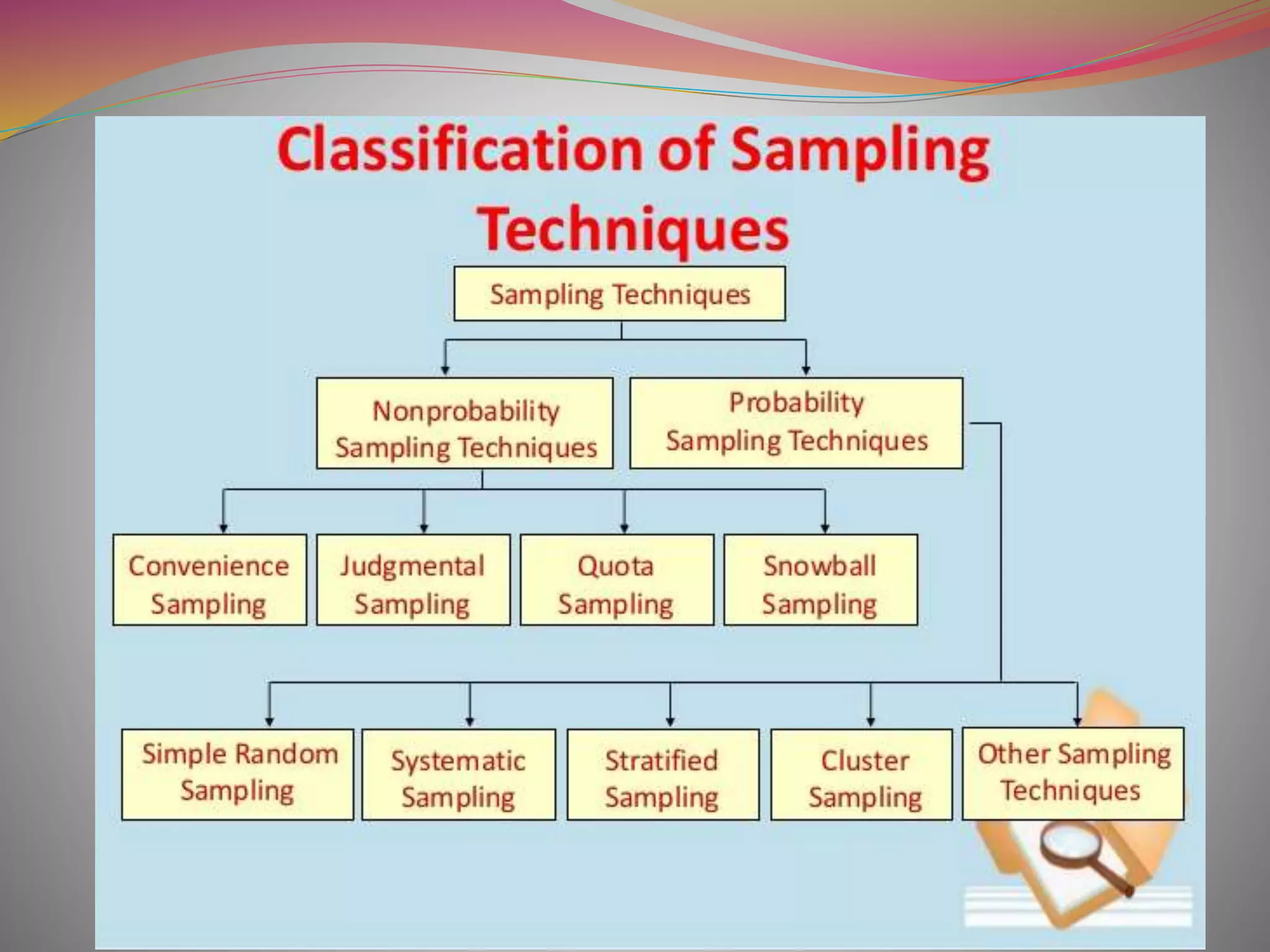
3.4) Various types of sampling
Population , we mean aggregate of individuals . A
population is any group of individuals that have one
or more characteristics in common that are of
interest to the researcher.
Sample A sample is a small proportion of a
population selected for observation and analysis .
Sampling A Sampling is that method in which data is
collected from the sample of items selected from
population and conclusion are drawn from them .
 Statement of the of the study
 Definition of the population to be sampled
 Determining the Data to be collected
 Methods of Measurement
 Choice of sampling unit
 Selection of sample
Organization of field work
 Summary and analysis of Date
 Information gained for future surveys
 Representativeness
 Adequacy
Independence
Homogeneity
 lack of Bias
 Smallness in size
 Accuracy and completeness
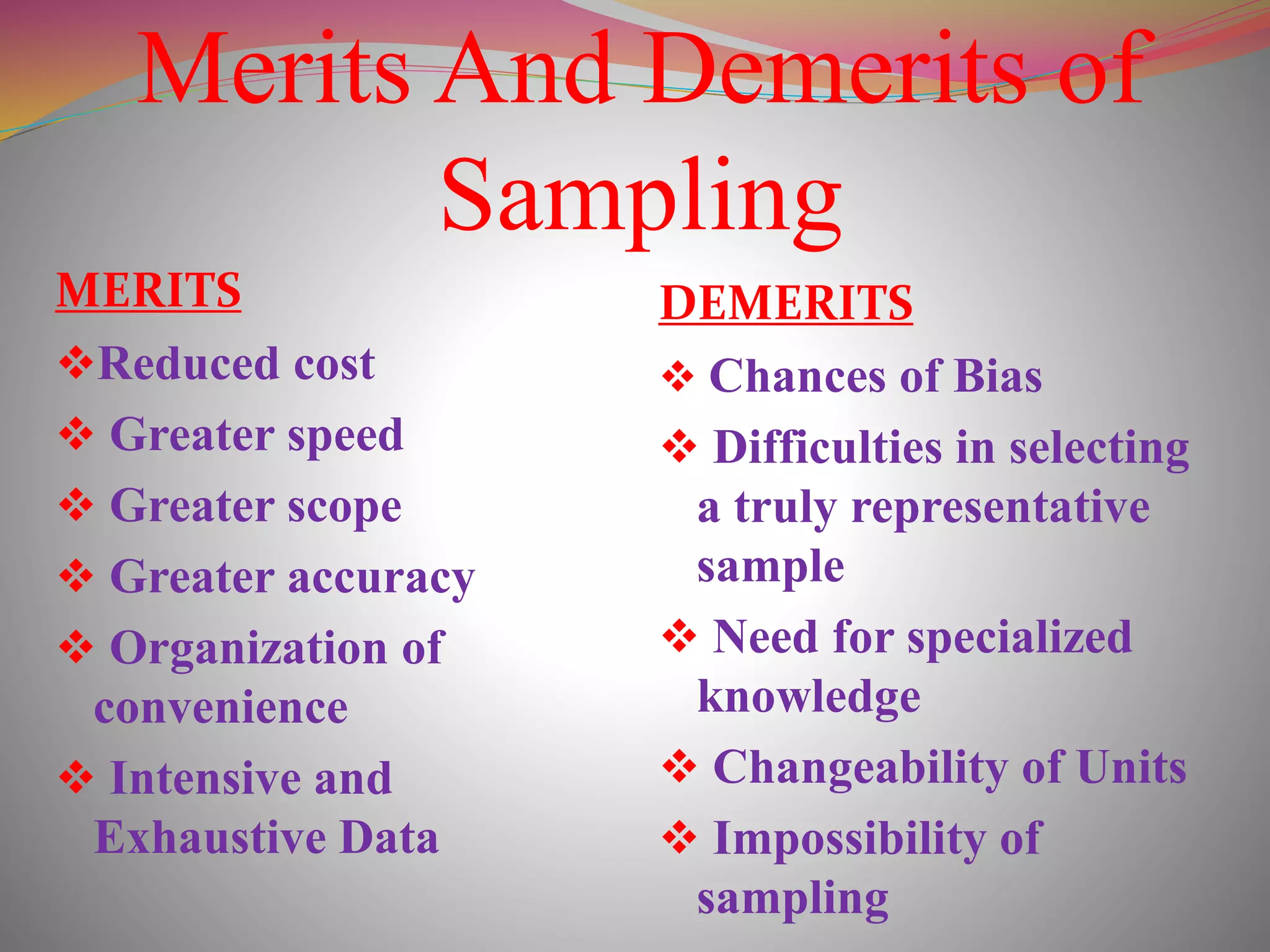
Merits And Demerits of
Sampling
MERITS
Reduced cost
 Greater speed
 Greater scope
 Greater accuracy
 Organization of
convenience
 Intensive and
Exhaustive Data
DEMERITS
 Chances of Bias
 Difficulties in selecting
a truly representative
sample
 Need for specialized
knowledge
 Changeability of Units
 Impossibility of
sampling
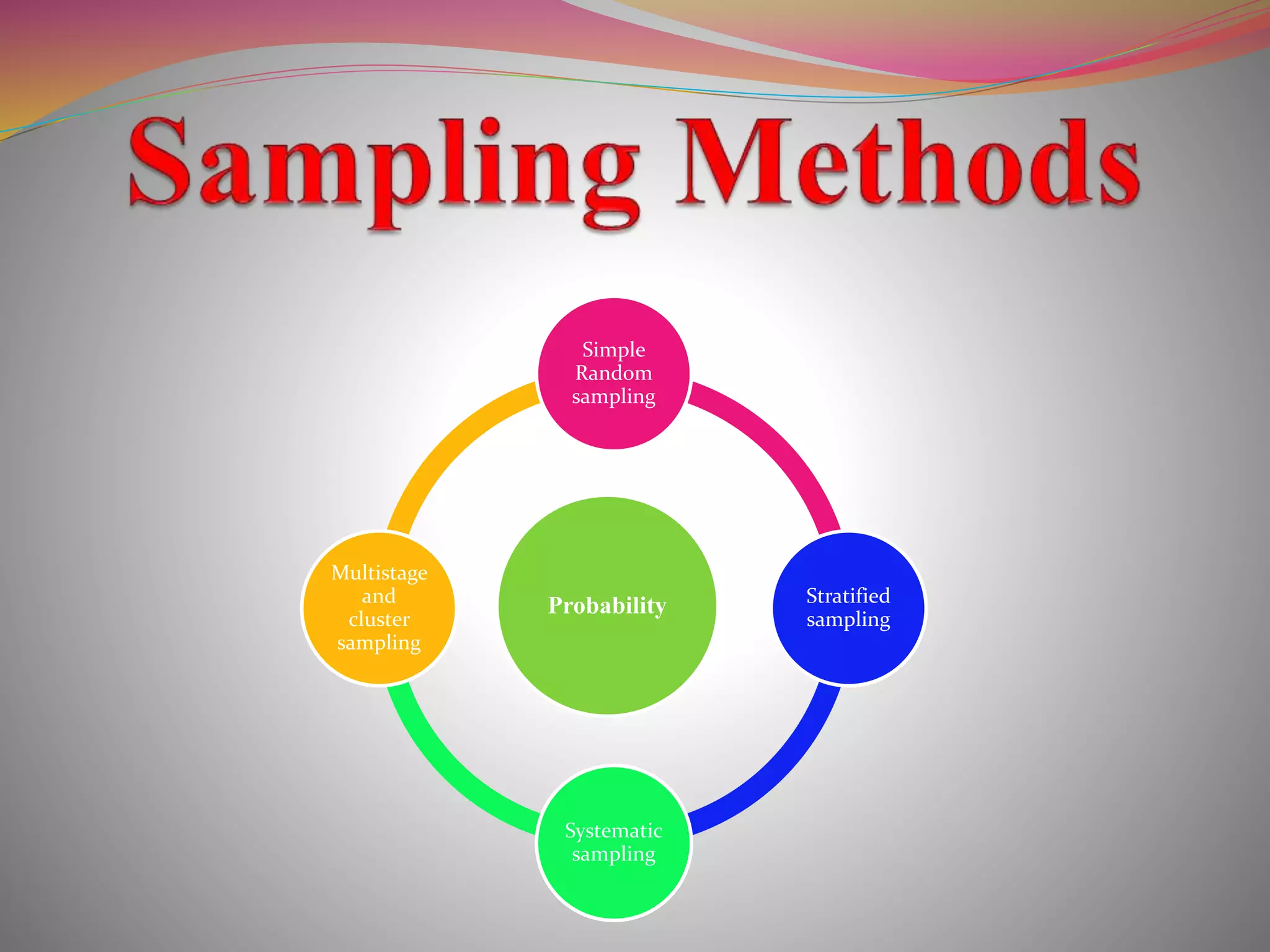
Probability
Simple
Random
sampling
Stratified
sampling
Systematic
sampling
Multistage
and
cluster
sampling
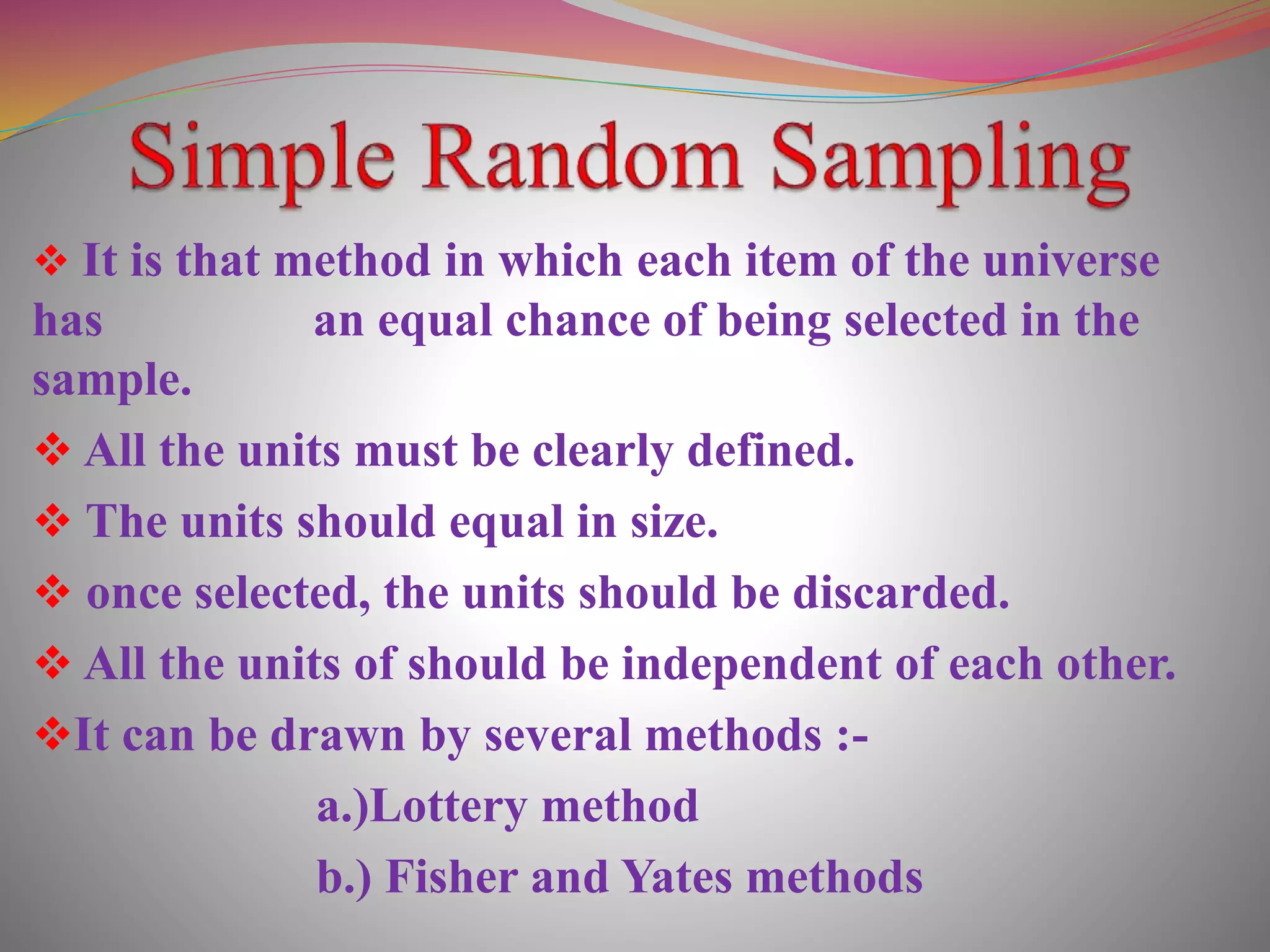
 It is that method in which each item of the universe
has an equal chance of being selected in the
sample.
 All the units must be clearly defined.
 The units should equal in size.
 once selected, the units should be discarded.
 All the units of should be independent of each other.
It can be drawn by several methods :-
a.)Lottery method
b.) Fisher and Yates methods
This method is used when the units of the universe are
heterogeneous rather than homogeneous.
 First of all units of population are divided into strata
in accordance with their characteristics.
 Stratum should be clear cut and free from
overlapping.
 If a stratum is perfectly Homogeneous selection of
even a few items from it is enough.
 It is dawn by selecting every nth item from
the population.
 Items are systematically arranged.
 The units are selected at equal intervals
 It easier and speedier to draw without a
mistake.
 Almost give accurate result.
 It is used in large scale survey for a more
comprehensive investigation.
 The researcher may have to use two-three or
four stage sampling.
 it is more convenient, less time consuming and
less expensive.
 This method is recommended only when it
would be impracticable to draw random sample.
 It has all members from randomly sample.
 This is used when the population falls into
naturally occurring subgroups.
 The universe is divided into many groups.
 It is easy and more practical method which
facilitates the field work.
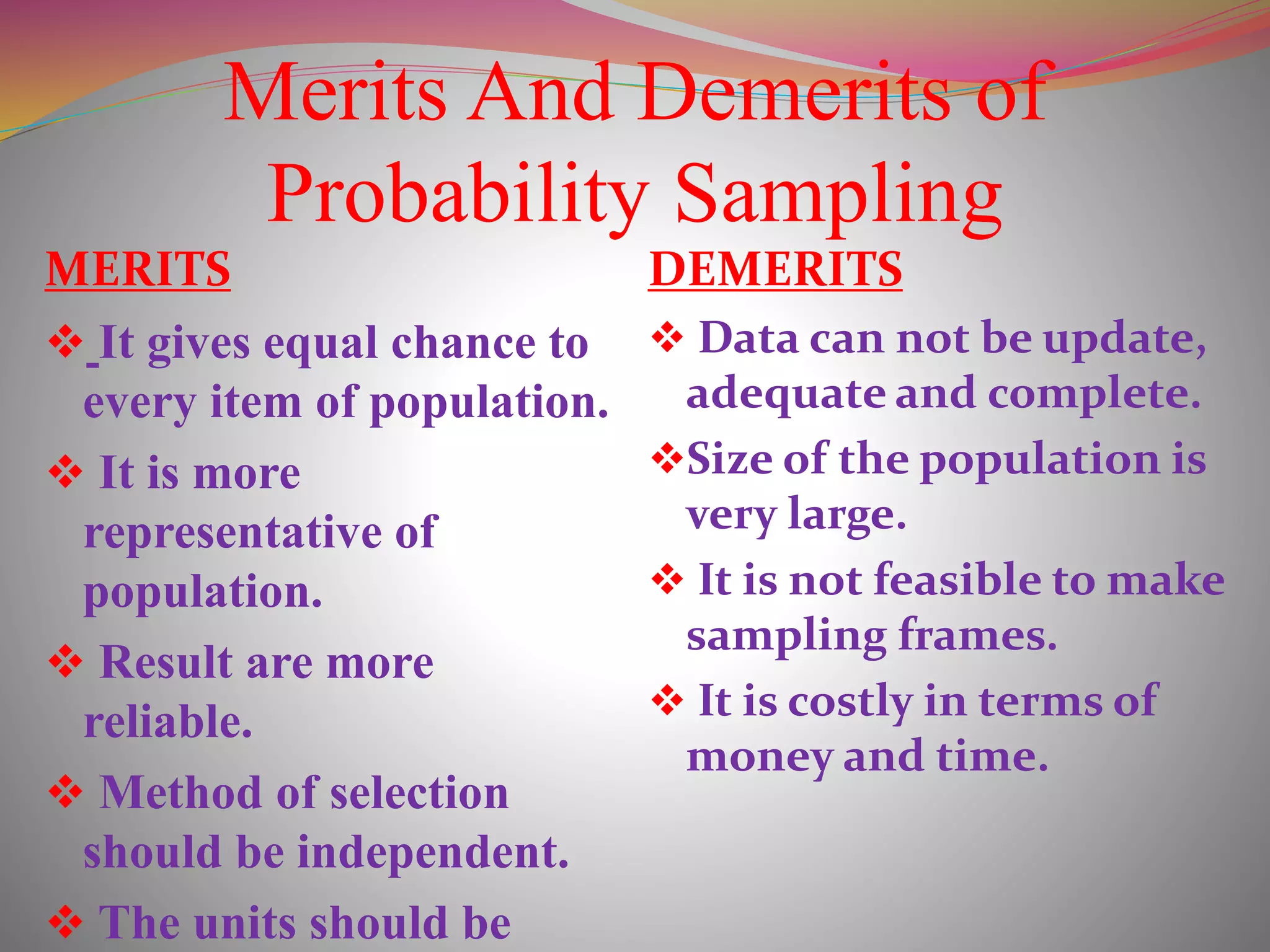
Merits And Demerits of
Probability Sampling
MERITS
 It gives equal chance to
every item of population.
 It is more
representative of
population.
 Result are more
reliable.
 Method of selection
should be independent.
 The units should be
DEMERITS
 Data can not be update,
adequate and complete.
Size of the population is
very large.
 It is not feasible to make
sampling frames.
 It is costly in terms of
money and time.
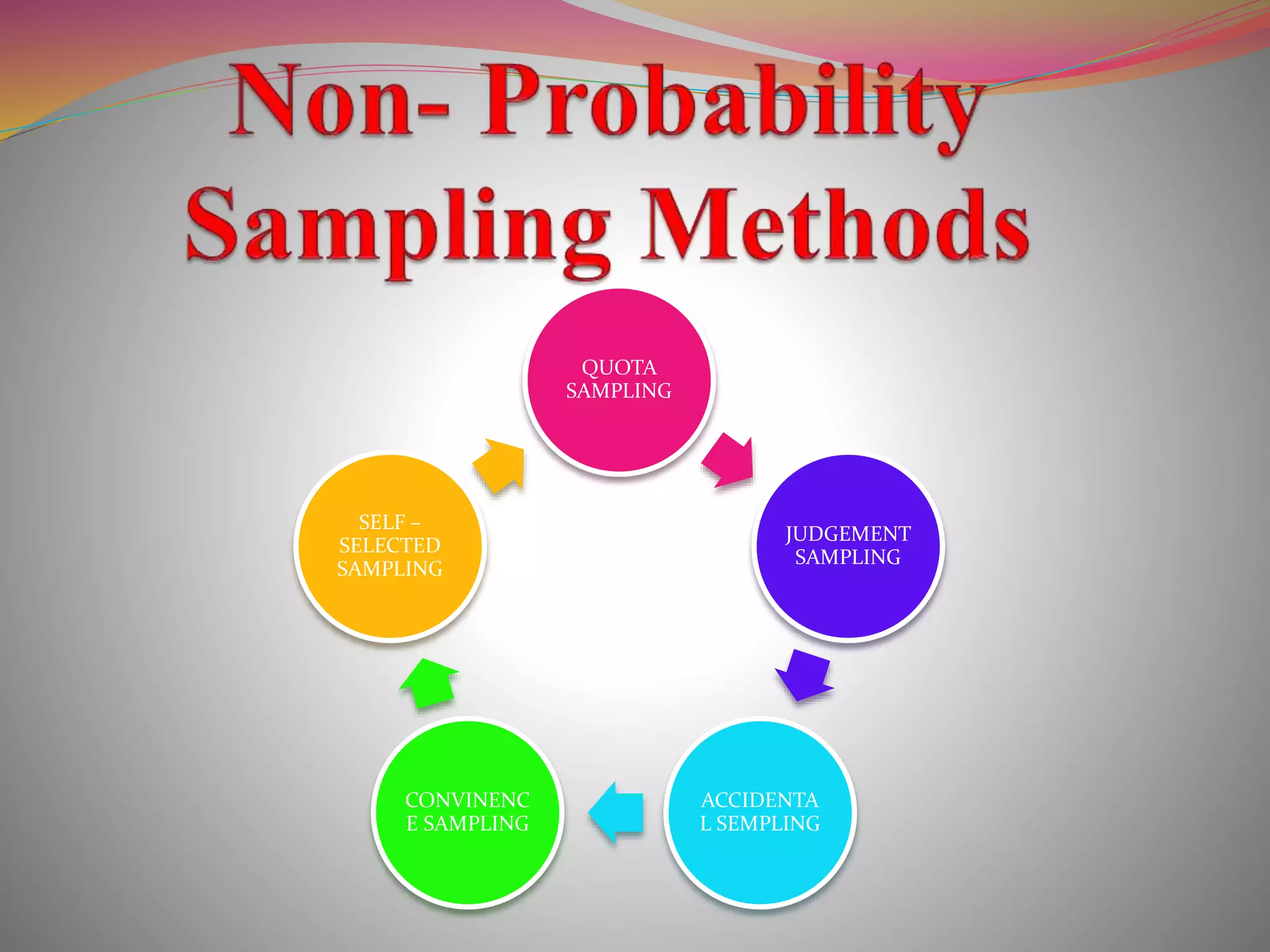
QUOTA
SAMPLING
JUDGEMENT
SAMPLING
ACCIDENTA
L SEMPLING
CONVINENC
E SAMPLING
SELF –
SELECTED
SAMPLING
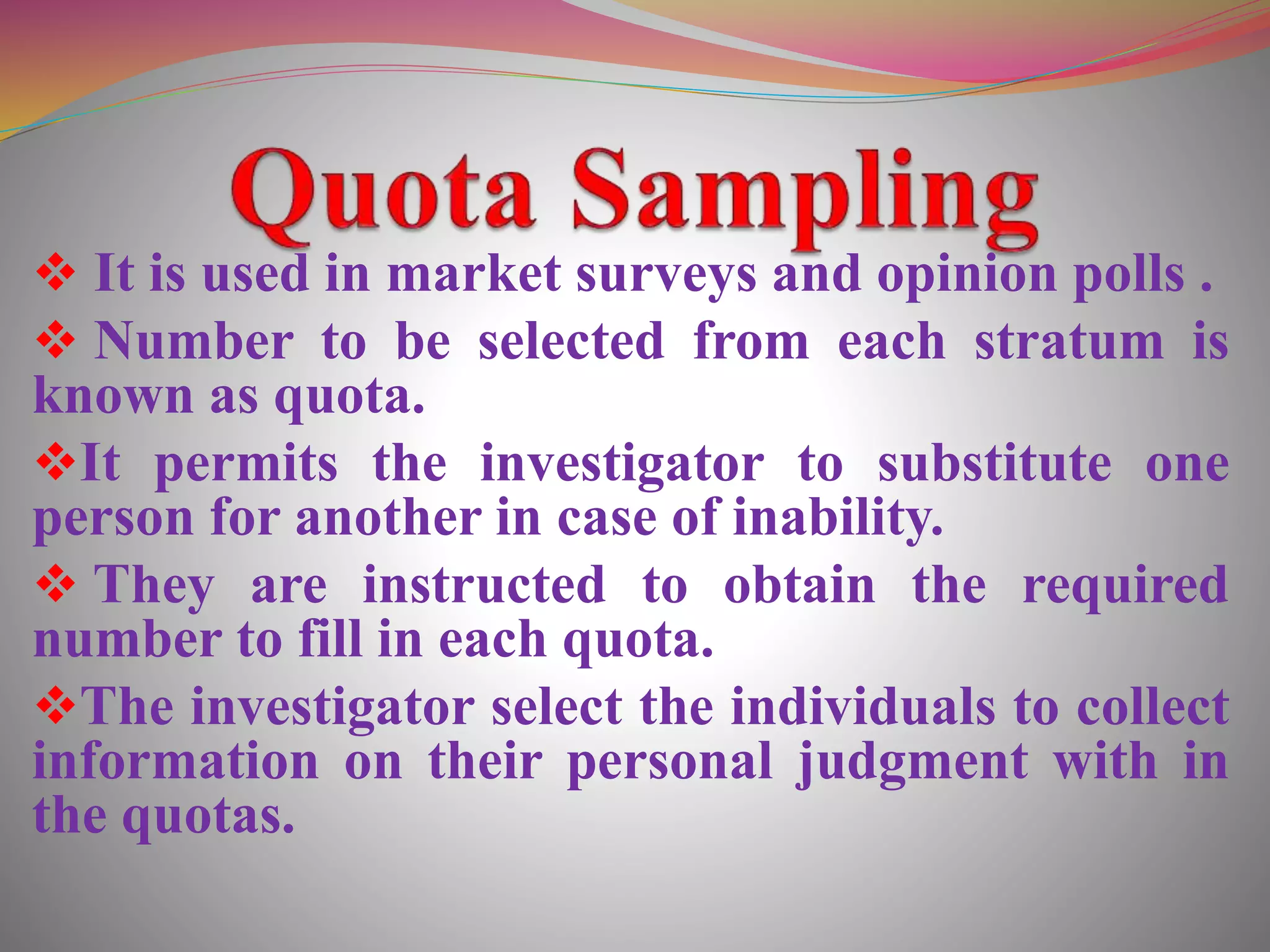
 It is used in market surveys and opinion polls .
 Number to be selected from each stratum is
known as quota.
It permits the investigator to substitute one
person for another in case of inability.
 They are instructed to obtain the required
number to fill in each quota.
The investigator select the individuals to collect
information on their personal judgment with in
the quotas.
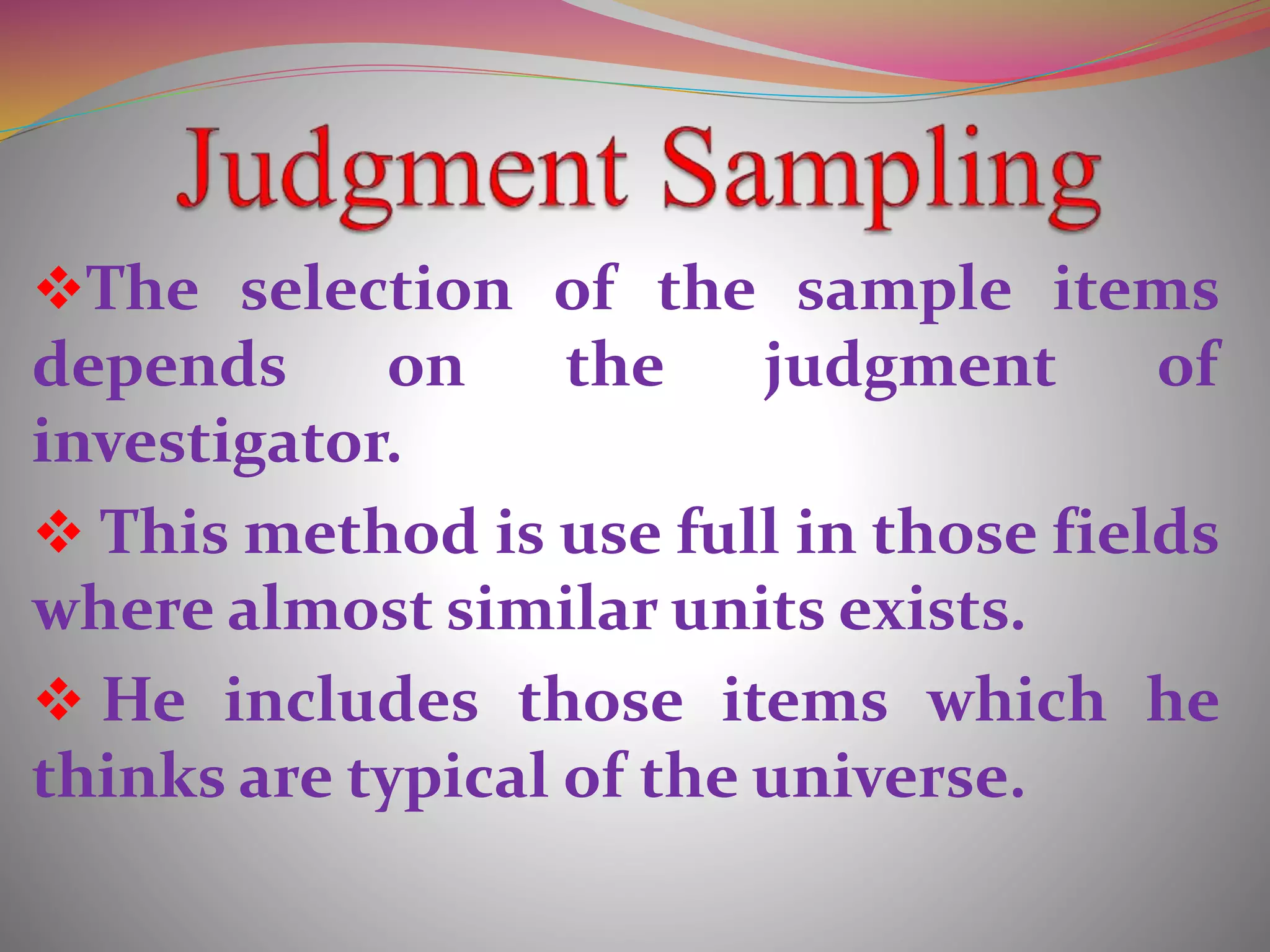
The selection of the sample items
depends on the judgment of
investigator.
 This method is use full in those fields
where almost similar units exists.
 He includes those items which he
thinks are typical of the universe.
 It is also known as incidental sampling.
 In this the researcher selects any case he
comes across.
 In this the investigator uses readily
available units.
 Non-parametric statistics may be used in
analysis of result.
 It is generally known as careless, unsystematic
or opportunistic sampling.
 The sample is selected according to the
convenience of the sampler.
 No pre-planning is necessary for the selection
of items.
 This method is appropriate for sample
because the list of sample units are not clear in
themselves.
 In this sample is not fixed
 The sample are actually by the investigator, the
people offer themselves for selection.
 Those who care to respond to the sample come
themselves.
 People come forward on their own to act as
subjects of the study.
Merits And Demerits of Non-
Probability Sampling
MERITS
It is convenient and
quick and cost effective.
Sample frame does not
required .
Sample size can be
achieve clearly
DEMERITS
 There is non data
obtained .
 Sometimes the results
does not represent the
whole population.
 Sampling errors of such
sample cannot be
determined in such
sample
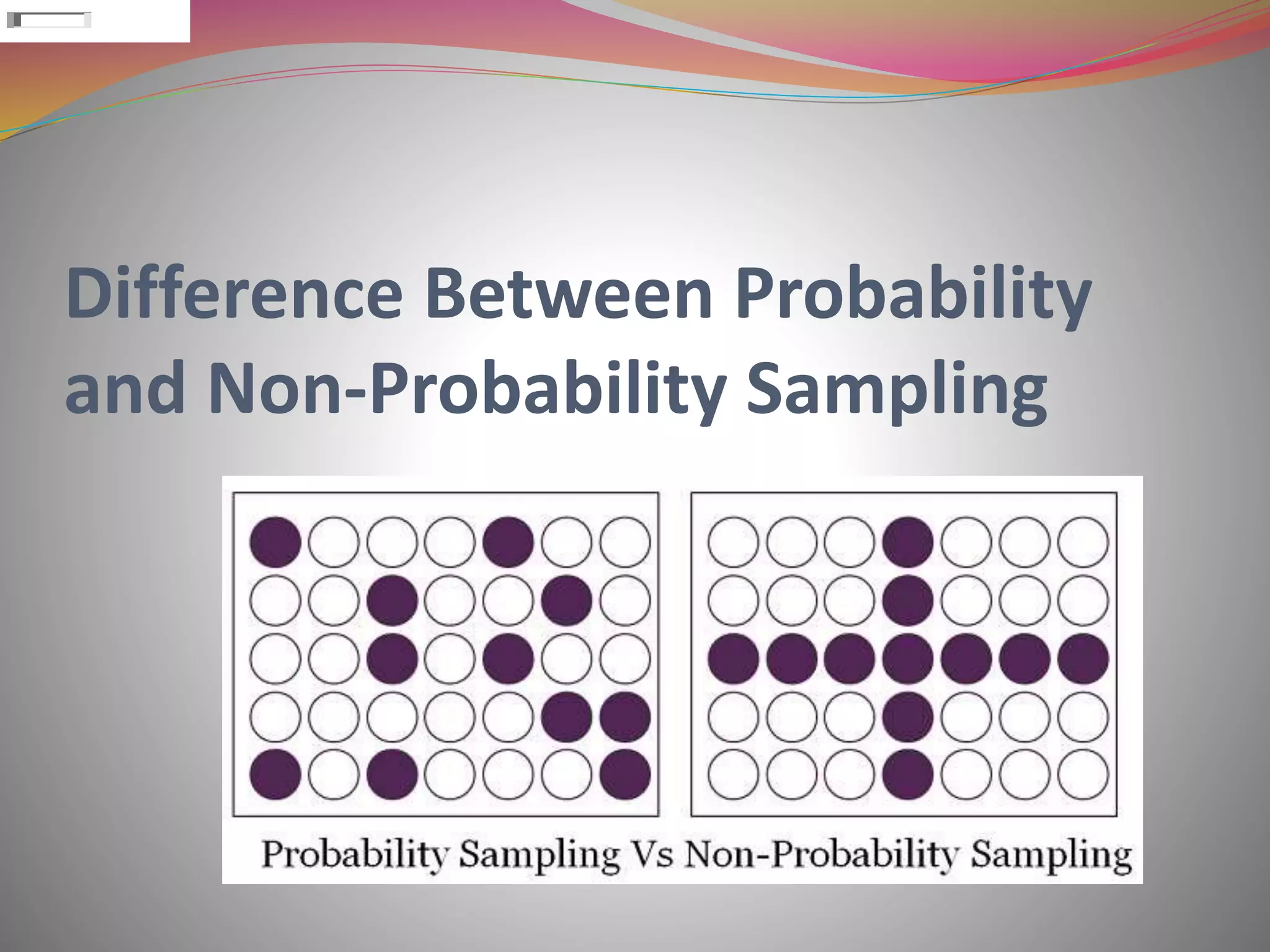
Difference Between Probability
and Non-Probability Sampling
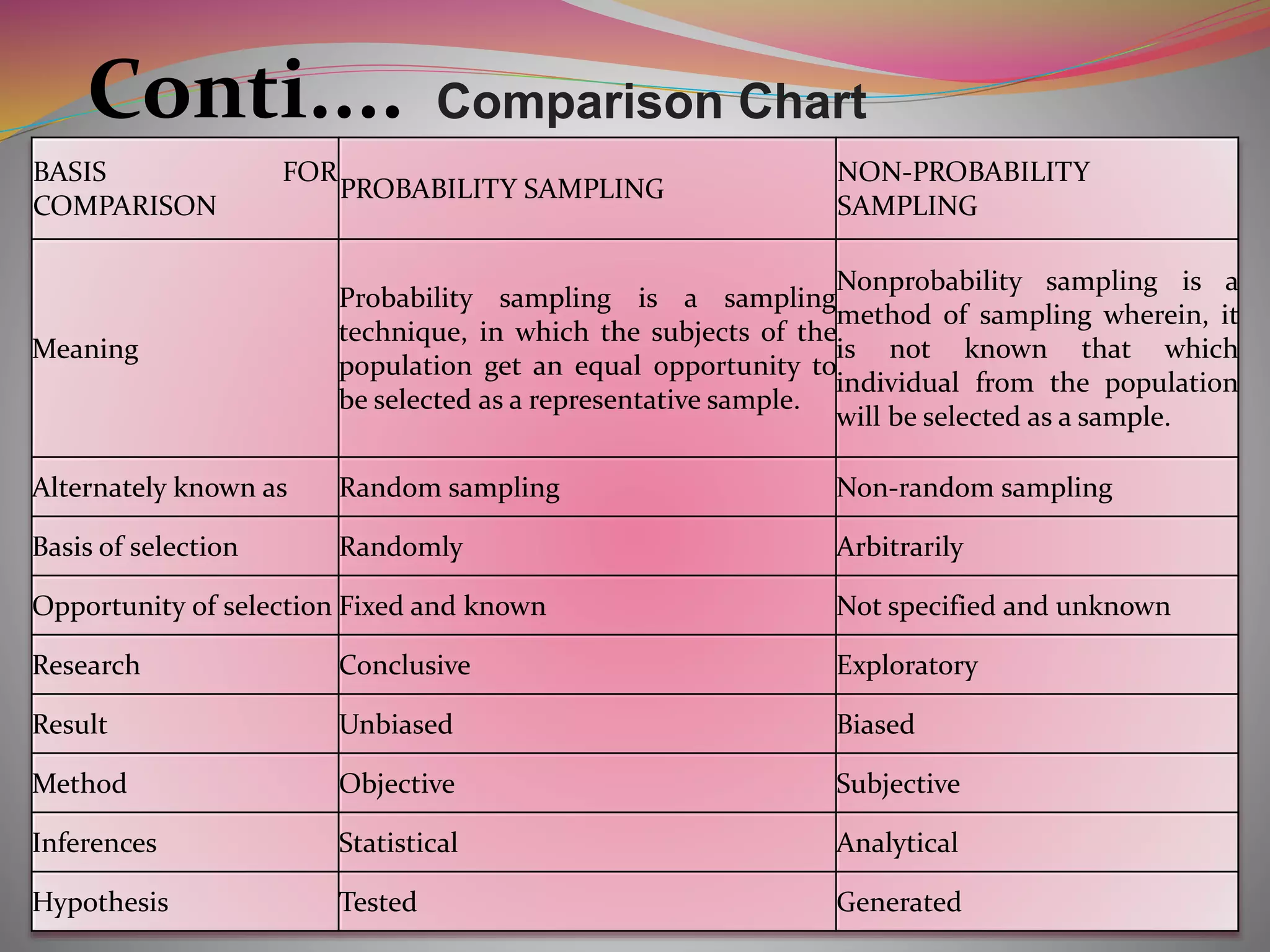
Conti....
BASIS FOR
COMPARISON
PROBABILITY SAMPLING
NON-PROBABILITY
SAMPLING
Meaning
Probability sampling is a sampling
technique, in which the subjects of the
population get an equal opportunity to
be selected as a representative sample.
Nonprobability sampling is a
method of sampling wherein, it
is not known that which
individual from the population
will be selected as a sample.
Alternately known as Random sampling Non-random sampling
Basis of selection Randomly Arbitrarily
Opportunity of selection Fixed and known Not specified and unknown
Research Conclusive Exploratory
Result Unbiased Biased
Method Objective Subjective
Inferences Statistical Analytical
Hypothesis Tested Generated
Comparison Chart
By: Aastha Bhatia
educationalist

Sampling

  • 1.
    UNIT-3 Sampling 3.1) Concept ofpopulation and sample 3.2) Steps and characteristics of a good sample 3.4) Various types of sampling
  • 2.
    Population , wemean aggregate of individuals . A population is any group of individuals that have one or more characteristics in common that are of interest to the researcher. Sample A sample is a small proportion of a population selected for observation and analysis . Sampling A Sampling is that method in which data is collected from the sample of items selected from population and conclusion are drawn from them .
  • 3.
     Statement ofthe of the study  Definition of the population to be sampled  Determining the Data to be collected  Methods of Measurement  Choice of sampling unit  Selection of sample Organization of field work  Summary and analysis of Date  Information gained for future surveys
  • 4.
     Representativeness  Adequacy Independence Homogeneity lack of Bias  Smallness in size  Accuracy and completeness
  • 5.
    Merits And Demeritsof Sampling MERITS Reduced cost  Greater speed  Greater scope  Greater accuracy  Organization of convenience  Intensive and Exhaustive Data DEMERITS  Chances of Bias  Difficulties in selecting a truly representative sample  Need for specialized knowledge  Changeability of Units  Impossibility of sampling
  • 7.
  • 8.
     It isthat method in which each item of the universe has an equal chance of being selected in the sample.  All the units must be clearly defined.  The units should equal in size.  once selected, the units should be discarded.  All the units of should be independent of each other. It can be drawn by several methods :- a.)Lottery method b.) Fisher and Yates methods
  • 9.
    This method isused when the units of the universe are heterogeneous rather than homogeneous.  First of all units of population are divided into strata in accordance with their characteristics.  Stratum should be clear cut and free from overlapping.  If a stratum is perfectly Homogeneous selection of even a few items from it is enough.
  • 10.
     It isdawn by selecting every nth item from the population.  Items are systematically arranged.  The units are selected at equal intervals  It easier and speedier to draw without a mistake.  Almost give accurate result.
  • 11.
     It isused in large scale survey for a more comprehensive investigation.  The researcher may have to use two-three or four stage sampling.  it is more convenient, less time consuming and less expensive.  This method is recommended only when it would be impracticable to draw random sample.
  • 12.
     It hasall members from randomly sample.  This is used when the population falls into naturally occurring subgroups.  The universe is divided into many groups.  It is easy and more practical method which facilitates the field work.
  • 13.
    Merits And Demeritsof Probability Sampling MERITS  It gives equal chance to every item of population.  It is more representative of population.  Result are more reliable.  Method of selection should be independent.  The units should be DEMERITS  Data can not be update, adequate and complete. Size of the population is very large.  It is not feasible to make sampling frames.  It is costly in terms of money and time.
  • 14.
  • 15.
     It isused in market surveys and opinion polls .  Number to be selected from each stratum is known as quota. It permits the investigator to substitute one person for another in case of inability.  They are instructed to obtain the required number to fill in each quota. The investigator select the individuals to collect information on their personal judgment with in the quotas.
  • 16.
    The selection ofthe sample items depends on the judgment of investigator.  This method is use full in those fields where almost similar units exists.  He includes those items which he thinks are typical of the universe.
  • 17.
     It isalso known as incidental sampling.  In this the researcher selects any case he comes across.  In this the investigator uses readily available units.  Non-parametric statistics may be used in analysis of result.
  • 18.
     It isgenerally known as careless, unsystematic or opportunistic sampling.  The sample is selected according to the convenience of the sampler.  No pre-planning is necessary for the selection of items.  This method is appropriate for sample because the list of sample units are not clear in themselves.
  • 19.
     In thissample is not fixed  The sample are actually by the investigator, the people offer themselves for selection.  Those who care to respond to the sample come themselves.  People come forward on their own to act as subjects of the study.
  • 20.
    Merits And Demeritsof Non- Probability Sampling MERITS It is convenient and quick and cost effective. Sample frame does not required . Sample size can be achieve clearly DEMERITS  There is non data obtained .  Sometimes the results does not represent the whole population.  Sampling errors of such sample cannot be determined in such sample
  • 21.
    Difference Between Probability andNon-Probability Sampling
  • 22.
    Conti.... BASIS FOR COMPARISON PROBABILITY SAMPLING NON-PROBABILITY SAMPLING Meaning Probabilitysampling is a sampling technique, in which the subjects of the population get an equal opportunity to be selected as a representative sample. Nonprobability sampling is a method of sampling wherein, it is not known that which individual from the population will be selected as a sample. Alternately known as Random sampling Non-random sampling Basis of selection Randomly Arbitrarily Opportunity of selection Fixed and known Not specified and unknown Research Conclusive Exploratory Result Unbiased Biased Method Objective Subjective Inferences Statistical Analytical Hypothesis Tested Generated Comparison Chart
  • 23.